By Redazione | 04/02/2026 18:33
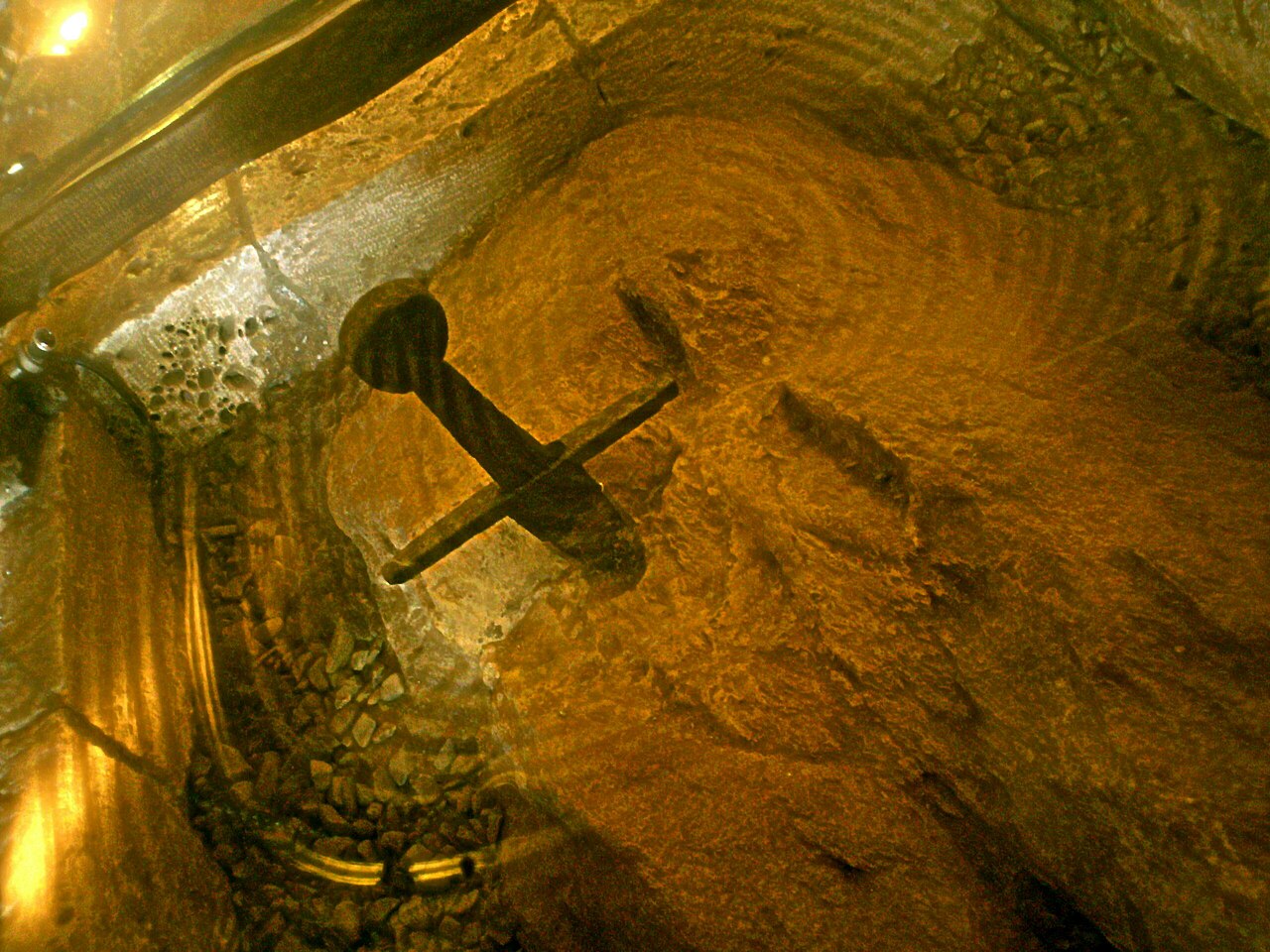
In the silence of the Tuscan countryside stands a place where time seems to have crystallized in the exact moment of a medieval miracle. It is theHermitage of Montesiepi, located in the municipality of Chiusdino in the province of Siena, a religious-monumental complex that represents one of the most relevant examples ofGothic-Cistercian architecture in Italy and that guards, embedded in living stone, the tangible evidence of a history that many mistakenly associate only with Breton literary cycles: the Sword in the Stone. This ancient blade, protected today by a shrine to preserve it from neglect and attempted theft, belongs not to a British king but to Galgano Guidotti, a young knight whose conversion profoundly marked 12th-century spirituality.
The story of this sacred place is rooted in the troubled and then redeemed life of its protagonist. Galgano was born around 1148 in Chiusdino to a family of small local nobility, the Guidotti, linked by vassalage relations to the bishops of Volterra. Historical sources describe an initially dissolute young man, devoted to a life of abuse and engaged in arms following in his father Guidotto's footsteps. However, after the early death of his parent, the knight's existence underwent a radical turn, marked by dreams and mystical visions that led him toward a profound conversion and a desire to dedicate his life to peace and spirituality. Despite his mother's attempts to dissuade him from such a path, a prodigious event marked the young man's destiny: during a journey to Civitella Marittima, Galgano's horse suddenly came to a halt, refusing to continue further. Left free, the animal led the knight right to the top of the hill of Montesiepi. It was here that Galgano, driven by an inner need to gather in prayer and finding no other way to create a sacred symbol, performed the act that would make him immortal: he thrust his own sword into the rocky ground. The blade penetrated the stone, transforming into a cross, an indelible symbol of his ultimate renunciation of the lure of material and worldly life in favor of a hermitic and spiritual one.
Galgano's retreat on the hill was brief but intense, destined to last only one year, as the hermit died on December 3, 1181. However, during this short time, a group of followers formed around the figure of the penitent knight, and numerous faithful turned to him for comfort, so much so that the miracles attributed to his intercession were punctually recorded in the acts of the canonization process, which remains to this day the main document for reconstructing the saint's life. Only four years after his death, around 1185, the bishop of Volterra, Ildebrando Pannocchieschi, obtaining the imprimatur of Pope Lucius III, commissioned the construction of a circular chapel intended to enshrine the saint's tomb and that miraculous sword that emerged from the floor.
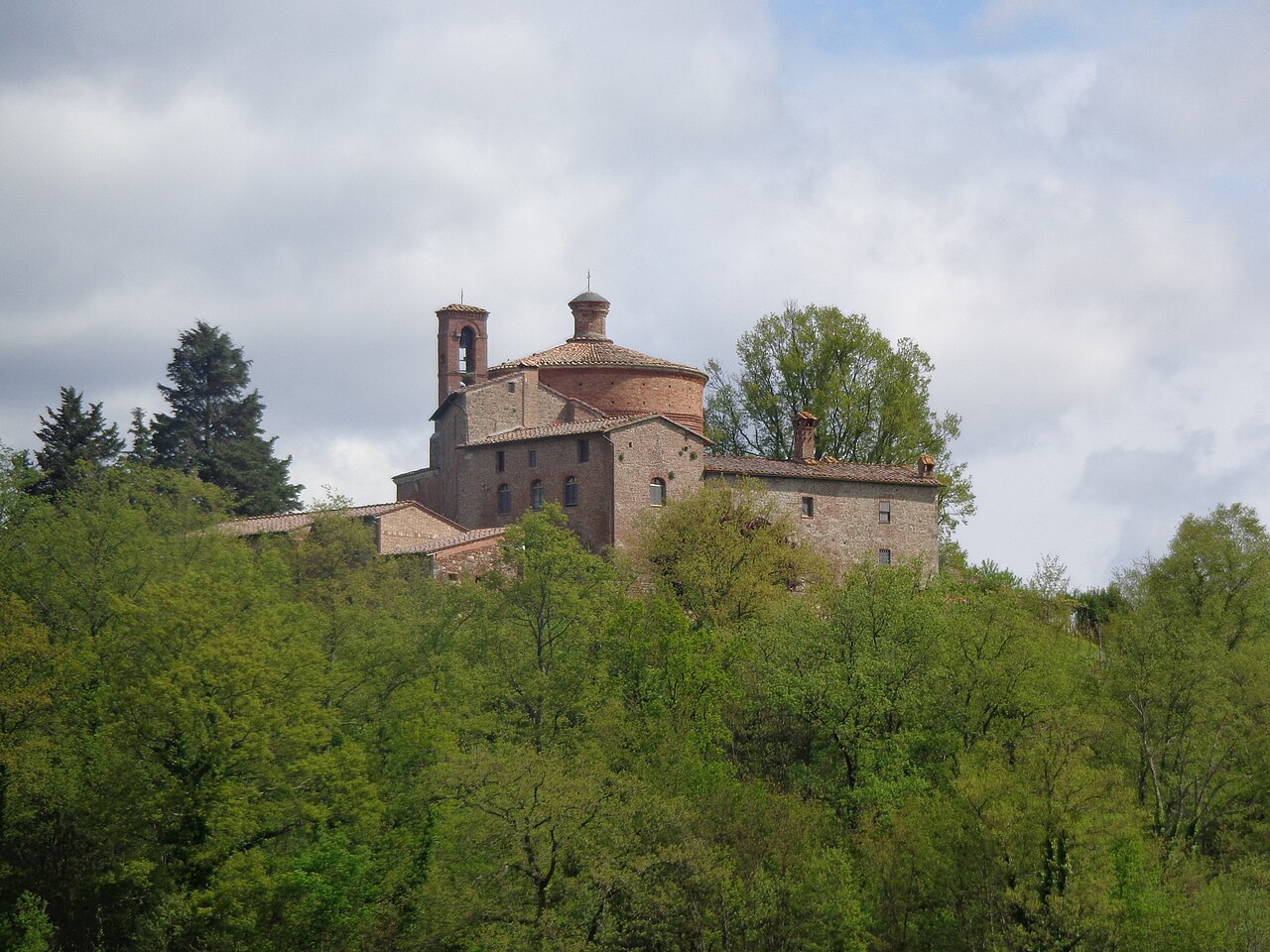
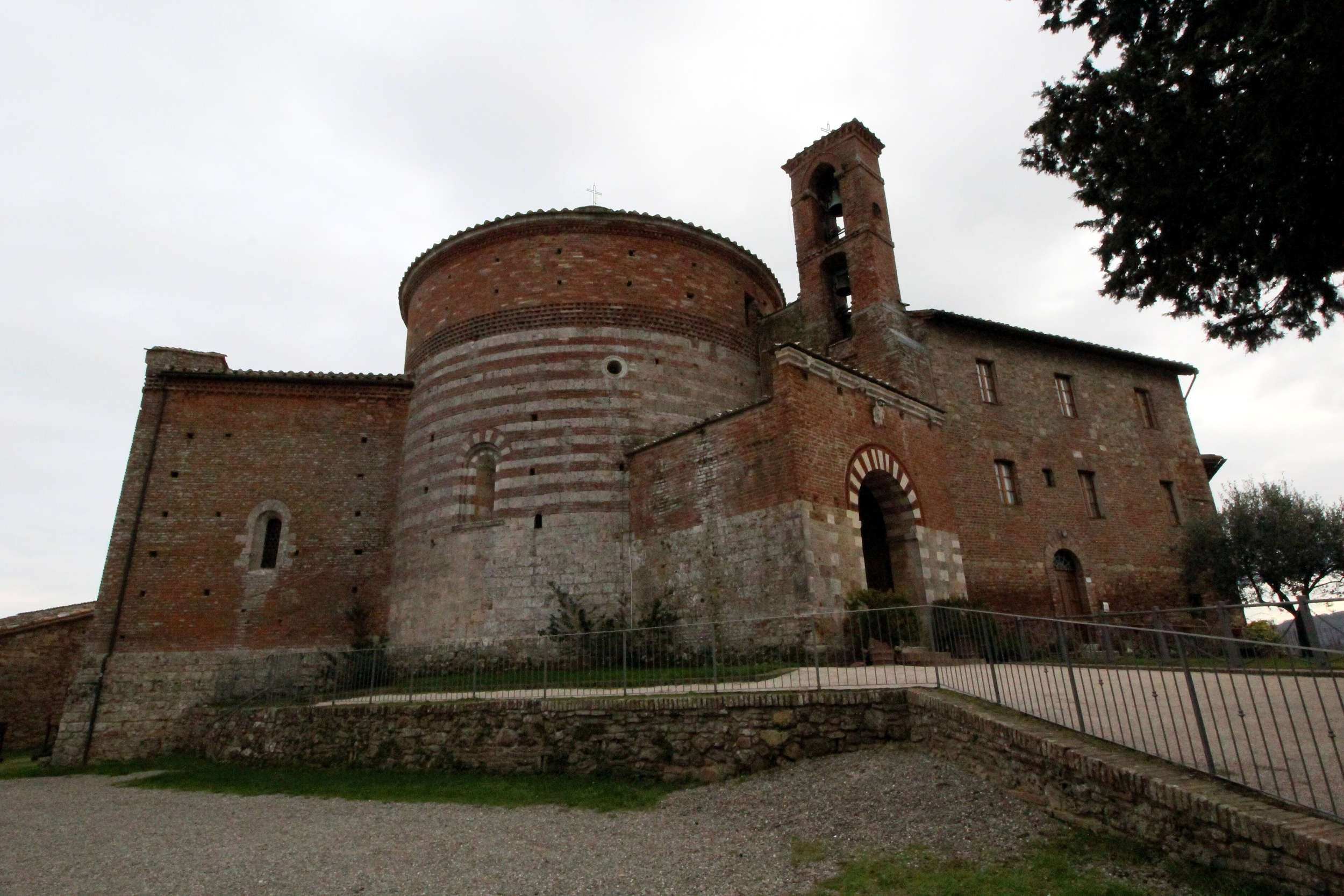
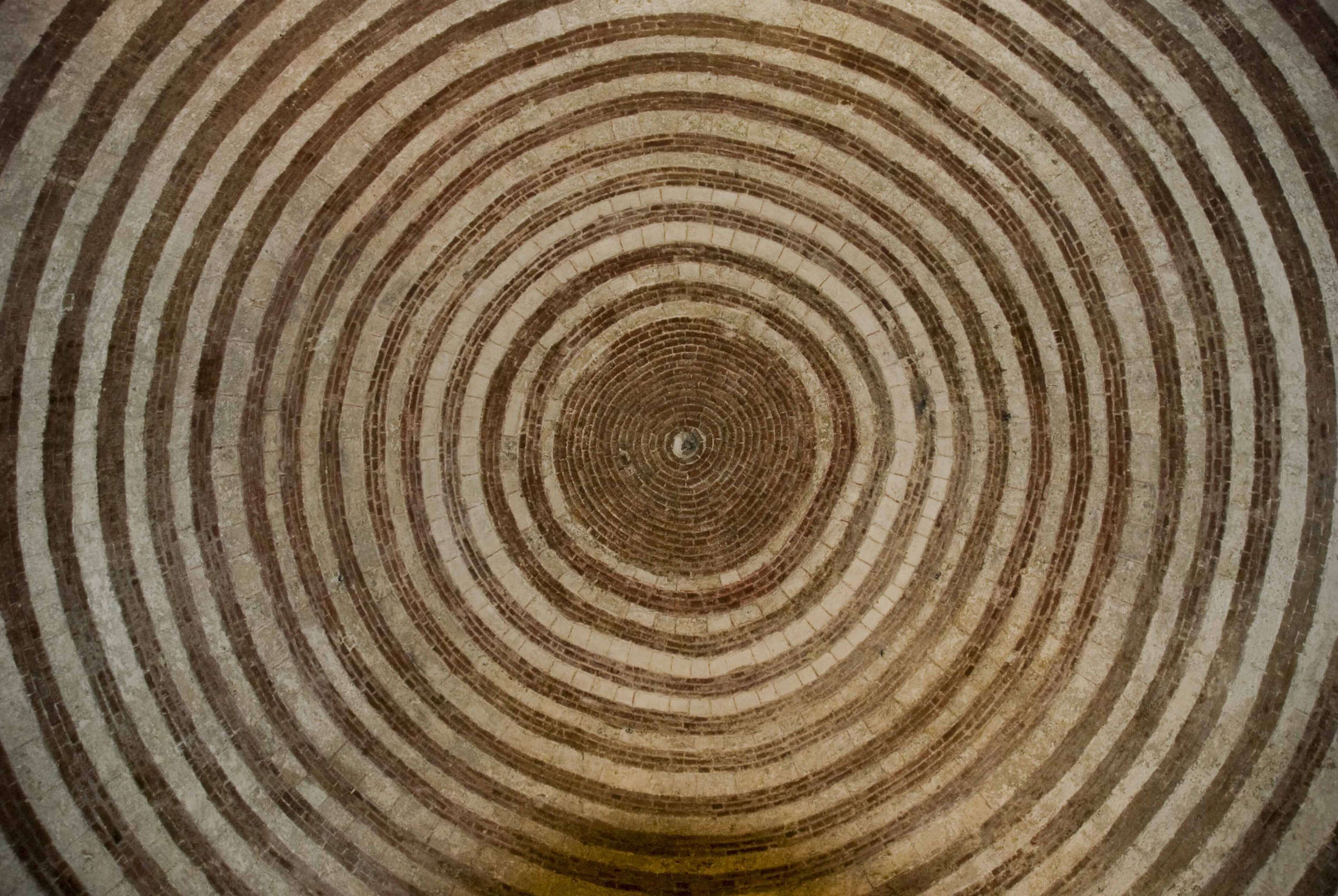
The resulting building, known as the Rotunda of Montesiepi, is a construction of singular charm that chronologically precedes the most famous abbey located in the valley, the Abbey of San Galgano. The church has a circular plan, interrupted only by a small semicircular apse located on the side opposite the entrance. The wall structure is made of two-color, consisting of rows of travertine alternating with red bricks, a chromatic choice that gives the whole a visually striking effect. This alternation of materials is also found in the interior and culminates in the splendid hemispherical dome with concentric rings, an architectural solution that recalls the Pisan-Luccan Romanesque style and represents one of its earliest manifestations in Sienese soil. The uniqueness of this dome lies in the fact that its external form is hidden: looking at the Hermitage from the outside, in fact, one does not sense the presence of the inner hemispherical vault, which evokes ancient suggestions comparable to the Etruscan Tholos tombs of Cerveteri or Vetulonia, or even the tomb of Cecilia Metella in Rome.
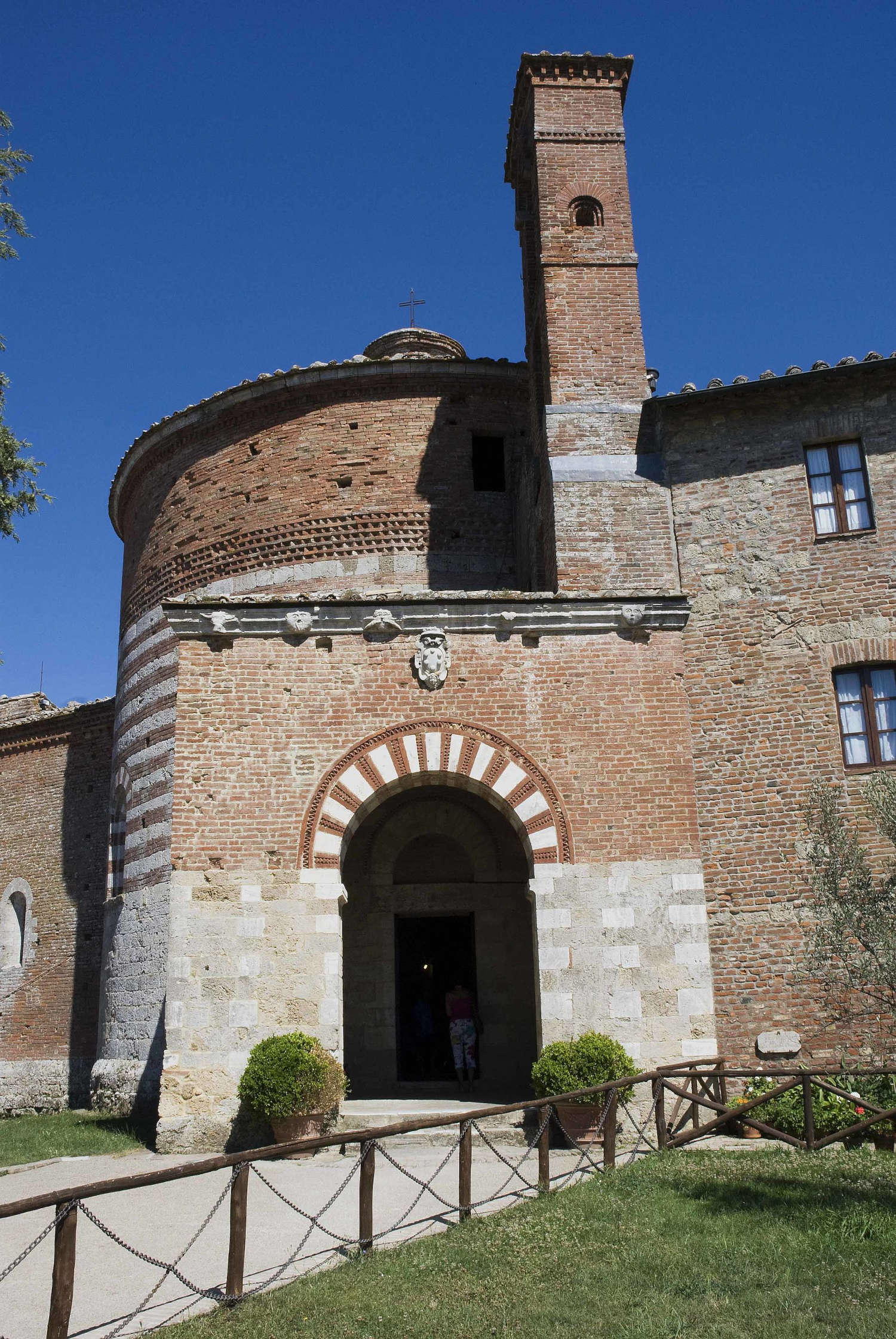
The façade of the pronaos, added a few years after the construction of the original core, is dominated by a round-arched portal repeating the two-color motif, surmounted by a Medici coat of arms and decorated, at the apex of the cornice, with anthropomorphic, zoomorphic, and phytomorphic sculptures that include three human heads, a bovine head, and a leaf. Over the centuries, the building underwent several transformations and extensions. During the first half of the 14th century, the church was enriched through the construction of a chapel with a rectangular plan covered with a cross vault, leaning against the outer wall and commissioned by the Cistercian converso Ristoro da Selvatella. Later, in the 17th century, a blind lantern was built on the roof, while in the late 18th century the rectory house and buildings for agricultural use that now complete the complex were built. A curious historical detail concerns the original lead roof of the church, which was sold around the middle of the 16th century by the commendatory Girolamo Vitelli, presumably to make a profit, and later replaced by the present brick drum.
In the center of the Rotunda, at the very focal point of the original floor, emerges the rock that forms the apex of the hill, with the sword of St. Galgano embedded in it. For a long time, the historical veracity of this relic was a matter of debate, with many tending to consider it a forgery or a later reproduction. However, a thorough metallographic investigation coordinated by Professor Luigi Garlaschelli of the University of Pavia in 2001 dispelled many doubts, certifying that the weapon authentically dates back to the 12th century. The sword, which until 1924 could be extracted from the rocky crevice, suffered several acts of vandalism over time that forced then-parish priest Don Ciompi to block the blade by pouring molten lead into the crevice to fix it permanently. Today, to further protect it from the sometimes disrespectful curiosity of visitors, the relic is covered by a durable Plexiglas dome.
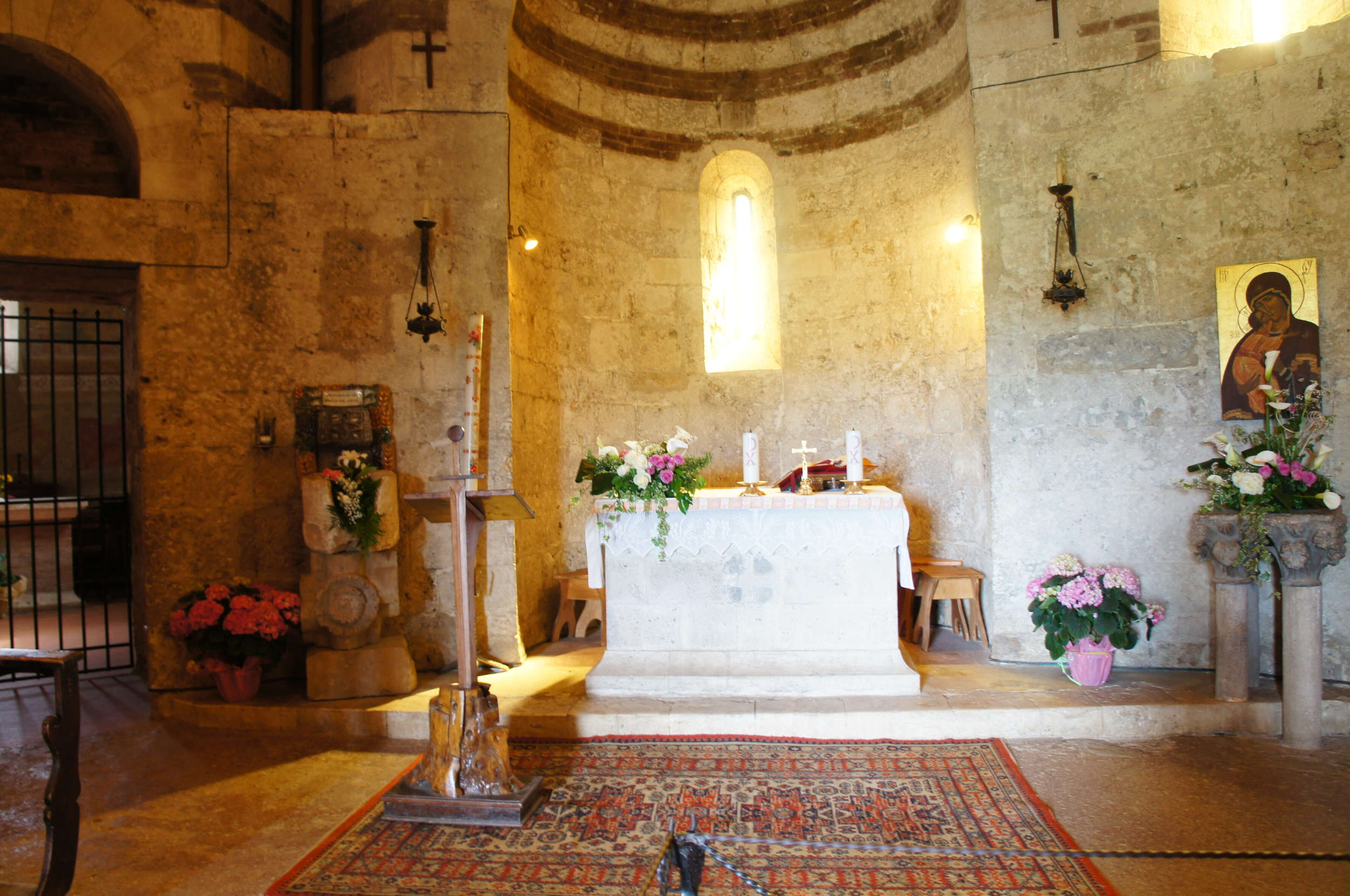
But the Hermitage of Montesiepi is not just the custody of a chivalric relic; it is also a treasure chest of pictorial art of inestimable value. In fact, the rectangular chapel added in the 14th century houses a cycle of frescoes created between 1334 and 1336 by Ambrogio Lorenzetti, one of the greatest exponents of Sienese painting. Although the works have suffered the passage of centuries, presenting today much deterioration, a restoration project in 1967 made it possible to detach them, recover them and put them back in their place together with the underlying sinopites that came to light during the work. Prominent among the scenes depicted is a Majesty of extraordinary theological and iconographic complexity. In this representation, the figure of Eve appears at the feet of the Virgin, lying down and dressed in a goatskin to symbolize lust, while with one hand she holds a fig tree, the symbol of sin, and with the other she displays a scroll explaining the morality of redemption. A fascinating detail that emerged thanks to the restorations concerns the figure of the Madonna herself: in the original version conceived by Lorenzetti, the Virgin held a scepter in her left hand and in her right, instead of the Child, she held a globe, symbols of power and royalty generally referred to male figures or emperors. This bold early version was later erased and modified, probably to conform to more traditional liturgical canons, possibly at the hands of the painter Niccolò di Segna.
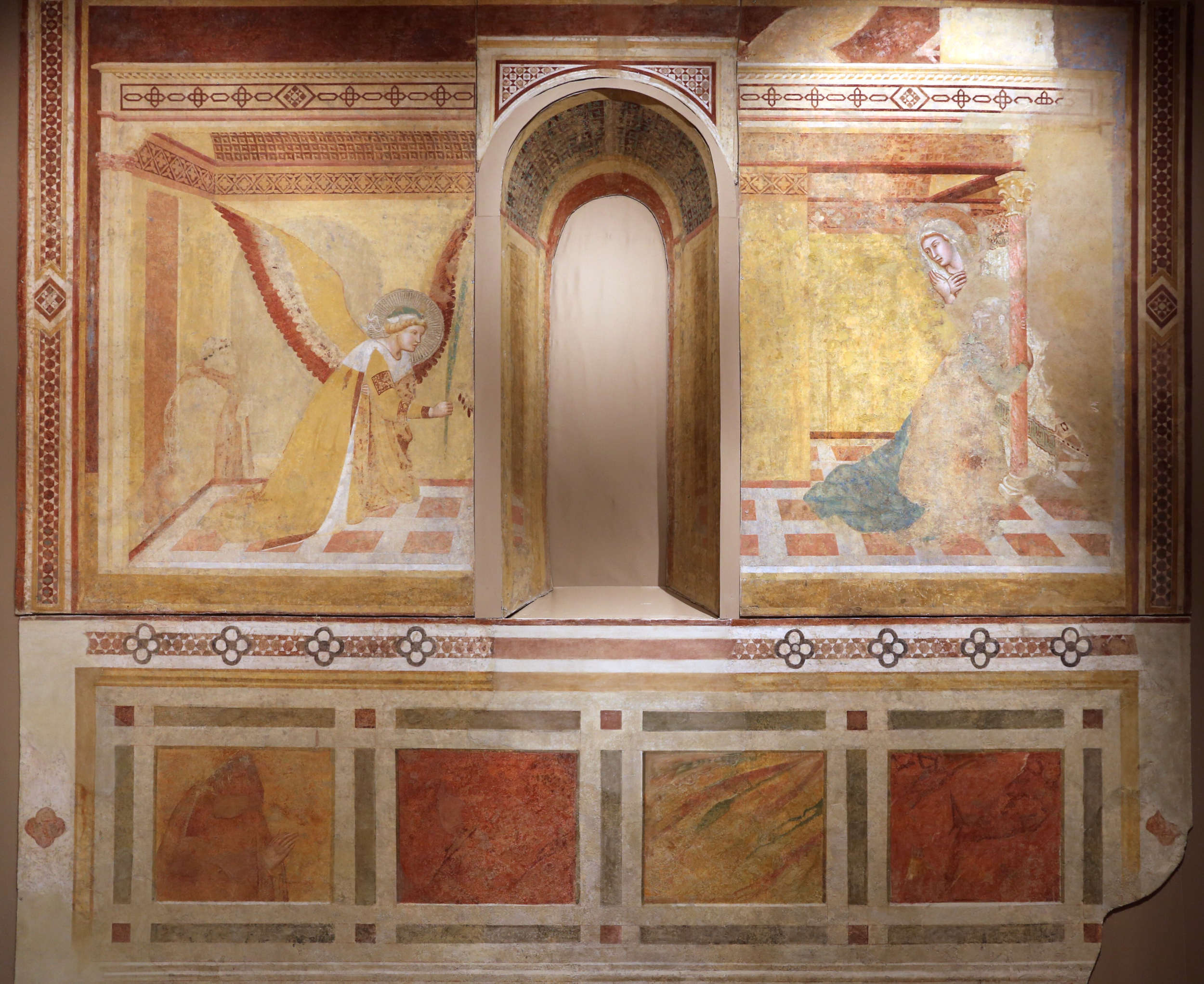
On the same wall as the Majesty, below, is a fresco depicting theAnnunciation, where the actual window of the chapel was ingeniously used by the artist as an integral architectural element of the depiction. Recent restorations have restored legibility to Mary's face and hands, allowing us also to notice a mysterious detail: behind the archangel Gabriel appears the shadow of a saint, perhaps St. Galgano himself, intent on praying and later erased for unknown reasons. On the upper left wall is a fresco of a scene in which Galgano, surrounded by saints and angels, offers a model of the rock with the sword thrust into it, while below is a view of the city of Rome, a possible allusion to the pilgrimage made by the saint to the Eternal City. Here again Lorenzetti's hand is revealed in his ability to narrate through images the life and spirituality of the time.
As for Saint Galgano, of the saint's body today, the head remains, preserved in a modern reliquary in the church of San Michele Arcangelo in Chiusdino, while the Rotunda continues to watch over the sword that was an instrument of war transformed into a symbol of peace. The visitor who comes to Montesiepi today is confronted with a complex that lives in symbiosis with the nearby monumental Abbey of San Galgano, built in the valley beginning in 1218, some 30 years after the Rotunda, and consecrated in 1268. While the Abbey experienced a period of splendor followed by a slow decline caused by the practice of commendation, which led to the collapse of the roof and its current state as a majestic ruin, the Hermitage has maintained its structural integrity and its function as a place of worship. Admission to the Hermitage of Montesiepi is allowed daily and is free of charge, so that anyone can admire the sword and frescoes without barriers.
Since September 1, 2017, the management of the cultural heritage of San Galgano has passed under the jurisdiction of the Municipality of Chiusdino, which takes care of the enhancement of this extraordinary corner of Tuscany. For those who wish to explore further, the area also offers other places connected to the memory of the saint, such as his Birthplace in the village of Chiusdino, where tradition has it that he came to light around 1150. The Hermitage of Montesiepi thus remains an essential stop for anyone who wants to understand not only the history of Sienese art, but also the deep spirituality that permeated the Italian Middle Ages. Here, among the two-colored stones and under the stern gaze of Lorenzetti's Madonna, the sword in the rock ceases to be a children's fable and becomes the concrete testimony of a man who chose the silence of a hill to the din of weapons, leaving to posterity a message of peace that, more than eight centuries later, has not lost its evocative power.