By Federico Giannini, Ilaria Baratta | 08/12/2025 13:35
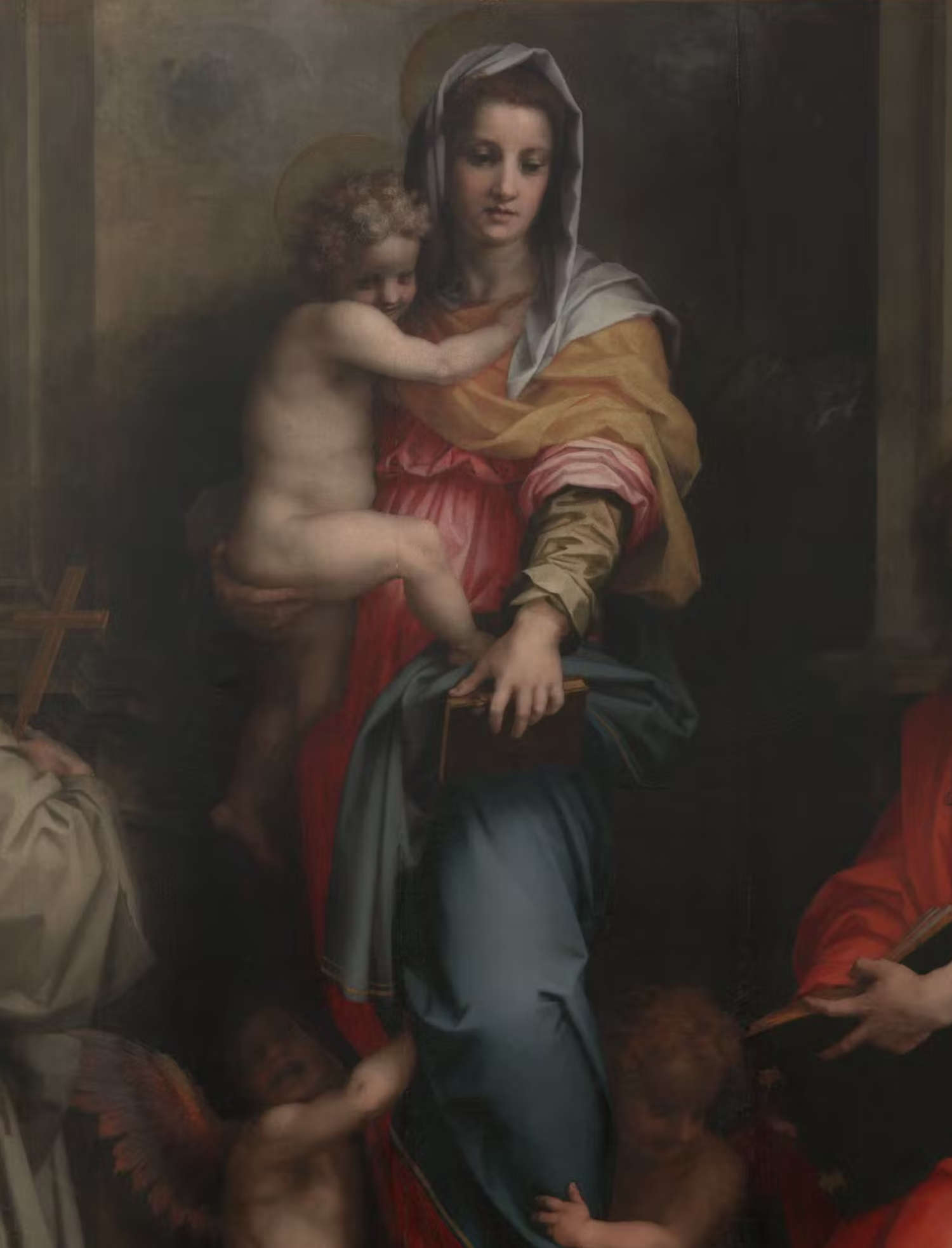
We owe to Giorgio Vasari the title by which one of Andrea del Sarto 's (Andrea d'Agnolo; Florence, 1486 - 1530) greatest masterpieces is known, the Madonna of the Harpies, a panel more than two meters high that is kept in the Uffizi and is placed at the opening of the itinerary through the rooms of sixteenth-century Florence. It is so called because Vasari interpreted as harpies the figures that adorn the pedestal on which stands the Virgin holding the Child. It is a seemingly immediate composition, appearing to us behind that patina of ease, of spontaneity, of balance that had earned Andrea del Sarto the nickname "painter without errors," because in his canvases everything is controlled, everything is rigorous, everything is measured. And not for nothing would he become a model for the entire next generation: in the sixteenth century, in Florence, all painters looked to Andrea del Sarto, tried to copy him, to imitate him, to be inspired by his compositional schemes. And in turn, Andrea del Sarto looked to the pyramidal schemes of Leonardo and especially Raphael, seeking, however, a personal path made up of soft tones, enveloping lights, heavy draperies that almost give theimpression of being material, of an intellectualism that is expressed above all in the intimacy and depth of the looks, gestures, the absence of triumphalism, and the humanity of his characters.
We see all these elements also in the Madonna of the Harpies, which surprises us also because Andrea del Sarto succeeds in conveying to the subject all the depth of his art with a surprising economy of means. An ease that is only apparent, for beneath this well-balanced surface lies the entire lesson of the three greatest artists of the Florentine Renaissance: the compositional scheme of Raphael, the monumentality of Michelangelo's figures, and the soft, nuanced tones of Leonardo da Vinci. The Madonna is standing above the plinth with the harpies, where we also read the painter's signature, with date and dedication celebrating the Assumption of the Virgin ("Andr. Sar. Flo. Fac. / ad summu regina tronu defertur in altum M.D.XVII," which we could summarily translate as "painted by Andrea del Sarto, Florentine / the Queen will be assumed to the highest throne / 1517"), and holds in her hands the Child, who s'clings to her in a somewhat precarious pose, while on the sides St. Francis and St. John the Evangelist invite us with their gaze to take part in this apparition, and at the Virgin's feet two cherubs, one of them with outstretched wings, are embracing Mary by the legs. Vasari spends words of praise on this panel: "Has this Madonna, from the upright man, a very well done Saint Francis, in the head of whom is known the goodness and simplicity that was truly in that holy man; besides that are the feet beautiful, and so are the cloths, for Andrea with a very rich turn of folds and with some sweet bruises always contoured the figures so that one could see thenaked; on his right hand he has a St. John the Evangelist, imitation young man and in the act of writing the Gospel, in a very beautiful manner; one sees, besides this, in this work a smoke of transparent clouds over the casamento and the figures that seem to move. Which work is held today among the things of Andrea of singular and truly rare beauty."
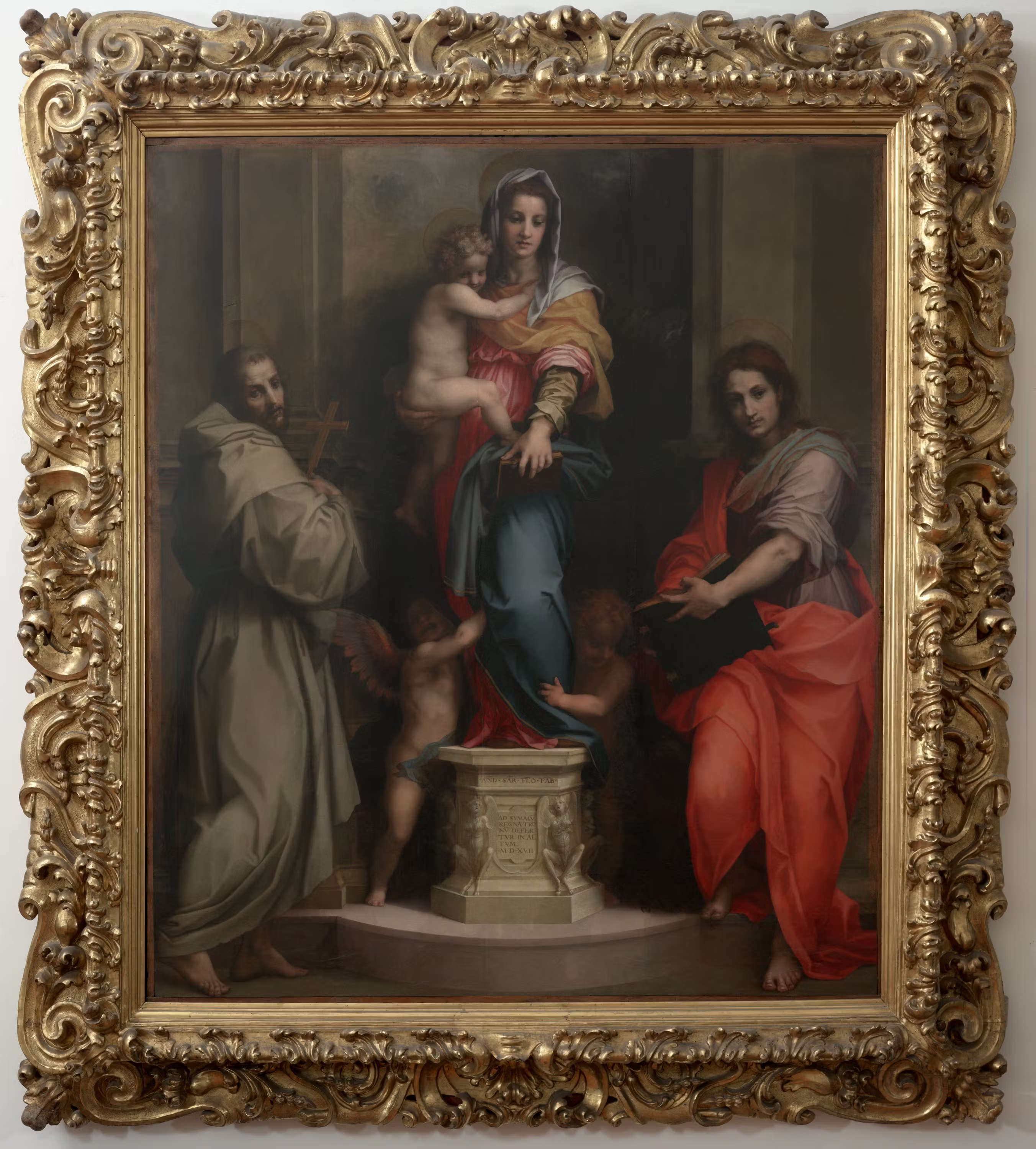
It was May 14, 1515, when the nuns of the convent of San Francesco de' Macci in Florence commissioned the painting from Andrea del Sarto: they had asked him for a rather conventional painting, a Madonna and Child crowned by two angels with, on either side, the figures of St. Bonaventure and St. John. It took Andrea two years to complete the work, and as we can clearly see he did not stick to the instructions. We do not know why the artist decided to hastily change the figure of St. Bonaventure to that of St. Francis, and not to paint the two angels crowning the Virgin, changing them to the two cherubs around the base, which were not stipulated in the contract. Now, it must be said that changes during the course of the work from what was agreed upon in the contract were perhaps not the practice, but still something very usual at that time. For Our Lady of the Harpies , however, it is different. There are, meanwhile, some curious details: the little angels at the Virgin's feet look almost frightened, they seem to be hiding behind her legs. And she, with her left hand, is holding up a book, which she holds against her knee. And then, she is looking downward, not the Virgin pointing her eyes in front of her or gazing tenderly at the Child, as most of Raphael's Madonnas did (the Sistine Madonna, for example, who turns her gaze toward us, or the Madonna of the Canopy, where Mary's eyes are all for her son). And even the Child seems almost to retract, while the saints, on the other hand, not only appear unperturbed: they are inviting us to observe the scene carefully. Finally, compared to the Andrea del Sarto contract, the very subject of the painting changes, which is no longer a crowned Virgin.
In order to understand why these changes and attitudes are made, we must also pass by the harpies, which respond to a precise iconographic program. Of course, we do not know exactly what the program was, and scholars have produced often conflicting readings, but it is clear that someone must have instructed the artist on what to paint: it should be remembered that at that time artists collaborated closely with literati, theologians, clergymen, and humanists whose task it was to set up the theoretical basis, so to speak, of a painting or cycle of paintings, and the artists' to translate it into images (and it is not certain that artists did not participate in discussions about the meaning of what they would paint or sculpt). It is probable, according to Antonio Natali's studies, that it was a Franciscan theologian, Antonio di Ludovico Sassolini, a follower of Savonarola, guardian of the convent of Santa Croce on several occasions between 1503 and 1515 and then minister of the Conventuals of the Tuscan Province, and again, starting in 1519, general of the order, who dictated the changes. It is interesting to know that at that time the convent of San Francesco de' Macci depended on the convent of Santa Croce, so it would not be strange that the painting was modified during the course of the work due to the interest of the guardian of Santa Croce. Moreover, Vasari, in his Life of Andrea del Sarto, writes that the work was made "to a friar of Santa Croce of the Minor Order, who was then governor of the nuns of San Francesco in Via Pentolini and took great delight in painting."
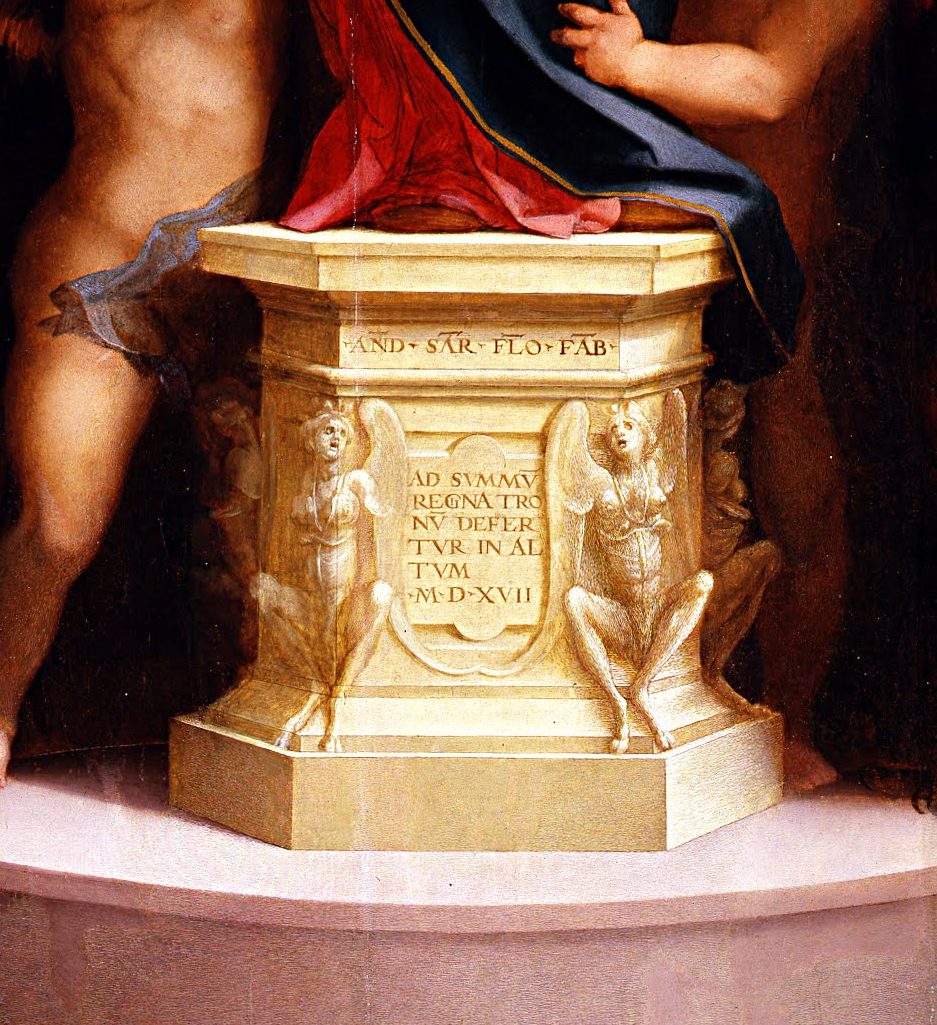
Having identified the probable "mind" behind Andrea del Sarto's painting, it is necessary to ask what this mind wanted to say to the nuns in the convent. The interpretation that has been most quoted and discussed in recent times is, again, that of Natali, who since 1984 has wanted to see in the Madonna of the Harpies a reference to theApocalypse of St. John, in particular chapter IX, where it speaks of the locusts of the abyss: monstrous locusts that had the appearance of war horses, crowns of gold on their heads, heads with human-like features, hair of women, teeth of lions, abdomens resembling breastplates of iron, scorpion tails equipped with spines, wings capable of fractiousness with a roar similar to that of horse-drawn chariots launched on assault. In Revelation they are summoned by the sound of an angel's trumpet and emerge from a pit that emits smoke similar to that of a furnace: it is from the smoke that the locusts emerge and begin to ravage the earth. The appearance of Andrea del Sarto's harpies would thus seem to correspond to that of the locusts of Revelation: they have equine legs, an armored abdomen, a human face, large wings, and a swallowed head. At this point, the painting would insist on the salvific role of the Virgin, who in this painting is the woman destined to crush the evil one with her feet (and it is perhaps for this reason that she is standing on the foot of the plinth, which could allude to the well from which the locusts come out: the two putti, therefore, are perhaps fixing her, perhaps forcibly and even a bit worriedly, to make her close the mouth of the abyss). Even the inscription on the plinth, "ad summu regina tronu defertur in altum," comes from a medieval hymn dedicated to the Assumption of the Virgin, linked to theApocalypse of John, and the presence of the saint is easily explained: he is the one who wrote about the locusts. Francis, on the other hand, is not only the titular saint of the church that would have welcomed the painting, but he would also be identified, according to this interpretation, as the angel of the sixth seal of theApocalypse, that is, the divine creature who would lead humanity to salvation: it was, moreover, St. Bonaventure himself, author of the Legenda maior, the first biography of the saint from Assisi, who had identified St. Francis with the angel of the sixth seal, with the creature destined to imprint the sign of the cross, the Tau, on the foreheads of human beings. Reinforcing this reading would also be the element of smoke visible behind the Virgin, restored by a restoration carried out in 1983 by Alfio Del Serra and also noted by Vasari ("one sees [...] in this work a smoke of transparent clouds above the base and the figures that seem to move").
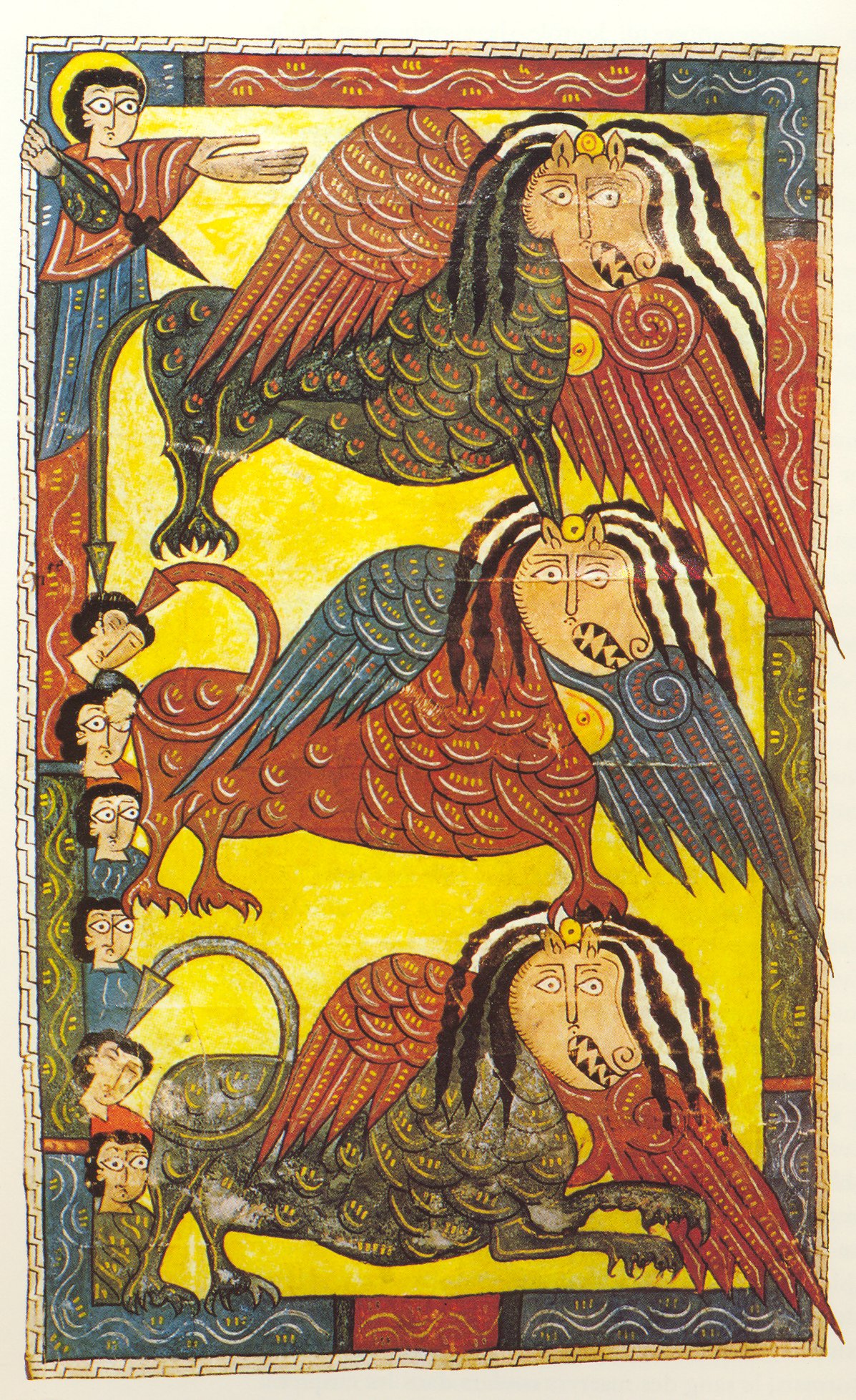
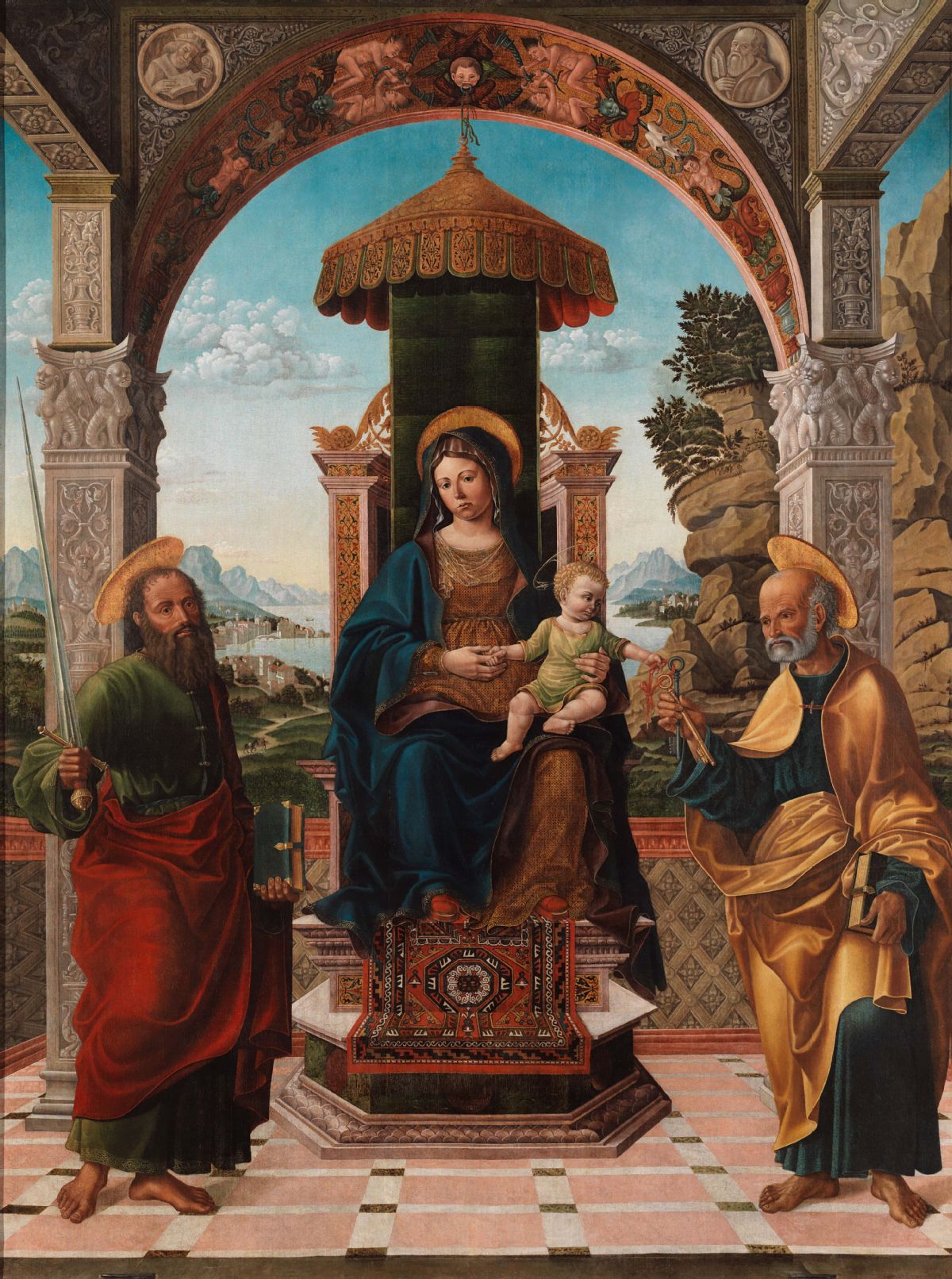
All resolved, then? Was Vasari wrong, and are what we think are harpies actually the locusts of the Apocalypse? We cannot say for sure, because there are some elements that do not lay in favor of Natali's version. Andrea del Sarto's beings do not precisely match those of Revelation: for example, the scorpion's tails and lion's teeth are missing. Strange, if an artist had wanted to make his creatures unambiguously identifiable. Besides, one might wonder why Vasari, who could rely on first-hand information close to him in time, so blatantly equivocated the subject. Art historian Simona Cohen then pointed out that any iconographic precedent would be missing (which, however, would not in itself be evidence against the "apocalyptic" interpretation, so to speak: Andrea del Sarto might have invented a new iconography). The Beatus of the Escorial, the 10th-century Spanish manuscript with the reproduction, illustrated, of the Apocalypse (a work that for at least three centuries provided an iconographic basis for depicting scenes from the book of John) depicts locusts as very different beings than Andrea del Sarto's: they are like large lions with horse bodies, women's hair, scorpion tails, gnashed teeth, and spread wings. According to Cohen, there would be too many differences between Andrea del Sarto's figures, the biblical text, and the only examples that tradition could provide. And there would also be similarities with other mythological creatures that can be found in the history of art: they are in fact depicted with spread legs with their genitals well in evidence, like the sirens of medieval art, creatures associated with sin and for that reason depicted in such an unseemly position. And they have some traits in common with the harpies of Greek mythology (the large bird wings, the woman's face) but also with the sphinxes (the leonine body, the spread wings). The problem, however, is that these beings are neither harpies nor sphinxes, because they cannot be precisely identifiable with any of these creatures, and there are no iconographic traditions that could support the locust theory of Revelation. Instead, for Simona Cohen, it is likely that the iconographic program was linked to a celebration of theImmaculate Conception, a theological concept that not infrequently, in Renaissance paintings, was itself linked to depictions of hybrid or monstrous creatures, half animal and half human beings, which artists of the fifteenth and sixteenth centuries saw depicted on classical relics, Roman sarcophagi, and fragments of ancient friezes, and for which there was a renewed interest at the time, partly because of the possible meanings, usually negative, that could be attributed to these creatures. In this sense, the depiction of monstrous creatures in a sacred conversation such as the Madonna of the Harpies can be considered is certainly not unique: it is almost contemporary, from 1519, the Madonna and Child Enthroned between Saints Peter and Paul by Francesco Bassano who is now preserved in the Museo Civico of Bassano del Grappa (on the columns of the canopy that houses the throne of the Virgin we find capitals with sphinxes, which moreover have curious tails resembling the tail of a scorpion, while in the sub-arch we see sirens and satyrs), while in the Madonna and Child with Saints by Giovanni Mansueti, an ink drawing on paper from the end of the fifteenth century, we see the sculpture of 'a satyr decorating the throne on which Mary sits, and again sphinxes adorn the throne of the Madonna and Child with Saints Andrew and Peter by Ludovico Mazzolino, painted in the early 16th century. The examples, in short, are many. In some cases, the sphinxes could be read as a symbol of wisdom, an allusion to the throne of the Virgin as sedes sapientiae. But other figures, such as Francesco Bassano's sirens or Giovanni Mansueti's satyr, might instead depict the evil forces that are defeated by the Virgin, with a function similar to that of the locusts in Revelation.
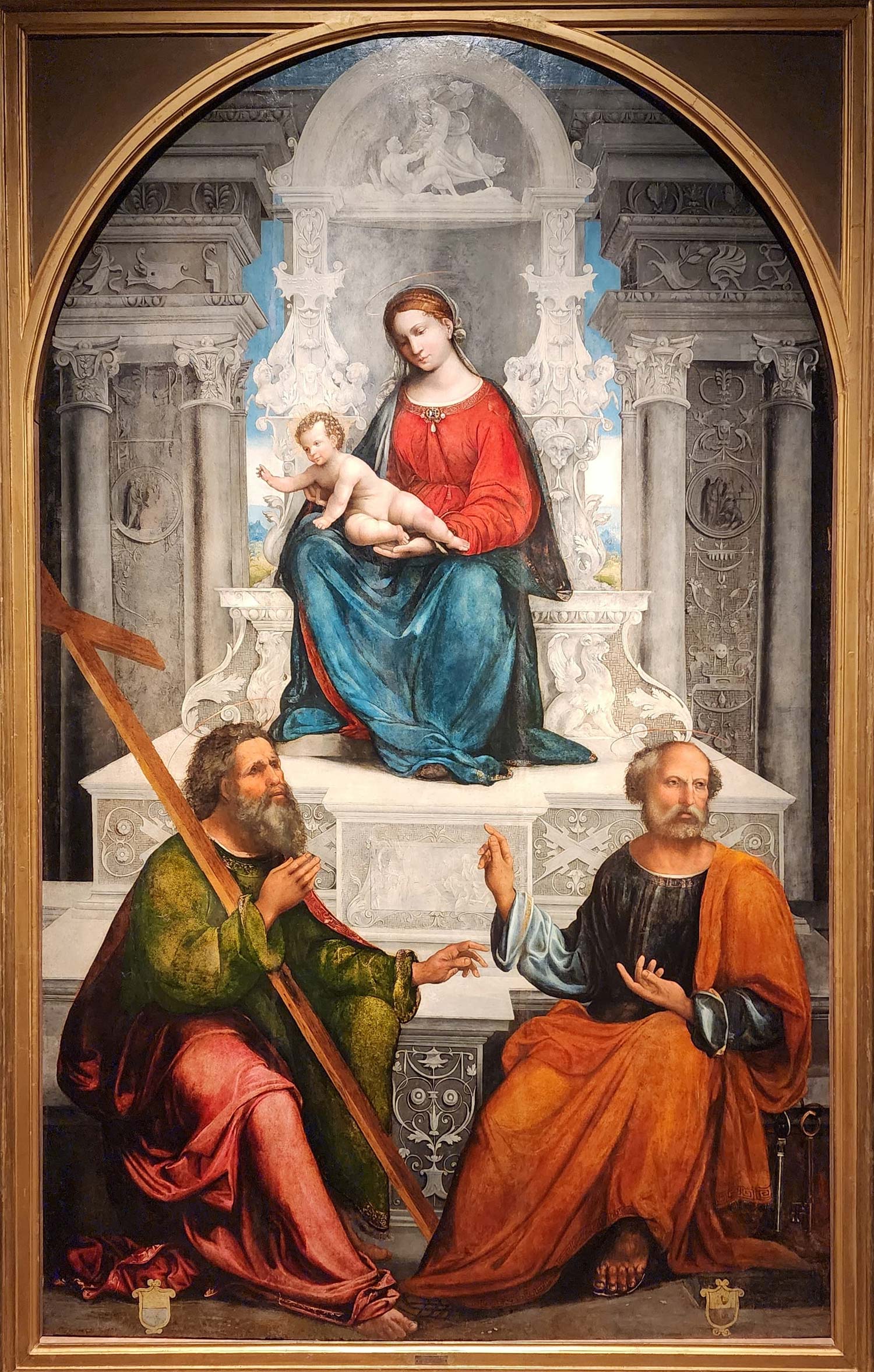
Still, a relationship with the Book of John would remain in place: after all, it is the same saint who, in Andrea del Sarto's painting, holds it in his hands. The Franciscans had a very strong connection with the theme of the Immaculate Conception (it was, after all, the Franciscan theologian John Duns Scotus who had fixed the doctrine of the Immaculate Conception), and the figure of the Woman of John's Apocalypse was interpreted as proof that the Virgin had been conceived without sin in the mind of God. The purity of the Virgin, according to the mentality of the time, was held up as a fundamental model for women's convents, and her conception in the absence of original sin made her not only the savior of humanity but also, in a way, the patroness of women who consecrated themselves to the monastic life (many, admittedly, were forced to do so, but unfortunately coercion did not matter for the purposes of theological discourse). Andrea del Sarto's Virgin would thus be the Immaculate Conquering Sin, represented by the monstrous hybrids at her feet, and further underscored by the position of her legs flaunting her genitals, functional to show unequivocally the sinful nature of temptation, of seduction.
Another scholar, Steven J. Cody, also points out the fact that Andrea del Sarto's "harpies" do not respond to any iconographic precedent and would be read, if anything, as those strange beings that adorned the grotesques of Renaissance painters and often alluded to sin and sensuality: hence also the particular insistence on the pubis and breasts of these strange creatures. And Cody also reasons about the possibility that this understanding of sin was aimed at the nuns who saw this painting in the convent church. "Andrew," Cody writes, "knew his audience. The nuns at St. Francis prayed to the Virgin and Child as they contemplated this painting-that is why they contemplated it. The nuns focused on the image of Mary and Christ as they sought to communicate spiritually with the real Mary and Christ in heaven and, more immediately, in their hearts. Through the medium of painting, Andrew increased that sense of communion, that feeling of closeness."
The mass of smoke rising behind Mary's back would remain to be interpreted. John Shearman had understood it as incense smoke, and if the reading were correct the incense would be responsible for mediating between heaven and earth, since it is the incense smoke, in religious tradition, that carries prayers to heaven. According to Cody, however, the smoke could also allude to the theological concept ofobumbratio as expressed in the Gospel of Luke, where we read that the archangel Gabriel, in announcing to Mary the conception of Jesus, tells her that "the Holy Spirit will descend upon you, and the power of the Most High will cover you with its shadow." The cloud of smoke could therefore be a representation of the Holy Spirit descending on the Virgin, covering her with the shadow of God. It is, in short, the physical presence of the Holy Spirit. Finally, the projected presence of St. Bonaventure would be explained on the basis of his Itinerarium mentis in Deum, a theological work that takes the form almost of a mystical guide, a kind of manual on how to elevate the soul from earthly things to union with God. And Andrea del Sarto may have structured the painting to make the viewer follow the same path described by St. Bonaventure, who invited the viewer to look at the beauty of creation in order to intuit the beauty of God: the artist thus went out of his way to captivate the viewer with sensory beauty (the bright colors, the realistic draperies, the sweetness of the faces: tools to engage the senses of the nuns and initiate the ascent), to capture the eye and then compel one to think, to move from the eye to the mind, to meditate on the mystery of the Incarnation, to look no longer only with the eyes, but with the head. And one could also explain in this sense the presence of the cloud of smoke: since God is too great to be understood, the excess of divine light will appear to the human mind as darkness. Like when one stares too long at the sun and then can no longer see anything. Here, the dark cloud could visually represent this concept: divine light so intense that it becomes a shadow to the human eye. The last phase, then, is ecstasy: according to Cody, Andrea del Sarto's vivid colors and light would be designed to allow this ecstatic rush toward God. A painting that is actually, according to this reading, a Bonaventurian spiritual machine.
It remains difficult, in short, to determine which reading is the most convincing. It is likely that other scholars will continue to grapple with this masterpiece, among the most difficult of the Florentine sixteenth century, which has been part of the Medici collections since 1704 (it was the last altarpiece that Grand Prince Ferdinand decided to have removed from the churches of Tuscany to bring everything into his own collection: in this case, the church got a complete restoration of it in return, directed by one of the greatest artists of the time, Giovanni Battista Foggini). And as part of the ancient grand ducal collections, today everyone can see it at the Uffizi: it is one of the cornerstones of the collection and one of the paintings that most fascinates the thousands of visitors each year who see what was once reserved only for the nuns of San Francesco de' Macci.