By Mauro Minardi | 27/03/2026 21:52
Death and resurrection. These are the words that define the meaning of Venice in In Search of Lost Time, a work where the city holds a profound symbolic value in the story told there, with the protagonist's discovery of his own vocation for literature and, at the same time, the rediscovery of his most intimate and authentic self.
A place long dreamed of, yearned for, mythologized by the novel's Narrator, Venice is also the concrete destination of one of the few trips Proust made outside France. In the years around 1900 he was working on a translation of The Bible of Amiens by John Ruskin, the Victorian-era English critic and reformer to whom he had vowed an almost filial devotion, driven by enthusiasm for that recovery in ethical and religious terms of the art of the Middle Ages in which certain eternal laws of human history had been fixed.
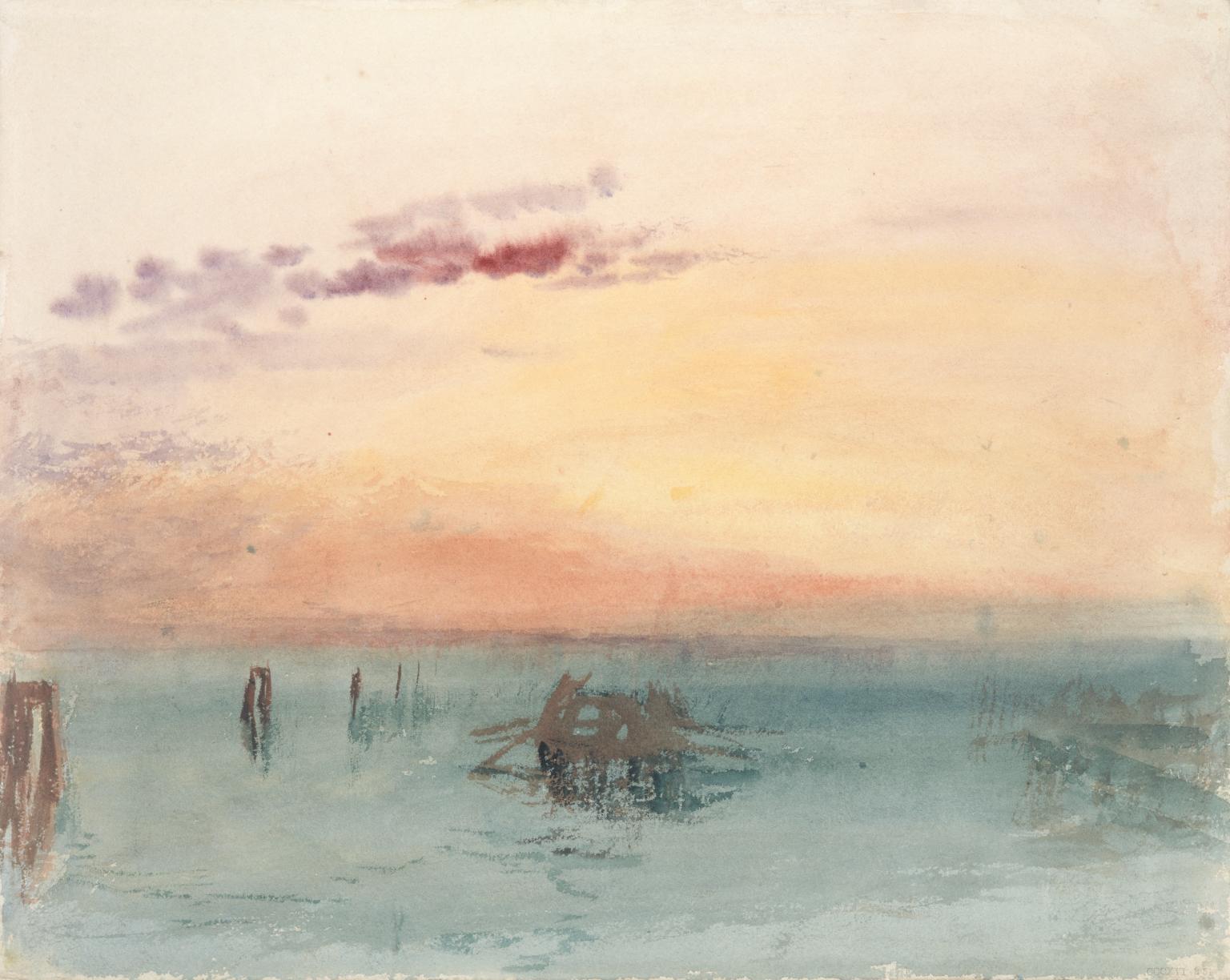
Ruskin had died on January 20, 1900, and in May the 29-year-old Marcel Proust was in Venice. With this trip he honored the beloved writer, who had given Amiens the appellation "Venice of Picardy," "Queen of the Waters of France," thus throwing a long suspension bridge between the bulk of its Gothic cathedral and the gracefully flowery palaces emerging from the Grand Canal, which he moreover portrayed in drawings and watercolors of admirable delicacy. Inspired by a desire "to be able, before he died, to approach, to touch, to see embodied, in the rosy, shaky but still standing palaces, Ruskin's ideas about the domestic architecture of the Middle Ages," Proust had read in The Stones of Venice what a thrill it might have been to approach the lagoon before the mid-nineteenth century, when the construction of the railroad had created a more convenient landing on the islands. "In the travels of old," however, "there were few moments when the memory was dearer to the traveler than that which brought him within sight of Venice, when his gondola sprang from the Mestre Canal into the open lagoon," with the view afforded us by the watercolors of Turner, Ruskin's favorite contemporary painter. "The brackish breeze," the text of The Stones of Venice continues, "the moaning of the snow-white sea-birds, the masses of dark grasses hatching or gradually flowing away, in throbbing tangles on the sandy shoals, under the push of the tide, all gave the illusion of the ocean in whose bosom the great city rests, quiet. This was touching Venice before the "maddening arrival at a train station."
On that study trip Proust was not alone. His mother accompanied him, and he was joined by his friend Reynaldo Hahn and the latter's cousin, the young English artist Marie Nordlinger, who, alongside Madame Proust, was helping him with the translation of The Bible of Amiens. It is not yet certain whether he stayed at the Hotel Danieli or, as many believe, at the Hotel Europa, which in those years was based at Ca' Giustinian, thus having a splendid view of the Grand Canal's outlet over the basin of St. Mark's and the Basilica of La Salute. Indeed, in the novel Proust will recall how several historic buildings had been converted into hotels, which lent a worldly accent to those relics of late Gothic and Renaissance architecture. It is an accent that he finds in the palaces on the Grand Canal: "like a chain of marble cliffs at the foot of which one goes by boat in the evening to watch the sun set," these seem for the protagonist of the Recherche to be architectural creations of nature, but "at the same time" the comings and goings of gondolas from one to the other evoke the bustling comings and goings of carriages "on the boulevards, on the Champs-Élysées, at the Bois, on any great fashionable avenue," where "the most elegant women" sail.
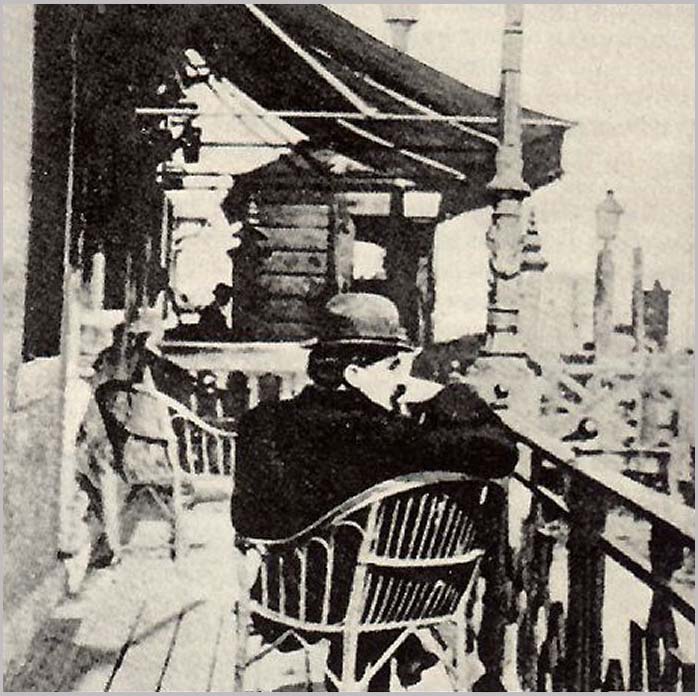
A photograph of Proust sitting on a terrace looking pensively out to sea is the only visual evidence of the Venetian sojourn. Very little is known about the trip, which was limited to a few weeks, but we do know with what fervor the future author of The Recherche followed in Ruskin's footsteps, "in those blessed days," he will recall in his commentary on The Bible of Amiens, "in which, with a few other disciples 'in spirit and truth' of the master, we used to go by gondola through Venice, listening to his word on the water's edge and approaching every temple that seemed to rise from the sea to offer us the object of his descriptions and the very image of his thought." And, in fact, the only documentary record associating Proust with the Venetian capital concerns his presence, on May 19, at the Biblioteca Marciana, where he consulted The Stones of Venice. His signature, in the visiting register of the monastery of San Lazzaro degli Armeni, dated October 19 , raises some doubts and would possibly be linked to a second and for the moment mysterious move to the lagoon.
The Ruskinian nature of this experience is, moreover, poured into the Recherche, in the third chapter of its penultimate volume(Disappeared Albertine), when after Albertine's death, shot through with memories and remorse of the troubled life in common with the girl, the Narrator makes that long-desired journey, offering us a description of the most admired places inspired by Proust's 1900 trip. Most scholars agree that this section is among the most autobiographical in the novel. When, at ten o'clock in the morning, the shutters of his hotel room were opened, the first thing the protagonist saw was - blazing and symbolic, "glowing with a sun that made it almost impossible to gaze upon" - the golden angel of St. Mark's bell tower, "a promise of joy more certain than he could ever be commissioned to announce to men of good will." In Albertine 's missing text, therefore, the Piazzetta of St. Mark's, with the pillars of Acre, also finds mention. Following in Ruskin's footsteps, Proust had to take a special interest in the medieval and early Renaissance city, in whose artistic testimonies his predecessor had seen the greatest Christian virtues embodied and on which the Queen of the Adriatic had raised her own glory, before a gradual decline in politics, commerce and above all customs that for him began in the sixteenth century, that is, in the century in which we see the height of her greatness. A few years later the writer would recall how thanks to Ruskin it had been possible to discover a Venice that otherwise "we would never have glimpsed," saturated with its thousand-year history and less decadent than how it was described by his contemporaries. The Proust who, a decade after that sojourn, writes his novel has become a different person from the years of such infatuation, and his outlook is more complex and certainly less moralistic in comparison with his former master.
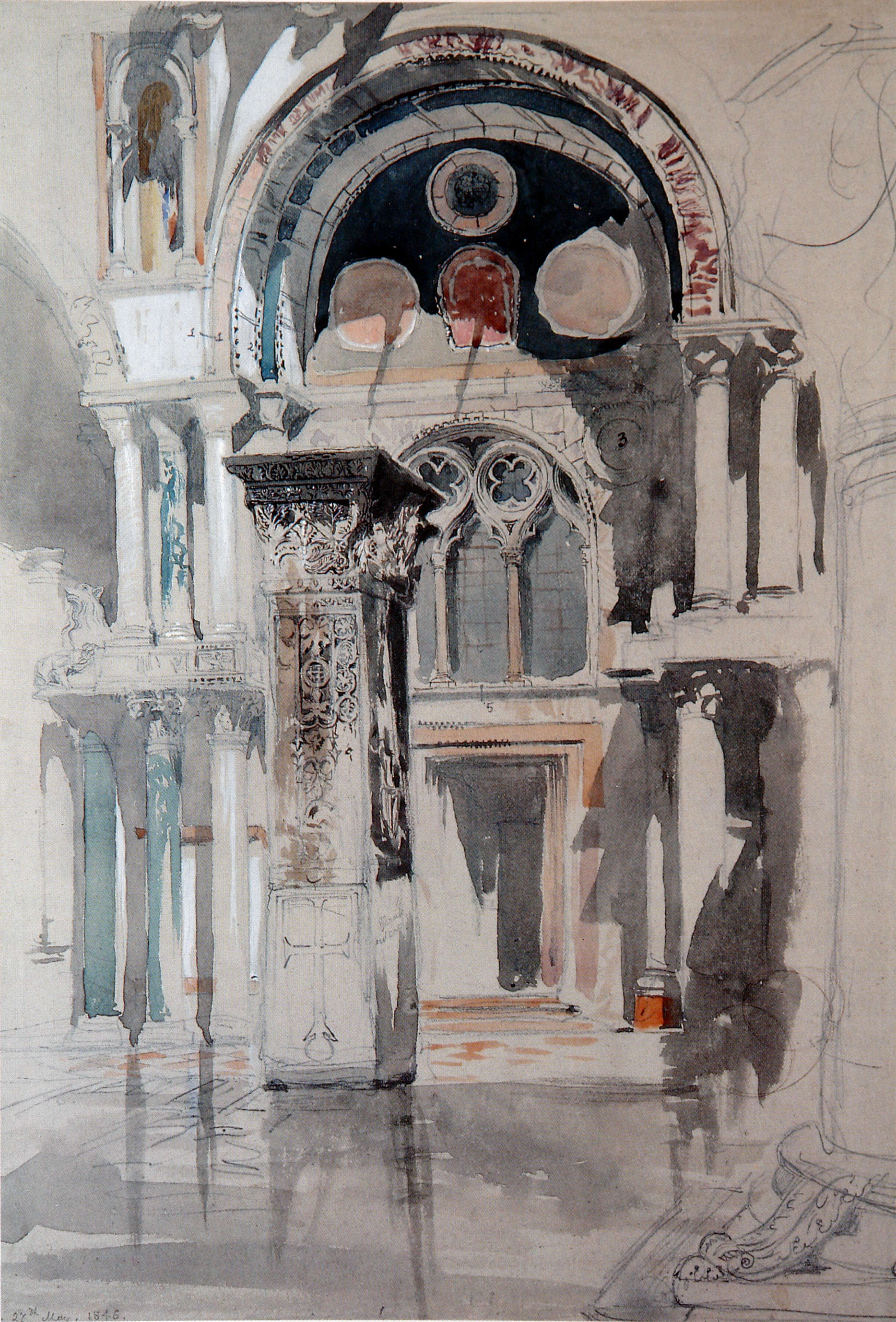
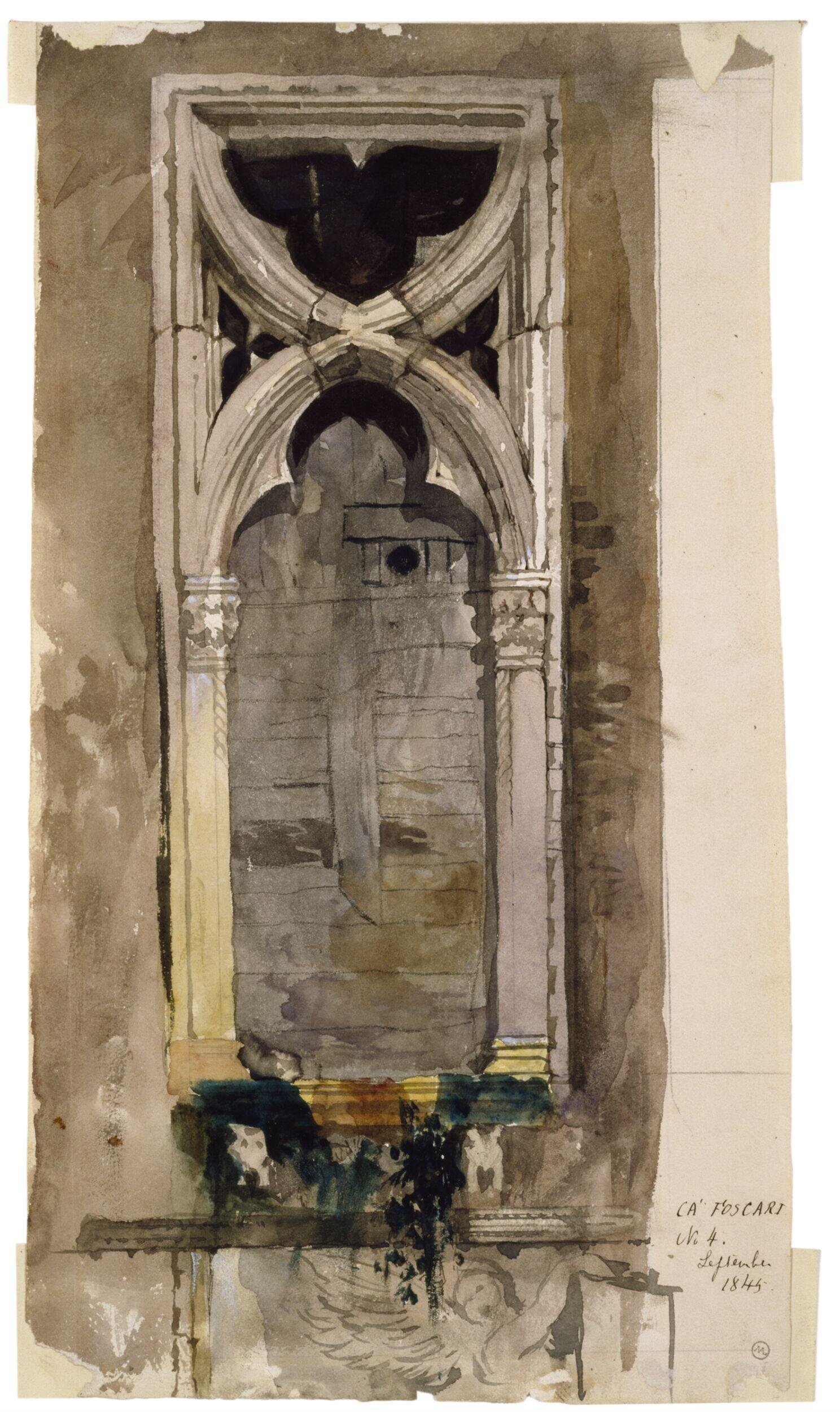
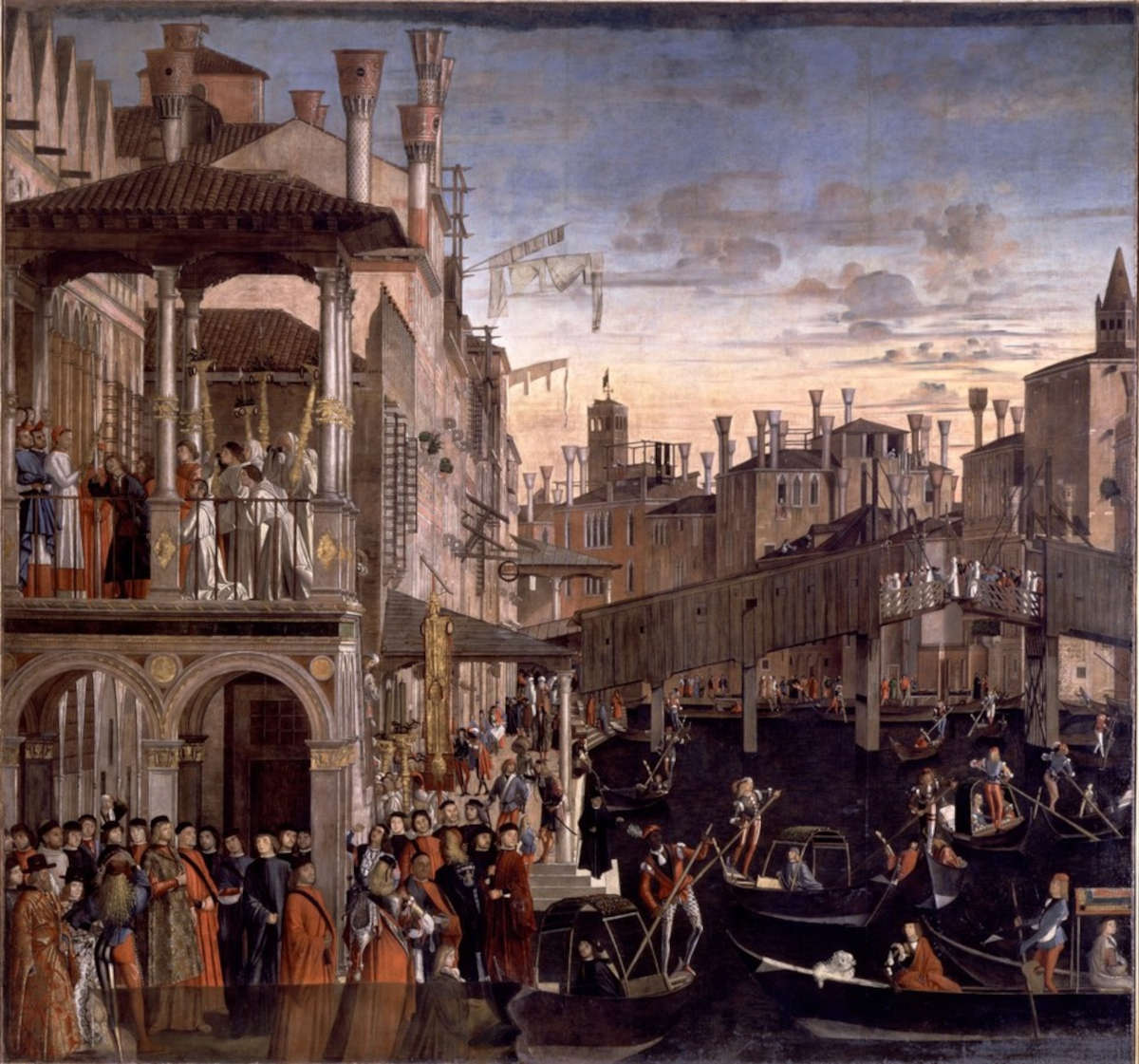
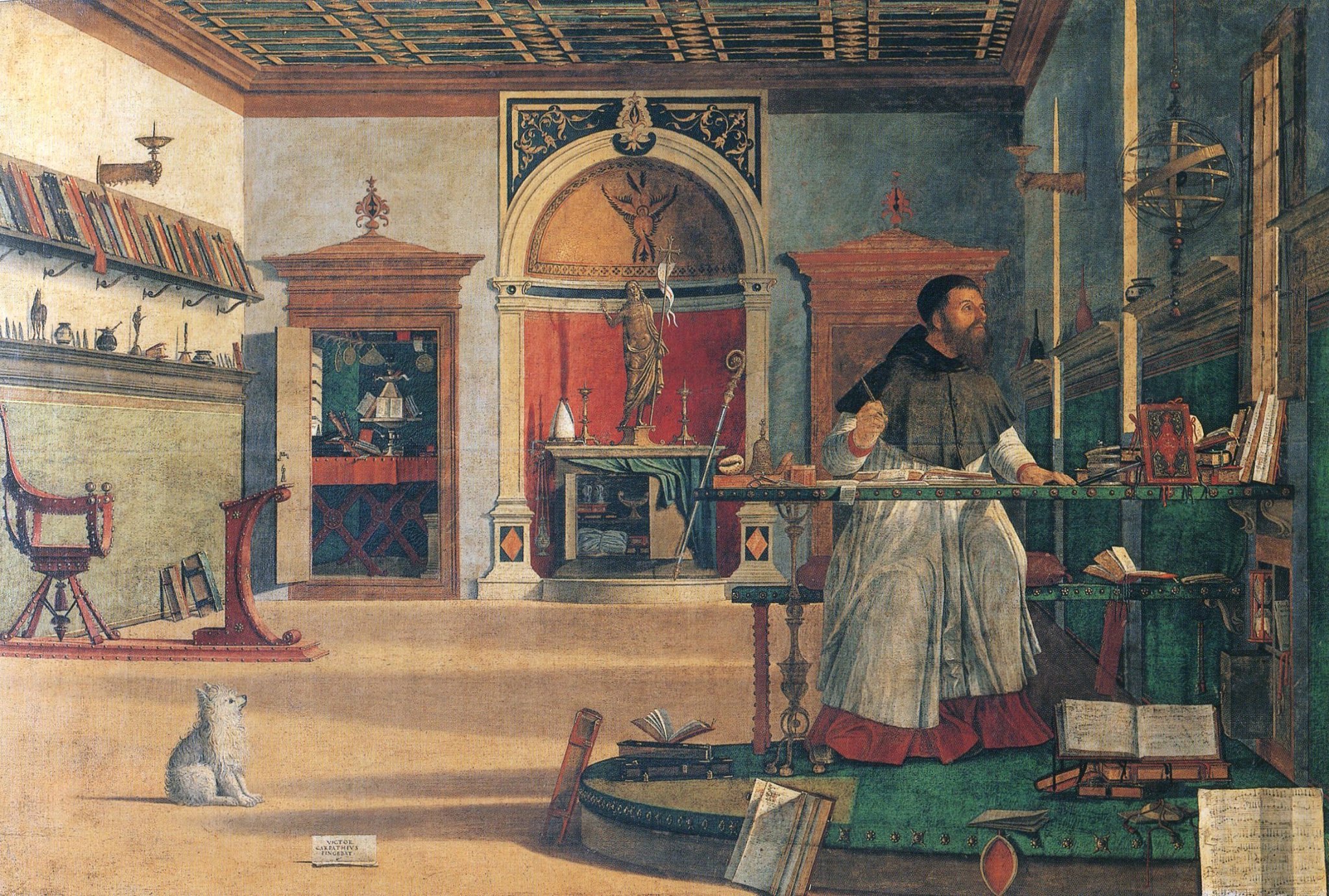
After the Basilica Marciana, the places most visited by the Narrator (and, we may think, by Proust) are those that hold works by Vittore Carpaccio. The latter had been Ruskin's most beloved Venetian painter and is among those most mentioned in the Recherche, with a respect for the one who had introduced him to the author that is tinged with profanity. Frequently in the novel the artist is mentioned alongside Paolo Veronese, in a common allusion to lavish sets and places: Ruskin, who saw in the latter the exponent of a secular and worldly vision opposed to one attuned to more sacred values, would have been scandalized by such a juxtaposition, on a par with that proposed by Proust between the scene of the Miracle of the Relic of the Cross at the Rialto Bridge and Whistler's Venetian views. How can we forget that the American painter had brought a libel suit against Ruskin (which was resolved in his favor)? It is precisely this canvass by Carpaccio, part of a cycle made for the Scuola Grande di San Giovanni evangelista, that holds a special place within the Venetian sojourn narrated in Albertine's disappearance. Proust saw it, along with the cycle of the Legend of Saint Ursula, at the Gallerie dell'Accademia. Observing the painting, which he admires for its realistic details, for "the stupendous carnicine and violet sky," the Narrator is paralyzed before a figure, in whom he discerns the model of the cloak refashioned centuries later by Mariano Fortuny and with which Albertine had dressed on the evening of their last walk, on the eve of her escape and death. "I had recognized it all, and for a moment, as the forgotten cloak had returned to me, for me to look at it, the eyes and heart of the man who was that evening about to go to Versailles with Albertine, I was invaded for a few moments by a turbid feeling and immediately dispelled by desire and melancholy." Now, this cloak bears the inscription-which has become even clearer as a result of the recently completed restoration-"Time," so focal for the author of À la recherche du temps perdu that one wonders whether the importance he attached to this detail is mere coincidence or is subtly, mysteriously sought. The passage is, among many in the novel, a key to understanding what role works of art hold in Proust: they are not merely the object of aesthetic contemplation, but an integral part of the novelistic scaffolding; they innervate it, substantiate it. In 1916, while editing this piece, the writer confided to his friend Maria di Madrazo the meaning of the Fortuny leitmotif, which would have in his book a value "from time to time sensual, poetic and painful." The Spanish-born scenographer, painter and costume designer, whom some say Proust got to know during his stay in the city, had in fact been inspired by Venetian Renaissance paintings to recreate clothes that renewed their glittering sumptuousness. In the Recherche, the Narrator will purchase for his Albertine some of the chamber robes woven by this "brilliant son of Venice," as Proust calls him: one among them "seemed like the tempting shadow of that invisible Venice. It was invaded with Arab ornamentation like Venice, like the palaces of Venice [...], like the columns whose oriental birds, which alternately signify life and death, were reproduced in the glitter of the fabric, of a deep blue that as my gaze went into it was transformed into melting gold, through the same transmutations that before the advancing gondola turn the blue of the Grand Canal into flaming metal. And the sleeves were lined with a cherry pink so typically Venetian that it is called Tiepolo pink."
With Fortuny's robes and the symbols shrouded in them, the significance of Venice in the Recherche is expressed: a place of death for Thomas Mann's famous novella , it is during the stay in its lagoon that Albertine, buried "in the 'Piombi' of an inner Venice", really dies for the Narrator, who realizes, with the evidence that Carpaccio's canvas offers him, that the process of oblivion is inexorably taking its course and that the image of her is disintegrating like the stones of buildings rose by the action of the waves. At the same time, the exorcism narrated in the Miracle of the Relic of the Cross reveals to him that the one exorcised is himself, freed from the demon of jealousy and sick love. At this point he can mirror himself in another work by Carpaccio, the Vision of St. Augustine from the San Giorgio degli Schiavoni cycle, which at the time was thought to depict St. Jerome in his study. Skimmed by a beam of light, surrounded by books, placed before a statue of the risen Christ, the saint towers as if at the center of an allegory of writing. Behind him, in a cubicle laden with study objects, are other volumes, and their placement seems to be echoed in the famous pages devoted to the death of the writer Bergotte: "in the illuminated showcases, his books, arranged three by three, kept vigil like angels with outstretched wings, seeming, for the one who was no more, a symbol of resurrection." After all, for both Ruskin and Proust Venice is a book, a "colossal gospel" - writes the latter - composed in its illuminated pages by its centuries-old monuments.
If Proust loved Carpaccio it was also because in his canvases, like the whole of Venice, it is the "works of art, it is the magnificent things that perform the function of giving us the familiar impressions of life." With its truthful portrayal of the city and the tingling industriousness of its inhabitants, the Miracle of the Relic of the Cross at the Rialto Bridge preserves the memory of something that, not unlike Albertine, is gone, dead and buried: the wooden Rialto Bridge, the old fondaco dei Tedeschi, some of the palaces on the Grand Canal. Already Ruskin had said that we are indebted to him as much as to Gentile Bellini, to whose images we can rely "to imagine the original beauty of those few desecrated fragments," the last of which had been destroyed by modern Venetians. Against the desecration inflicted by destructive Time and men the work of art thus saves the face of what is lost.
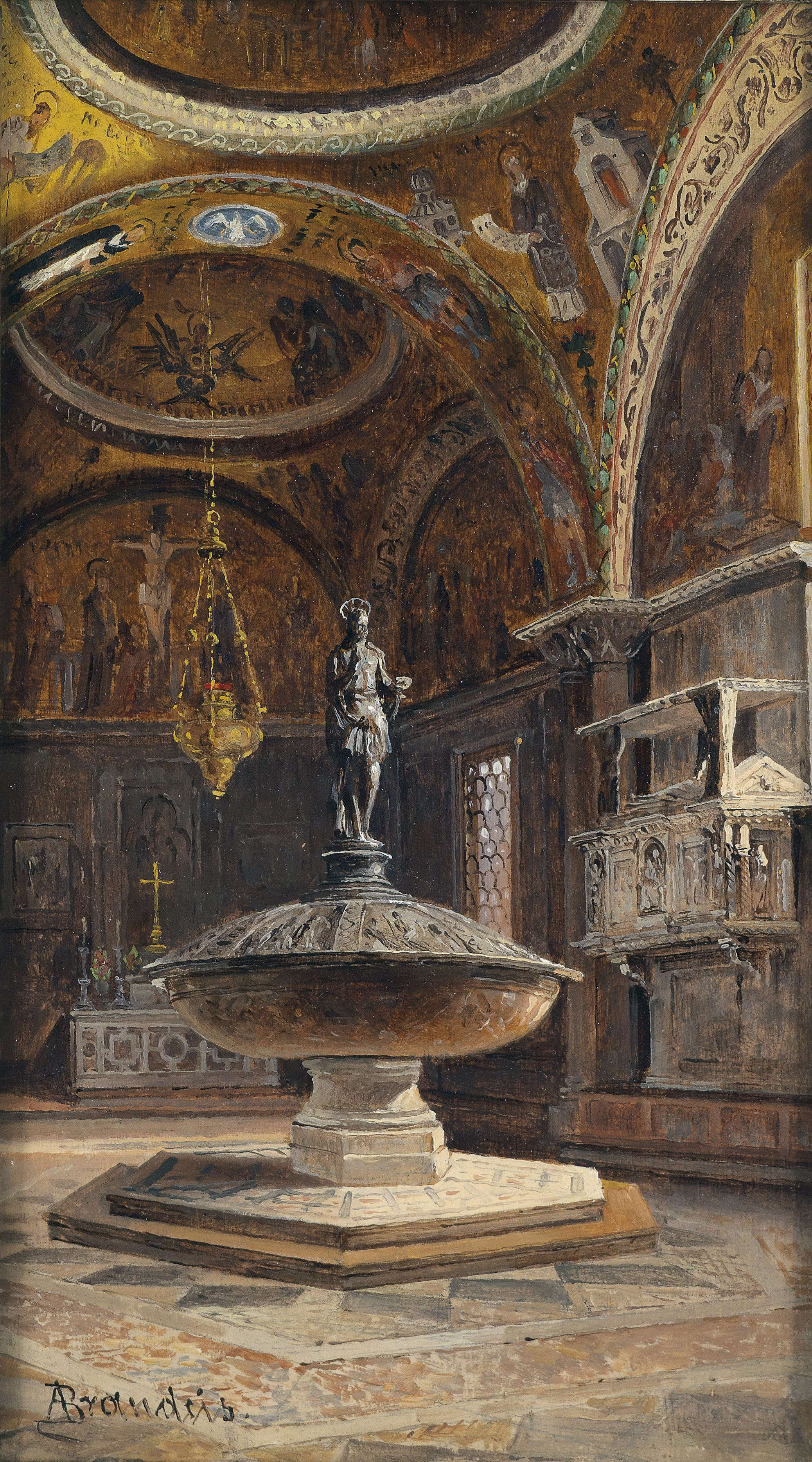
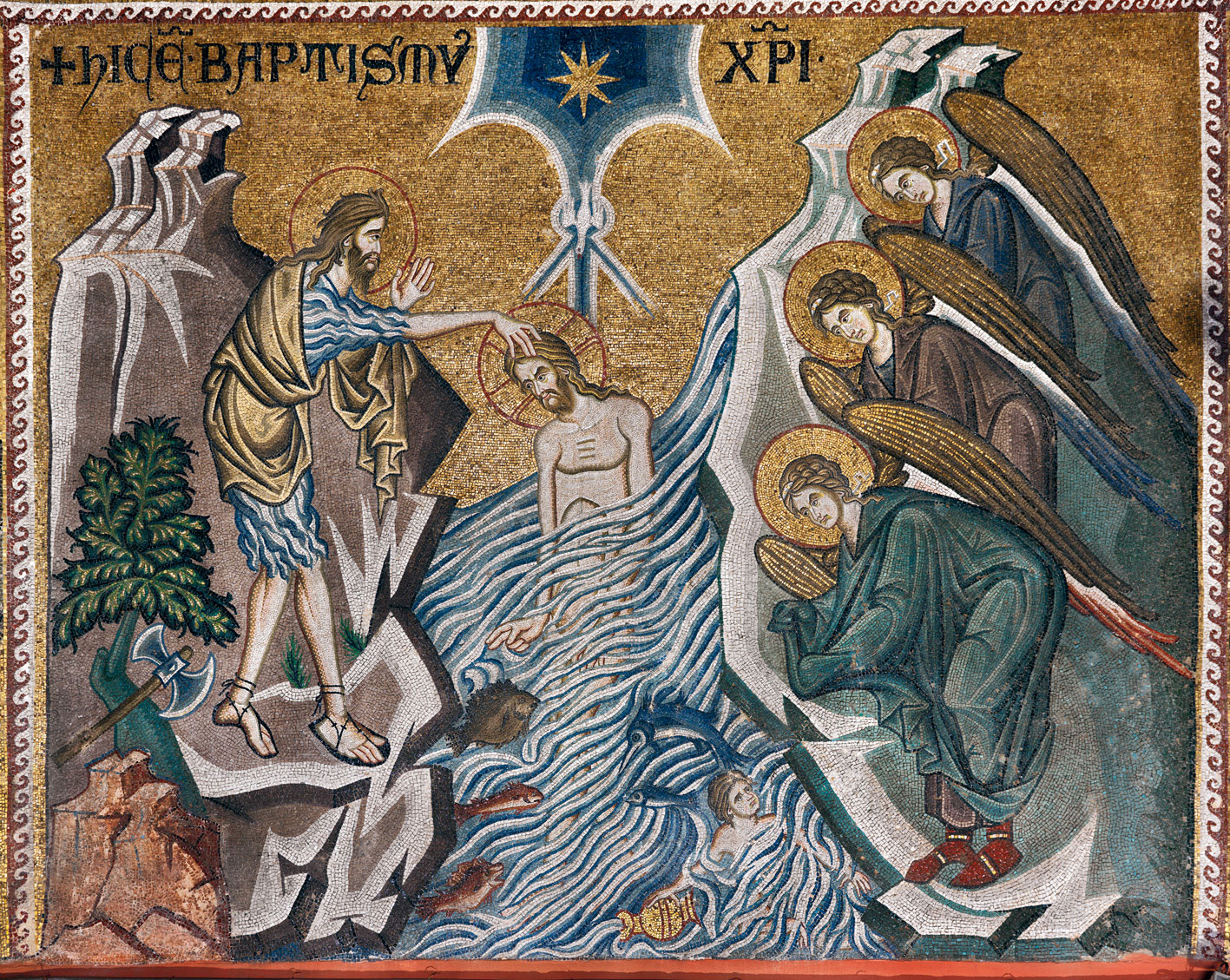
In the waters of the lagoon the Narrator washes away his love and guilt over Albertine's death, thus being purified in order to tap into his vocation. It is therefore no coincidence that in the same chapter devoted to the Venetian sojourn there is another key moment of confrontation with a work of art, in the silent, shadowy coolness of St. Mark's Baptistery. This place, too, had been described by Ruskin, in the pages of The Rest of St. Mark's, and had been among the favored destinations of the Proustian party's visits inside the basilica. The writer does not dwell much on the church and the most relevant parts of its decoration, reserving instead a special mention for the less famous fourteenth-century mosaic, made at the time of Doge Andrea Dandolo, depicting the Baptism of Christ, which the Narrator observes with his mother. Perhaps only the attentive reader of the Recherche will understand how washing from the original sin of guilt, snobbery and, at the bottom of it all, selfishness can be so important to the initiatory journey taken by the novel's protagonist, and how this mosaic can prove to be a metaphor for an entire experience, and its vision a keystone that preludes the time found again. When, in the last volume, the Narrator is about to stumble on the uneven pavement of the courtyard of the Guermantes palace, the mechanism of involuntary memory is miraculously triggered and he suddenly and all at once finds "Venice, of which my efforts to describe it and the self-styled snapshots taken by my memory had never told me anything, and which the same sensation once felt on two unequal slabs of the baptistery of St. Mark's had returned to me." With the chance repetition of the same incident on the poorly leveled stones an entire city is thus resurrected, a buried past, as, with the episode of the madeleine dipped in tea, Combray.
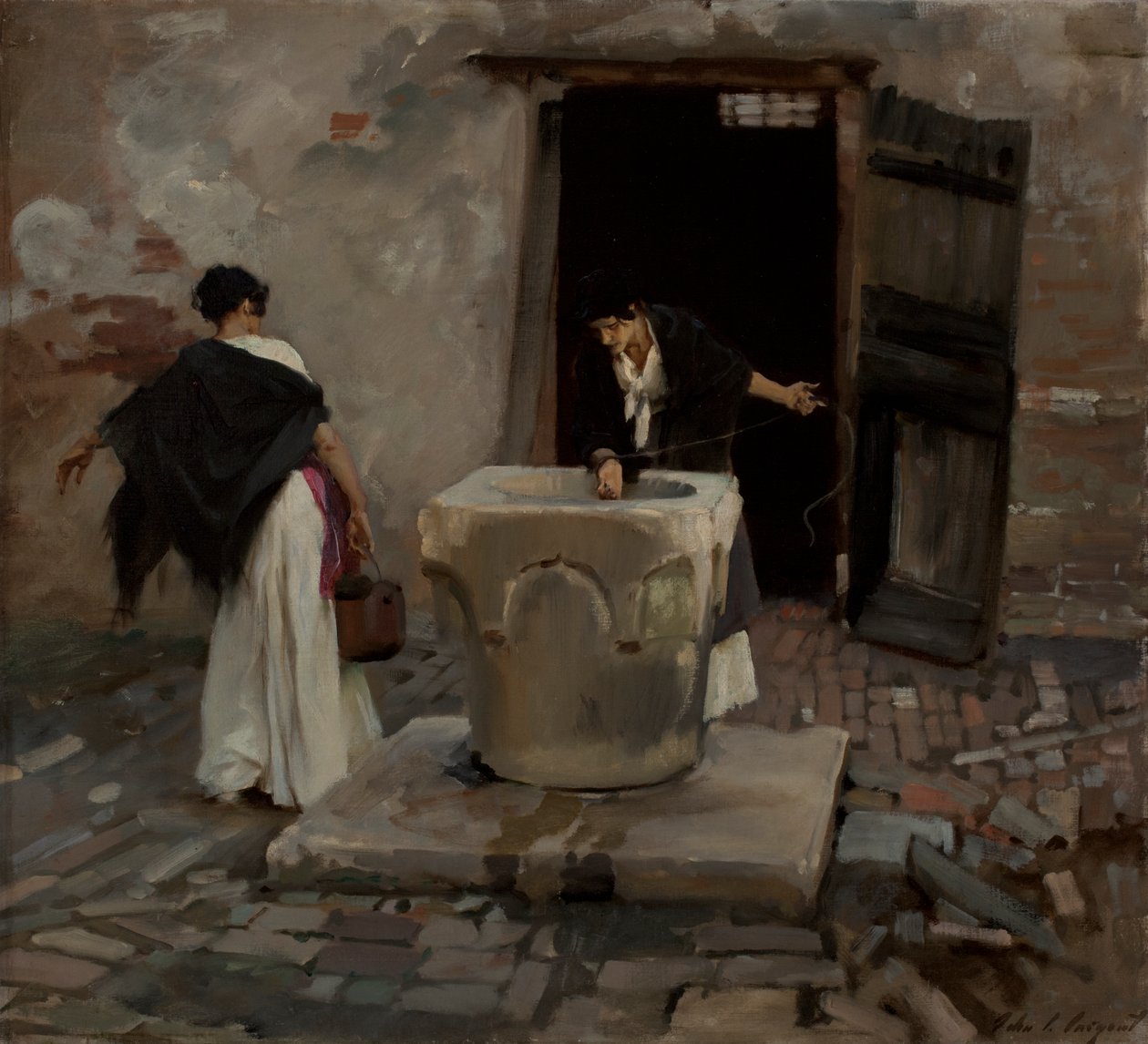
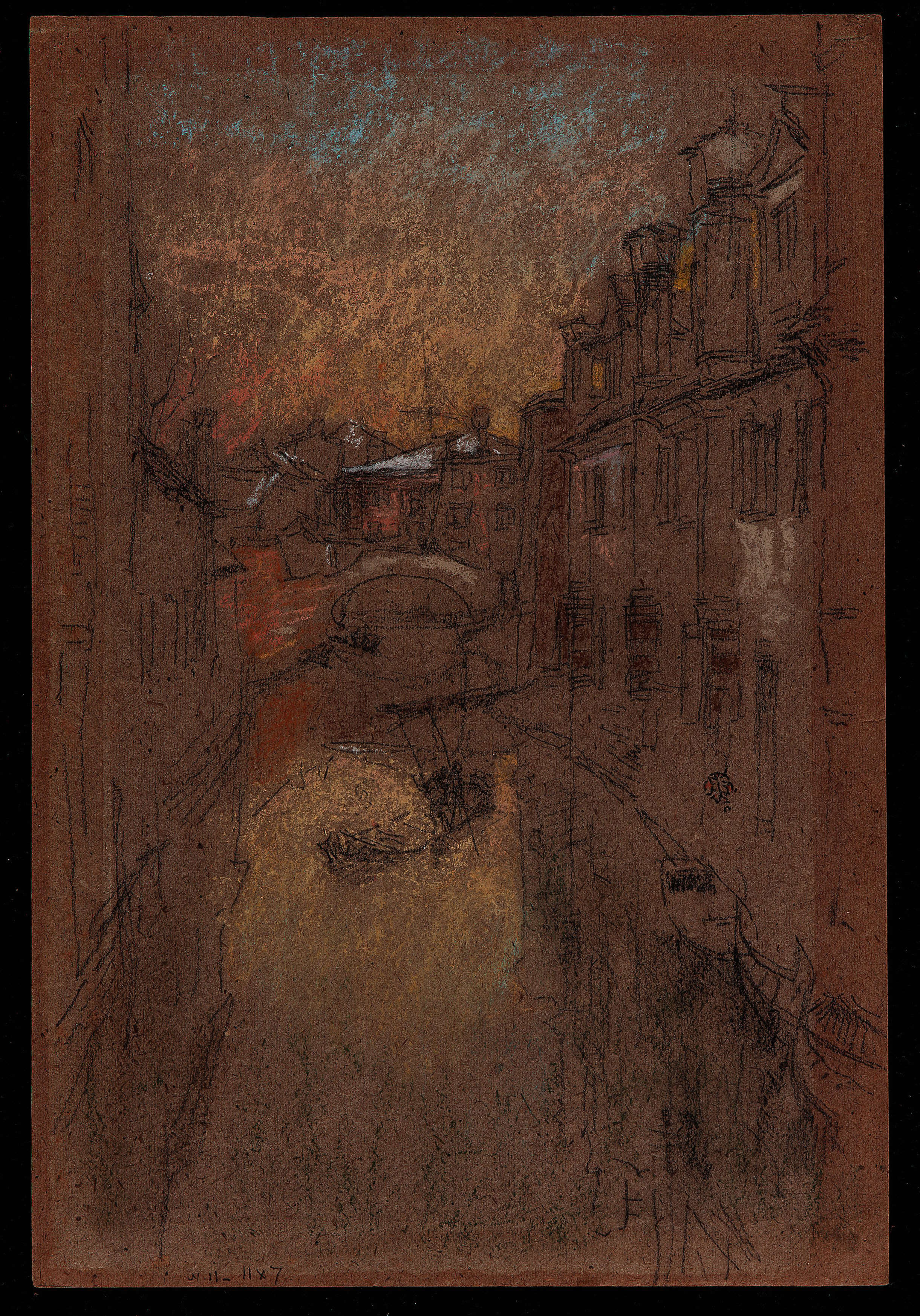
San Marco, San Giorgio degli Schiavoni, the Salute, the Gallerie dell'Accademia, the historic palaces... It is not only these monuments that interest Proust and the character in his book. There is another aspect of the relationship with the trip's affectionate and omnipresent companion, his mother. When she allows it, he is free to wander "alone in the enchanted city," and, attracted by the nocturnal charm of "that maze of little streets [...] of which no guidebook, no traveler" had informed him, he loses himself as if in the complicated meanderings of a land of the Thousand and One Nights. In the mysterious alleys there are brats, little girls, a few old women "with the face [...] of a witch," "little workers with large black fringed shawls" that may evoke certain genre scenes painted by Sargent. In the "labyrinth of this city of the Orient" one discovers unexplored little churches, arbors of secret gardens, and "sometimes a more beautiful monument appeared, figuring there like a surprise in a suddenly opened box, a little ivory temple." This is the côté of Venice opposed to the spring mornings of visits and studies: "I had the impression, further accentuated by my desire, that I was not in the open air, but was entering deeper and deeper into something secret." The city exerts a sensual allure, and on the day his mother had arranged for his departure the Narrator is informed that a young maid on whom he had fixed a promise of pleasure had gone down with her mistress to their hotel. He resolves to leave no more, and on the heartbreaking notes of O sole mio sung by a musician the torment of giving up following his mother is fulfilled. This scene, which we also know thanks to some variants penned in earlier drafts, has perhaps something of truth to it. It is not unlikely that in the course of those Venetian weeks Proust felt the desire to escape the confines imposed by living with maman and to delve into a less touristy Venice. Speaking of which, Proust notes that "out of an entirely natural reaction against the fake Venice of the bad painters, very great artists have been wrong to devote themselves solely, finding it more realistic, to the Venice of the humble fields, of the small abandoned rios." He criticizes this inversion of taste, aimed at the search for a sense of the picturesque no less fictitious than the "coldly aesthetic" representation of the city "in its most celebrated part." Perhaps among the great masters devoted to the illustration of minor Venice Proust also included the aforementioned Whistler, who in his pastels (which he saw at the 1905 Paris retrospective) and etchings had drawn abundantly from that repertoire of views, while he saves "the superb studies of Maxime Dethomas," two of which had in fact enriched the À Venise article he published in 1919 in the journal Les Feuillets d'Art.
His stay in Venice also included a trip to Padua, aimed at discovering the frescoes of Giotto and Mantegna, which would merit an essay in its own right. Beyond that, not much remained of this trip to Italy: Proust would have liked to push further south and touch Florence, another city magnified by Ruskin, but the terror of pollen in the heart of spring dissuaded the asthmatic explorer. As a result, if the theme of Venice finds ample space in the Recherche, that of Florence is far less important: no less profound than the waters from which it emerges, the currents that flow through it, and no less obscure than these, La Serenissima binds itself to transformation, and its immemorial splendor, surviving the cataclysm of centuries, is really for Proust one of the forms in which Time is embodied.