By Redazione | 23/05/2026 16:04
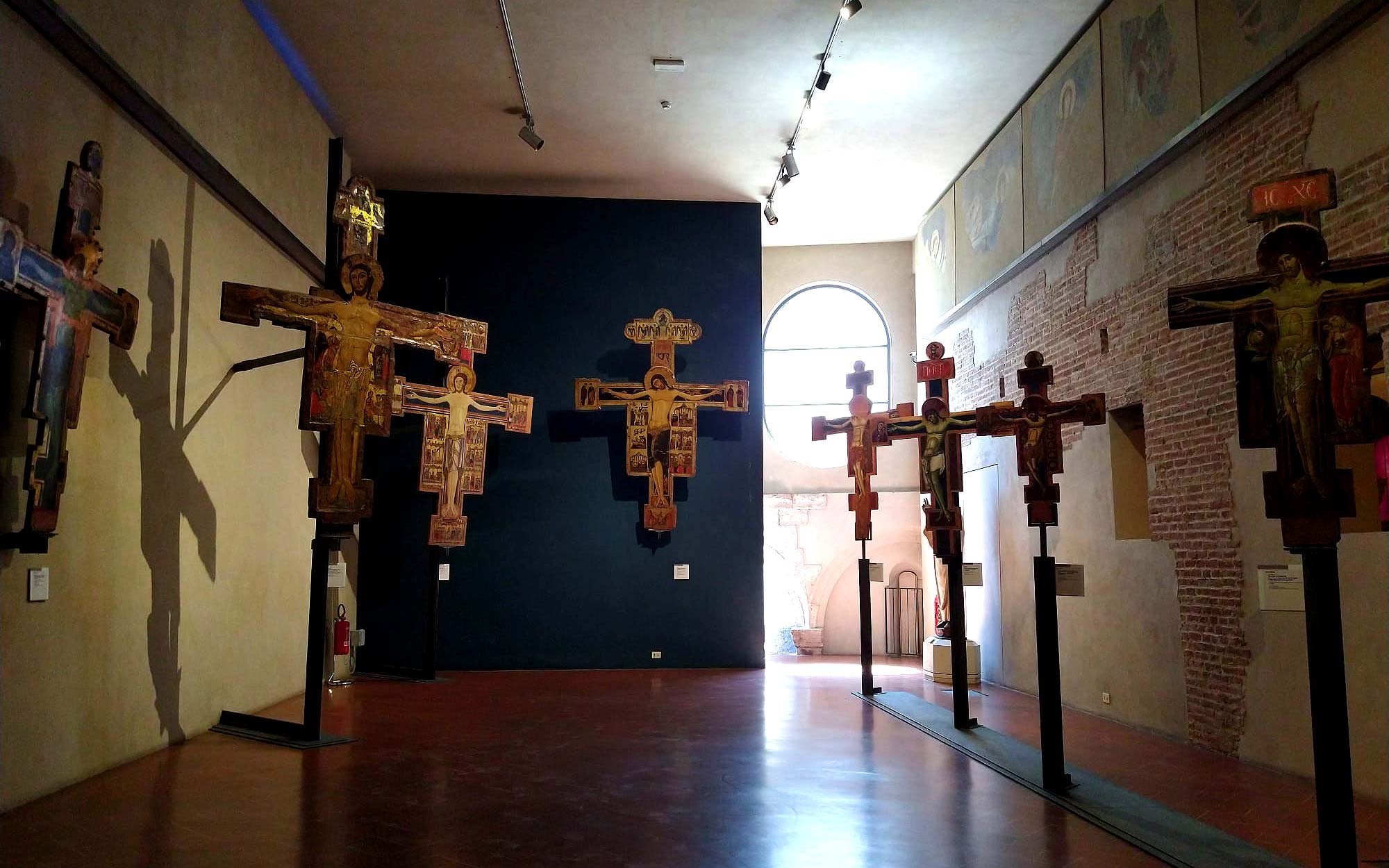
A cross painted to seal the encounter between East and West. A meeting we witness by looking at a large panel (297 centimeters high by 234 centimeters wide) now preserved in the Museo Nazionale di San Matteo in Pisa, hanging on a wall in the room where the world's largest collection of painted crosses is kept. It is the so-called Cross No. 20(or Crucifix No. 20), a work painted in tempera and gold on parchment applied to panel, from the ancient Pisan convent of San Matteo, and attributed to a Pisan-Byzantine master whose identity is still unknown. On this cross appears, for the first time in the West, in a shaped and painted cross, the image of a dying Christ on the cross: his head reclined on his shoulder, his eyes closed, rivulets of blood flowing from the wounds of his hands, feet and side. This is the iconography of Christus patiens, the suffering Christ.
To understand how this image came to Pisa it is necessary to remember what Pisa was in the Middle Ages: one of the most important maritime republics, a commercial and military power whose horizon extended far beyond the banks of the Arno. Its merchants frequented the ports of the Levant, its sailors knew the routes of the eastern Mediterranean, its diplomats had relations with Byzantium and the Crusader kingdoms of the Holy Land. The sea was the lifeblood of the city, and with goods also traveled ideas, devotions, styles, sacred images. Cross No. 20 is, in this sense, also a document of the cultural trade that took place on the Pisan sea routes: a work that bears imprinted, in its technique, iconography and color palette, the unmistakable sign of another culture, which came all the way to the banks of the Arno via the sea.
The cross was kept in the Monastery of St. Matthew, the religious institution that would later cede its name to the museum of the same name. It is not documented with certainty whether the work was commissioned specifically for the monastery's church, but the hypothesis is considered plausible by scholars, since in the early thirteenth century that building was undergoing an expansion, only partially completed. A public commission, intended for a space of high liturgical visibility, would have justified both the iconographic ambition of the work and the choice to entrust it to a master of exceptional quality. The cross's path through history is then anything but linear: between 1810 and 1837, after the suppression of the convent, the work was transferred to the Dal Pozzo chapel of the Monumental Cemetery at the behest of its conservator, Carlo Lasinio, and here it would remain until the end of the nineteenth century, when it became part of the Civic Museum's collection and was catalogued with the number that still identifies it today: Cross No. 20.
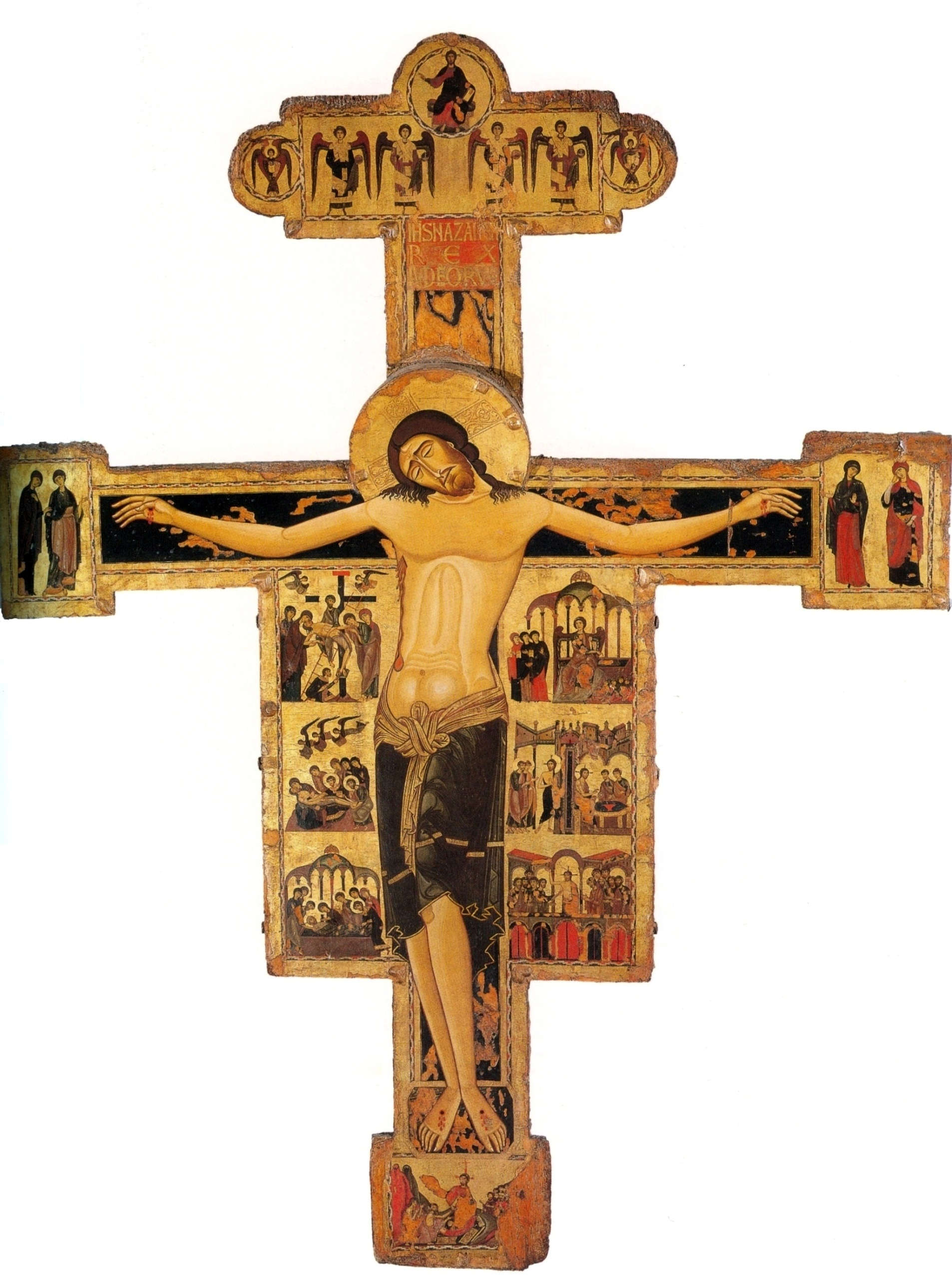
To describe this work means first of all to measure oneself against the central figure that dominates it. Christ is fixed to the cross with four nails. The body is covered only by the loincloth, the folds of which fall down the back creating like golden geometric patterns, stopped by a knot at the waist of great elegance. The head bends gently to the left, the hair and beard are rendered with delicate softness, while the anatomy of the chest and abdomen is still very rigid, just as the body still falls almost perpendicular, thus not presenting the unnatural but highly dramatic twist that would mark the crucifixes of Giunta Pisano and Cimabue. A trickle of blood flows from the side. Note that the eyes are closed, and this seemingly minimal detail actually represents a kind of revolution.
Throughout the 12th century, painted crosses had preferred the figure of Christus triumphans: Christ on the cross with his eyes open, his body erect, his gaze turned toward the faithful with an expression of imperturbable kingship. It was a theological image before an emotional one, designed to communicate triumph over death rather than the pain of death itself. The triumphant Christ does not die: he reigns from the cross, and his death is already a victory. With Cross no. 20 this conception gives way to something profoundly different: the Christ depicted there is a man who suffers, or who has just died, or who sleeps while awaiting the resurrection (so much so that there has even been talk of a separate iconography, the Christus dormiens, which was not, however, welcomed by all critics: Gigetta Dalli Regoli, for example, called it "a recently identified iconography [...] that does not seem credible to me"). The line between these three interpretations is thin, however, and critics have walked it at length.
What is certain is that the iconography of Christus patiens comes from the East. In Byzantine art this image was already present from the 10th century, and it had developed and articulated over the following centuries, reaching a particular refinement during the Comnenian dynasty in the second half of the 12th century. It is precisely to this period that scholars trace the iconographic choices of Cross No. 20, beginning with the composed depiction of grief. In any case, everything speaks of the sea, because this culture had come to Pisa through maritime trade, through the diplomatic and commercial contacts the republic had with the Eastern Roman Empire and the Levantine world.
Critical tradition has long identified the author of Cross No. 20 with a Byzantine artist who took refuge in Pisa after the Crusader conquest of Constantinople in 1204. That year was catastrophic for the empire's capital: the Fourth Crusade, diverted from its original objectives, fell upon the world's most important Christian city with a violence that left even parts of Catholic Europe itself dismayed. Many artists, craftsmen and intellectuals fled from the East to the West, taking their skills and visual repertoire with them. Pisa, with its close Mediterranean ties, was among the cities that welcomed these exiles. The inscription on the portal of the church of San Michele degli Scalzi is dated precisely 1204, and the lintel of the Pisan baptistery also bears traces of an oriental hand. The presence of Greek artists in the city was thus documented, and Cross No. 20 fits into this extraordinarily fertile context of cultural osmosis. "Moreover," scholar Lorenzo Carletti has written, "the particular technique of execution-the Cross is painted on parchment applied on board-refers to a culture other than local expressions. With this work we are really facing a particular moment of encounter between East and West."
There is, however, one element that distinguishes this cross from the simple importation of a foreign model: its narrative structure, Carletti further explains, responds to an indigenous tradition. The arrangement of the Passion scenes in the side panels (three on each side, to be read from top to bottom) echoes an organization typical of Pisan crosses of the time, such as those in the church of San Frediano, the Holy Sepulchre and Santa Cristina, all of which can be dated to the second half of the 12th century. The artist who made Cross No. 20, therefore, was well aware of the expectations of the local patrons and adapted to them, grafting his own oriental culture into a morphology already rooted in Pisan tradition. This suggests that the work was not made elsewhere and then transported by sea, but that the master worked directly in Pisa, adapting his own language to the specific demands of those who hired him.
To the left of the body of Christ, in the three panels flanking the central figure, the first part of the narrative unfolds: at the top the Deposition from the cross, then the Lamentation over the dead Christ wrapped in the Shroud by Our Lady and assisted by St. John, Joseph of Arimathea and Nicodemus, and finally the Burial (i.e., the Deposition in the tomb), with the addition compared to the Gospel tradition of the figures of Nicodemus and Joseph of Arimathea. A small, centrally planned temple serves as the backdrop to this scene of the Burial, and the same building reappears in the first panel on the right side, as a visual cue guiding the viewer's eye to the continuation of the narrative. It is a narrative device of great elegance, a way of orienting the reading of the image as one would do with punctuation in a written text.
On the right side the story resumes with the Visit of the pious women to the tomb, then the First Appearance to the disciples and the Supper at Emmaus, both painted on the same register, divided into two portions, and finally theIncredulity of St. Thomas. The narrative structure is thus perfectly balanced: on the left the death and burial, on the right the resurrection and its signs. In the center is the body of Christ holding together the two poles of the Christian story. At the terminals of the transverse arm are placed, on one side the Virgin and St. John the Evangelist, on the other two pious women, both depicted full-length in an attitude of grief. Below, on the piedychrome, is the Descent to the Underworld. Above, on the cymatium, Christ Pantocrator enthroned within a clypeus, surrounded by angels and seraphim.
The compositions are designed to be comprehensible, the gestures of the characters are eloquent, the deployments of the figures are ordered according to a clear logic. It is, in essence, art in the service of liturgy, devotion, preaching. And it is art that carries within itself, without contradiction, two civilizations: the Western one that determined its structure, the Eastern one that provided its visual language.
The titulus written on the cross deserves a separate mention. In the work, the arrangement of the inscription on three lines chooses to isolate the word REX on the second line, enlarging the three letters and the space between them, thus placing it at the center of the epigraphic message. The effect on the communicative power of the inscription is remarkable: the word that says Christ's kingship stands alone, separated from the name and legal title, as if to emphasize that beyond Pilate's condemnation, beyond suffering, there remains the lordship of that body nailed to the cross. It is a calligraphic detail that reveals how much Cross No. 20 was thought out in every aspect, from painting technique to textual composition.
Speaking of technique: Cross No. 20 is painted on parchment applied on panel. This is not a common choice. In Italy there are very rare examples of this technique, which is closer to the art of the miniaturist than to that of the painter on panel. And in fact one of the most fascinating interpretative strands concerns precisely this affinity with the miniature. Viktor Lazarev, in 1936, imagined the author of Cross No. 20 as a fine miniaturist of the Comnenian era, drawing attention to the subtlety of the drawing and the peculiarity of the technique on parchment. Evelyn Sandberg Vavalà, in 1929, had recognized a calligraphic taste of great refinement, while expressing some doubts about the author's strictly Byzantine training. Pietro Toesca, in 1927, on the other hand, had emphasized the rigid schematizations and a certain woodiness that was unusual for a Greek painter, as if the artist was indeed of oriental training but had already absorbed something of the local culture. Roberto Longhi, in 1948, had posed the question in terms that remain among the most incisive in the critical literature on this work, wondering whether one should see in it "a breath of new life" or rather
a "handcrafted diminution of the ancient model of the Orient." The tension implicit in this alternative is still productive: is Cross No. 20 an absolute masterpiece or a work of transition? Is it the summation of a tradition or the beginning of something new?
The most balanced answer is probably the one that holds both possibilities together. Enzo Carli, in 1974, paved the way for the assessment that has since become dominant in recent criticism: the work is a masterpiece capable of expressing, Carletti explained, "a broader and more thoughtful culture than the other Pisan crucifixes of the time, drawing on the stylistic and spiritual sources of the Byzantine tradition." It is neither just a product of the East nor just a work of the Pisan school: it is something irreducible to both categories, a moment of authentic encounter between two civilizations that do not cancel each other out but merge into something new.
Before Carli, the critical history of the work had already known fascinating seasons. Alessandro Da Morrona, in 1793, had attributed it to a master of Giunta Pisano, thus putting it before the great thirteenth-century crucifier. Sebastiano Ciampi, in 1810, had advanced it to the 12th century, an assessment later confirmed by Cavalcaselle in 1864. Particularly curious is the tradition reported by Luigi Grassi in 1837 and by Nistri in 1852, who wanted the work executed by the mythical Greek painter Apollonius, an almost legendary figure who, according to Vasari, worked in Tuscany in the thirteenth century. Giovanni Rosini, in 1839, had already opted for an anonymous Byzantine master with a date no later than 1210, and this remains the most established attribution in contemporary criticism.
Interestingly, the critical history of Cross No. 20 reflects, in a small way, the history of understanding the relationship between Italian and Byzantine art in the Middle Ages. For generations it was a matter of establishing boundaries, of figuring out where Eastern influence ended and local tradition began. Cross No. 20 resists this classification and suggests that perhaps the question is misplaced: it is not a question of which side of the border it lies on, but of recognizing that the border, at least in Pisa in the early thirteenth century, was as porous as the Mediterranean routes, crossed incessantly by ships, goods, men and images.
The success of the iconography of Christus patiens in the following decades was extraordinary. This image almost completely replaced the old tradition of the Christus triumphans, penetrating almost the entire Italian territory and progressively taking on an ever more pronounced dramatization, with a twisting of the body and an expression of suffering that in the works of Giunta Pisano and later Cimabue reached results of extraordinary emotional intensity.
It must be said that in Cross No. 20 this dramatization is still far off: the body is not arched, the suffering is expressed with measure, and the palette is muted and composed. The work still suggests a dimension that is more of meditation than of weeping, more of contemplation than of lament. In any case, what distinguishes Cross No. 20 from later works is not a lack, but a quality: that of standing on the threshold, of inhabiting the transitional space between two worlds, without belonging completely to either.
Those who look at it today, at the end of the hall of the National Museum of St. Matthew, sense something of this suspended balance. Christ of the Cross No. 20 does not cry out its death: it brings it, with a silent dignity that comes from afar, from a millennia-old tradition of sacred images that had traveled the Mediterranean on the same routes that Pisan merchants used for their cargoes. It is an image that arrived by sea, like so many precious things that Pisa has been able to welcome and make its own throughout its long maritime history. And like things that have arrived by sea, it bears within itself the mark of the voyage: something that does not belong completely to the place of departure or the landing, something that has taken on its own character, its own uniqueness, its own originality, precisely along the way.