By Redazione | 30/06/2026 19:31
The imposing monolith of Theodoric’s Mausoleum, as scholar Marisa Bianco Fiorin wrote in 1992, “has always aroused great curiosity among the general public and considerable interest among art and architecture specialists over the centuries,” especially because of its shape: “a single block of limestone shaped like a dome, of exceptional compactness and durability, with a diameter of about 11 meters, a height of 3 meters, and a total weight of about 400 metric tons.” Yet that dome, carved from a single block of stone to cover the architectural structure, is not the only intriguing feature of the monument—one of Ravenna’s most famous and visited sites, situated in the center of a fourteen-hectare park, not far from the historic center, beyond the railroad tracks. It is, one might say, a monument that defies the centuries with its pristine grandeur. The Mausoleum of Theodoric is, in fact, not merely a royal tomb—the monument intended to house the remains of Theodoric the Great ( Pannonia, 454 – Ravenna, 526), king of the Ostrogoths; it is also a visible synthesis of a tumultuous era, a meeting point between the solidity of Roman architectural tradition and influences that came partly from the East and partly from the Germanic world. This structure, designated by UNESCO as a World Heritage Site (as part of the “Early Christian Monuments of Ravenna” site), is the most significant example of funerary architecture left by the Ostrogoths in Italy.
The monument still appears to us as a kind of vision in the midst of a lush green meadow, and this is likely how Theodoric the Great imagined it as well, having begun its construction around the year 520, shortly before his death: The Ostrogothic king was not merely seeking a place for his eternal rest, but intended to leave an indelible mark of his political and cultural stature. Theodoric, often unfairly portrayed by hostile historians as a crude barbarian, was in reality a cultured ruler and a skilled mediator, capable of ensuring a long period of stability and peace between the Latin population and the new Gothic rulers. The mausoleum therefore reflects this ambition of his, standing out as a structure that completely breaks away from Ravenna’s typical architectural landscape—dominated at that time by brick—and asserts itself through the strength and whiteness of Aurisina stone, a pale gray limestone named after its place of extraction—the quarries near Duino-Aurisina, close to Trieste.
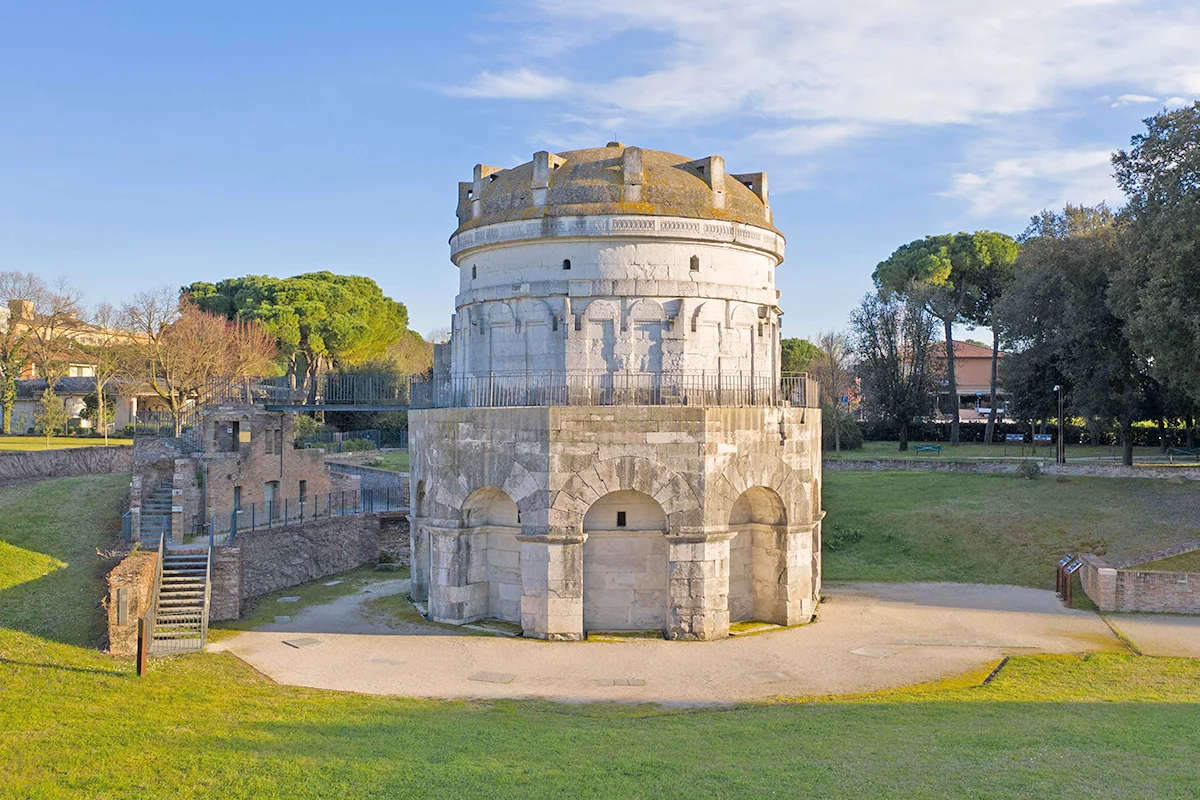
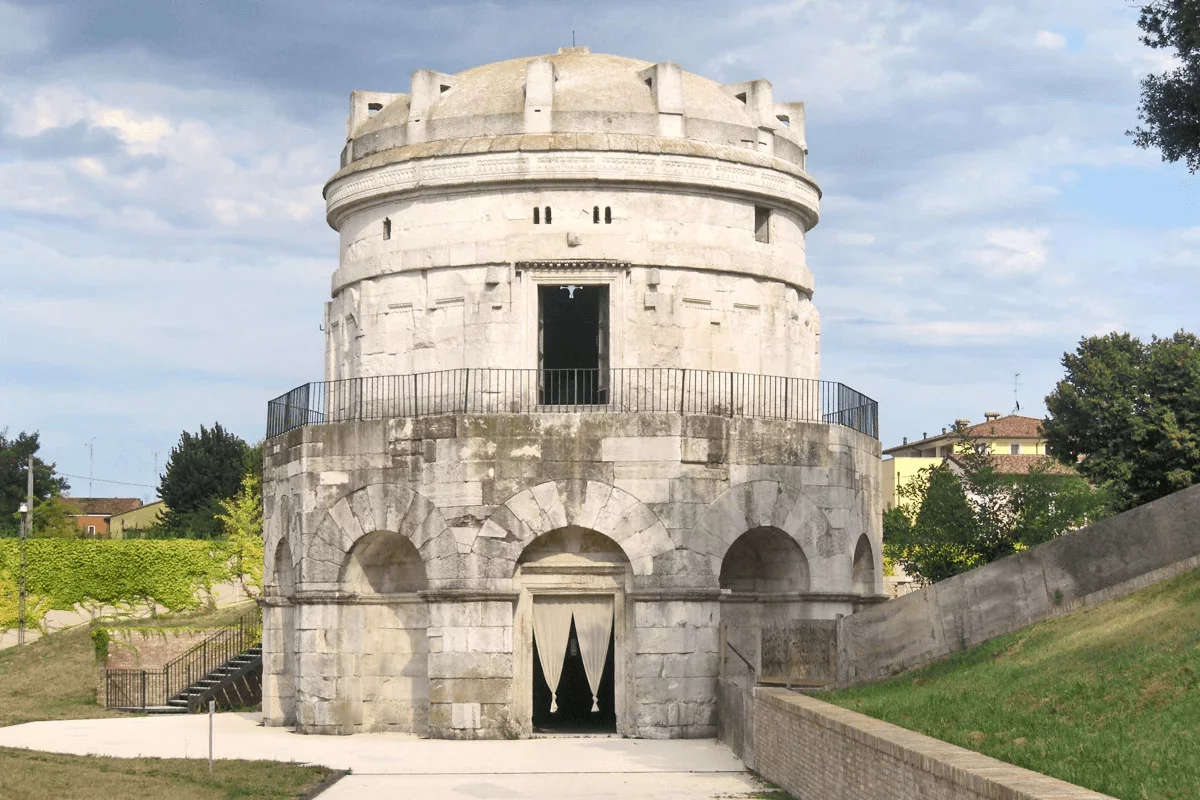
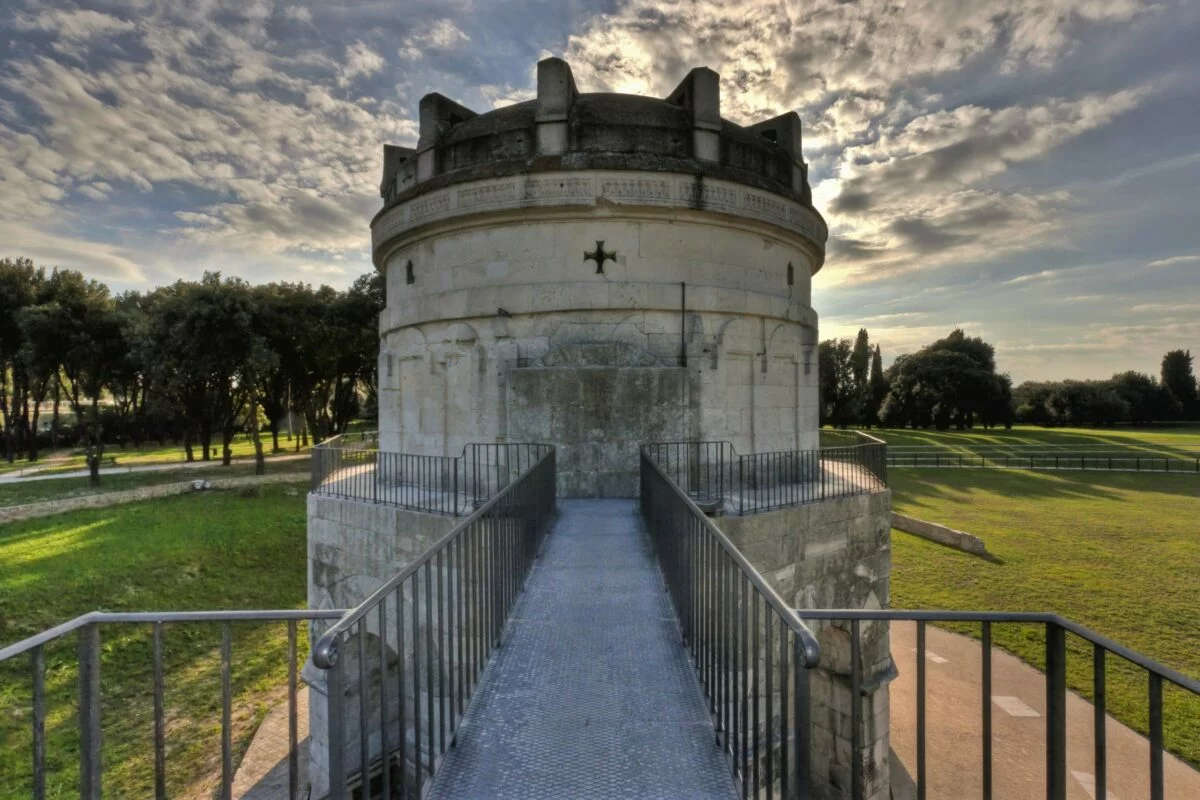
Today, the complex is managed by the Emilia-Romagna Regional Museums Directorate and continues to attract scholars and visitors from around the world, fascinated not only by its appearance but also by the numerous technical questions that its construction still raises—some of which remain unresolved to this day. The setting in which the mausoleum stands emphasizes its monumental character and helps make it a symbol of this city in Romagna: observing it today means reconstructing a past in which human ingenuity was able to transform blocks of rock into an eternal image of royalty and symbolic protection.
The origins of Theodoric’s Mausoleum date back to a pivotal moment in Italian history. Although the decision to build it is attributed directly to the sovereign (as mentioned, around 520), it has also been hypothesized that the work may have been completed under the regency of his daughter Amalasunta, following her father’s death in 526. The building was erected in an area called “Campo Coriandro,” a site outside the city walls historically dedicated to burials—and in particular to the Gothic community of the Arian faith—which was then located near the coastline. The monument’s fate changed radically with the end of Ostrogothic rule: when Ravenna was reconquered by the Byzantines in 540, the religious and political climate changed drastically, and following Justinian’s edict of 561, the structure was taken away from Arian worship, consecrated to the Orthodox rite, and transformed into a chapel dedicated to Saint Mary. It was precisely during this transitional phase that Theodoric’s remains met an uncertain fate: they were removed from the tomb and scattered, and the king’s physical presence was erased from the very structure that had been created for him.
Over the following centuries, the mausoleum took on various names and functions. In the 9th century, the protohistorian Andrea Agnello, in his *Liber Pontificalis Ecclesie Ravennatis*, quotes a passage attributed to the Anonymous Valesian—who wrote in the 6th century—referring to “a monument of hewn stones, a work of marvelous grandeur and weight,” with an “enormous boulder covering it”; Andrea Agnello also documents that, three centuries later, the building was by then known as “Santa Maria ad Farum,” due to its proximity to a port equipped with a lighthouse. Despite losing its original function, the monument’s massive structure remained a constant point of reference in travel literature and Ravenna’s historical chronicles, while also becoming the subject of folk legends that sought to explain its unique architecture. Having passed into the possession of the Church of Ravenna after 560, the mausoleum survived looting and alterations and has endured into the modern era as a silent witness to a vanished kingdom. Its history thus reflects the complex vicissitudes of Ravenna, which evolved from the capital of kingdoms to an imperial province, yet has remained capable of preserving the charm of a place created for the immortality of a ruler who had dreamed of uniting two worlds.
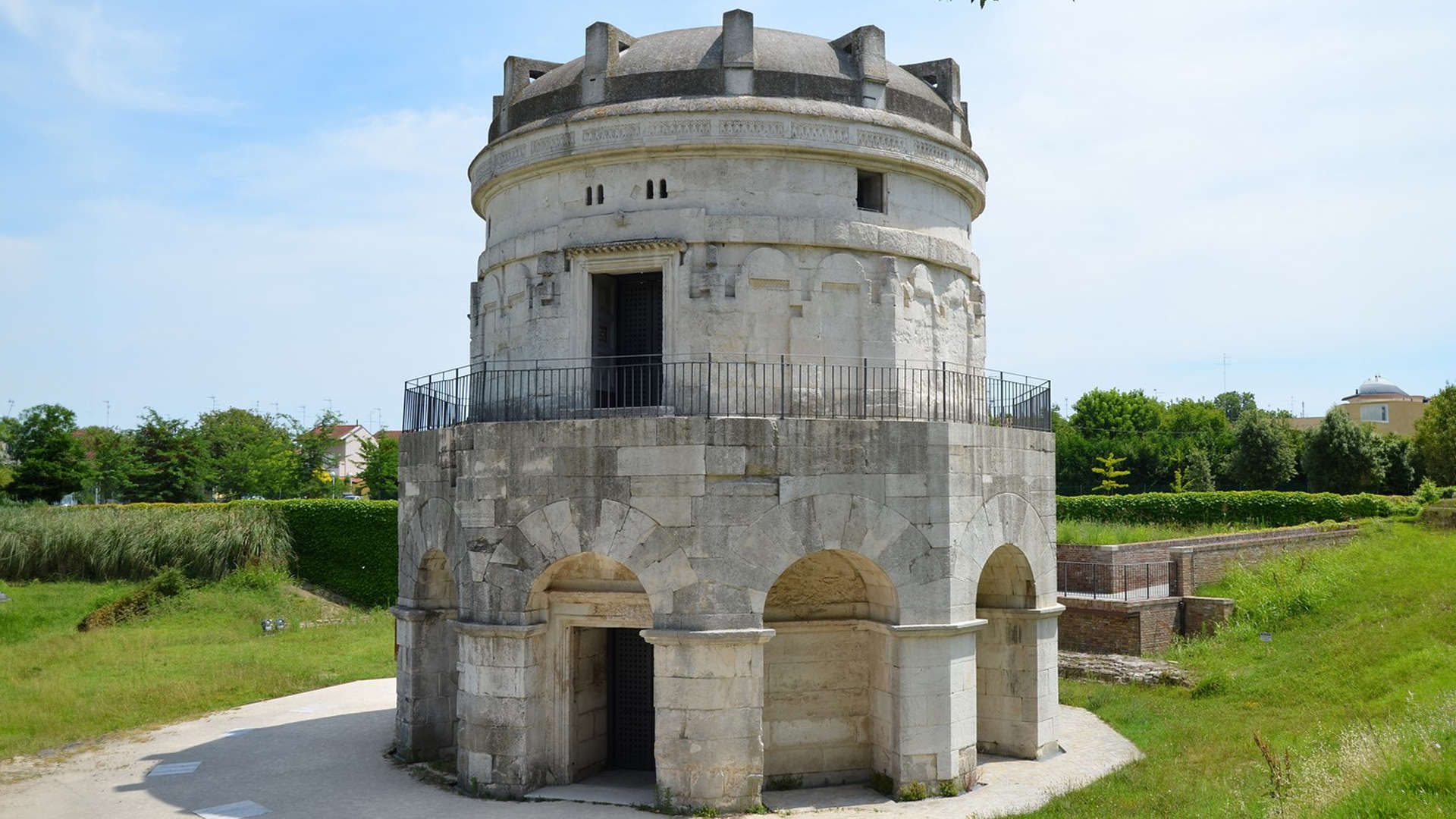
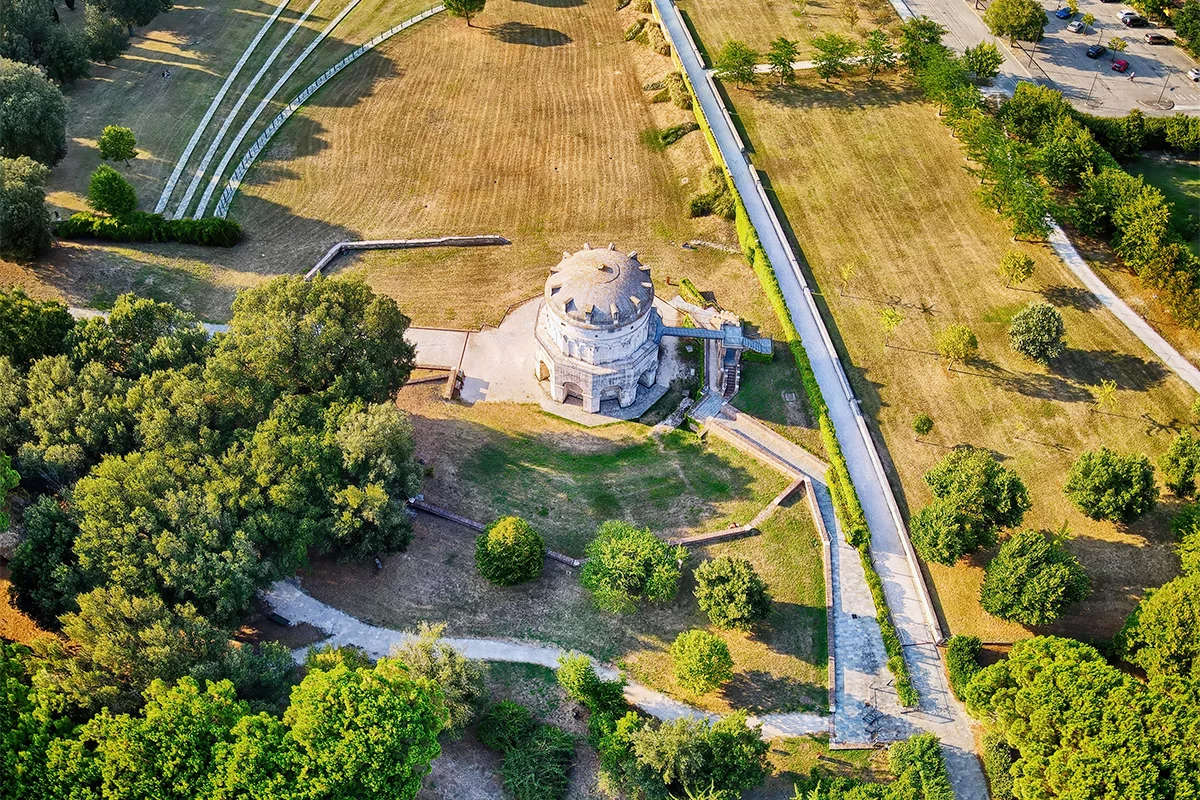
From an architectural standpoint, Theodoric’s Mausoleum stands out forits complete absence of bricks, as it is built entirely of large blocks of Aurisina stone set using dry-stone masonry. The structure’s stability is ensured by millimeter-precise alignment of the stone courses, held together internally only by sturdy swallowtail-shaped iron clamps. The building is laid out on a decagonal plan and extends over two superimposed levels, echoing the style of the great Roman mausoleums and illustrious structures such as Diocletian’s Palace in Split.
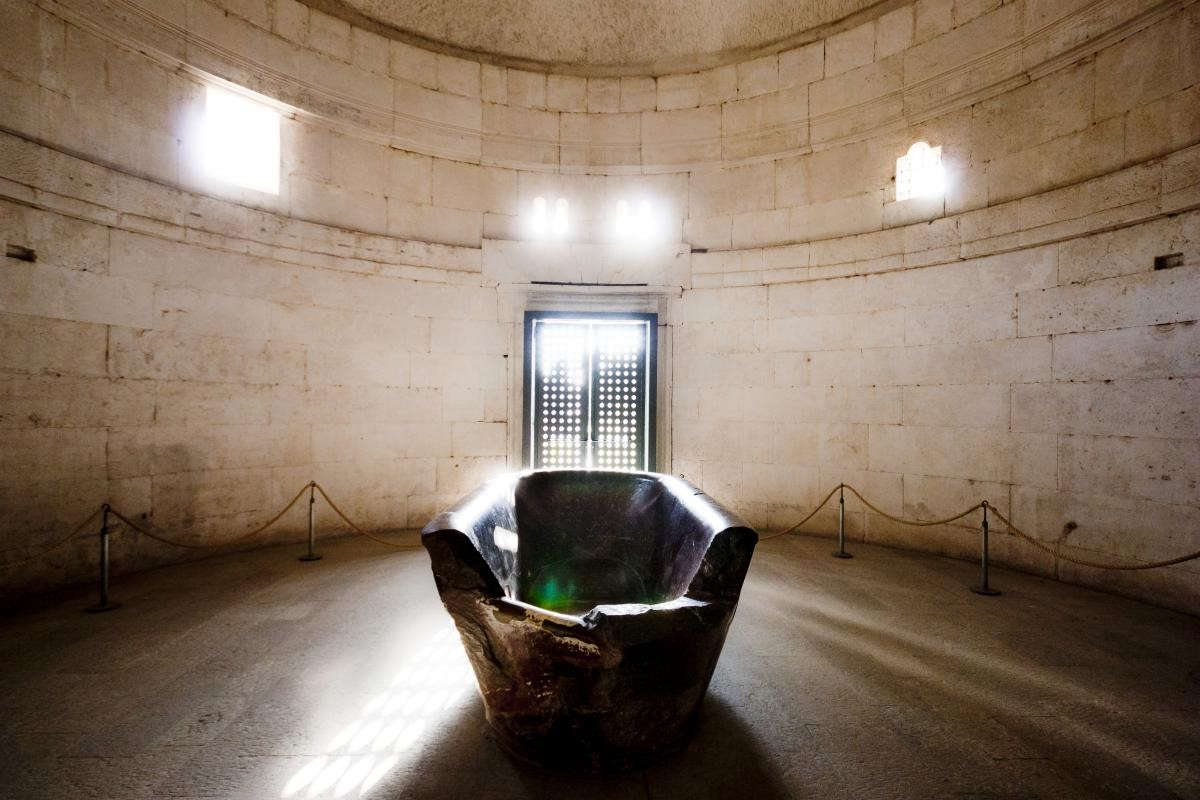
Externally, the lower level features arched niches on nine of its ten sides, while the tenth houses the entrance portal. Inside, the space is organized according to a Greek cross plan with a cross-vaulted ceiling, where Christian decorations such as the shell motif can be seen. It is believed that this lower level may have been intended for liturgical ceremonies or the burial of members of the royal family. The second level, which is smaller and set back from the base, creates an external walkway approximately one meter and thirty centimeters wide along the perimeter. This upper chamber, circular in plan, was the designated site for the king’s sarcophagus, and it appears that it originally had no access stairs—a fact that underscores its purely commemorative and funerary function.
The most extraordinary feature is undoubtedly, as mentioned at the outset, the monolithic dome that crowns the building. It consists of a single, immense block of stone shaped into a low-domed cap. Its estimated weight of several dozen metric tons leads us to conclude that its installation was a true marvel of ancient engineering, though today it remains a mystery. We can, however, note that there are twelve loops, or eyelets, on the summit, engraved with the names of eight apostles and four evangelists: these elements were likely essential for lifting and positioning the monolith. Among the hypotheses regarding the method of installation, some scholars suggest the use of an earthen ramp or even the construction of a temporary dam to transport the block by water to the summit. The dome is also bisected by a large crack, which has fueled folk legends claiming that divine lightning struck Theodoric as punishment, although it is more likely that the crack formed during the difficult installation process. Just below the dome, a “pincer-shaped” frieze stands out—a decorative motif typical of Gothic goldsmithing that further attests to the encounter between different cultures.
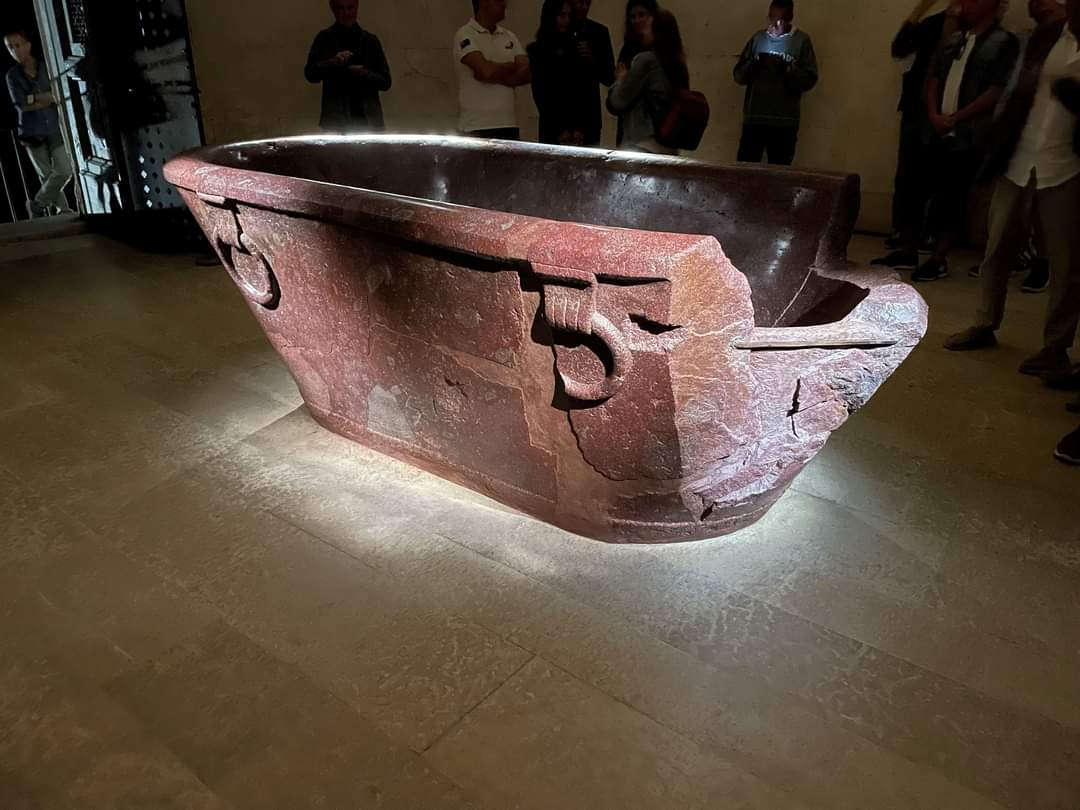
At the center of the upper chamber is also housed one of the most interesting elements of the entire mausoleum: the magnificent red porphyry basin, an artifact that, like the dome, has fueled debate and curiosity for centuries. This object was not originally intended for funerary purposes: it in fact belongs to a refined series of basins designed for baths and thermal facilities, dating from the 1st to the 4th century A.D., and it was only in late antiquity that it was repurposed as a sarcophagus to house, according to tradition, the remains of Theodoric, and was likely completed with a lid that is now lost. The choice of porphyry—a precious stone associated with imperial dignity—underscored the importance of the deceased sovereign.
The history of this sarcophagus has been a turbulent one: although the Anonimo Valesiano and Andrea Agnello attest to its presence on the ground, near the monument, between the 6th and 9th centuries, a bizarre 16th-century legend claimed that the basin was originally located atop the dome. According to this account, the object fell during the war between the Republic of Venice and the Duchy of Milan, and specifically during the 1438 siege of Ravenna by Milanese troops led by Niccolò Piccinino, who is said to have struck the mausoleum with a grenade in an attempt to wrest Ravenna from the Venetians. In reality, there is no contemporary documentary evidence of this location, which is now considered a literary device employed by the city’s earliest chroniclers.
Today, the basin bears clear signs of a thousand-year history: deep fractures—some of which have caused the loss of entire sections of its side—and sections that have been cut away due to the numerous relocations it has undergone, including its transfer to the Church of San Sebastiano in 1564. These are all scars that do not diminish its charm but bear witness to the cultural value attributed to the work over time. Recently, the basin underwent restoration work aimed at stabilizing its structure, removing sediment that dulls its luster, and preserving this extraordinary artifact for the future.
The Mausoleum of Theodoric thus remains one of the most powerful testaments to an era when Ravenna was the hub of a changing world. Its architecture, so different from the norms of the time, continues to speak to the personality of a king who, despite belonging to a lineage deemed “barbarian,” proved himself a guardian of classical culture and a champion of coexistence among peoples. The silent mass of the monument, which symbolically evokes the celestial vault through its monolithic dome, serves as a shield not only for a now-empty tomb but for the very idea of a Europe capable of integrating diverse identities.
Tracing the history of this building therefore means embracing the allure of the enigma: from the construction techniques that still defy our understanding today, to the legends of divine lightning strikes, to the wandering history of the porphyry basin, there is much we do not know about Theodoric’s mausoleum—and that we will likely never know with certainty. The fact that the mausoleum has survived to this day—despite the dispersal of its occupant’s remains and the religious transformations it has undergone—is proof of the intrinsic strength of its stone and the universal value that every era has recognized in it.
Today, nestled within its park, the mausoleum is not only a UNESCO site worth visiting but a place for reflection on the fragility of kingdoms, the passage of time, and the endurance of art. Theodoric sought eternity through the solidity of Aurisina stone and, paradoxically, achieved it not through the preservation of his physical remains, but through architecture.