By Federico Giannini, Ilaria Baratta | 17/07/2026 16:46
During the final decade of his long career in Florence, Jacopo Ligozzi—who was one of the most original painters active between the late sixteenth and early seventeenth centuries—devoted himself to an undertaking that at first glance seems far removed from his best-known craft (that of a great portraitist, as well as the designer of stage sets for the Medici court’s festivities and an illustrator of plants and animals for the Medici studiolo), but which in reality represents a natural extension of it: the design of glassware for the grand ducal glassworks. This is a little-explored chapter of his biography, yet it effectively captures both the man and the historical moment in which he operated—that of a Florence which, between the 16th and 17th centuries, was establishing itself as a laboratory for artistic and scientific experimentation in the service of the court. Not only that: these intricately crafted glasses that Ligozzi designed for the Medici court give us a clear sense of the importance that conviviality held at that time: just as today, after all, a good part of social life took place around the table , and glasses like Ligozzi’s also served “political” purposes, so to speak. To amaze the guests, to demonstrate the skill of the court artists and the modernity of Florentine workshops, and to showcase the court’s spending power (these objects were often made, in fact, from precious metals and crystals).
A native of Verona, where he was born in 1543, Ligozzi had arrived in Florence by at least 1575—earlier than had long been believed (scholar Alessandro Cecchi discovered the documents proving he was already on the Medici court’s payroll that year)—and had settled there, working as a court painter in the service of Grand Duke Francesco I. His specialty, that of an “engraver,” had secured him a privileged position in the workshops of the Casino di San Marco, where the skills of artists, artisans, and naturalists converged around the Grand Duke’s interest in the applied and experimental arts. In that environment, Ligozzi developed an analytical eye for nature that would accompany him throughout his life and is evident in much of his work, from his early naturalistic illustrations to his later commissions forthe Opificio delle Pietre Dure, that is, the workshop established in 1588 by Ferdinando I de’ Medici, where Florentine commesso works were produced.
It was precisely this capacity for observation, combined with a versatility that allowed him to alternate between sacred painting, set design for court festivities, and the design of semi-precious stone inlays, that made Ligozzi the ideal candidate for a new commission that arrived in 1617: the creation, commissioned by Cosimo II, of several designs for glasses for the Medici glassworks, at a time when the renowned—and still thriving— Tuscan glassmaking industry was seeking its own identity, distinct from the Murano model that had shaped its origins. The tradition of glassmaking in the city of Florence dated back to 1569, when the Murano glassmaker Bortolo d’Alvise had opened a glassworks at the behest of Cosimo I, launching a crystal production that had become well-established in the following decades under Francesco I and Ferdinando I. Until then, Venetian influence had remained predominant, especially in the creation of non-figurative vessels, while glasses shaped like plants, animals, and various objects—though also common in Murano—had their roots in a goldsmithing tradition from beyond the Alps. With Ligozzi at the grand ducal glassworks, this balance began to shift.
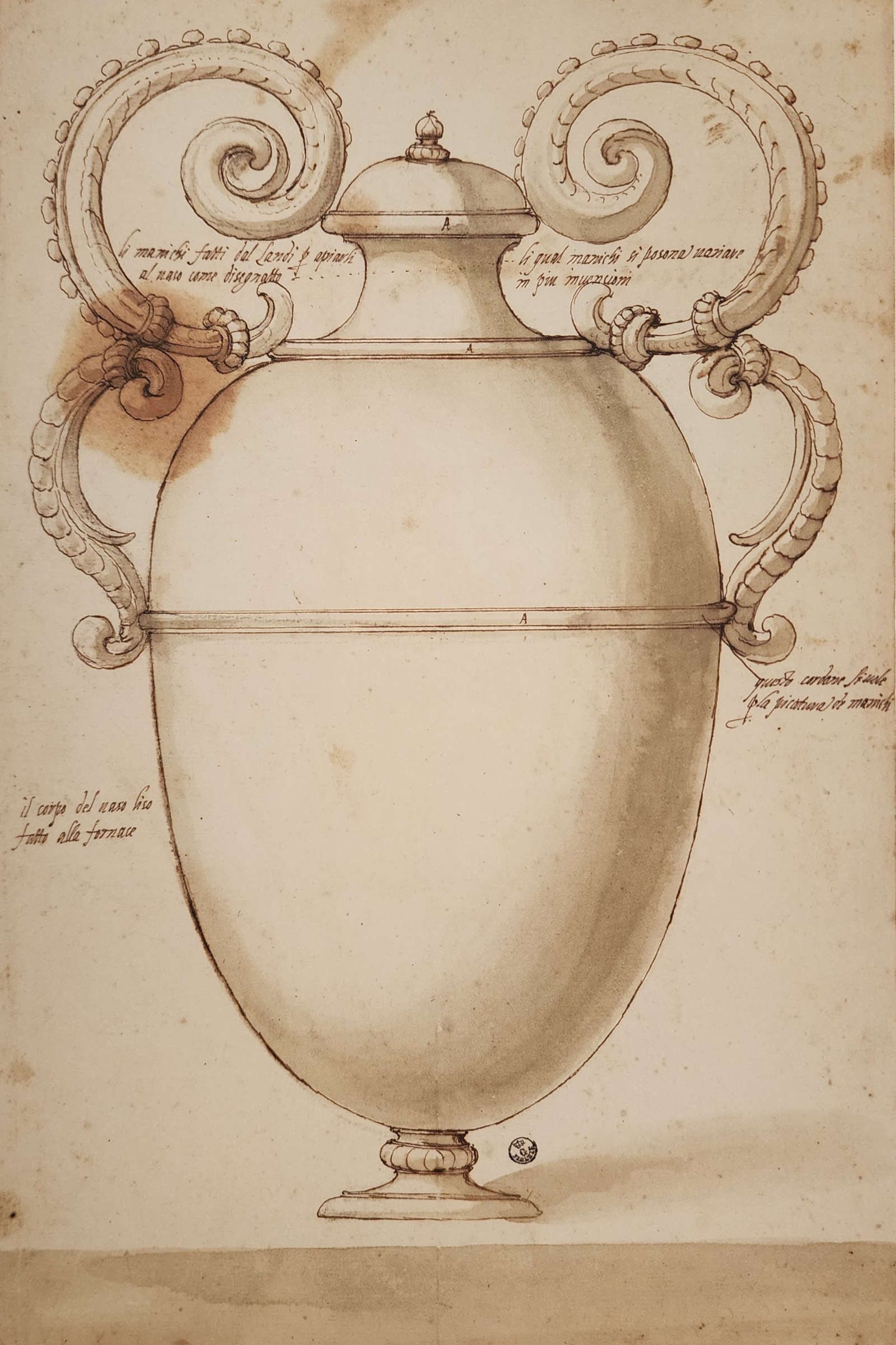
As scholar Corinna Gallori has reconstructed, the context in which this commission took shape was that of the glassworks set up in Boboli between 1617 and 1618 by Grand Duke Cosimo II, who entrusted its technical direction to Niccolò di Vincenzo Landi, an expert enameler and master glassmaker. Specialized artisans had been summoned from Murano to work in that furnace; as late as 1619, they were still producing what contemporary sources refer to as “bicchieri di capriccio o altro,” that is, glasses with fanciful and bizarre shapes—objects meant more to be admired for their showiness than to be used for practical purposes. Cosimo II’s personal interest in the enterprise was anything but formal: the Grand Duke loved to engage directly with the master glassmakers, asking them to amaze him with extravagant creations, in an atmosphere of curiosity and playfulness that, indeed, permeated the entire court culture of the period. In this atmosphere, Ligozzi worked on a substantial body of drawings now preserved in the Uffizi’s Department of Drawings and Prints, compiled in an album whose very title, “twenty-nine drawings of various kinds of glasses,” establishes the chronological framework of the project: the work dates from 1617—when one of the best-known sheets had already been completed—to July 1618. These drawings were exhibited and thoroughly studied in 2014 as part of the major exhibition *Jacopo Ligozzi. “A Highly Versatile Painter, ” held at Palazzo Pitti and curated by Alessandro Cecchi, Lucilla Conigliello, and Marza Faietti. As Gallori explained in the exhibition catalog, two archival documents allow us to closely trace the project’s progression: on October 8, 1618, Ligozzi submitted an invoice for seventy-six drawings of glasses or jugs, executed in pen and then shaded with watercolor or colored, receiving a payment of 110 Florentine lire of the time a few days later—a rather considerable sum (to put this in perspective, consider that a bricklayer, during the same period, earned around 50 lire a month) for a set of 33 sheets containing 76 drawings. The same documents make it clear that the drawings had been commissioned by the Grand Duke and delivered specifically to Niccolò Landi, confirming that they were intended to be transformed into glass at the Boboli glassworks and not merely to remain as graphic exercises.
Some documentary evidence also suggests that Ligozzi did not limit himself to providing commissioned designs, but actively participated in the conceptualization phase of the objects, in a collaborative relationship with the Grand Duke that a letter from the time explicitly describes as a work of “invention” by Cosimo II himself. This detail paints a picture of a collaborative effort between the sovereign—who was passionate about technical curiosities—and the artist, who was capable of translating them into forms that glassmakers could produce.
Ligozzi’s drawings display remarkable technical skill and an attention to detail comparable to that of his most refined naturalistic miniatures. “The compositions created by the Veronese artist,” explains Gallori, “break away from the forms of Venetian-style glass, favoring traditional and linear designs, combined in such a way as to achieve a result that is both refined and spectacular. It has also been noted that Ligozzi’s designs reveal a certain knowledge of various glassmaking techniques and show that they were developed in close collaboration with master glassmakers.” The sheets often contain instructions for use and precise technical notes: for example, one drawing specifies that the glass stems must be made by Landi, while another provides instructions on how to replace a jar in case of breakage.
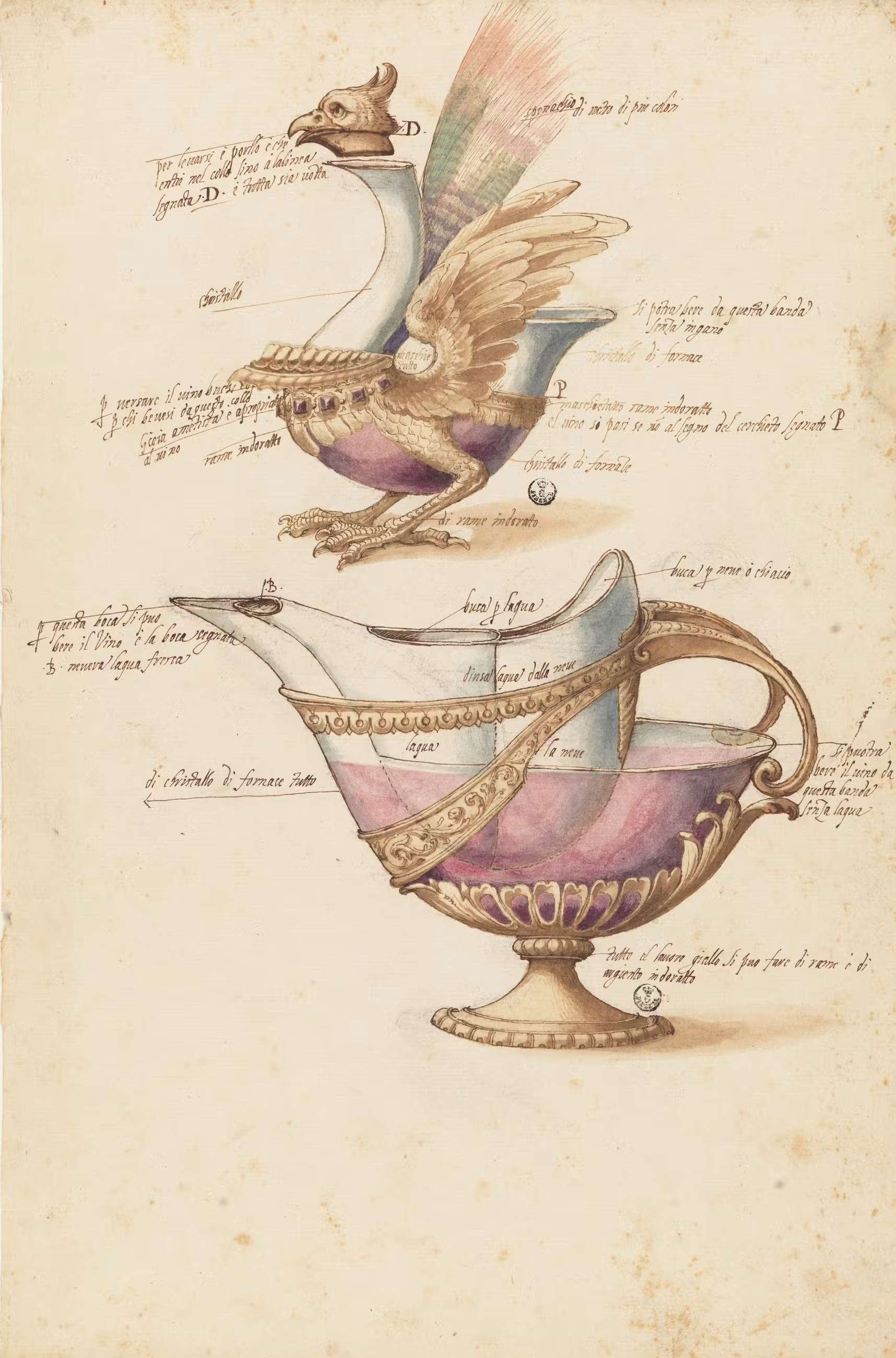
There are several characteristic examples from Ligozzi’s repertoire, and some are occasionally displayed in exhibitions on the art of the period. Among the strangest is a whimsical bird-shaped glass with a plume made of multicolored drawn glass; one drank from it by removing the animal’s copper head, which was nothing more than the vessel’s stopper; its main opening, however, was located on the back, a design specifically intended to create the comical effect of surprising whoever was about to drink from it. On the same sheet, a second design appears, conceived to address a different problem: that of mixing different beverages while cooling them at the same time, to cater to the trend of iced drinks that was spreading between the late sixteenth and early seventeenth centuries. In this case, the glass consists of three separate containers, each blown individually and then assembled while hot without the use of molds. The three compartments, as Ligozzi himself explains in his notes on the sheet (“hole for water,” “hole for snow or ice,” “one can drink the wine from this side without the water,” and so on”), were to be filled with wine, water, and snow or ice. The ingenious glass also had two openings: from one, it was possible to drink wine mixed with water; from the other, undiluted wine. The glass, as stated on the sheet, was to be “made entirely of furnace-blown crystal,” while the base, described as “entirely yellow in finish,” according to Ligozzi, “can be made of copper or gilded silver.” In some ways, it almost seems like a precursor to modern filter pitchers: the glass, in fact, has a compartment for wine, one for ice (or snow, as was customary at the time), and one for water; the mixture of water and wine was obtained by drinking from a sort of spout at the end of an opening through which both liquids flowed.
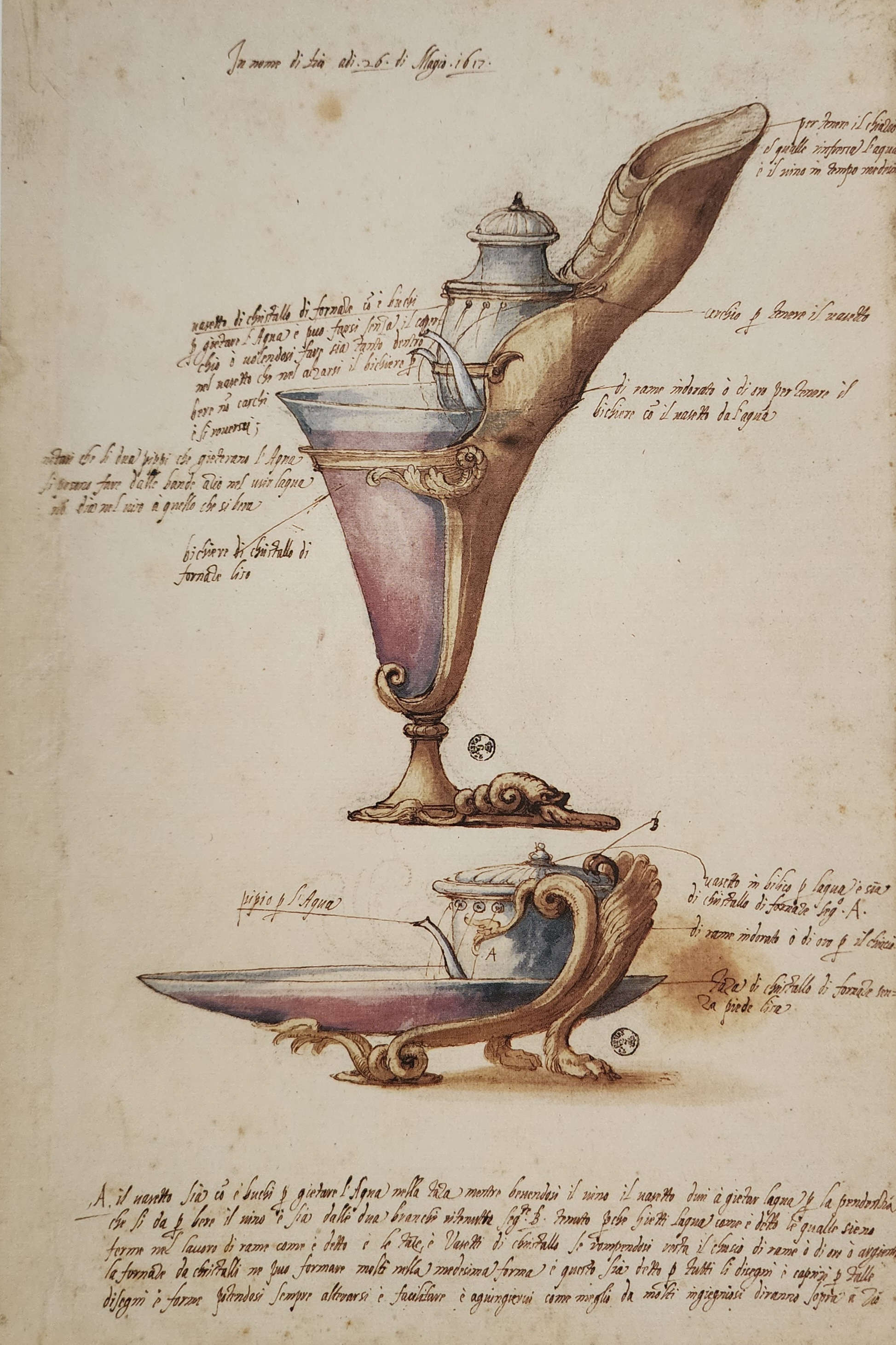
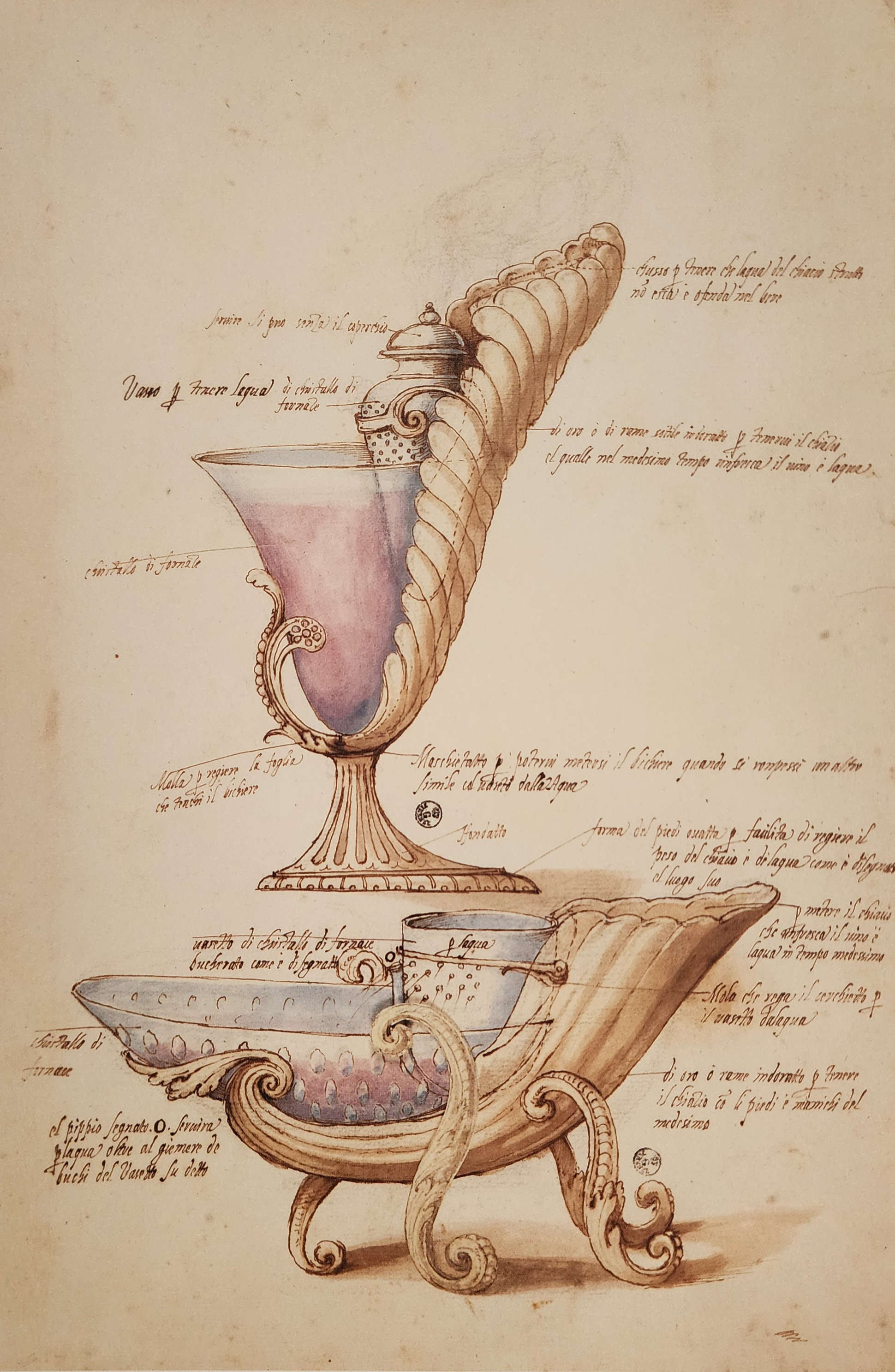
Other sheets show solutions that are no less inventive (for example, a vessel that has two octopus tentacles instead of handles) and no less ingenious: in a pair of glasses, for example, Ligozzi inserts small, perforated containers for ice or water, from which small jets of liquid were meant to flow out, thereby mixing the wine with water as one drank. Furthermore, one sketch depicts a sort of tabletop fountain: in the illustration—complete with a water-inlet vessel—a multi-tiered cup is shown, topped by a small, perforated crystal jar from which water would cascade into the glass below. A spectacular little waterfall designed to mix drinks, consisting of a series of flat, tiered cups connected by thin crystal rods crafted by Landi himself.
The value of these drawings extends beyond their graphic quality. With the introduction of these composite glasses, curious tabletop fountains, and these contraptions designed to amaze diners, Ligozzi pioneered a genre entirely unknown to the Murano tradition, ushering in a phase of Florentine glass production that scholars date to between 1617 and 1618, distinct both from the preceding period—which was still tied to the Venetian model—and from the subsequent one, during which, between approximately 1618 and 1670, the Medici glassworks would embark on a fully independent path. During that third phase, other leading artists would contribute—from Jacques Callot to Stefano Della Bella to Baccio del Bianco—called upon to design increasingly complex figurative glasses, often featuring moving parts that made them resemble small automata.
It remains, however, very difficult to determine how many of these designs were actually realized in glass, given the scarcity of Medici pieces that have survived to the present day; it cannot be ruled out, however, that at least the most challenging and ingenious pieces remained on paper. It should also be noted that these objects were not confined to the halls of the Palazzo Pitti. The glasses produced in the Florentine glassworks, along with the drawings that served as their templates, circulated as instruments of diplomatic representation, in accordance with a practice already well-established in the years prior to Ligozzi’s commission. Allied courts regularly received gifts of crystal and glassware crafted in Florence, reciprocating with artifacts of a different style. The same was true of diplomats, who received gifts of Florentine glassware that they in turn distributed among friends and acquaintances, in a network of exchanges that attests to how much the possession of these objects was perceived, in early seventeenth-century Europe, as a distinctive sign of prestige and good taste.
Within this context, Ligozzi’s drawings are part of a broader artistic genre—the so-called “bicchierografie,” graphic collections of designs for drinking vessels that flourished between the sixteenth and seventeenth centuries in various court circles, from Medici Florence to Del Monte’s Rome. Giovanni Maggi’s own *Bichierografia*, created for Francesco Maria Del Monte, attests to how close the dialogue was between the Florentine workshops and the collecting circles of the papal capital, to the point that some of the Roman artist’s designs almost literally replicate designs already in circulation in Florence. As scholar Maria Grazia Tagliavini has written, bicchierografie “constituted a true artistic genre between the 16th and 17th centuries, representing collections of designs provided by the artist to the craftsman for the creation of the objects.” The existence of a genuine correspondence between graphic production and glassmaking is evidenced not only by the clarity and simplicity of execution in most of the sketches— almost certainly the work of glassmakers or, in any case, artists with an excellent knowledge of glassmaking techniques, but also by the presence—even in some of the most complex drawings—of technical instructions useful for the execution of the objects.”
Ligozzi’s work for Cosimo II is therefore not an isolated episode, but rather a piece of a shared tradition, capable of intertwining decorative flair with the technical skill of glassmakers, and to transform an everyday object like a glass into a small marvel, worthy of astonishing princes and cardinals. What is certain is that, in this phase of his career, Ligozzi once again confirmed his ability to move with ease between the various fields of court applied art, bringing to the design of a utilitarian object—the glass— the same meticulous attention he had devoted for decades to the study of natural forms, in an ideal continuity between scientific miniatures and decorative invention that characterized his entire artistic career in the service of the Grand Dukes of Tuscany.