





L’Aquila is home to a new work by Ai Weiwei, created by the Chinese artist specifically for the capital of Abruzzo. It is titled *Figure and Wheelbarrow for L’Aquila* and was unveiled yesterday as part of the initiatives for L’Aquila, Italian Capital of Culture 2026. The project is curated by Giacinto di Pietrantonio and is promoted and supported by the Carispaq Foundation, the Terzo Pilastro Internazionale Foundation, the Regional Council of Abruzzo, the City of L’Aquila, the L’Aquila Capital of Culture 2026 Coordinating Committee, and ANCE L’Aquila, with support from Galleria Continua and the MU6 Association.
The project stems from the artist’s direct engagement with the city and its recent history. In July 2025, during a visit to L’Aquila, Ai Weiwei walked through the historic center, pausing to observe the monuments and the numerous construction sites still involved in the reconstruction process. That experience sparked the idea of transforming one of the most common objects found on construction sites—the wheelbarrow—into a symbol of the city. In the sculpture, the construction tool becomes a metaphor for a broader process: it represents daily labor, the effort required to rebuild, and the toil involved—but also the ability to look toward the future and start anew. For Ai Weiwei, this choice also takes on an autobiographical dimension. The wheelbarrow evokes memories of his childhood and his relationship with his father, Ai Qing, a Chinese poet who wrote a poem titled *Wheelbarrow*.
Overlaid on this personal memory is another experience of particular significance in the artist’s life: the 2008 Sichuan earthquake. After the earthquake, Ai Weiwei dedicated himself to documenting the aftermath of the disaster and gathering information about the victims, focusing in particular on children. The connection with L’Aquila thus stems from the convergence of different experiences united by themes such as loss, memory, reconstruction, and the need to envision a new future.
Made of steel, the sculpture stands nearly three meters tall and measures 3.40 meters in length. The work depicts Ai Weiwei himself pushing a construction wheelbarrow. The artist thus physically becomes part of the representation of L’Aquila’s reconstruction, creating a dialogue between his own story and that of the city.
“Figure and Wheelbarrow for L’Aquila” is part of the program for L’Aquila, Italian Capital of Culture 2026, which has identified contemporary art and dialogue with internationally renowned artists as key elements in recounting the region’s transformation.
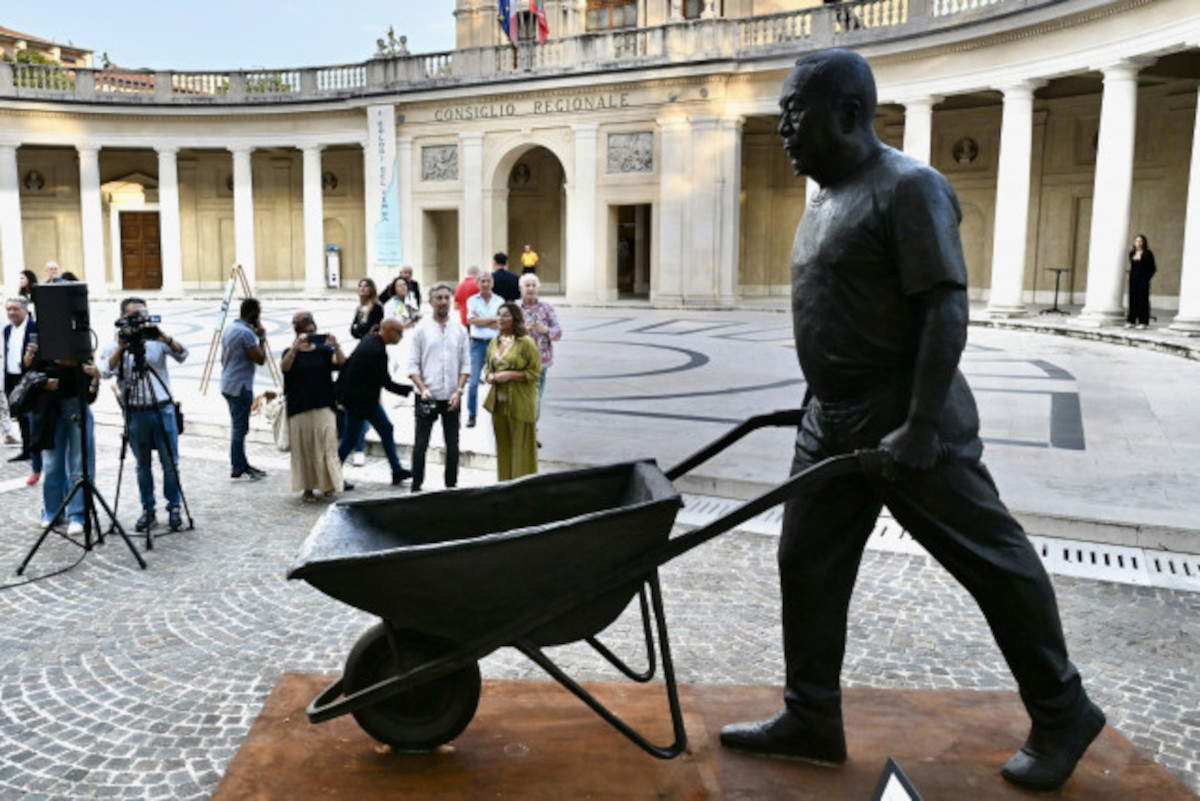
“My visit to L’Aquila was essential to understanding how similar my country’s experience in 2008 was to that faced by the city after the 2009 earthquake,” Ai Weiwei stated in a video message. “As I walked through the streets and reconstruction sites, and learned the stories of the victims and those who had lost everything, I also encountered a city capable of rebirth, using beauty and culture as its guiding thread. This gave rise to the idea of a public art sculpture linked to the history of this place: a symbolic figure carrying a construction wheelbarrow, which becomes the archetype of the phase L’Aquila is currently undergoing—one marked by hardship, reconstruction, and rebirth. Today, the work stands in a public square, and I hope that, when people look at it, they will recognize it not only as a testament to memory but also as a lesson in survival and hope.”
“It is an immense privilege for the Regional Council to host the art installation by the internationally renowned master Ai Weiwei,” stated Lorenzo Sospiri, president of the Abruzzo Regional Council. “Through this prestigious initiative, Palazzo dell’Emiciclo reaffirms its role as a place for the preservation, exhibition, and promotion of works of art of extraordinary cultural value. The gift to the city of *Figure and Wheelbarrow for L’Aquila*, sponsored by the Carispaq Foundation and arriving during this exceptional year dedicated to culture, joins the Regional Council’s prized collection. The work is part of the Palazzo’s modern and contemporary art collection, which already includes pieces such as the stained-glass window *I giorni* and works by Franco Summa, as well as *L’Arcobaleno* by Mario Ceroli."
|
| Ai Weiwei with a wheelbarrow: The Chinese artist creates a site-specific work for L'Aquila |

Warning: the translation into English of the original Italian article was created using automatic tools. We undertake to review all articles, but we do not guarantee the total absence of inaccuracies in the translation due to the program. You can find the original by clicking on the ITA button. If you find any mistake,please contact us.

















 IT
IT FR
FR DE
DE ES
ES CN
CN


