


by Redazione 26/10/2026


Categories: News Focus / Disclaimer
A painting in a private collection abroad could be, according to research that *Finestre sull'Arte* was able to preview, the “Orator in a Toga” painted by Caravaggio for his friend Onorio Longhi. Three scholars propose that the figure is Demosthenes, based on historical sources, iconographic comparisons, and scientific analysis.
A previously unpublished painting in a private collection abroad has been attributed to Caravaggio: it is believed to be a depiction of Demosthenes, specifically the “toga-clad orator”—that is,the orator whom, according to sources, Michelangelo Merisi painted for his friend Onorio Longhi and to whom Giovan Battista Marino may have dedicated two of his madrigals. This is the view of scholars Carmelo Occhipinti, Michele Frazzi, and Mario Bigetti, who have published their research in the volume *L’urlo di Caravaggio*, published by UniversItalia as part of the *Monografie di Horti Hesperidum* series under the patronage of the University of Rome Tor Vergata (311 pages, 20 euros, ISBN 9788832939736), which Finestre sull’Arte was able to preview. The book brings together an introductory essay by Occhipinti, one by Frazzi on iconology, documents, and compositional sources, and one by Bigetti with comments on the diagnostic analyses. “Nothing like this had ever been seen in Rome before Caravaggio’s arrival,” writes Occhipinti in the book’s introduction. “By depicting a figure in the act of speaking—or rather, of screaming, and so intensely as to instill in the viewer a sense of profound unease, if not outright fear—the Lombard painter had sought to make visible what, by its very nature, could not be pictorially represented: the voice. Indeed, the scream.”


The attribution to Caravaggio (Michelangelo Merisi; Milan, 1571 – Porto Ercole, 1610) is the thesis put forward by the three authors, built on a body of evidence ranging from literary and documentary sources to technical-scientific analyses conducted on the painting and iconographic studies. The clues are numerous and reinforce one another, but it will obviously be up to scholars and the scientific community to examine them in order to verify the thesis that Caravaggio is the author of this image.


One might begin with the two madrigals by Giovan Battista Marino ( Naples, 1569–1625), included in *Galeria*, the collection of verses on paintings and sculptures published in 1620. The second, in particular, might at first glance appear to be a description of the painting: “What are you doing there on the shores / Of a rugged Alpine cliff / To the whisper of the waves, / Or the gentle speech of a wise master? / Are you growing accustomed to enduring / Perhaps the resonant murmur / Of the hoarse and thunderous abyss? / You are quite mistaken, for, intent on listening to you, / The fierce winds and savage storms / Learn to fall silent.” The one asking the questions is Marino, and the addressee is the man in the painting: Marino sees him standing on a cliff, facing the stormy sea, and asks him if he is learning to endure the clamor of the assemblies. Then he immediately corrects himself, realizing that it is he who is mistaken, not the painting: it is “the hideous winds” and the “fierce storms” that fall silent, listening to that man, and “learn to be still.”
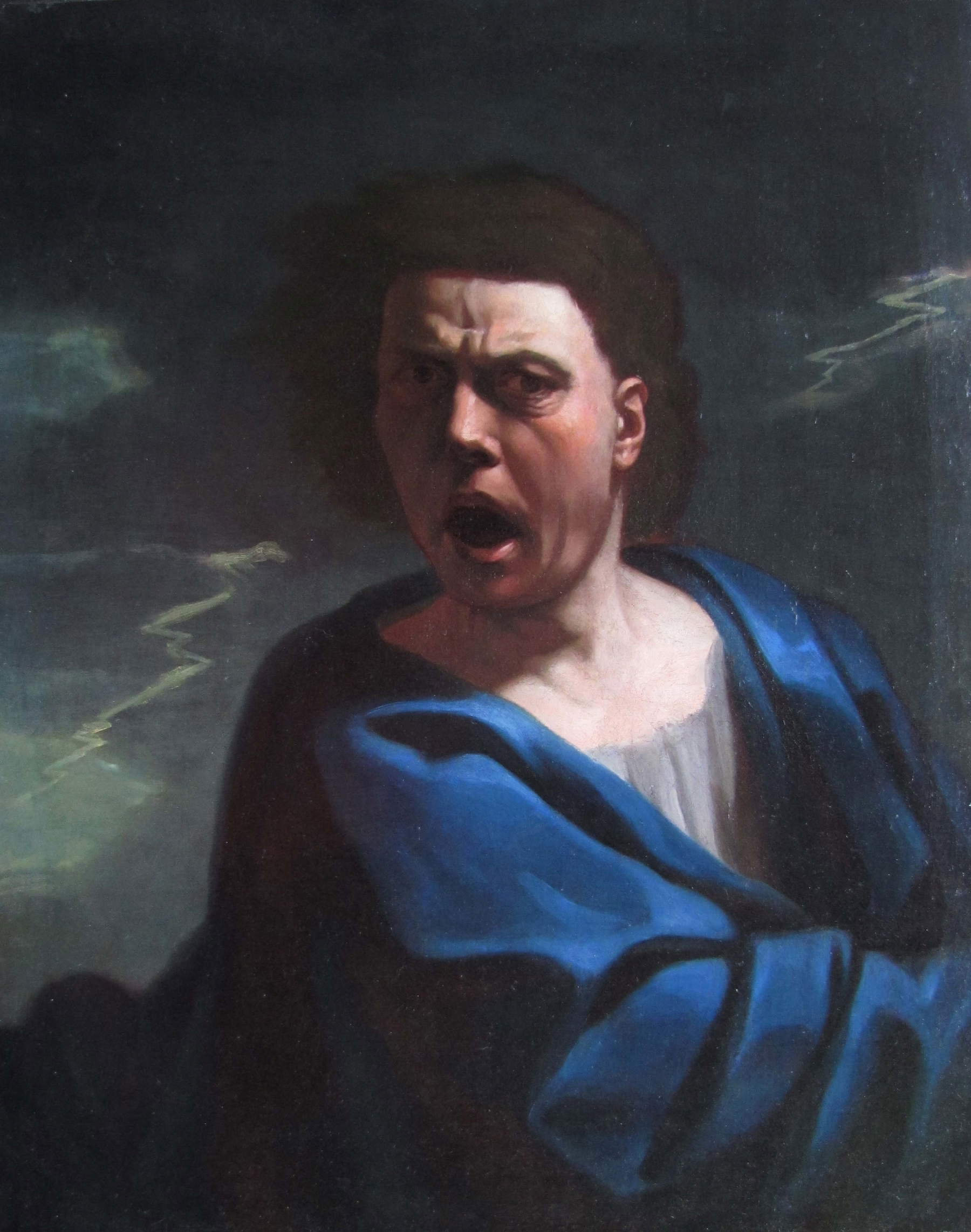
There has long been debate over the existence of the painting described by Marino. According to Occhipinti, Frazzi, and Bigetti, this painting does exist, and they have an image to show: it is a canvas measuring 76 by 61 centimeters, now in a private collection abroad, depicting a man in half-length portrait under a green-black sky, in the midst of a storm. His mouth is open in an expression that distorts his face; his bloodshot eyes are fixed on the viewer; and he wears a large blue cloak. Behind him, a bolt of lightning cuts diagonally across the sky. The three scholars, as mentioned, identify him as Demosthenes, attribute the work to Caravaggio, and more: they also recognize it as the painting that Marino had before his eyes and as the “orator in a toga” listed among the possessions of Onorio Longhi, the painter’s closest Roman friend.
The orator’s body, the lightning, the realism of the expression
The painting focuses on the body rather than the idea. The man, in fact, turns his torso in one direction and his head in the other (his arms extend from left to right, while the wind that ruffles his hair and lifts his cloak blows from right to left): the result is a contrasting movement, almost a twist, in a format—that of the half-length portrait—which usually presupposes a still, nearly immobile subject. Frazzi, in his essay, notes how difficult it is to find such energy in this genre: the face, in his view, corresponds point by point to Alberti’s description of a man in a rage, with “swollen and red” eyes and face, his entire body consumed by fury.
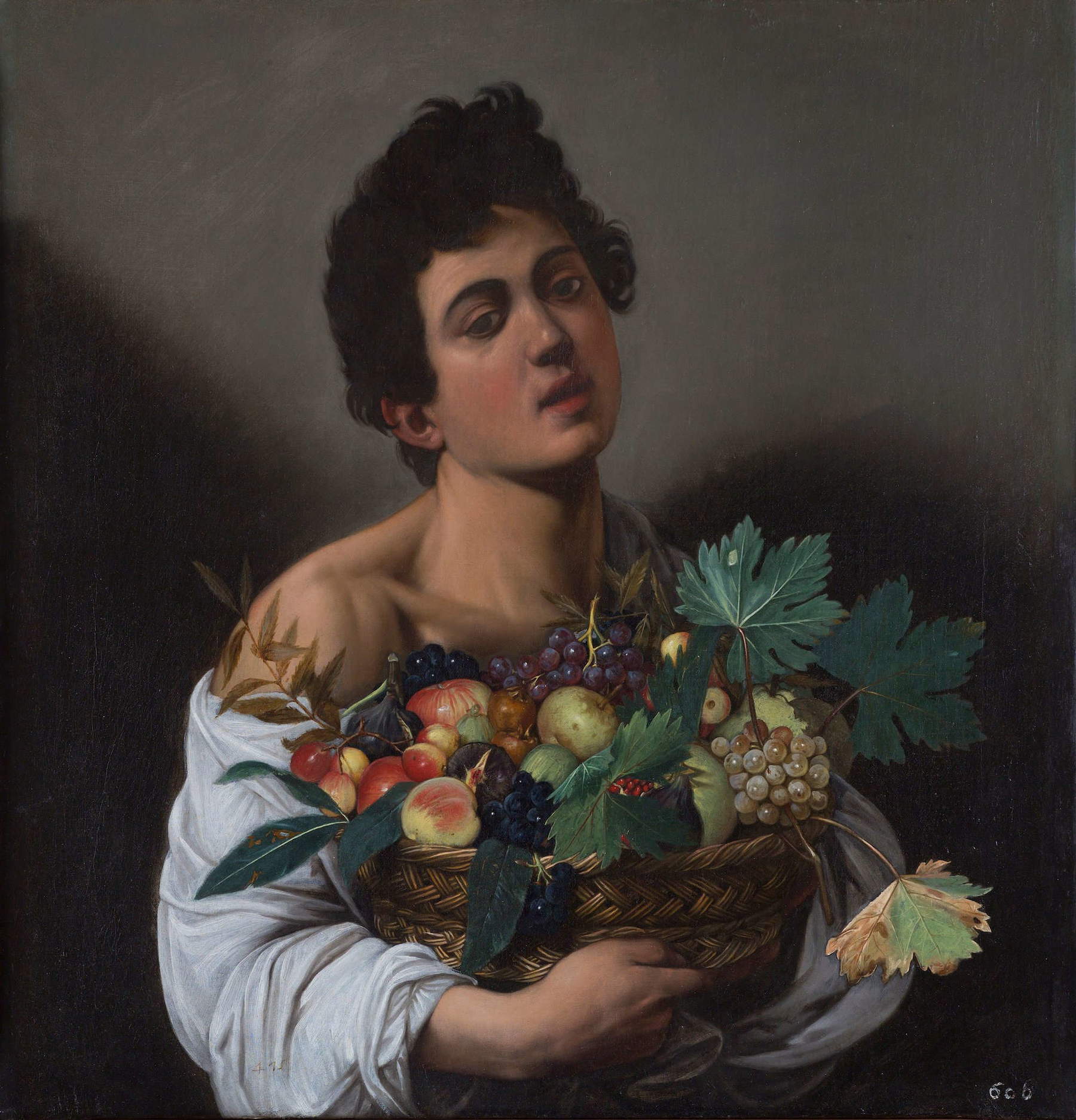
In the landscape, we see a bolt of lightning, and for the authors, this element further highlights the work’s significance: “Confirming this,” Frazzi emphasizes, “are both the exceptional rarity of this iconographic motif in the artistic landscape and the scale it assumes on the canvas, spanning its surface from one end to the other.” It also serves to “suggest the direction and angle of the light,” and according to Frazzi, this is “a technique typical of Caravaggio, which we find in numerous works by the painter in which, for this purpose, he generally uses a beam of light that stands out against a wall”: the lightning bolt, in fact, descends at an angle of about forty-five degrees, and the light strikes the left side of the face; it is precisely at that point that the dark line outlining the cheek turns vermilion. The upper edge of the ear is also tinged with red, and this element helps create an optical effect called “subsurface scattering”: if you shield your eyes with your fingers against a strong light, the skin through which the light passes takes on a reddish hue. Caravaggio, Frazzi notes, had already painted something very similar in the ear of the gypsy woman in *Buona Fortuna* and in that of the *Boy with a Basket of Fruit*.
Then there is the gaze: the man is not looking to the left—as is the figure from whom, as we shall see later, he is partly derived—but toward us. “The viewer,” writes Frazzi, “must have the impression of being face to face with the painted figure, as if personally involved in the scene. This way of establishing an immediate and intense relationship with the viewer is also a typical characteristic of Caravaggio’s early works.” Furthermore, the scholar has also noted certain similarities with other paintings by Caravaggio: the shape of the hair, the shape of the horizontal wrinkle on the speaker’s forehead, and the painterly rendering of the nose, in his view, recall analogous details from *The Boy Bitten by a Green Lizard*.

Michelangelo, Cavalier d’Arpino, and the Live Model
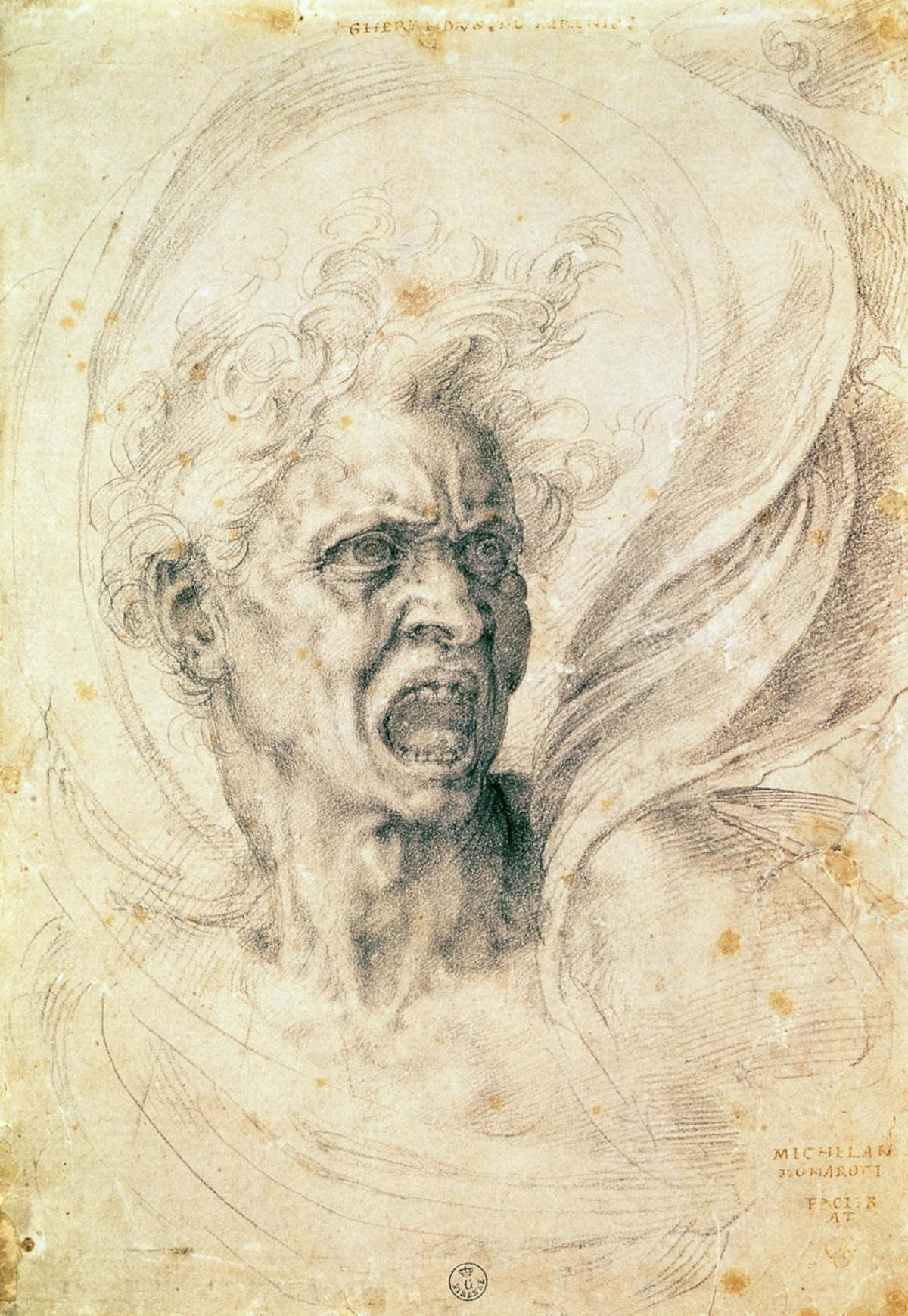
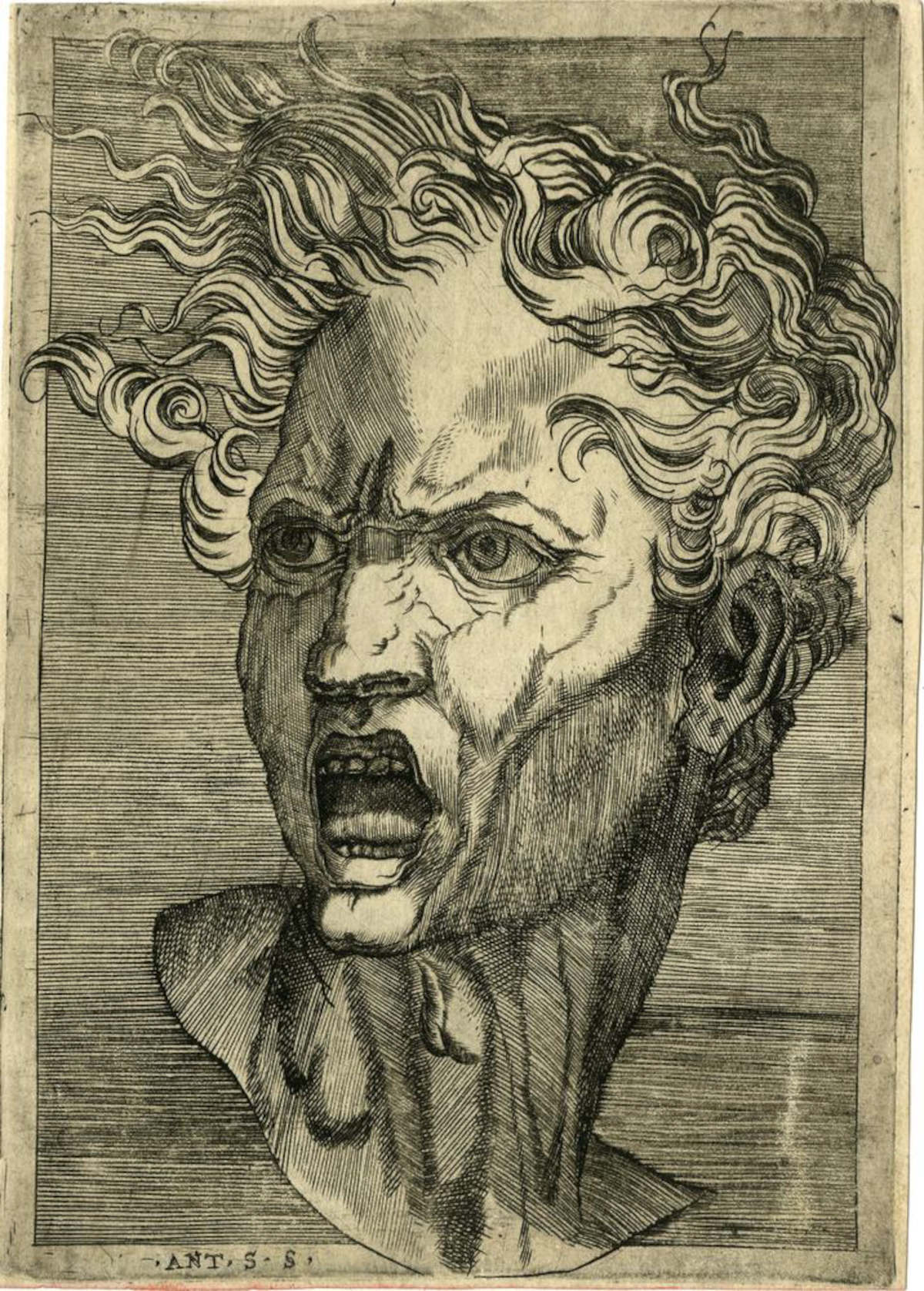
The three scholars did not limit themselves to observing the realism of the face; they analyzed the painting to see how it was constructed. Regarding this aspect, Frazzi took into account three techniques that would be characteristic of a painter active in the late 16th century, or at any rate “of Mannerist origin,” as the scholar writes. The first is the face, an element for which the painter likely drew upon an engraving of Michelangelo’s *Furia*, known from Antonio Salamanca’s 1562 print, which Caravaggio also used for *Medusa* and for *Neptune* in the Ludovisi fresco. The second is the chiasmus—the figure with its head and body turned in opposite directions—which Lomazzo called the “fury of the figure” and which Caravaggio employs for the fleeing boy in The Martyrdom of Saint Matthew, who also has his mouth wide open. The third isthe enlargement of the arm in the foreground relative to the other, to accentuate depth: this technique is employed, among others, by Parmigianinoin *Antea*, and by Caravaggio himself in *The Boy Bitten by a Green Lizard*.
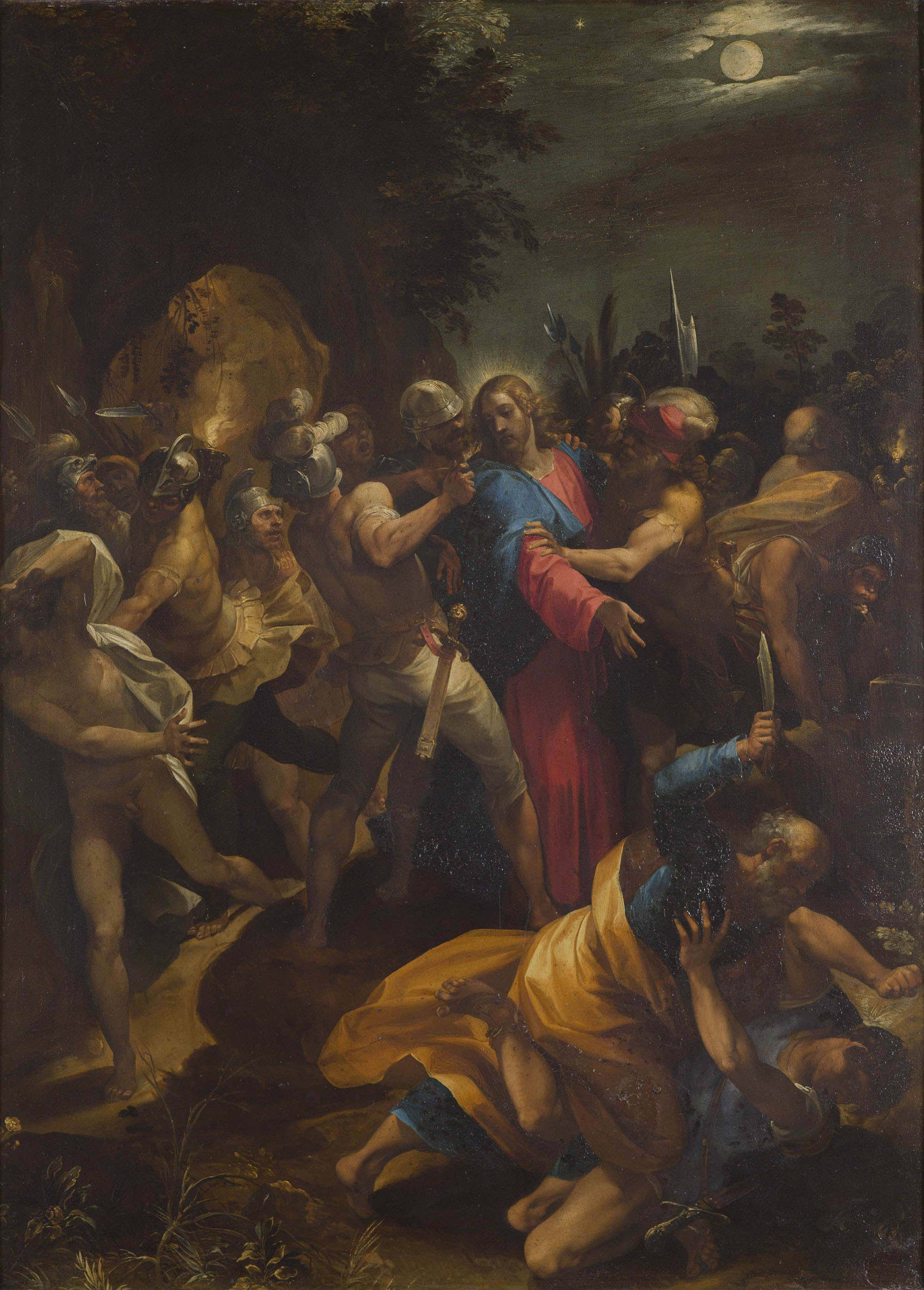
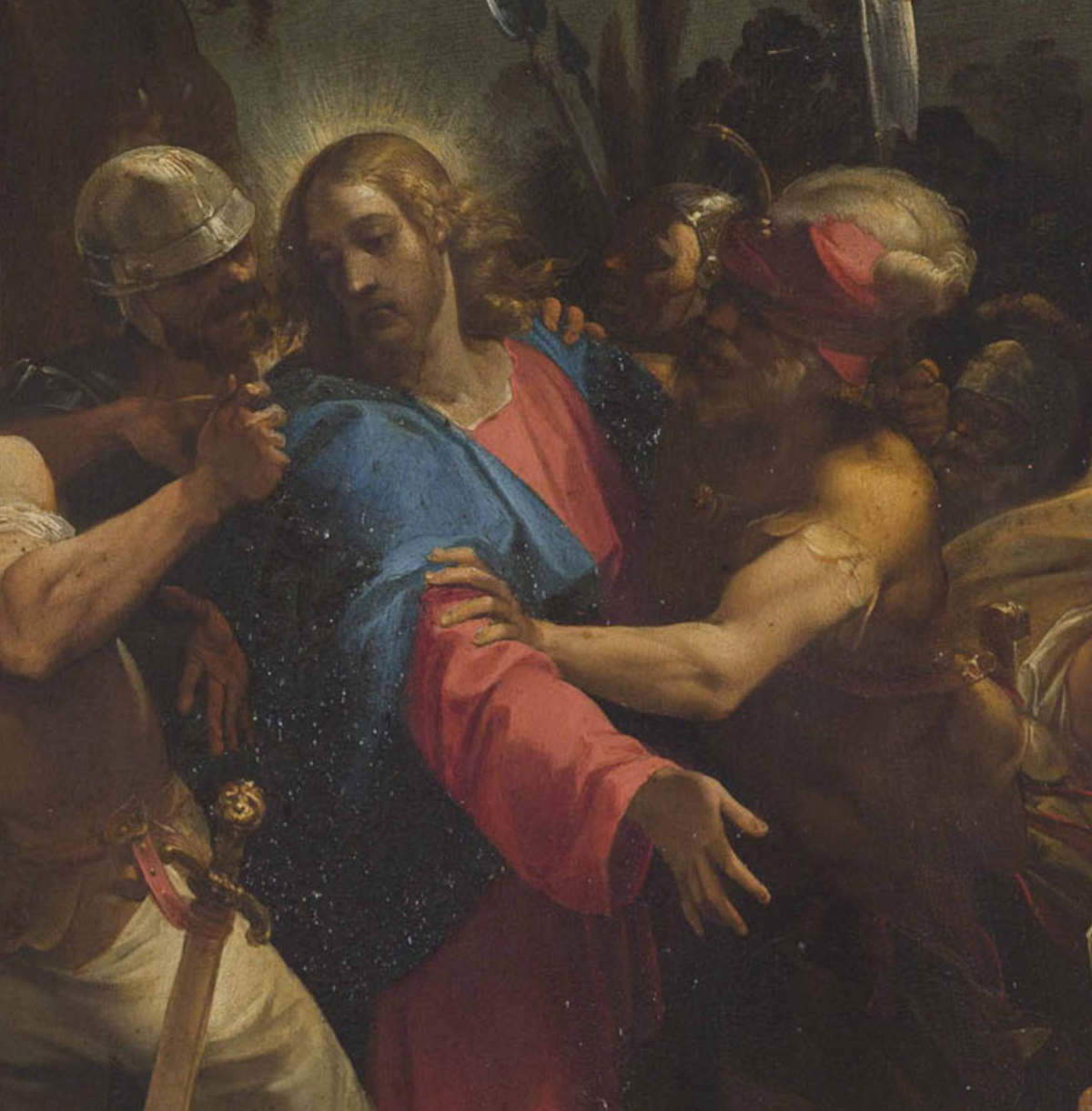
Added to this Michelangelesque lineage is one that points to Cavalier d’Arpino ( Giuseppe Cesari; Arpino, 1568 – Rome, 1640), in whose workshop Caravaggio worked for about eight months. According to the three scholars, the broad fold covering the arm in the foreground echoesthe Ezekiel painted in the Contarelli Chapel (1593), and the bust is thought to derive from that of Christ in the Arrest in the Garden by Arpino, which Röttgen dates to 1596–1597—precisely the years when Caravaggio was part of the Ciociaria painter’s circle. The folds, writes Frazzi, “exhibit a geometric morphology, which brings them closer to the faceted forms typical of Cesari’s works, especially during his early period.”
The result, however, diverges from sixteenth-century painting, and Frazzi explains this with a quote from Vincenzo Giustiniani, who in 1620 described Caravaggio’s painting as “in the manner of the masters, yet with the example of nature before him.” In other words, Caravaggio took poses from the great masters and had a live model recreate them; and in *Demosthenes*, the scholar argues, this approach is evident: the features are not those of *Furia*, the eyes are slightly misaligned—as is the case in live portraits and in several of the painter’s other works. The forehead wrinkles are asymmetrical, the cheeks are sunken from the effort, and the nostrils are flared. Frazzi goes so far as to analyze the expression using the facial expression coding system developed by Ekman and Friesen, and concludes that it corresponds to the signs of extreme anger.
There is also a possibility that Frazzi mentions in a side note, regarding the artist’s early trade: according to Bellori, the young Caravaggio painted three portraits of illustrious men a day, “for a grosso each.” In the workshops of Lorenzo Carli and Antiveduto Gramatica, where the artist worked, that genre was their specialty, and Cardinal Del Monte owned as many as 276 of them. Demosthenes is an illustrious man, and the half-bust composition recalls Roman sculptural portraits, such as the Cicero in the Capitoline Museums.
Identifying the Figure Depicted in the Painting
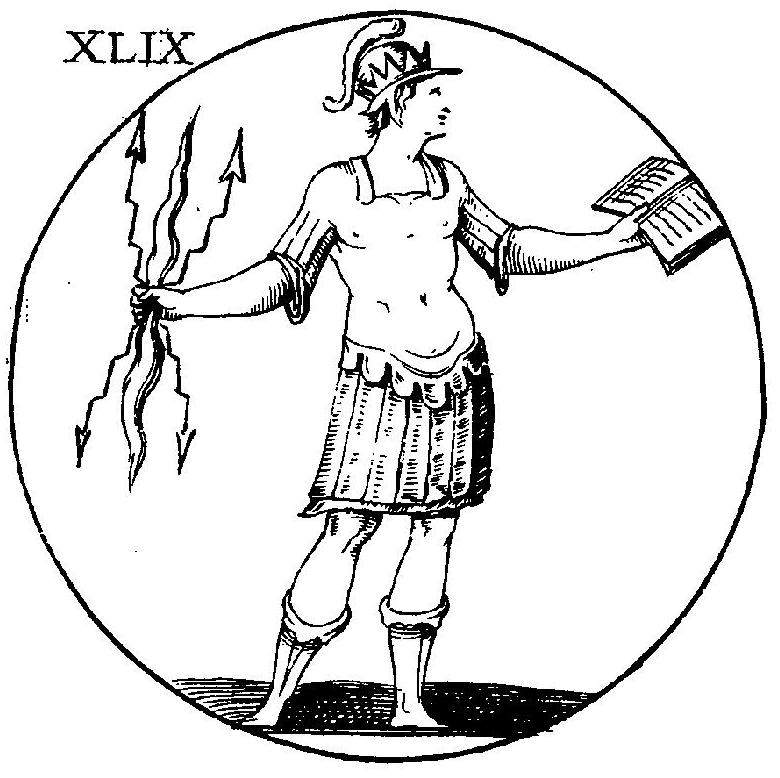
To understand who this man is, we must start with the flash of lightning, because it is anything but a mere element of the background. Pierio Valeriano, in his *Hieroglyphica* of 1566, associates itwith eloquence: the ancients recounted that famous orators, such as Pericles, unleashed thunder and lightning while they spoke. Cesare Ripa, inhis *Iconologia*, places a bolt of lightning in the hand of the personification of Eloquence. Behind these two sources lies an even older tradition, one that links lightning to a particular orator. Cicero refers to a lofty and grandiloquent style as “lightning,” and his model is Demosthenes. The image reappears in Pliny the Younger, in Dionysius of Halicarnassus, and above all in Pseudo-Longinus’s treatise *On the Sublime*, which features Demosthenes as its protagonist: Longinus compares him to a hurricane or a bolt of lightning and assigns Cicero the role of a fire that spreads slowly. That treatise, printed in Basel in 1554 with a dedication to the Farnese family, was already circulating in Italy during the second half of the sixteenth century.
According to these three scholars, at least, several elements in the painting point to Demosthenes: the toga over the tunic, the pose of the arm wrapped in the cloak typical of ancient orators, the open mouth as if speaking, and the flash of lightning. To these, Frazzi adds the fact that Lomazzo, in his *Treatise on the Art of Painting*, recalled Demosthenes as having “a terrifying look in his eyes,” while Plutarch described him, as he declaimed, as seized by an almost Bacchic fury. The result is an ancient orator, and according to the authors of the essay, Demosthenes is the only one who fits the painted image.
The painting that Marino had seen
Giovan Battista Marino, one of the greatest poets of the seventeenth century, is summoned by Occhipinti as a sort of witness. First, however, we must go back further in time: in antiquity, Plutarch wrote that Demosthenes was in the habit of going down to the beach at Phaleron and reciting his speeches amid the roar of the waves, to accustom himself to the noise of the crowd. He would therefore not have spoken of wind or storms. Marino’s madrigals, on the other hand, do not pit Demosthenes against the sea, but rather against the winds and storms, and in the second one, they have him say that his eloquence consists of “eloquent bolts of lightning.” For Frazzi, this variation from the classical account is proof that the poet was not rewriting Plutarch but was describing a scene he saw before his eyes, in which there was precisely a man shouting, the wind, the storm, and lightning: “This divergence from the ancient source, combined with the precise correspondence between the elements described by the poet and those depicted in the painting, constitutes a particularly decisive fact. The depiction outlined by Marino appears, in fact, distinctive and detailed, to the point of suggesting a true ekphrasis of the work in question. All these precise correspondences, therefore, allow us to identify with certainty the painting seen by Marino and described in *La Galeria* as the painting we are discussing.”
La Galeria also offers a useful precedent, according to Occhipinti. Marino almost never names the artists of the paintings he describes, but we know with certainty that the *Susanna and the Elders* he owned was by Caravaggio, because he himself states this in a letter from 1620. And Bellori, who speaks of Marino and Caravaggio as “very close friends,” reports that the poet introduced the painter to the home of Melchiorre Crescenzi (of whom Merisi painted a portrait—now lost—but which Marino mentions in *La Galeria*), who belonged to a circle of patrons that would later lead Caravaggio to the commission for the Contarelli Chapel.
Occhipinti adds a curious detail concerning the placement of the madrigals. In the *Galeria*, they open the section on “Orators and Preachers,” and are followed by verses on a portrait of Cicero. If Cicero, in relation to his time, was likened to Cavalier d’Arpino, the scholar writes, then Demosthenes could only have been Caravaggio’s subject. Plutarch, after all, offered more than one point of connection: superiority over others, and the “strangeness and harshness of manners” that the orator’s adversaries held against him.
Onorio Longhi’s “Orator in a Toga”
Scholars have since linked the painting in question to documentary evidence, pointing to the painter Onorio Longhi ( Viggiù, 1568 – Rome, 1619), a close friend of Caravaggio. Among the paintings that belonged to Longhi—mentioned in a description studied by Patrizia Cavazzini and others—is a work by Caravaggio referred to as a “large head-and-shoulders portrait” depicting “a speaker in a toga, a painting by Caravaggio.” In his book, Frazzi analyzes the term in detail. “Parlatore,” according to the 1612 Vocabolario della Crusca, is one who speaks, a speaker, an orator; the definition goes on to note that a good speaker must teach, delight, and move—the three Ciceronian tasks. “Togato” is straightforward: a man wearing a toga—which is present in the painting—with a tunic underneath. As for the “head-sized canvas,” this was the format used for busts and heads, and the adjective “large” indicates a size larger than standard. The painting’s dimensions of 76 by 61 centimeters, according to Frazzi, add up: the “dimensions […] are compatible,” he writes, “with those of an oversized ‘tela di testa.’ This data, therefore, also constitutes evidence supporting the proposed identification, since the work’s measurements are consistent with the type of format indicated in the inventory description.”
Onorio Longhi, born in Viggiù on October 12, 1568, is a figure straight out of a novel, well known to scholars of Caravaggio: he was an architect, the son of another architect, a law graduate who never practiced law, a poet and musician, one of the first members of the Academy of San Luca (1594), and one of the founders, in 1600, of the Academy of the Humorists. His contemporaries described him in terms that seem to have been written for his painter friend: Giovanni Baglione, their rival artist, spoke of a “mind so eccentric that it was hard to keep up with him.” In 1603, the Baglione trial found Longhi and Caravaggio on the same side: they were charged for verses that mocked the rival painter. Caravaggio defended himself by saying he did not compose verses, “neither in the vernacular nor in Latin.” In 1606, following the murder of Ranuccio Tomassoni, both were banished, and Onorio took refuge in Milan. He returned to Rome in March 1611, by which time Caravaggio had already died, and in the pardon decree he was described as an “orator.”
After his return to Rome, Onorio dedicated himself to keeping his friend’s memory alive: according to Occhipinti,*L’Oratore* was a gift from Caravaggio, and Longhi must have been very proud of it. The inventory from 1652—the year of the death of his widow, Caterina Campana—lists a collection of paintings in which the Caravaggios formed the core: in addition to *The Orator*, it included “a portrait on canvas of Mr. Honorio Longo, painted by Michelangelo Merisio da Caravaggio, with a fully gilded frame,” one of his wife, and a *St. John the Baptist in the Desert*. Onorio’s son, Martino Longhi the Younger, would have liked his descendants to transform his father’s collection into a “museum” that, as Occhipinti writes, “would appear, in a certain sense, dedicated to the memory of Caravaggio: in fact, the painter’s name was to stand out there alongside those of the greatest masters of the sixteenth century and the contemporary era.” Having no children, upon his death in 1660 he left his estate to relatives in Viggiù, the Longhi family, who had since moved to Bergamo, and from this point onward the documentary trail goes cold: for the centuries that followed, we know only—from technical analyses—that the canvas was re-stretched between the late 18th and early 19th centuries.
What the Technical-Scientific Analyses Reveal
The technical-scientific investigations, presented by Mario Bigetti, use various instruments to verify whether the technique corresponds to what Marco Cardinali has summarized as typical of Caravaggio: incisions on the ground, sketches in white lead and color, absence of a preparatory drawing, the ground left visible, pentimenti, and rapid execution.
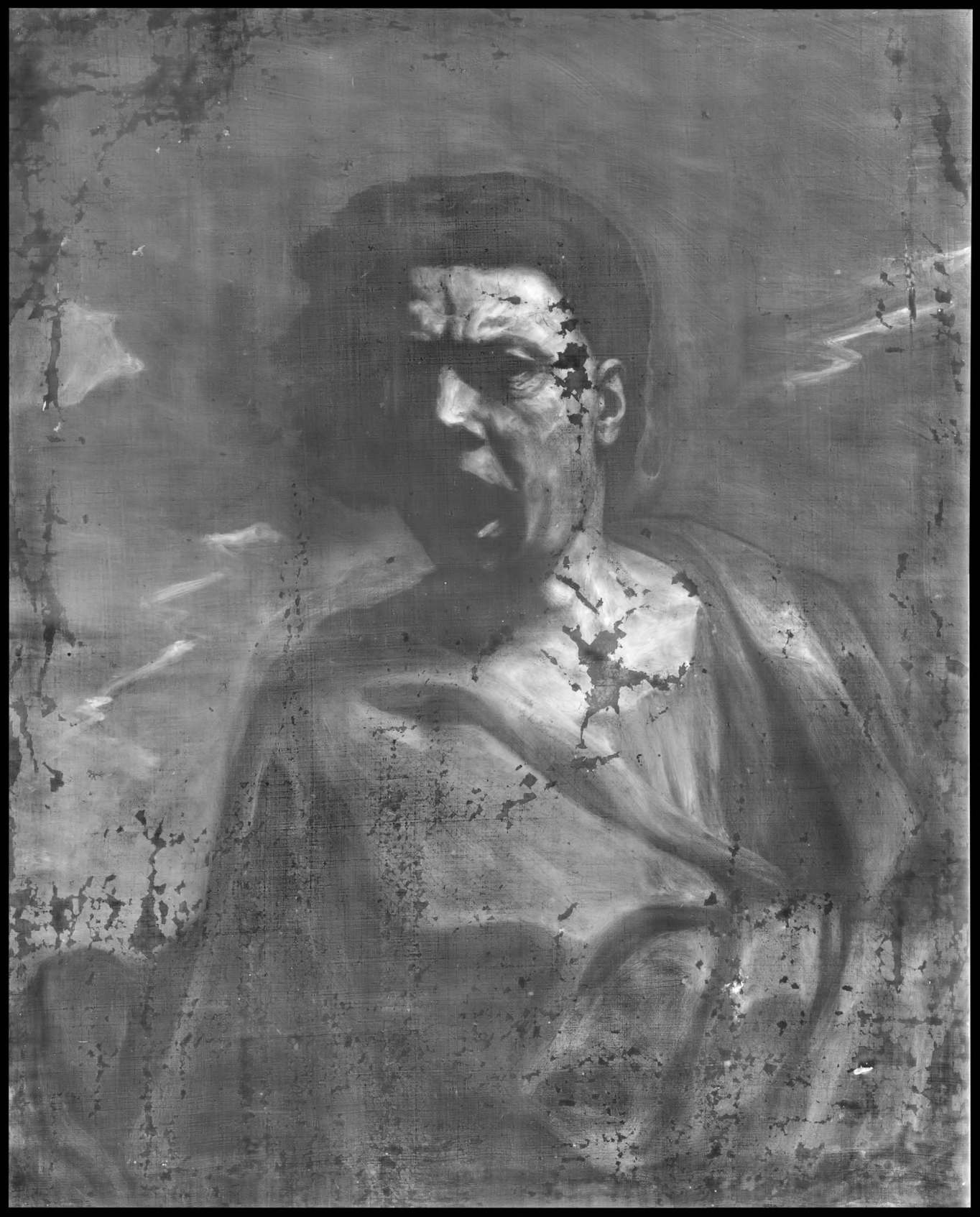
Incisions were found on the face and torso, but not in other areas of the painting. One of these, visible under X-rays, is located about three centimeters above the right eye and marks the area of greatest light. Another marks the upper part of the same eye and is revealed by an anomalous break in the craquelure; a third is at the base of the nose and is also visible in natural light. For Bigetti, this means that the painter began with the face, with the model in front of him, as he did in Rome in his early years, and only later turned his attention to the rest of the painting. Confirming this, the face is painted directly onto the reddish ground, while the rest is covered by a dark glaze applied later. In the X-ray, the painter marked the position of the mouth with a few black lines and only later made it rounder and wider: in the volume, Demosthenes’s mouth is compared to the sketch of Holofernes’s mouth, where space is left in the center for the red of the tongue.
Next come the corrections (the “pentimenti”): the hair on the right side was originally shorter and blown back by the wind, similar to that of the Fury, and left the neck exposed. It was then widened by a couple of centimeters, until it covered the neck and fell onto the shoulder. Furthermore, the left shoulder was about two centimeters lower, and the cloak did not wrap around the back of the neck, so the skin of the torso touched the sky directly (the edge that now separates the torso from the sky was added later). The outline of the cloak was initially conceived to be higher up but was replaced by a cloud that rebalances the masses, and the lightning bolt also changed shape: originally, it was a dense, orange stroke; it was then covered by the green of the sky and replaced by a thinner yellow stroke, painted with a drier, more controlled brush. For Bigetti, the nature and number of these changes rule out the possibility that this is a copy, because a copyist would not alter, on the fly, the shape of the hair and the position of the shoulders.
The laboratory of the Department of Physicsat the University of Milan analyzed the blue of the cloak, the green of the sky, and the yellow of the lightning using X-ray fluorescence. The painting is made of white lead and earth pigments: lead and iron throughout, the limited palette found in Caravaggio’s early works. The blue of the cloak contains calcium, an indication of lapis lazuli; in the lighter areas, there is less and less pigment and more and more white lead, while the green of the sky consists of green earth. The yellow contains neither antimony nor tin: in the first decade of the 17th century, painters began using Naples yellow, which contains antimony; therefore, the painting appears to predate this date. As for the support, it is a tightly woven, fine-textured canvas, approximately 15 × 12 threads per square centimeter—the density Caravaggio used in his early works, up until around 1600: *Boy with a Basket of Fruit*, the *Maddalena Doria*, and the *Capitoline Good Fortune *. The reddish ground layer topped with a dark primer is found in *Boy Bitten by a Green Lizard * and, in a more complex form, in the *Barberini Judith and Holofernes *. Material analysis, in addition to iconographic and documentary analyses, would open a dating window ranging from 1597 to 1602.
Finally, there is a test the authors cite regarding X-ray analysis, which applies to the painter’s entire body of work. A comparison has shown that X-rays of Caravaggio’s works reveal such well-defined chiaroscuro that they resemble a black-and-white photograph of the painting, whereas those of his followers never achieve this level of definition. “Demosthenes,” says Bigetti, “would fall into the first group. ‘The X-rays of Caravaggio’s paintings are distinguished by such a high level of detail that they produce a black-and-white image of the work that is surprisingly similar to what can be observed in natural light.’ This characteristic was verified through a series of experimental studies conducted on a significant sample of paintings, which involved comparing the X-rays of 36 original works with those of 74 copies. The results confirmed the specificity of this particular radiographic feature, which stands out as a distinctive trait of Merisi’s work. The X-rays of paintings by Caravaggio’s followers and Merisi’s copyists never achieve the level of definition and the refined articulation of chiaroscuro found in the X-rays of his own works. Only the latter produce an image in which the distribution of light and shadow is perfectly legible down to the finest details, revealing the extraordinary precision with which Caravaggio constructed his chiaroscuro relationships and highlighting the distinctive features of his personal painting technique. The chiaroscuro transitions in Caravaggio’s painting are distinguished by the balance and harmony with which they are distributed, whereas in the works of other painters, abrupt contrasts and discontinuities are more common, attributable to different painting techniques. The way color is applied is, in fact, an individual and distinctive characteristic of each painter, comparable, in some respects, to the uniqueness of handwriting.”
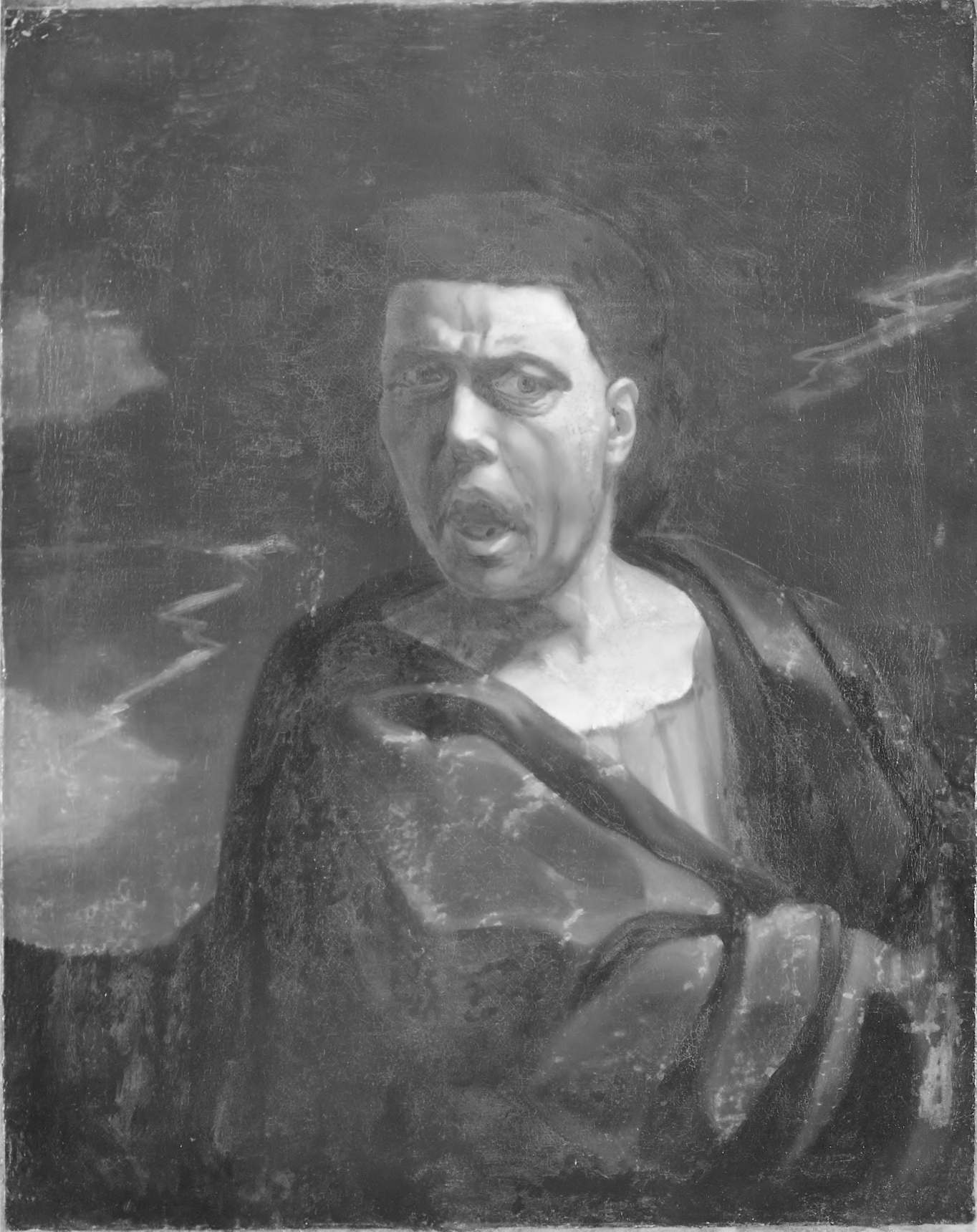
Caravaggio’s The Scream
In drawing his conclusions, Frazzi quotes Berne-Joffroy (“What begins with Caravaggio’s work is, quite simply, modern painting”) and, in his analysis of the subject, compares the painting to Edvard Munch’s *The Scream *. In his diary, Munch recounts having heard “a great, infinite scream piercing through nature,” and for the scholar, the same correspondence between human anguish and the fury of the elements is found in Demosthenes: inside and out, the scream and the storm become one and the same. This is not a comparison to be taken literally, but the book’s title brings it into the discussion.
Occhipinti, in the essay that opens the volume, opts instead for a more narrative tone. He begins with the image of Demosthenes who, according to Quintilian and Valerius Maximus, trained on the shore by shouting at the waves, and wonders how to depict the voice—something that sculpture could not capture. The answer, he writes, lies in a man captured at the very moment when breath becomes a cry and the cry becomes a word. The painter would thus have portrayed Demosthenes as a man shouting at the crowd, at the world, at nature—and in doing so, would also have revealed something about himself.
For those who wish to evaluate the attribution proposal by Occhipinti, Frazzi, and Bigetti, the book is available to scholars and enthusiasts. With the hope that, sooner or later, the community of scholars and enthusiasts will have the opportunity to see the orator in person.
Warning: the translation into English of the original Italian article was created using automatic tools. We undertake to review all articles, but we do not guarantee the total absence of inaccuracies in the translation due to the program. You can find the original by clicking on the ITA button. If you find any mistake,please contact us.