By Redazione | 16/02/2026 13:27
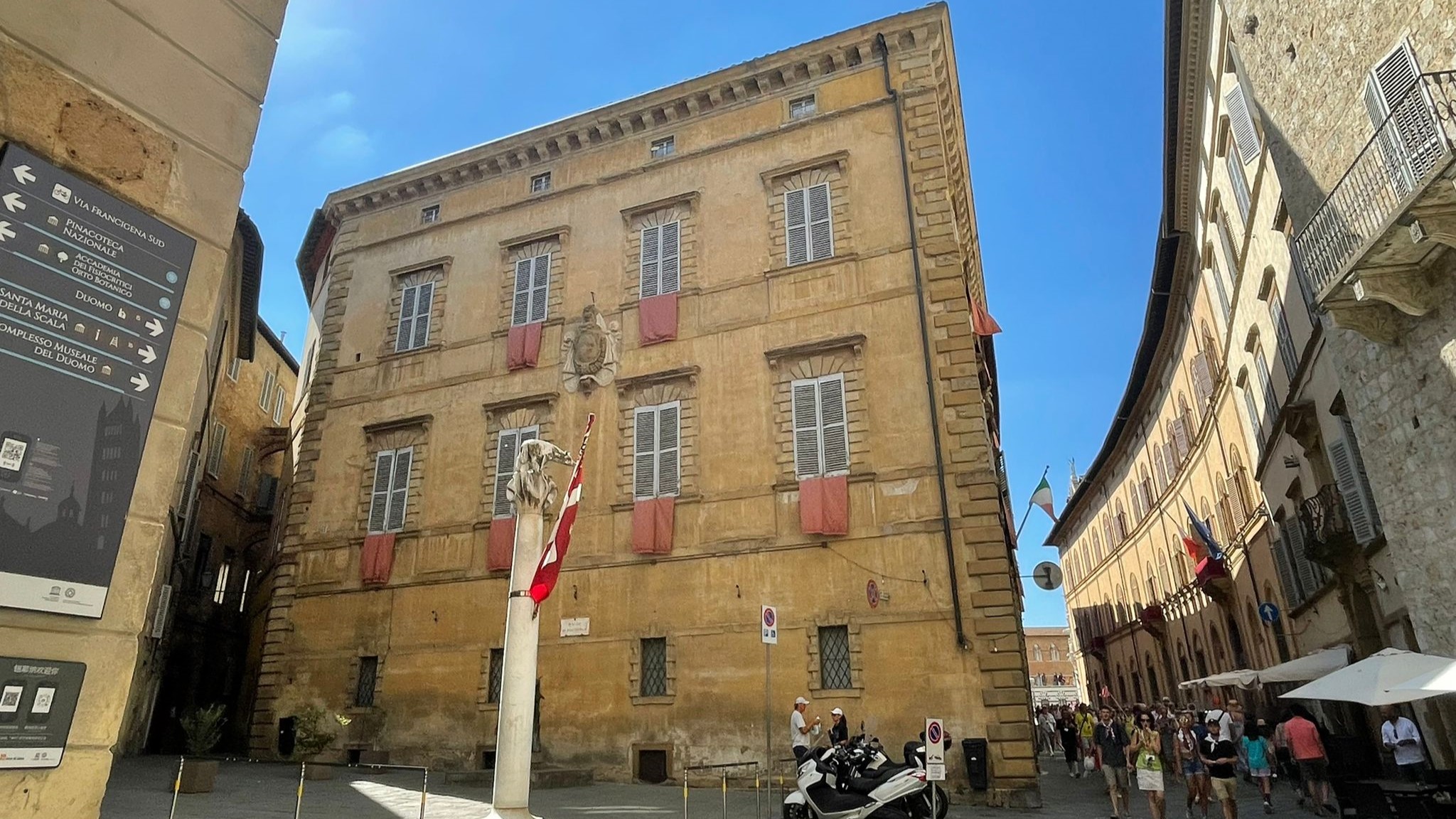
The image of Siena is usually associated with its medieval past, but in fact in the urban fabric of the city one can still breathe the air of its Renaissance, and in particular, at the corner of Piazza Postierla and Via del Capitano, stands one of the most significant of the local 16th century, Palazzo Chigi alla Postierla, also known as Palazzo Chigi Piccolomini or Chigi Piccolomini Palace at the Postierla, now a state museum dependent on the National Picture Gallery of Siena. Although the current name recalls the famous lineage that gave birth to Pius II, the building was actually born out of the dynastic ambitions and strategies of the Chigi family. In fact, it was Scipione di Cristofano Chigi (Siena, 1507 - 1580), a leading figure in 16th-century Sienese politics, who gave the decisive impetus for the building's construction around the middle of the century (although work would not be completed until 1573), probably entrusting its design to Bartolomeo Neroni known as Il Riccio (Siena, c. 1505 - 1571). The palace is not only an example of architectural mastery, but represents a kind of stone diary of Siena's political transformations, suspended between the waning of the Republic and the dawn of Medici rule.
"The palace, among the most important realities of 16th-century Siena, deserves rediscovery," art historian Marzia Minore explains. "Often the image of Siena remains linked to the 13th and 14th centuries, but the 16th century represents a season of great quality, also well documented in the collections of the Pinacoteca with masters such as Sodoma and Domenico Beccafumi. Palazzo Chigi makes it possible to delve into precisely that phase, with decorated salons, pictorial cycles and an important 17th-century collection, as well as sketches by Giuseppe Mazzuoli, a pupil of Gian Lorenzo Bernini, and a model attributed to the same master."
The exterior structure is presented with a sober solemnity typical of the taste of the time, but it is the internal articulation that reveals the uniqueness of the project. One of the most unusual features for Sienese building of the period is the presence of a double piano nobile, an architectural choice that finds few comparisons in the city, except in such high-ranking residences as Palazzo Petrucci or the Palazzo delle Papesse. This peculiar spatial arrangement was not an aesthetic whim, but responded to a precise family need dictated by Scipione Chigi himself. In fact, his testamentary wills, dating back to 1578, make it clear that the building was to be divided in such a way as to guarantee independence and dignity to both sons: the second floor was destined for the cadet Cristofano, a knight friar of Malta, while the second floor became the residence of the eldest son Camillo, who was destined to inherit the entire complex only later.
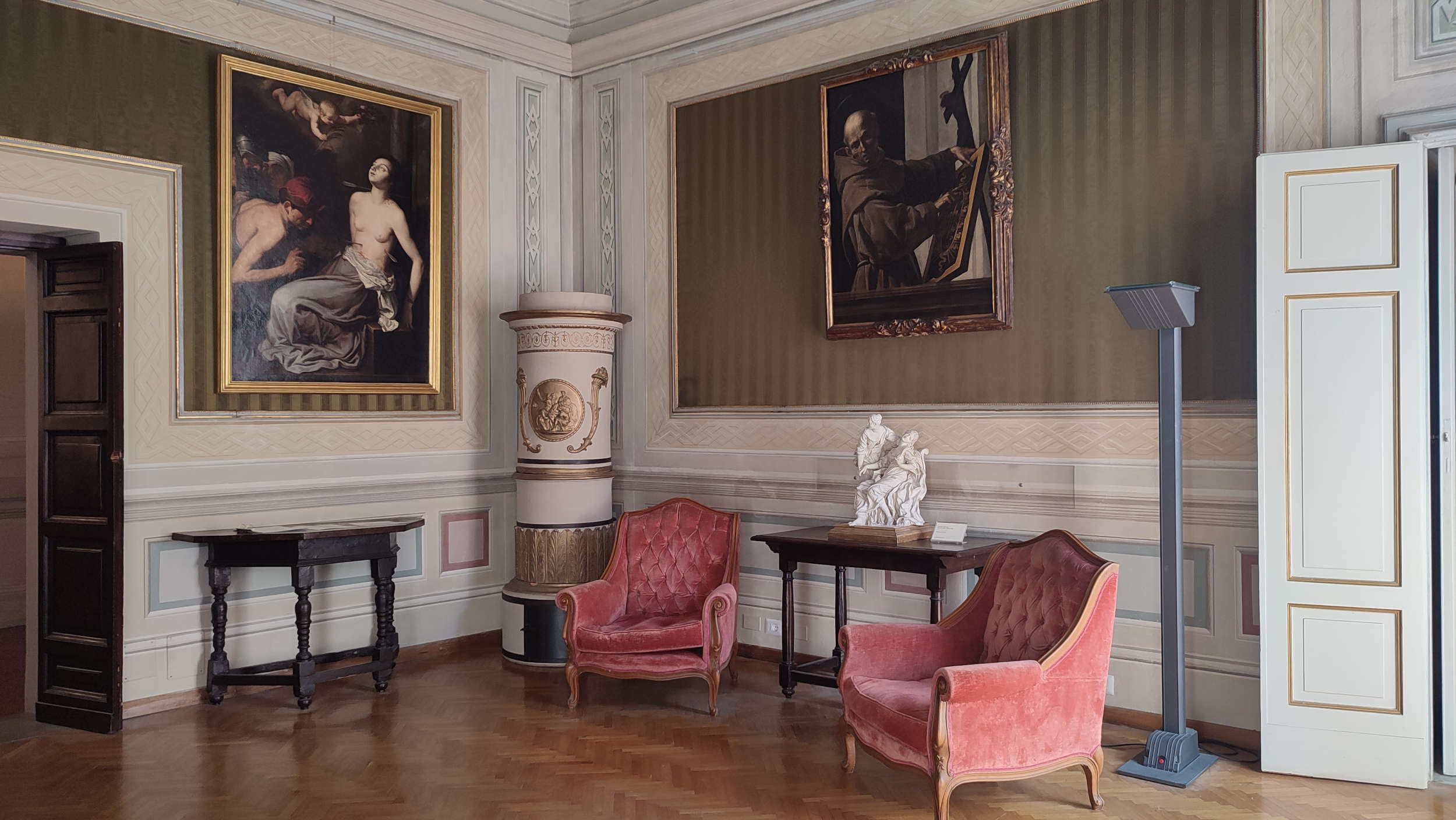
This splitting of the apartments created two parallel worlds within the same wall envelope. The second floor, lived in by a knight of the Hierosolymitan order, and the second, designed for a man destined for public life and government, reflect the different souls of the Sienese nobility of the time. Camillo Chigi, just like his father, was in fact oriented toward positions of prestige, consolidating that tradition of service to institutions that had seen Scipione as a protagonist of dramatic moments in the city's history. It was Scipione Chigi himself who acted as ambassador during the wearisome siege of Siena in 1555, charged with communicating the surrender to the commander of the imperial and Medici troops at Belcaro. Despite the fall of the Republic, Scipione managed to skillfully navigate the waters of the "New State" of Siena under Cosimo I de' Medici, holding prominent positions as Gonfaloniere and Captain of the Third of the City.
The heraldry decorating the facades tells precisely a story of diplomacy and papal favor. On the elevation overlooking Piazza Postierla stands the Chigi coat of arms, the work of sculptor Girolamo del Turco, where the classic golden mountains surmounted by the star appear framed with the Della Rovere oak. This is a privilege granted in 1509 by Pope Julius II to Cristofano Chigi, Scipione's father, as thanks for a real estate transaction involving the Villa della Suvera that favored the pontiff's interests through the mediation of Pandolfo Petrucci. Above the main entrance door, however, dominates today the blue cross with the golden crescents of the Piccolomini, inserted after the family purchased the palace in 1785 from the heirs of Lorenzo Chigi.
The evolution of the palace over the centuries saw first the change of ownership from the Chigi to the Piccolomini, and then to the Piccolomini Clementini Adami in 1919. Finally, in 1959, the Italian state exercised its right of first refusal to purchase the property, earmarking it to house offices of the Soprintendenza and a section of the National Picture Gallery of Siena. Today, walking through these rooms, one can still perceive the social and political stratification of a city that was able to integrate its defeats and victories into an aesthetic of rare consistency. The palace is not a simple container of rooms, but an organism that adapted its forms to the needs of a family that wanted to remain a protagonist, managing to maintain a prominent position even under the Medici aegis.
The vicissitudes of the residents were inevitably intertwined with the configuration of the spaces. For example, Scipione's choice to include reminders of the fall of the Republic, such as the image of the prophet Jeremiah meditating on the ruins of the homeland in the salon of the first piano nobile, which was entirely decorated by the Dutchman Bernard van Rantwyck (documented in Siena from 1572 to 1596), suggests how the palace was also intended as a place of private political memory, veiled behind the screen of religious narrative. Similarly, in the hall on the second piano nobile, the reference to the fate of Scipio Africanus, the Roman hero who chose exile in Literno after being unjustly accused, resonated deeply within the walls of a house inhabited by a nobility that, in the late fifteenth and mid-sixteenth centuries, had experienced trials, banishment and confiscation. The Bellanti family, to which Eleonora, wife of Scipione Chigi, belonged, had also been the victim of similar political turbulence, making the atmosphere of the palace's rooms charged with meanings that went far beyond pure architectural aesthetics.
Getting to the heart of the interior spaces, the second floor salon stands out as one of the most striking rooms in the complex. Beyond the overall decorative impact, the hall's architecture is enriched by extraordinarily crafted wooden elements that have an itinerant history. These are the corner pilasters and pilasters carved by Antonio Barili, the most celebrated master of wood in early 16th-century Siena. These elements did not originate for Palazzo Chigi, but were commissioned in 1509 by Pandolfo Petrucci for the so-called "camera bella" of his palace in Piazza San Giovanni, on the occasion of his son Borghese's marriage to Vittoria Piccolomini. Only in the nineteenth century, after being found in the Duomo rectory and purchased by the City, did they find their place in these rooms, bringing with them the echo of another great season of the Sienese patriciate. The pilasters depict female figures embodying the Christian and cardinal virtues, such as Faith, Hope and Prudence, the latter accompanied by its classical iconographic attributes, the serpent and the mirror.
Side rooms surrounding the main halls complete the palace's interior geography, offering more intimate spaces that nevertheless maintain the proportion and elegance of Riccio's design. Each room is connected by a logic of representation that culminates in the large fireplace on the second floor, the work of Marcello Sparti, which still defines the centerpiece of the upper hall. This room, mirroring the one on the lower floor but distinct in function, was the stage for the life of Camillo Chigi and, later, his descendants, including his son Scipione iuniore, born in 1584. The continuity of family names within the halls underscores Scipione seniore's desire to build not just a building, but an authentic monument to the continuity of the lineage.
If the architecture of Palazzo Piccolomini alla Postierla is the solid body of a dynastic strategy, its stucco decoration represents its soul, the detail that transforms the walls into a stage for heroic and moral narratives. The building's ornamental metamorphosis has a precise start date: August 12, 1573, when Scipione di Cristofano Chigi signed a contract that would change the face of the interior, entrusting the plastic direction to Marcello di Giulio Sparti da Urbino (Urbino, news from 1565 to 1608). Sparti, also known as Sparzo, was not a mere performer, but a "master of stucco work" trained in the prestigious workshop of Federico Brandani, a school that carried with it the lessons of the most advanced and dynamic Mannerism. His arrival in Siena marked a break with the local tradition of the early 16th century, where stucco was often relegated to a mimetic or subordinate role to painting. With Sparti, who worked together with Rantwyck, plastic relief took on a bursting physiognomy, still visible today in no fewer than 11 rooms of the palace, where the material seems to rebel against the two-dimensionality of the walls to become living history. The city of Siena, moreover, boasts a record, as scholar Ilaria Bichi Ruspoli explains, "Decorative stucco 'all'antica' made its appearance in Siena at the dawn of the 16th century, in alignment with Roman taste and fashion. The cultural distance between Siena and Rome has never been so close, thanks to the personalities of Cardinal Francesco Tedeschini Piccolomini and the Magnifico Agostino Chigi, whom another Magnifico, Pandolfo Petrucci, interposed with firmness and shrewd marriage policies."
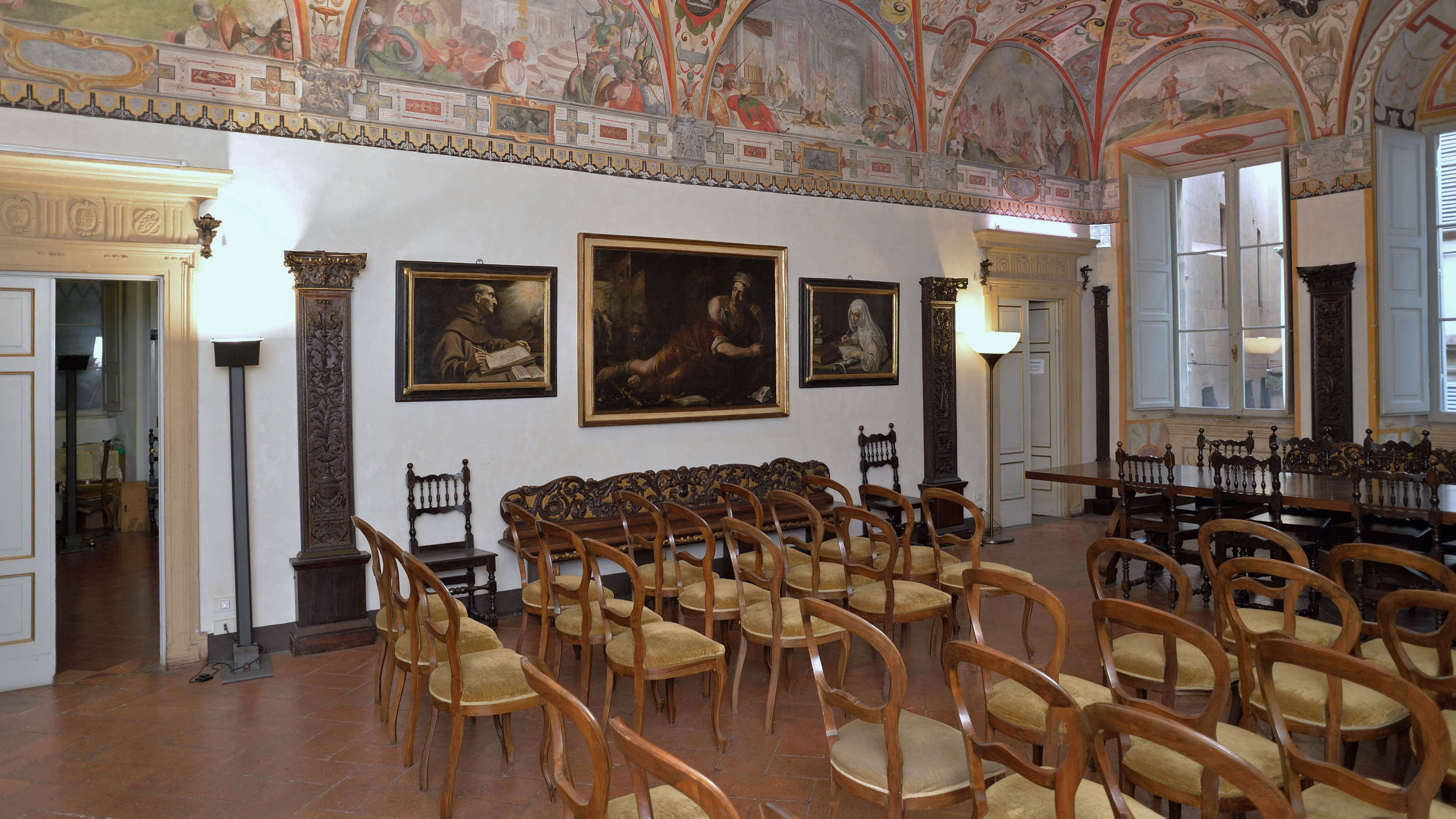
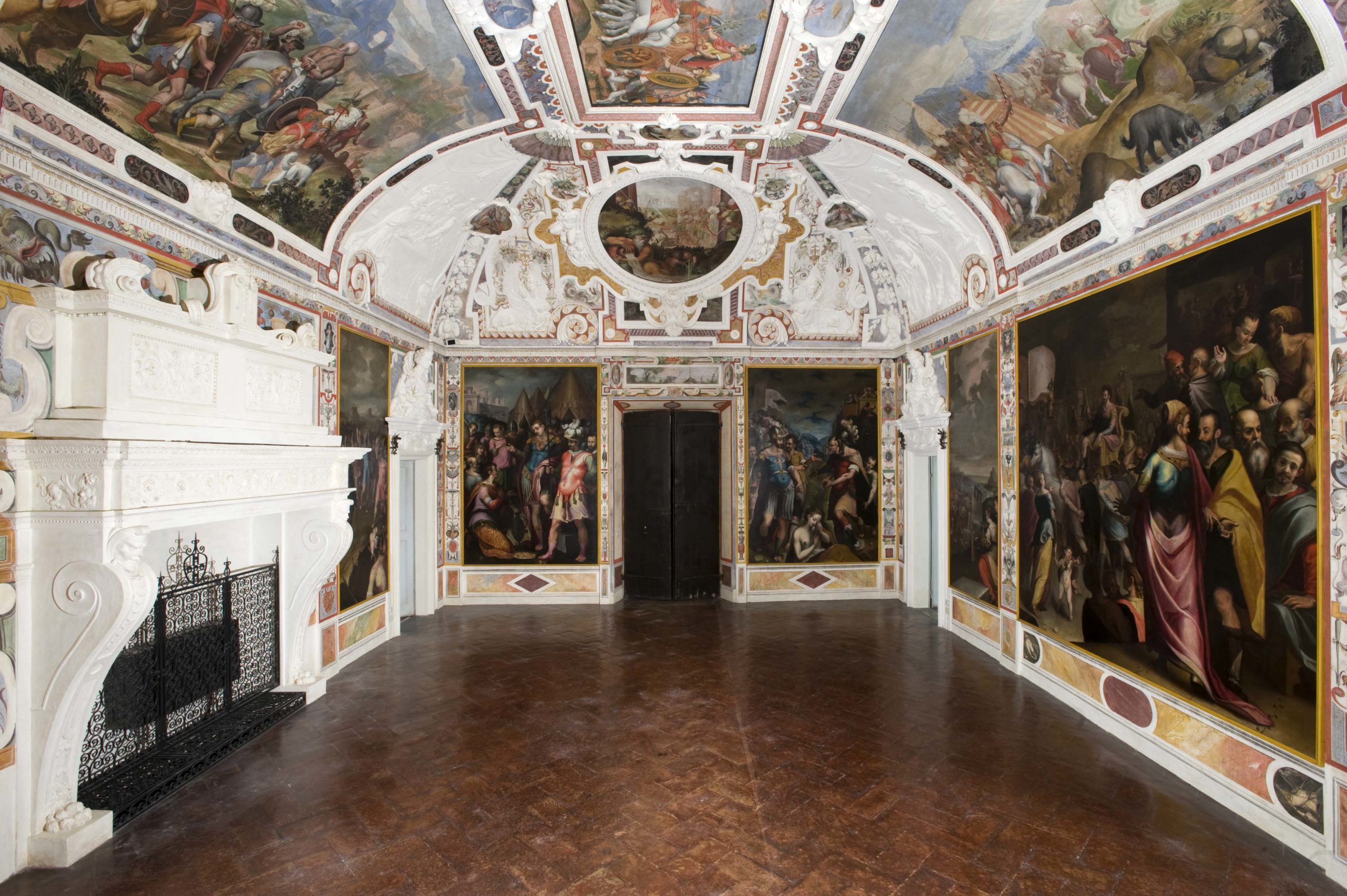
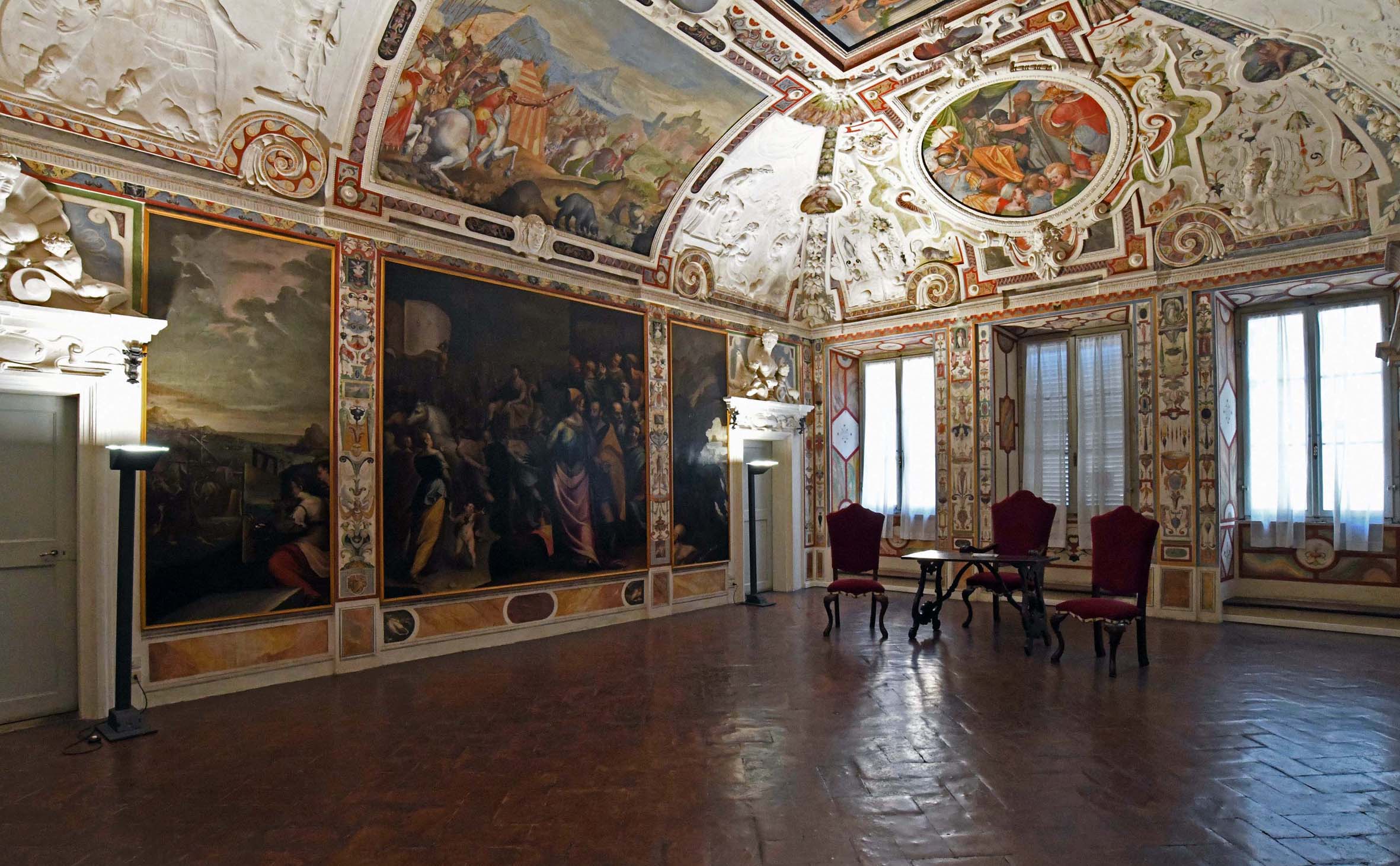
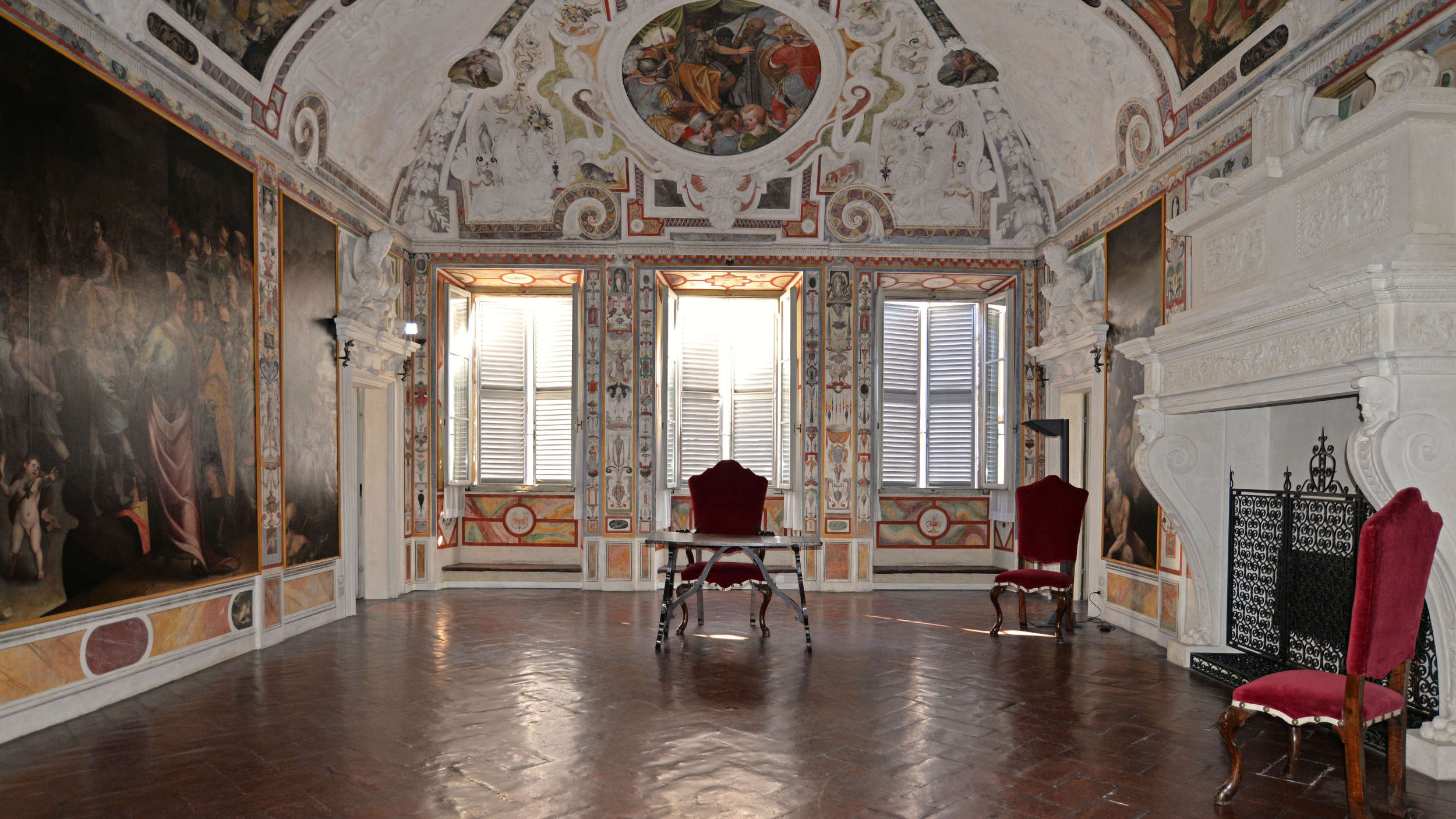
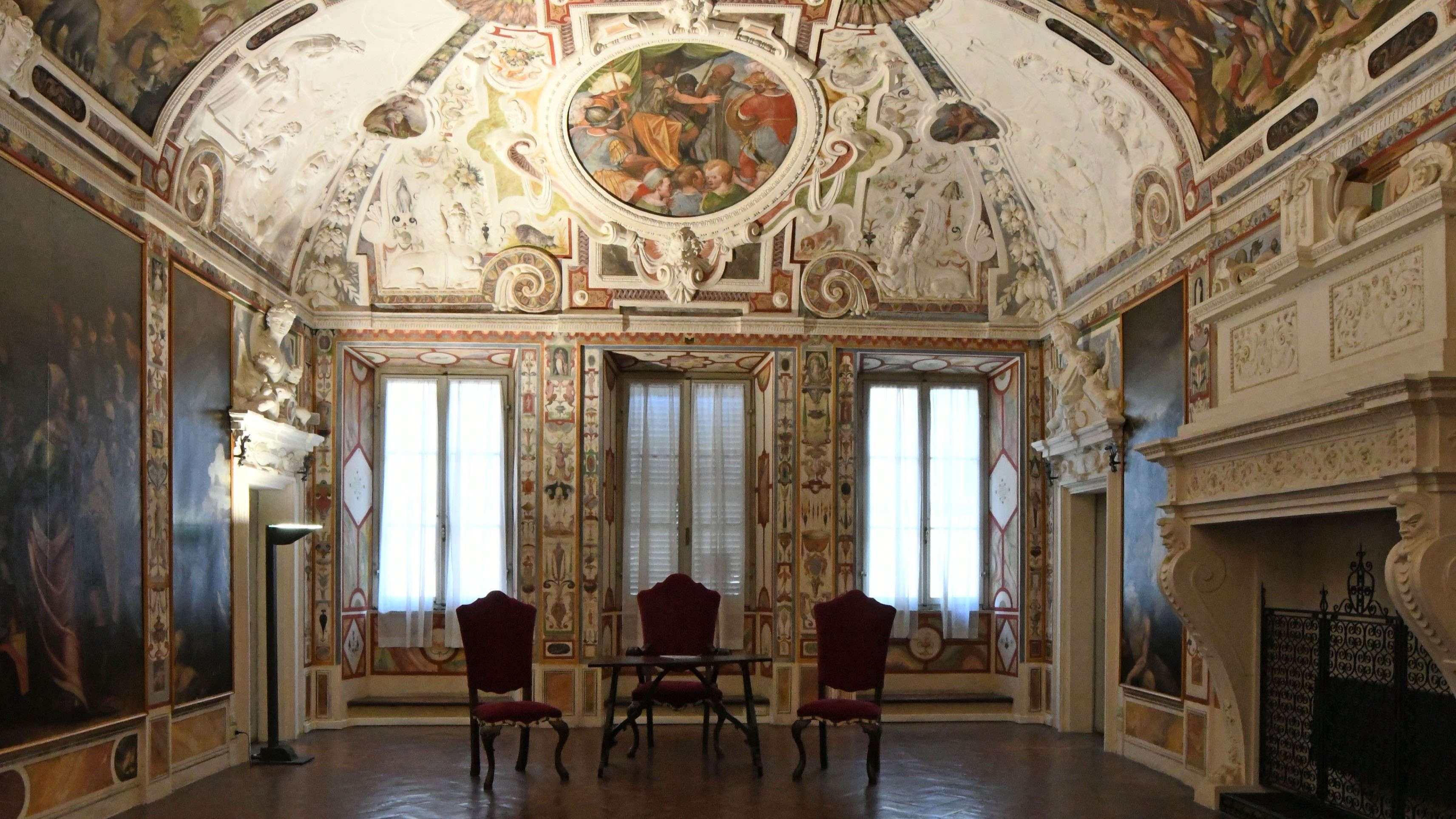
The entrance to Sparti's plastic universe already takes place in the hall on the second floor, where the ceiling houses one of his most dramatically charged interventions: the depiction of Joel killing Sisara. In this episode from the Book of Judges, the Urbino plasterer demonstrates his ability to synthesize action into a moment of extreme violence and morality, showing Eber's wife in the act of driving the tent peg into the temple of the sleeping enemy general. But Sparti's mastery is not limited to the central scenes. In fact, the artist introduces to Siena a decorative fashion destined for great fortune: that of beam-bearing corbels animated by feral claws and screaming masks, elements that give the supporting structures an almost animal energy, typical of the grotesque taste rediscovered in the "caves" of the Domus Aurea.
Going up to the second floor, in the hall destined for the eldest son Camillo Chigi, the plastic decoration reaches its apex of political and biographical complexity. Here Sparti does not merely decorate, but builds a story that unfolds in the corners of the vault. At the center of a long critical debate, these four stucco scenes would depict episodes from the life of Furio Camillo, the Roman condottiere chosen as an ideal model for the heir of Scipione Chigi, especially by virtue of their shared name. The images shaped by the Urbino, which would thus, according to this interpretation, be added to Rantwyck's frescoes that likewise tell stories of Furio Camillo, would show crucial moments in the condottiero's biography: Camillus dividing the spoils of war or, according to another reading, asking the Romans to return them to fulfill a vow to the temple of Apollo; the surrender of the inhabitants of Faleri before the general's magnanimity; the Senate ambassadors offering dictatorship to the exile; and, finally, the celebration of his statue in the Forum.
However, the stucco in the Piccolomini Palace is also the terrain of iconographic enigmas. Scholar Marilena Caciorgna has suggested that Sparti's scenes may actually refer to another hero of Roman prudence, Fabio Massimo, the Temporeggiatore. In particular, one stucco would seem to her to show the prisoner exchange scene, an episode where Fabius Maximus ransomed Roman soldiers at his own expense by selling his own land. Another plastic scene would show the general speaking in the Senate against the young Scipio, acting as a narrative hinge between the elder's prudence and the future African's exuberance. This ambiguity between the figures of Camillus and Fabius Maximus does not detract from the value of the work, but it underscores how stucco was used to convey profound moral concepts: loyalty, personal sacrifice, and the ability to bide one's time for the salvation of the homeland.
In addition to the heroic narrative, Sparti signs in the upper hall fixed furniture elements of exceptional plastic value, such as the monumental fireplace and the busts surmounting the side doors, integrating architectural sculpture into the decorative fabric of the room. In the adjacent rooms, his plastic imagination knows no rest, giving rise to friezes exploring the Labors of Hercules, river gods, allegories of Abundance, War and even Death. One also encounters an image interpreted as a depiction of Atlas supporting the globe, a reminder of the responsibility and toil that weigh on the shoulders of great men. Venus and Cupid appear in other spaces, a reminder that the life of a 16th-century nobleman was not only made up of public offices, but also of refined affections and pleasures.
Sparti's technique, characterized by reliefs that capture light and create deep shadows, finds its Sienese manifesto in the palazzo alla Postierla. Unlike the Dalla Monna brothers, who years later would dominate the Sienese scene with more cursive and serial stucco work, Marcello Sparti maintains a very high regard for the singularity of invention and the expressive power of detail. His stuccoes are not mere frames, but leading actors in space, capable of giving three-dimensional form to the Chigi's dreams of grandeur. Through plaster and marble dust, Urbino was able to transform the walls of a palace into an open book on ancient history, where every face and every modeled gesture invites the visitor to reflect on the virtues needed to govern themselves and the city.
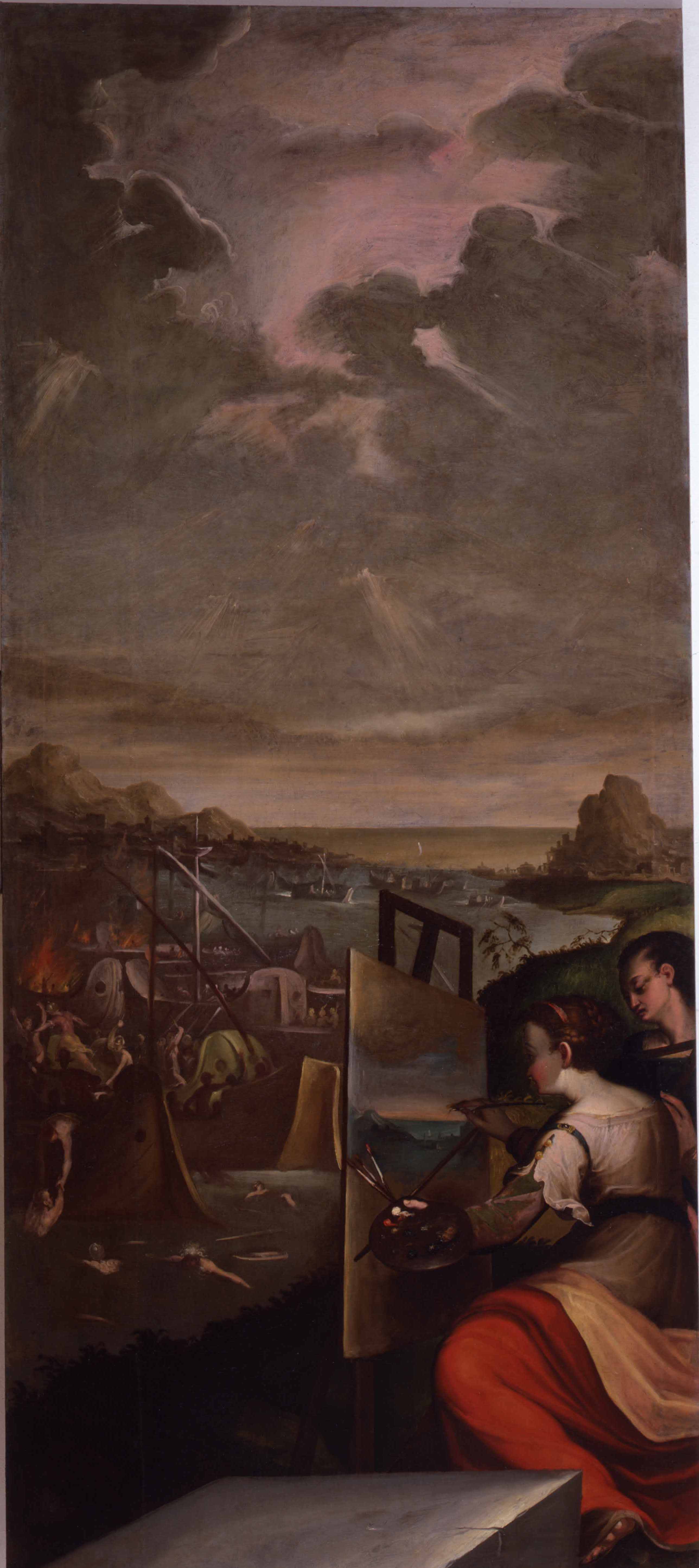
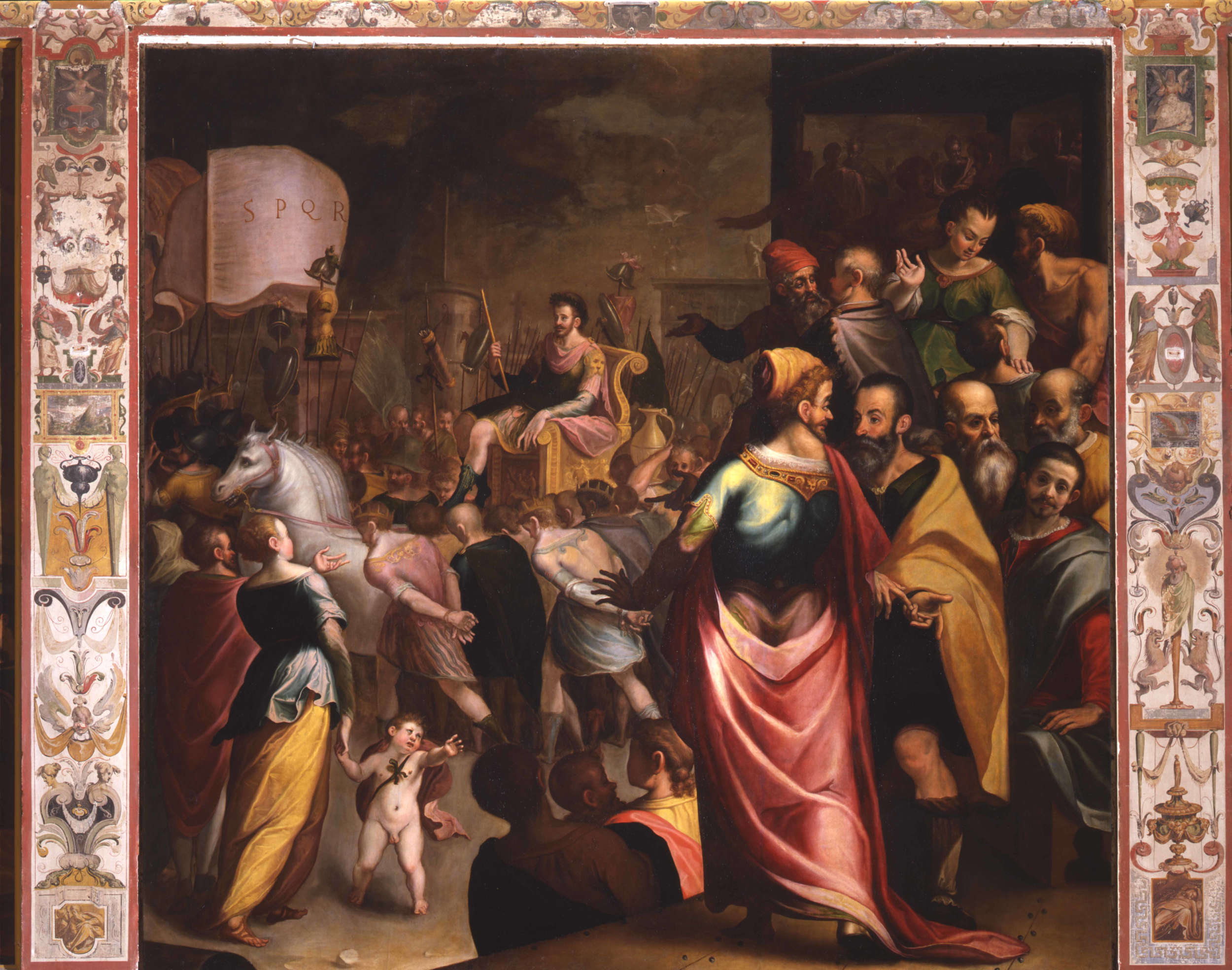
If Marcello Sparti's stucco framework provides the moral and plastic framework for the rooms on the second floor, the actual narrative of Palazzo Piccolomini alla Postierla relies on the majesty of the seven large canvases that cover the walls of the main hall on the second floor. These paintings, made in oil and attributed by critics to Dirck de Quade van Ravesteyn (The Hague, 1565? - news until 1620), a Dutch artist probably trained between the Netherlands and the Fontainebleau school, constitute one of the rare and excellent examples of "painted biography," as Marilena Caciorgna has defined it, present in the Sienese artistic scene. Indeed: according to the scholar, it is the most significant example of a cycle dedicated to a single figure in sixteenth-century Sienese art. The choice to celebrate the exploits of Scipio Africanus was not a simple exercise of admiration for classical antiquity, but responded to a precise strategy of self-celebration and political reflection on the part of the patron, Scipione di Cristofano Chigi, who intended in this way to pay homage both to his own name and to the tradition of civic virtue of his lineage.
The narrative cycle opens on the right wall with an episode that immediately brings into focus the hero's temperament: the young Scipio rescuing his wounded father during the Battle of Ticino. It is a scene charged with dynamism, where filial devotion is intertwined with military courage, underscored by the allegorical presence of the river deity of the Ticino, depicted according to classical canons as a bearded man lying on an amphora. This beginning is not only chronological, but programmatic, as it introduces the theme of the first test of valor, typical of Plutarch's biographies that served as literary models for similar pictorial endeavors.
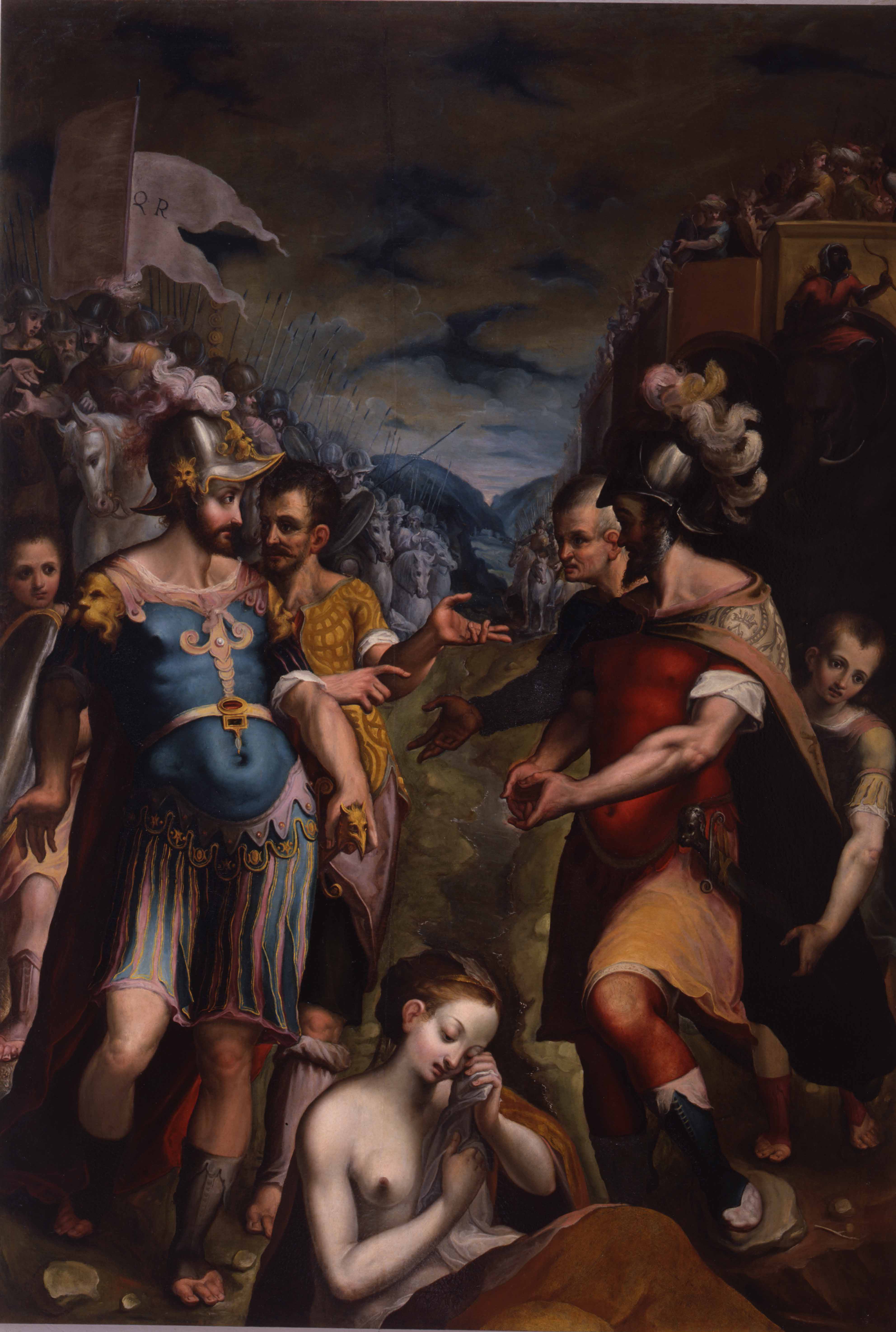
Continuing our reading of the canvases, we come across the dramatic juncture following the defeat at Cannae. Here the Africanus, just 19 years old, is portrayed in the act of firmly preventing Roman soldiers and young nobles from leaving Italy in a moment of despair. This is a crucial passage for understanding the message the Chigi family wanted to convey: tenacity in the face of state adversity, a virtue that Scipione Chigi himself had to exercise during the convulsive years of the decline of the Sienese Republic. The narrative then shifts to one of the most famous episodes dear to the iconographic tradition of the Renaissance: the Continence of Scipio. The scene illustrates the restitution of a young captive to her father and fiancé Allucio, leader of the Celtiberians, accompanied by the gift of treasure offered for ransom as an additional dowry. In this painting, the leader's magnanimity becomes a moral lesson on the ability to master one's impulses in favor of justice and diplomacy. Some scholars speculate that the figure looking toward the viewer on the far right of the canvas may be the very face of the patron or his son Camillus, creating a direct bridge between the Roman hero and the hosts.
The climax of the war exploits is represented by the conversation between Scipio and Hannibal, a meeting of giants that precedes the Battle of Zama. Ravesteyn paints here the tension of the failed negotiation, where the weeping female figure in the background personifies the tragic fate of Carthage, now close to destruction. The final victory is sealed by the next canvas, which shows the Romans intent on burning the Carthaginian fleet. This is a less frequent episode in the painted biographies of the period, but in the Sienese cycle it takes on special relevance to emphasize the totality of the triumph and the end of the Punic threat.
The sixth act of the series is devoted to Scipio's Triumph in Rome. In a riot of insignia, helmets, and corslets, the hero enters the capital greeted by a crowd among which several portraits stand out, perhaps members of the court of Rudolph II in Prague, where the painter later worked, or faces of the Sienese nobility of the time. It is suspected that a self-portrait of Van Ravesteyn himself is also among these figures, recognizable in the mustachioed man staring at the viewer.
However, it is the last painting that gives the profound and perhaps most bitter meaning to the entire cycle: theExile of Scipio at Literno. While most painted biographies ended with the apotheosis of triumph, the Piccolomini Palace series chooses to narrate the outraged retreat of the African, unjustly accused of concussion by his own fellow citizens. The scene, set in a cavernous cavern lapped by the sea where the figure of Neptune towers, shows the hero receiving the homage of pirates, or latrones. These marauders, paradoxically, show a higher regard for Scipio's virtue than that bestowed on him by Rome. This epilogue was not a random choice but a sophisticated allusion to the political situation in Siena. Indeed, the theme of theingratitude of the homeland and consequent exile was a painfully familiar topos to the local patriciate. Many Sienese families, including the Bellanti (a lineage to which Eleonora, wife of Scipione Chigi, belonged) had experienced trials, confiscations, and banishment during struggles for power. The reference to Scipio's famous epitaph, "Ingrata patria, ne ossa quidem mea habes," resonated within these walls as a warning and a defense of noble dignity wounded by institutional upheavals.
The literary sources that inspired this ambitious iconographic program were identified mainly in Francesco Petrarch's "De viris illustribus" and in the biography of Scipio compiled by the Florentine humanist Donato Acciaiuoli. Petrarch himself, in fact, dwells in great detail on the episode of the pirates at Literno, providing the painter with the narrative cues to build the atmosphere of melancholy grandeur that characterizes the last canvas.
Stylistically, Ravesteyn's work is distinguished by a lively palette and nervous drawing, typical of the Nordic taste that sought a synthesis between Italian monumentality and attention to descriptive detail. The canvases are not just decorations, but open windows onto an ethical conception of public life, where heroism is measured not only in triumph, but also in the ability to bear injustice and ingratitude with nobility.
Through this cycle, Palazzo Piccolomini alla Postierla confirms itself as a place where ancient history is used as a mirror for the present. The biography of Scipio Africanus thus becomes the ideal biography of the Sienese ruling class, capable of identifying with the wounds and successes of the Roman condottiere. In this hall, the visitor is invited to walk in the steps of a man who, after giving everything for his country, chose the solitude of his coastal villa rather than submission to dishonor. More generally, the palazzo at the Postierla is a fundamental testimony to sixteenth-century Siena, the story the story of a ruling class that sought stability in times of uncertainty, a residence that, despite its imposing size, retains a measure and dignity that make it one of the cornerstones of the Third City. The transition from the Chigi to the Piccolomini and finally to the State has allowed the preservation of this "biography in palace form," where every corridor and every hall continues to tell the story of the tenacity and culture of those who imagined and lived them.