





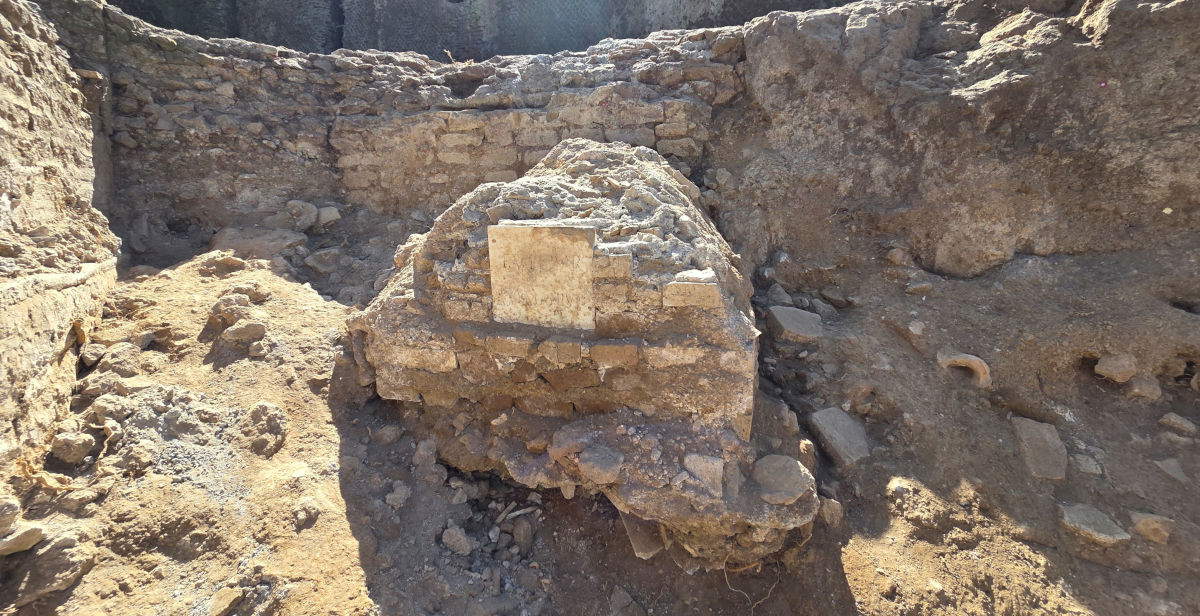
New evidence of the ancient Roman rite associated with the consecration of sites struck by lightning has come to light at the Villa Adriana in Rome, in the area of the so-called Amphitheater. The discovery was made in an area between the Amphitheater and the tuff bank, where archaeologists uncovered a small quadrangular structure built with tuff blocks bound by mortar. On the front, an inscribed marble slab measuring 40 by 35 centimeters is still in place, bearing the inscription FVLGVR SVBMANIVM in two lines of capital letters, fully preserved.
The discovery was made as part of research conducted by the Department of Humanities (DISTUM) at the Carlo Bo University of Urbino, under a grant from the Ministry of Culture and in collaboration with the Villa Adriana and Villa d’Este Institute. The inscription refers to a fulgur submanium, that is, a lightning strike attributed to Summano, the Roman deity of nocturnal lightning.
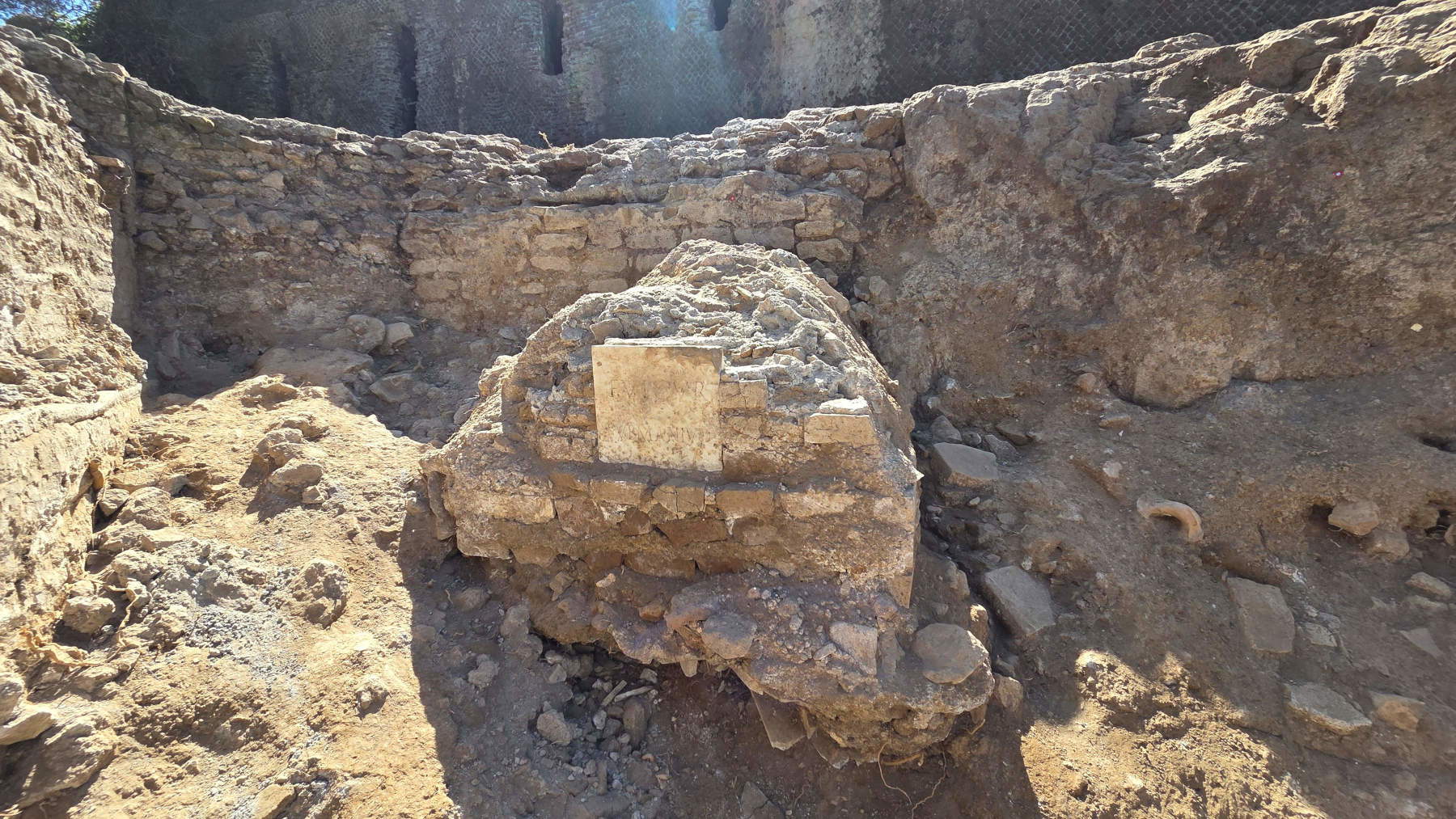
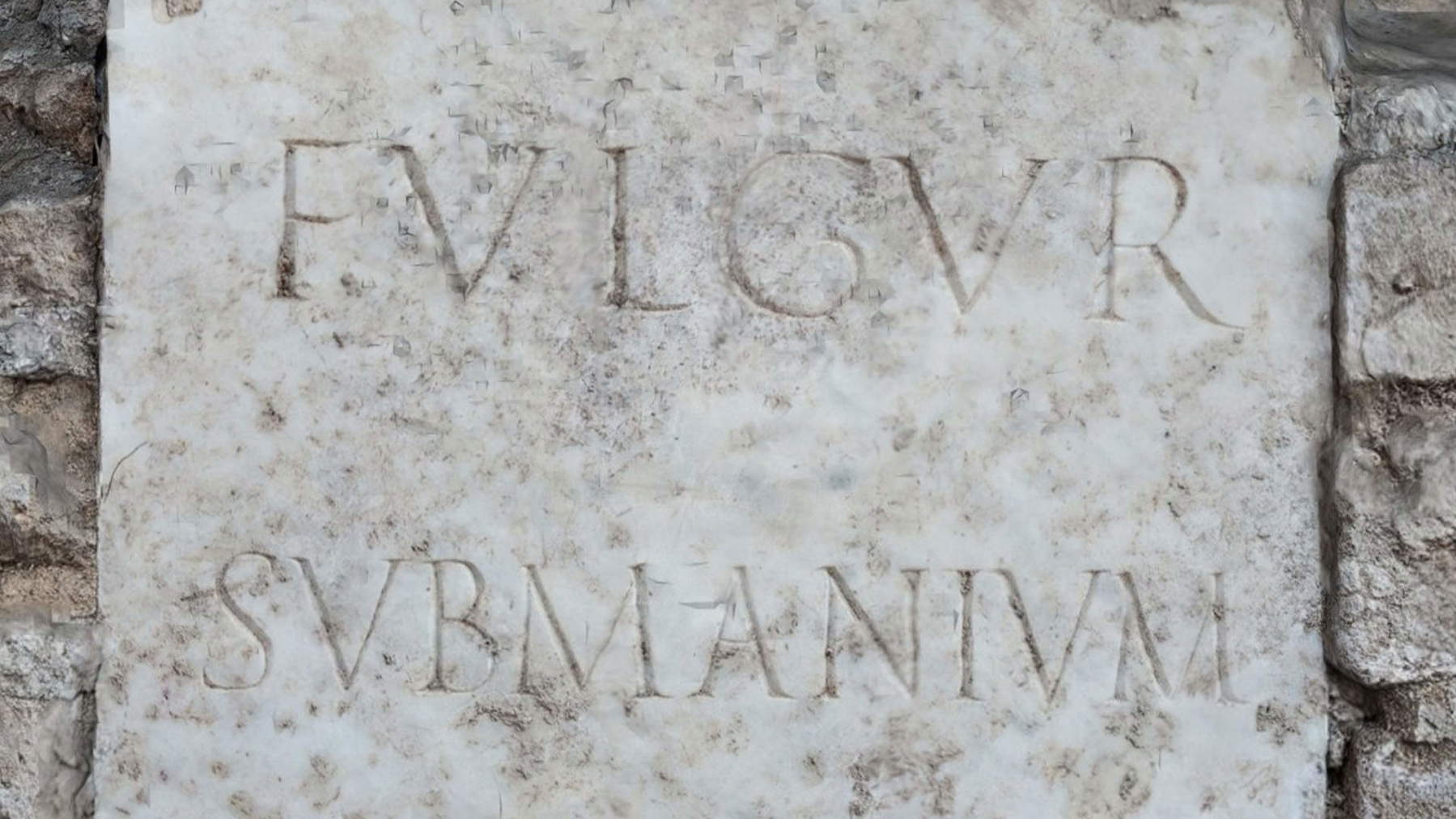
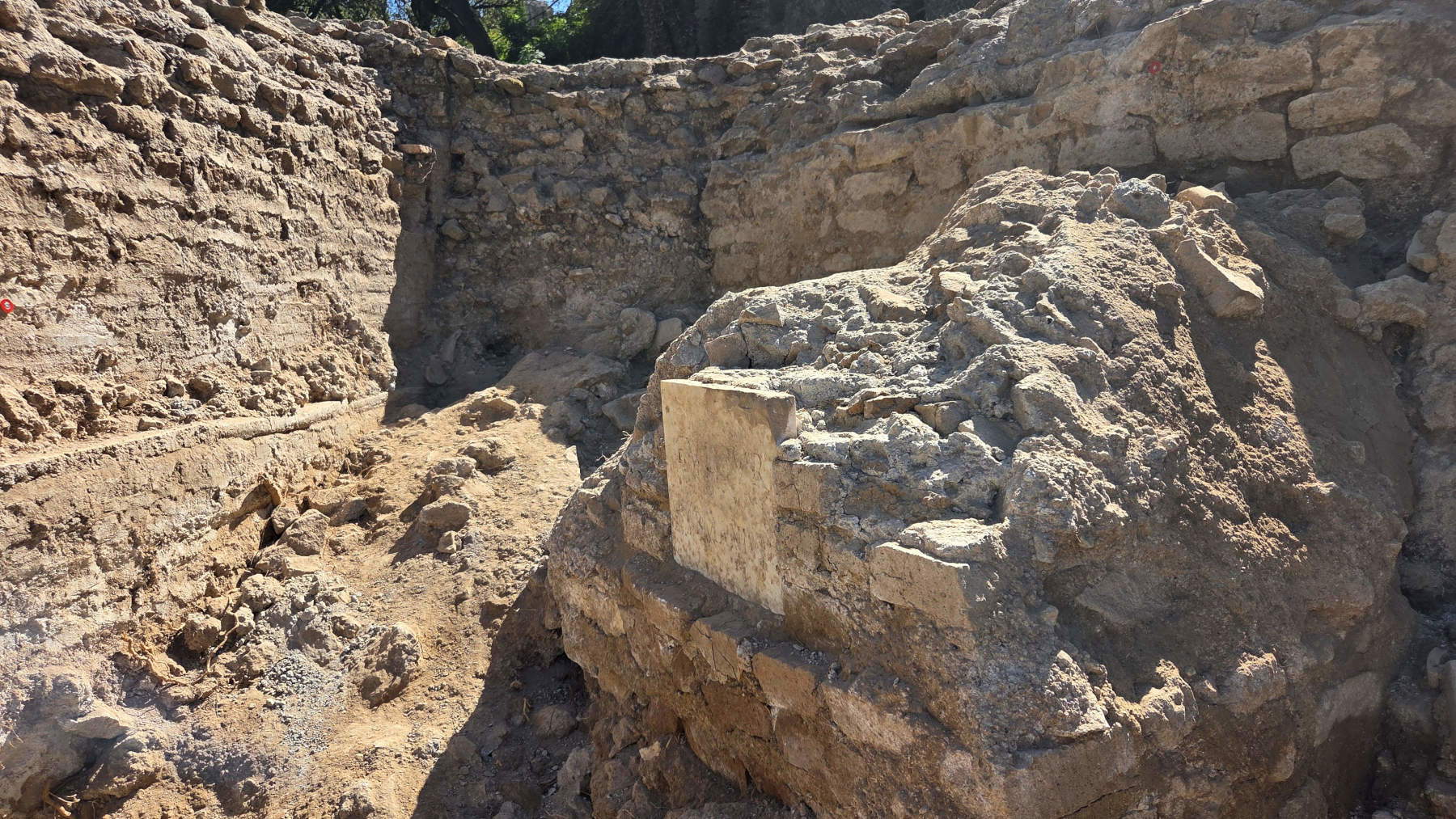
The original location of the slab is of particular interest. According to archaeologists, the complex is in fact linked to the ritual sanctification of the site struck by lightning and may constitute the marker or boundary of a bidental, the sacred space associated with this type of event.
In the Roman world, a site struck by lightning was considered religiosus, consecrated by the intervention of the deities. The physical traces left by the lightning strike were collected and buried in the ground, accompanied by ritual formulas and sacrifices: the expression *fulgur conditum* refers to this practice of deposition and burial.
“This discovery,” emphasizes Alberto Samonà, director of the Villa Adriana and Villa d’Este Institute, “shifts the focus from grand architecture to the more intimate sphere of Roman religiosity. Finding the material evidence of the sanctification of a place struck by lightning allows us to experience firsthand the meticulous ritual procedures of the time. It is a finding of extraordinary scientific value, for which I am grateful to Professor Cavallero, director of the excavation, and to the team from the University of Urbino, who worked in fruitful collaboration with our archaeologists at the Villa Adriana and Villa d’Este Institute. Archaeological research at the VILLÆ of Tivoli continues to prove invaluable in revealing not only the forms of power but the entire cultural, anthropological, and religious framework of the ancient world.”
““The Department of Excellence DISTUM,” notes Professor Berta Martini, director of the Department of Humanities (DISTUM), “has supported this excavation since its inception, recognizing its value for research and student training both in the field and in UniUrb’s dedicated laboratories. This exceptional discovery confirms the importance of the collaboration between the University of Urbino, the Ministry of Culture, and the Villa Adriana and Villa d’Este Institute. The Department will continue to support the investigations and the study of the finds, including through the activities of the Imaging for Humanities laboratory and the use of new technologies in the field of archaeology.”
“The discovery of the inscription FVLGVR SVBMANIVM, still preserved in its original position,” explains Professor Fabio Giorgio Cavallero, director of the excavation, “is a finding of exceptional importance. The stratigraphic relationship between the fulgur conditum, the leveling of the palace discovered in the area of the so-called Amphitheater in 2024, and the burial of its structures may clarify the sequence of events that led to the transformations of the entire monumental area. The discovery opens up new perspectives on the history of this sector of Villa Adriana and on the role of the fulgur conditum ritual in the reorganization of the spaces.”
“Archaeological research at Villa Adriana,” add Viviana Carbonara, the official in charge of excavation permits, and Sergio Del Ferro, the official in charge of Villa Adriana, “is essential for continuing to understand a site that still has much to reveal. The currently active excavation permits, together with investigations directly sponsored by the Institute that will begin in the coming months, are yielding previously unknown and, in some cases, completely unexpected results. The discovery of the inscription dedicated to the ‘fulgur submanium’ demonstrates once again how excavation can open up new perspectives on our understanding and help rewrite pages of the site’s history, revealing its complexity and extraordinary cultural richness.”
 |
| Villa Adriana: An Inscription Discovered That Reveals a Site Consecrated After a Lightning Strike |

Warning: the translation into English of the original Italian article was created using automatic tools. We undertake to review all articles, but we do not guarantee the total absence of inaccuracies in the translation due to the program. You can find the original by clicking on the ITA button. If you find any mistake,please contact us.

























 IT
IT FR
FR DE
DE ES
ES CN
CN


