




by
Federico Giannini  @federicogiannini1
14/10/2026
@federicogiannini1
14/10/2026



Categories: Exhibition reviews / Disclaimer
In Rome, at the Scuderie del Quirinale, a major exhibition reconstructs the entire world of Jacopo Carucci, known as Pontormo. But behind the haunted figures, the bodies overcome by death, and the suspended visions of his paintings, one question remains: how much of his mystery stems from the man himself, and how much from his art? It is a question that accompanies visitors throughout the exhibition. A review by Federico Giannini.


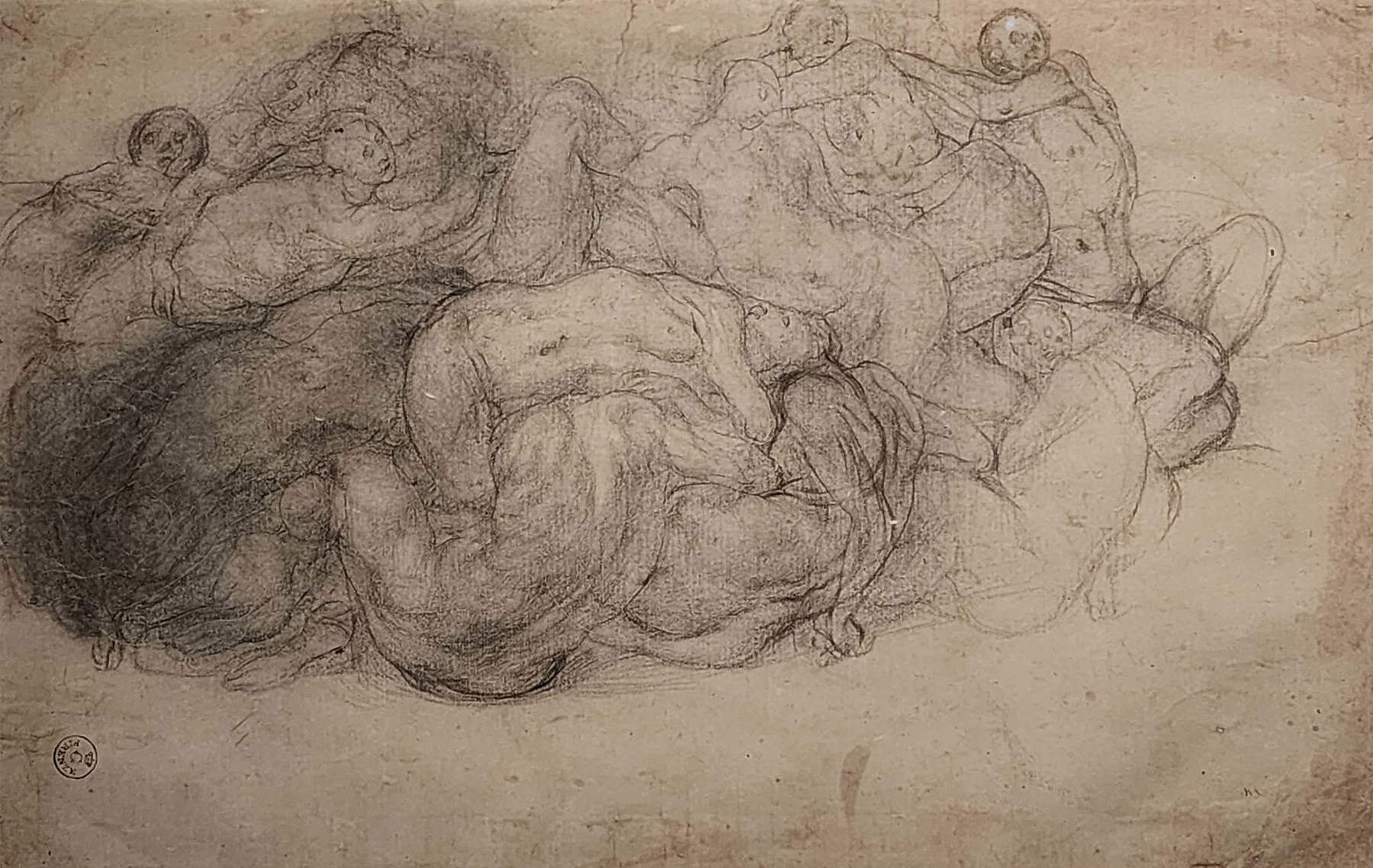
To his contemporaries, the frescoes that Pontormo painted in Florence on the walls of the choir of San Lorenzo must have seemed an extreme, laborious expression of defiance— that “negative Sistine Chapel,” as Luciano Berti had called it—the epitome of an extremism that paid the price for its intransigence with oblivion: first criticized, then deteriorated, ruined, and whitewashed, and then demolished in the mid-18th century—a violent death met with no regret by those who were there at the time and witnessed the ruin, the stumps, and the rubble, remembering that it was a loss not to be mourned. What remains are drawings, sheets that, at the robust Pontormo exhibition staged at the Scuderie del Quirinale, are partly displayed inside a horizontal display case—the kind where visitors must bend over at a ninety-degree angle to get a better look, to see the details—especially toward the end of the exhibition, when the public, exhausted by Carucci’s psychedelic visions, hopes to make its way to the exit, to return to reality, and thus tends to overlook them. And yet they are the most outrageously carnal works to be found within this impeccable and despotic, sordid and splendid, gloomy and acerbic, which has brought together nearly everything that could be gathered of Pontormo’s work—even the frescoes, even the ensembles created for sites that have remained intact for five centuries—an exhibition brimming with comparisons, episodes, contexts, reunions, and encounters. Little survives of the San Lorenzo choir, and of that little, two sheets are on display: one is titled “Study for the Great Flood,” but more precisely it is a tangle of naked bodies, desperate muscles, and flesh swept away, submerged, and drowned by the whirlwind. It is one of the last images of death conceived by this artist—if not the very last—and even without giving credence to the 17th-century legend about Pontormo, who, in order to depict those figures lifelike, kept corpses in troughs of water to make them swell, there is more than enough here to sense the anguish of a painter who, perhaps, had never stopped thinking about death.


Vasari’s biography of Jacopo Carucci, known as Pontormo—*The Life of Iacopo da Puntormo, Florentine Painter*, included in Giunto’s edition of *The Lives*—opens with a notarial list of bereavements: his father died when he was five, his mother at ten, his grandfather at twelve, and from then on he grew up alone with his grandmother, who taught him to read and write; when he was old enough to work, she placed him in a shoemaker’s workshop. By the age of eighteen, however, he had already lost his entire family, including his grandmother and his sister, who was three years younger than him: his existence was marred by this staggering, grim succession of traumas, compounded by the events of the time (the year he lost his sister, 1512, is also the year in which Prato—not far from his hometown of Pontorme and from Florence, where he had already begun working—was attacked and slaughtered by the Spanish army allied with Pope Julius II, who intended to bring down the Republic of Florence and restore Medici rule: in Florence, news of the bestial looting, rapes, torture, and senseless killings of defenseless Prato residents—even those who had hoped to find refuge in churches—made such a profound impression that it prompted the city to surrender spontaneously to the Medici and their allies), it is natural to imagine (as Giorgio Vasari imagined, as Luciano Berti imagined) that a sort of complex, a recurring thought, must have taken shape in Pontormo’s mind—one that the artist perhaps attempted to push aside. Or, at the very least, the suspicion arises almost imperceptibly that death explains Pontormo’s painting, only to then change one’s mind and think that it is Pontormo’s painting that leads us to reinterpret his life through the lens of death.


Broadly speaking, this is the question that guides us through the galleries of this rigorous exhibition, and it is perhaps one of the most sensible questions to ask while walking through it, because there is nothing to say about it, except that its one plus four curators—namely, Cristina Acidini with Elena Capretti, Philippe Costamagna, Bruce Edelstein, and Carlo Falciani—probably can’t stand to lose and have therefore gone to great lengths to secure an easy victory, much like Brazil against Liechtenstein at the Maracanã, and to top it off with the best possible curators, the ones capable of persuading clubs to send their strongest players, the ones who never get a lineup wrong, the ones who’re always smiling at the press: they’ve gathered it all (if one were to play the role of a whiny nitpicker, one might just note the absence of *Giuseppe in Egitto*, a key work by Pontormo, in the room where the Borgherini Chamber has been reconstructed), they’ve recreated settings and contexts, scattered a few handfuls of Andrea del Sarto here and there, a light drizzle of Dürer’s woodcuts in the Galluzzo fresco room, a few sprinkles of Michelangelo, and an entire gallery of portraits by Rosso Fiorentino, Puligo, and Franciabigio. And then there’s the lighting, which borders on perfection, and the contexts that have been pieced back together (we’ve mentioned the Borgherini Chamber, but at the Scuderie even the Bettini Chamber has been restored for the first time—and, moreover, to a “degree of completeness that not even the patron ever saw,” as the exhibition panels explain), the many stylistic approaches that are compared right from the start, with the first room immediately stunning the public with the frescoes of the Chiostrino dei Voti, featuring Pontormo and Rosso side by side from the very beginning. What can one say about an exhibition like this? That the Deposition should have remained at Santa Felicita, that it was necessary to avoid tearing it from its context because it has been perfect and intact for five hundred years and should be left as it is? That Baccio d’Agnolo’s frame is missing, and since they were already there, they might as well have brought that too—otherwise, the “Deposition” seems incomplete? That the tondos by Pontormo and Bronzino in that plaster mock-up imitating the layout of the Capponi Chapel are arranged in a semicircle rather than in pairs on either side, as they are in the original? That they’ve emptied the Uffizi, leaving it—until the new year—deprived of a fundamental chapter of the 16th century in Florence? That the finale, with the Visitation displayed almost as if it were a totem, risks turning the work into a sort of second-rate Mona Lisa? That it is anachronistic today to seize nearly the entire body of work of a giant and display the spoils in a designated venue—one that is, moreover, far from the artist’s natural habitat? One might say that this isn’t the first time the Deposition has left its church (it did so recently for the magnificent exhibition on the Florentine sixteenth century at Palazzo Strozzi nine years ago); one might say that it’s impossible to recreate the chapel’s appearance in full detail, but it’s necessary to convey an idea of it, and besides, the walls of the original are white, and until not long ago, the small dome was also unpainted; one might say that the Uffizi will manage just fine for a few months even without the Pontormo, people will say that the public still needs recognizable icons—otherwise, how can they remember Pontormo?—and they will say that the very purpose of a monographic exhibition is to bring together as many works by a single artist as possible in a single venue, especially since this exhibition—to which the curators have chosen to give the banal title *Pontormo*, as if to say that here we are presented with a total, pure, absolute Pontormo—is, in fact, the greatest exhibition ever dedicated to Pontormo, surpassing even that of 1956, which did not have access to, as this one at the Scuderie does, of the “Lady of Frankfurt”—which is by Bronzino but was attributed to Pontormo until quite recently—of the “Madonna of the Corsini Princes” in Florence, which has, however, always been attributed to Pontormo from Berenson onward, and of certain works from private collections that are rarely on view. Is seventy years an acceptable time for a return?


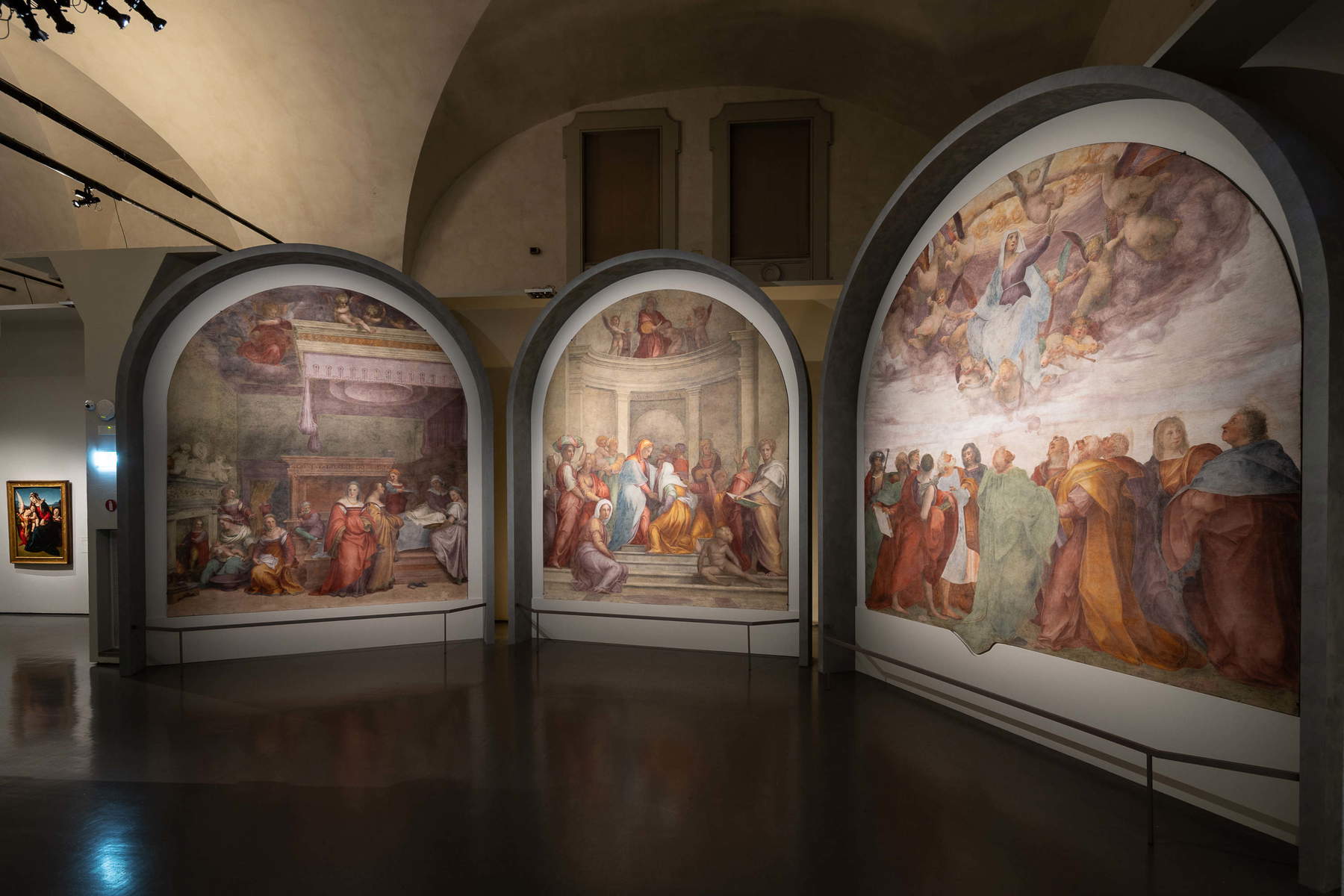
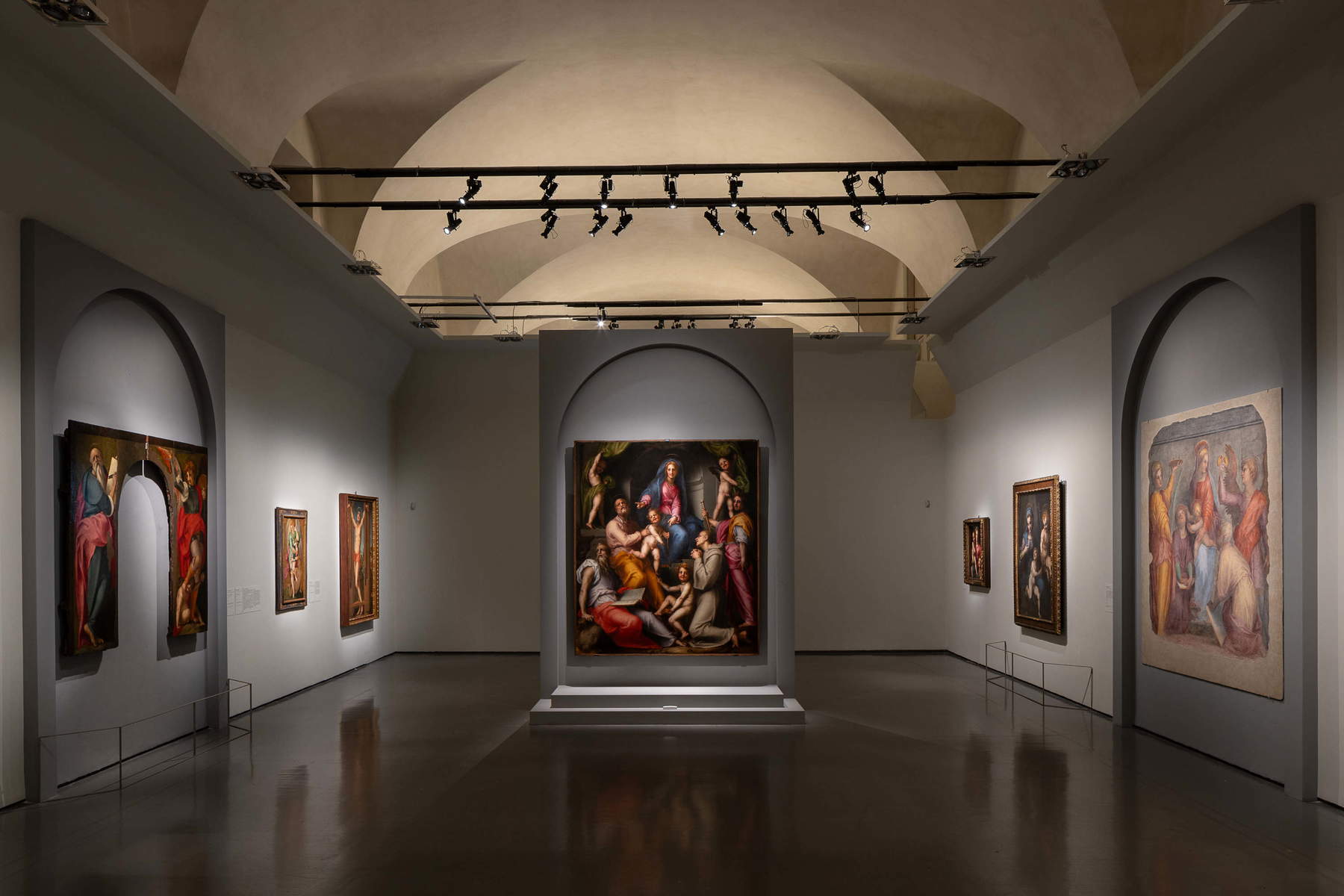
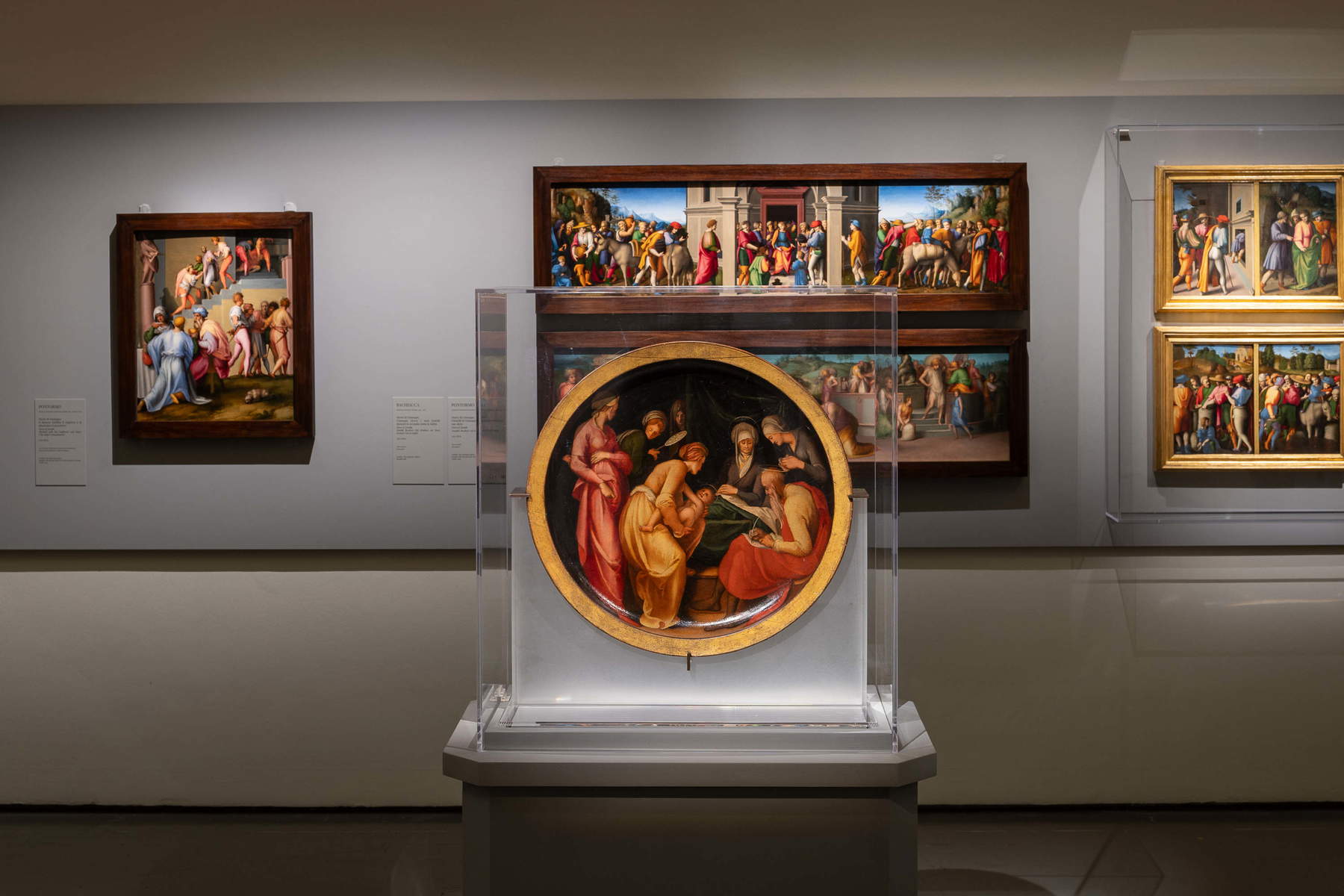
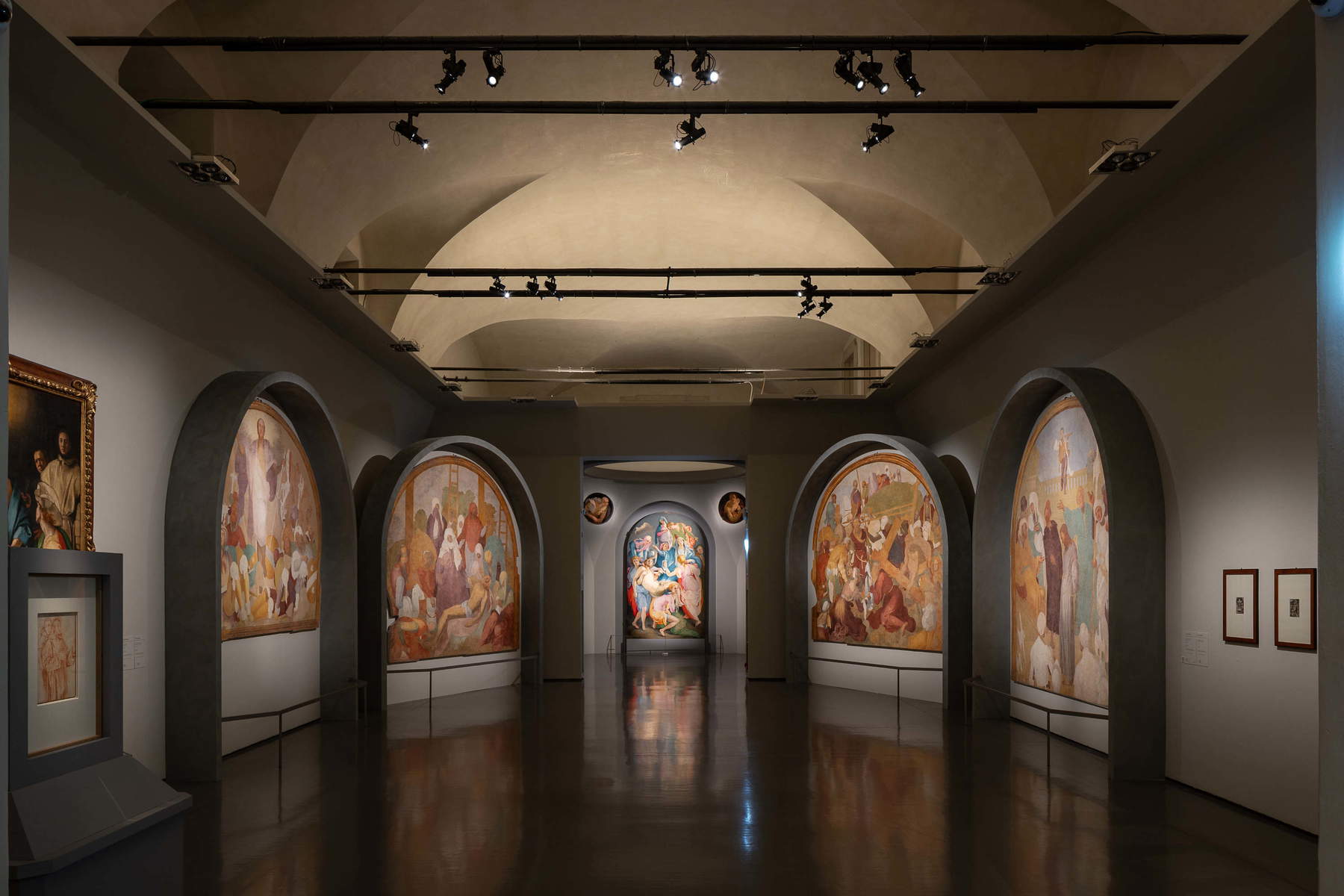
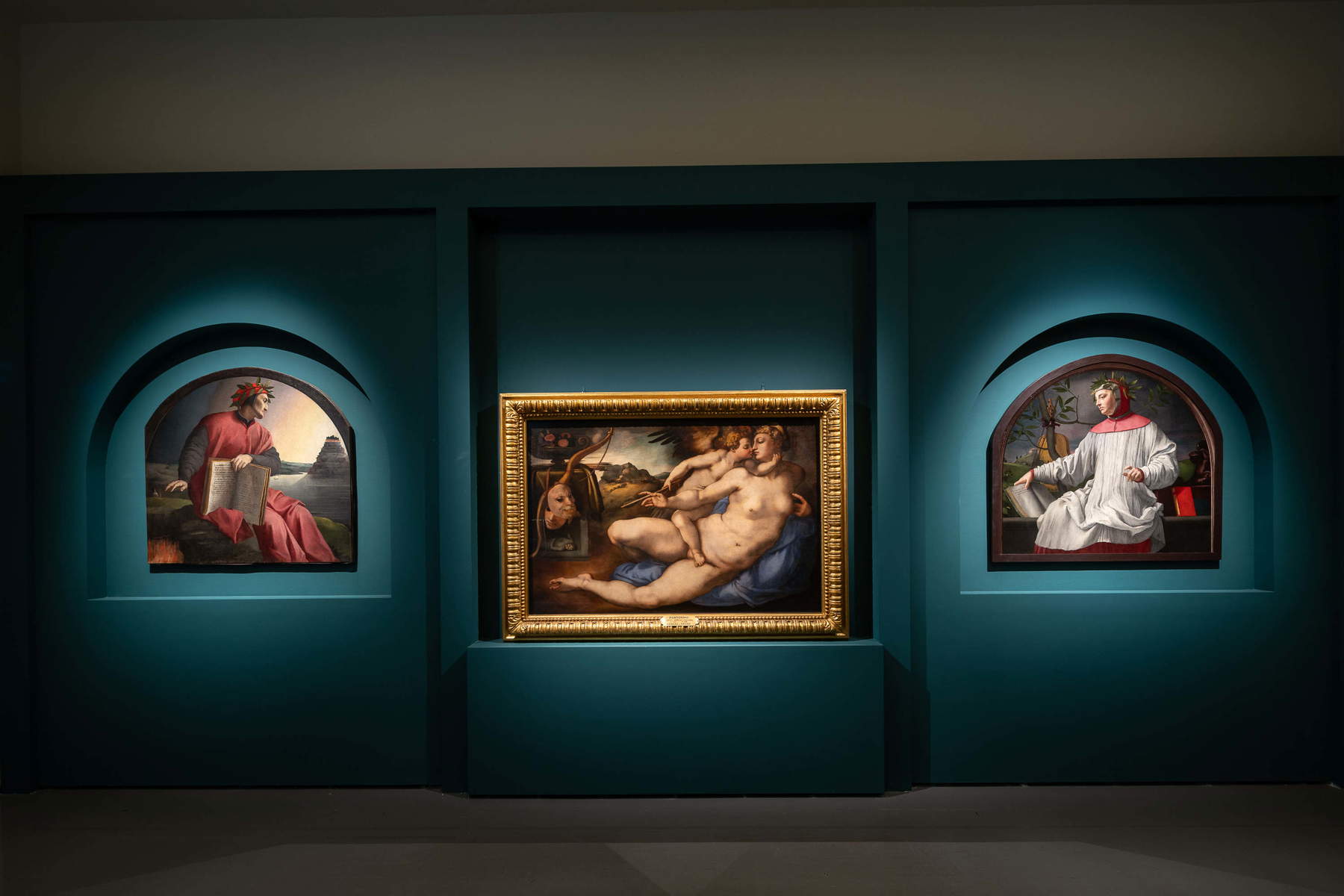
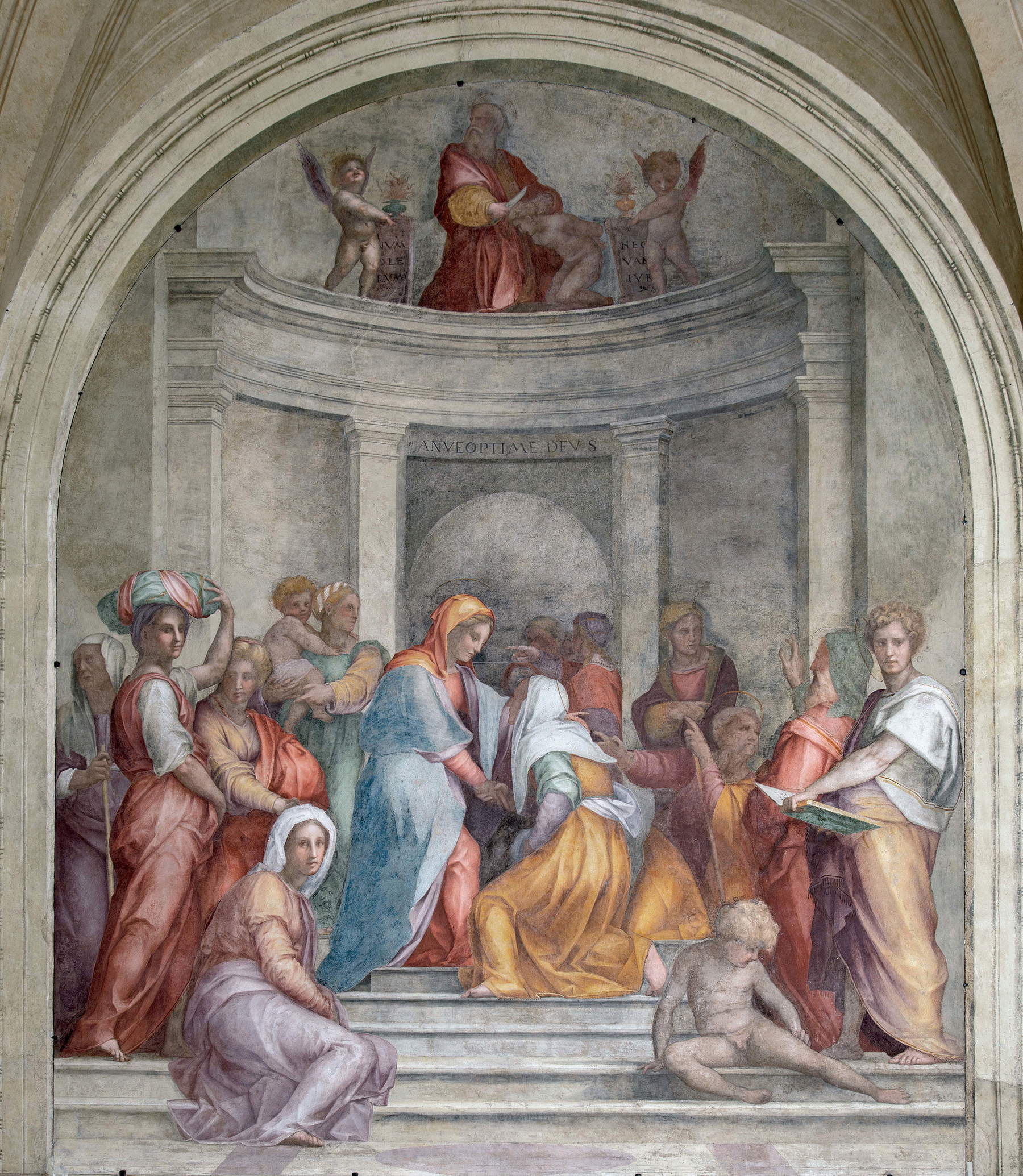
While searching for an answer to the question, perhaps it is best to create one’s own Pontormo, to detach him from the rhythm of the spectacle, to find him within the curators’ flawless narrative, amid the folds of those perfect installations, beyond the barriers, hanging on the temporary walls, between the lines of the captions. It is clear that Pontormo is perhaps, more than others, a painter to be viewed from the side, diagonally—if only to avoid being blinded (a risk one runs from the very first room, when the visitor is thrust, and with a certain violence, against the three frescoes in the Chiostrino dei Voti: on the left, the master Andrea del Sarto; in the center, Pontormo; and on the right, his ghostly, phantom-like Doppelgänger, Rosso Fiorentino: in the *Visitation*, the young Jacopo, aged twenty, still retains a semblance of order—an order that here is Doric—and yet those billowing folds of cloth, that jumbled, implausible narrative with its improbable little nude on the staircase, all those judgmental glances directed at us—starting with that of the blond figure standing on the right, perhaps a self-portrait of the painter—well, all of this is already a foreshadowing of the mature Pontormo). And it is evident right from what is perhaps his first known work—or if not the first, then one of his earliest—that hospital scene which one does not encounter immediately along the curators’ suggested route: one must recover from the impact of the detached frescoes from the Chiostrino dell’Annunziata; one must see the Pontormo who painted the two saints for the church in his hometown—works that have been brought to the exhibition following their restoration, transported here directly from that very church— and then one must move on to the “audition” with the masters—Andrea del Sarto, Mariotto Albertinelli, and a persuasive, enameled Piero di Cosimo—who is placed in dialogue with the Pucci Altarpiece, the first work—along with the two saints from Empoli—in which Pontormo begins to display, with a certain mastery, his mature repertoire of evasions, elongations, contortions, translucent and vitreous colors, and dazzling iridescence, and mask-like faces that would sometimes become actual masks (note, in the next room, the two little monsters holding the family coat of arms on the back of the birthing table depicting the Birth of Saint John the Baptist). One needs time to recover from all this before coming to one’s senses again upon seeing the small fresco depicting the hospital scene, with the miracle of the healing of the Blessed Humility (and the very same little slippers in the foreground that Andrea del Sarto had painted in the Chiostrino dei Voti, a sort of homage to his master), that Pontormo who, even as a boy, had a certain familiarity with death—or at least with all the anguish that the sight of a hospital filled with patients lying motionless in their beds can provoke, others having themselves washed with compassion, and amid all this clinical green, this waiting-room green, one almost seems to overlook the saint praying for the resurrection of a dead little girl (it should be noted, however, that there is no unanimous agreement on the precise subject of Blessed Humility’s prayer).
Then there is, one might say, a death that is also generative, because the frescoes of the Certosa del Galluzzo were painted when Jacopo took refuge here to escape a brutal plague that was ravaging Florence: “It is to ‘the epidemic,’” Cristina Acidini reiterates in her essay written for the exhibition, “that we owe the paintings on the walls of the Great Cloister, beginning in 1523, of the memorable cycle of the Passion of Christ in five large lunettes”: four of these have been loaned to the exhibition through the generous concession of the Community of San Leolino, which today serves as the custodian of the Certosa. Standing before these frescoes—a unique example in Pontormo’s oeuvre, as it is the only instance of massive inspiration drawn from the ideas of Albrecht Dürer—it is natural to feel somewhat compelled to wonder what had happened within the rooms of the Certosa that led Pontormo to begin painting “in the German style,” as they must have said in his day, only to stop shortly thereafter. Any assessment, however, is flawed from the outset due to the state of preservation of these frescoes, which today are shadows, shadows amidst which one occasionally glimpses the fleeting clarity of a face, a bow, a hand, a sleeve—modern shadows without consent, due to the violence inflicted by external agents that have eroded the colors and caused the details to disintegrate. We do not know the reasons for this further anti-classical and anti-rhetorical turn; one can only speculate on the artist’s circumstances, on the historical moment, on a possible crisis in Pontormo’s life: the plague, solitude, the pontificate of Adrian VI, the end of the world as it had been until then, and the resulting shift—as Berti would have written—“into a foreign realm, into a dialogue with printed sheets from distant lands, featuring a different style of figuration, and one as violently imaginary as Dürer’s in his two series of the Passions.” Now, however, if one looks—and the exhibition allows for this—at Dürer’s Risen Christ and, immediately afterward, Pontormo’s Risen Christ, one will realize that, despite the evident inspiration and beyond the similarities, there exists an irreconcilable gulf between those two figures: Dürer’s Christ triumphs like an emperor; Pontormo’s Christ is pure spirit. Dürer’s Christ stares straight ahead; Pontormo’s Christ feels the need to raise his eyes to heaven. Dürer’s Christ stands firmly on the ground, his legs in a contrapposto pose, like Apollo, like Jupiter. Pontormo’s Christ has just begun to levitate; he is detached from the ground and is rising upward. Dürer’s Christ affirms the signs of his power over the world. Pontormo’s Christ manifests himself as distance, as impossibility.
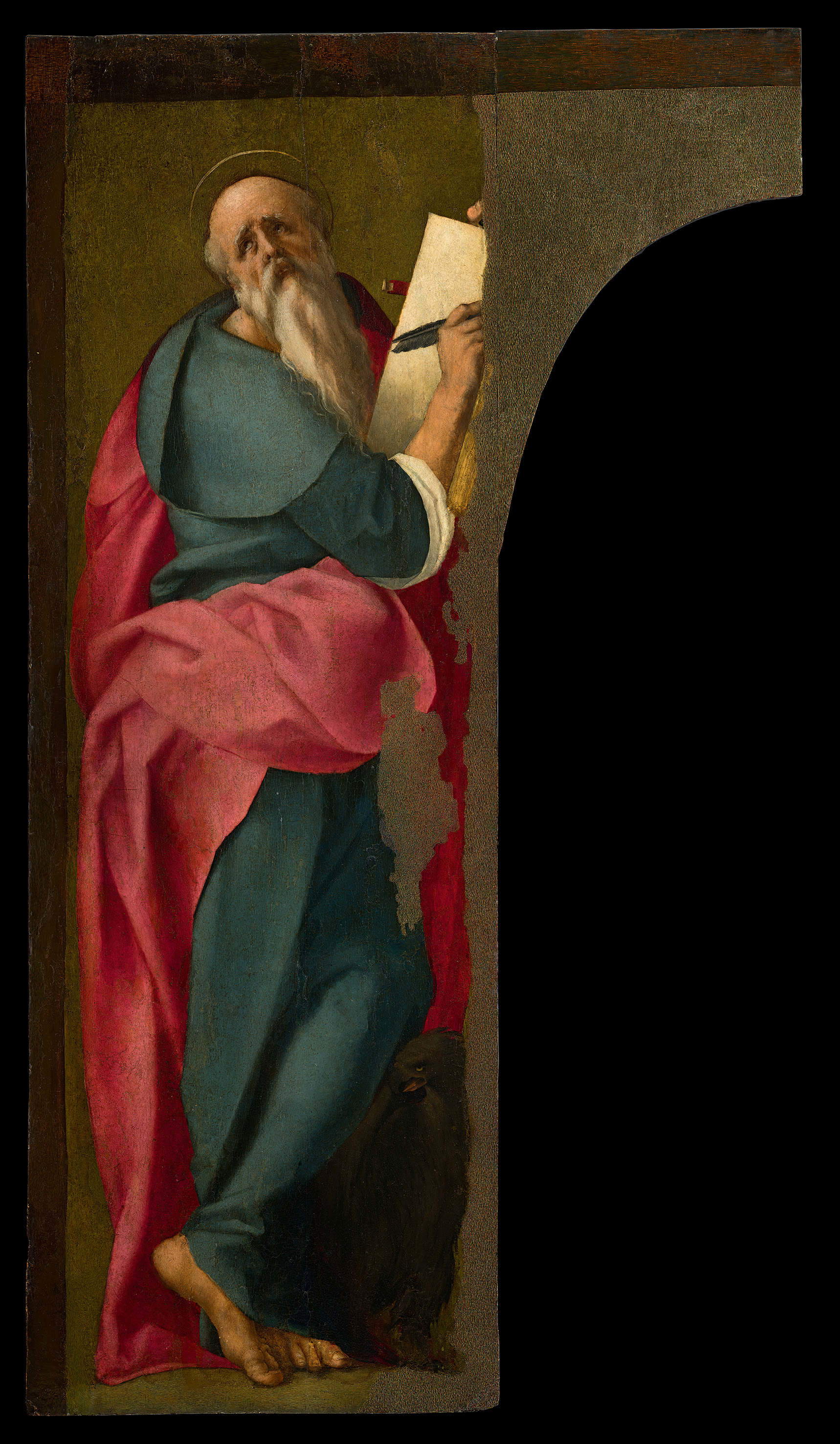
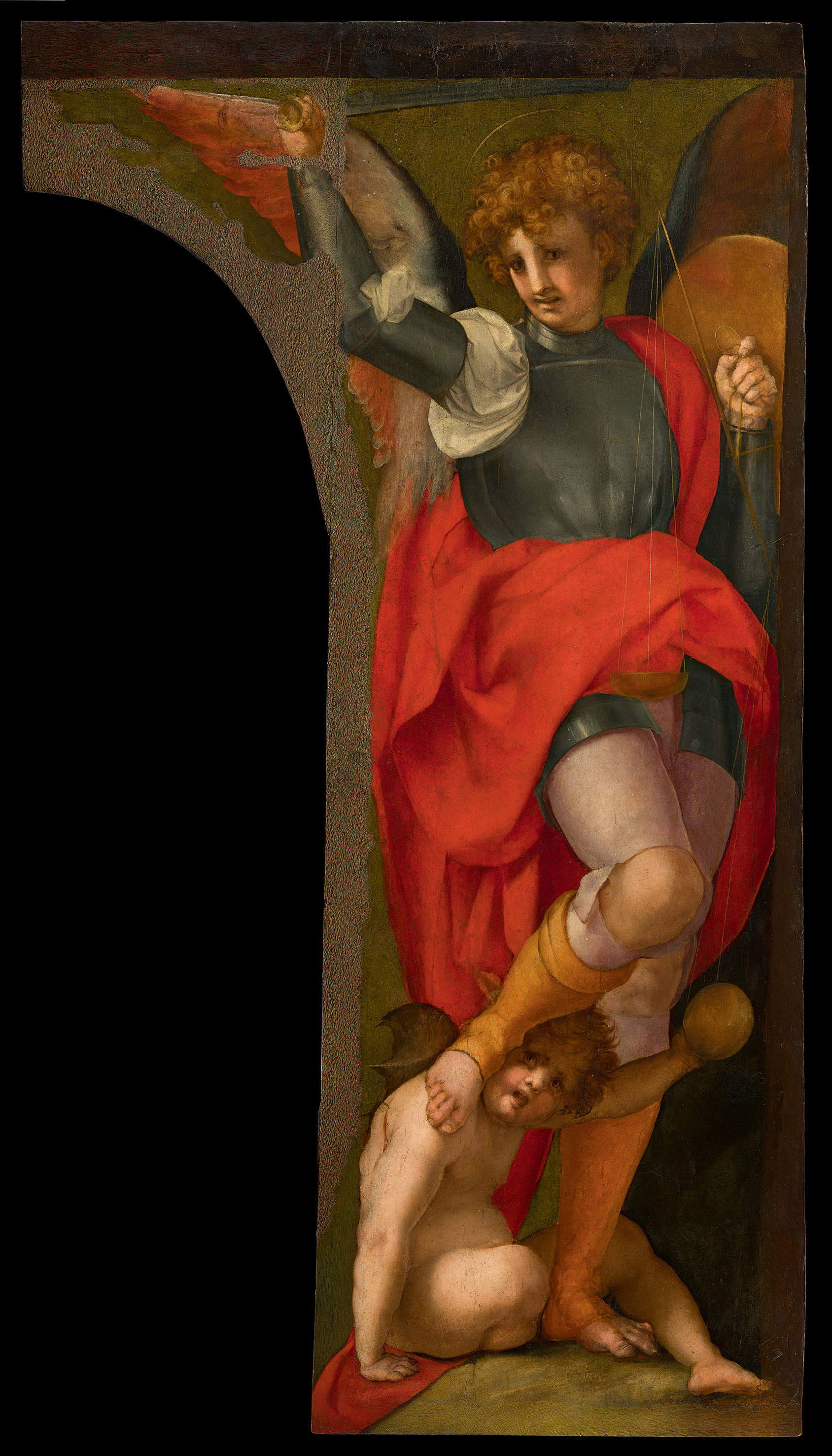
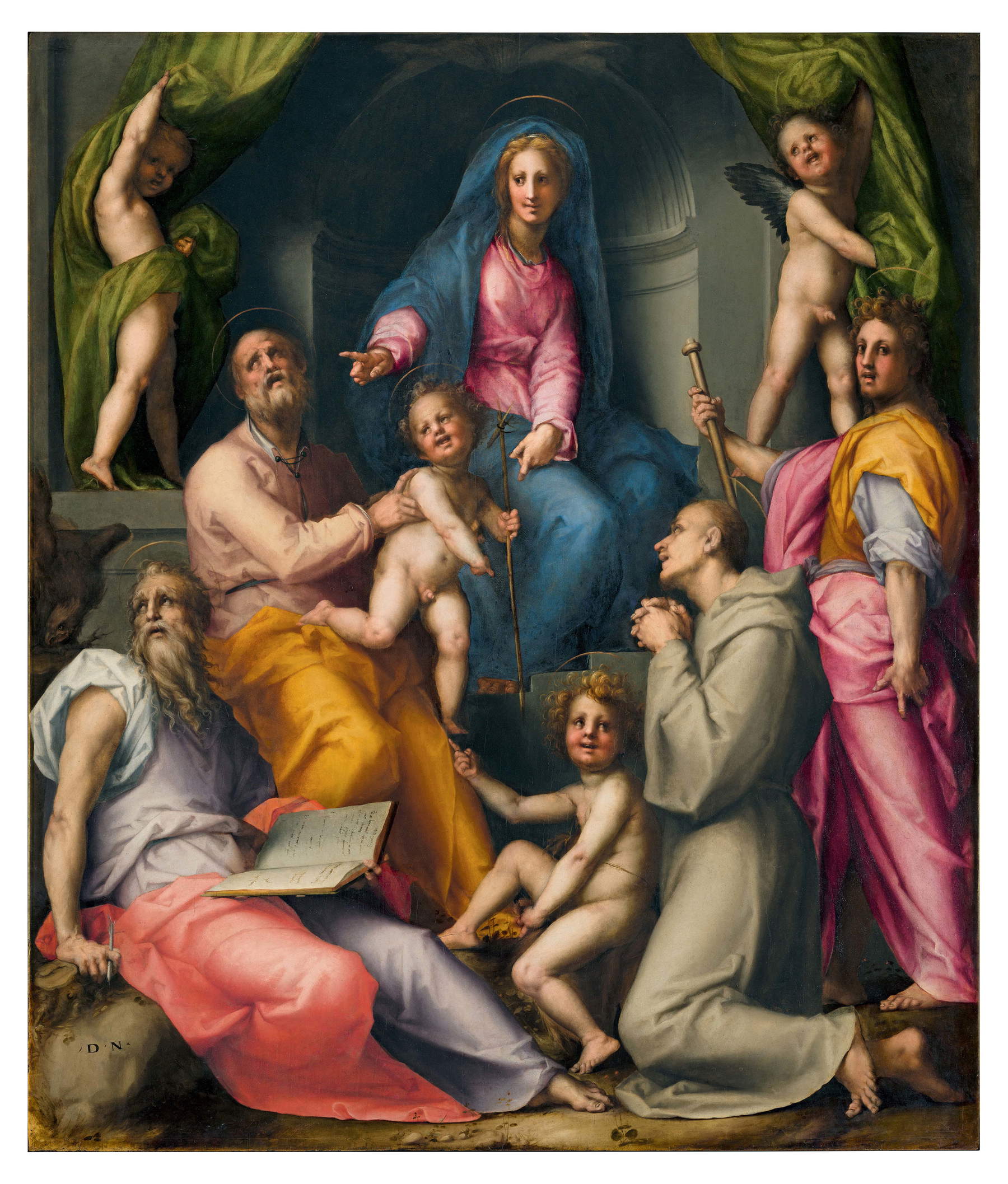
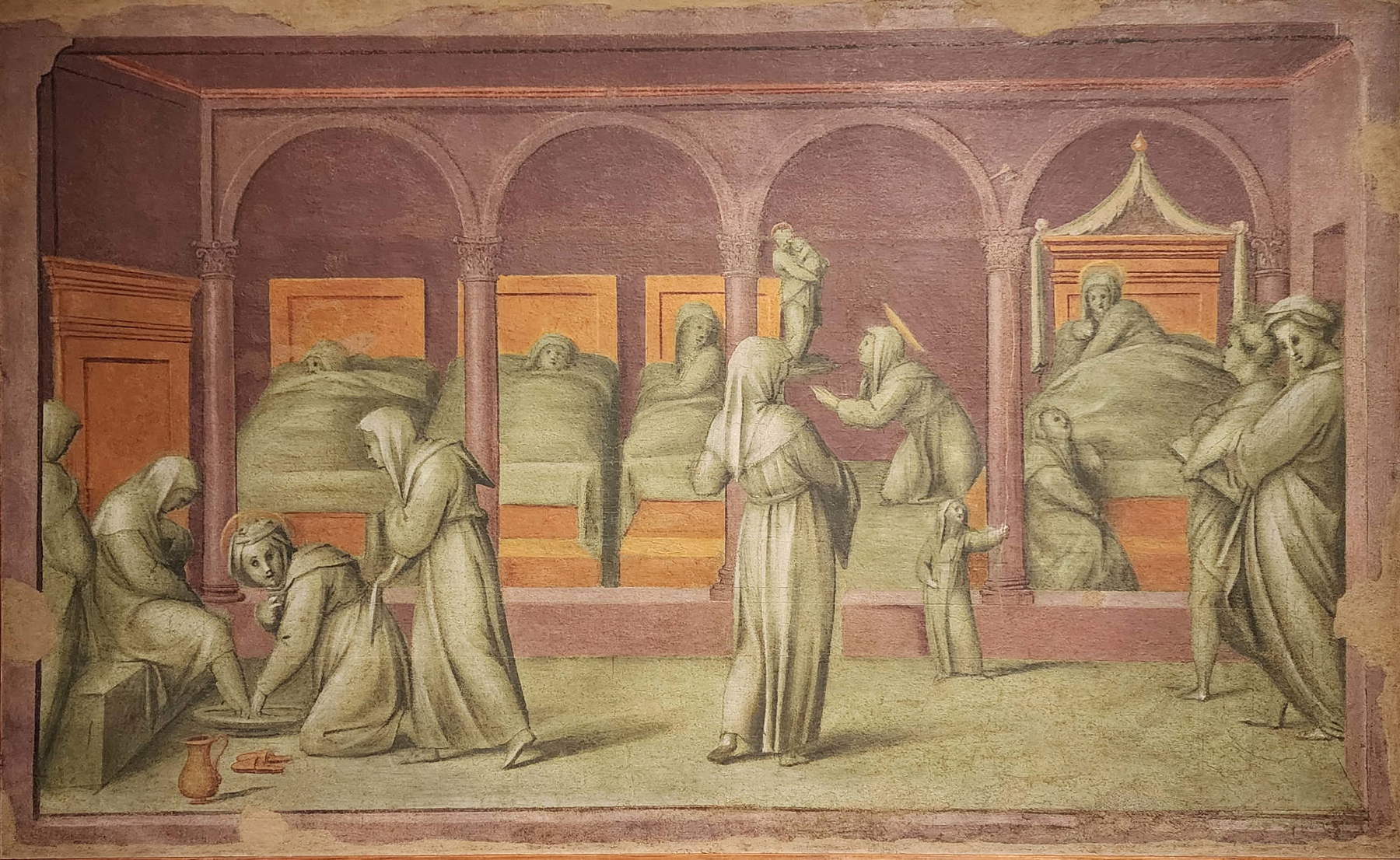
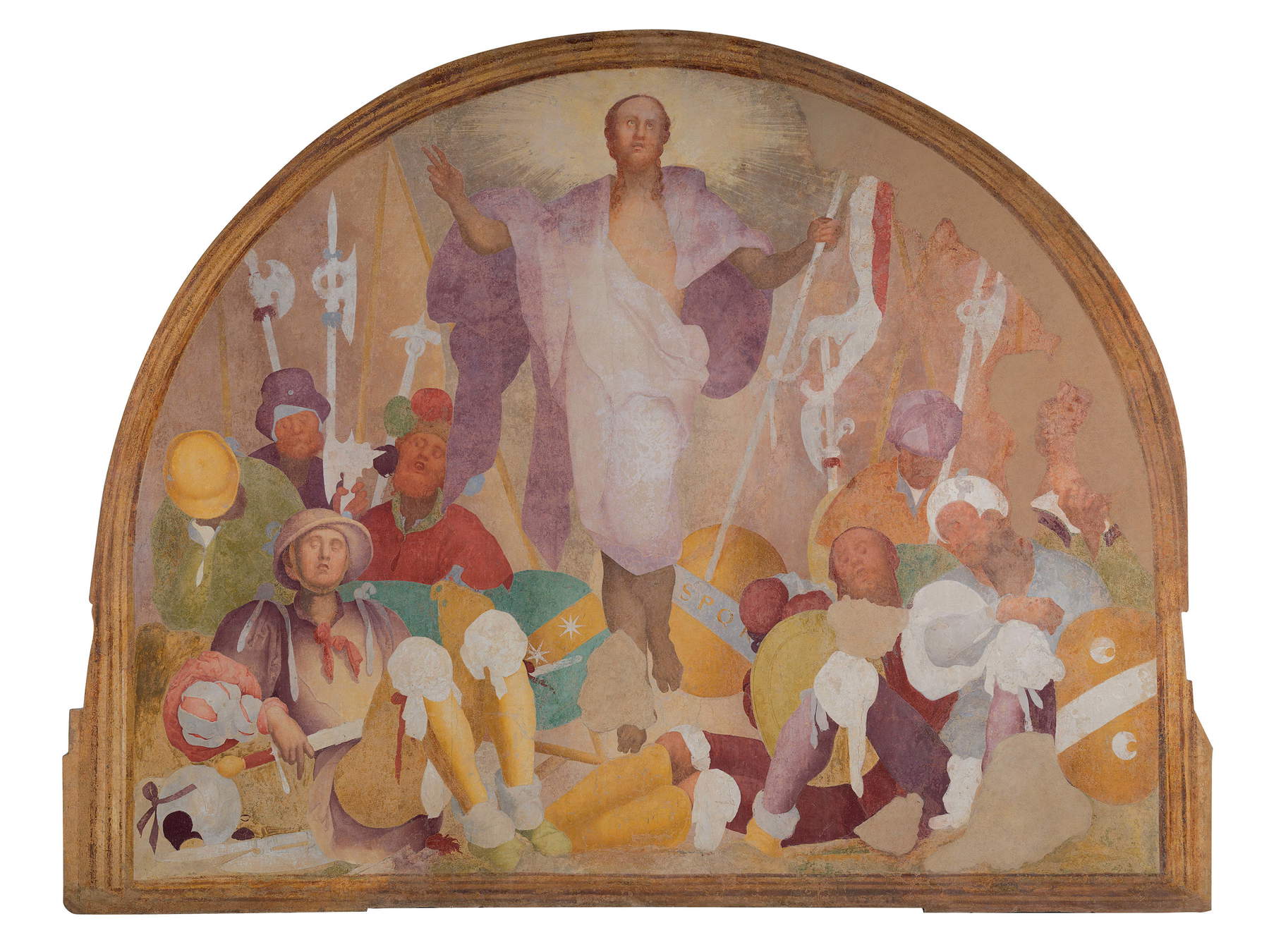
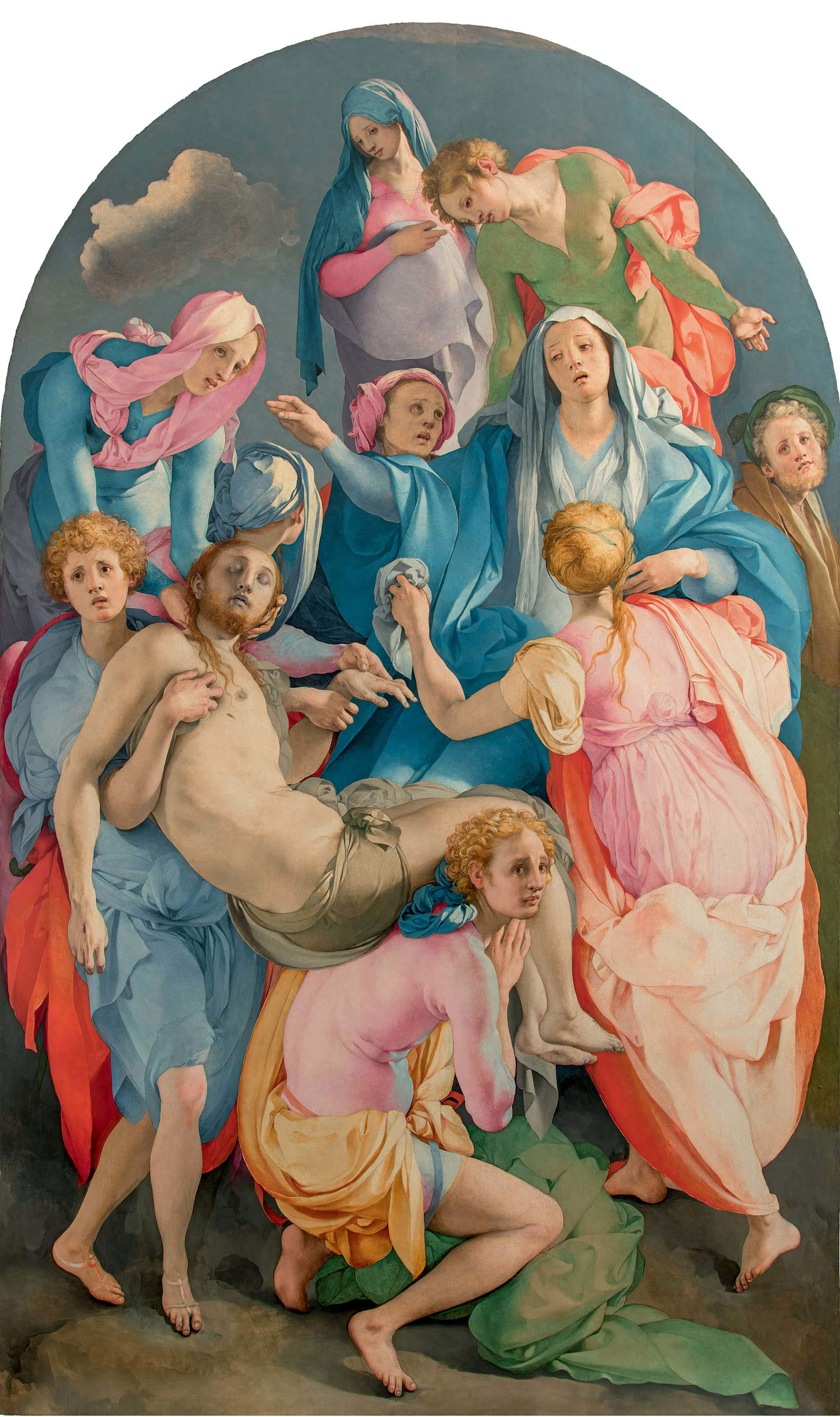
It may be true that Pontormo had gone through a period of personal crisis, but one might think that, even if the crisis were temporary or, more simply, even if one were to dismiss the Galluzzo frescoes as a conditioned response to the historical context, one senses in Jacopo Carucci’s art the trace of a mental turmoil: whether it be a turmoil in the face of death, illness, or the historical moment—it is as if Pontormo’s paintings had come to express the anguish of a man faced with something he could not understand, let alone control, a man entangled in a web from which he could not free himself. The paradox is that even the divine is incomprehensible, and human beings can only entrust themselves to that which is above them, without even being able to touch it. Indeed, it is precisely when we reflect on this Christ—halfway between matter and spirit—that the Deposition of Saint Felicita appears in the exhibition to offer an image of this desire that cannot be mastered. In Saint Felicita, this powerlessness gives rise to ecstasy. An abstract, incorporeal ecstasy—certainly not oblivious to a more earthly, harsher, even more passionate tradition (the Vesperbilds of medieval churches come to mind)—an ecstasy due in part to the revelation the artist experienced inside the Sistine Chapel, yet one that rejects every standard of proportion and balance—a state that, as Gigetta Dalli Regoli has written, goes so far as to contradict tradition understood as the set of “methods for constructing images that were widely shared in the past and thus became a codified system,” to the point that it seems as though one is witnessing a flight of angels rather than a Deposition, a gathering of acid-hued, livid ghosts floating in an empty space, a swirling mass “enveloped in a grandiloquent display of drapery” (Luisa Becherucci), a languid and painful caress in which, if one is to grasp a sliver of truth, it will be found at most in the emotions, in the expressions. It is amid this floating array of acid mauves, washed-out blues, and herbaceous, unreal greens that the search began for the “neurotic, moody, and transgressive” Pontormo, writes Acidini in his essay—so close to twentieth-century sensibilities— the Pontormo from the psychiatric ward—the Pontormo who paints canvases and frescoes to be read as medical records, as nosographic classifications, as psychopathological assessments. It is true that overinterpreting images risks turning them into caricatures (and often, with Pontormo, this has indeed happened), that deciding in advance that an artist is tormented leads one to mistake every painting for a diagnosis, and that the exhibition also sets among its goals that of restoring Pontormo to Jacopo Carucci, toning down the alleged eccentricities in the name of greater fidelity to the truth. Certainly: Pontormo was not that antisocial outcast who would have vented his frustrations by leaving signs of incurable madness all over his paintings. And yet this does not erase from his art that intensity which is impossible to dismiss and which is difficult to interpret without bearing in mind the possible trace of a disturbance. A turmoil that certainly does not make a painter any more dissociated or unbalanced—a painter who, until the very last days of his life, worked on commissions of the highest prestige; who maintained relationships of spontaneous cordiality with other painters, with men of letters, and with the Medici court; and who knew how to conduct himself in society: it simply makes him more human, without the need to imagine a man who must necessarily have been tormented, on the brink of madness, in order to recognize just how unsettling his painting is.
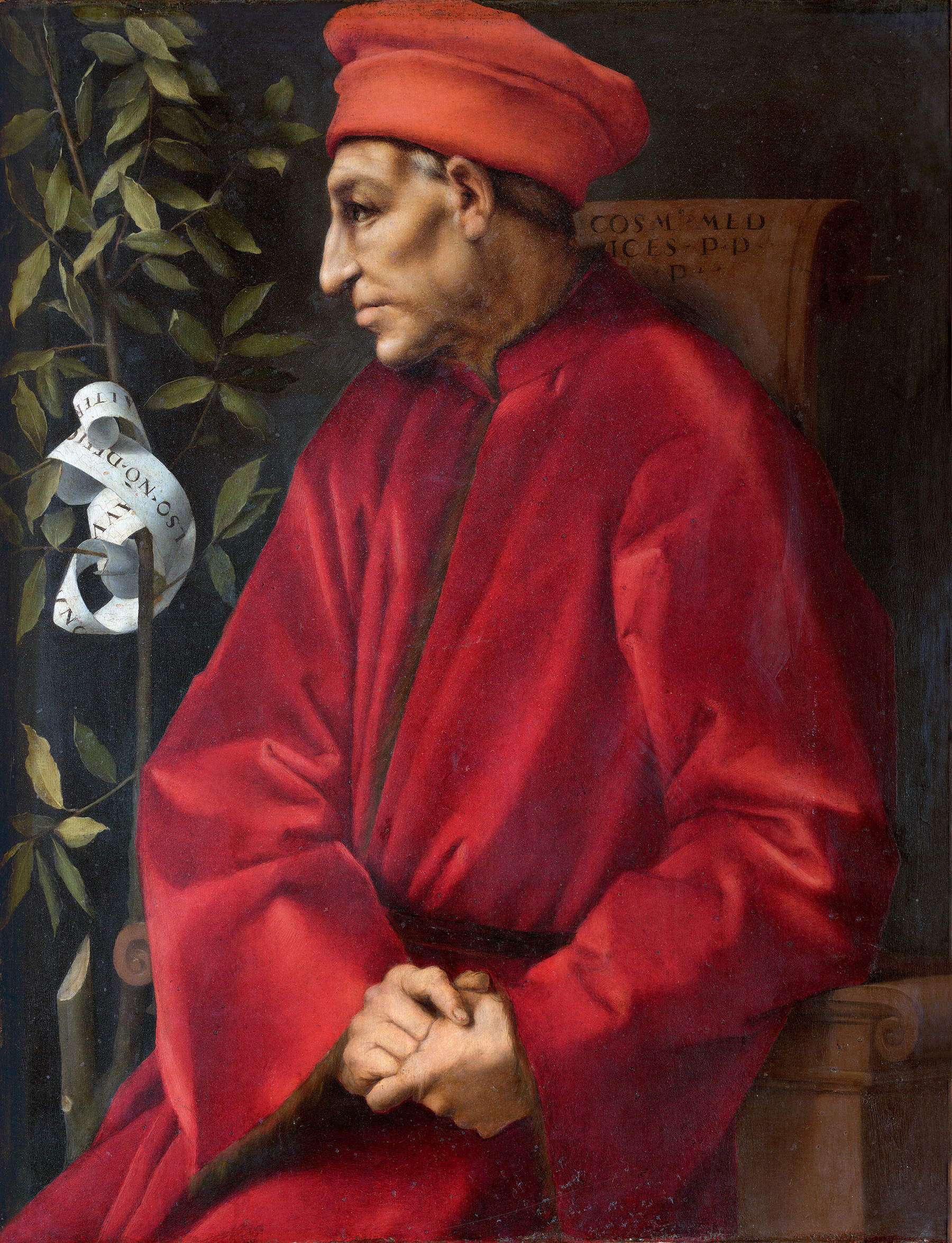
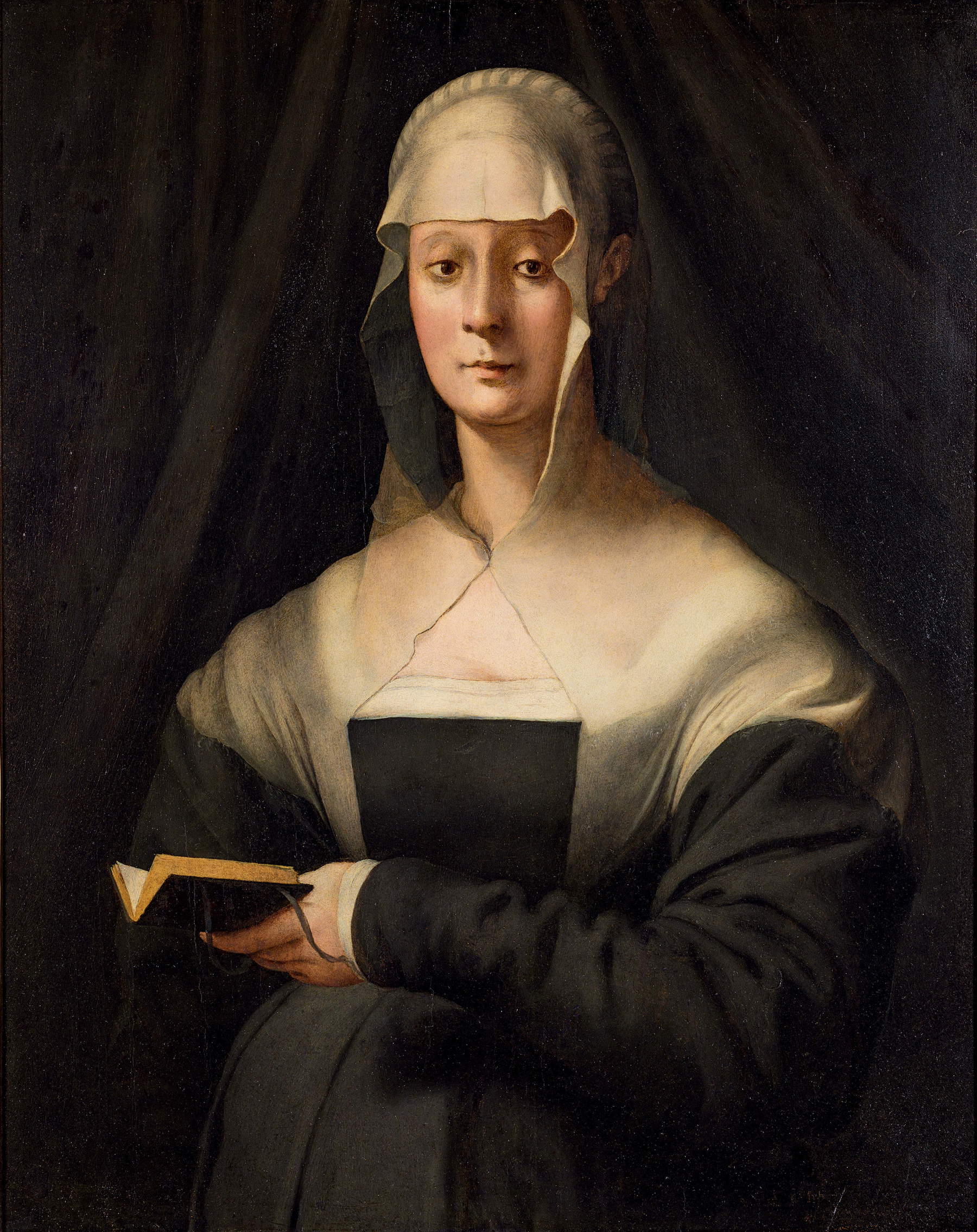
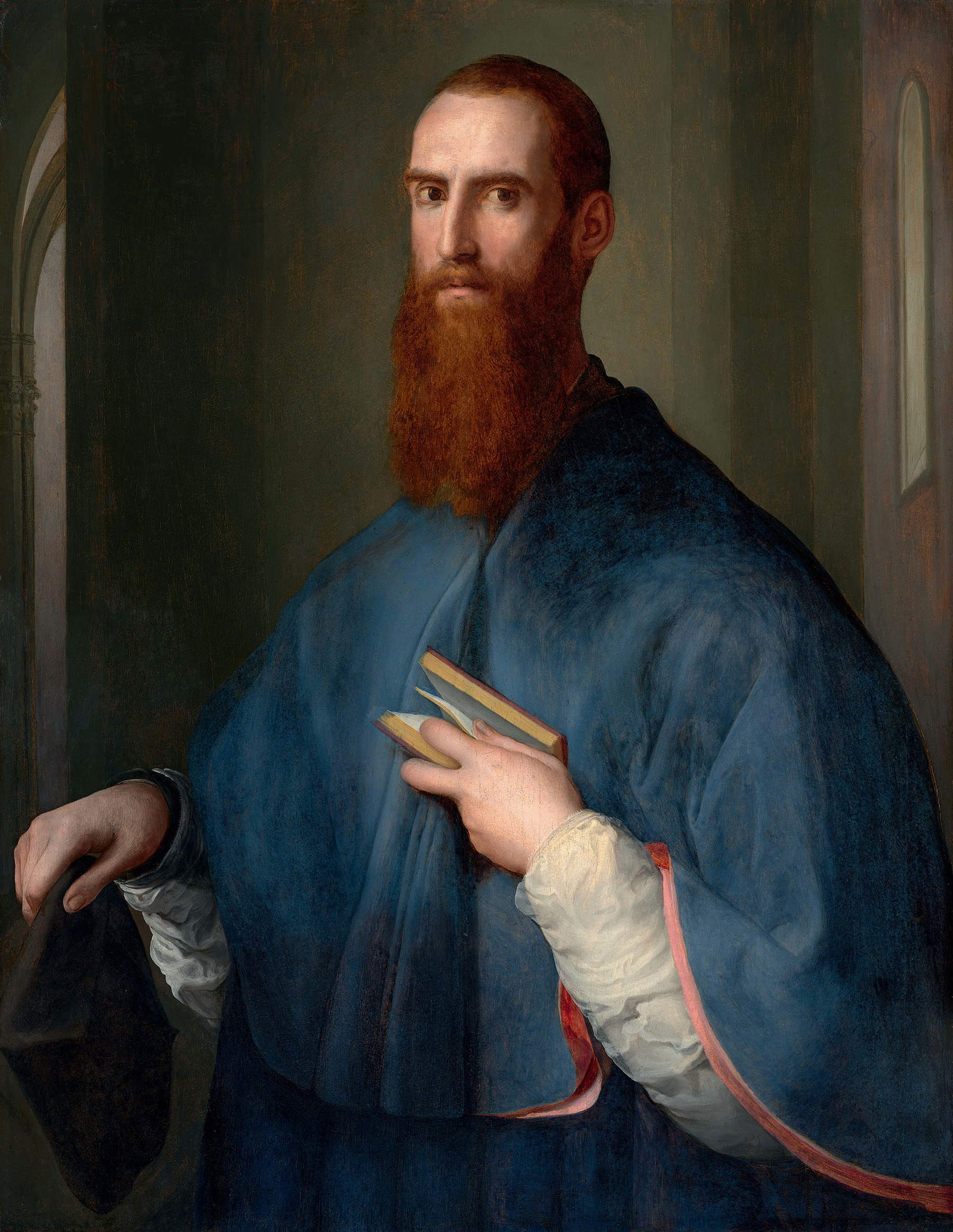
Take his portraiture as well. The idealized portraits (those of Dante and Cosimo the Elder) are at once courtly and obscure, symbolic and oblique; they possess a metallic soul: consider the Dante, for example, alongside the Petrarch by the equally icy Bronzino. They are evocations rather than allegories. The portraits of real figures, despite their vividness, maintain a certain distance. The young man from Lucca who, while fixing his gaze on the viewer’s eyes, loses his physical substance beneath clothing of improbable proportions. The goldsmith, on the other hand, averts his gaze. The lifeless eyes of Giulio de’ Medici. Maria Salviati, almost reduced to a geometric form. The metaphysical light of the Portrait of Monsignor. Compare all of this with Bronzino’s enigmatic, cold, and institutional stillness; with the authentic dignity of del Rosso’s young man; with the grotesque realism of Jacone’s Piero de’ Medici; and with the ministerial pride of Puligo’s virile portrait. It is as if there were almost always a tension.
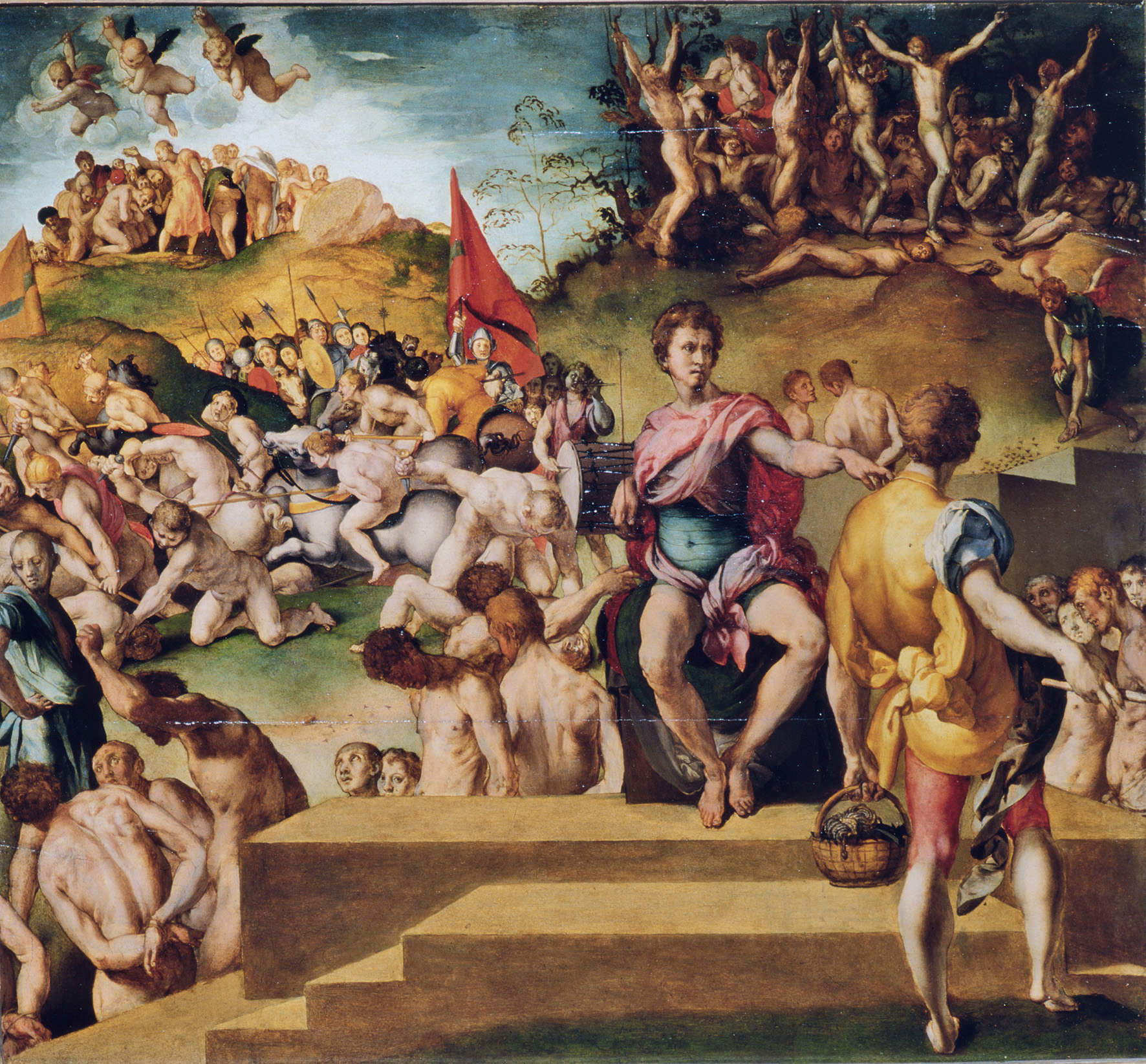
A tension that one might also seek in the tangled composition of *San Lorenzo*, akin to another scene of death from twenty years earlier—that of the Ten Thousand Martyrs, which Pontormo seems to depict with the precision of an anatomical study, if only because of their shared, indisputable Michelangelesque lineage. And yet the exhibition itself does not deny that the work depicting Christians being slaughtered and crucified on Mount Ararat, dating from around 1529–1530, could be a reflection of what was happening at the time: the Sack of Rome, the Landsknechts ravaging the city, Florence, which first expelled the Medici and then, two years later, was besieged by the combined armies of the pope and the emperor, united to restore the Medici to power; and the definitive fall of Florence in 1530, despite the modern fortifications designed by Michelangelo (the drawings are on display). By the time Pontormo was working on the frescoes in San Lorenzo, however, the political situation had calmed down—as much as one can speak of “calm” in the political situation of a duchy waging a war of expansion against a neighbor. The religious unrest, however, had not subsided—not by any means—and perhaps even Pontormo was searching, at those heights, for a more stable, definitive spiritual home. Massimo Firpo, in a study from a few years ago, which sparked considerable debate, went so far as to propose the hypothesis of a heretical choir at San Lorenzo, inspired by the catechism of Juan de Valdés—which had been placed on the Index in 1549 and which advocated the idea of salvation by faith alone, without intermediaries. According to Firpo, a further interpretation was grafted onto Valdés’s catechism, formulated by the intellectuals at the court of Cosimo I, who supported a reading of Valdés’s work that proposed resurrection for the saved and decay for the damned. There would therefore be no hell, no torment for the damned: only death, decay, putrefaction, and dust. Pontormo, therefore, would have painted a heap of bodies awaiting their decay and decomposition. Of course, there are also counterarguments, even more convincing ones (Elizabeth Pilliod laid them out two years ago: the theological uproar caused by the presence of the Medici relics that Clement VII had placed in the tribune designed by Michelangelo; the excessive exposure of those images, with the consequence that sooner or later someone would have noticed any heterodox content; the status of San Lorenzo as a collegiate church, meaning that the canons of the basilica would have immediately identified any heresy), but perhaps we must accept that, at least as far as we can tell from the surviving drawings, Pontormo remains an artist, an artist who responded to an iconographic program devised by others, and that his extremism and his defiance were first and foremost a matter of art—as macabre as one might wish, perhaps even morbid and oppressive for that era—but whose primary rationale likely lay in artistic considerations. Michelangelo’s model of the river god, which stands nearby the drawings—having arrived from Casa Buonarroti as if to serve as a supporter of a specific thesis—also reminds us of this, albeit subtly.
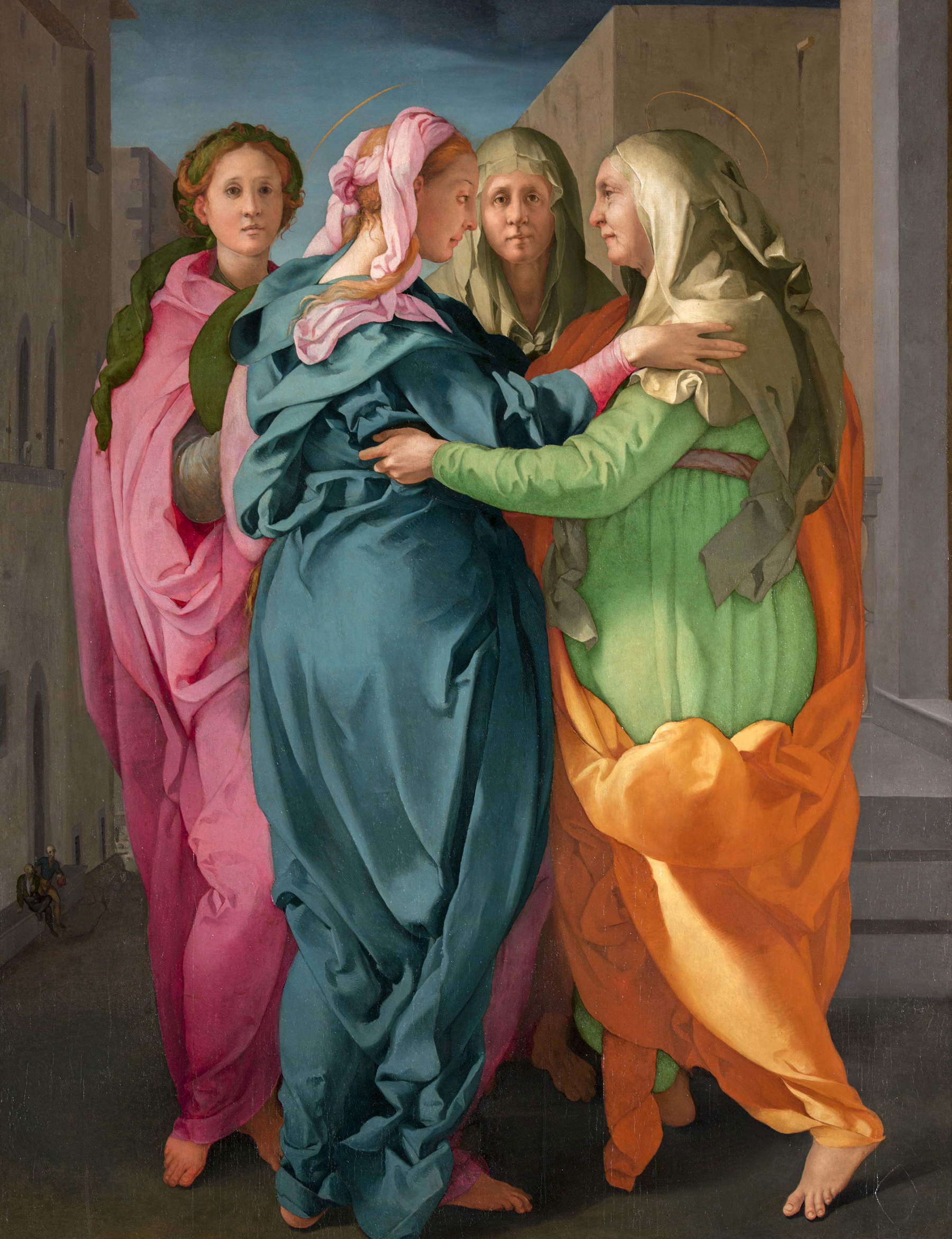
What, however, stirred within the man’s soul—even in the presence of a work of art—is difficult to say. At best, one can only surmise, knowing full well that the intuition might be wrong. One might view that intertwining of flesh as an omen, a torment, an unresolved suffering. So much so that the exhibition then makes up for it with the happy ending of the Visitation—a dramatic twist that breaks away from the precise chronological sequence the exhibition commendably follows with philological rigor in nearly every room and right up to the end: it is the concluding reversal, placed in front of a curtain that acts as a stage curtain, to bid the visitor farewell by offering an image that in recent times has toured the world like a rock star, bathed in so much notoriety as to become even reassuring. And yet perhaps there is little joy in the insistent, sinister duality of that image. Once again: it seems to be a testament to incomprehensibility, a manifestation of bewilderment, and at the same time a desire for divine comfort. Yet the contradiction is never resolved. Neither when Pontormo’s art becomes ethereal and almost abstract, as in *The Visitation*, nor when it is carnal, as in the drawings for *San Lorenzo*. Uncertainty, however, remains a possibility. Standing before Pontormo, let each person choose whichever they wish.
Warning: the translation into English of the original Italian article was created using automatic tools. We undertake to review all articles, but we do not guarantee the total absence of inaccuracies in the translation due to the program. You can find the original by clicking on the ITA button. If you find any mistake,please contact us.