



by Redazione 22/08/2026



Categories: Exhibitions / Disclaimer
From October 21, 2026, to April 5, 2027, Palazzo Sarcinelli in Conegliano will host a major exhibition dedicated to the depiction of women between the 19th and 20th centuries. More than 70 paintings depict middle-class and working-class women, artists, mothers, working women, and figures of power as seen through the eyes of the great masters of Italian art.

From October 21, 2026, to April 5, 2027, Palazzo Sarcinelli in Conegliano will host “Portraits of Women.” Featuring works by Hayez, Boldini, and Carrà, this exhibition is curated by Antonio D’Amico and organized by ARTIKA in collaboration with the Bagatti Valsecchi Museum and the City of Conegliano.
The exhibition brings together over seventy paintings from major private collections and Italian museums, offering a journey through the representation of the female figure from the 19th to the 20th century. Through works by artists such as Hayez, Boldini, Corcos, Zandomeneghi, Carrà, Irolli, Grosso, Sironi, Pellizza da Volpedo, Bucci, and Picasso, the exhibition aims to illustrate not only the evolution of painting but also the profound social and cultural changes that swept through Italy across two centuries.
From the Belle Époque to the 1950s, women became a central presence in art and a subject through which artists interpreted the transformations of society. Modernization gradually transformed daily life and expanded citizens’ rights, while women remained excluded from political participation and full social autonomy for a long time to come. It is precisely in this context that the artistic representation of women took on increasingly complex meanings. The female figure could be a seductress and a femme fatale, a mother and a worker, an aristocrat or a commoner, a muse and a protagonist of modern life. Her portrait thus became a tool for expressing the desires, fears, aspirations, and contradictions of a rapidly changing era.




Between the late nineteenth and early twentieth centuries, the myth of the femme fatale took shape—a fascinating and seductive female figure, yet one perceived as dangerous and destabilizing. Beautiful, mysterious, and often unattainable, the femme fatale became one of the most recurring images in the artistic imagination of the period. Artists depicted her through sensual poses, elegant attire, or, conversely, through the nude, transforming her into a symbol of the anxieties of a society still deeply influenced by a male-centered worldview.
The exhibition also aims to showcase other facets of the female world. Alongside mythologized figures appear characters from history and literature, such as Lucia Mondella, the Nun of Monza, and Count Egidio—works drawn from private collections and therefore rarely accessible to the general public.
A central role in the exhibition is reserved for Giovanni Boldini, the artist who captured the essence of women during the Belle Époque. In his paintings, the female figure takes on various identities: she is a noblewoman, a wife, a lover, a sister, an intellectual, an enemy, and a seductress. Always elegant and self-assured, Boldini’s woman embodies the charm, freedom, and sophistication of the society of her time. His depiction resonates with that of Giacomo Grosso, whose works feature young women posing as if to draw the viewer into the refined and sumptuous settings of the bourgeoisie. Literature, too, contributes to constructing this image of women as superior, almost divine beings. This is particularly true of Gabriele D’Annunzio, whose literary work is ideologically intertwined with Boldini’s pictorial vision, highlighting not only women’s seductive power but also men’s vulnerability in the face of seduction.
The exhibition gradually broadens its scope, moving beyond the exclusively aristocratic and high-society image to portray ordinary women. Federico Zandomeneghi’s paintings feature working women, commoners, peasant women, seamstresses, embroiderers, and small-scale merchants, depicted in the simplicity of their daily activities. These are women immersed in family life—mothers and wives—but also figures compelled to work out of economic necessity while simultaneously drawn to the possibilities of emancipation and social mobility. This dimension enters into dialogue with the works of Ulisse Caputo, in which the female figure is represented through a visual language characterized by sensuality and chromatic intensity.
Moving from the Romanticism and Symbolism of Francesco Hayez and Carlo Mascarini to the Realism of Mario Sironi, the exhibition extends to the Futurist experiments of Anselmo Bucci and Umberto Dudreville and to the Novecento painting of Carlo Carrà. Social transformations and the consequences of World War I also altered the role of women in society. While men were engaged at the front, women took on new tasks and responsibilities, gradually stepping beyond the traditional confines of the home. This transformation finds particular expression in the paintings of Mario Sironi, who depicts a woman increasingly detached from a purely aesthetic representation and ever closer to the image of the human being in all her complexity. In his nudes, the erotic element typical of nineteenth-century iconography gradually disappears. Instead, the body becomes a place of toil, vulnerability, and self-awareness, reflecting the hardships of a society deeply marked by war and the transformations of the 20th century.
The exhibition concludes with Pablo Picasso’s refined lithograph *Le Corsage à Carreaux*, created in 1949. The work symbolically represents the transition toward a new artistic and cultural era. Through a seemingly classical figure, Picasso in fact takes the portrait into a more introspective dimension, focusing on the human soul and definitively leading the viewer into modernity.
“Portraits of Women” thus aims to offer an interpretation of Italian art through a diverse array of female figures: bourgeois and common women, working women and mothers, aristocrats and intellectuals, salon figures, women in positions of power, and legendary personalities. The paintings reflect a wide range of artistic sensibilities and, through poses, gazes, clothing, and settings, convey the diverse conceptions of womanhood that emerged between the late nineteenth century and the first half of the twentieth century.
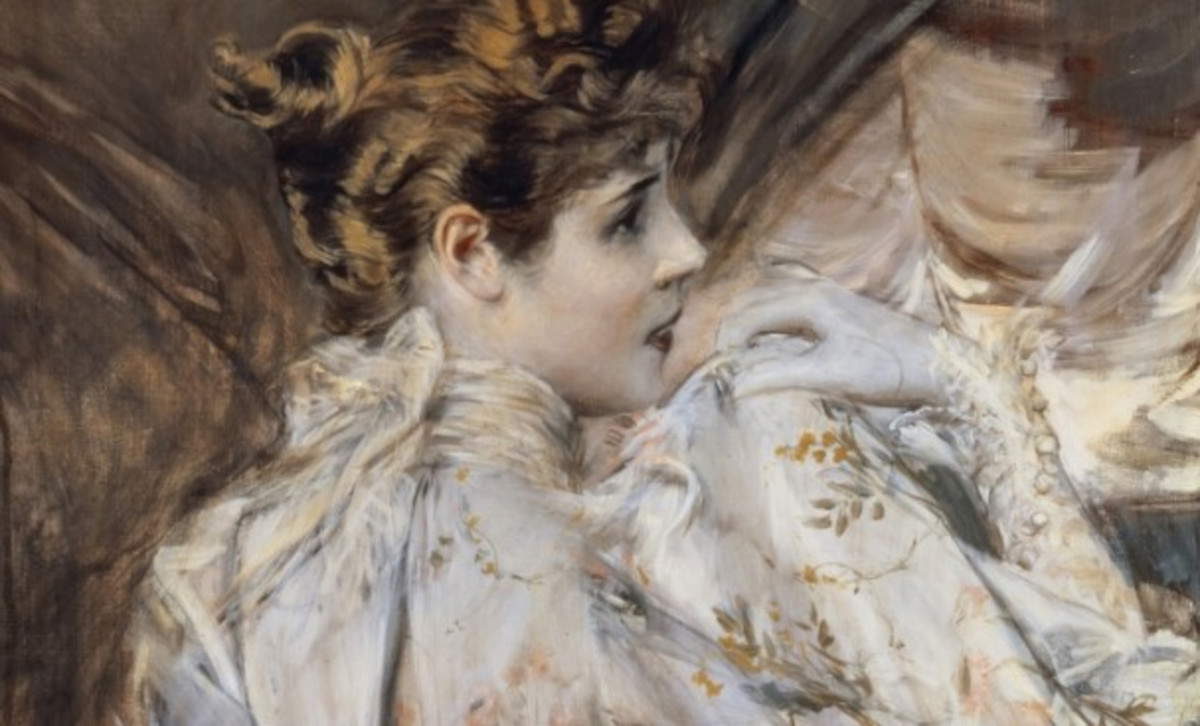 |
| In Conegliano: The World of Women from the 19th to the 20th Century, from Hayez to Boldini and Carrà |
Warning: the translation into English of the original Italian article was created using automatic tools. We undertake to review all articles, but we do not guarantee the total absence of inaccuracies in the translation due to the program. You can find the original by clicking on the ITA button. If you find any mistake,please contact us.