




by Redazione 14/10/2026



Categories: Market / Disclaimer
From November 20 to 22, 2026, “Roma Arte in Nuvola” returns to the Nuvola dell’Eur, featuring approximately 140 Italian and international galleries, with Germany as the guest country. Exhibitions, installations, performances, talks, and awards will transform the fair into a major event dedicated to modern and contemporary art.


Three days to explore different artistic languages and eras, from the great masters of the 20th century to the experimental work of the new generations. From November 20 to 22, 2026, the Nuvola dell’Eur will host the sixth edition of Roma Arte in Nuvola, the event that brings together approximately 140 Italian and international galleries in the capital, complementing the art market with a comprehensive cultural program. The guest country is Germany, the focus of an exhibition dedicated to its artistic and cultural ties with Italy, while Lombardy is participating with a project that showcases the creativity of artists under 40.


Conceived and directed by Alessandro Nicosia, promoted by Eur SpA, and under the artistic direction of Adriana Polveroni, the fair reaffirms galleries as the centerpiece of the exhibition program, featuring works ranging from painting to sculpture, from photography to the most diverse forms of contemporary art. Alongside the commercial exhibitions, a rich program of thematic shows, installations, performances, talks, and awards fosters dialogue among artists, museums, institutions, and the public.


Germany takes center stage in the group exhibition *Viaggio in Italia. Nostalgia for Italy*, curated by Gregor Jansen and Julia Apitzsch and organized in collaboration with the Embassy of the Federal Republic of Germany in Italy. The project aims to celebrate the 75th anniversary of the resumption of diplomatic relations between the two countries and to explore the mutual influences that, over the centuries, have shaped their respective artistic cultures. Eight artists from different generations come together to create an exhibition that reflects on the relationship between identity, memory, and the Italian imagination. On view are works by Friedrich Andreoni, Johanna Diehl, Heike Gallmeier, Candida Höfer, Sven Johne, Thomas Struth, Thomas Scheibitz, and Fabian Treiber.


Lombardy, the guest region, focuses instead on the younger generations with a selection of Art Posters created in collaboration with Triennale Milano and Fondazione Milano Cortina 2026. The Olympic and Paralympic posters, created by artists under 40, interpret the cultural value of the Games through contemporary painting. Previously presented at the Triennale and the Italian Pavilion at Expo Osaka, the works bring to the fair a reflection on the relationship between art, sports, and collective identity.
Institutional participation is one of the central elements of Roma Arte in Nuvola, which renews its collaboration with the Ministry of Culture, the Lazio Region, Roma Capitale, and the Rome Chamber of Commerce. The Ministry’s presence is spread across various exhibition spaces dedicated to the preservation and promotion of cultural heritage, artistic research, and support for contemporary production. For the first time, the Department for the Promotion of Cultural Heritage (DiVa) is participating with “Made in MiC,” an initiative that connects museum collections, artisanal traditions, and design. The project aims to develop a new generation of cultural merchandising products, creating opportunities for historical heritage and design creativity to come together. The General Directorate of Archives is also returning for the third consecutive year, telling the story of fashion and “Made in Italy” through documents from the State Archives of Rome, Florence, Naples, and Turin. The exhibition spans different eras and styles: from 18th-century lace to sketches by Adolfo Coppedè, from Neapolitan glove-making to Gutteridge, all the way to the prêt-à-porter of the Gruppo Finanziario Tessile and collaborations with Giorgio Armani, Valentino, and Ungaro.
For the fourth consecutive year, the General Directorate for Contemporary Creativity presents programs and funding opportunities dedicated to artistic production. The space also houses photographic works acquired for the National Gallery of Umbria through the “Strategia Fotografia” public call for proposals, a testament to the contribution of ministerial policies to the enrichment of public collections.
The dialogue with museums continues with the National Gallery of Modern and Contemporary Art in Rome, which is exhibiting two works by Marinella Senatore, and with MAXXI—the National Museum of 21st-Century Arts—which is presenting two works by Thomas Ruff.
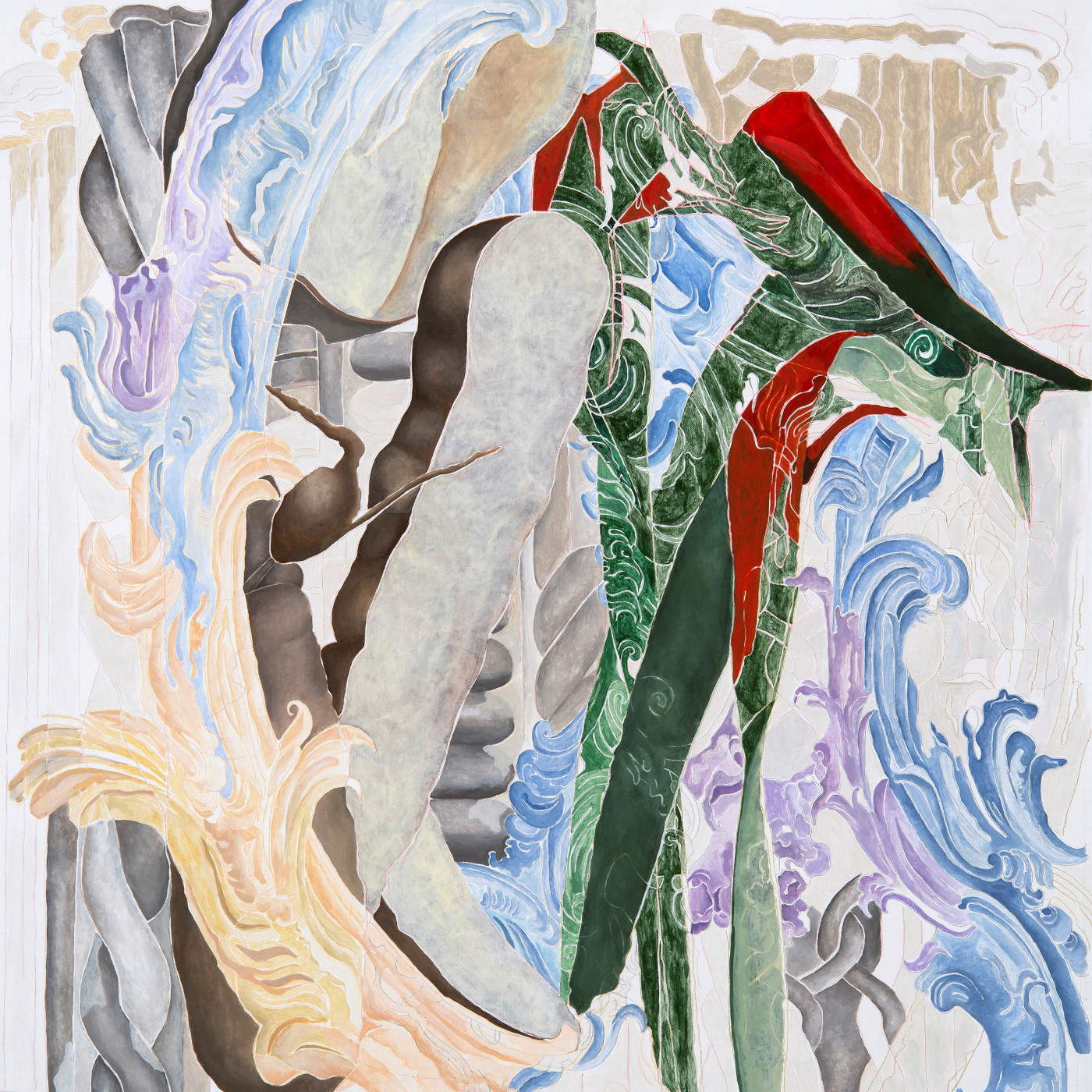
Among the featured exhibitions, “Cagli is Also a Sculptor” stands out—a project born from the collaboration between the Central Institute for Restoration andthe Corrado Cagli Archive, marking the fiftieth anniversary of the artist’s death. Curated by Giuseppe Briguglio, Miriam Pitocco, and Livia Sforzini, the exhibition explores a lesser-known aspect of his body of work through masks and portraits in cardboard and metal created between 1959 and 1967, some of which have never been shown or are rarely exhibited. The title draws on an expression used by Aldo Palazzeschi in 1962 to highlight Cagli’s sculptural dimension. The exhibition explores the transformation of materials—from cardboard to metal—and the symbolic meaning of the face and the mask, elements in which identity, ritual, and formal experimentation intertwine. The exhibition thus offers an opportunity to reinterpret the artist’s work beyond the best-known expressions of her artistic exploration.
The Tornabuoni Arte gallery presents a retrospective dedicated to Giorgio de Chirico, spanning his career from the early 20th century through the 1970s. At the heart of the exhibition is his relationship with Rome, the city he chose as his permanent home in 1944 and which is linked to the artist’s home-studio in Piazza di Spagna. Works and texts guide visitors through the various phases of his artistic exploration, from his metaphysical period to his subsequent reinterpretations of the themes and images that defined his artistic language. Among the works on display are *Il pittore* (1927), a female nude from 1923 that once belonged to Alberto Savinio’s collection, *Piazza d’Italia con piedistallo vuoto* (1955), *Il Trovatore*, and *Bagni Misteriosi*, both from 1968.
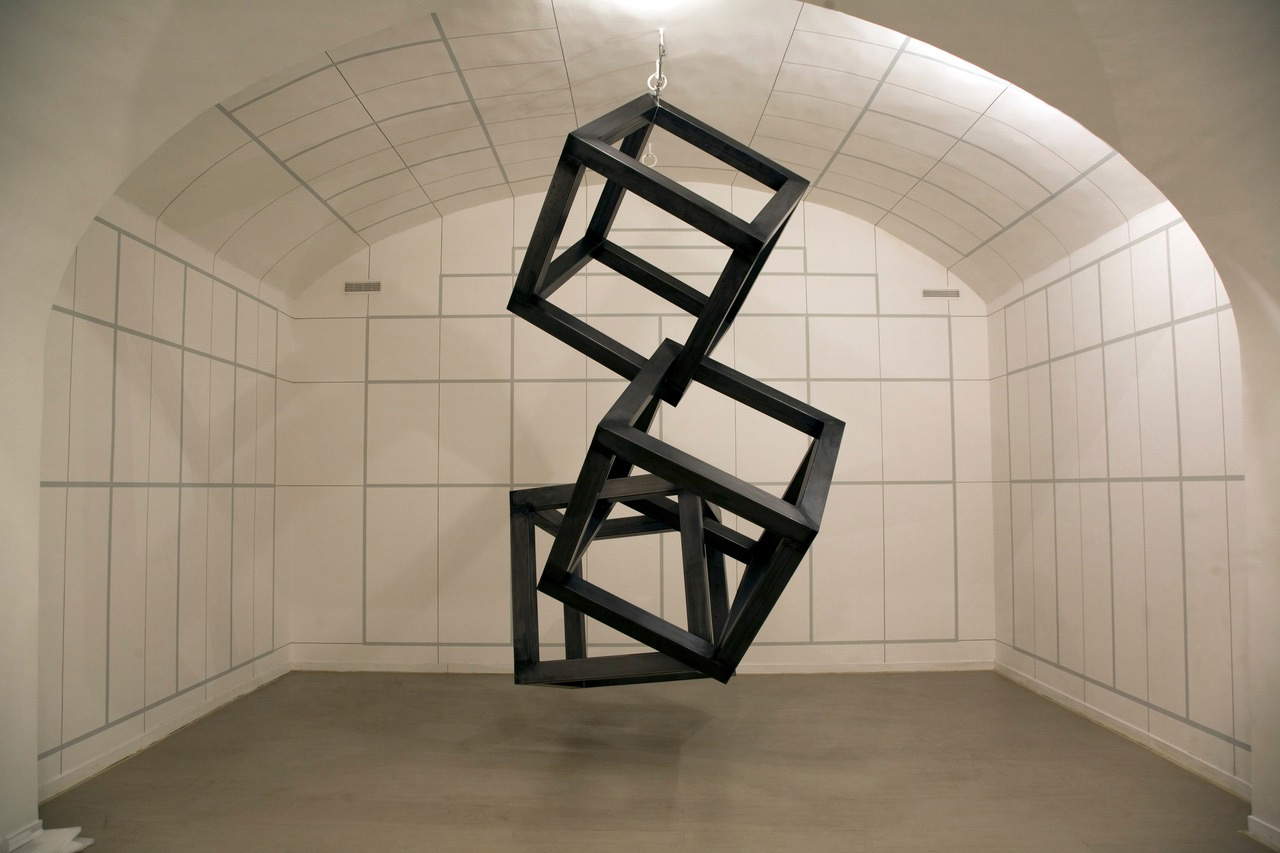
In the foyer of La Nuvola, *Untitled*, a tribute exhibition dedicated to Hidetoshi Nagasawa and curated by Adriana Polveroni, brings together monumental works by the Japanese sculptor. Marble, lead, wood, and bronze become tools for creating unexpected balances, in which the solidity of the materials confronts a spiritual tension and the perception of space. The arrangement of the works interacts with the architecture of the Nuvola and with the reflections of the city on its luminous surfaces. A sculptor, architect, and performer, Nagasawa moved to Milan in 1967, where he came into contact with figures such as Enrico Castellani and Luciano Fabro. His artistic practice has woven together Eastern spirituality and Western avant-garde movements, exploring silence, emptiness, and the relationship between sculpture, architecture, and nature.
The program also includes installations that expand the ways visitors can experience the exhibition spaces. Among these, *Spiagge* by Pietro Fortuna brings together works created between 2016 and 2024, focusing on the relationship between the artwork and the viewer’s gaze and on the ways in which the public engages with what they observe.
The program also extends beyond La Nuvola, reaching the historic center with *Eco domestiche. Corrispondenze contemporanee nella casa dell’anima*(Domestic Echoes: Contemporary Correspondences in the House of the Soul), an exhibition conceived and curated by Pier Paolo Pancotto at the Mario Praz House Museum. This group exhibition integrates contemporary works into the rooms of the residence and among the objects of the historical collection, while preserving the home’s intimacy. The result is a dialogue between past and present, the public sphere and the private realm, material reality and literary memory—one that invites viewers to reinterpret domestic space through diverse artistic sensibilities. Among the participating artists are Andrea Bolognino, Paolo Canevari, Enzo Cucchi, Debora Hirsch, Eva Marisaldi, Genuardi/Ruta, Lu.Pa, Alessandro Pessoli, Marta Ravasi, Namsal Siedlecki, Nico Vascellari, and Ilaria Vinci.
Rounding out the event is a program of discussions moderated by Adriana Polveroni, dedicated to the exhibitions, the artists, and the transformations of the art world. There will be in-depth discussions on Germany, this year’s guest country, and on the figure of Corrado Cagli, while the talk “Mal d’Italia” will explore the presence of Italian artists on the international scene with Peter Benson Miller, Cecilia Canziani, Costantino D’Orazio, and Gian Maria Tosatti. The event concludes with “Senti chi parla!”, a discussion bringing together Giulio Cassanelli, Silvia Cini, Silvia Giambrone, and H.H. Lim—the protagonists of the performances presented during the fair. The event offers an opportunity to share with the public the experiences, gestures, and meanings behind the performative works.
Four awards dedicated to artists and galleries are also scheduled: the C.O.R. (Creare Organizzare Realizzare) Award, the INSIDEART Award, the Canson 2026 Award, and the Hilton Rome Eur La Lama Award.
|
| Roma Arte in Nuvola 2026: The capital’s art fair returns with 140 galleries. Germany will be the guest country |
Warning: the translation into English of the original Italian article was created using automatic tools. We undertake to review all articles, but we do not guarantee the total absence of inaccuracies in the translation due to the program. You can find the original by clicking on the ITA button. If you find any mistake,please contact us.