





The Metropolitan Museum of Art in New York has acquired 38 paintings by Chang Dai-chien (Zhang Daqian) from the collection of the artist’s daughter, Sing Sheng Chang. The works, dating from the 1930s to the 1980s, document the breadth of the Chinese painter’s artistic exploration—he is considered one of the central figures of modern Chinese ink painting—across different periods, styles, and genres.
The collection includes works that trace Chang Dai-chien’s evolution from the classicist experiments of his youth through the abstract turn of the 1960s to his later works, in which the two tendencies are brought together in a synthesis. Of particular note are the works created during his exploration of so-called “splashed-color” and “splashed-ink,” which he developed primarily between 1965 and 1968, when the artist explored the relationship between modern abstraction and the theory and practice of Chinese ink painting.
The selection acquired by the museum also includes examples of figurative painting, gestural paintings of lotus flowers, meticulous floral paintings, and self-portraits, offering an overview of the various genres explored by Chang throughout his career. Taken together, the works document the vitality and modernity achieved by ink painting in the 20th century through the career of one of its leading figures.
A distinctive feature of the acquisition is the personal nature of the collection. The Sing Sheng Chang Collection, in fact, offers a glimpse into the artist’s private life and his activities within his family. Among the works are several pieces from the early phase of his career, including a number of paintings created in the 1940s at the site of the Buddhist cave temples of Dunhuang—works that, according to the museum, are now found only in limited numbers outside of Asian museum collections.
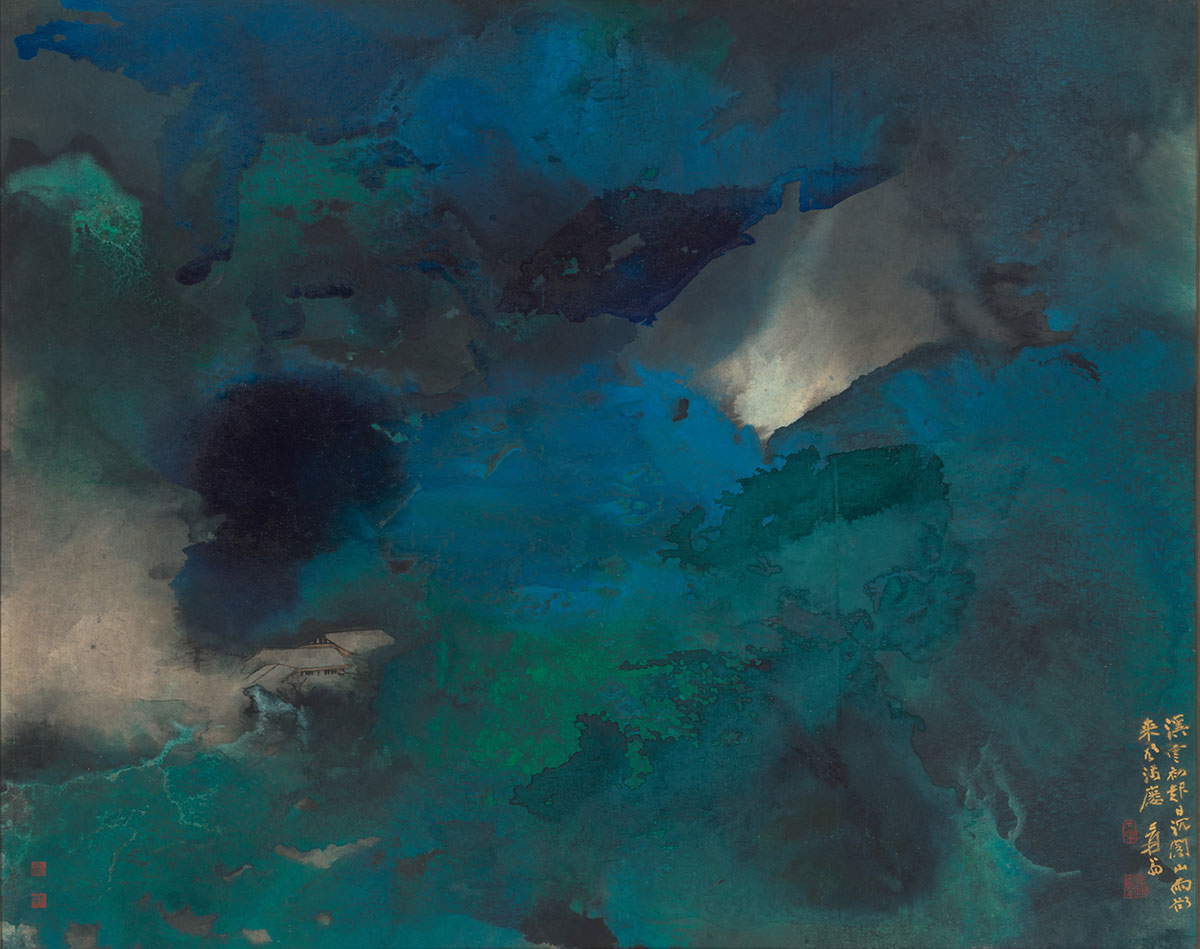
The collection also includes unfinished works, partially completed experiments, and paintings the artist dedicated to his daughter—elements that help document aspects of the works’ development beyond those intended for public display. All the paintings were bequeathed to Sing Sheng Chang by his father and mother, Chang Hsu Wen-po, the artist’s wife. This family provenance thus allows the finished works to be displayed alongside materials that also convey the process-oriented nature of Chang Dai-chien’s painting practice.
The artist’s interest in abstraction developed particularly during the 1960s. With paintings characterized by spray-paint and spray-ink techniques, Chang sought to trace the roots of modern abstraction within the tradition of Chinese ink painting, linking contemporary explorations of gesture, material, and color to principles rooted in the history of Chinese painting.
The new acquisition also expands the core collection of works by Chang Dai-chien already held by the Metropolitan Museum of Art. The museum’s collection also includes the twelve works pledged in 2021 by Jack and Susy Wadsworth, as well as an important collection of classical Chinese paintings and calligraphy that once belonged to the artist himself. These ancient works entered the Met’s collections in 1989 through the bequest of John M. Crawford Jr., who had purchased numerous works by Chang Dai-chien in the 1950s.
The collection of works in the Chinese tradition preserved by Crawford played a role in the artist’s development, fueling his search for a modern and personal voice. The acquisition of Sing Sheng Chang’s collection will therefore allow the museum to contextualize the ancient works collected by the artist alongside a selection of his own paintings. The Met plans to explore this comparison through its galleries, publications, and website, with the aim of presenting a case study on the relationship between an understanding of the past and the transformation of ink painting in the 20th century.
“Chang Dai-chien is one of the most significant figures in modern painting. He was able to combine a deep understanding of classical Chinese culture with a transnational perspective, giving rise to a style of ink painting that, while rooted in local tradition, was open to a broader global vision,” said Max Hollein, Director and CEO of the Met. “This important acquisition will allow for a deeper understanding of Chang Dai-chien through key works that illustrate his entire creative journey, offering a comprehensive overview of the artist’s life. We are grateful to Sing Sheng Chang for entrusting his father’s legacy to the Met, thereby making the museum a leading center for the study of this great artist.”
“Chang Dai-chien is the most important modern Chinese painter to use ink,” said Joseph Scheier-Dolberg, curator of Chinese painting at the Met. “His early dedication to mastering the classical tradition and his two years of intensive study at the Dunhuang Caves gave him a unique understanding of the history of Chinese painting; this foundation was then transformed into decades of pioneering experimentation, from the 1940s through the 1980s. Although Chang has long been recognized as a key modern artist in East Asia, he has not been adequately understood in Europe and the Americas. This acquisition will enable the Met to tell Chang’s story—which is inherently modern and transnational—and to situate his contribution within a broader narrative of interconnected global modernity.”
“Chang Dai-chien defined modernity according to his own vision, through a career characterized by extraordinary virtuosity and tireless experimentation,” said Lesley Ma, curator of the Met’s Department of Modern and Contemporary Art. “This exceptional collection of works highlights Chang’s innovative expressions in the use of ink on paper, underscoring the importance of East Asian aesthetics in 20th-century art. We are honored to celebrate his legacy while deepening our research and commitment to rethinking global modernity in anticipation of the opening of the future Tang Wing dedicated to modern and contemporary art.”
 |
| The Met Acquires 38 Paintings by Chang Dai-chien from His Daughter's Collection |

Warning: the translation into English of the original Italian article was created using automatic tools. We undertake to review all articles, but we do not guarantee the total absence of inaccuracies in the translation due to the program. You can find the original by clicking on the ITA button. If you find any mistake,please contact us.















 IT
IT FR
FR DE
DE ES
ES CN
CN


