




by Redazione 15/10/2026



Categories: News / Disclaimer
New walkways, redesigned visitor routes, and exhibits dedicated to the legend of Odysseus: the Archaeological Park of the Villa of Tiberius and the National Archaeological Museum of Sperlonga are undergoing renovations to improve physical and cognitive accessibility. The project is part of a broader program of conservation, scientific research, and heritage enhancement.


The Archaeological Park of the Villa of Tiberius and the National Archaeological Museum of Sperlonga are revamping their visitor itineraries with initiatives focused on accessibility, public engagement with cultural heritage, and a fresh interpretation of the sculpture collections. The project, supported by a 500,000-euro grant from the European Union’s NextGenerationEU program, is part of the National Recovery and Resilience Plan (PNRR) and concerns the archaeological complex administered by the Lazio Regional Directorate of National Museums of the Ministry of Culture. The completed works involve both outdoor spaces and museum exhibits, with the goal of facilitating visits by audiences with diverse needs and offering new tools for understanding the site’s history, with particular attention to the sculptural groups linked to the myth of Odysseus.


Funding comes from Mission 1 of the PNRR, dedicated to “Digitization, Innovation, Competitiveness, and Culture,” Component 3 “Culture 4.0,” as part of Investment 1.2, “Removal of physical and cognitive barriers in museums, libraries, and archives to enable broader access to and participation in culture.” The interventions therefore aim to improve the physical conditions for accessing the complex and, at the same time, to make the archaeological finds more accessible through an overhaul of the information systems and the exhibition layout.


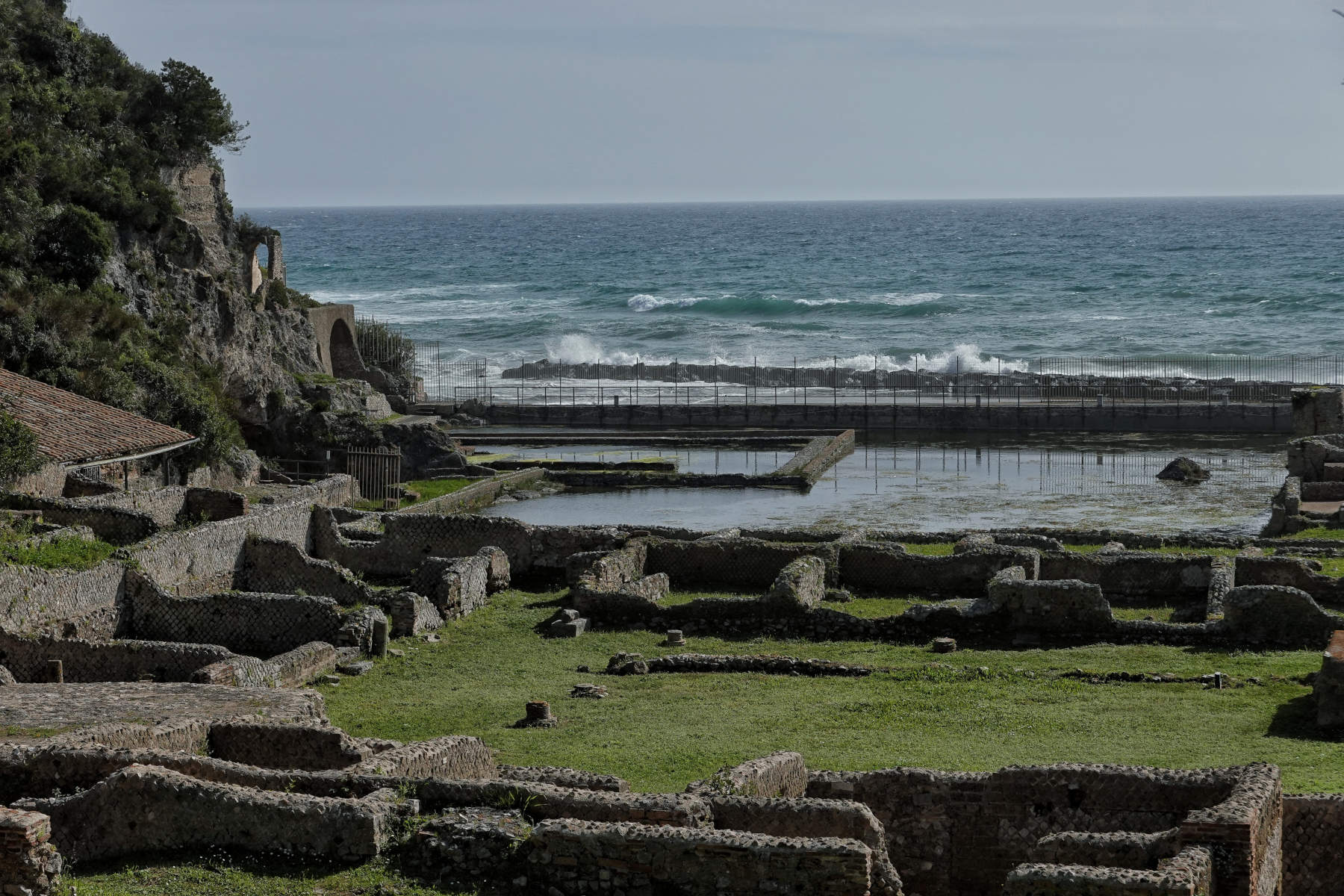
New walkways have been built in the Archaeological Park to help visitors navigate the uneven terrain and the discontinuities of the archaeological site. The paths are also accessible to people in wheelchairs and have been designed to blend into the landscape with the least possible impact. The choice of materials and technical solutions takes into account the presence of ancient structures, while the non-slip surface features geometric patterns reminiscent of the villa’s floor decorations. The walkways serve more than just a practical purpose: they also allow visitors to view the archaeological complex and the surrounding landscape from different vantage points than those offered by the previous paths.


Rounding out the outdoor improvements is the renewal of the information systems, with the installation of seven bilingual information kiosks designed to facilitate navigation and provide different levels of insight into the heritage site. The goal is to make the site easier to understand by offering information that accompanies the visit and helps contextualize the preserved structures. The access route to the cave—currently closed to the public to allow for structural surveys—has also been redesigned. The walkways set up for the entrance and a separate exit will allow, upon reopening, for visitor flow to be organized along a one-way route, preventing the overlapping of visitor streams. The new route will also lead to the area of the nymphaeum and the gymnasium, encouraging visitors to explore parts of the complex that have been less frequently visited until now.
The museum reinterprets the sculptural groups through the myth of Odysseus
At the National Archaeological Museum of Sperlonga, the project involved the redesign of the section dedicated to the famous sculptural groups from the cave. The new exhibition itinerary connects the historical and artistic dimensions of the works with the mythological stories they depict, offering an interpretation that follows some of the main episodes of the Trojan War and the adventures narratedin the Odyssey. The entrance to the section is marked by a large panel dedicated to Odysseus’s journey through the Mediterranean, culminating in his return to Ithaca. The reference to the Homeric hero serves as the central theme of the museum’s narrative, guiding visitors in understanding the subjects of the sculptures and their connection to ancient culture.
The exhibition displays have also been redesigned to enhance the clarity and perception of the works. The panels feature clear, easily readable text, while the display platforms and blue backdrops serve a dual purpose: they help protect the sculptures and introduce a chromatic contrast that makes the modeling and chiaroscuro of the marble surfaces stand out more clearly. The educational hall has also been completely renovated and is set to become a multipurpose space. The space will be able to host conferences, educational activities, and temporary exhibitions, expanding the museum’s potential uses and its ability to organize initiatives for visitors, schools, and scholars.
Among the improvements aimed at enhancing visitor reception is the construction of a public parking lot, designed to address a long-standing issue regarding access to the site. The projects funded by the PNRR are, in fact, part of a strategy that views accessibility not only as the adaptation of pathways but also as an overall improvement in the conditions for visiting and participating in cultural activities.
A conservation program totaling over 2.6 million euros
Over the past five years, the Ministry of Culture has allocated additional funding of over 2.6 million euros to the Sperlonga site as part of a program for the protection, conservation, and enhancement of the archaeological complex. Among the projects already completed are the renovation of the roofs and the construction of new restrooms outside the museum, accessible via a ramp, representing an investment of 400,000 euros. The new restrooms were designed to improve visitor reception and manage visitor flow, featuring gender-neutral spaces and a nursery equipped with a changing table and a nursing chair. This project is part of a broader effort to adapt the facilities to visitors’ needs and to make the complex more accessible.
Scientific research plays a central role in the program, complementing the physical renovations with studies of the sculptures and the archaeological context. In collaboration with the IMT School for Advanced Studies Lucca, a project is underway for the maintenance, study, and reassembly of the sculptural groups, funded with 500,000 euros through the Fund for the Protection of Cultural Heritage, established by Law 190/2014. The project includes a reassessment of previous restoration work, a typological study of the works, and diagnostic analyses of the marble. These activities are complemented by photomodeling techniques, which aid in the documentation and study of the sculptures.
At the same time, archaeological surveys conducted in collaboration with the University of Milan—funded by the General Directorate of Museums with 280,000 euros—have made it possible to create a three-dimensional survey of the grotto. The ongoing stratigraphic analysis is reconstructing the history of the complex over a time span ranging from the 1st century B.C. to the 4th century A.D., broadening the perspective beyond the Tiberian era alone. The findings may provide new evidence to test hypotheses regarding the original placement of the sculptures and the transformations the area has undergone. The results of the two research projects will be correlated, fostering a dialogue between the study of the marble sculptures and that of the archaeological context.
The program also includes structural and conservation analyses of the grotto, as outlined in the 2024–2026 public works plan and funded with 350,000 euros. In addition, urgent safety measures will be carried out in the Coenatio, along with further scheduled maintenance activities, for a total cost of just over 600,000 euros. The research activities are also bringing the site back to the forefront of scientific discourse through the organization of conferences and seminars dedicated to presenting and discussing new findings. The aim is to promote the dissemination of acquired knowledge and to integrate archaeological, art-historical, and conservation studies.
A project for the scheduled maintenance and conservation of archaeological sites, with a budget of 500,000 euros, is also set to begin shortly. The initiative will involve three sites under the jurisdiction of the Lazio Regional Directorate of National Museums: the Archaeological Park of the Villa of Tiberius and the National Archaeological Museum of Sperlonga; the Archaeological Park of Minturnae, including the Ponte Real Ferdinando; and the Archaeological Park of the Villa of Domitian in Sabaudia. This project is part of a systemic management strategy for archaeological heritage, aimed at ensuring continuity in conservation efforts and optimizing protection and maintenance measures.
The promotion of the collections also takes place through national and international exhibition initiatives. The sculpture by Palladio is currently on display in the exhibition “Troy in Rome: Myths, Legends, and Stories of the Ancient Mediterranean,” held at the Colosseum Archaeological Park. The head of Ulysses, on the other hand, was recently presented in Miami, in collaboration with the Ministry of Foreign Affairs and International Cooperation (MAECI), alongside a robotic replica. In preparation for the U.S. exhibition, specific devices were created to protect the work, including an anti-vibration base and a custom-made transport case. The solutions adopted address the need to protect the sculpture during transport and installation, in a context where the movement of artworks requires technical measures appropriate for their preservation.
The collaboration with the MAECI will continue in December in Milan, during the National Export Conference, where the display dedicated to the head of Odysseus—previously presented in Miami—is scheduled to be presented again. Discussions are also underway with the Acropolis Museum in Athens regarding a potential loan of the head of Ulysses and the statue of Circe for an exhibition dedicated to Homer, scheduled for 2027. The connection with the local community is also supported by the educational programs of the Archaeological Park and the museum, which offer monthly workshops and guided tours. These programs are complemented by discounted ticket options designed to encourage visits to multiple archaeological sites in the province of Latina.
A combined ticket is available for 12 euros; it is valid for one year and includes one admission to each of the sites included in the circuit: the Archaeological Park of the Villa of Tiberius and the National Archaeological Museum of Sperlonga, the National Archaeological Museum of Formia, the Archaeological Park of Minturnae, and the Ponte Real Ferdinando in Minturno. An annual pass is also available for 15 euros.
Another area of activity focuses on engaging with contemporary creativity. One such initiative is FLUIRE, a project dedicated to the theme of water, with a budget of 100,000 euros, carried out in collaboration with three other sites under the Lazio Regional Directorate of National Museums. Selected through a call for proposals by the Ministry of the Environment and Energy Security, the initiative includes educational activities, a festival, and the creation of a site-specific artwork for 2027.
Statements
“A cultural site is truly accessible when everyone can experience it, understand it, and recognize it as part of their own heritage,” says Elisabetta Scungio, director of the Lazio Regional Directorate of National Museums. “In Sperlonga, the PNRR represents a step in a broader effort: not just new visitor routes and a renovated museum, but a strategy that brings together conservation, research, maintenance, hospitality, and promotion. Investing in heritage means caring for it over time and creating ever-new opportunities for learning and participation. It is in this continuity between concrete actions and a long-term vision that the quality of our commitment is measured.”
“The sculptures in Tiberius’s cave possess extraordinary narrative power: the adventures, dangers, and choices of Odysseus take shape in their forms,” states Cristiana Ruggini, director of the Archaeological Park of the Villa of Tiberius and the National Archaeological Museum of Sperlonga. “The new exhibition design highlights this storytelling capacity, complementing the archaeological and art-historical interpretation of the works with a narrative dedicated to the myth. We want to offer every visitor a gateway to knowledge, maintaining the rigor of the content while making it more accessible. The improvements to the Park complement this effort, strengthening the connection between the collections, the grotto, and the villa’s landscape.”
 |
| Sperlonga: 500,000 euros from the PNRR to make the Villa of Tiberius accessible and renovate the museum |
Warning: the translation into English of the original Italian article was created using automatic tools. We undertake to review all articles, but we do not guarantee the total absence of inaccuracies in the translation due to the program. You can find the original by clicking on the ITA button. If you find any mistake,please contact us.