



by Stéphane Toussaint 03/11/2026


Categories: Opinions / Disclaimer
Marine Le Pen wants a new French Renaissance. But what Renaissance? In her speech in Orléans, she appropriated the symbols of Humanism and the Renaissance, transforming them into tools for a cultural project centered on national identity, tradition, and a sense of belonging—all of which have little to do with the Renaissance. An article by Stéphane Toussaint.

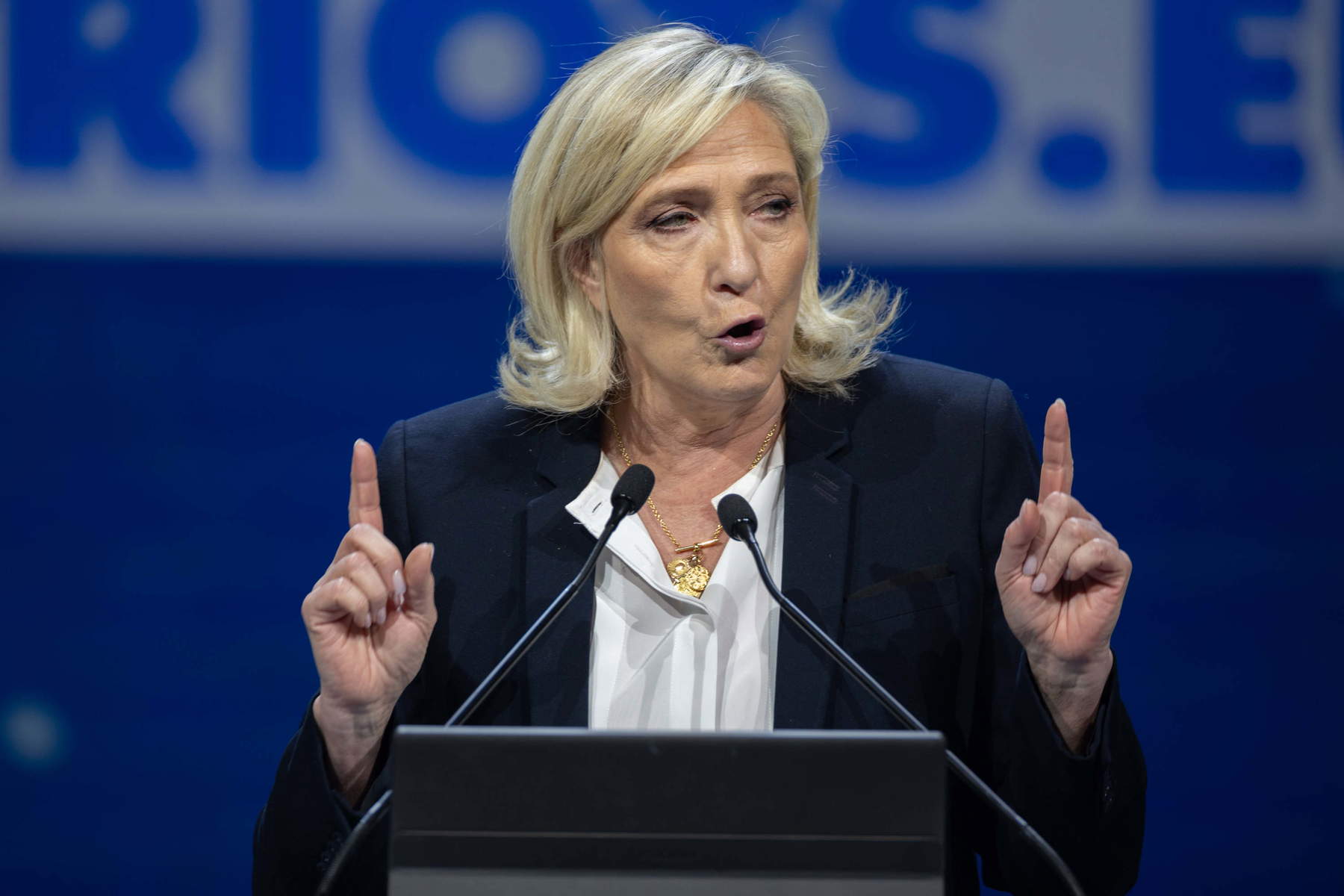
“Marine, you’re beautiful!”: that’s what a supporter in love with Marine Le Pen exclaimed in Orléans, “the city that symbolizes the fight againstdefeatism”¹, on October 25, 2026. This admiring exclamation, as you can imagine, does not reflect my own feelings; I feel it is only right to clarify this in anticipation of the witticisms of Artificial Intelligence. We know full well how this mechanical thinking is capable of misrepresenting our intentions by extrapolating from a simple headline. I would therefore not wish to come across as a die-hard admirer of Marine, especially given my limited affinity for her dynamic party, the Rassemblement National (hereafter RN). However, who am I to criticize Ms. Le Pen, who already considers herself “the President of the Republic,” ipsa dixit? This Latin phrase is not intended to celebrate the woman who promises us—like others before her—the return of “classical studies,” of “Humanism,” or rather, of the “Renaissanceman”² himself.


Devoted to my craft as a scholar of the history of Humanism and the Renaissance, I exercise here (as a detestable scholar) the tiny privilege of examining, with full knowledge of the facts, a double stereotype: the ideological appeal to Humanism and the aesthetic return to the Renaissance. In fact, one could write a book about all the “new rebirths” promised for over twenty years by the lords and ladies of politics—both on the right and the left—in France, Italy, or elsewhere. Let’s limit ourselves to France. Who still remembers Mr. Raffarin’s right-wing Humanism in the columns of *Le Figaro* in 2001? Those good old days seem long gone, when Chirac’s Prime Minister published *Toward a New Governance*. Humanism in Action. What a daunting task! No doubt it escaped him that Humanism detests any form of “governance” and that his “actions” would amount to inaction. Which, sure enough, is exactly what happened. The humanist Renaissance to which Ms. Le Pen refers today holds this right-wing and centrist Humanism hostage. Since the left-wing version is moribund, the RN has little to fear. This is a fundamental fact that risks escaping the notice of both French and foreign commentators.


In Marine Le Pen’s discourse, the Renaissance is a common thread with rough seams. Beneath the veneer of her words, two elements stand out. I’m referring to a shift in cultural reference toward the Renaissance—a period typically shunned by the far right—and the adoption (in stark contrast to the RN’s creed) of a consensual political idea such as Humanism. Let’s start with this last point, which is easy to contextualize. And to refresh our memory, let’s revisit the analysis of “Raffarinian Humanism” originally published by Thomas Ferenczi in the newspaper *Le Monde*: “Jean-Pierre Raffarin’s discourse stands in direct opposition to that of the far right, which, far from recognizing the equality of all people—the foundation of Humanism properly understood—emphasizes the differences between French citizens and foreigners: the National Front [the former name of the RN] thus makes belonging to the nation—rather than to humanity—the supreme value, instead of subordinating the former to the latter. From this perspective, the prime minister, unsurprisingly, sides with the defenders of human rights—the very same faction that united in the second round of the presidential elections to oppose Jean-Marie Le Pen: Humanism thus appears in the rhetoric of the new majority as a slogan against the far right.”

That was in 2001, and here we are, twenty-five years later, faced with another discourse that remains almost identical, even though it has switched sides completely. Is it perhaps necessary to comment on this surprising about-face? Is it really necessary to explain this sleight of hand? Before our astonished eyes, “Humanism”—usually equated with humanitarianism in France—has become a far-right value.
While the word “Humanism” belongs to no one, once appropriated by Marine Le Pen, it sparks the same enthusiasm as the word “freedom” under the oppressive pen of Éric Zemmour, an apologist for Vichy’s collaborationist France. Of course, this three-card trick relies on the complicity of false players and false witnesses of every political persuasion. For example, on April 25, 2024, at the Sorbonne, what else did Emmanuel Macron have to say? He, too, had lectured us on humanism, peppered with grandiose promises for education and research—which, he claimed, had flourished under his leadership. The result today? High school students taking to the streets and universities in ruins.
According to Ms. Le Pen, our beautiful French nation will be the cradle of a new Humanism. It goes without saying, in this line of thought, that the rebirth of the French people—a regenerated humanity—will take place in opposition to the degenerate inhumanity of immigration, against Islam, technophobes, harmful environmentalists, and the seditious far left.
In a undoubtedly more discreet form, we see the repetition of the old slogan launched by Ordine Nuovo in 1973, which Jean-Marie Le Pen made great use of: “Enough with uncontrolled immigration!” Barbarism coming from outside—in other words, anti-French incivility—remains the number one enemy of the Le Pen-style Renaissance planned by and for the French alone. According to this principle, a rebirth through Humanism will simply mean “living as French people.” The program seems very straightforward. RN voters are not expected to have read Burckhardt ’s *The Civilization of the Renaissance * or Garin’s *The Man of the Renaissance *. After all, would that perhaps imply that non-French people, for their part, are ignorant of the good life? The question at least deserves to be asked. But Ms. Le Pen instead delivers a eulogy to courtesy, elegance, and civilization, marked by a monarchist and nostalgic discourse—in the vein of Charles Maurras—much like the one given by Professor Rouvillois, duly cited, author of *Courtesy and Politics in 2024*. He is a disciple of Stéphane Rials, a professor at the right-wing Panthéon-Assas University and the expert author of *Revolution and Counterrevolution*, a theme dear to that milieu. In any case, it would be a serious mistake to underestimate the subtlety of the ultra-conservative academic analyses that have long fueled Marine Le Pen’s ideological wave.
As the sole historical reference to a great humanist in the Orléans speech, I heard Erasmus cited along with “his sound pacifist thinking,” likely an allusion to the *Querela Pacis* of 1517. However, an intentional error lies hidden here. Coming from a self-declared supporter of Netanyahu, Trump, and Putin—bloodthirsty warmongers—this error (or rather, the deception perpetrated by Le Pen’s daughter) is based on the concealment of the RN’s traditional references: Saint Joan of Arc, the warrior, is no longer explicitly invoked as she was under her father’s Front National. The medieval heroine would perhaps be out of place in a discourse centered on the aesthetics of the Renaissance, an era cited countless times. Would the gleaming armor of the saintly liberator be a hindrance to Ms. Le Pen, who today denounces a “sclerotic” and “obscurantist” Middle Ages? How can one promote the Hundred Years’ War when one needs to galvanize one’s troops through the “deep conviction” of a new, peaceful Renaissance? She admits it herself: Marine Le Pen’s Renaissance springs spontaneously from the “critical sense” (!) of far-right social media —the true heirs, in her view, of the humanist press that liberated “knowledge and the audacity to create” and led to the “discovery of the new world… and new ways of building.” A rather bold, far-fetched comparison. With this, the “French patriots” want “an intellectual turning point” modeled on the Renaissance.
But again, which Renaissance are we talking about? Marine Le Pen repeatedly states that her Renaissance will not be revolutionary. Nor will it be reactionary. The far-right’s “intellectual and aesthetic turning point” will come about solely through Beauty, an eternally flexible concept. For Ms. Le Pen, “the question of Beauty is deeply political,” in the sense that her “dream” is that one day we’ll be able to say, “It’s beautiful; it’s French.” If I’m not mistaken, people already say that in museums and stores in the Emirates, as well as at Orly. Whether it’s Monet’s paintings or Vuitton handbags, it matters little: the Louvre Abu Dhabi and Mr. Arnault are handling our affairs with great profit. But Ms. Le Pen has something else entirely in mind and couldn’t care less about LVMH. She’s thinking about the fine arts. Her idea of “beauty” isn’t that of French fashion reserved for a cosmopolitan elite of rootless people. No, French “beauty” will be for everyone, especially for the “people,” with a marked affinity for regionalism, the village, and the family. In Marine Le Pen’s reassuring words, we hear the eternal “douce France,” the sweet homeland dear to Maurice Barrès and Charles Trenet.
Since Beauty will be brought to life by the RN, we will see it shine in a revitalized society, in urban planning, in heritage preserved and passed down, to ultimately triumph through “the soul of our people.” “A nation’s ascent toward the Beautiful, the True, the Just, security, prosperity, and creativity”: this positive and idealistic aesthetic might even echo Plato, with the difference that the Beautiful in the *Phaedrus* was never territorial or popular, let alone populist. Anti-intellectual and demagogic by nature, Le Pen’s aesthetic is nevertheless neither the Nazi aesthetic—already studied by Éric Michaud,³ in the vein of Arno Breker—nor that of the fascist Futurists.4 Its brutality, as yet invisible, is limited to the virile praise of the boundary typical of “Renaissance men,” and it is no empty rhetoric. In fact, the beautiful “French way of life” marks a clear nationalist and patriotic boundary on the territory. To those who cross its threshold without authorization, Marine Le Pen declares allusively in an icy tone: “We’ll take care of them.” Who are they? In addition to “uprooted” foreigners—spreaders of chaos—one thinks of those alleged “red” hooligans fought by the police in a vortex of violence that primarily benefits the RN. Hence the futility of taking too hard a line in Orléans. On the contrary, the emphasis is deliberately placed on social harmony, on beautifying France, and on rekindling the hearts of the people. At the heart of her politics—though she may not wish to admit it explicitly—Ms. Le Pen suggests that her noble aims, whether we like it or not, are channeled through a national art, a national architecture, and a national literature. When the time seems right, there is no doubt that she will impose her aesthetic directives as part of a propaganda campaign already foreshadowed in her speech: “explanation, example, education… punishment!”
Who might be the fortunate writers, architects, and visual artists of Le Pen’s conception of beauty? Are their names already secretly known? Or will they emerge from the heart of that good people of France, finally liberated from the violent, noisy cities defaced by graffiti? For now, it’s impossible to know more. Let’s be content with this extreme Renaissance that bears the sweet names of “method… elevation… evolution without rupture… source of values and principles… history without nostalgia… tradition without paralysis…”. It’s hard to imagine a more consensus-driven rhetoric.
Le Pen’s fervor for the Renaissance may well alarm our virtuous medievalists, especially those on the left. But in practice, beneath the ideological illusion, the Le Penist move can be explained concretely by the bitter legal dispute pitting the RN against Macron’s party, which was registered on April 5, 2022, under the new name “Rinascita.” The lawsuit filed by Gabriel Attal— , secretary-general of Rinascita—for misappropriation of a political trademark resulted in Ms. Le Pen’s victory on July 30. It would be a shame to forget that.
In conclusion, I would like to point out that the “men of the Renaissance” do not claim at all—as Ms. Le Pen would have us believe—that the purpose of Beauty is nationalistic or patriotic, nor that such Beauty is exclusively masculine and European. It is also worth recalling the remark by Professor Garin, whom I congratulated on the anthology *L’uomo del Rinascimento* published in 1988: “What can you do? It’s a gimmick by the publisher… the Renaissance man doesn’t exist.” Le Pen’s insistence on “the” Beautiful, the lexical and paradoxical exclusion of feminine beauty, the obsession with the Renaissance man—where, alas, are the women of the Renaissance?— all of this is perplexing if one thinks only of the mysterious androgynous figures of Botticelli or Leonardo da Vinci. Moreover, Leonardo’s caricatures cheerfully contradict the exaggerated cult of the Vitruvian Man, a cliché that has become almost harmful. Please, let’s return to the Louvre and admire Ghirlandaio’s *The Old Man and His Grandson*: this charming grandfather is a delightful monster of the purest 15th century! The Renaissance often cultivated the grotesque and ugliness as a calculated counterpoint to the dictatorship of conventional canons.5 And then, what about a truly cosmopolitan Renaissance, oriented toward the Near East, Africa, and India—a Renaissance that, for two centuries, did nothing but break down the boundaries of territory, language, and curiosity?
When confronted with the historical truth of its model, the Le Pen-style Renaissance appears rather blurred. What might it be hiding? During a speech delivered in her stronghold of Hénin-Beaumont on September 13, 2026, Ms. Le Pen championed the cause of her urban planning program before a group of business leaders: “Beauty in architecture leads to the good.” The intention is commendable. But in this regard, the conclusion reached by an association of architects—advocates of a return to local traditions and a reduction in the use of concrete—is nothing short of astonishing: “It is, however, highly likely that the ‘beautification’ Marine Le Pen speaks of consists of covering a reinforced concrete structure with polystyrene moldings or thin strips of stone cladding stapled onto industrially manufactured walls. Beauty in a kit, provided by the very people who created the ugliness.” Long live the concrete Renaissance?
Will “Ugliness”—the great enemy of the Orléans patriots, a dire symptom of a weak and degenerate civilization—perhaps give way to the dynamism of “Beauty”? Let’s be careful here. Ms. Le Pen’s aesthetic exuberance goes hand in hand with axioms of grave significance: produce more, accelerate growth, exploit the land, extract hydrocarbons, deregulate construction. In short, just as artists and intellectuals who refuse to conform to Le Pen’s version of Beauty, Nature—the supreme artist of our lives—will also have to toe the line.
Notes
1 The speech can be viewed via replay on YouTube at https://www.youtube.com/watch?v=hNRDKV1LfYU
2 The quotes from Marine Le Pen in the text, enclosed in quotation marks, are my own translations taken from the video.
3 Éric Michaud, *Un art de l’éternité: l’image et le temps du national-socialisme*, Paris 1996.
4 See the manifesto by Fillìa, alias Luigi Colombo (1904–1936), titled “Rapporti tra futurismo e fascismo” (1930) https://www.memofonte.it/files/Progetti/Futurismo/Manifesti/II/196.pdf
5 Diane Robin, *Aux origines de l’esthétique. Le goût de la laideur au seuil de la modernité*, Paris 2021.
Warning: the translation into English of the original Italian article was created using automatic tools. We undertake to review all articles, but we do not guarantee the total absence of inaccuracies in the translation due to the program. You can find the original by clicking on the ITA button. If you find any mistake,please contact us.