




by Redazione 16/10/2026



Categories: Ancient art / Disclaimer
A “capriccio” by Canaletto—that is, an imaginary view of ruins, bridges, and architecture on the water—which has so far been overlooked in the literature on the artist, will be auctioned by Mallams in Oxford on October 21. The estimate is 40,000–60,000 pounds.


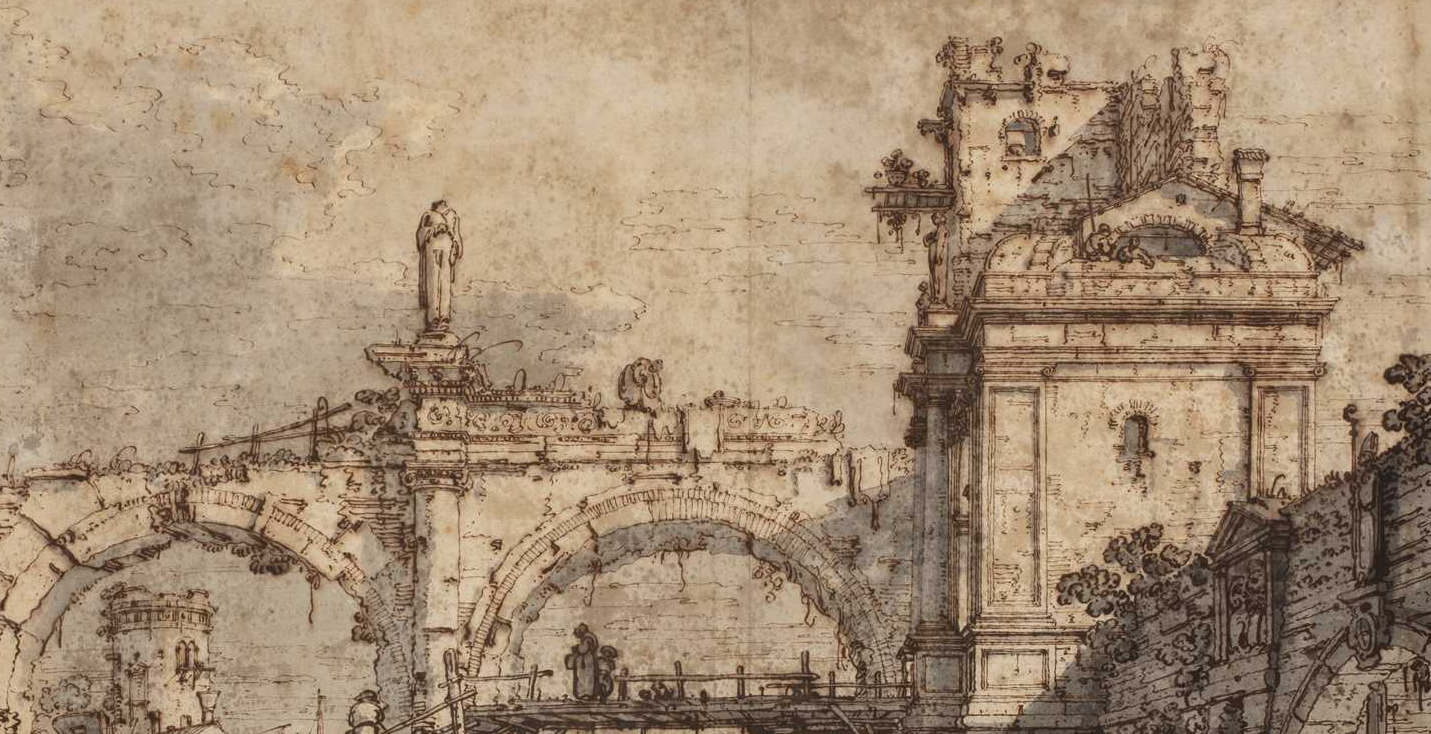
A wooden bridge spans a body of water, connecting the banks of an imaginary landscape dominated by a ruined Renaissance arch and a pavilion. Not far away, a circular tower can be seen, while a boat carries a man wrapped in a cloak and a gondolier. This scene is a far cry from the famous views of Venice with which Giovanni Antonio Canal, known as Canaletto (Venice, 1697–1768), entered the collective imagination. Yet it is precisely this fantastical composition—a drawing executed in pen and brown ink—that could help us better understand a significant part of the Venetian painter’s oeuvre: his “architectural capriccios, ” works in which buildings, ruins, and landscapes are freely combined, without the need to reproduce a real location.


The drawing in question, which has never before been documented in the literature on the artist, will be auctioned on October 21 by Mallams auction house in Oxford, in the United Kingdom, with an estimate of between 40,000 and 60,000 pounds, equivalent to approximately 47,000–71,000 euros. The work measures 37 by 53.3 centimeters within the double black frame drawn on the sheet of Italian paper. It is executed in pen and brown ink, with a light gray wash, and features a circular watermark with an image.


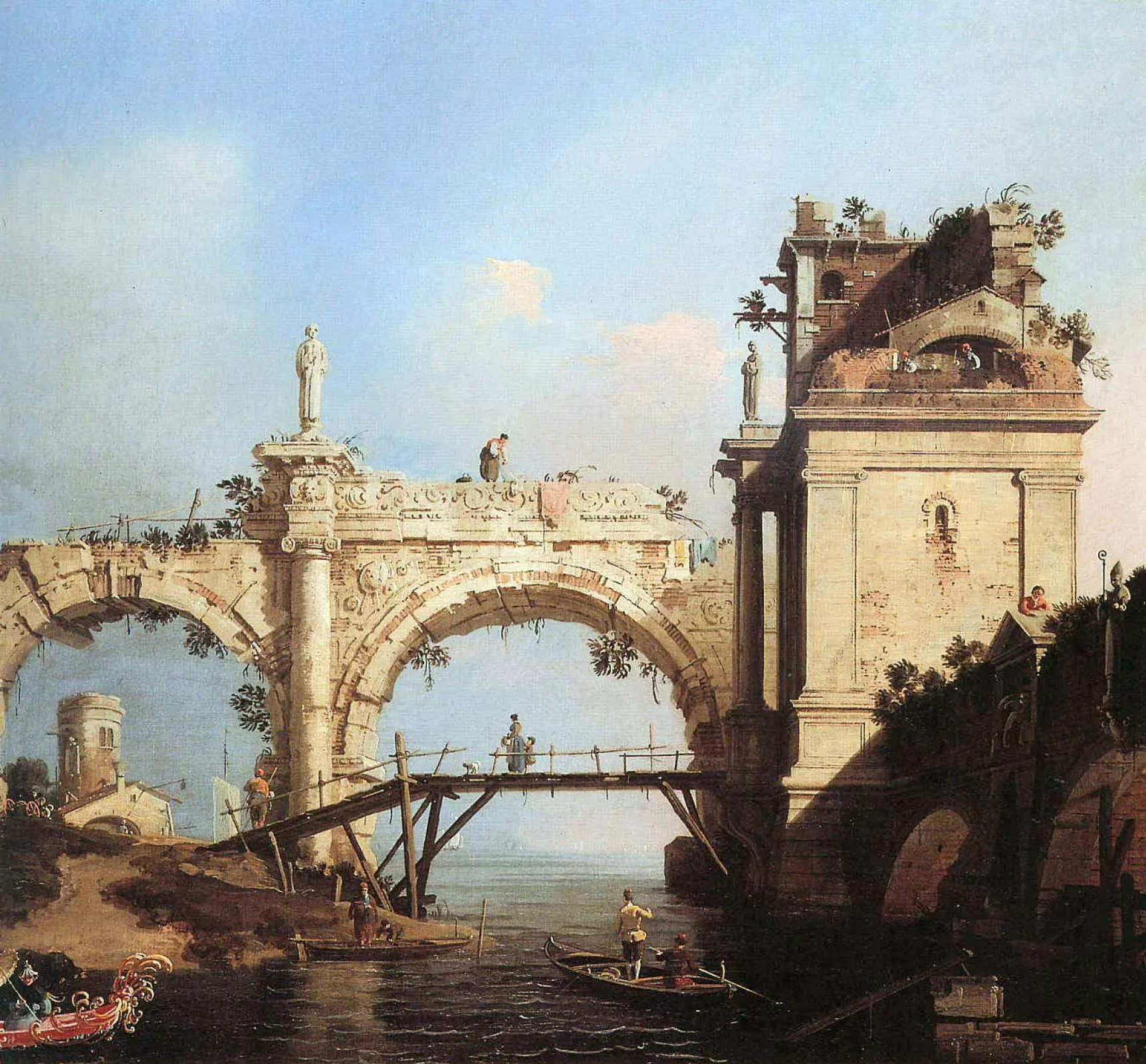
What makes the drawing particularly interesting is not only its long absence from public view: the composition, in fact, corresponds precisely to a painting by Canaletto known to scholarly literature, yet it exhibits a series of differences that suggest the drawing may have been conceived before the painted version. The hypothesis is that it is a preparatory sketch, perhaps created to show a patron what the commissioned work would look like. The correspondence with the painting—which was sold by Christie’s in London on December 8, 1995—was identified during the examination of the work. The painting, which measures 86.7 by 96 centimeters, is documented in William George Constable’s authoritative catalog on Canaletto, first published in 1962 and subsequently revised and updated by John G. Links in the 1976 and 1989 editions. The painting is reproduced in the first volume of the catalog, plate 93, and cataloged in the second volume under number 511.


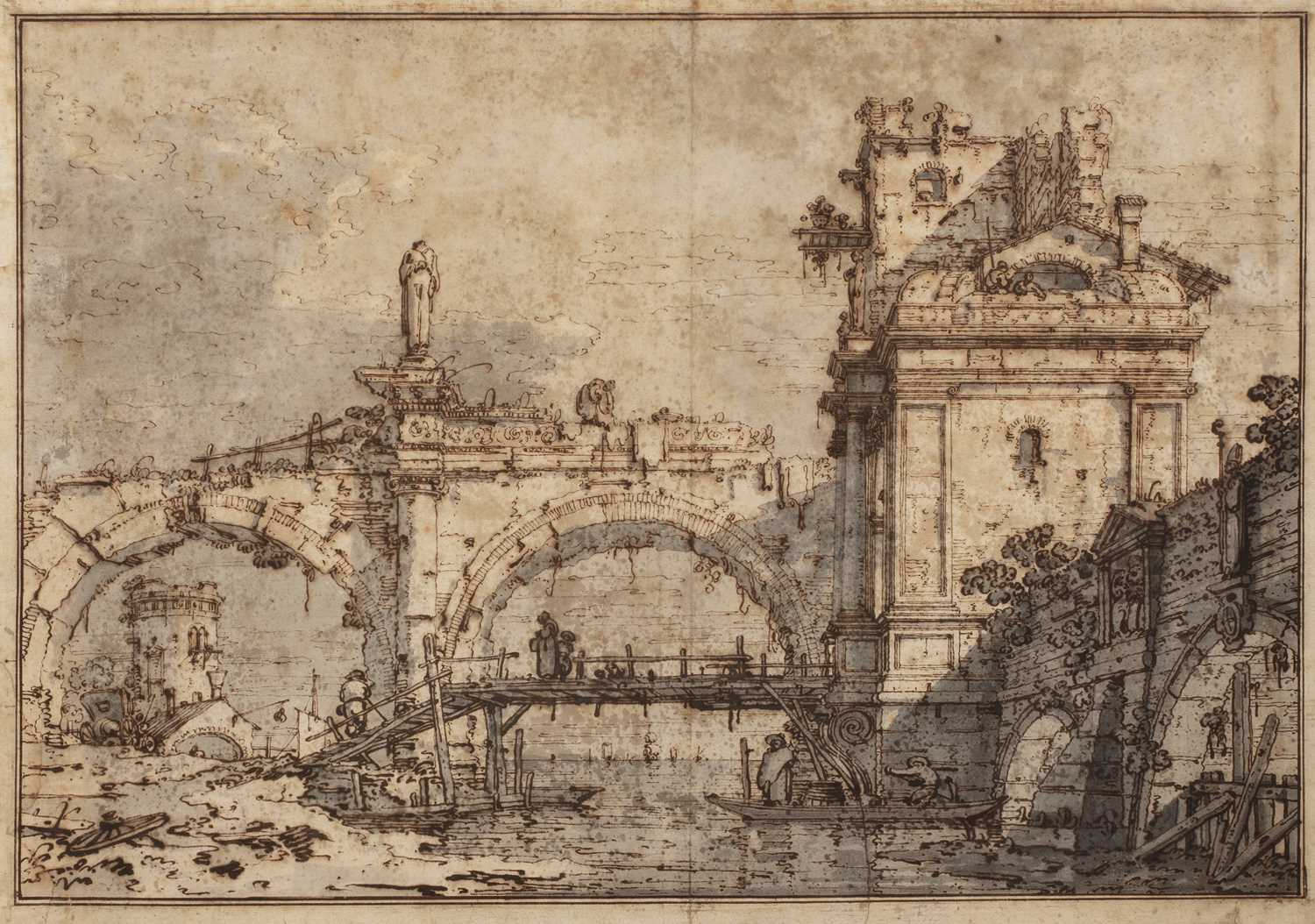
A comparison of the two versions reveals how Canaletto modified various elements of the scene. The most obvious difference concerns the boat in the foreground: in the drawing, it is positioned to the right of center, running parallel to the picture plane, and carries a man in a cloak and a gondolier. In the painting, however, the boat occupies the center of the composition and is oriented obliquely toward the horizon; the standing male figure has also changed. In the painted version, a second, decorative boat also appears in the lower left corner, carrying an Eastern figure holding a parasol—an element not present in the recently discovered drawing. The architecture and the figures populating the landscape have also been modified in the transition from the drawing to the canvas. The circular tower in the background, for example, is smaller in the painting, and the statue depicted in the scene has a head here, whereas in the drawing it is headless. Furthermore, on the left side, the bridge has more supports in the painted version, and the positions of the woman and child crossing it have changed, as has that of the dog accompanying them: in the painting, compared to the drawing, these elements are arranged differently. The pavilion on the right also shows some variations: in the painting, only one statue is visible, though it is positioned so as to protrude from the building and stand out more clearly, and the two young men on the roof are different from those depicted in the drawing and are placed farther apart from one another.
It is precisely these differences, considered as a whole, that support the hypothesis that the drawing predates the painting. According to the catalog entry accompanying the work, the drawing bears the characteristics of a model intended to illustrate to the patron the expected result of a commission. This is, however, a plausible reconstruction, not a definitively documented fact. A clue supporting this interpretation can be found on the back of the sheet, where an inscription in English reads: “‘a Present from Sig Canal d Canaletti’,” meaning a gift from Mr. Canal, known as Canaletti. The inscription seems to suggest that the drawing was given as a gift to the recipient of the painting. The catalog entry sees no reason to doubt the authenticity of the inscription and notes that Canaletto on other occasions produced two versions of the same drawing, keeping one and giving away the other.
A significant precedent is provided by the drawings the painter gave to Joseph Smith, his agent and dealer. These drawings entered the British Royal Collection in 1763, along with the bulk of Smith’s collection. They are documented in K. T. Parker’s catalog of Canaletto’s drawings held in the King’s Collection at Windsor Castle, published in Oxford and London in 1948, and in the Constable catalog. The references cited in the entry include numbers 55, 119, 114, 116, and 117 in Parker’s catalog and numbers 552, 732, 745, 749, and 750 in the second volume of Constable’s catalog. All but one of these sheets date from Canaletto’s years in England. The painter moved to London in May 1746 and remained there until 1755, with an eight-month stay in Venice between 1750 and 1751. The drawing to be auctioned in Oxford is also thought to date from the final part of that stay in England: the proposed date thus falls within a period in which Canaletto worked on numerous imaginary compositions, some of which are known in multiple versions.
The historical provenance of the painting corresponding to the drawing, however, remains unknown. Regarding the drawing, the auction catalog suggests it may have belonged to Charles Burney (1726–1814), a British music historian, composer, and musician. The hypothesis is that it subsequently passed to his son Charles Parr Burney (1786–1864), who served as archdeacon of St. Albans from 1840 to 1845 and of Colchester from 1845 to 1864, and was then passed down through the Burney and Comyn families to the current owner. Its provenance from Charles Burney is indicated as possible, not certain. Furthermore, this sheet is not the only known drawn version of the composition: a simplified replica, of nearly identical dimensions, remained unknown until its sale at Christie’s in London on July 4, 1984. In that case as well, the dimensions were approximately 36.5 by 52.5 centimeters. The drawing, reproduced in the Constable catalog revised by Links in 1989 and in the supplement published by Links in 1998, came from the collection of Christopher Head, who died in 1911 (a drawing by Giambattista Tiepolo and two by Francesco Guardi were also offered at that sale). The replica of Canaletto’s “capriccio” subsequently passed through other auctions: it was offered by Sotheby’s in New York on January 14, 1992, sold by Sotheby’s in London on July 5, 1993, and finally sold by Tajan in Paris on November 23, 2001. The most significant difference compared to the drawing currently offered by Mallams concerns the dog on the wooden bridge: in the replica, it is to the left of the woman and the child, while in the drawing up for auction, it occupies a more central position.
The existence of multiple versions confirms how widespread this composition was in Canaletto’s oeuvre. Numerous variations are known, most of which—and probably all—date from the years the artist spent in England. The catalog entry considers this scene one of the painter’s most successful inventions from that period, going so far as to call it likely his most popular imaginary subject. Among the painted versions are two large canvases: the first is an oval composition created for Chesterfield House in London before February 1752 and now in a private English collection. The second large canvas, square in format, features a variation of the composition with a single archway and is housed at the Baltimore Museum of Art. Another version, of more modest dimensions, extends the scene to the left with a Corinthian colonnade receding into the depth of the painting. The painting, recorded as signed and dated 1754 on the reverse, was offered for sale by Sotheby’s in New York on May 30, 1991. A replica was sold by Christie’s in New York on January 29, 1998, from the collection of Helen E. Abell of Kentucky. Its dimensions were 50.2 by 83 centimeters.
Finally, there is a finished drawing, likely signed, in which the arches appear more elaborate and compressed in the central part of the composition. The sheet, measuring 30.5 by 43.8 centimeters, was sold by Sotheby’s in New York on January 27, 2010, and is documented in the Constable and Links catalog.
The subject belongs to a part of Canaletto’s oeuvre that may be less immediately recognizable today than his cityscapes, but which played a significant role in his career. While the modern public primarily associates the painter with images of Venice and London, the auction lot description notes that Canaletto himself may have attached particular value to his capriccios. These imaginative compositions, in fact, were held in high regard, especially among the artist’s Italian contemporaries.
A capriccio is not limited to reproducing an existing building or landscape: in this case, Renaissance ruins, a pavilion, a tower, a bridge, and various figures come together to construct an imaginary place, organized through architectural elements and narrative details. A comparison of the different versions of the scene allows us to trace the changes made by the painter and to observe how the same invention could be adapted to different formats and approaches.
The authenticity of the drawing has been confirmed by Charles Beddington, one of the leading scholars of Canaletto. The October 21 auction in Oxford will thus bring to market a sheet not previously recorded in Canaletto’s bibliography, linked to a composition of which several painted and drawn variations are already known. The inscription on the reverse, the differences from the painting, and the possible provenance through the Burney family are the main elements around which the proposed reconstruction of this work is structured.
 |
| A previously unseen drawing by Canaletto resurfaces after centuries: it will be sold at auction |
Warning: the translation into English of the original Italian article was created using automatic tools. We undertake to review all articles, but we do not guarantee the total absence of inaccuracies in the translation due to the program. You can find the original by clicking on the ITA button. If you find any mistake,please contact us.