





In the municipality of Bortigali ( Nuoro), in the heart of Sardinia, a Tomb of the Giants has been discovered at the Carrarzu Iddia archaeological site, near the town of Macomer: This discovery enriches our understanding of Nuragic civilization and helps to define with greater precision the organization of the ancient landscape in one of the island’s most significant areas. The monument, which had long been completely hidden by vegetation, was rediscovered thanks to survey activities conducted by Sardinia’s two Superintendences of Archaeology, Fine Arts, and Landscape, which were already engaged in the excavation and restoration of the nuraghe located at the site.
The tomb is located on the southern slope of Crastu Littu, at an elevation of approximately 740 meters, in a location of particular interest both from a strategic standpoint and in terms of the landscape. From this vantage point, the view sweeps across the Macomer plain, the highlands of Abbasanta and Paulilatino, all the way to the hills of the Nuoro area and the Gulf of Oristano—a panorama that immediately conveys the importance of this site within the settlement network of Nuragic Sardinia.
The discovery was made as part of the archaeological surveys that have long been conducted at the Carrarzu Iddia complex. Once the monument was identified, the two Superintendencies, in agreement with the landowners, launched an operation to clear away the dense vegetation and debris covering it, revealing the structure once again—which has been preserved in what are considered exceptional condition.
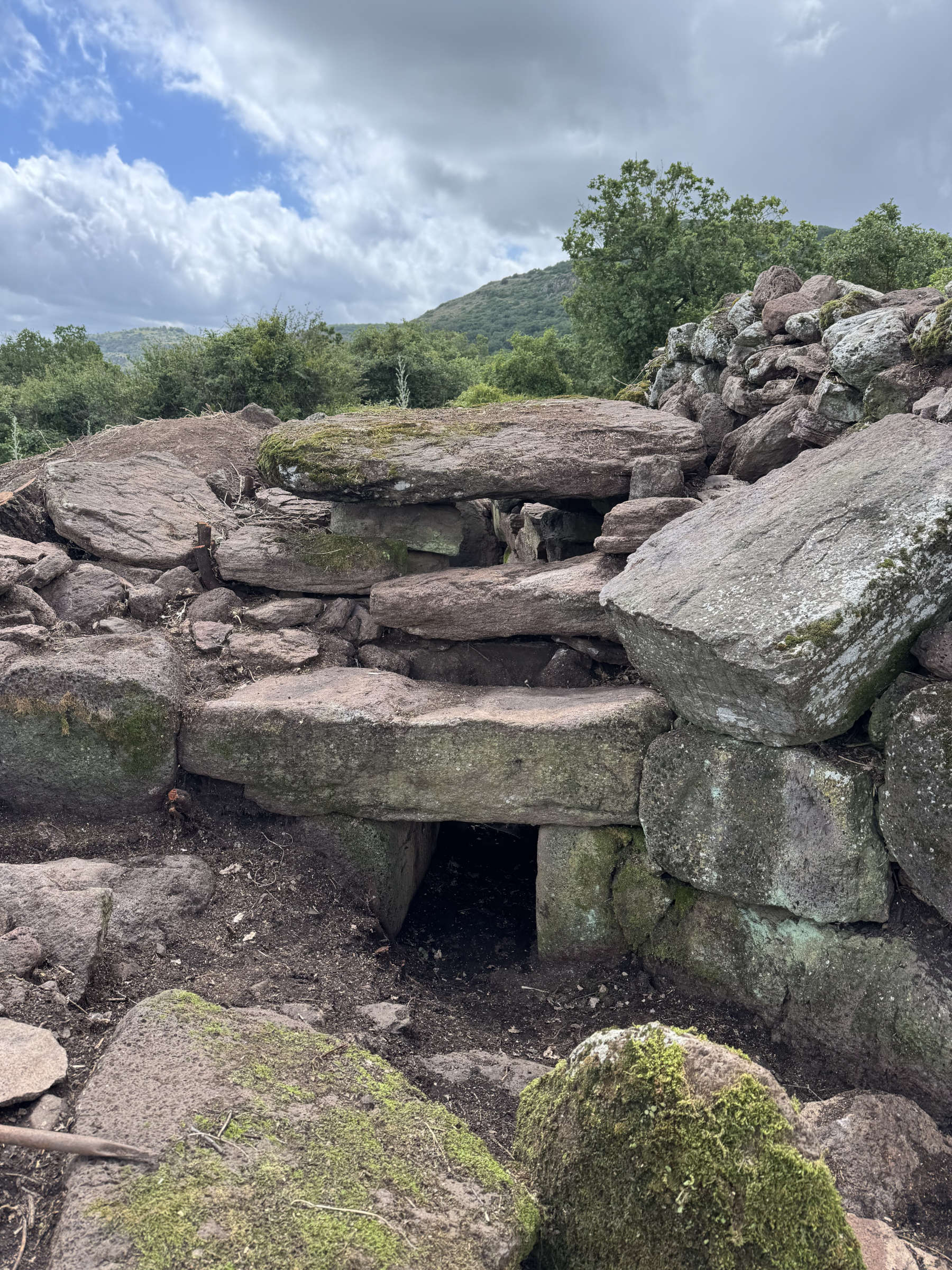
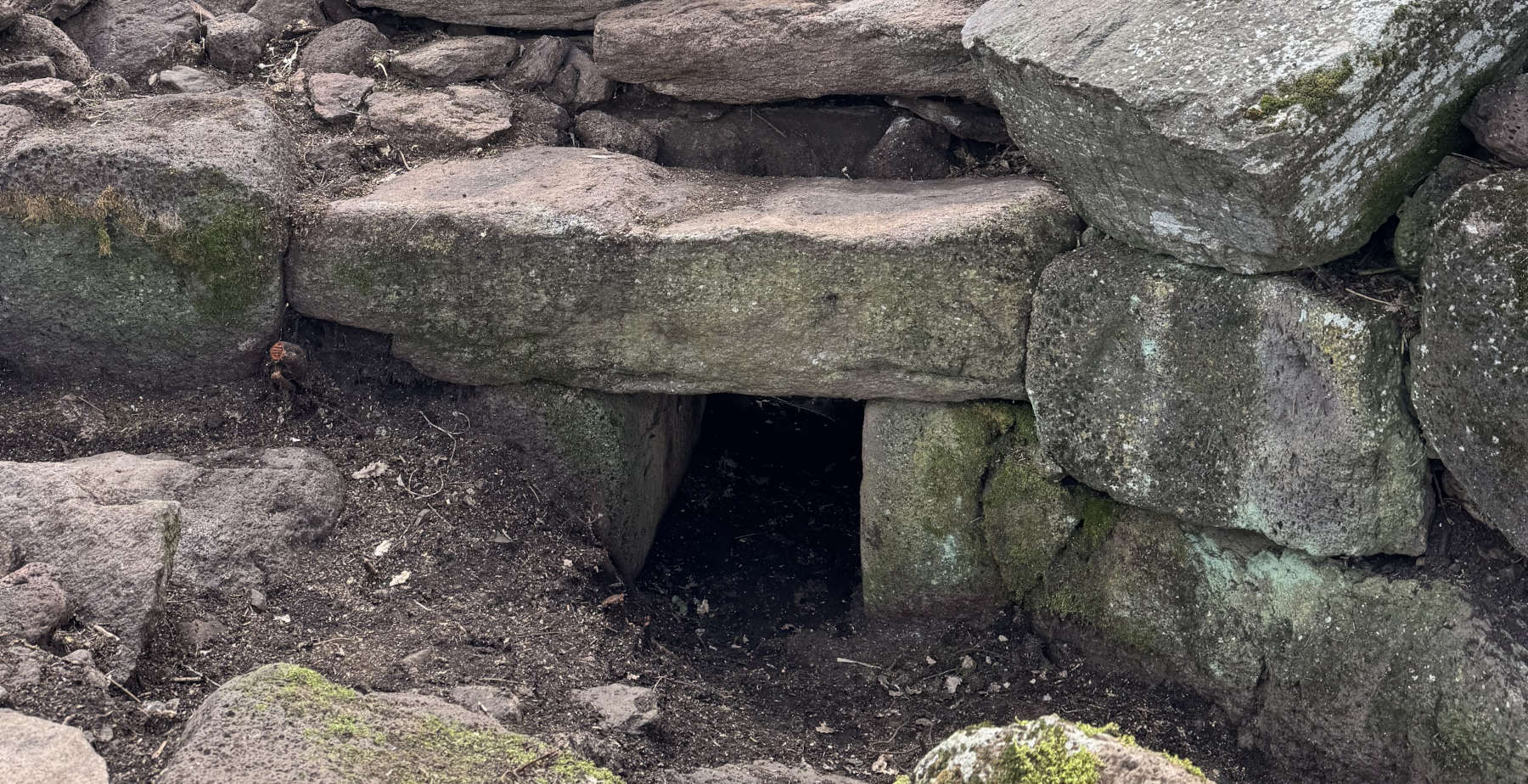
The funerary monument is constructed of trachyte blocks and retains the fundamental architectural elements characteristic of this type of collective burial. In fact, the burial chamber and the monumental semicircular exedra preceding the entrance—one of the most representative features of the Tombs of the Giants and one of the aspects that distinguish this monumental type within the funerary architecture of protohistoric Sardinia—are still clearly visible.
Among the elements that have most caught the attention of archaeologists is a particular internal feature of the structure. Inside the burial chamber, the space is divided into two levels near the entrance—a construction solution that has been documented only rarely in the Tombs of the Giants known to date. Precisely because of its uniqueness, this feature will be the subject of further investigation and study, which may help shed light on aspects of funerary practices and construction techniques developed by the Nuragic communities that are still poorly understood.
However, the monument has not survived to the present day in a completely intact state. Archaeologists have determined that the tomb was subject to illegal excavations in the past, a phenomenon that has unfortunately affected numerous archaeological sites in Sardinia. Despite this tampering, ceramic materials of particular interest have been recovered from inside the structure, documenting human occupation dating back to the earliest phases of Nuragic civilization. This is an important piece of evidence, as it allows us to chronologically date the monument’s use and place it within the broader context of the evolution of the communities that inhabited this area of the island.
The new discovery takes on even greater significance when viewed within the archaeological context of Carrarzu Iddia. The surrounding area has, in fact, yielded numerous traces of human presence spanning an extremely broad chronological arc, from prehistory to the Roman era. In particular, the Nuragic period appears to be exceptionally well-documented, as evidenced by the extraordinary concentration of monuments and structures preserved in the region.
According to archaeologists, the landscape revealed by the investigations highlights an extremely complex spatial organization, in which settlements, places of worship, and burial grounds are closely interconnected. These are not, therefore, isolated monuments, but elements belonging to a complex territorial system that reflects the social, economic, and religious organization of the Nuragic communities.
The recently unearthed Tomb of the Giants is, in fact, part of a major archaeological complex consisting of two proto-Nuragic structures, a sacred well, a settlement, and a vast burial ground that was already in use during the pre-Nuragic period. Evidence of an even earlier occupation of the site is provided by the presence of a dolmen, which attests to the continuous use of the area for funerary and ritual purposes even before the development of Nuragic civilization.
Taken together, these monuments paint a picture of a territory organized according to a precise plan, in which spaces designated for housing, worship, and burial were part of a single landscape system. This new discovery therefore helps to enrich our understanding of this complex and offers new perspectives for reconstructing the settlement’s evolution over the centuries.
The Tombs of the Giants represent one of the most characteristic and monumental expressions of Nuragic civilization. Their emergence is generally dated to around 1800 B.C., during a period of profound social and cultural transformations that led to the development of the grand stone structures typical of protohistoric Sardinia.
From an architectural standpoint, these tombs represent the evolution of the earliest dolmens. Compared to the dolmens, the Giants’ Tombs feature a significantly enlarged burial chamber, designed to accommodate collective burials, and introduce the characteristic semicircular exedra positioned in front of the entrance—an element that would become one of the symbols of Nuragic architecture.
The expansion of the chamber likely reflects changes in community organization and funerary practices, while the construction of the exedra attests to the growing development of monumental architecture linked to ancestor worship. In fact, this space did not serve merely an architectural function; it was the site where ceremonies, rites, and collective practices related to the memory of the deceased and the veneration of ancestors took place—aspects central to the religious life of Nuragic communities.
The discovery of the Tomb of the Giants at Carrarzu Iddia thus offers an important opportunity for scholars to delve deeper into the subject. The monument’s exceptional state of preservation, combined with its rare two-level internal layout and the ceramic artifacts found in the burial chamber, may provide new insights into construction methods, the evolution of funerary practices, and the chronology of the early phases of Nuragic civilization.
 |
| Sardinia: A monumental Tomb of the Giants Discovered Near Macomer |

Warning: the translation into English of the original Italian article was created using automatic tools. We undertake to review all articles, but we do not guarantee the total absence of inaccuracies in the translation due to the program. You can find the original by clicking on the ITA button. If you find any mistake,please contact us.





























 IT
IT FR
FR DE
DE ES
ES CN
CN


