




by Redazione 08/09/2026



Categories: Archaeology / Disclaimer
The restoration project for the large exedra and the underground gallery of the Baths of Trajan at Colle Oppio has been completed. The project, carried out as part of the PNRR – Caput Mundi initiative, opens new archaeological spaces and important artifacts from Imperial Rome to visitors.


The restoration and enhancement project for the large exedra and the underground gallery of the Baths of Trajan at Colle Oppio has been completed. The project, carried out as part of the PNRR – Caput Mundi initiative, opens new archaeological spaces and important artifacts from Imperial Rome to the public. The Baths of Trajan are now preparing to welcome visitors once again through a tour route that allows them to observe up close some of the most important decorations preserved within the complex. The work focused on the upper levels of the exedra and the underground gallery, addressing both the conservation of the structures and improvements to accessibility and the quality of the visitor experience.


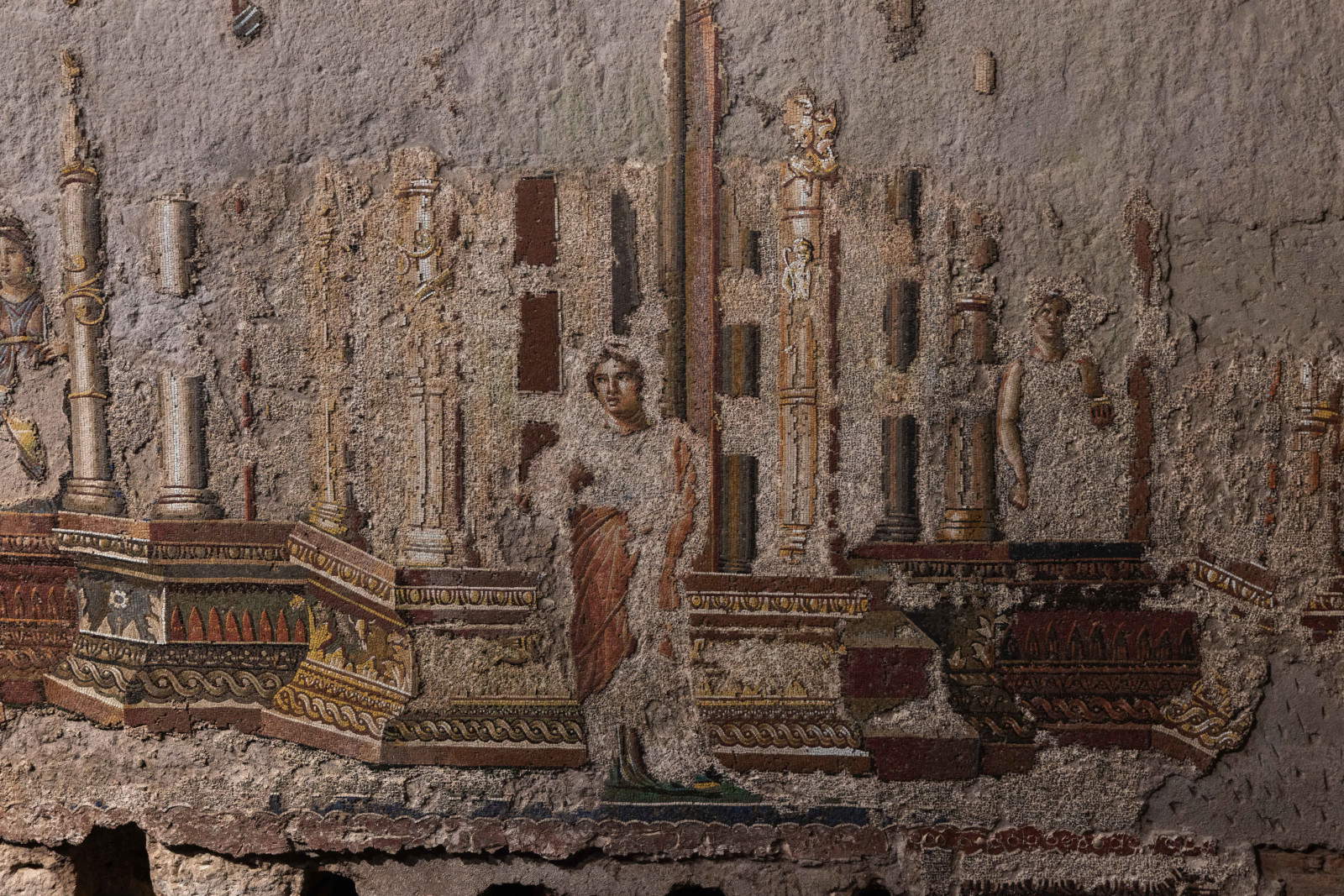
Among the project’s most significant achievements is the restoration of the “Painted City” and the “Great Mosaic.” The former is a fresco measuring approximately ten square meters depicting, as viewed from above, a city surrounded by walls and towers. The buildings are rendered using a distinctive perspective technique. The decoration belonged to a structure predating the Baths of Trajan and dates back to the 1st century A.D.
The Great Mosaic, on the other hand, adorned the walls of a large room overlooking a nymphaeum. The preserved section, visible to a height of about five meters, features a complex architectural composition reminiscent of a theatrical scaenae frons, organized in two registers with statues and royal figures.


Due to their artistic quality and the extent of the surfaces still preserved, both works represent an exceptional example within the Roman archaeological heritage. The restoration has improved their legibility and conservation condition through various procedures, including preventive biocide treatment, the removal of surface deposits, the consolidation of surfaces, and necessary grouting.


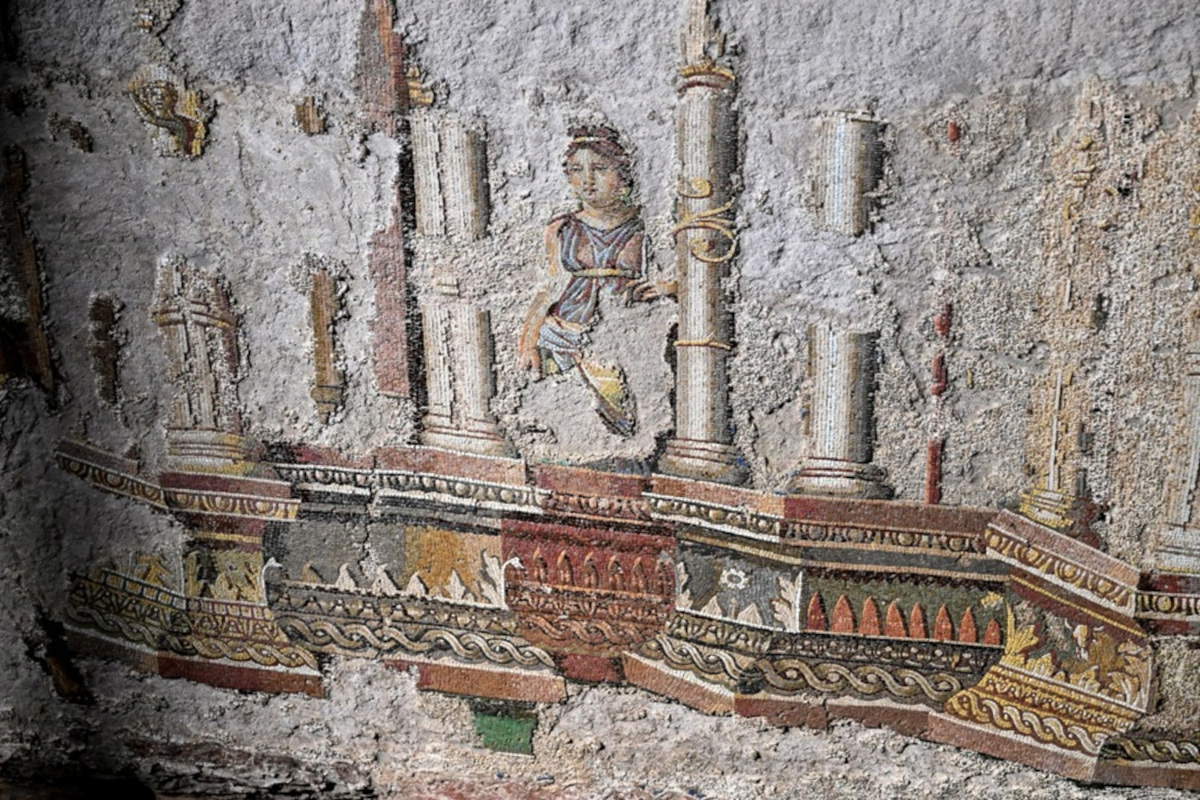
The activities carried out during the PNRR project were not limited to restoration. New archaeological surveys and the expansion of the excavation have, in fact, added important information to our understanding of the stratigraphy of Colle Oppio. An additional section of mosaic decoration depicting a port city—composed of a series of buildings likely facing the sea—has been unearthed. The motif appears to be associated with the so-called “maritime villas.” Beneath the decoration, remains of a cladding made of large marble slabs were also uncovered. In the center of the wall, a niche—also clad in marble—approximately 2.20 meters high was identified. These elements allow for a more precise reconstruction of the room’s monumental dimensions, whose walls must have reached a height of about 12 meters. This decorative complex, too, can be dated to the second half of the 1st century A.D.
The new exhibition route also sheds light on the specific function of the large southwestern exedra, which measures about 30 meters in diameter. The structure preserves traces suggesting it was used for cultural purposes and the transmission of knowledge. The two rows of niches may have been intended for the storage of books and documents, while the steps were likely used to accommodate the public during readings and meetings. Opposite the exedra stood a portico supported by the underground gallery—the very one that today houses the “Painted City” and the “Great Mosaic.” This spot on the Oppian Hill thus features an extraordinary overlap of eras: the remains of buildings from the Neronian-Flavian period coexist with the later grand thermal complex commissioned by Trajan, in a stratification spanning the 1st and 2nd centuries A.D.
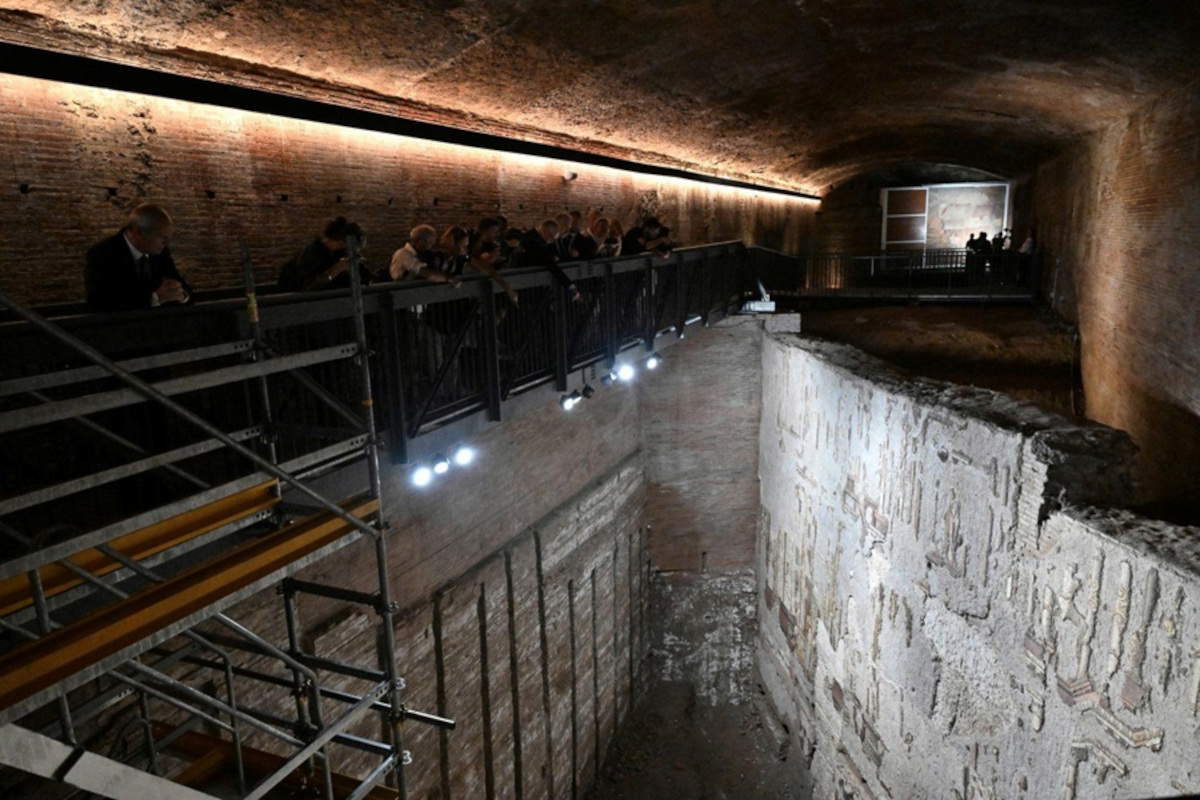
The project also included a series of improvements designed to make the visit more accessible and engaging. Next to the gallery entrance, a reception area with a bookshop has been set up, while a new walkway connects the two sections of the gallery, passing over the chamber containing the Great Mosaic.
A large triangular room, meanwhile, houses the fistulae—the lead pipes that were part of the baths’ ancient water supply system. In the exedra area, assessments of the complex’s seismic and structural vulnerability were conducted, including load tests on the vault of the gallery below. The project also included the creation of new pedestrian paths, scenic viewing areas, and the redesign of the green spaces. Finally, a new lighting system enhances both the public spaces and the presentation of the archaeological structures.
The redevelopment is not limited to heritage preservation. The exedra will, in fact, be equipped with a new tiered seating system, designed to host concerts, conferences, and other events. The project was further enhanced with a mechanized vertical lift connecting the upper and lower levels, as well as new educational displays designed to provide visitors with more information about the structures and archaeological artifacts.
“With this project, we are giving back to the city and finally making a wonderful site—in the heart of Colle Oppio—accessible to the public, while restoring and highlighting unique artifacts from Rome’s history. The restoration of the “Città Dipinta” and the “Grande Mosaico,” along with the new discoveries that have emerged from the excavations, also highlights the extraordinary nature of a city where every intervention on its heritage can bring new fragments of history to light and enrich our understanding of the past. This is one of the most important objectives of Caput Mundi, a program that has allowed us to carry out widespread interventions on the capital’s archaeological and cultural heritage, combining preservation, research, and accessibility, and returning to Romans and visitors sites that have been little known or inaccessible for far too long. “The Baths of Trajan are a new and important piece in this great effort to preserve and highlight Rome’s millennia-old history,” declared Mayor Roberto Gualtieri.
The Baths of Trajan were commissioned by Emperor Trajan and designed by Apollodorus of Damascus, considered the most famous architect of the time. The complex was inaugurated on June 22, 109 A.D. Covering an area of approximately 60,000 square meters, the baths occupied a large terraced area on the Oppian Hill and incorporated older structures, including some rooms belonging to the Domus Aurea. A vast green area lined with porticoes also extended around the bath complex. The baths were not conceived solely as a place for physical care: the spaces were also used for sports, recreation, and cultural activities.
Access to the new tour route will initially be on a trial basis, with limited openings and organized tours for small groups. This approach will allow for monitoring visitor numbers and assessing their impact on the delicate archaeological surfaces. For the month of September, the first openings are scheduled for Saturday, September 12, and Sunday, September 13, 2026. The underground gallery and the exedra will be open to the public over the weekend via free guided tours in Italian, by reservation.
Starting October 2, 2026, the schedule will expand: tours will be held from Friday through Sunday, with six daily sessions at 10 a.m., 11 a.m., 12 p.m., 1 p.m., 2 p.m., and 3 p.m. Each time slot can accommodate a maximum of 15 participants. Reservations are recommended by calling 060608.
 |
| The Baths of Trajan Reopen to the Public: “The Painted City” and the “Great Mosaic” Have Been Restored |
Warning: the translation into English of the original Italian article was created using automatic tools. We undertake to review all articles, but we do not guarantee the total absence of inaccuracies in the translation due to the program. You can find the original by clicking on the ITA button. If you find any mistake,please contact us.