





, a new permanent space dedicated to Gerhard Richter (Dresden, 1932), will be built in Doha, Qatar—a pavilion conceived by the artist himself as a site-specific work that unites architecture and art. The Doha Pavilion, as it will be called, will be a standalone structure designed by Richter to house a specific collection of his paintings and sculptures. Selldorf Architects collaborated on the project, working with the artist to translate his vision into architecture. The pavilion will be located in MIA Park, the expansive public space outside the Museum of Islamic Art, and will open on November 20, 2026, on the eve of the opening of Rubaiya Qatar, the country’s new international contemporary art quadrennial. The announcement was made today in Berlin and Doha. “Qatar’s ambitious program for public art installations has been developed through our relationships with leading figures in contemporary art,” said Sheikha Al Mayassa bint Hamad bin Khalifa Al Thani, president of Qatar Museums. “It is a tremendous pleasure to now be working with an artist recognized as one of the greatest of his generation, Gerhard Richter, whose new Doha Pavilion enriches both our collection of public art and the international cultural landscape.”
The project also stems from a personal experience of the artist. Richter recounted that his trip to Doha in 2013 took place two years after he began developing his “Strip” paintings, and that the city’s architecture and history inspired the idea for a pavilion capable of bringing together the various thematic threads of that body of work. “The exterior of the pavilion features decorative tiles based on the Patterns that first led me to the Strip paintings,” Richter explained. Inside, the Strip paintings are juxtaposed with the Mirrors, while the Strip Tower is situated at the center of the structure. “Doha is the right place—and the only place—for my pavilion,” the artist added.
Gerhard Richter’s career, spanning from the 1960s to the present, is characterized by an extremely diverse body of work that has explored and expanded the formal and conceptual possibilities of art and the way we relate to images. His extensive body of work includes paintings, objects, installations, works on paper, editions, and photographic documentation, and is grounded in a multifaceted exploration of history, memory, and perception.
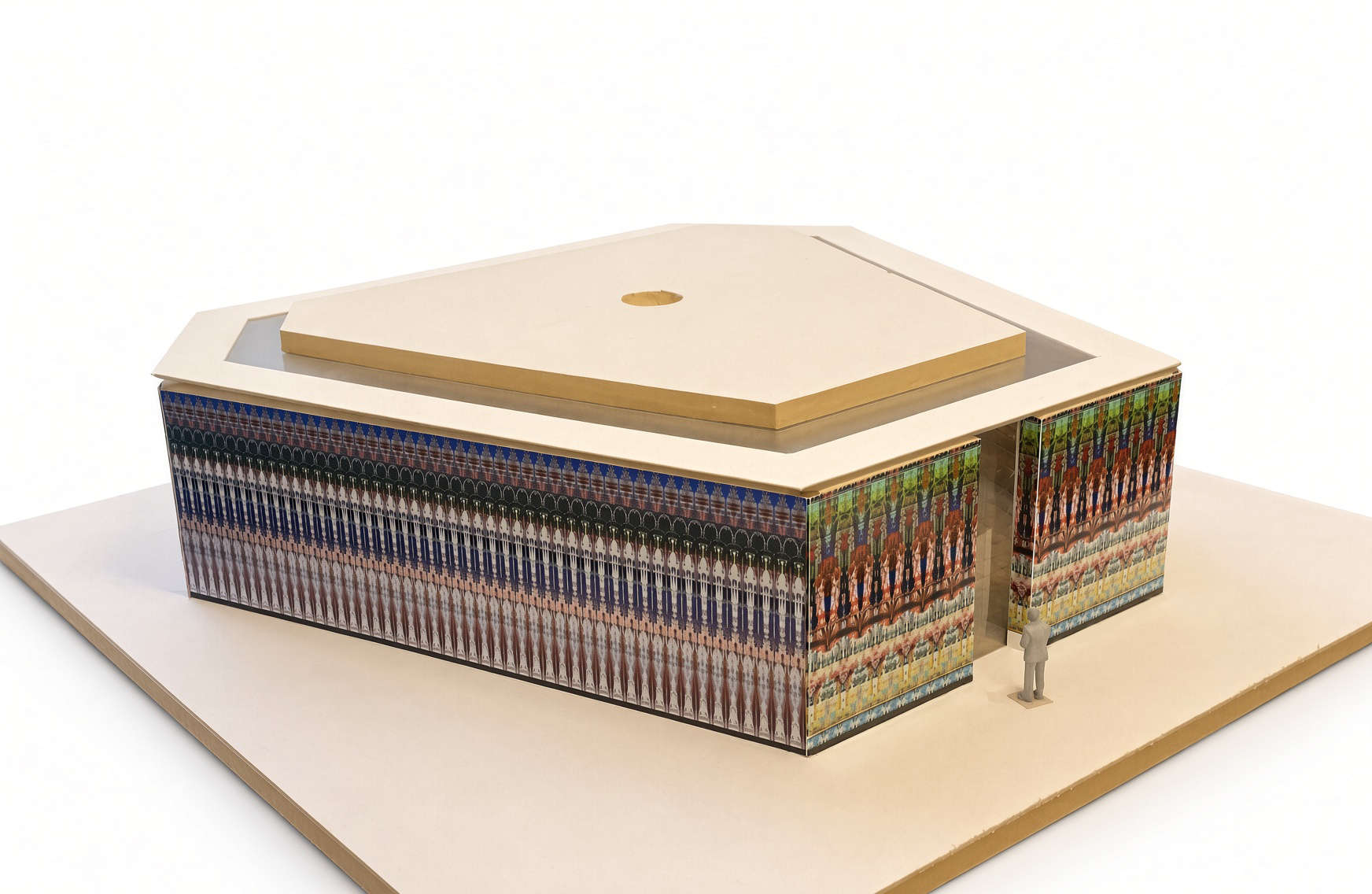
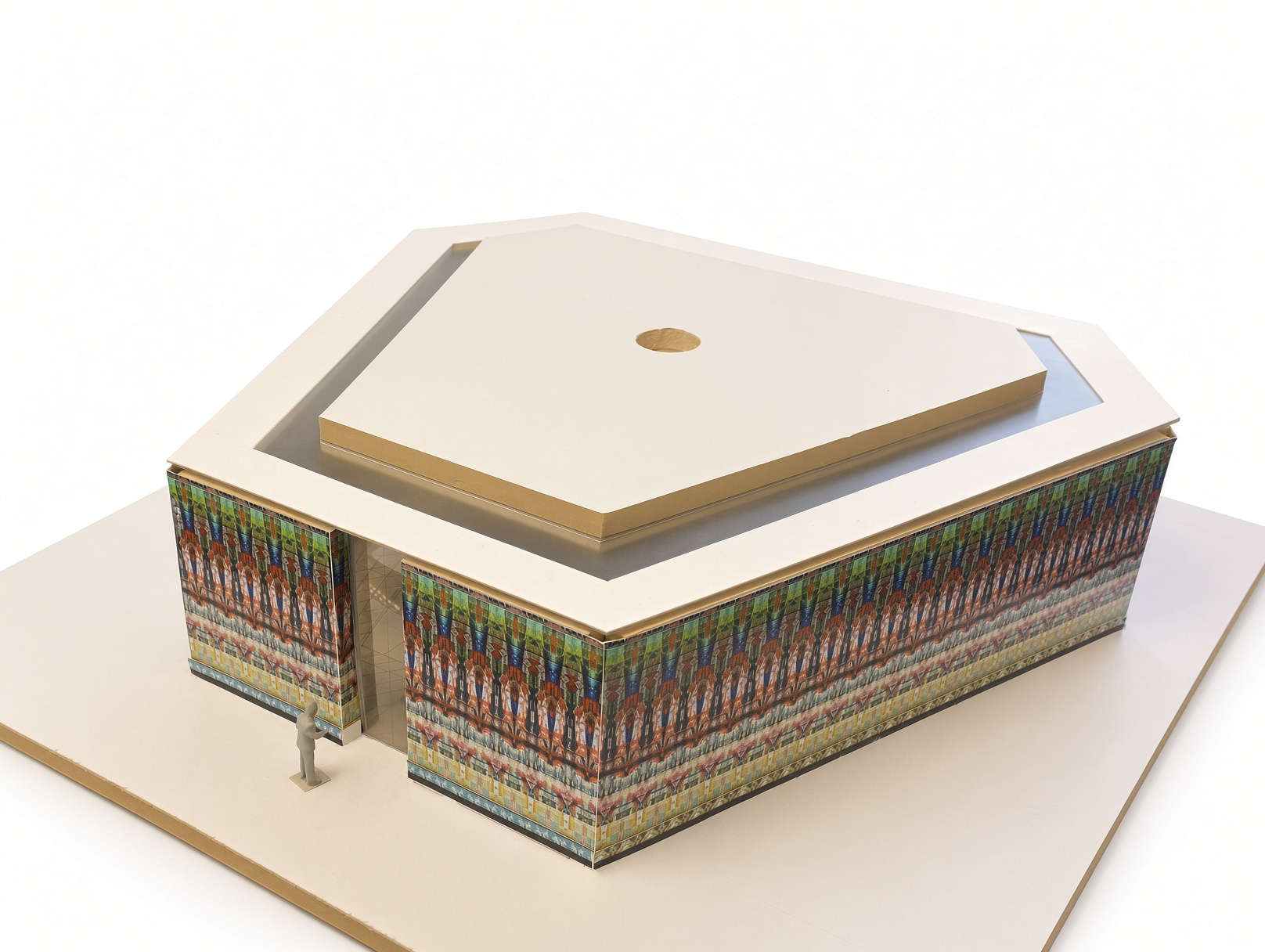
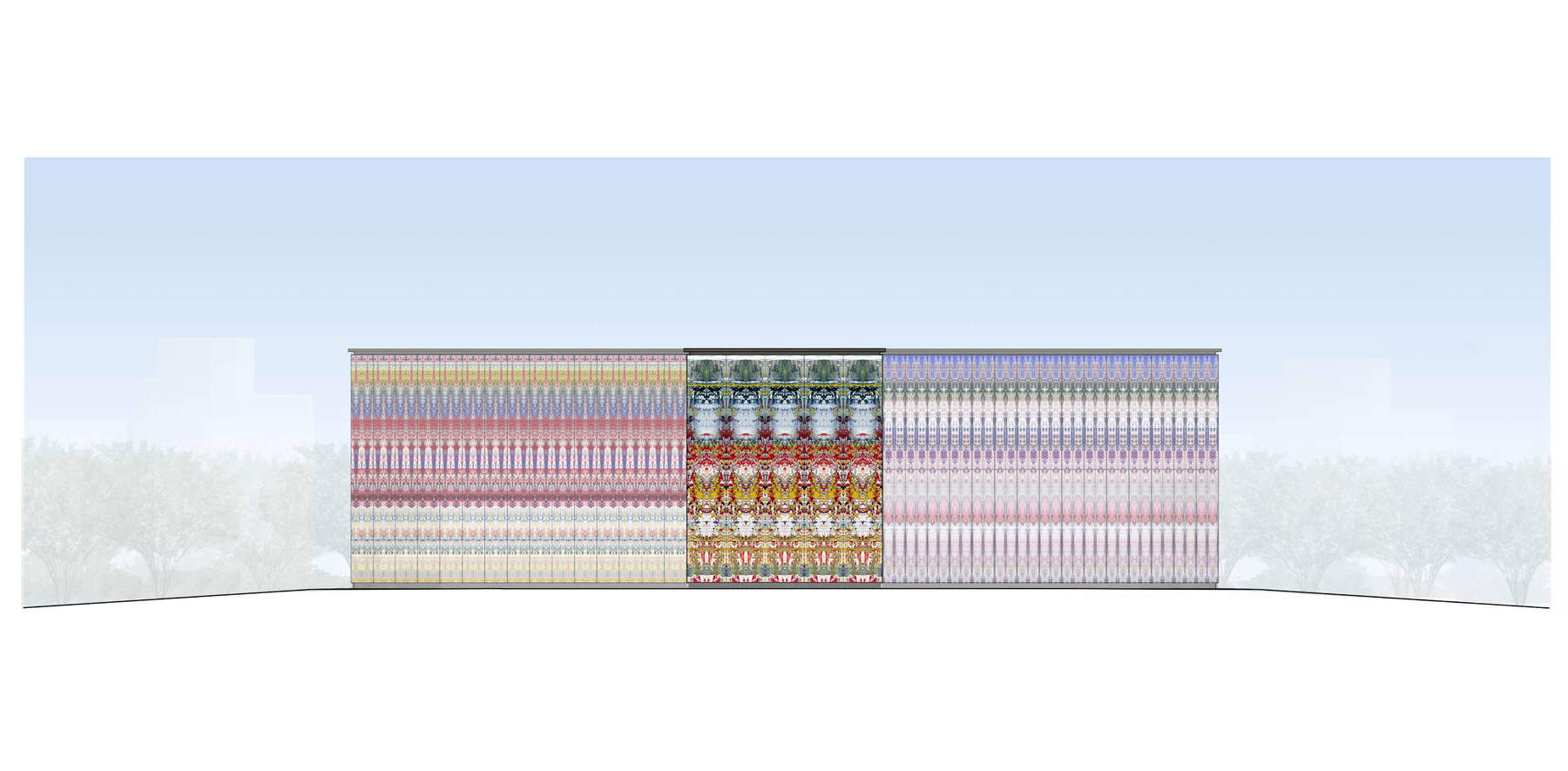
The Doha Pavilion encapsulates some of the main strands of this research. The structure has a hexagonal floor plan and features a series of repeated patterns composed of printed panels on its six exterior walls. The patterns are linked to the artist’s book *Patterns*, created by Richter in 2011, which documented the creative process behind his famous *Strip* series of paintings, begun that same year. The walls thus transform the digitally generated compositions into a new architectural form, bringing into three-dimensional space the analytical and experimental approach with which Richter approached painting and, more generally, perception.
The configuration of the patterns covering the six exterior walls is the result of a meticulously calculated process. In 2010, Richter took a digital image of his 1990 painting *Abstract Painting (724-4) * and divided it into two vertical strips. These were subsequently subdivided into 4, 8, 16, 32, 64, 128, 256, 512, 1024, 2048, 4096, and finally 8192 strips. Each strip is mirrored and repeated, producing a horizontal, symmetrical pattern. The mathematical process and the visual result evoke the meticulously constructed geometries of Islamic art, characterized by intertwined arabesques and tiles that repeat potentially infinitely. In this interplay between calculation, repetition, and perception, the pavilion’s architectural motifs can also serve as windows onto the spiritual world, much like the geometric patterns found in Islamic art.
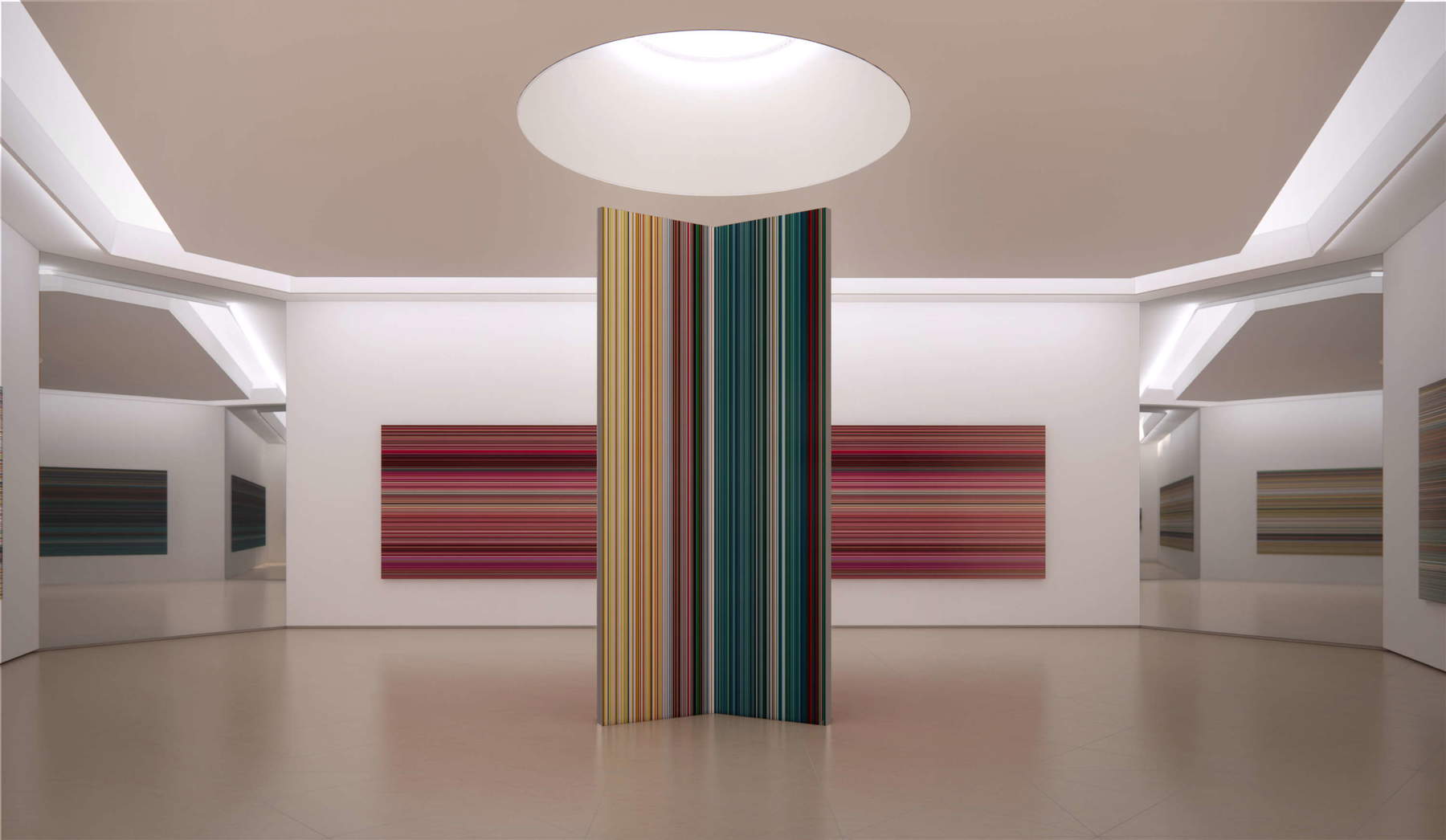
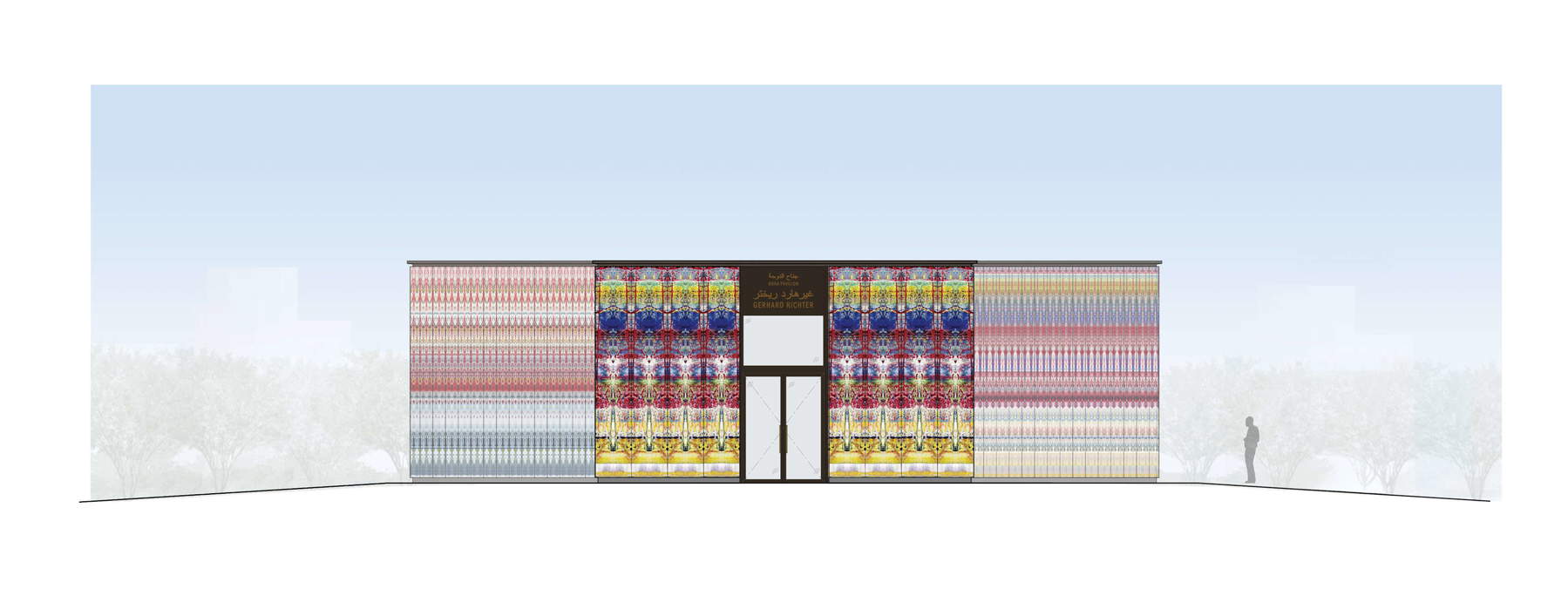
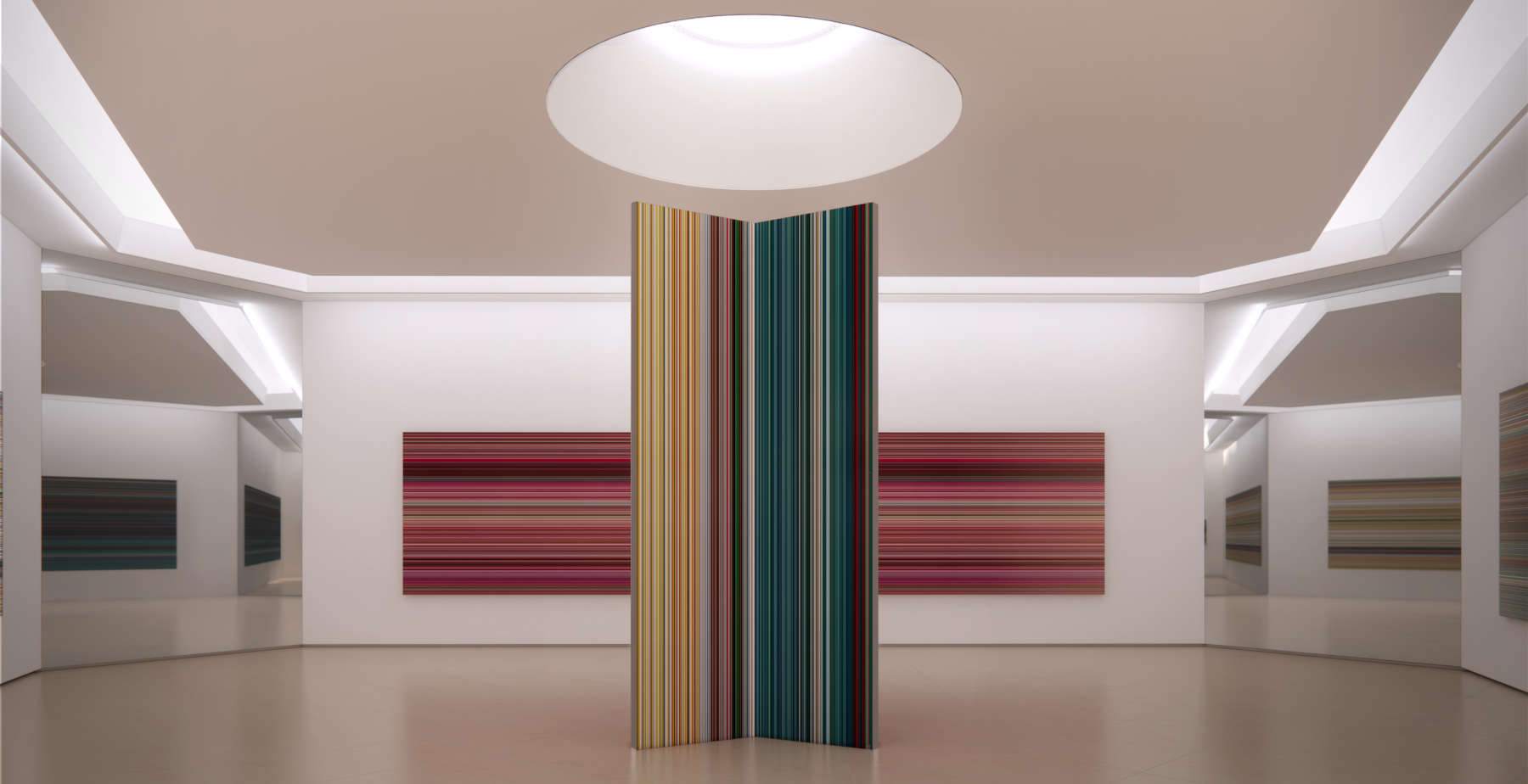
Inside the pavilion, three large “Strip paintings” —by Richter are on display, taking the described process to its extreme conclusion. The works transform the complex surface of the original abstract painting into a succession of thin horizontal strips, each representing a section of the original image exactly 0.08 millimeters wide. Further subdivisions would be possible, but beyond a certain threshold they would become indistinguishable to the naked eye. At the center of the pavilion stands the Strip Tower, a tripartite sculpture that translates the principles of the Strip Paintings into the language of autonomous sculpture. Richter designed it specifically for this venue, making its central element a point of connection between his two-dimensional and three-dimensional artistic explorations.
Among the Strip Paintings are two large Mirrors, part of a group of works that Richter began creating in the 1980s. The two mirrors, which extend from floor to ceiling, are mounted on the narrower walls of the pavilion and reflect the interior space, including the artworks and the people passing through it. The result is the perception of a potentially infinite space that changes in response to the movements of visitors. The “Mirrors” are thus also conceived as a literal reflection—or a meditation—on painting and the production of images. The project is completed by a stone sculpture titled “Brunnen,” situated directly outside the pavilion.
“It is a rare honor to assist Gerhard Richter in realizing his vision for this project, which represents an important addition to his relentless and fascinating exploration, as well as a privilege to contribute to Doha’s extraordinary collection of contemporary architecture,” said Annabelle Selldorf. The architect also expressed her gratitude to Sheikha Al Mayassa, Gerhard Richter, and the entire Qatar Museums team.
 |
| A permanent pavilion designed by Gerhard Richter will be built in Qatar |

Warning: the translation into English of the original Italian article was created using automatic tools. We undertake to review all articles, but we do not guarantee the total absence of inaccuracies in the translation due to the program. You can find the original by clicking on the ITA button. If you find any mistake,please contact us.




















 IT
IT FR
FR DE
DE ES
ES CN
CN


