




by Redazione 30/08/2026



Categories: Contemporary art / Disclaimer
From September 5 to October 11, Palazzo Santo Stefano in Padua is hosting a solo exhibition by Andrea Chiesi, curated by Marina Sonzini, which traces more than thirty-five years of exploration of the contemporary landscape, ranging from industrial ruins to reclaimed natural areas.

Padua is set to host a major exhibition by Andrea Chiesi (Modena, 1966), an artist from Emilia-Romagna unanimously recognized as one of the great talents of his generation, featuring a retrospective that traces his career, pursued with consistency and dedication for over thirty-five years. The exhibition, titled *Oltre la Soglia* and curated by Marina Sonzini, is on view at Palazzo Santo Stefano, located at Piazza Antenore 3—the institutional headquarters of the Province of Padua—from September 5 to October 11, 2026. It will be open to the public every Friday, Saturday, and Sunday, from 10:30 a.m. to 1:00 p.m. and from 3:00 p.m. to 7:00 p.m., with free admission.
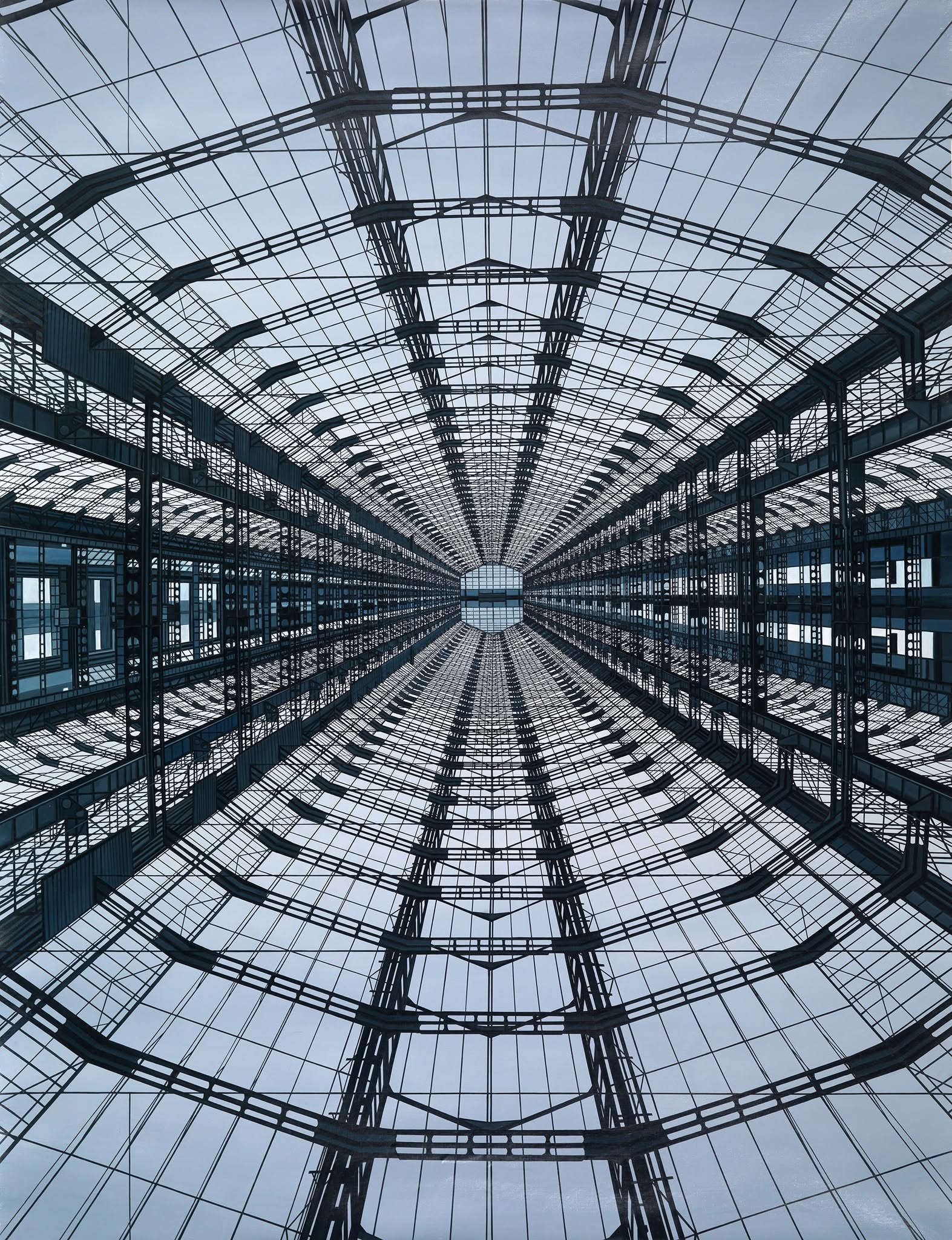
The exhibition occupies the rooms on the main floor of Palazzo Santo Stefano, a building that, in addition to serving as the provincial government’s headquarters, has opened its doors to art since April 2024, hosting a series of free exhibitions. The exhibition will present a significant selection of works that reflect an artistic exploration centered on the observation of the contemporary landscape, with a particular focus on abandoned and interstitial spaces, post-industrial ruins, and large steel structures such as bridges, carousels, and gasometers. These are places that exert an irresistible fascination on the artist, who explores and photographs them and then, in the solitude of his studio, sketches them in pencil on linen canvas—a process that allows him to uncover their details and enter into a symbiotic relationship with those spaces. Only then does he proceed to oil painting, a process characterized by extreme slowness, concentration, and precision—almost a form of meditation.


In recent years, alongside oil painting on linen, Chiesi has also returned to drawing on paper, as well asintaglio engraving, thus retracing his artistic origins. The result is a densely interwoven pattern of black lines created with permanent markers, over which the artist applies light glazes of diluted India ink on Rosaspina Fabriano paper. As the chair of painting at the Brera Academy of Fine Arts, Chiesi is a master of drawing with few equals on the contemporary art scene, capable of creating works that are magnetic, hypnotic, mysterious, and deeply engaging for the viewer.


Over the years, the artist’s perspective—which began with the observation of industrial structures—has gradually shifted toward nature and toward the plants that grow, reclaiming places abandoned by humans. It is an introspective perspective, suspended between the poetic and the neo-Gothic, in which nature is portrayed as the generative force that gives rise to all things, ultimately embracing the law of cause and effect according to which every phenomenon is interdependent and interconnected with others. A system that inextricably links every organic and inorganic form, and in which the exploration of time finds confirmation in that sense of cyclicality that evokes ideas of rebirth and continuous transformation.
The next phase in the artist’s exploration led to the depiction of a hortus conclusus par excellence—a botanical garden—a place where plant elements, water, and light are inextricably intertwined, and where the stewardship of nature—the repository of the laws of the universe—becomes, for the artist, a testament and a true mission. It is no coincidence that this particular series of works is being presented in an exclusive premiere in Padua, a city that boasts the world’s oldest botanical garden.
In Chiesi’s works, the real world is depicted as a threshold: places are reinvented, architectural forms are taken to extremes, vanishing points are multiplied, and structures are mirrored to amplify the viewer’s sense of estrangement and immersion, reinforcing the visual connection between what lies above and what lies below in the composition. This effect is further accentuated by the use of an extremely limited color palette—a minimalist color scheme that emphasizes strong chiaroscuro contrasts: thus, intense hues alternate with dark, nocturnal atmospheres dominated by blue; more rarefied, twilight-like settings where shades of gray prevail; or compositions entirely transformed into shades of sepia or magenta, pushed to their most extreme tones. Beyond the vanishing point, however, a redeeming light always emerges, as if to suggest that one must pass through the darkness to reach the light.
In this process, the places depicted cease to be merely part of the external landscape and are reborn as a silent, inner world: space is transformed into an intimate, personal place, a mental abstraction suspended outside of time, inviting the viewer to cross a threshold of perception and lose themselves within the painting—in what becomes the great painting of the Universe itself, the great work that Nature and Man have created together and that continues to be reborn within each of us. It is precisely within ourselves, according to the artist’s vision, that we are called to seek the light, entering and crossing the thresholds of the known.
Even the relationship with the human figure, within Chiesi’s body of work, has evolved over time. The figures that once filled his early sketchbooks and notebooks, as well as his first artist’s books, have gradually become observers of their own existential journey, assuming the roles of actors, witnesses, guardians, and seekers all at once. These are almost invisible presences, traversing the stages of human life within a time that is infinitely longer—that of nature and the universe.
Through his work, Andrea Chiesi conveys all of this, and the viewer, in the position of a mere observer, is in fact projected into his paintings, experiencing firsthand what it is like to stand on the threshold. Each person thus becomes a sort of Odysseus standing before his own Pillars of Hercules, the protagonist of his own personal journey. Chiesi’s art sublimates this experience—rendered with a technical mastery truly rare in the contemporary art scene—and offers a vision imbued with intimate spirituality, which seems to suggest that, beyond the threshold, beyond time, and beyond every human affair, there is always a light waiting for those who have the courage to cross it.
|
| Andrea Chiesi Exhibition in Padua: A Retrospective Spanning His Entire Career |
Warning: the translation into English of the original Italian article was created using automatic tools. We undertake to review all articles, but we do not guarantee the total absence of inaccuracies in the translation due to the program. You can find the original by clicking on the ITA button. If you find any mistake,please contact us.