


by Redazione 27/10/2026


Categories: Contemporary art / Disclaimer
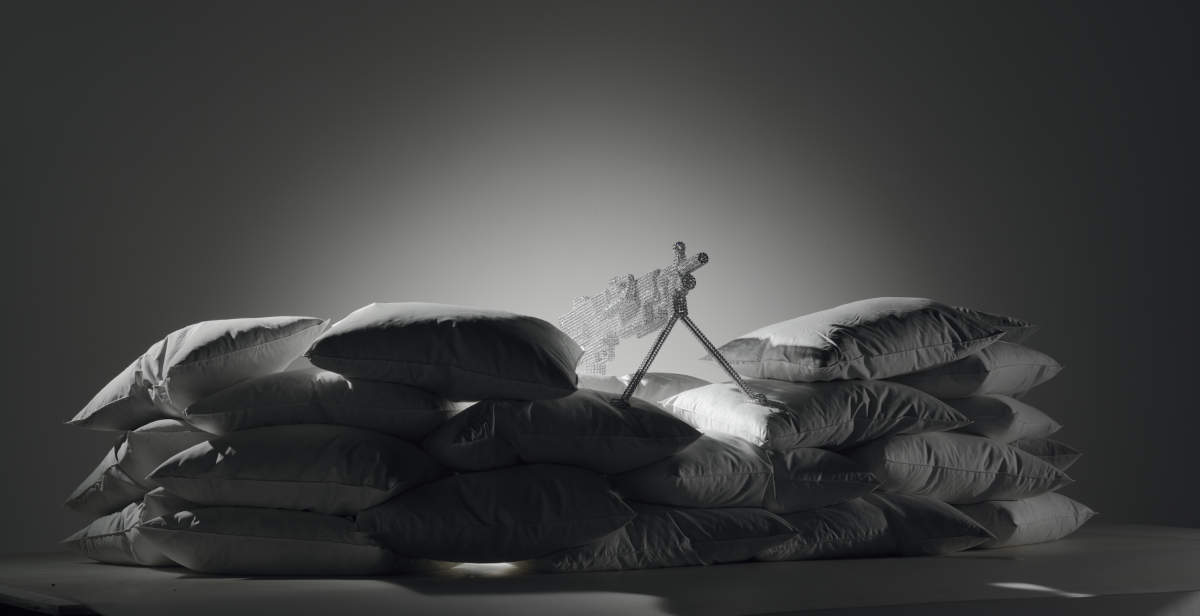
At the Flashback Art Fair in Turin, from October 29 to November 1, Nicola Bolla presents *Vanity Soldier Dream*, a 2012 work in which machine guns covered in crystals and cushions evoke a symbolic trench. This work intertwines war, dreams, and the defense of art, questioning the relationship between appearance and value.
What value can a Kalashnikov encrusted with Swarovski crystals have today? This is the question behind *Vanity - Soldier Dream*, a work created in 2012 by Nicola Bolla, which will be on display at the Foto Contemporary booth during the 14th edition of the Flashback Art Fair in Turin, from October 29 to November 1, 2026. The presentation of Bolla’s work is part of the theme of the 14th edition of the Flashback Art Fair, titled IN TIME.


Curated by Stefania Poddighe and Ginevra Pucci, the event takes place at Flashback Habitat, an independent center for contemporary cultures located at Corso Giovanni Lanza 75 and directed by artist Alessandro Bulgini. For fourteen years, the fair has challenged the distinction between ancient, modern, and contemporary art, presenting works from different eras as parts of a single experience.
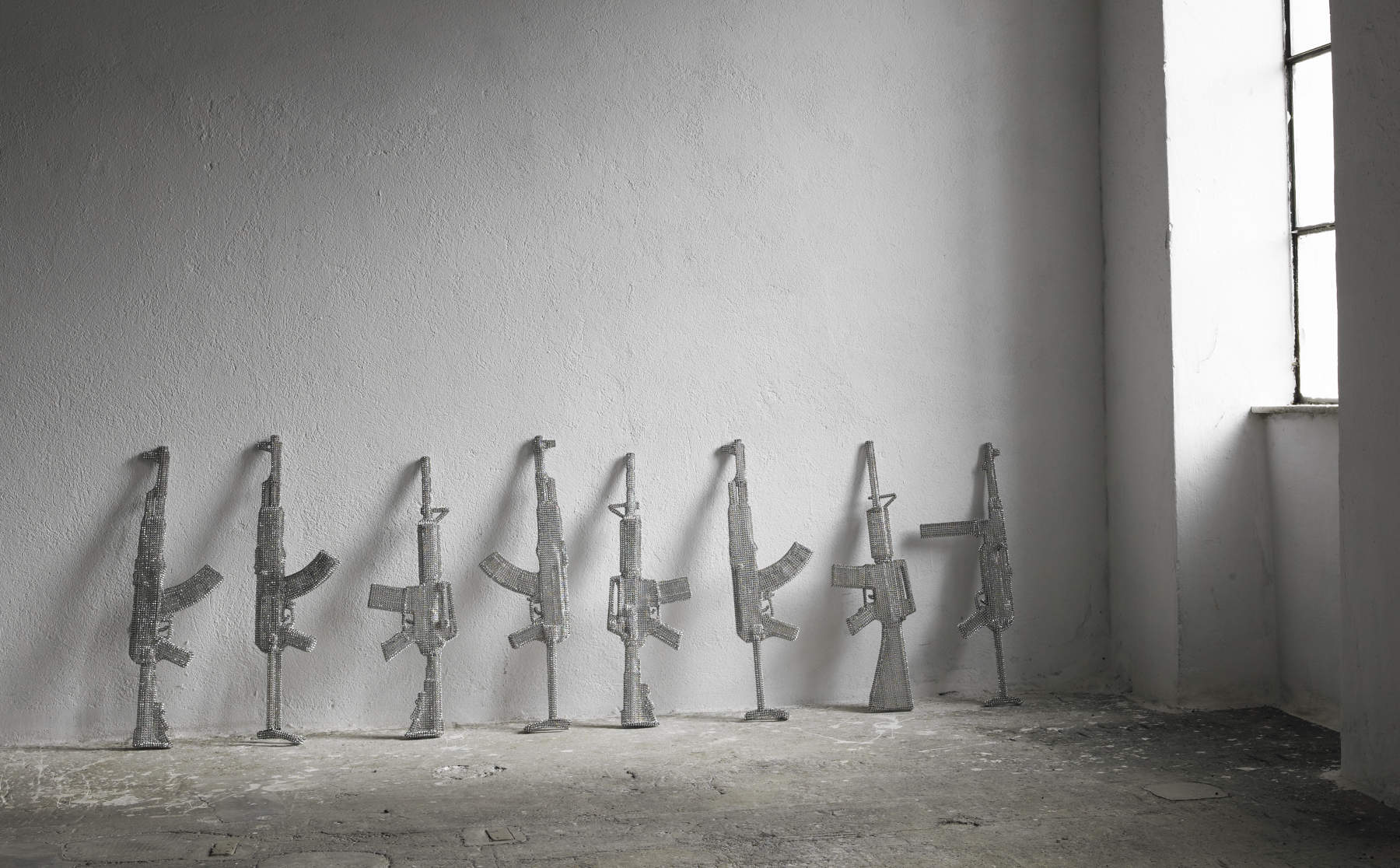
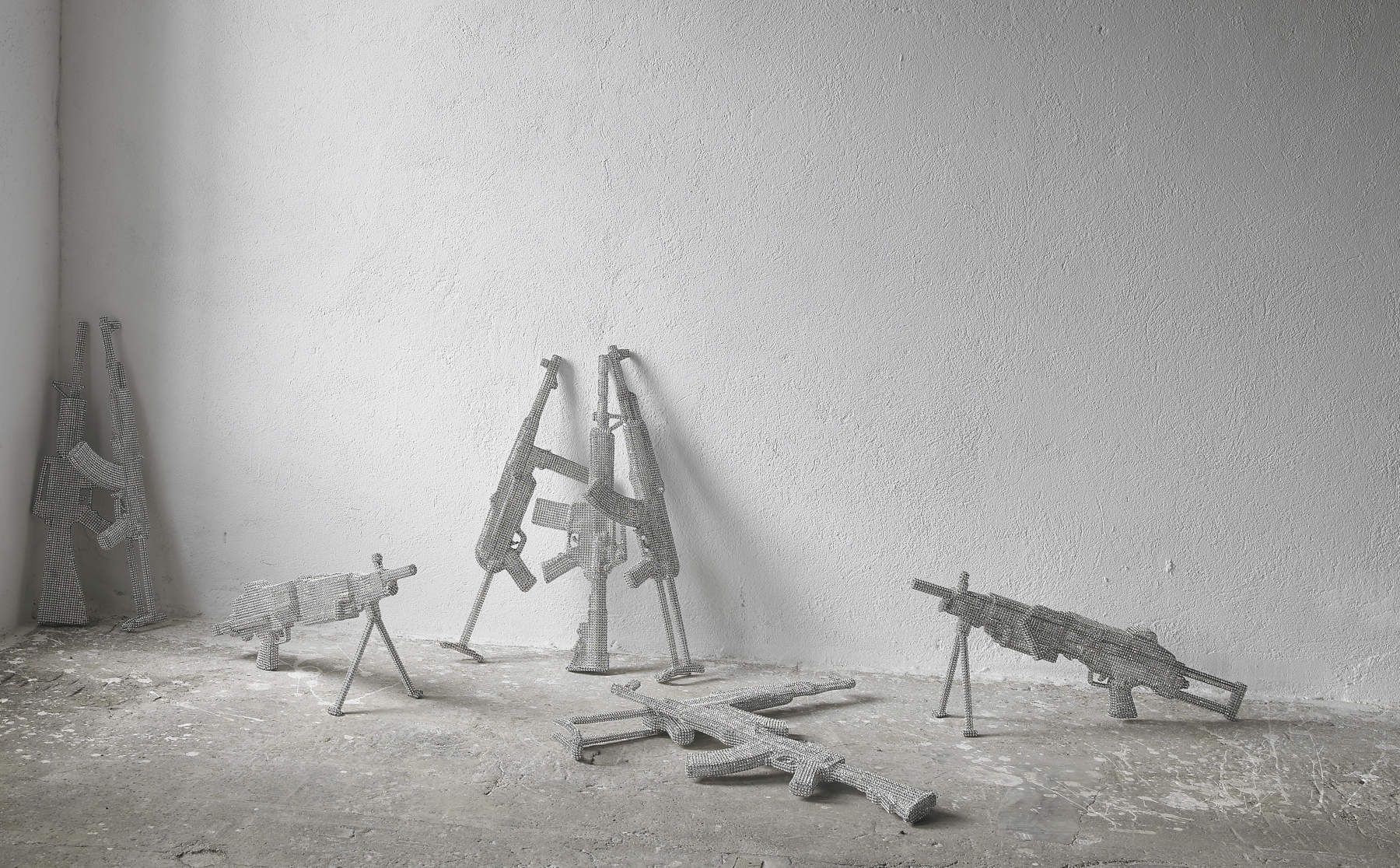
Rarely exhibited since its premiere at a Roman gallery, Bolla’s work explores the connection between the violence of weapons, the realm of dreams, and the need to protect what is valuable—starting with art.The work evokes a trench in which traditional sandbags are replaced by pillows, while machine guns covered in crystals are incorporated into an optical system that calls their function into question. The work thus addresses two themes: the defense of art and the relationship between dream and reality. Swarovski crystals, a recurring element in the artist’s practice, mimic the brilliance of diamonds through an ephemeral and unstable light. Their surface, in contrast to the fragility of the material, evokes the concept of vanitas and creates a tension between appearance and substance. In this work as well, the brilliance transforms the perception of the weapon without erasing the violence it evokes.


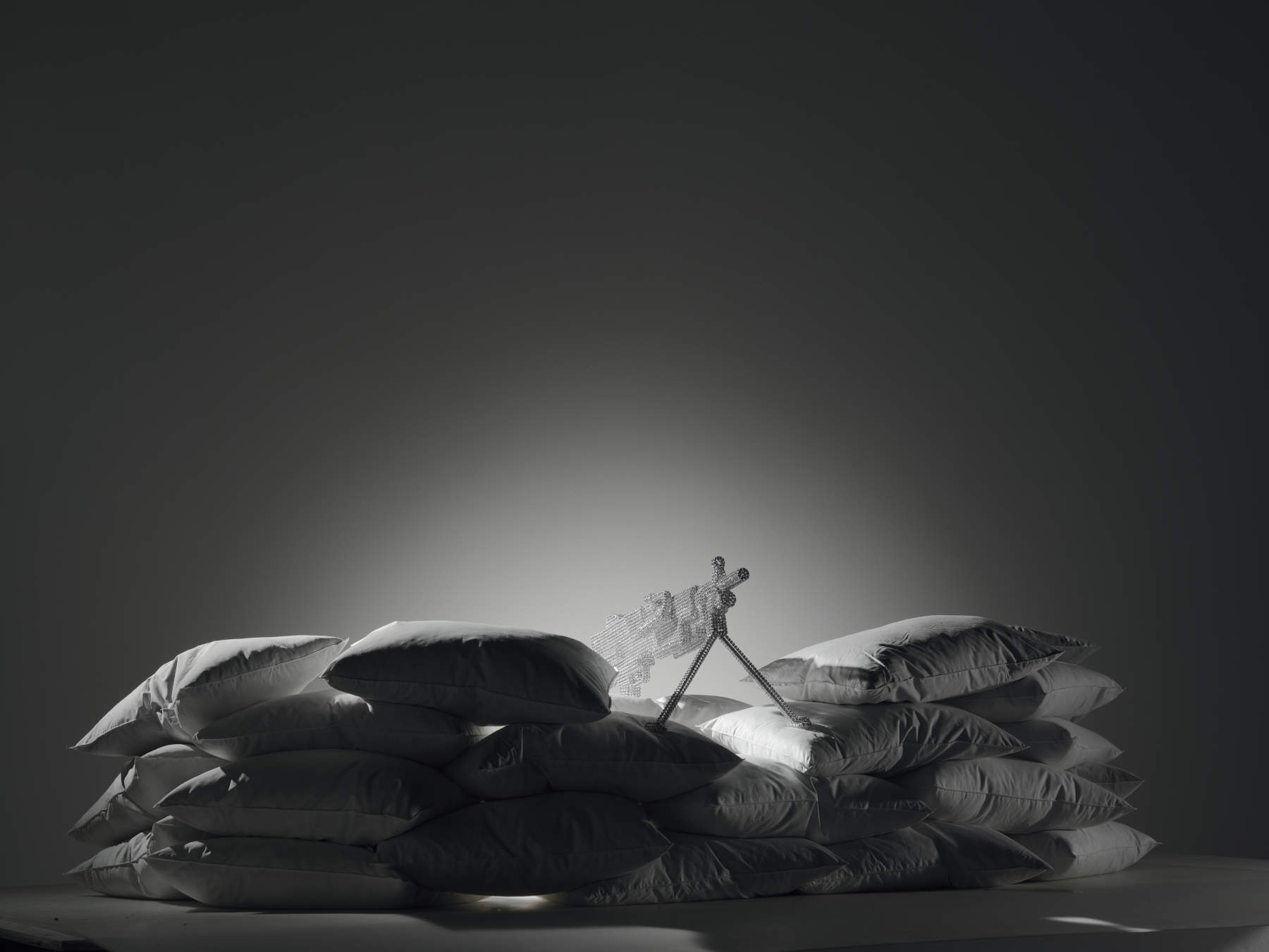
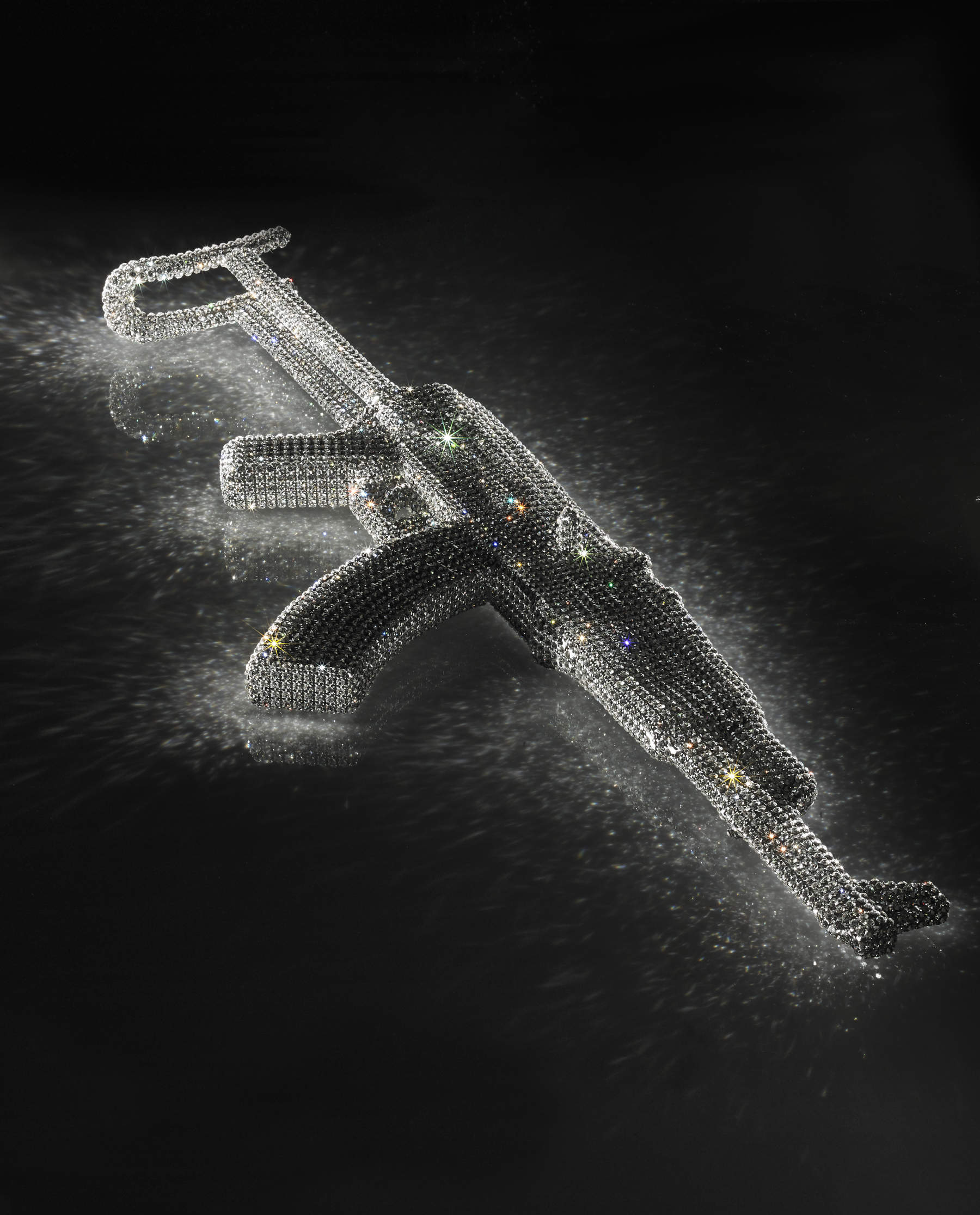
“Vanity - Soldier Dream is a work I created in 2012 and which, after being presented in a Roman gallery, has been exhibited very rarely,” the artist tells us. “Today it is being presented at the Flashback Art Fair in Turin, at the Foto Contemporary booth—one of the galleries I’ve been collaborating with for several years. The work is based on two main ideas. The first concerns the defense of art, understood almost in a heroic sense: the work takes the form of a trench, but instead of traditional sandbags, it uses pillows. The idea stems from a reflection on the soldier’s dream. In war movies, for example, soldiers often relive the violence they’ve experienced while sleeping. I wanted to subvert this image and give the dream a positive meaning: not a return to the atrocities committed, but rather the chance to remember art and recognize its value. Art is something that must be defended and protected. Initially, I had envisioned a much larger structure, composed of numerous machine guns and conceived as a sort of defense system for the realm of art: a protection of its spaces, but also a reflection on the divisions between cultures. The machine gun thus takes on an ambivalent meaning. On the one hand, it inevitably evokes the weapon and the violence of conflict; on the other, when incorporated into a work constructed using materials and forms that evoke dreams, it loses its practical function and becomes an aesthetic element, almost a Vanitas. It is not a glorification of the weapon, but a way to question the violence of war through its very image.
There is also a second fundamental aspect, linked to the nature of sculpture and the relationship between dream and reality. The cushions evoke the dreamlike dimension, while the crystals introduce light, lightness, and intangibility. My sculptures seem to glow with their own light precisely because of the characteristics of the material, which reflects and diffuses light, thereby also engaging the surrounding space. It is a way of understanding sculpture that is very different from the traditional one, which is generally associated with weight, volume, and opacity. Here, however, the material seems almost to dematerialize. In my work, I have always played on the ambiguity between the depicted work and the real object: between what an image evokes and what we actually have before us. This distance allows me to address even dramatic themes through lighter, more evanescent forms, without, however, diminishing their critical significance. I have repeatedly engaged with images of war and destruction, beginning with the atomic mushroom cloud, which I have reinterpreted through different materials and languages: from playing cards to marble, and even Swarovski crystals. When I created *Vanity - Soldier Dream* in 2012, the international context was different from what it is today. Today, the work takes on new relevance precisely because of its reference to war and the need to defend what is valuable. In this sense, some of my works seem to have anticipated issues that have become central in the present. Dreams, after all, have always been a fundamental element of my artistic practice. Artists are, first and foremost, dreamers: they imagine something and then try to translate it into a work of art. In this piece as well, the pillows, the machine gun, and the crystals all contribute to creating a dimension in which the reality of war is juxtaposed with the possibility of transforming its image.”
Born in Saluzzo, in the province of Cuneo, Nicola Bolla grew up in a family with strong ties to the arts: his father, Piero, is a painter, and his mother, Silvia Aimone, is a set designer. His interest in drawing and visual perception emerged at a young age. In the 1980s, he followed in his father’s footsteps and began to devote himself to painting, which, starting in 1984, took on a constant role in his personal and professional journey. At the same time, he continued his medical studies, specializing in ophthalmology. His dual identity as a doctor and artist helped shape an independent artistic practice, in which scientific observation is combined with the exploration of an ironic and multi-layered visual language.
Beginning in the 1990s, Bolla drew inspiration from the Wunderkammern—the Baroque-era “chambers of wonders”—where natural and artificial objects, relics, and both exotic and domestic elements coexisted. His work reinterprets these references through unexpected materials and challenges the original function of objects as well as the relationship between form and content. In 1997, he created *Skull*, a skull entirely covered in Swarovski crystals—a work that anticipated Damien Hirst’s *For the Love of God* by ten years. In Bolla’s work, however, crystal is not merely a symbol of luxury: it becomes a tool for exploring the illusion of value and the ambiguity between appearance and substance. Swarovski crystals—cut glass crystals that mimic the brilliance of diamonds without possessing their properties—reflect an ephemeral and unstable light.
Flashback Art Fair and the theme IN TIME
IN TIME, the theme proposed by Flashback Art Fair—which draws inspiration from the 2011 science fiction film directed by Andrew Niccol—invites reflection on time, awareness of the present, and the possibility of imagining a shared future. The edition’s featured image was, in fact, captured by astronaut Paolo Nespoli.
During a summer event dedicated to the dialogue between art and science, Nespoli recounted his experience of observing Earth from space: traveling at approximately 28,000 kilometers per hour, borders seem irrelevant and time takes on a relative dimension. This perspective challenges conventional divisions and invites us to recognize what truly matters.
For the 2026 edition, Flashback invites participating galleries to propose works capable of questioning the present, recognizing memory as a living substance. In this context, Bolla’s work prompts a reflection on the value of images and objects, on violence, and on the possibility of protecting what deserves to be preserved. The Kalashnikov encrusted with crystals remains tied to war, but its aesthetic transformation invites us to question our own perspective: what makes an object precious, and to what extent can beauty alter our perception of it without erasing its meaning?
 |
| He covered a Kalashnikov with Swarovski crystals. And he’s bringing his artwork to the fair in Turin |
Warning: the translation into English of the original Italian article was created using automatic tools. We undertake to review all articles, but we do not guarantee the total absence of inaccuracies in the translation due to the program. You can find the original by clicking on the ITA button. If you find any mistake,please contact us.