



by Redazione 21/11/2026


Categories: Contemporary art / Disclaimer
Perugia is hosting a project dedicated to Michelangelo Pistoletto, the featured artist of the new edition of Luci d’artista. At the National Gallery of Umbria, a new interactive version of *Mirror of Eternity* is on display, while Corso Vannucci is transformed into a luminous setting with *Cosmografia*, the installation created by the artist.


A dialogue between contemporary art, technology, and Renaissance heritage, designed to engage urban spaces as well: this is the concept behind “Pistoletto illumina Perugia.” “La Luce del Terzo Paradiso” is the exhibition project that, from December 4, 2026, to January 10, 2027, brings the works of Michelangelo Pistoletto—one of the best-known and most acclaimed figures in international contemporary art—to the Umbrian capital. The initiative unfolds through two distinct installations: at the National Gallery of Umbria, visitors will be able to discover a new version of the installation *Mirror of Eternity*, enriched for the first time by the work *Mosaico*, while Corso Vannucci will host *Cosmografia*, a series of light installations conceived specifically by the artist.

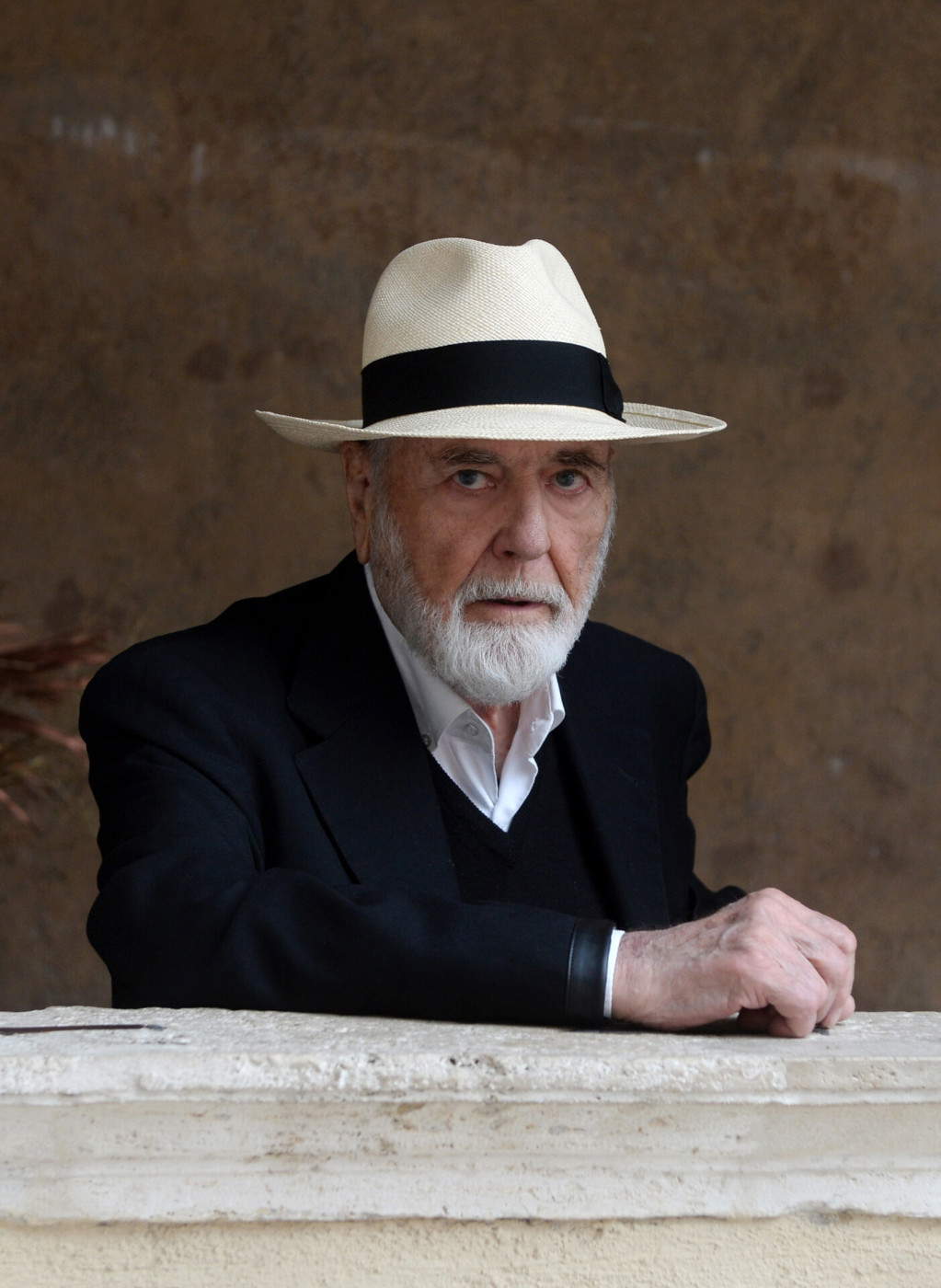
Curated by Costantino D’Orazio, Director General of Contemporary Creativity at the Ministry of Culture, the project marks the latest edition of *Luci d’artista*, an event that featured Mimmo Paladino in its previous edition. The exhibition is the result of a collaboration between the Ministry of Culture, through the General Directorate for Contemporary Creativity, the National Museums of Perugia—Regional Directorate of National Museums of Umbria, the City of Perugia, and the Pistoletto Cittadellarte Foundation. The initiative is supported by the Perugia Foundation, with a contribution from the Umbria Region and the support of Cancellotti S.r.l.


At the National Gallery of Umbria, the public takes center stage in *Mirror of Eternity*
At the heart of the exhibition at the National Gallery of Umbria is “Mirror of Eternity,” an interactive and immersive installation that invites visitors to participate directly in the creation of the artwork. The project is based on the Formula of Creation, one of the central principles of Pistoletto’s work: when two different elements come together, a third element can emerge, capable of introducing something new and unpredictable.

The space is organized around two large LED screens, each measuring 3×5 meters, and a central device that activates the experience. The screen on the right displays the result of the generative process: within the symbol of the Formula of Creation, two real portraits appear at either end, while a third image takes shape in the center, digitally generated by combining the participants’ faces. The second screen, on the other hand, functions as a constantly updated visual archive, collecting the portraits of the participants and the images produced by the system. In the center of the space, a mirrored wall houses the multimedia device and infographics explaining how the installation works. Using a QR code, each visitor can access the procedure and begin capturing their own image, thereby becoming an integral part of the artwork.
Mirror of Eternity thus transforms individual participation into a collective creation, interweaving personal identities, otherness, and new identities generated by technology. The result is a dynamic archive of faces that reflects the relationship between human beings, digital innovation, and the Formula of Creation.
Another section of the exhibition explores the Trinamic Code, translating the principle of the Formula of Creation into a visual and luminous language. The installation features large structures from the Third Paradise, created using rope lights. Arranged within the two outer circles are the symbols of the Trinamic Code, each corresponding to a word and designed by Pistoletto himself. The juxtaposition of two different symbols generates, within the central circle, a third, previously unseen symbol that carries a new meaning.
Language thus becomes an instrument of transformation: the encounter between two concepts does not result in a simple sum, but in the possibility of creating a third interpretation. The Third Paradise embodies precisely the structure of this dynamic, in which differences enter into a relationship and give rise to new forms and meanings.
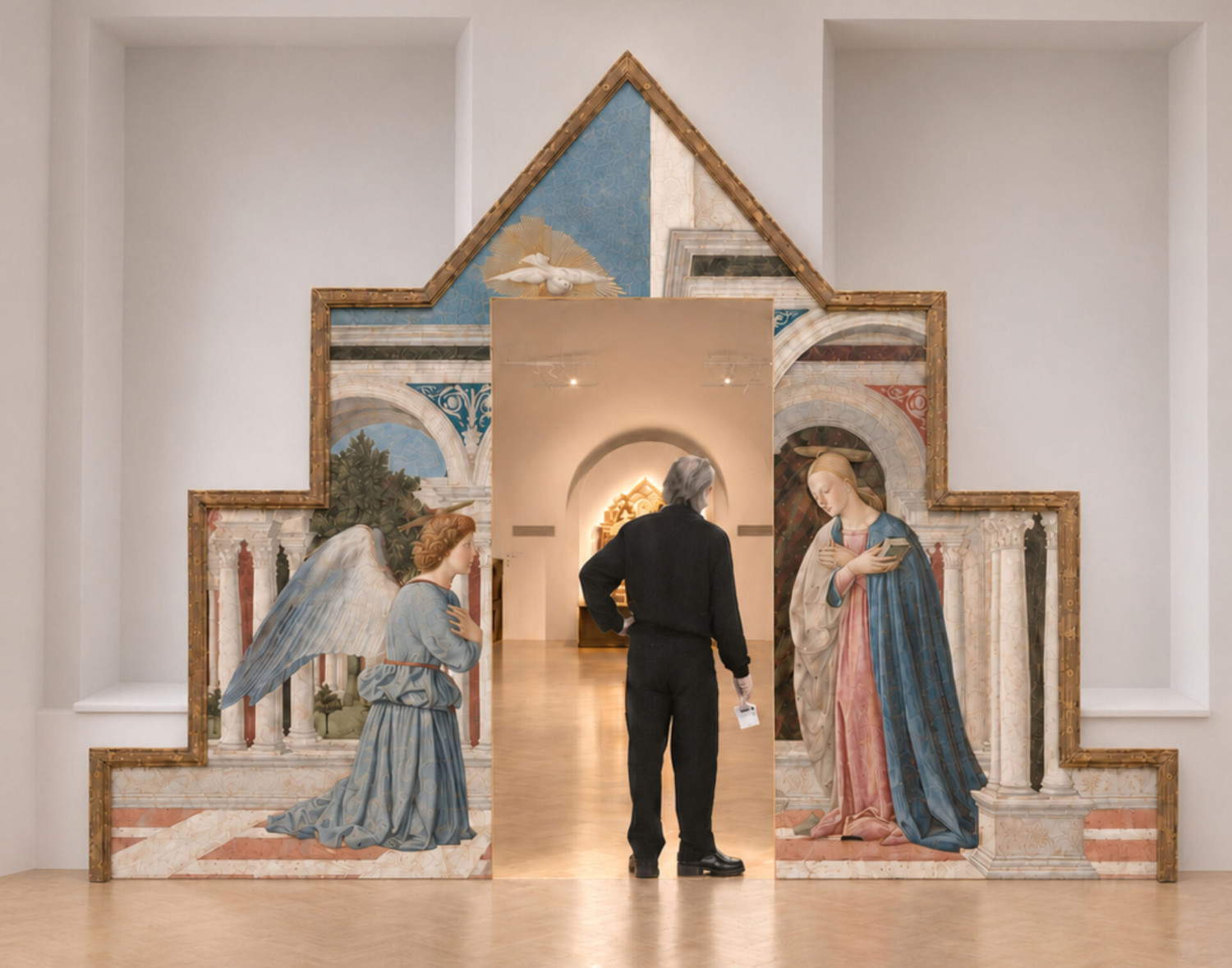
One of the exhibition’s most significant moments is the comparison between Michelangelo Pistoletto and Piero della Francesca, which connects contemporary art with one of the great masters of the Renaissance through an installation created specifically for the National Gallery of Umbria. The work *La nuova prospettiva* reproduces, in large format, a detail from Piero della Francesca’s *Polyptych of Saint Anthony*, focusing on the architecture that separates the two figures of the Annunciation. The colonnade, constructed according to a rigorous perspective, guides the viewer’s gaze toward the center of the composition, where *Il Pittore – Autoritratto* by Pistoletto is placed. It is a mirrored painting in which the artist is depicted from behind, holding a brush, on the reflective surface. Renaissance perspective thus interacts with the tangible space reflected by the mirror: the painted architecture appears to extend beyond the work’s boundaries, while the reflective surface incorporates the surrounding environment and the viewer’s presence.
Two other works are also on display in the same room. *QR Code Possession – Self-Portrait* depicts Pistoletto with a series of QR codes tattooed on his skin, linked to his artistic career. Self-Portrait, part of the Cascetta Collection, consists of a framed mirror, on the lower part of which the word “SELF-PORTRAIT” appears in capital letters.
Corso Vannucci comes alive with “Cosmografia,” the light installations of “Terzo Paradiso”
The exhibition project extends beyond museum spaces to engage the historic center of Perugia with “Cosmografia,” the light installation conceived by Michelangelo Pistoletto for the new edition of “Luci d’artista.” Corso Vannucci, the heart of the city, becomes the stage for a composition of suspended LED elements, arranged to reproduce the symbol of the Third Paradise, consisting of three interconnected circles.
The title of the installation evokes the original meaning of cosmography, understood as the description and representation of the order of the universe. In Pistoletto’s work, however, this idea translates into a sort of luminous script that brings the cosmos into the human and earthly realm. The lights outline an artificial constellation, inviting reflection on humanity’s responsibility in the search for a new balance with the world.
Here, too, the connection to the Formula of Creation emerges: the points of light suspended along Corso Vannucci are not mere Christmas decorations, but elements of a system of relationships through which the capacity of the encounter between differences to generate new possibilities is represented.
The exhibition will be accompanied by the publication of two volumes dedicated to the initiative and to Pistoletto’s artistic practice. The first, published by Cittadellarte Edizioni, will be a guide to the exhibition at the National Gallery of Umbria, enriched by an interview with the artist and a critical essay by curator Costantino D’Orazio. A second publication, scheduled for a later date and produced by Silvana Editoriale, will explore the comparison between Michelangelo Pistoletto and Piero della Francesca. The volume will feature essays by Costantino D’Orazio and Veruska Picchiarelli, along with photographic documentation of the exhibition installation.
With *Pistoletto Illuminates Perugia: The Light of the Third Paradise*, the Umbrian city thus becomes the site of an encounter between different eras, artistic languages, and forms. From the interactive installations at the National Gallery of Umbria to the light installations along Corso Vannucci, the project brings to the public space a reflection on the relationship between the individual, technology, art, and the environment.
|
| Pistoletto lights up Perugia with his "Cosmografia," and the National Gallery is hosting an exhibition dedicated to the artist |
Warning: the translation into English of the original Italian article was created using automatic tools. We undertake to review all articles, but we do not guarantee the total absence of inaccuracies in the translation due to the program. You can find the original by clicking on the ITA button. If you find any mistake,please contact us.