



by Redazione 20/11/2026


Categories: Works and artists / Disclaimer
In the Camposanto in Pisa, Benozzo Gozzoli, one of the greatest painters of the 15th century, depicted every stage of the grape harvest, right up to the biblical patriarch’s drunken revelry. This fresco, rich in details of daily life, was damaged during the war and has been returned to the public after a lengthy restoration.


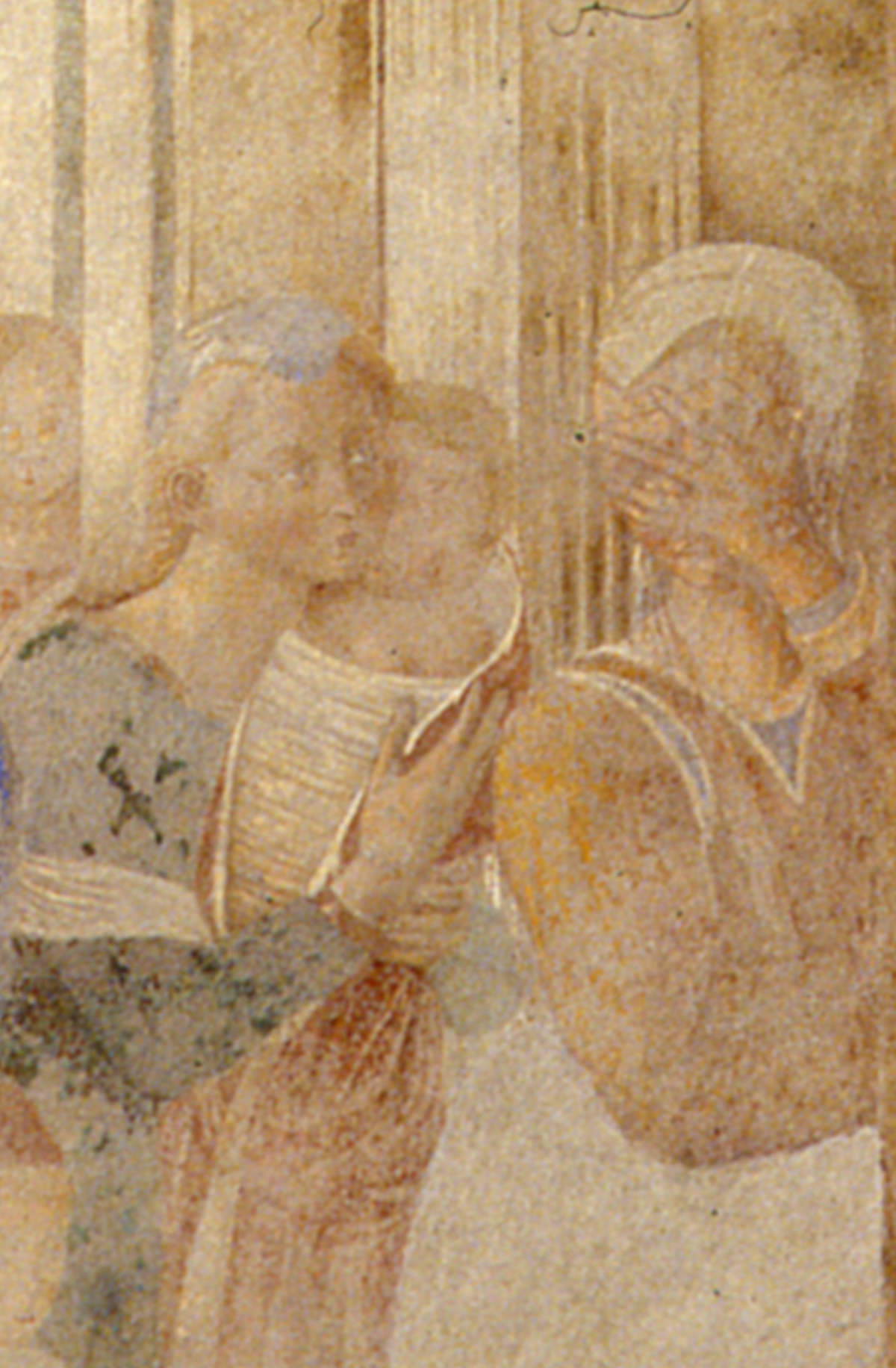
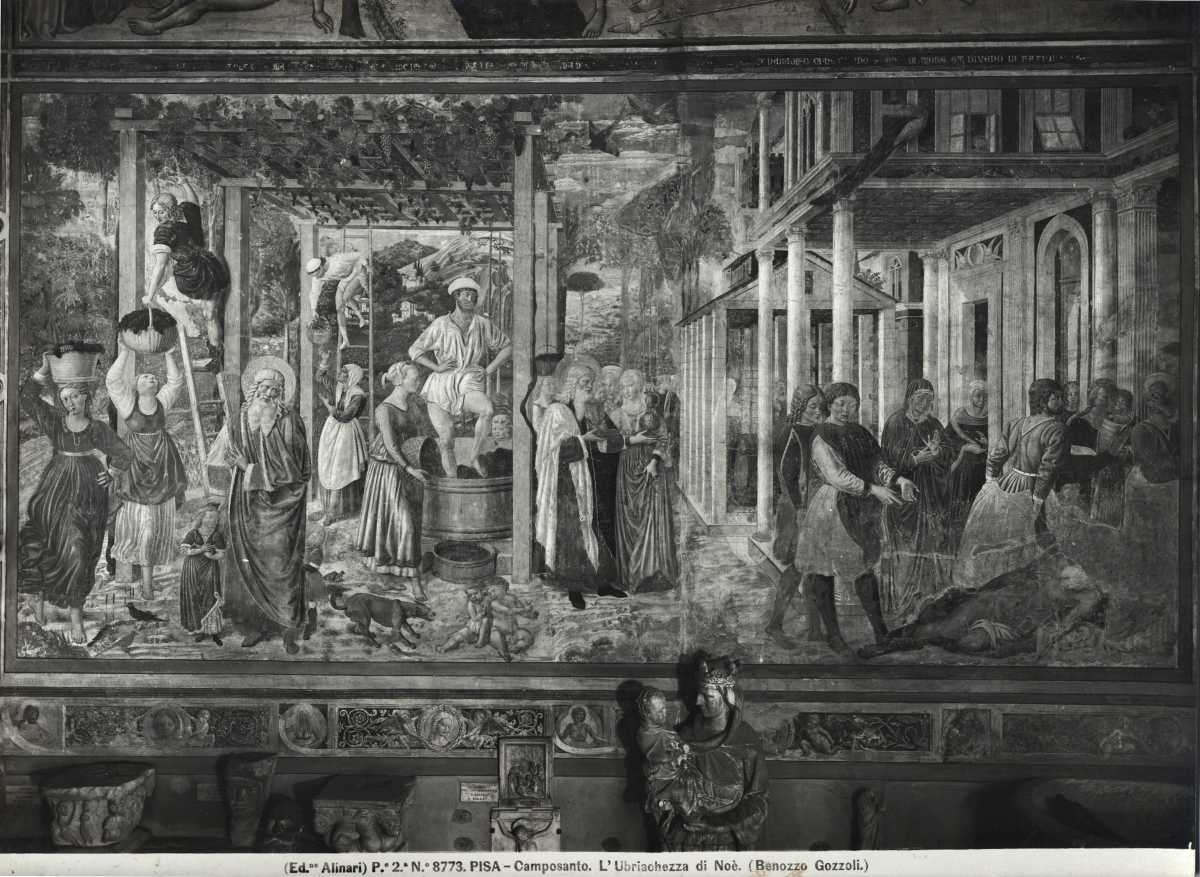
In one corner of the scene, a woman is hurrying away, raising a hand to cover her face—as if she had seen something she shouldn’t have—but she keeps her fingers spread apart and her head turned, so that she can continue to look through her fingers. In the nineteenth century, she was called “the Shameful One” and was one of the most famous figures in Pisa’s Camposanto. The one she pretends not to see is just a few steps away from her: Noah, the patriarch who survived the Flood, sleeps naked on the ground, overcome by wine. One of his sons, Ham, mocks him. Another, Shem, prepares a cloak to cover him. This is the end of the story: to understand how Noah ended up there, one must look at the rest of the fresco, a masterpiece by Benozzo Gozzoli ( Florence, 1420 – Pistoia, 1497), devoted almost entirely to the work that precedes intoxication: the grape harvest.
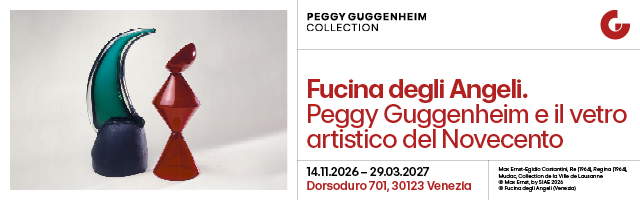

“The Grape Harvest and Noah’s Drunkenness” was the first of the twenty-six scenes that Benozzo painted for the Camposanto in Pisa, and it was also the first to be completed: according to tradition, the painter created it as a demonstration of his skill before the Pisans, which also explains the meticulous care with which the work was executed (today, however, we can only sense this, since the fresco was heavily damaged during World War II). In 1896, the art historian Igino Benvenuto Supino, in his famous guide to the Camposanto published by Alinari, noted that the entire painting—perhaps precisely because it was intended as a demonstration—was executed with great finesse, both in the figures and in the architecture.


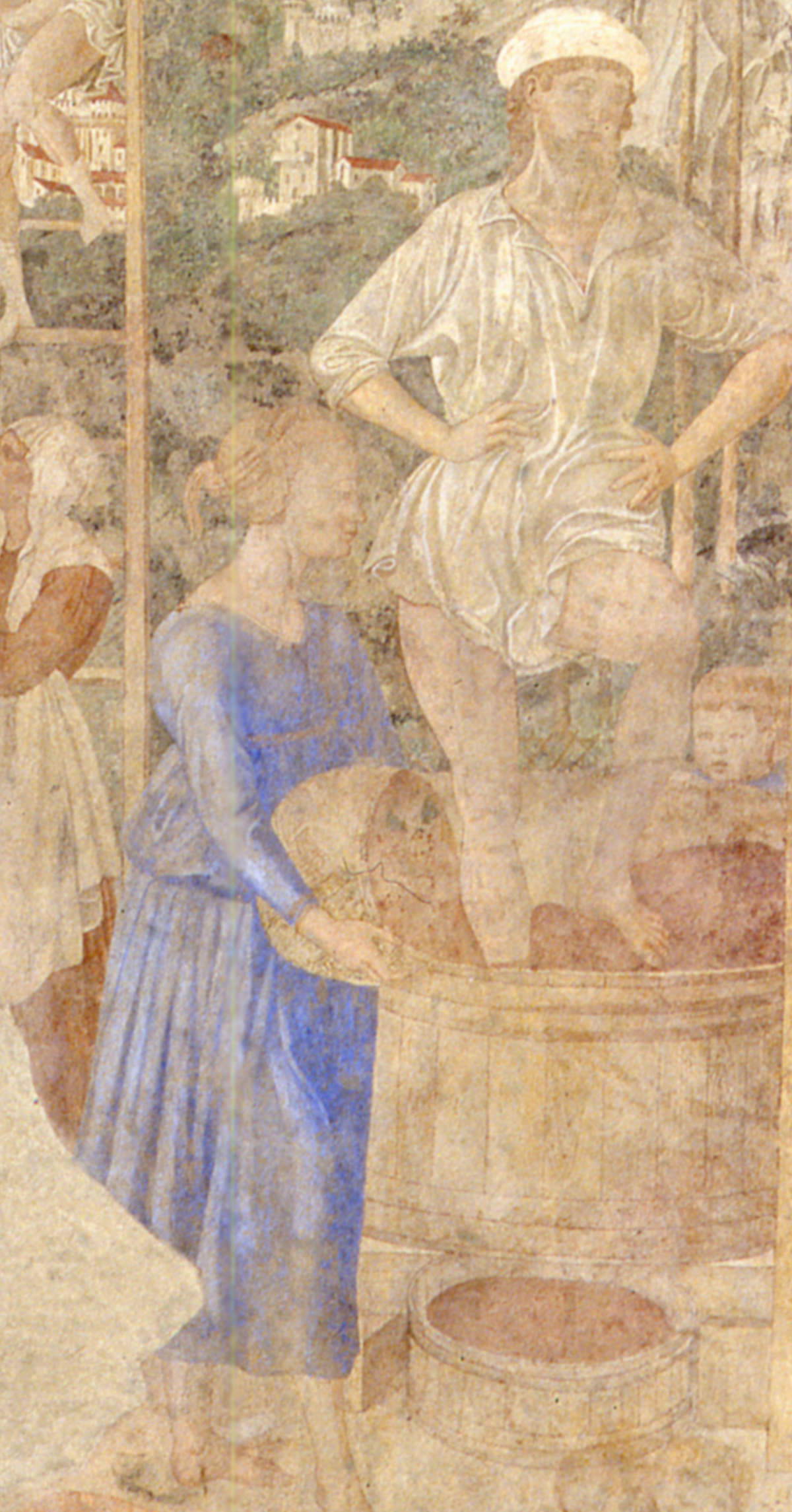
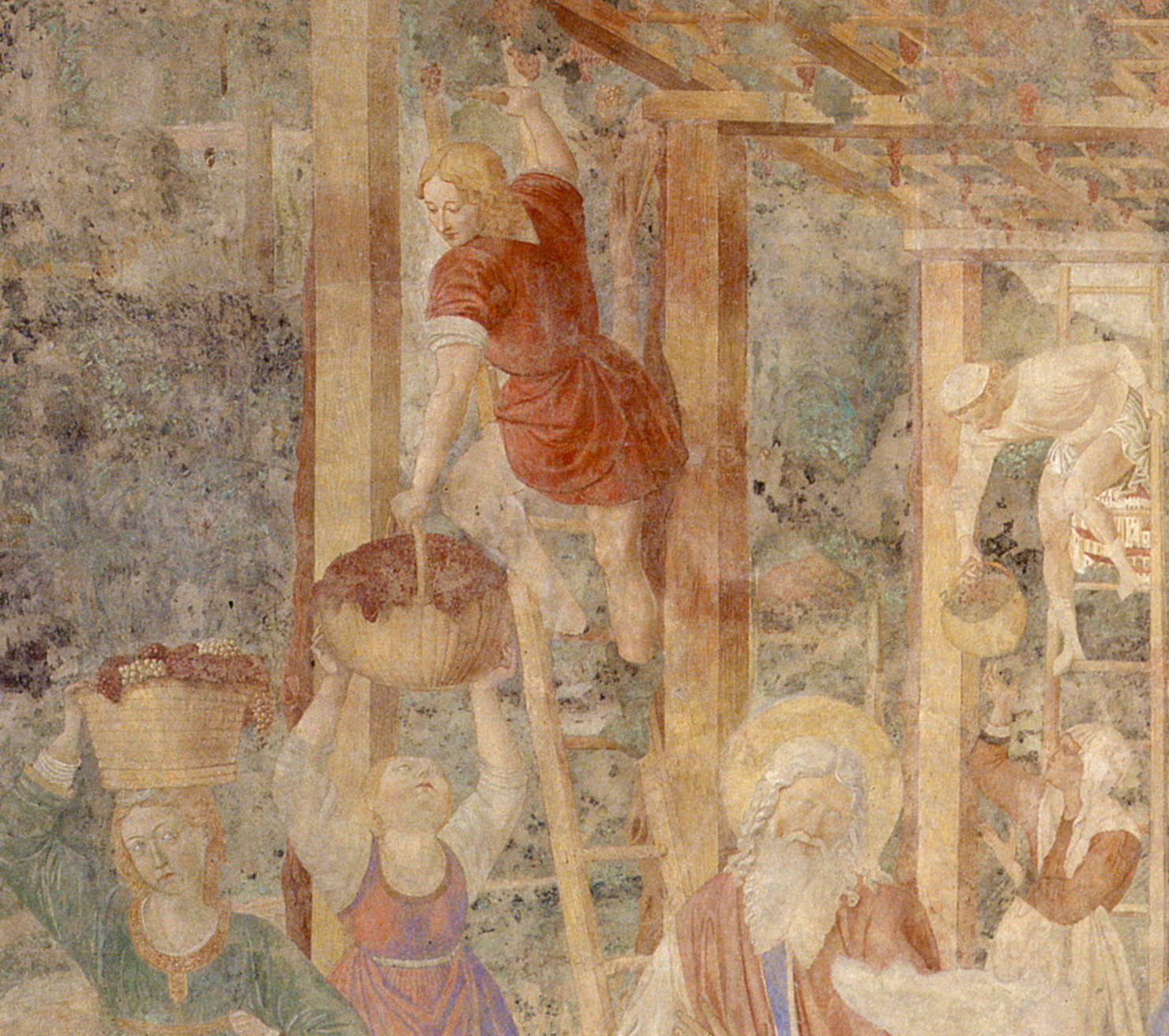
The narrative unfolds from left to right and begins with a scene of order. Noah stands between two of his grandsons, his hand resting on the head of one of them; he has just given the signal to begin the grape harvest, and around him the work has already begun. Benozzo depicts the grape harvest in all its stages. Two men, standing on ladders, pass baskets full of grapes to some women waiting below: one of them places the basket on her head and carries it to the wine vat, where a young man, barefoot and with his hands on his hips, is crushing the grapes; he has been identified as Shem, one of the patriarch’s sons. Next to him, one of Noah’s daughters-in-law tips her basket into the vat and places her hands in front of the bunches to keep them from falling out.


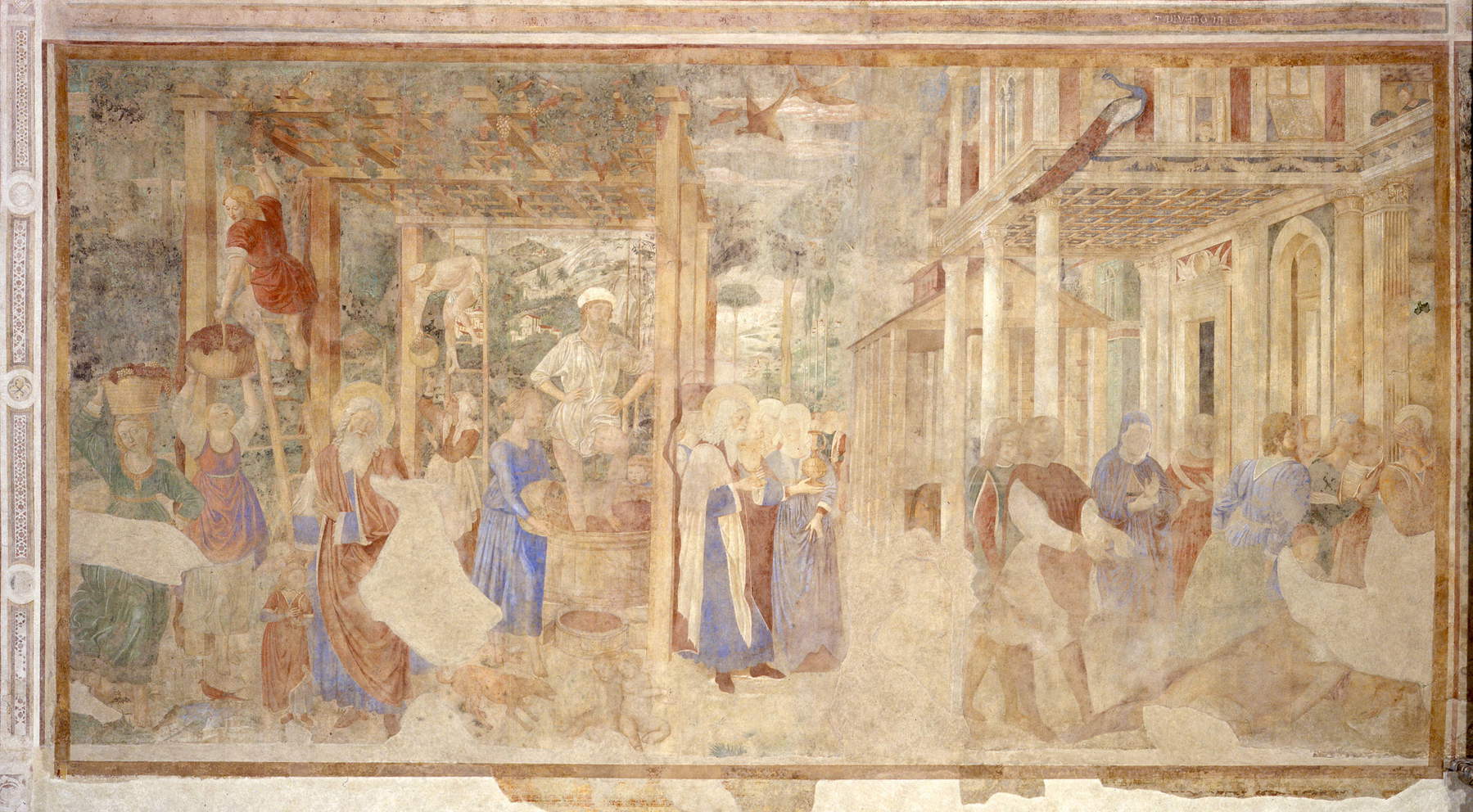
Thus, the entire work process is depicted within just a few meters of wall space. In effect, it is a full-fledged 15th-century grape harvest , though one might say it represents a harvest as it was before the advent of machinery. A scene that was common in Tuscany until just a few decades ago: picking, sorting, transporting, emptying, and pressing. Each figure has a specific task and gesture. In his 1896 essay, Supino particularly praised the woman with the basket on her head—elegant and natural in her movements—and the delicate profile of the woman pouring the grapes into the vat. Of the scene as a whole, he wrote that it is rendered “with great verve.”
In the central part, the work comes to a halt and… it’s time for a tasting. The patriarch’s family, with goblets and cups in hand, is in fact sampling the new wine. This is the transition leading to the final scene, on the right, in the foreground: Noah asleep, Ham mocking him, Shem with his cloak, and, in the corner, the Shy Woman peering through her fingers. In the center, in the foreground, Benozzo adds a detail that has nothing to do with the Bible: two naked children, sitting, are startled by a barking dog. It serves no purpose in the narrative, but it turns the grape harvest into a scene of everyday life, with all its hustle and bustle.
The idea of setting a scene from remote antiquity in the present applies not only to the grape harvest but to the entire cycle: Benozzo took stories from the Old Testament and situated them within the life of his own time. Anyone entering the Camposanto—which was already considered one of the wonders of Italy at the time—could recognize figures from that era in the scenes, as well as famous buildings such as the Medici Palace in Florence. In short, Noah’s wine was made just as it was made in 15th-century Tuscany. Beneath each scene ran an inscription in the vernacular explaining to viewers what they were seeing. In a space designed for visitors, the scenes were written and painted so that everyone could understand them.
When he received the commission, Benozzo was a highly sought-after painter. And the Camposanto commission was perhaps the most coveted job in Italy at the time; it seems that two artists from northern Italy—Andrea Mantegna and Vincenzo Foppa—had set their sights on it before him. However, the decision rested withthe Opera della Primaziale di Pisa, the body responsible for constructing and maintaining the buildings in Piazza dei Miracoli. What most likely tipped the scales in Benozzo’s favor was the support of the Medici, who had a member of their family, Filippo de’ Medici, serving as archbishop in Pisa. And Benozzo Gozzoli, working for the Medici, had created one of his masterpieces—the decoration of the Chapel of the Magi in their family palace on Via Larga—about twenty years before beginning work on the Camposanto.
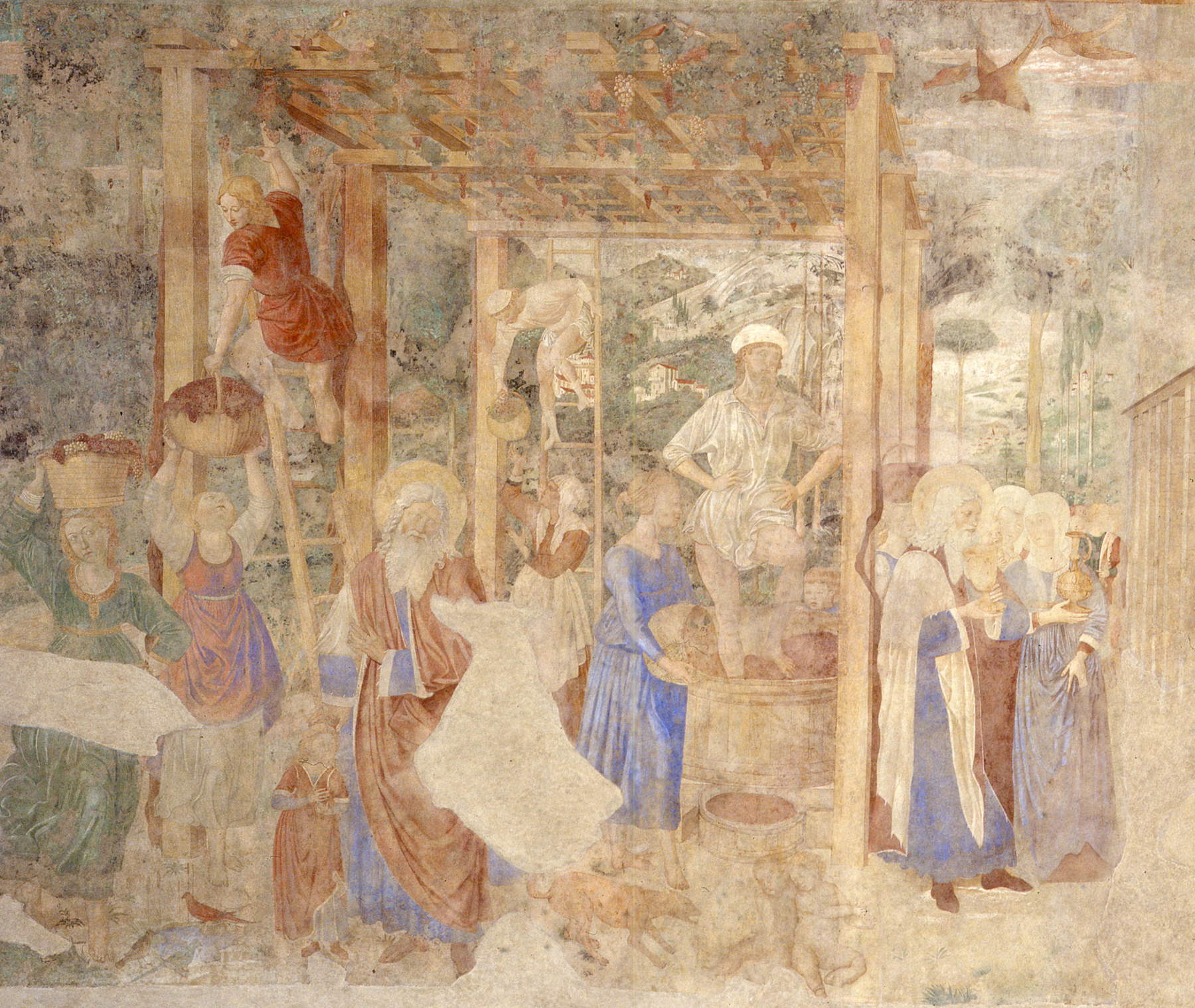
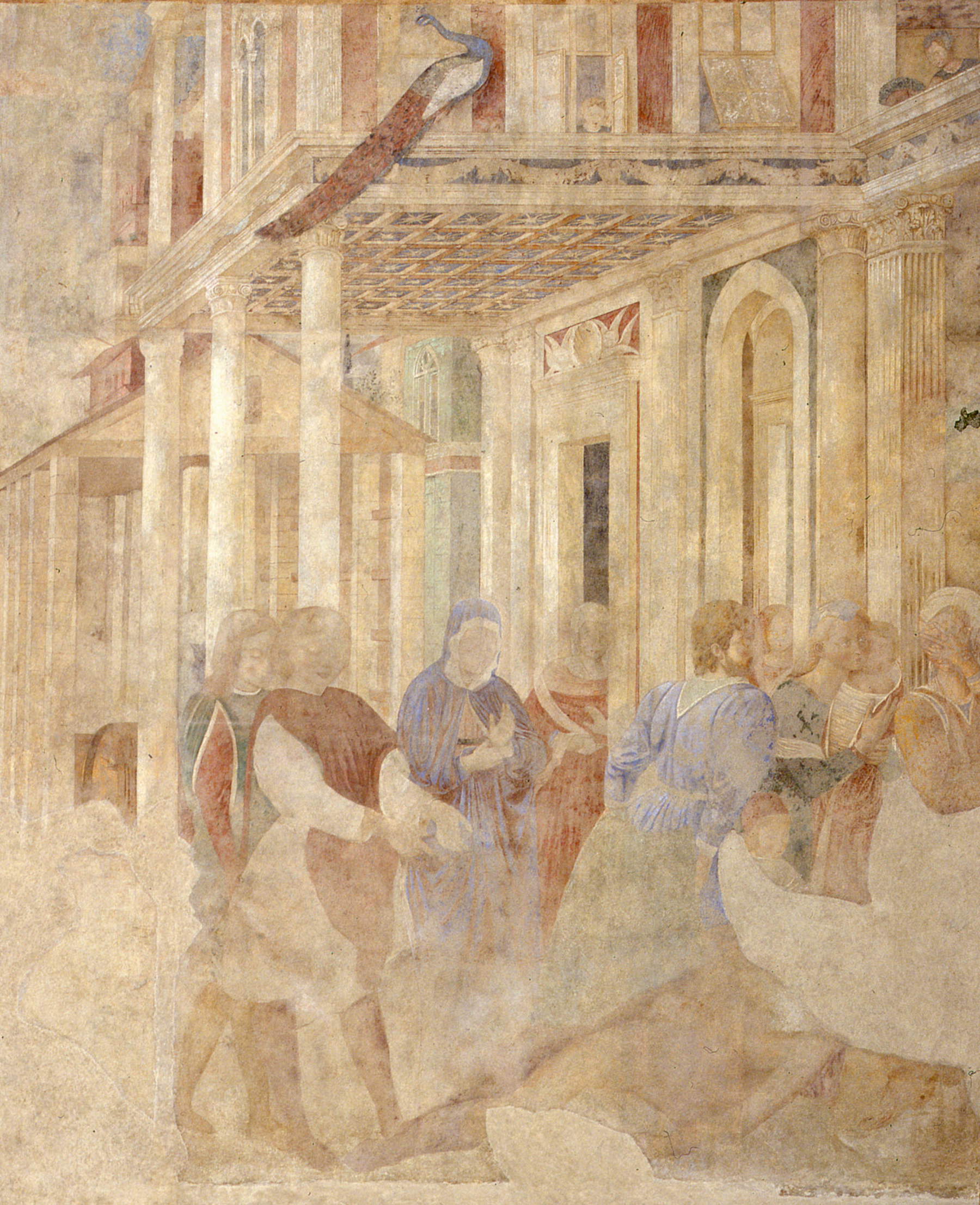
Gozzoli began working on the frescoes in the Camposanto between 1468 and 1469. There is no doubt about the duration of the work, as the payment records keep track of it: Benozzo worked on the wall for sixteen years, and the final bill was presented in 1485. From these same records, it is possible to reconstruct the order in which the scenes were painted. After the grape harvest came the Construction of the Tower of Babel, followed by the stories of Abraham, Lot, Isaac, Jacob, Joseph, Moses, and Aaron, up to David and Goliath andSolomon’s Meeting with the Queen of Sheba. The cycle began with the first man planting a vineyard after the Flood and ended with the court of Solomon.
Benozzo, however, was not starting from scratch: the arrangement of the scenes depended on the decoration already present on the walls, begun in the mid-fourteenth century by Piero di Puccio, continued for several decades, and then left unfinished. Gozzoli divided the large surface into two sections of equal height, each divided into thirteen scenes and framed by ornate borders in the classical style. Noah’s grape harvest occupied the first of these panels.
Benozzo Gozzoli’s contemporaries were impressed. Later, Giorgio Vasari—who was by no means an indulgent biographer—described the undertaking asa “terrific work,” an adjective that, in Vasari’s context, is to be taken as a compliment. The art historian was thinking above all of the sheer scale and magnitude of the undertaking, rather than its artistic outcome, but it remains a sign of the high regard in which the Pisan cycle was held. Later, someone went even further: in 1837, the scholar and draftsman Ranieri Grassi said that, moving from Benozzo to his predecessors, it seemed as though one were taking “the very same leap that painting subsequently made from Masaccio to Raphael.” It should be noted, however, that as early as 1896, the grape harvest scene was no longer as Benozzo had painted it: the very text that praises its refinement notes that the patriarch’s nude had been completely redone and that many other parts of the fresco had been restored. The Sleeping Noah, one of the scene’s focal points, was therefore already, even then, largely the work of others.
The worst damage occurred in July 1944. During a bombing raid that struck Pisa, a fire broke out in the Camposanto and destroyed or damaged most of the frescoes, both those by Benozzo and those by the other masters present: among the 14th-century artists were Spinello Aretino, Buffalmacco, Andrea Buonaiuti, Taddeo Gaddi, Piero di Puccio, Francesco Traini, Antonio Veneziano, and Francesco da Volterra; and among those from the 16th and 17th centuries, Paolo Guidotti Borghesi, Agostino Ghirlanda, Aurelio Lomi, and Zaccaria Rondinosi. Today we know what Benozzo’s scenes looked like mainly thanks to two types of documents. The first are the engravings by Domenico Landini, created for the volume on the frescoes of the Campo Santo in Pisa published in Florence in 1812. The second are the photographs taken before the fire; it is also thanks to these that the description of *La Vergognosa* and the children frightened by the dog can still be linked to an image.
After the war, the entire cycle was protected and removed from the walls—an operation of a scale and importance never before seen in the field of restoration. The condition of the works was precarious, and methods and products were tested that would prove, in part, inadequate in the years that followed. The main problem stemmed from the casein, used as an adhesive during the emergency work, which damaged the paintings that had already been removed from the walls. At that time, there were no alternatives, and without that intervention, whatever had survived the fire would have been lost—even though the damage from that time still has consequences today. The solution came later, thanks in part to the experience gained by applying what had been learned while working on the works affected by the Florence flood: the paintings were transferred onto two overlapping hemp canvases, secured to fiberglass supports, and the casein was replaced with an acrylic resin-based adhesive. To oversee the work, the Opera della Primaziale established a permanent scientific committee, which decided to test the system on a single wall; only after repeated checks over time ruled out further deterioration was the method applied to the others as well.
The detachment also had an unexpected effect. In fact, sinopias— the preparatory drawings traced directly onto the plaster— were discovered beneath the frescoes; these are now on display at the Museo delle Sinopie in Pisa. They reveal how Benozzo composed the scenes, but they are not enough to restore the cycle to its pre-1944 state—that is, the most ambitious work of his career.
For years, *The Grape Harvest* remained in storage, hidden from the public, but in 2005 it was among the first of Benozzo’s scenes to return to the Camposanto, along with *The Curse of Ham*, which continues the story of Noah. Shortly thereafter, *The Construction of the Tower of Babel* was also reinstalled. Work then continued on the other stories along the north wall of the Camposanto. Once again, *The Grape Harvest* came first: in the 15th century as a test of the painter’s skill, and in the 2000s as the first scene to return to its place after the fire.
Warning: the translation into English of the original Italian article was created using automatic tools. We undertake to review all articles, but we do not guarantee the total absence of inaccuracies in the translation due to the program. You can find the original by clicking on the ITA button. If you find any mistake,please contact us.