





Fifty years after the earthquake that devastated Friuli on May 6, 1976, the City of Udine is dedicating an exhibition to the memory of that event and to the profound transformations that have taken place in the region since then. From July 17 to October 18, 2026, visitors can view the exhibition *Earthquakes and Transformations. Photography and Science on the Cusp of 1976 in Friuli, curated by Silvia Bianco, Antonio Giusa, Vania Gransinigh, and Andrea Pertoldeo.
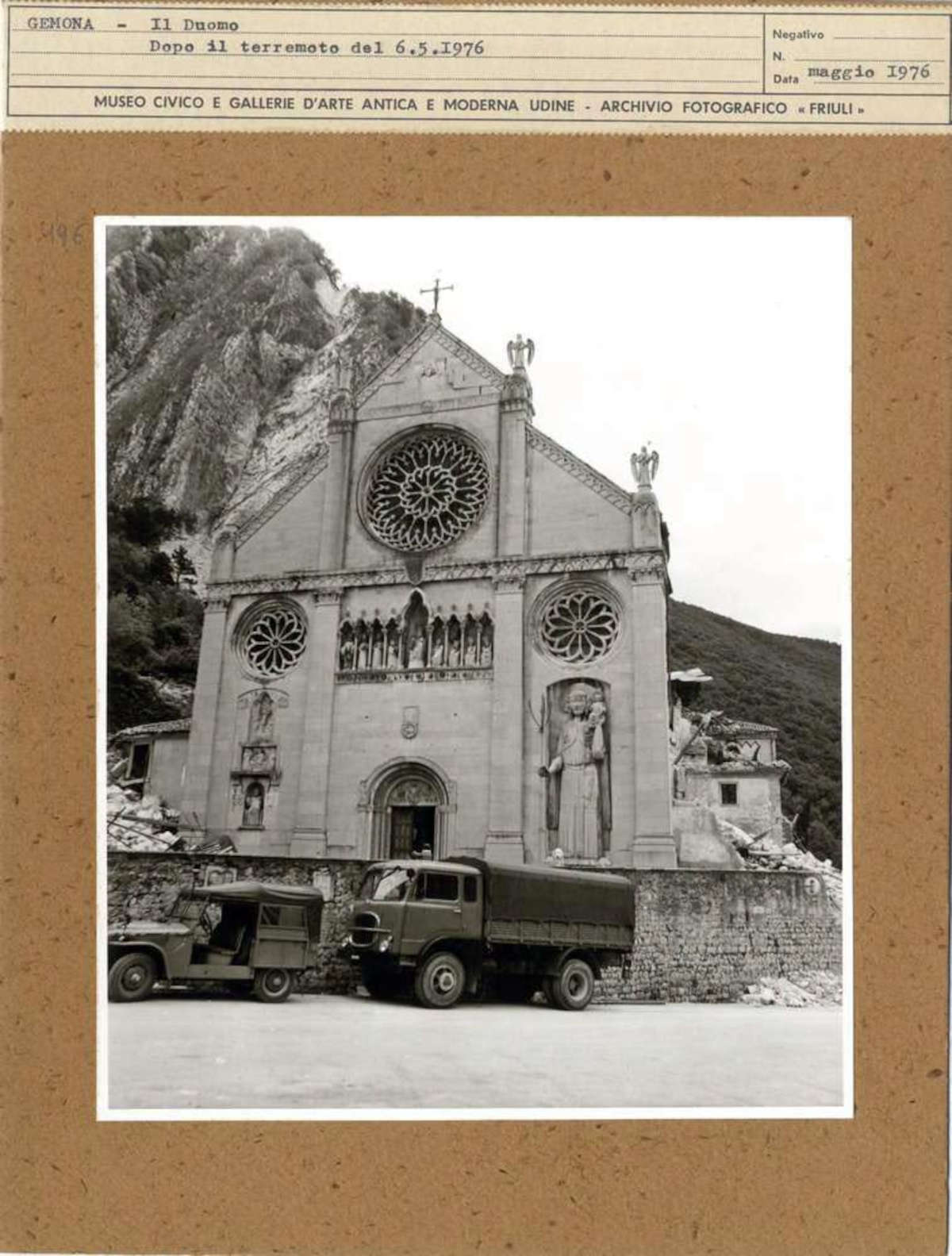
The exhibition marks the fiftieth anniversary of the Friuli earthquake and offers a perspective that goes beyond a purely commemorative approach. The earthquake (with a magnitude of 6.5 on the Richter scale, at a depth of 5.7 km, with its epicenter northeast of Tarcento in the Julian Alps— the quake claimed 990 lives) is in fact interpreted as a true historical turning point, a vantage point through which to understand the scientific, cultural, and landscape-related transformation of an entire region. The exhibition does not focus solely on the period of destruction and reconstruction, but analyzes how Friuli has changed over time, linking the memory of the past with the perspectives of the present.
The exhibition begins in the mid-19th century, specifically in 1866, a year markedby Friuli’s annexation to the Kingdom of Italy and the simultaneous founding, in Udine, of the Civic Museum and the Royal Technical Institute. From this point, a narrative unfolds through three distinct timelines that guide visitors through the history of photography, the evolution of scientific research, and the transformations of the landscape.
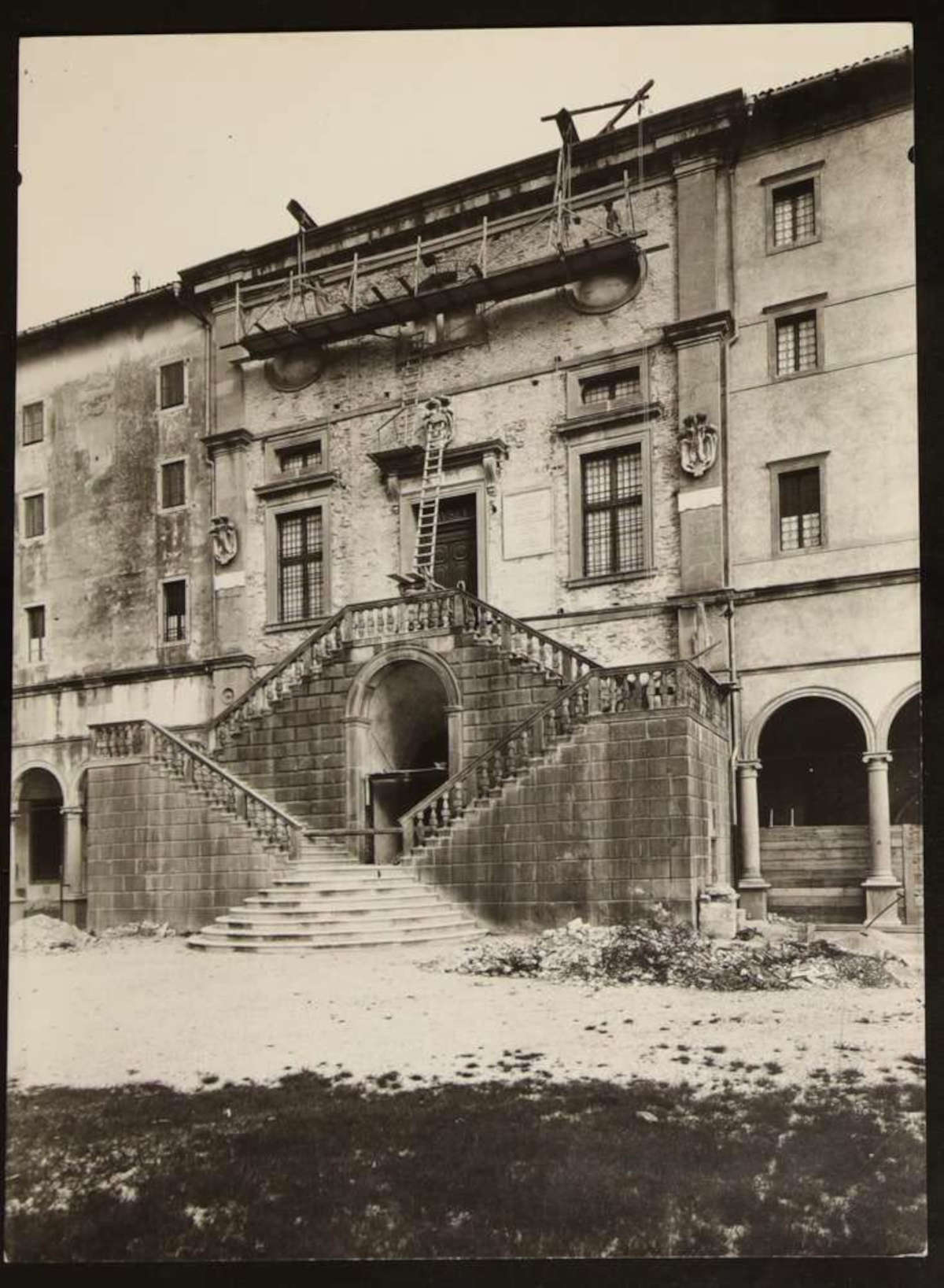
At the heart of the exhibition is the presentation of the important collections preserved by the Civic Museums of Udine and the “Vincenzo Joppi” Civic Library, which contain essential evidence for reconstructing the relationship between images, the territory, and scientific knowledge. The exhibition documents the evolution of photography and seismology through materials of great historical significance, ranging from the earliest calotypes (an early photographic process that produced images using a negative-positive system) created by Augusto Agricola to the photographic views of Giuseppe Malignani, all the way to the scientific studies of Robert Mallet and Giuseppe Mercalli.
Among the materials on display are also photographs taken by Wilhelm Helfer (a photographer known for documenting the earthquake that struck Ljubljana in 1895), on loan from the National University Library of Ljubljana, which help broaden our perspective on the Friuli region and on how the landscape has been observed and documented over the decades. A specific section of the exhibition is dedicated to the 1928 Carnia earthquake, a key precedent for understanding the region’s long and complex seismic history. The event is reconstructed through the scientific analyses of Michele Gortani and the photographic reportages by Attilio Brisighelli and Carlo Pignat—testimonies that convey the human and territorial dimensions of yet another moment of crisis and transformation.
Alongside the historical documents, the project offers a direct comparison with the present thanks to the work of four contemporary photographers—Olivo Barbieri, Marina Caneve, Davide Degano, and Giulia Iacolutti, who were commissioned in 2025 and 2026 to offer new interpretations of the territories and institutions many years after the earthquakes that shaped them.
The four photographic projects address different yet complementary themes. Olivo Barbieri focuses his work on the complex urban reinvention of the Slovenian capital, observing the changes in a city shaped by history and contemporary transformations. Marina Caneve, on the other hand, investigates the effectiveness and functioning of the global seismological network, centering on the relationship between technology, prevention, and scientific knowledge. Davide Degano turns his gaze to contemporary Friuli, exploring the reality of the younger generations and shifts in social mobility in a region profoundly altered by the 1976 earthquake. Giulia Iacolutti, on the other hand, offers an intimate exploration of the theme of post-trauma, constructing a narrative based on the study of gestures and traces preserved in historical archives.
The project thus creates a dialogue between contemporary photographs and archival materials, resulting in a hybrid exhibition in which art, history, and science coexist continuously. Drawings, lithographs, photographs, and publications from the collections of the Civic Museums of Udine and the “Vincenzo Joppi” Civic Library are juxtaposed with images created specifically for the exhibition by the four photographers, along with materials on loan from national and international institutions and private collections.
The exhibition features approximately 250 items, most of which belong to Udine’s collections. Among these are historical and scientific artifacts of particular interest, such as the seismograph recording from the Grotta Gigante—the only system active on May 6, 1976, during the earthquake— the OGS monitoring stations, and several 17th-century drawings of Udine Castle, on display for the first time. The section dedicated to the pioneers of photography and science , meanwhile, traces the parallel development of photographic observation and geological and seismological research. The 19th-century calotypes by Augusto Agricola, the views by Giuseppe Malignani, the studies by Robert Mallet and Giuseppe Mercalli, and the images by Wilhelm Helfer trace a journey in which photography becomes a tool for understanding the territory.
Particular attention is also given to the relationship between earthquakes and scientific research. The exhibition illustrates how seismic events have served as pivotal moments in the development of detection tools, the analysis of the territory, and the formation of a new collective awareness regarding disaster prevention.
The exhibition also features two stations dedicated to in-depth exploration. One is createdby the OGS–CSM Seismological Research Center and offers a closer look at the work of institutions that study earthquakes and monitor seismic activity. The second station allows visitors to consult the CFTIvisual portal, the Atlas of Visual Sources on Italian Earthquakes created by the National Institute of Geophysics and Volcanology (INGV)—a resource that collects and makes accessible historical images and documents related to seismic events in Italy.
“Earthquakes and Transformations” is thus a project that uses the 1976 earthquake not only as a reminder of a tragedy, but as an opportunity to reflect on change. The earthquake serves as a lens through which to observe the evolution of the Friulian landscape, the progress of scientific research, the role of photography in documenting reality, and the relationship between community and territory.
The exhibition is organized by the Civic Museums of the City of Udine and the Center for Research and Archiving of Photography (CRAF), in collaboration with the Seismological Research Center of the National Institute of Oceanography and Experimental Geophysics (OGS) and the Friuli Film Archive. The project is supported by BCC Banca di Udine and Fondazione Friuli and is sponsored by the Association of Earthquake-Affected Municipalities and Mayors for the Reconstruction of Friuli, the Pordenone-Udine Chamber of Commerce, Confindustria Udine, the Friuli Nel Mondo Foundation, and the University of Udine.
The exhibition is open to the public Tuesday through Sunday, from 10 a.m. to 6 p.m., with last admission at 5:30 p.m. This exhibition, spanning half a century of history, invites visitors to view the Friuli earthquake not merely as an event of the past, but as the starting point of a transformation that is still underway.
“The Friuli earthquake,” commented Regional Council President Mauro Bordin during the exhibition’s opening, “has left us an immense legacy, but with it also an important responsibility: to continue passing on to new generations the spirit that drove a reconstruction effort that has remained a model of reference both nationally and internationally. This reconstruction was made possible by the massive volunteer effort that sprang up at the time, featuring key players such as the Red Cross, blood donors, the Alpini, and ordinary citizens, but also, of course, a careful and timely response from institutions at all levels—not to mention the strategic role played by the Church at the time, with Archbishop Battisti and the clergy, who directly supported families day by day, helping them through moments of great despair and difficulty. Let us not forget, either, the hospitality shown by so many families—from Friuli and beyond—who threw open the doors of their homes to the displaced. All of this, combined with a wise and careful use of available resources, enabled Friuli to rebuild in the same places in a short time. This is the Friulian model of which we should all still be proud today, and which we have a duty to explain and illustrate so that young people, too, can feel part of a community that is what it is today thanks to a spirit that took root fifty years ago and is still present among us.”
“Our goal,” states Federico Pirone, Udine’s Councilor for Culture, “was to conceive an original exhibition project that would help us reflect on the legacy of the earthquake and the transformations of our Friuli and its communities, without any form of rhetoric. We asked four established photographers—none of whom experienced the 1976 earthquake—to offer a contemporary and outsider’s perspective on today’s Friuli. We complemented this with a dialogue with history and its documentation, preserved in many of our city’s spaces, from the Civic Museums to the Library. Visitors can discover multiple layers of meaning, and thanks to this layered approach, they can form their own personal reflections on these tragedies—particularly on their legacy. We wanted to break with convention, moving beyond the predictable nostalgia. Today’s Friuli is the legacy of that earthquake, but after 50 years it has changed radically and must find a new path to its identity, beginning with memory. This objective was fully embraced by the participating artists and curators, who—together with Fondazione Friuli and Banca di Udine—believed in this project. Our thanks go out to all of them.”
 |
| Earthquakes and Transformations: In Udine, Photography and Science Tell the Story of Friuli After the 1976 Earthquake |

Warning: the translation into English of the original Italian article was created using automatic tools. We undertake to review all articles, but we do not guarantee the total absence of inaccuracies in the translation due to the program. You can find the original by clicking on the ITA button. If you find any mistake,please contact us.





























 IT
IT FR
FR DE
DE ES
ES CN
CN


