



by
Noemi Capoccia  @noe_capo
07/11/2026


Categories: Works and artists / Disclaimer
In the Hall of Peace at the Civic Museum of Siena, Ambrogio Lorenzetti painted the famous cycle depicting Good and Bad Government in 1338–1339. In this article by Noemi Capoccia, we focus on the scene depicting the effects of Good Government in the countryside: orderly fields, hunters, farmers, and the figure of the Securitas, who ensures order and tranquility outside the city walls.

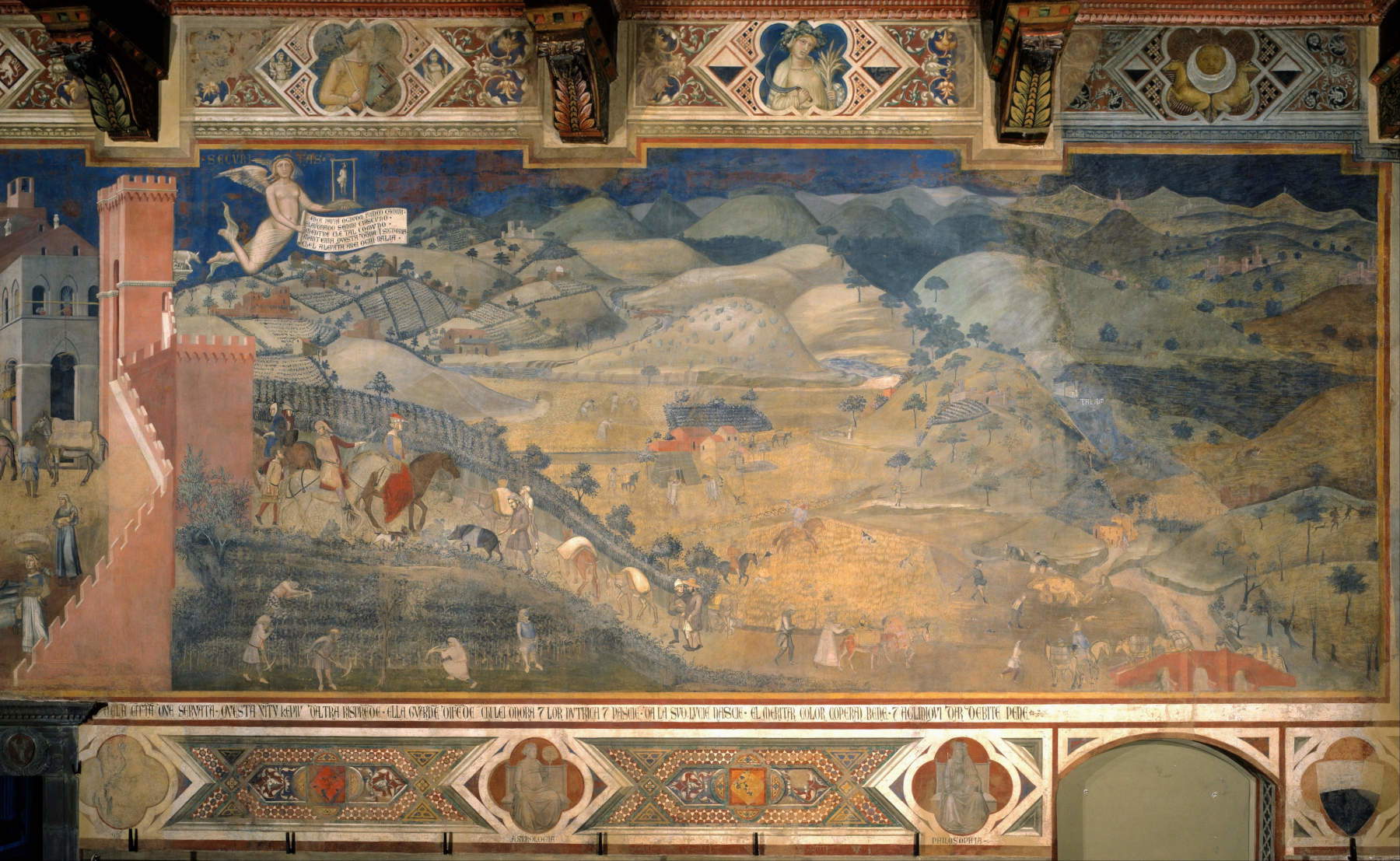
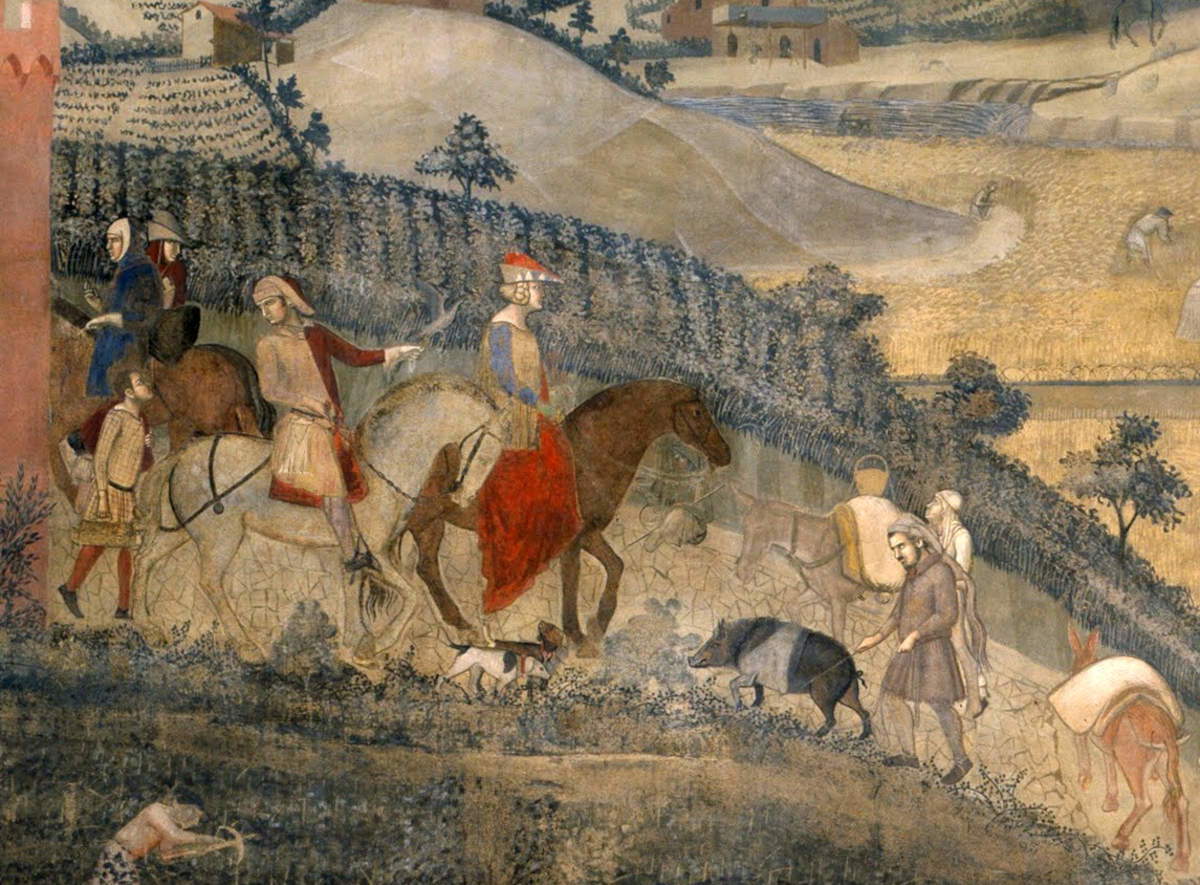
You leave the city through a gate left open, beneath the crenellated walls that protect it, and the road immediately widens until it disappears into the fields. Along the way, you pass people coming from opposite directions: on one side, hunters on horseback heading out into the countryside; on the other, farmers traveling in the opposite direction, carrying sacks of grain into the city. All around, the landscape is orderly. Near the walls, olive trees and grapevines cluster together; farther away, in the flatlands, wheat dominates the scene, and various types of rural settlements can be seen. Some are hoeing and others are plowing with the help of animals; some are returning laden with goods and livestock, while the hills appear cultivated and flourishing. High above, however, above the gate—like a sentinel guarding the two spaces—a winged figure holds a scroll in one hand and a small gallows with a hanged man in the other. This is Securitas.


The scene just described is the work that Ambrogio Lorenzetti ( Siena, c. 1290 –1348) painted in 1338 (with payments recorded through 1339) in the Sala della Pace of the Civic Museum of Siena—the chamber where the Nine, the executive body of the ancient Republic, carried out their governmental duties. We are referring to the fresco *Effects of Good Government in the Countryside*, part of the cycle*Allegory and Effects of Good and Bad Government*, a work that depicts the positive consequences of good administration outside the city walls.


To understand the meaning of this landscape, however, it must be viewed within the context of the cycle to which it belongs. The cycle of Good and Bad Government, painted by the Sienese artist, offers an allegorical representation of the various forms of government in a medieval city and how each, in opposite ways, affects the lives of its inhabitants. The frescoes, in fact, convey a complex message concerning the proper way to exercise political power; precisely because of its universal significance, this message has made them one of the most famous pictorial works in the world. Two contrasting concepts—the Republic and Tyranny—are depicted across three walls. Accompanying the images is a series of inscriptions that, when read in sequence, form a poetic song of 62 verses, intended to clarify and reinforce the message conveyed by the figures.


It is the interplay between text and image that determines the direction of interpretation. The sequence begins with the great Allegory of Good Government on the north wall, moves on to its effects on the city and the countryside, and culminates, on the opposite wall,in the allegory of Bad Government and its disastrous consequences. In this sequence, the countryside does not represent a separate episode, nor is it merely a landscape scene. It is a segment of an argument structured around cause and effect, linking the prosperity or ruin of an entire community to specific political choices. For this reason, those entering the hall were presented with a reasoning process that was both visual and verbal: the figures demonstrated what the verses explained, while the verses themselves named what the figures illustrated.
The space housing the pictorial cycle has changed its name several times: it was originally known as the Hall of Peace or the Hall of Crossbows, because it housed a storehouse for those weapons, and was later called the Hall of the Council of Nine, in memory of the government that commissioned the painter to create the fresco decoration, completed between 1337 and 1340. The room is quite large, and Lorenzetti frescoed three of its walls. The state of preservation is more than satisfactory, and the colors used retain their splendor—at least on the walls depicting “Good Government.” The situation on the wall depicting “Bad Government” is different. In any case, the secular nature of Lorenzetti’s undertaking deserves to be emphasized: *Allegory and Effects of Good and Bad Government* is not a devotional cycle; rather, we can consider it a fresco conceived for the very place where power was exercised—a work addressed to those who governed there and to those who came before them.
To fully appreciate the “Effects of Good Government ” series, it is helpful to begin with the grand allegory from which the entire narrative takes its cue. Allegories are a common feature of medieval painting: abstract concepts are conveyed through personification or symbolism, so that the message is immediately understandable to the viewer. One example isthe *Apologue of the Unicorn*, a 13th-century medieval work from Ferrara, in whichthe unicorn serves as an allegory for the fear of death. Similarly, the medieval Dances of Death have allegorical value and serve as a memento mori—that is, a reminder that we must all die. The three allegorical beasts in Dante’s Divine Comedy also belong to this tradition, as they give visible form to abstract concepts. Well, Lorenzetti employs the same rhetorical device to describe Good and Bad Government and the effects each produces in the countryside and in the town. There are numerous characters, both male and female, and each carries a meaning and a powerful message, addressed to both medieval and modern viewers. The inscriptions accompanying the figures help viewers recognize them.
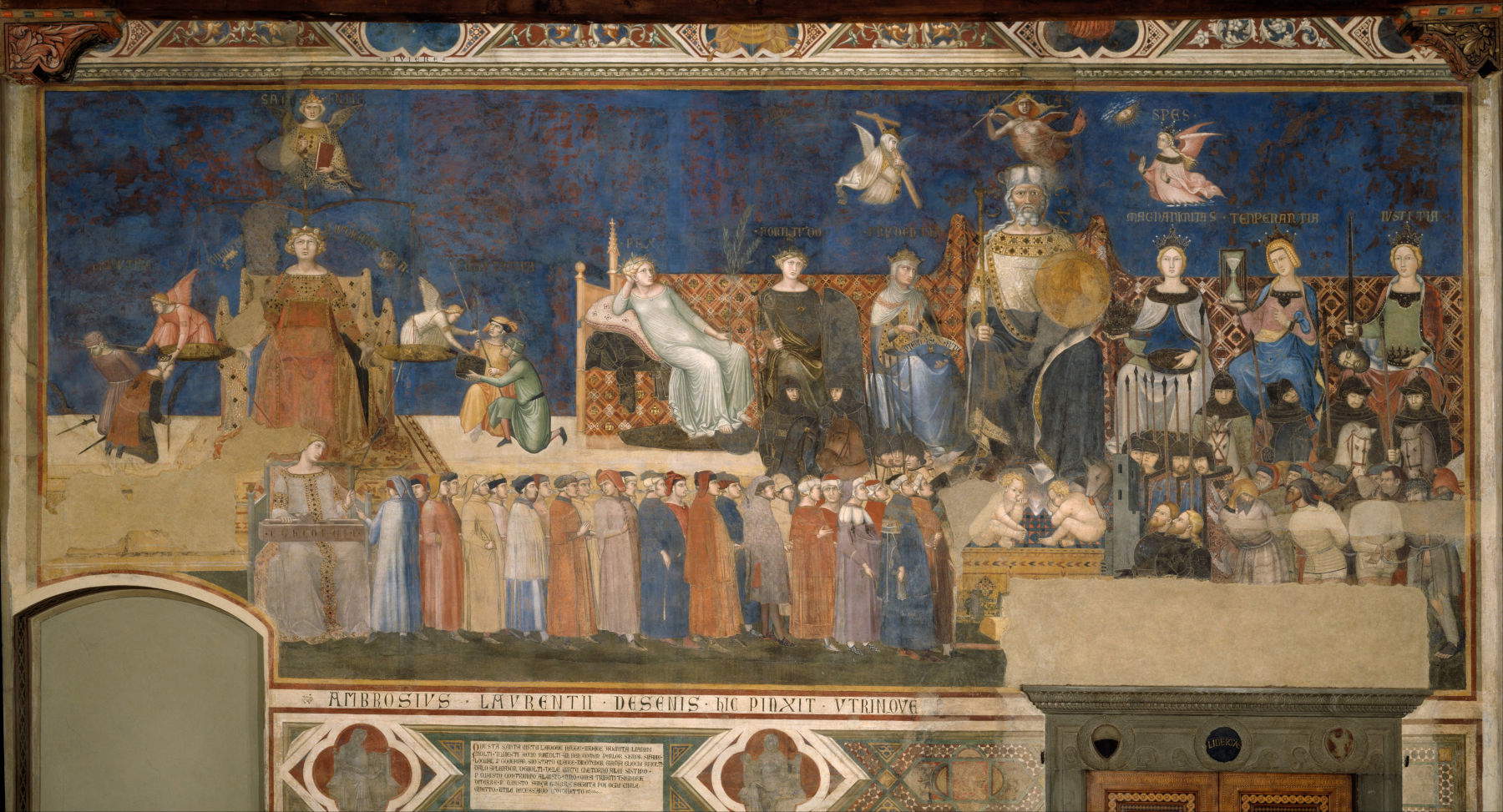
We can begin with the allegories foundin the Allegory of Good Government. Justice, seated on an imposing throne with her eyes raised toward Wisdom depicted above her: it is, in fact, Wisdom’s role to guide and inspire her. Wisdom, richly dressed in the style of the era, holds a set of scales above Justice’s head. On one of the pans—the left one—an angel beheads a man and, at the very same moment, crowns another: this is justice as conceived by Aristotle. Thus, punishment and reward coexist in a single gesture, and this pairing foreshadows the meaning of the gallows that Securitas holds in her hand in the countryside scene.
Concordia, meanwhile, appears majestic, seated with a plane resting on her lap, for it is her task to level the relationships among the members of society. Intertwined threads extend from her to a group of twenty-four citizens, who are advancing toward the throne of the Common Good. Good Government sits on a sumptuous throne, with a solemn demeanor and surrounded by elegant female figures. On the far left are Peace, Fortitude, and Prudence, each holding an object that identifies her. Peace is rendered with particular finesse: she rests on a cushion and wears a wreath of olive branches on her head. At the feet of the male figure are Ascanio and Senio, the legendary founders of Siena, suckled by the she-wolf, evoking the city’s origins. On the right side, however, criminals and delinquents appear, watched over by armed guards, in contrast to the line of Sienese citizens.
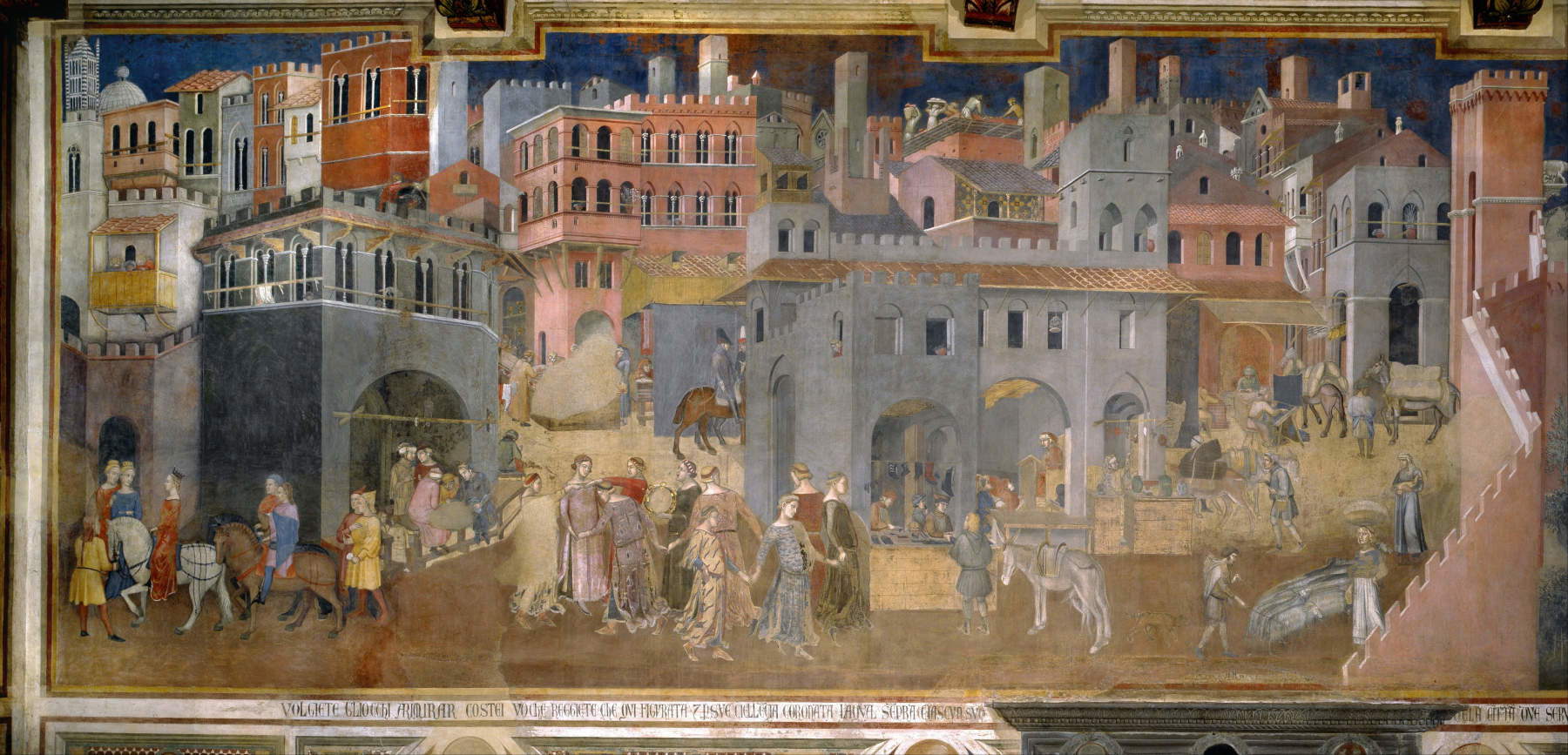
From the allegory, we move on to the effects. On the northeast wall of the Sala dei Nove, in direct relation to the fresco just described, Lorenzetti depicted what Good Government produces: a just and righteous system generates a better and more harmonious society. The first scene opens onto an outdoor city street. Houses and palaces unfold toward the viewer as if in a cross-section of the city, populated by many small figures. The setting is that of a turreted city center that takes the form of an ideal city: the painter includes attractive homes, buildings under construction, and merchants at work in their shops. People look out onto the street from balconies, and the painting is completed by towers of polychrome marble, battlements, and windows adorned with slender columns. The city depicted is growing. In the background, on the roof of a house, workers are laying the roofing, while inside the buildings, many merchants display their wares along the main street. A teacher can also be seen giving a lesson to attentive and focused students. From a window, a woman watches a circle of young women on the street: some are singing and playing music, while others are dancing, letting their dresses billow with their movements. Construction, commerce, education, and music are distinct activities, but all can take place without fear, and this setting sets the stage for the next scene.
From here, the view shifts outward. The walls open onto fertile countryside, and the scene—which follows seamlessly from the previous one—shows the effects of Good Government in the countryside surrounding the ideal city. On the far left, one can make out the crenellated walls defending the settlement. The entrance gate is open, and from there a road branches off, disappearing into the fields. Merchants, farmers, and knights bring the richly detailed landscape to life. The fact that the gate is open (in a context where walls are meant to protect) is one of the aspects that best sums up the meaning of the image: the city’s boundaries no longer divide, but allow people and goods to pass through.
There is a continuity of composition between the two scenes. The countryside is not depicted as a separate world, but rather as the natural extension of the urban space, and the road leading out of the gate serves as a visual link between the town and the surrounding countryside. The viewer follows the path of the figures: from the city street, filled with shops and dancers, one reaches the city walls, and upon passing through the gate, finds oneself among the fields. The narrative flows uninterrupted; this fluidity makes it clear that the city and the countryside depend on one another and that their fates are determined by the same government.
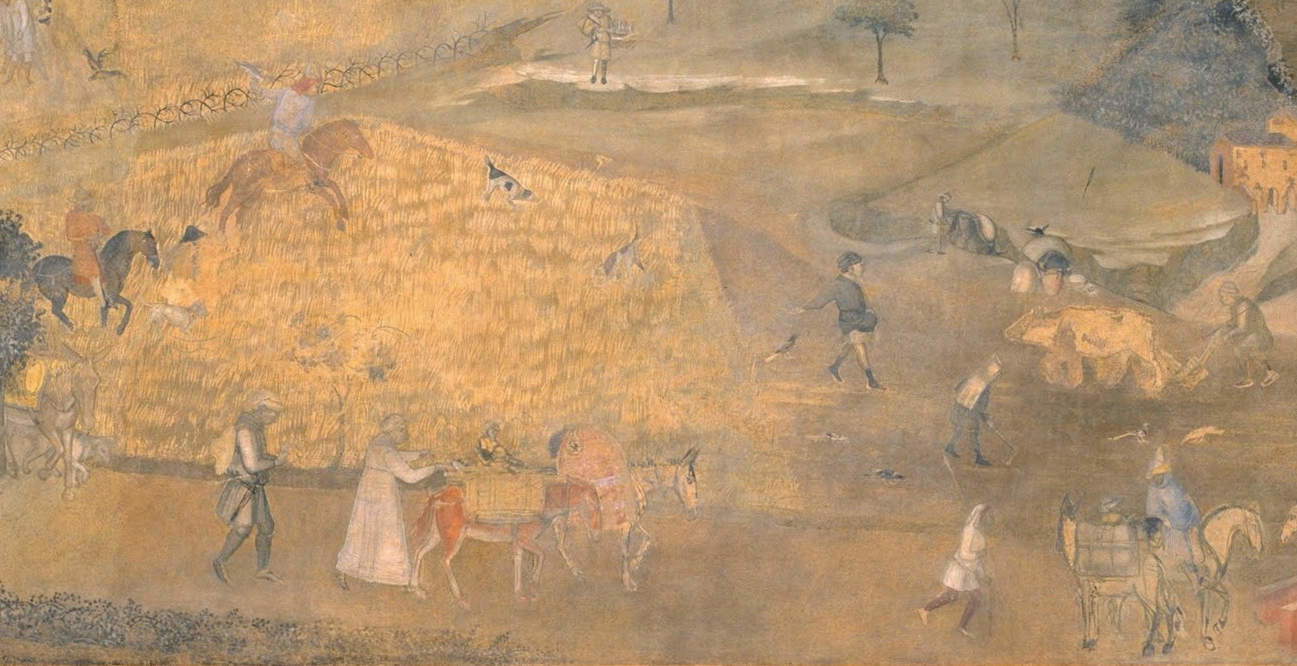
Outside the walls, the atmosphere is relaxed, and the hand of man is visible everywhere. The crops are arranged in an orderly fashion and vary in type as the distance from the city increases. Olive trees and grapevines are concentrated around the perimeter of the city walls; in the intermediate zone, on the flatlands, cereals dominate, and various types of rural settlements can be identified. It is, in fact, an organized territory, where each area has a function and the connection to the city is never broken. The division into zones conveys the impression of a territory administered with care. Crops most closely tied to daily consumption and the market are grown near the town, while grains occupy the vastest flat areas. No part of the landscape appears neglected or left to chance, and even the rural settlements—distinguished by type—convey a sense of widespread and stable human presence. It is a landscape lived in without fear, for the signs of agricultural labor are not accompanied by those of defense.
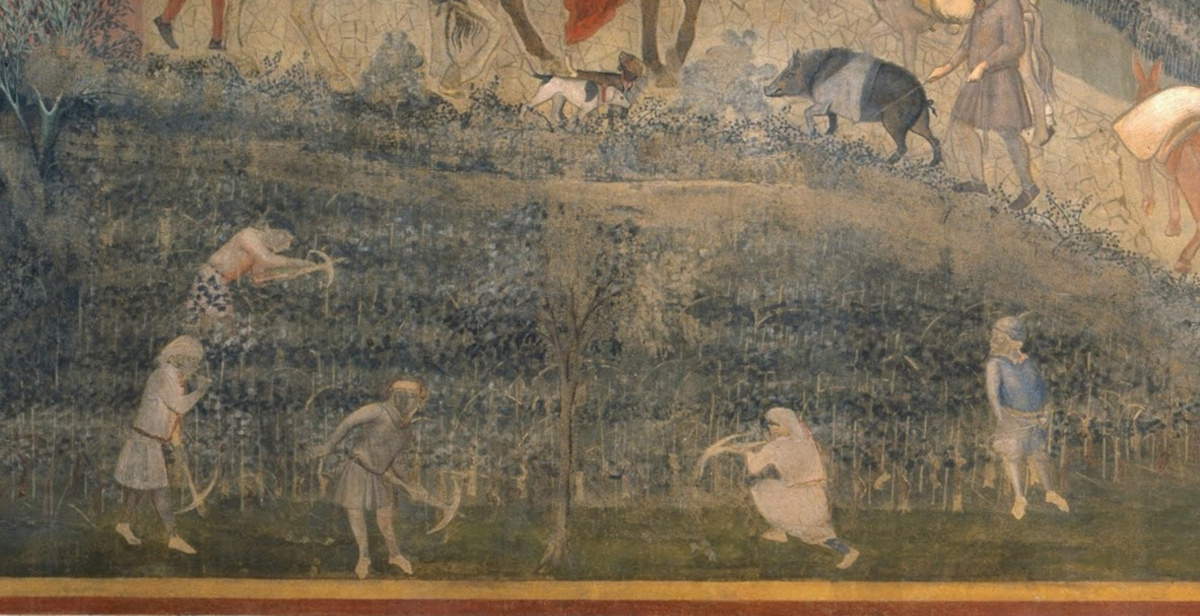
The countryside is full of figures in motion. Some are working the land—some with hoes, others with animal-drawn plows. The hills appear cultivated and lush. Other figures are leaving the city, while others are returning with goods and livestock, and still others seem intent on hunting. In particular, hunters on horseback are heading toward the countryside, while farmers, moving in the opposite direction, are bringing sacks of grain into the city; the fields, on the whole, appear well-tended. This carefully rendered movement in opposite directions along the same road signifies the continuous exchange between the town and the surrounding countryside. According to the interpretation proposed by the Civic Museum of Siena, even Nature appears subdued and tamed by the effects of Good Government.
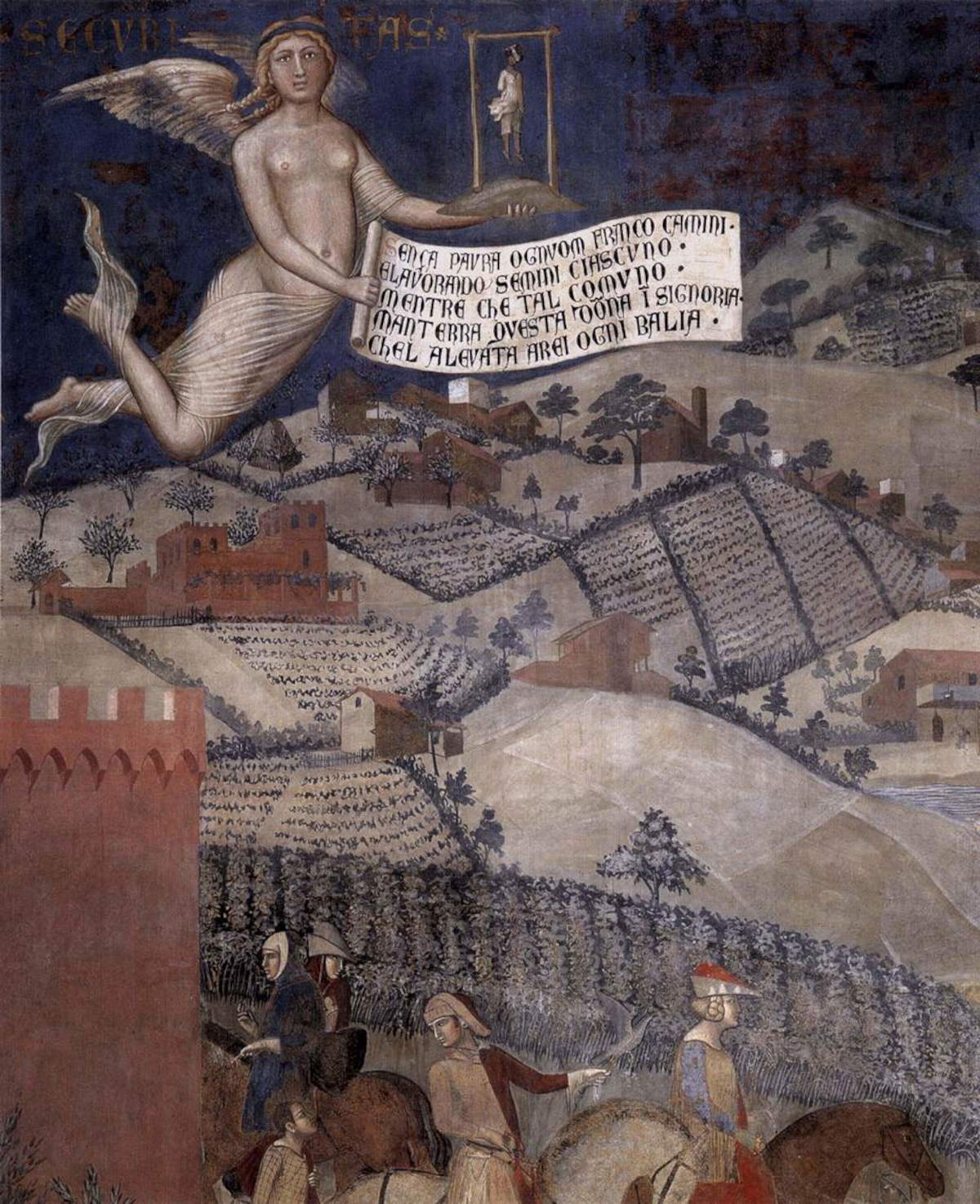
Thus, activities of various kinds coexist in the scene. Farmwork, the transport of goods, the return of livestock, and hunting belong to distinct social conditions—ranging from the farmer hoeing the fields to the horseman heading toward the woods—yet they are depicted in the same space and with identical serenity. Lorenzetti’s countryside is not the domain of a single class of people: it is a landscape where work and leisure, production and trade coexist, demonstrating an order that sustains the entire community and not just one part of it. At the center of the composition, straddling the city and the countryside, stands the winged figure positioned high above the entrance to the town, like a sentinel guarding both realms. This is Securitas, or Security, who holds a scroll in one hand and a small gallows with a hanged man in the other.
The text on the scroll explains that, thanks to Good Government, security and tranquility can reign in both the city and the countryside, and that public order is safeguarded. It reads: “Let every free man walk without fear / and let each one sow through his labor / while this commune / maintains this lady in power / whom every nurse would have raised.”
The gallows near the cartouche helps clarify the meaning of the image. The security evoked by the inscription thus appears as the result of guaranteed public order, which also includes the punishment of those who violate it. The verses (which invite everyone to walk without fear and to work by sowing) explicitly link freedom of movement and agricultural productivity to the duration of the commune’s rule. In this interpretation, the countryside prospers because it is safe, and it remains so as long as the commune keeps the figure who protects it in power. The position of Securitas also reinforces her role. Placed high above the doorway, she stands precisely at the point of transition between the two spaces and can be considered the guardian of both. She belongs neither to the city nor solely to the countryside; rather, she watches over the place where the two realms meet. Her wings distinguish her from the other figures—all engaged in concrete actions—and place her on another level: that of the idea underpinning the scene, the condition that allows each of the tasks depicted beneath her to take place.
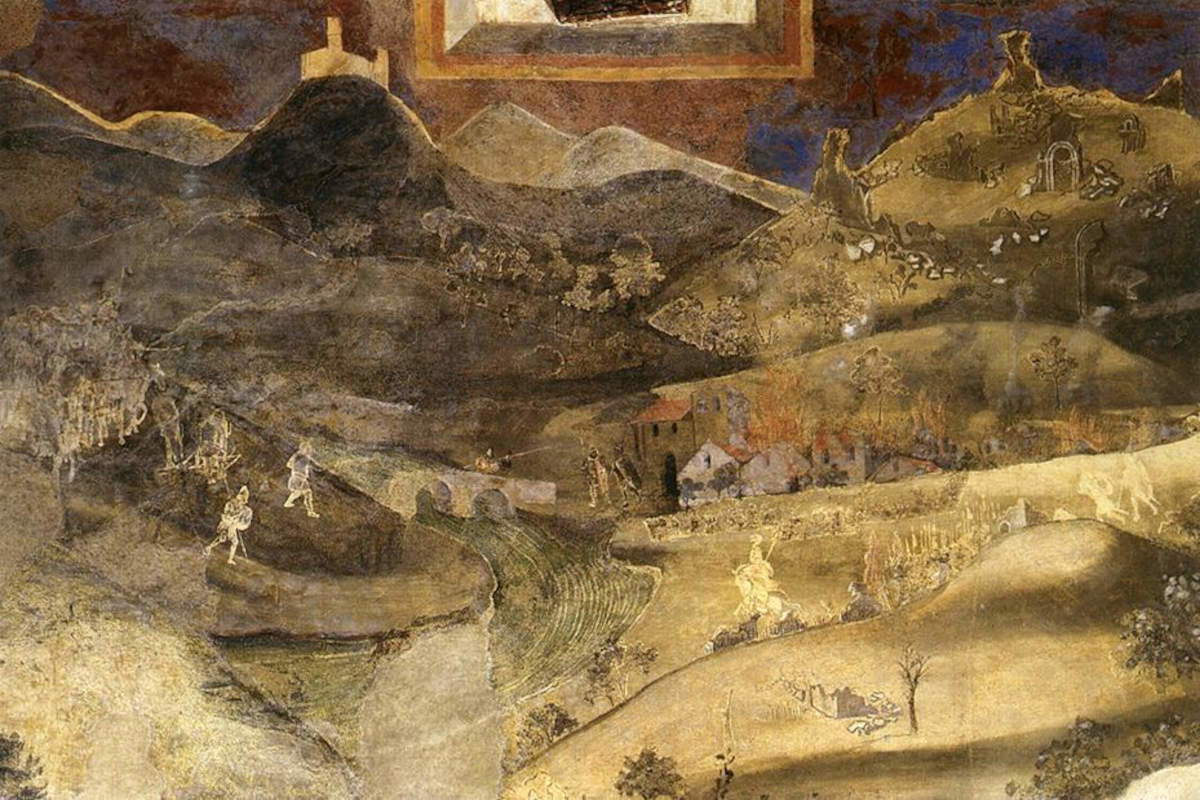
The cycle, however, does not end here. On the opposite wall are depicted the effects of Bad Government, in the city and in the countryside. The viewer encounters a bleak vision: that of a town and a region destroyed and impoverished, transformed into a scene of theft, kidnappings, murders, and armed clashes—a warning of how political choices can affect, for better or worse, the lives of the entire community. The contrast with the orderly and flourishing countryside of *Good Government* is the cornerstone of the entire composition, and the comparison between the two walls immediately clarifies the cycle’s central theme. Unlike the others, the *Bad Government* wall is currently in poor condition.
The comparison therefore also concerns the physical condition of the works. On one side are the walls of Good Government, with colors still vibrant and clarity sufficient to allow viewers to discern the details of urban and agricultural life; on the other is the wall depicting ruin, marked by the work’s deterioration. The two situations are independent of the scenes’ content, but the difference in condition means that today the positive images are more easily perceived than the negative ones.
In any case, the “Good Government” countryside scene serves a specific function within the cycle. It complements the portrayal of the benefits of just government by extending them beyond the city walls and demonstrates that security, employment, and the circulation of goods concern not only the urban space but the entire territory administered by the municipality. The crops arranged in bands, the roads traveled in both directions, the figures engaged in farmwork, hunting, and the transport of goods—with Securitas at the center overseeing both realms—give shape to a unified image that, as intended by the cycle, speaks as much to those who saw it in the Middle Ages as to those who view it today.
It is this universality that explains why Lorenzetti’s frescoes are counted among the world’s most famous pictorial works. The discourse on the proper exercise of power, conveyed through easily understandable images, is not tied to the context of fourteenth-century Siena and can be interpreted independently of it. The countryside, in this sense, is one of the clearest examples: a landscape in which all the elements—from the wheat to the vines, from the road to the open gate—point to a precise idea of what a government should ensure. The Civic Museum of Siena preserves this narrative in the very same room where the Nine carried out their duties, and nearly seven centuries later, the colors used by Lorenzetti remain strikingly vivid. What in the 14th century was a political statement directed at rulers and citizens has become one of the world’s most famous pictorial works, and continues to be interpreted—just as it was then—through the interplay of images and inscriptions.
Warning: the translation into English of the original Italian article was created using automatic tools. We undertake to review all articles, but we do not guarantee the total absence of inaccuracies in the translation due to the program. You can find the original by clicking on the ITA button. If you find any mistake,please contact us.