




by Redazione 15/10/2026



Categories: Exhibitions / Disclaimer
From November 6, 2026, to February 28, 2027, the Accorsi-Ometto Museum of Decorative Arts will present an exhibition dedicated to the fashion designer and the women who inspired his work—from cinema to opera, from science to the aristocracy. Also on display are sketches and illustrations, with a special focus on Duchess Maria Luisa Gaetani d’Aragona.


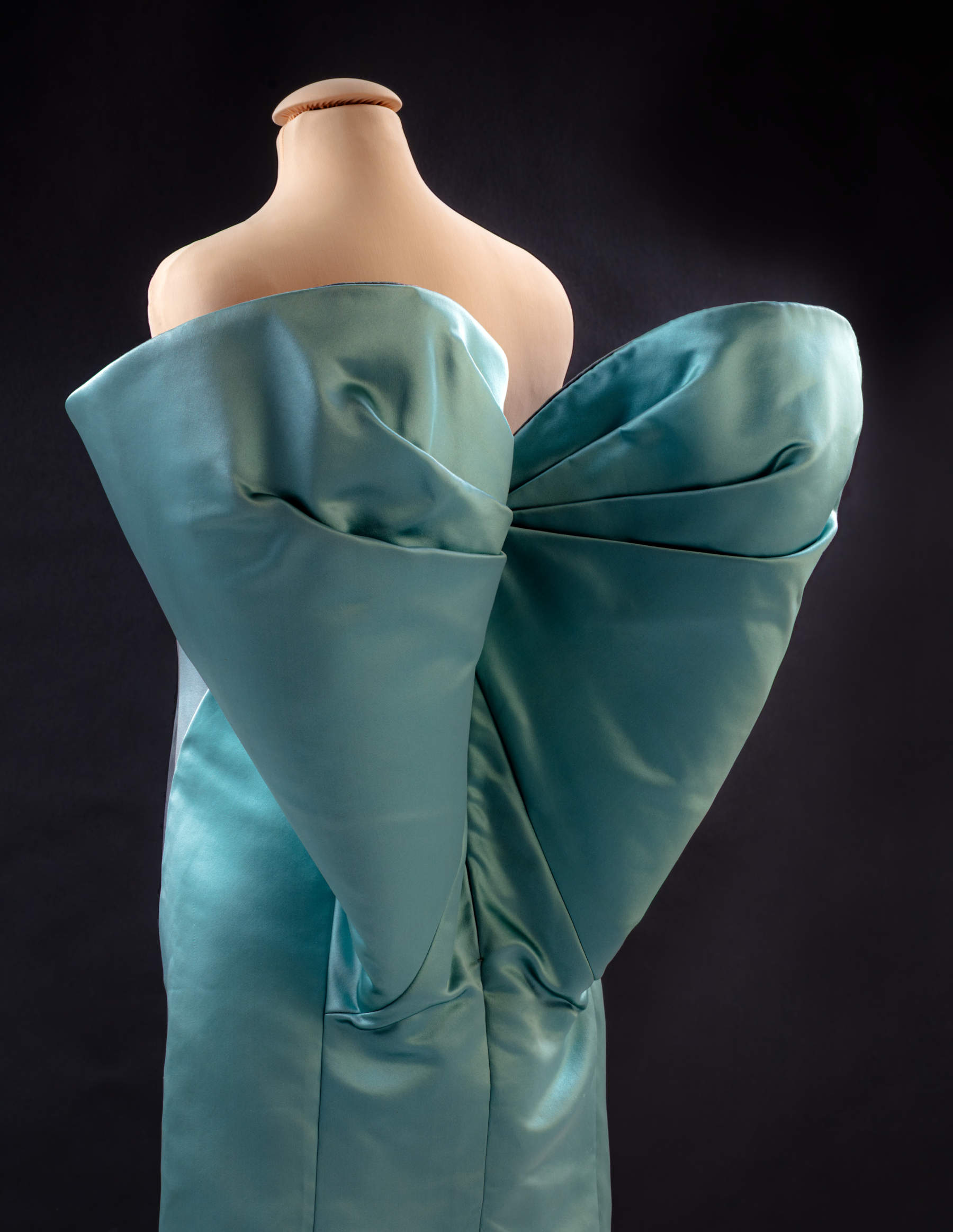
From November 6, 2026, to February 28, 2027, the Accorsi-Ometto Museum of Decorative Arts in Turin will host an exhibition featuring Roberto Capucci. *Dressing THE Muses*, an exhibition curated by Silvia Mira, an art and costume historian, is dedicated to the relationship between the designer and the women who accompanied and inspired his creative journey. Through fifty garments, the exhibition reconstructs a universe in which fashion engages with theater, cinema, art, music, and science, interpreting the concept of beauty through shapes, volumes, and materials.


The protagonists of the exhibition come from different worlds: they are actresses, opera singers, figures from the worlds of culture and scientific research, and members of the aristocracy and high-profile business circles. Some of them, such as Duchess Maria Luisa Gaetani d’Aragona, Marisa, Valentina, and Violetta Nasi, and Clementina Marini Clarelli, have made part of their personal wardrobes available for the exhibition. Alongside the creations made for these women, the exhibition features dresses worn by figures such as Silvana Pampanini, Lucia Bosè, Catherine Spaak, Valentina Cortese, Raina Kabaivanska, Katia Ricciarelli, and Rita Levi Montalcini.


The exhibition opens with a wedding dress, a garment that, in Capucci’s vision, represents the ultimate expression of royalty. The construction of forms, the control of volumes, the study of lines, and an understanding of materials are some of the elements through which the designer developed a recognizable language, based on formal research and the transformation of the garment into an articulated structure.


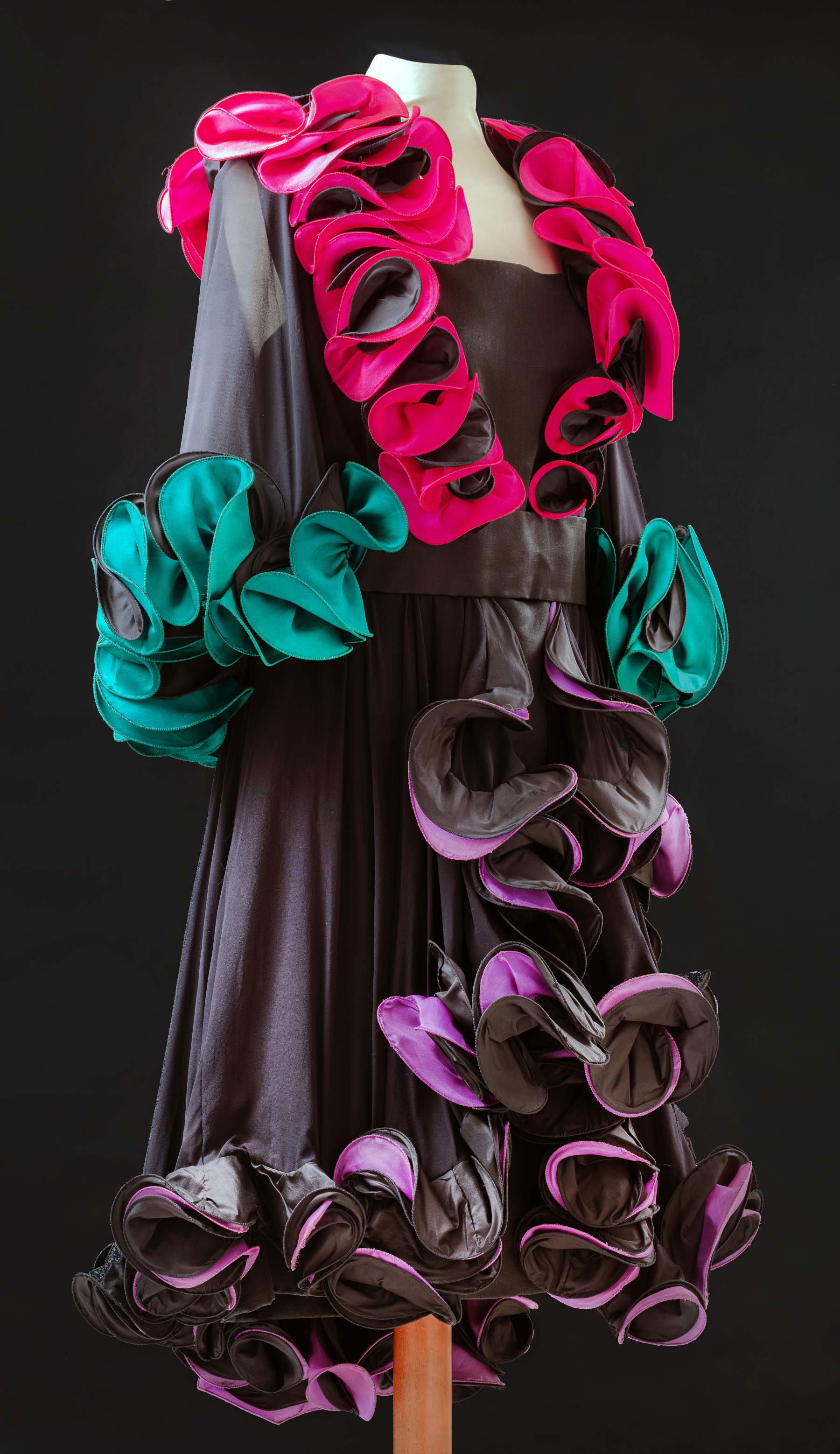
From the idea of royalty, we move on to a piece linked to the history of science: the velvet dress worn by Rita Levi Montalcini on December 10, 1986, when the researcher received the Nobel Prize in Medicine at the Stockholm Concert Hall. The presence of this garment lends fashion a documentary dimension, linking it to a significant moment in the public life of one of the 20th century’s most important scientific figures.
One section is dedicated to the Italian actresses who frequented Rome’s fashion ateliers in the 1950s and 1960s. A cocktail dress by Silvana Pampanini is on display, while Catherine Spaak is represented by a simply cut dress: both come from the collection of Massimo Cantini Parrini. Lucia Bosè’s wardrobe, on the other hand, is represented by a classic daytime ensemble and a robe-manteau, both from the collection of the Passoni Art Institute in Turin. Rounding out the group is an evening gown in taffeta and purple velvet, preserved by the Roberto Capucci Foundation, worn by Valentina Cortese, one of the designer’s favorite muses.
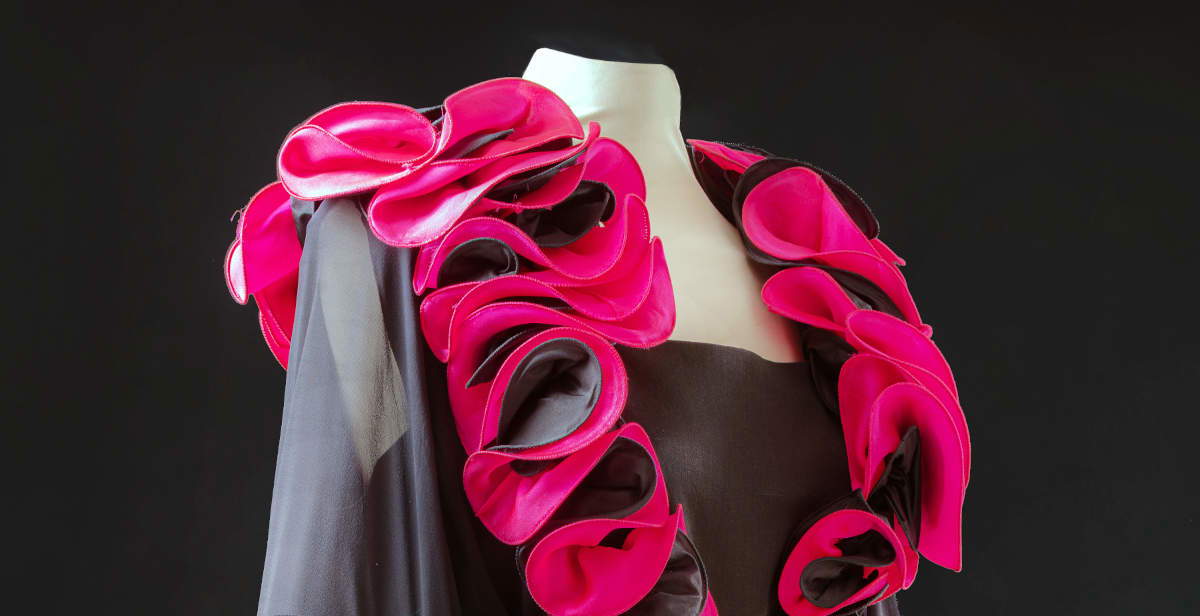
The connection with opera singers is evident through two creations linked to the stage and concert performances. For Raina Kabaivanska, Capucci created a black taffeta and sequin costume for *The Merry Widow*, worn in Trieste in 1991 and now part of the Roberto Capucci Foundation’s collection. Also on display is a concert dress by Katia Ricciarelli in red georgette, accented with a double ruffle in red and cyclamen taffeta, worn in Paris in 1986. These two garments illustrate how the designer’s creative vision engaged with the demands of musical performance, developing solutions tailored to personalities with a strong stage presence.
The exhibition continues in the galleries of the Accorsi-Ometto Museum’s permanent exhibition, where twenty dresses created between the 1980s and 1990s for aristocratic families and prominent business leaders—drawn from a private collection—are presented in dialogue with the historical furnishings.
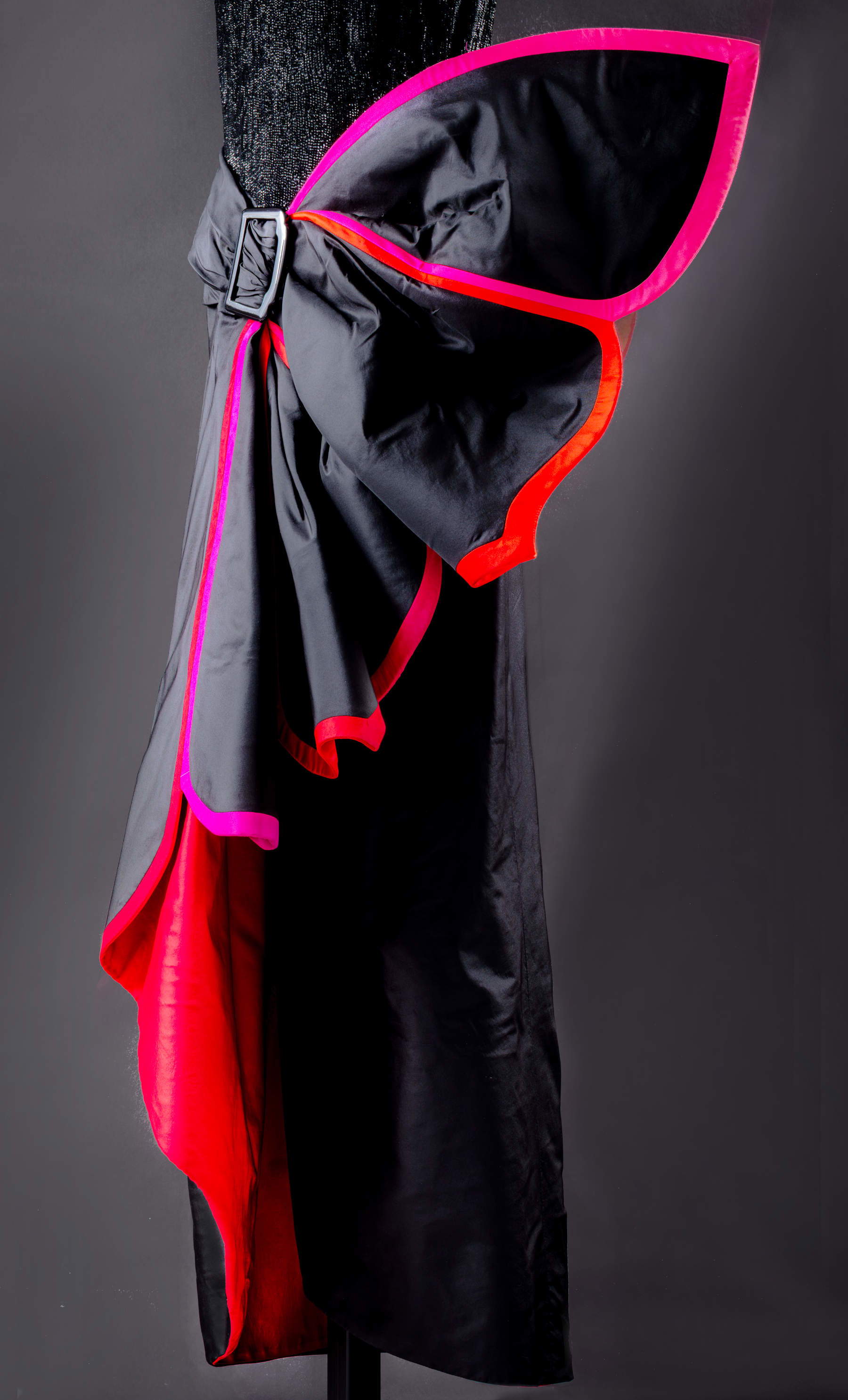
Alongside the dresses, the exhibition features a selection of sketches—organized by decade from the 1950s to the 2000s—and illustrations by the designer. These materials allow visitors to trace the design phases of the creations and observe how the structures, color combinations, and volumes that characterize his work took shape.
Of particular interest is the collection of sketches related to Capucci’s first collection, presented in the fall-winter of 1951 and exhibited for the first time in Turin. The drawings from the 1960s, on the other hand, reflect his Parisian period and a phase of intense experimentation, marked by the use of fluorescent colors and unusual materials, including plastic.
In the 1970s, his creative exploration also turned toward so-called “poor” materials—such as rope, bamboo, and stones—used in ways that challenged fashion conventions and expanded the expressive possibilities of clothing. In the following decades—the 1980s and 1990s—references to nature, the study of lines, and the use of pleats took on particular significance. Finally, the sketches from the 2000s document a phase in which her aesthetic exploration was further developed and led toward new formal syntheses.
Among the materials on display are also the sketches for the costumes of the ballet *Le creature di Prometeo*, presented at the Festival dei Due Mondi in Spoleto in 2020. These works bear witness to the convergence of Capucci’s artistic language and dance, a field in which costume design must engage with the body’s movement and the demands of choreographic performance.
The Wardrobe of Maria Luisa Gaetani d’Aragona
A separate section is dedicated to Duchess Maria Luisa Gaetani d’Aragona, to whom the exhibition reserves a sort of “exhibition within an exhibition.” About fifteen dresses selected from her personal wardrobe, presented for the first time in Turin, serve as the starting point for retracing some of her life experiences, from her travels to her photography, and on to her philanthropic activities.
A passionate photographer, Gaetani d’Aragona documented numerous trips over the course of decades. She dedicated the book *India. Images for Samdhya*, published in 2008, to India. In 2013, she also created *Save Syria*, a photographic project focused on Syria’s historical and artistic heritage threatened by the conflict. The initiative accompanied her commitment to supporting the work of Amnesty International.
Alongside her photographic work and book publications, she has focused on social initiatives, including support for the Pediatric Palliative Care Center at the Bambino Gesù Hospital in Passoscuro. The garments selected from her wardrobe thus become tools for reconstructing a personal history that encompasses cultural interests, travel experiences, and philanthropic commitment.
“Roberto Capucci is not a fashion designer; he is not a tailor,” states Silvia Mira. “He is an artist. Capucci’s Muses are those capable of inhabiting wonder, of living up to wonder, because they possess the ability to understand it and to serve as a conduit for the fulfillment of a yearning for the infinite.”
 |
| Roberto Capucci dresses his muses: in Turin, fifty dresses tell the story of his creative universe |
Warning: the translation into English of the original Italian article was created using automatic tools. We undertake to review all articles, but we do not guarantee the total absence of inaccuracies in the translation due to the program. You can find the original by clicking on the ITA button. If you find any mistake,please contact us.