





A Venice defined by light, matter, and space takes center stage in the art market. It is *Concetto Spaziale, Mezzogiorno in Piazza S. Marco*, one of the most significant works from Lucio Fontana’s famous *Venezia* series, which on October 22 will be the centerpiece of Christie’s upcoming 20th/21st Century: Paris Evening Auction with *Thinking Italian*. The painting, created in 1961 and offered on the market for the first time, goes up for auction with an estimate of 5,500,000–7,500,000 euros.
The work was first exhibited in the same year it was created, at Palazzo Grassi in Venice, where it remained on display from July through October. More than forty years later, the painting returned to the international spotlight through major museum exhibitions: between 2006 and 2007, it was featured at the Peggy Guggenheim Collection in Venice and subsequently at the Solomon R. Guggenheim Museum in New York.
Created in 1961, *Mezzogiorno in Piazza S. Marco* belongs to the small group of twenty-two works in the *Venezia* series, one of the most famous and innovative in Fontana’s oeuvre. Compared to his other Spatial Concepts, these works are closely tied to specific locations, times of day, and weather conditions in the lagoon city. Venice thus becomes, for the artist, a veritable laboratory for exploring space through light, color, and matter, transforming a real place into a perceptual experience.
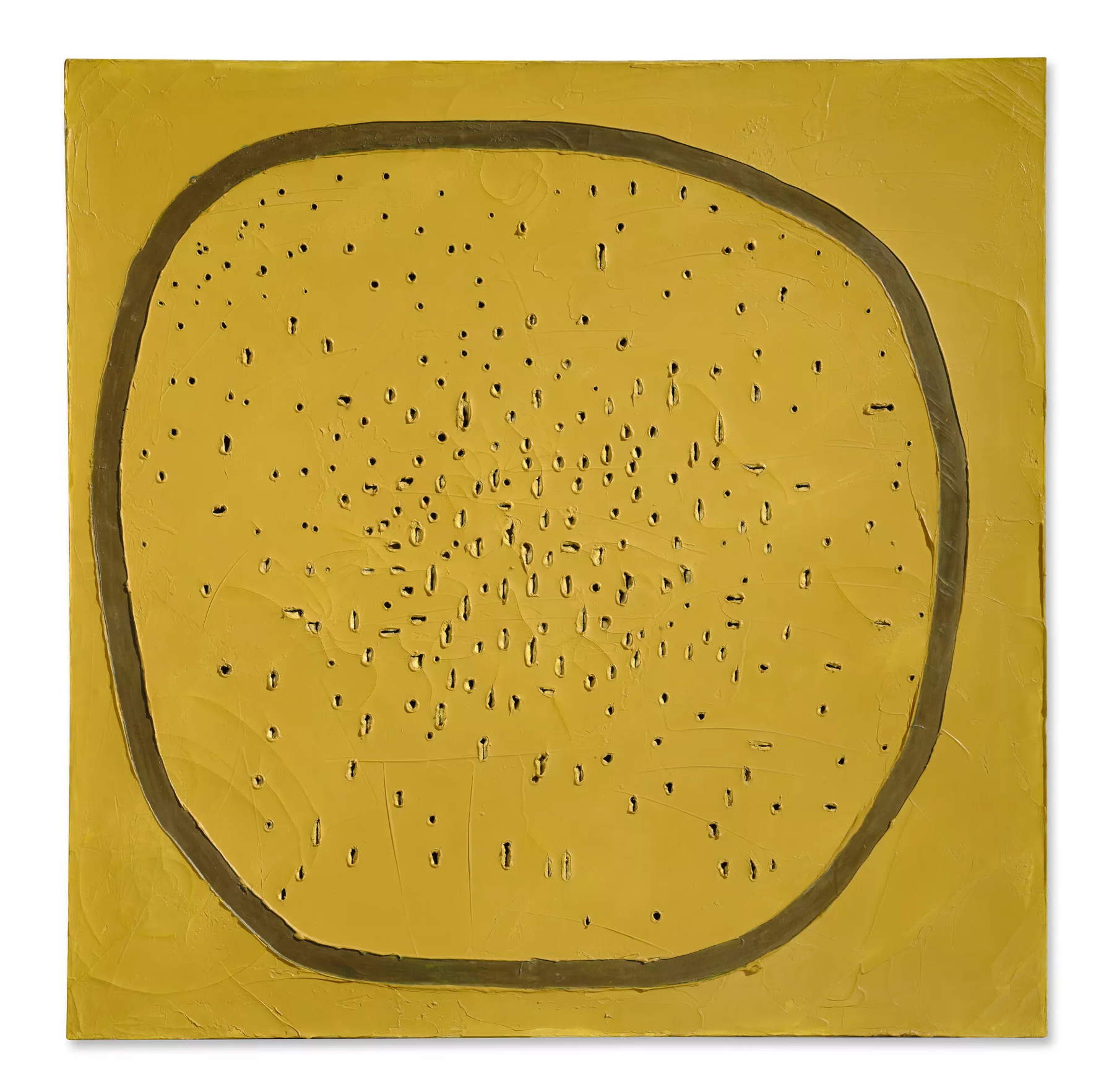
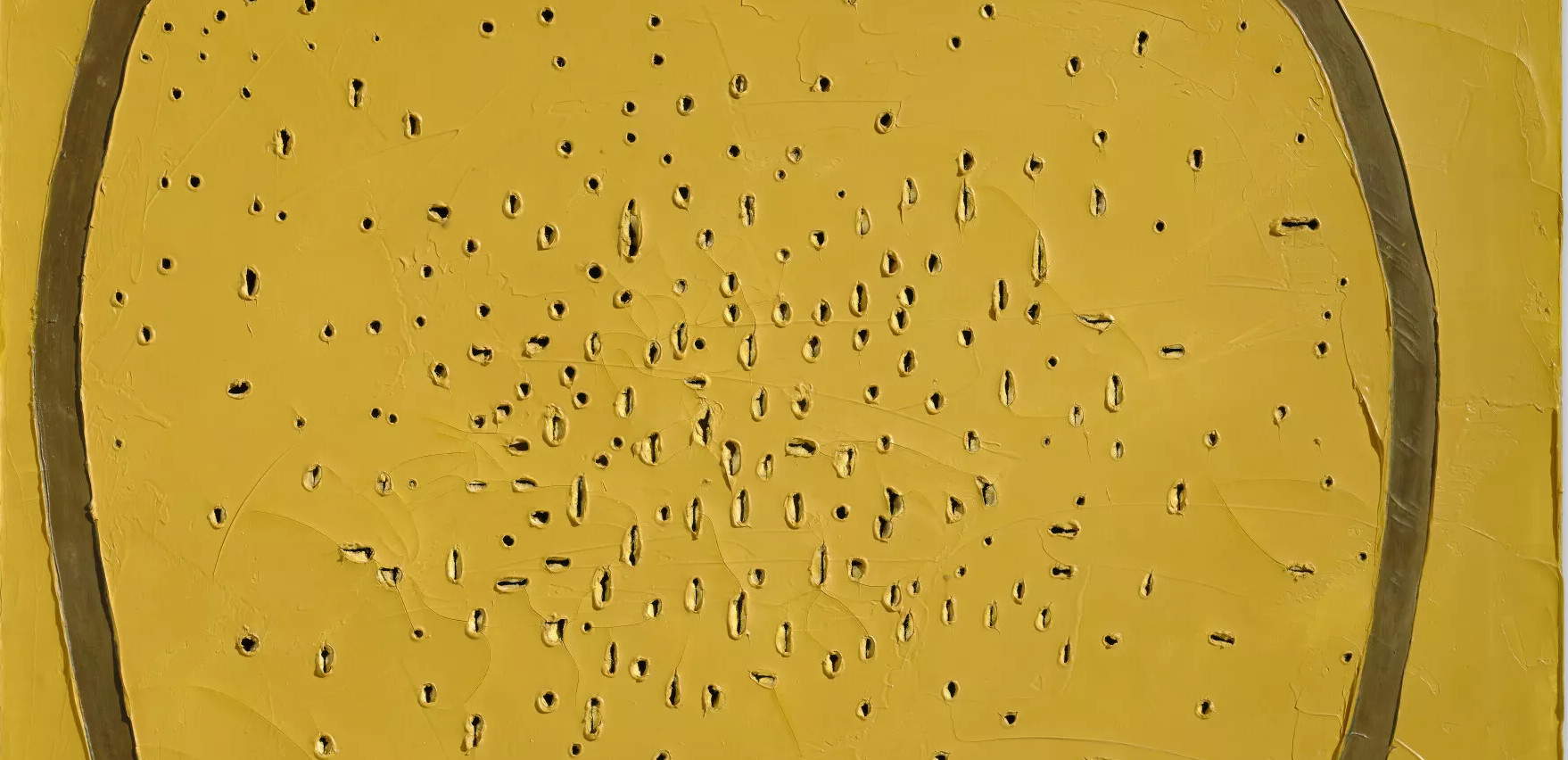
In the painting set for auction, Fontana focuses on the midday light in St. Mark’s Square. The golden mosaics of the Basilica serve as the starting point for a composition dominated by an intense, luminous yellow, traversed by a large golden ring and the artist’s characteristic perforations. With just a few elements, Fontana manages to evoke both the monumental identity of Venice and that spatial and cosmic dimension that lies at the heart of his artistic exploration.
The Venice series represents a decisive phase in the artist’s evolution and marks an expansion of the experiments he had already begun with his famous *Attese* series. What changes is not only the color but also the way he conceives the pictorial surface, which becomes increasingly textural and three-dimensional. To achieve these effects, Fontana uses a special quick-drying synthetic paint capable of preserving grooves, imprints, and reliefs. Spatulas, tools, and hands thus become an integral part of the creative process. The canvas is no longer merely a support onto which to apply color, but a surface to be built and shaped almost like a sculpture.
In *Mezzogiorno in Piazza S. Marco*, the yellow thus takes on an extraordinary intensity, as if light were transformed into matter, while the golden ring emerges as a sculptural element and the focal point of the composition. Fontana once again transcends the boundary between painting and sculpture, transforming the canvas into an open, dynamic space in which light, matter, and gesture become the tools for portraying a Venice suspended between concrete experience and a cosmic dimension.
“A masterpiece of postwar Italian art, the painting has remained in the same family collection for over forty years, having come directly from its original owner. Purchased by the renowned Italian collector and founder of Palazzo Grassi, Paolo Marinotti, the work has remained largely hidden from the public, having been exhibited publicly only three times in its history,” said Mariolina Bassetti, Chair of the Department of Postwar and Contemporary Art for Continental Europe.
 |
| Lucio Fontana’s *Venezia d’oro* is set to go up for auction for the first time: Christie’s is projecting a price of up to 7.5 million |

Warning: the translation into English of the original Italian article was created using automatic tools. We undertake to review all articles, but we do not guarantee the total absence of inaccuracies in the translation due to the program. You can find the original by clicking on the ITA button. If you find any mistake,please contact us.


























 IT
IT FR
FR DE
DE ES
ES CN
CN


