





Naples bathed in the first light of dawn, with the sea barely rippled, the silhouette of Castel dell’Ovo, and Vesuvius glimpsed in the background. This is the city as depicted by Jean-Baptiste Camille Corot in *The Bay of Naples with Castel dell’Ovo*, a painting created in 1828 that is now joining the collections of the Capodimonte Museum and Royal Park. The work will be on display starting October 8 in Room 78 on the second floor of the Royal Palace. The painting was acquired this summer by the Ministry of Culture—General Directorate of Archaeology, Fine Arts, and Landscape—thanks to a recommendation from the Florence Export Office.
Corot’s relationship with Italy played a fundamental role in his artistic development. The artist set out for the Italian peninsula in 1825, drawn in part by Stendhal’s descriptions, and initially visited Rome, Narni, and Tivoli. His direct encounter with the vestiges of antiquity and, above all, with the light of the Roman and Umbrian countryside gradually transformed the way he observed and painted nature. In the spring of 1828, Corot arrived in Naples, where he stayed for about two months. He would return to the city in 1834 and 1843, but it was his first stay that left a decisive mark on his painting. Direct observation of the landscape and the study of the chromatic variations caused by light led him, in fact, toward a practice increasingly aligned with plein air painting.
In *The Bay of Naples with Castel dell’Ovo*, Corot chooses to depict the landscape at dawn. The rising light illuminates Vesuvius, partially hidden by the buildings along the coast, while the bay remains backlit. The first rays of the sun cast the elongated shadows of the castle, the grove, and the Real Casino di Pesca del Chiatamone—commissioned by Michele Imperiali, Prince of Francavilla, Gentleman of the Bedchamber, and Chief Steward to the King—onto the sea.
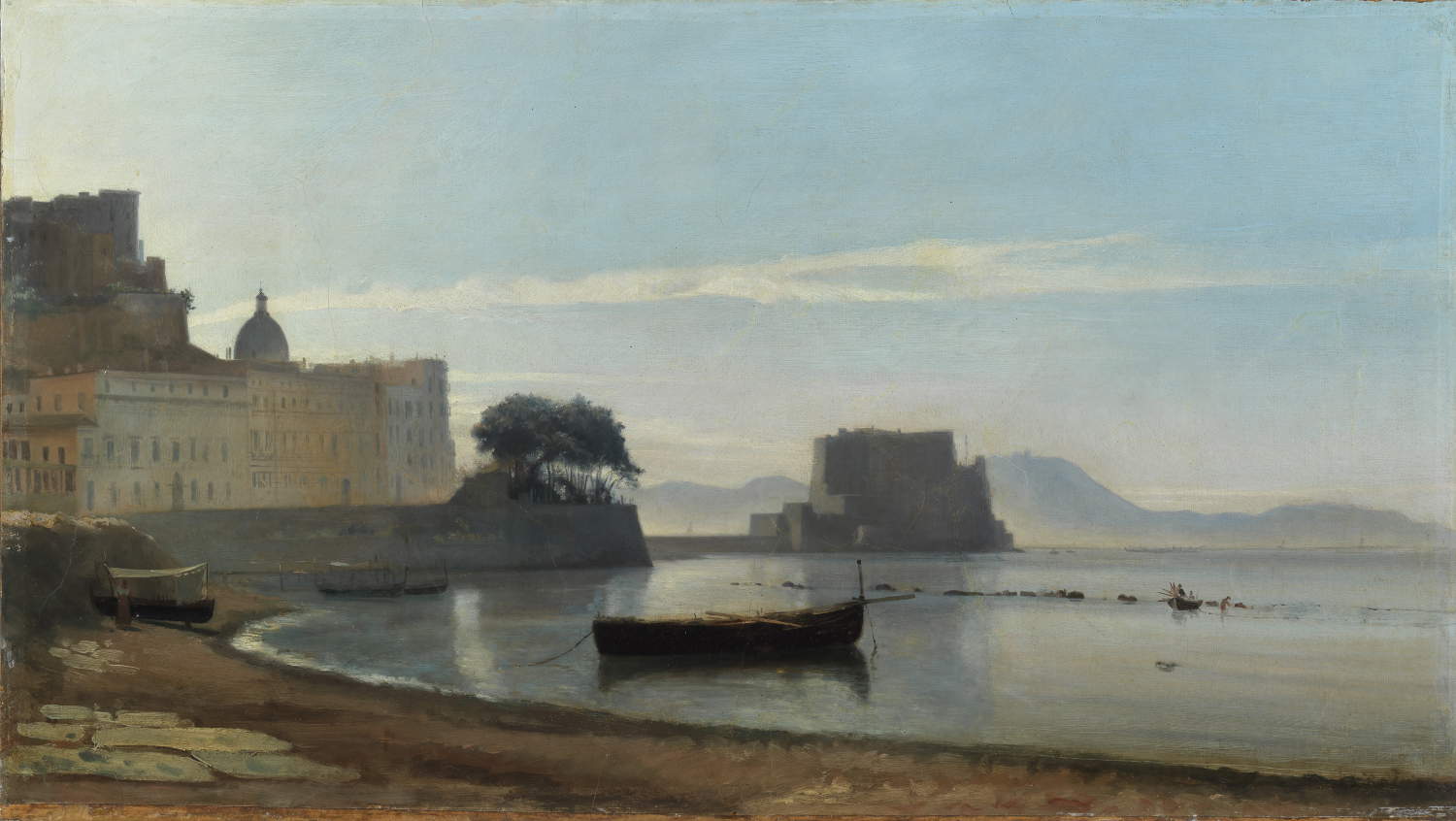
The view, likely painted from the entrance to the Villa Reale, allows us to recognize some of the buildings that characterized the Neapolitan landscape at the time: next to the castle stands the Palazzo d’Aquino di Caramanico, while in the background we can make out the dome of the Church of the Crocelle and the Gran Quartiere di Pizzofalcone. Behind Castel dell’Ovo, the mountain peaks rise into view. Rounding out the scene are a few figures: a woman on the beach and some sailors on a boat offshore. The wind ripples the surface of the water. Everything contributes to conveying the impression of a precise moment, when the city is slowly beginning to awaken and the cool sea air gives way to the warmth of the day.
The painting belongs to a group of works created by Corot during his stay in Naples, which are particularly significant in his body of work and were highly prized throughout the nineteenth century by collectors and art dealers. These works are characterized by quick sketches and immediate impressions, born of a new way of observing reality. His association with the colony of German painters in Rome also contributed to this shift. In Naples, as in the capital, Corot explored the city’s surroundings in search of landscapes and natural variations, but when facing the gulf, he seems to have been particularly struck by the chromatic relationship between the sky and the sea. Compared to the more traditional brown tones and stark light contrasts, the artist experimented here with more delicate tonal and atmospheric harmonies, resulting in light, almost monochromatic surfaces bathed in a characteristic silvery light.
Throughout the nineteenth century, Naples became one of the preferred destinations for European artistic travel. The gulf became a place of the imagination where light, memory, and emotion merged. It was in this context that the Posillipo School, founded by Anton Sminck van Pitloo, developed, advocating a more direct and emotional relationship with nature. Corot’s painting fits into this evolution, standing apart from the detailed and analytical views of artists such as Hackert and van Wittel or the crowded scenes of Della Gatta and Fabris. Instead, his artistic exploration resonates with that of numerous foreign painters drawn to the Neapolitan landscape—including Wutky, Rebell, Turner, and Catel—who were oriented toward a more sentimental depiction of the gulf.
Particularly important was the relationship between Corot and Pitloo, which fostered the exchange of ideas between France and Naples. From the Barbizon School came the practice of observing from life, an interest in atmospheric effects, and the practice of plein air painting, along with experimentation with oil on paper—a technique that allowed for the creation of immediate images and the capture of the ever-changing light. Lightweight canvases and pocket-sized sketchbooks thus replaced, at least in part, the traditional easel. This transformation would contribute to a profound change in the way landscapes were viewed and depicted, and one of its most significant examples is found in Corot’s small landscape painting, which has now been acquired by Capodimonte.
“We thank Minister of Culture Alessandro Giuli and all the officials and art historians who worked to ensure that this iconic painting remained in Italy and was acquired for Capodimonte,” emphasized Eike Schmidt, Director of the Capodimonte Museum and Real Bosco. “This is an acquisition of great significance because this important artist, a precursor of the Posillipo School, was not yet represented in our 19th-century collection. Corot’s perspective, with its romantic vision, once again bears witness to the European dimension of art in Naples.”
|
| Corot’s View of the Bay of Naples with Castel dell’Ovo Joins the Collections of the Capodimonte Museum |

Warning: the translation into English of the original Italian article was created using automatic tools. We undertake to review all articles, but we do not guarantee the total absence of inaccuracies in the translation due to the program. You can find the original by clicking on the ITA button. If you find any mistake,please contact us.

























 IT
IT FR
FR DE
DE ES
ES CN
CN


