




by Redazione 31/08/2026



Categories: News / Disclaimer
In an exclusive interview with *Corriere della Sera*, former Minister of Culture Dario Franceschini reveals publicly for the first time that he is living with Parkinson’s disease and talks about the illness, his work, his family, and his decision not to hide it.
Inan exclusive interview with *Corriere della Sera*,Dario Franceschini spoke publicly for the first time about living with Parkinson’s disease, which he was diagnosed with in November 2020.The former Minister of Culture, one of the most influential figures in Italian politics, speaks about his illness, his work, his family, and his decision not to hide his condition in order to encourage others facing the same situation. “I have Parkinson’s,” Franceschini says, explaining that it is a disease still partly shrouded in mystery, whose causes are unknown and for which there is no definitive cure. In his case, moreover, a form of atypical parkinsonism has recently developed, affecting his balance and causing speech difficulties.
A friend was the first to notice some signs, struck by the way Franceschini moved his hands. Senator Graziano Delrio, a physician, had also urged him to get checked out after noticing how he dragged his feet. The diagnosis, Franceschini says, came as a shock. In 2014, he had already suffered a heart attack, in addition to other health issues that were later resolved, but he had always considered those episodes to be mere hiccups along the way. Parkinson’s, however, was something entirely different: “It’s a different kind of disease; it stays with you forever,” he says.


His first thought went to his wife, who is younger than he is, and to his daughters. Franceschini imagined the pain and difficulties his condition might cause his family. Immediately afterward came what he describes as an instinctive reaction: to hide the disease. The senator explains how someone diagnosed with Parkinson’s may come to feel ashamed of the visible symptoms—from difficulty speaking to problems walking, right down to tremors. It is precisely to counter this tendency toward isolation that Franceschini chose to speak openly about his own experience. According to the senator, in addition to medication, it is essential to stay active, have something to do every day, and continue to feel part of social life.
“I’m not giving up; I’m continuing to live, to be here,” he says, emphasizing the importance of filling one’s days and finding new sources of inspiration. Franceschini also mentions journalist Vincenzo Mollica, who also lives with Parkinson’s and who, through a series of videos posted on YouTube, has described his experience with great clarity. This journey, too, prompted him to go public about his condition.
The decision wasn’t easy. Franceschini admits that talking about his illness requires overcoming personal inhibitions and difficulties, but he says he thought long and hard about it. The doctors, neurologists, psychologists, and physical therapists he has met along the way have explained to him that sharing his daily life could encourage other people with Parkinson’s to step out of the shadows.
Despite the difficulties, the senator continues to carry out his political work, albeit at a pace that is inevitably different from the past. According to Franceschini, however, the disease does not merely take something away; it can also profoundly change the way one views life and one’s work. The disease, he says, “resets your personal ambitions; it makes you lose that sense of invincibility that a politician is supposed to project—showing, almost by definition, that they have no weaknesses, fears, or fragility. The obligation to be a high achiever vanishes suddenly. Illness forces a radical shift in perspective. And in fact, inevitably, you also see things you didn’t see before, or you begin to give them the importance they deserve.”
The illness has also strengthened his conviction regarding the need to ensure equal access to care, regardless of income, gender, or social background. In the case of Parkinson’s, Franceschini notes, medication must be complemented by professionals such as psychologists, physical therapists, and speech therapists. The fact that not everyone can afford this support, or that access may depend on the region where one lives, represents, in his view, a profound injustice. This also underpins his stance on healthcare: the debate over the national healthcare system, he argues, should not turn into an ideological clash between the right and the left.
Alongside politics, Franceschini continues to pursue another of his great passions: writing. His new novel, *La Fiuma*, published by La Nave di Teseo, will be released on October 6. The book continues the story that began with *Aqua e tera*, which concludes on April 24, 1945—the day of Ferrara’s liberation. The Ferrara region once again takes center stage in the new novel, depicted through the most difficult years of the 20th century and against the backdrop of violent clashes between socialists and fascists. A central role is given to women and their journey toward emancipation, not only in the workplace but also in their personal lives.
Today, however, writing also presents a challenge tied precisely to the nature of the work itself. Working on a novel, in fact, requires spending a great deal of time alone, in front of the computer, immersed in the story one wishes to tell. “A state of solitude that, if you’re well, is fascinating and, in some ways, exhilarating, but which, if you have Parkinson’s, risks turning into a real trap: because, as I was saying, you must never isolate yourself, but instead continue to engage with the world until your very last drop of energy,” he explains.
Dario Franceschini has held numerous institutional positions throughout his political career. He served as Undersecretary of State to the Prime Minister from 1999 to 2001, then as Minister for Relations with Parliament and Coordination of Government Activities from 2013 to 2014. From 2014 to 2018, he served for the first time as Minister of Cultural Heritage and Activities and Tourism, returning to lead the ministry from September 5, 2019, to February 12, 2021. On February 12, 2021, he was reappointed minister and, following the renaming of the ministry, assumed the title of Minister of Culture, holding the position until the appointment of Gennaro Sangiuliano in October 2022. The total length of his tenure at the helm of the ministry made him the longest-serving Minister of Culture in the history of the Italian Republic.
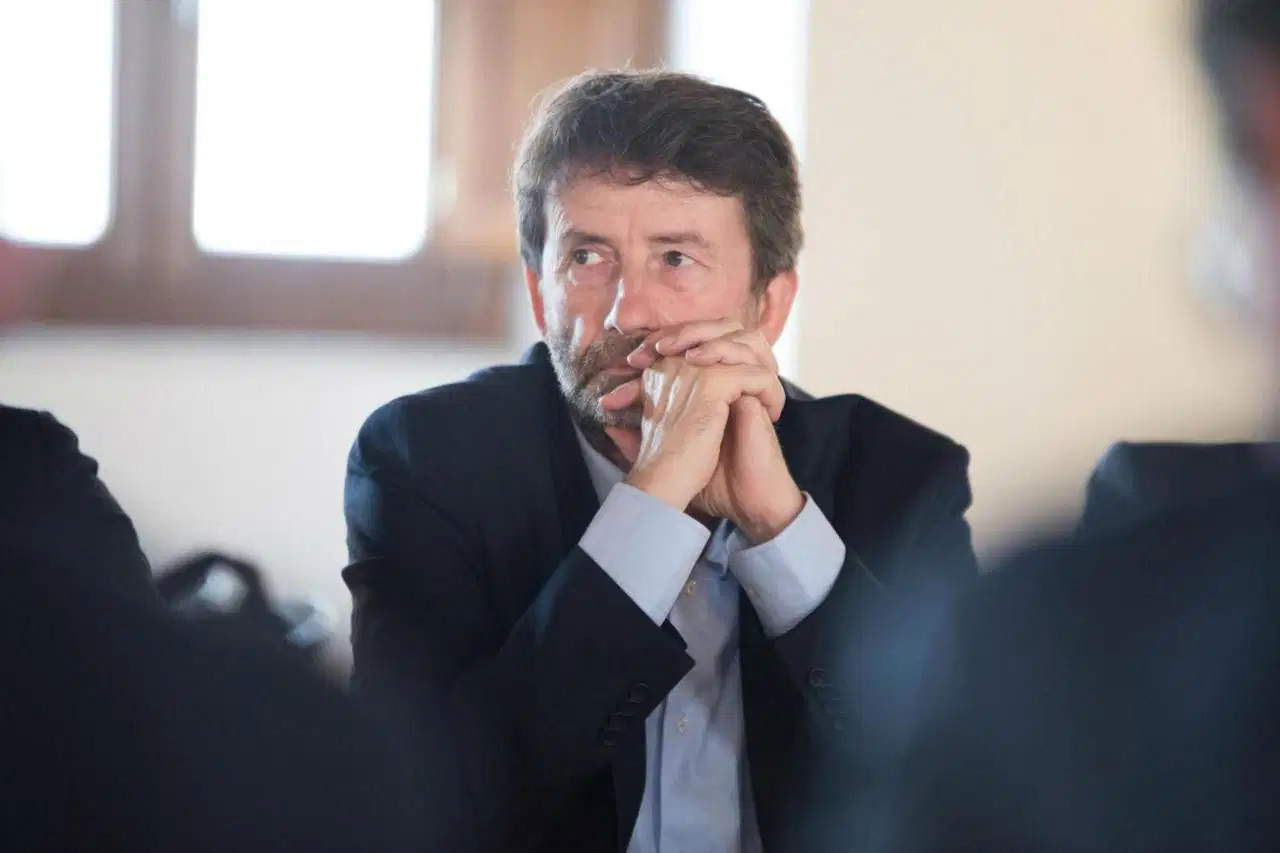 |
| Dario Franceschini Reveals: “I Have Parkinson’s” |
Warning: the translation into English of the original Italian article was created using automatic tools. We undertake to review all articles, but we do not guarantee the total absence of inaccuracies in the translation due to the program. You can find the original by clicking on the ITA button. If you find any mistake,please contact us.