




by Redazione 27/08/2026



Categories: News / Disclaimer
A heist took place in just four minutes at the Villena Museum in Spain: the thieves made off with most of the 66 artifacts from the Villena Treasure, a rare and valuable collection of Bronze Age goldwork, with the gold valued at an estimated 1.7 million euros.


The Villena Museum (MUVI) in Spain was the target of a robbery on Thursday morning aimed at stealing the Villena Treasure, one of the most important collections of prehistoric gold and silverwork in Europe. The museum has been placed under seizure by the Judicial Civil Guard, which is conducting initial investigations inside the building. According to official sources cited by the *Periódico de Villena* and as reported by the newspaper itself, the perpetrators acted in a coordinated manner and with great speed, using several vehicles and completing the operation in about four minutes. The theft involved the 66 objects—mostly made of gold—that make up the treasure. According to the City of Villena, the museum’s alarm went off around 5:20 a.m. The thieves reportedly left the building at 5:24 a.m. The mayor of Villena, Fulgencio Cerdán, confirmed that most of the treasure had been stolen, describing the loss as one that has deeply affected the local community. “We are absolutely devastated; I’m even shaking,” Cerdán told The Guardian, which was among the first newspapers to report the news. “For those of us who live in Villena, this is devastating. It’s part of our heritage, our wealth.”
Among the items remaining in the museum are reportedly three silver vessels, a bracelet, and part of the decorations from the so-called “bastón del reyezuelo,” a sort of prehistoric ceremonial scepter. Authorities are trying to piece together exactly how the break-in occurred and determine how the thieves managed to pull off the heist in such a short amount of time. The thieves reportedly arrived in several vehicles and, according to Manuel Pineda, the Spanish government’s representative in Alicante, entered the museum through a window. The city, however, clarified that all security systems activated as expected and ruled out any malfunction of the system.



One element that could prove significant in the investigation concerns another alarm that went off shortly before the theft at the city’s sports center. Investigators are examining whether the incident may have been deliberately triggered by the thieves as a diversion to draw attention away from the museum. According to Mauro Hernández, a professor of archaeology at the University of Alicante and an expert on the Villena Treasure, the manner in which the theft was carried out suggests a carefully planned operation: “They had planned everything very well,” he told Cadena SER radio, emphasizing that the perpetrators “knew how to do it, how to act, and how to escape.”
The Villena Treasure was discovered in December 1963 by archaeologist José María Soler and his colleagues. The objects were hidden inside a large basin buried in the dry bed of a rambla, a seasonal watercourse, in the Villena area. The find represented a discovery of extraordinary importance for Spanish archaeology and helped transform the city’s archaeological museum into the leading center for understanding the ancient history of the Alto Vinalopó region.
The treasure dates back to around 1000 B.C. and consists mainly of gold objects. The collection included 11 vessels, 28 bracelets, three bottles, and various other gold items, along with three silver bottles, two artifacts made of different materials, and an iron bracelet. One of the collection’s distinctive features is the variety of materials used: in addition to gold and silver, some objects include iron, amber, and a dark lead-based material coated with an iron-like oxide. It is precisely the presence of these unusual materials that has attracted the attention of scholars over the years. A recent study published in the journal *Trabajos de Prehistoria* has hypothesized that some of the iron objects were made using meteoritic iron, which originated from meteorites that fell to Earth. The possibility that some artifacts were produced from a material of extraterrestrial origin adds further scientific interest to an already exceptional collection.
The total economic value of the treasure is considered incalculable due to its historical, archaeological, and cultural significance. However, the mayor has estimated the value of the gold contained in the artifacts alone at approximately 1.7 million euros. Naturally, this figure does not reflect the collection’s true value, which is determined above all by its uniqueness and its significance for the history of Spain and European archaeology.
The Villena Treasure is, in fact, considered one of the most important collections of Bronze Age goldwork. According to the museum, it constitutes—along with the treasures of the royal tombs of Mycenae in Greece—one of the most significant known collections of Bronze Age gold vessels.
The history of the museum that houses it is closely linked to Soler’s discovery. The Municipal Archaeological Museum of Villena was inaugurated on November 3, 1957, with artifacts collected by José María Soler over more than forty years of archaeological work in the city and its surrounding areas. The discovery of the Villena Treasure in 1963 prompted the Spanish Ministry of Culture to officially recognize the importance of the collections, and in 1967 the José María Soler Archaeological Museum was established.
Over the decades, the museum’s collections have gradually expanded, making it possible to trace the history of the Upper Vinalopó region from the Paleolithic era through the 20th century. The collections include artifacts from the areas of Biar, Benejama, Campo de Mirra, Cañada, Caudete, Salinas, Sax, and Villena. Alongside the Villena Treasure, the prehistoric artifacts from Cabezo Redondo and those from the Iberian and medieval periods, discovered respectively at El Puntal de Salinas and the Castillo de la Atalaya, are of particular significance.
Another important milestone in the institution’s history occurred in 2004, when the museum assumed responsibility for a collection of over five thousand ethnographic objects donated by agricultural engineer Jerónimo Ferriz. The collection had been housed in the building of the former Electro Harinera Villenense, purchased by the municipality in 2001, and represents one of the most substantial ethnographic collections in the Valencian region, second in size only to another regional collection. The items collected by Ferriz primarily document the agricultural life and traditional crafts of the area, with a significant number of agricultural tools. However, the collection also includes carriages and wagons, objects from artisan workshops, furniture, textiles, artifacts related to popular religiosity, and numerous other items that allow for the reconstruction of local daily life in the 19th and 20th centuries.
The Villena Museum was ultimately established through the merger of these two important municipal institutions: on the one hand, the archaeological collection of the former José María Soler Museum; on the other, the ethnographic heritage collected by Jerónimo Ferriz Hernández and donated to the community of Villena. The new museum was established by the City Council through a resolution dated November 26, 2020, and received official recognition from the Conselleria de Cultura of the Generalitat Valenciana on April 27, 2021.
Since May 2024, the Treasure of Villena—which also serves as a symbol of the city—has been on display in a specially designed room within the new Villena Museum, which is municipally owned. The new location had made it possible to further highlight the collection and integrate it into an updated museum itinerary, thereby strengthening its role as the institution’s main attraction.
The theft therefore represents the temporary loss of a unique archaeological collection, inextricably linked to the history of the city that houses it. Investigators will need to determine what the thieves’ objective was and whether the treasure was stolen for its intrinsic value—with the intention of melting down or dismantling the artifacts—or whether the heist was motivated by a specific interest in archaeological finds destined for the black market. The value of these objects is, in fact, only part of the significance of a collection that holds a value—for archaeological research and for the collective memory of the Villena community—that cannot be quantified.
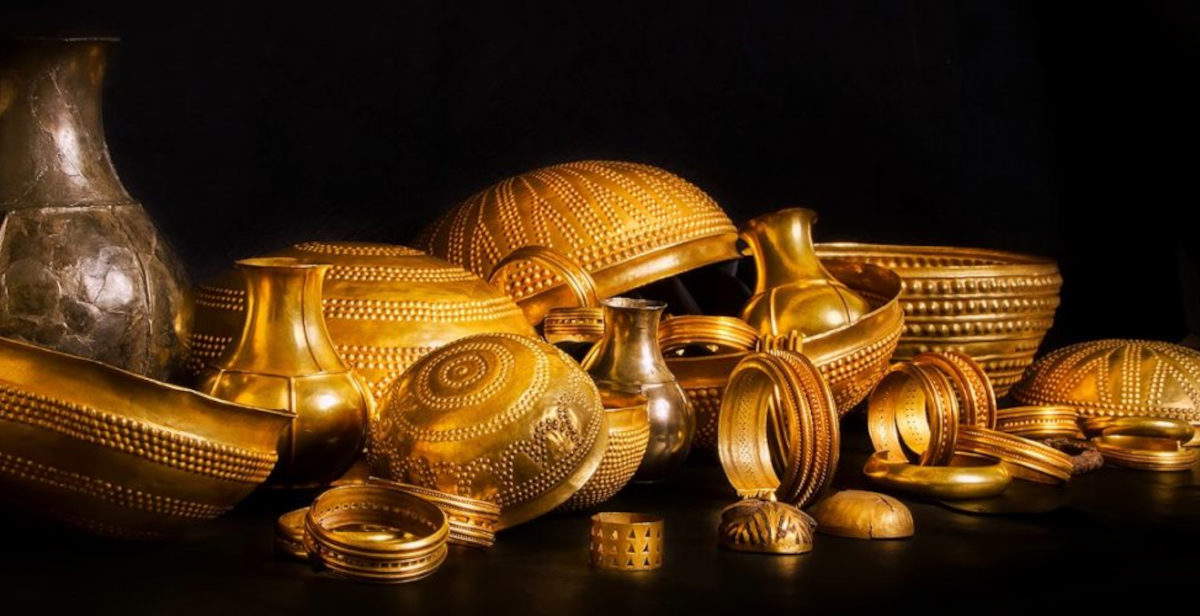 |
| Major Theft in Spain: The Villena Treasure, a Rare Collection of Bronze Age Gold Artifacts, Has Been Stolen |
Warning: the translation into English of the original Italian article was created using automatic tools. We undertake to review all articles, but we do not guarantee the total absence of inaccuracies in the translation due to the program. You can find the original by clicking on the ITA button. If you find any mistake,please contact us.