




by Federica Schneck 29/08/2026



Categories: Opinions / Disclaimer
Major contemporary exhibitions always seem to need one or more themes around which to build the exhibition. But when the theme takes center stage, the works risk becoming mere illustrations, and the audience risks losing the freedom to look, to understand—and even to not understand. Federica Schneck’s opinion.
Until not too long ago, an exhibition didn’t need to justify itself. The works were there, and it was enough simply to look at them. The curator could intervene, of course, but his or her mediation was optional, not structural. There was not yet that curatorial anxiety to create a coherent system, to construct unified narratives that held everything together, to affix a conceptual label to every room capable of reassuring the visitor that what they were seeing made sense—a precise, pre-established, non-negotiable meaning. Today, by contrast, it is difficult to imagine a major institutional exhibition that does not start with a theme. And not just any theme: a compelling, cross-cutting, preferably urgent one. Identity, memory, the body, borders, ecology, resistance. Words that appear in press releases from Basel and Turin, London and Rome, interchangeable like bricks in a curatorial Lego set that always produces the same building—with a different floor plan but the same low ceiling.
The problem isn’t the theme itself. The problem is that the theme has become the end, and the artworks the means. The reversal is subtle but devastating: the moment a work is chosen because it illustrates a topic, rather than for its irreducible singularity, something breaks in the pact between art and the viewer. The artwork ceases to be an autonomous entity with which the visitor can build a personal, unpredictable, even flawed relationship. It becomes a three-dimensional caption, an example of something already known.


This shift coincided with the rise of the curator as an authorial figure. It was a legitimate process, and in many ways a necessary one: exhibitions have become more complex, spaces larger, collections more extensive, and someone had to take the helm. But this direction, by dint of being exercised, has taken over. The curator has ceased to be a guide and has begun to act as a storyteller. And storytelling requires internal coherence—a thread that must not break.
That thread has become the theme, and the theme has begun to act as a filter: works consistent with the thesis are included, while those that contradict it or simply ignore it are excluded. The result is that major thematic exhibitions often function as poorly constructed anthologies: they take a title, build an intellectual manifesto around it, and then gather everything that can fit under that conceptual umbrella—which is usually broad enough to contain almost anything, because a theme that’s too specific can’t support institutional grandeur . The paradox is clear: a theme that is too broad becomes invisible. If everything is “body,” then nothing is body. If everything is “identity,” then nothing tells us anything about anyone’s identity. The generic nature of the theme produces the same feeling as a well-organized warehouse: everything in its place, everything labeled, nothing that speaks.
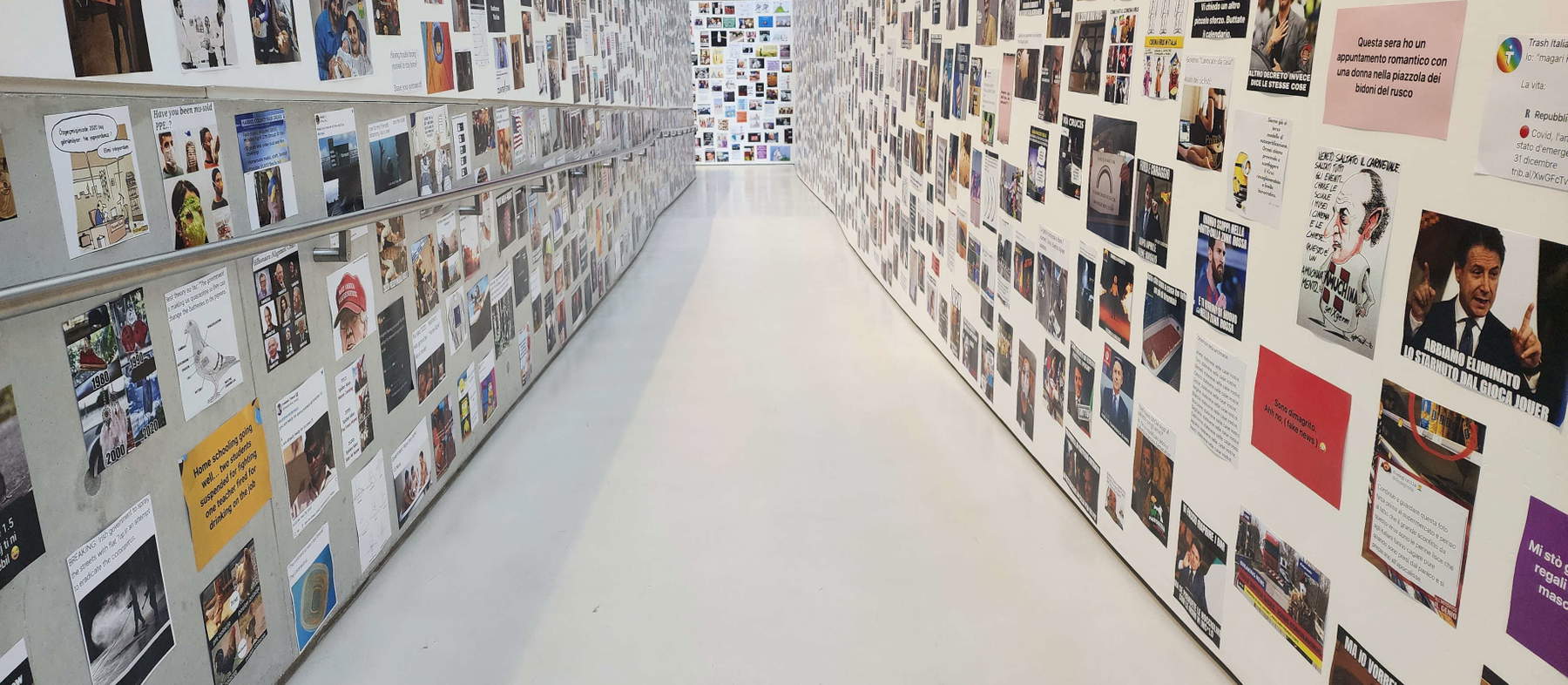
There is a common, optimistic belief that thematic exhibitions bring the public closer to art: they provide a narrative entry point for those lacking critical tools, create a guided experience, and offer reassurance. This is a common belief that holds true only if one believes that the public lacks critical tools or that, if they do lack them, the best course of action is to avoid providing them. It is a form of paternalism masked as accessibility. The reality is that thematic exhibitions often confuse rather than guide. A visitor who is not already familiar with the conceptual issues of contemporary art receives no real help from the thematic structure: they are given a promise—that of a unifying thread—which they are unable to follow, however, because they lack the foundation to recognize the stops along the way. They find themselves faced with thirty works that, according to the curator, all speak of “presence,” without understanding either the word or the works, nor how they fit together or why.
Those who do have that foundation, however, rarely need a theme to navigate an exhibition. They already know how to interpret a work within its context; they already know how to make connections. The thematic structure adds nothing for them; on the contrary, forcing works from different eras and artistic approaches under the same conceptual umbrella can obscure precisely those differences that make the study of contemporary art interesting.
The result is that thematic exhibitions do not truly speak to either the initiated or the novices. They speak to an “ideal audience”—the average, educated but non-specialist visitor—which, in practice, is such a vague category as to be almost meaningless. And in their attempt to reach this audience, they end up alienating everyone else.
The grand monographic retrospective—which in contemporary discourse is often treated as a conservative, almost obsolete form—at least had the merit of clarity: it told you who you were looking at, and let that artist do all the work. The historical exhibition with explicit chronological rigor had its advantages: it provided a timeline, allowing you to see how one thing emerged from another, how context shaped artistic production. It wasn’t necessarily more democratic, but it was more honest about its own structure. The thematic exhibition, on the other hand, is often dishonest in that it conceals its own construction. It presents as inevitable—as if those works “belonged together” due to some intrinsic quality—something that is actually the result of an interpretive choice, of a thesis the curator seeks to prove.
All of this applies to varying degrees across different exhibitions, and it would be unfair to apply it uniformly to every curatorial project that dares to have a conceptual title. Let us take, then , the exhibition *Tragicomica: Perspectives on Italian Art from the Late 20th Century to the Present*, currently on view at MAXXI in Rome through September 20, 2026, curated by Andrea Bellini and Francesco Stocchi, as an example.
The starting point is enticing, even brilliant: the idea is to map a “national sensibility” that runs through Italian art from the postwar period to the present, using a framework that intertwines high culture with popular culture and addresses the most complex themes through the distorting lens of irony. It is a legitimate, well-documented critical hypothesis, intellectually honest in its premises. But the problem isn’t the thesis itself; it’s how the thesis inhabits the space.
“Tragicomica” brings together over 300 works by more than 130 artists within a museum space that is, in and of itself, a destabilizing force: it takes you where you didn’t expect to go, makes you look at things from oblique angles, and strips you of the orthogonal reference points you’re accustomed to. It is a space that demands orientation, not one that grants it freely. In “Tragicomica,” this orientation is lacking: the exhibition unfolds without an explicit chronological order—which would have been helpful, given its span of eighty years—and without the various areas of the space being structured in a recognizable way. The compositional principle is clearly that of dialectical coexistence: works from different eras placed side by side to create short circuits, comparisons, and productive dissonances. It’s a noble principle—when it works. Here it works only intermittently, because the tension between the tragic and the comic is too broad a theme to structure an entire space. It is a sensibility, not a subject, and sensibilities cannot be organized into rooms, hung in sequence, or read like chapters.
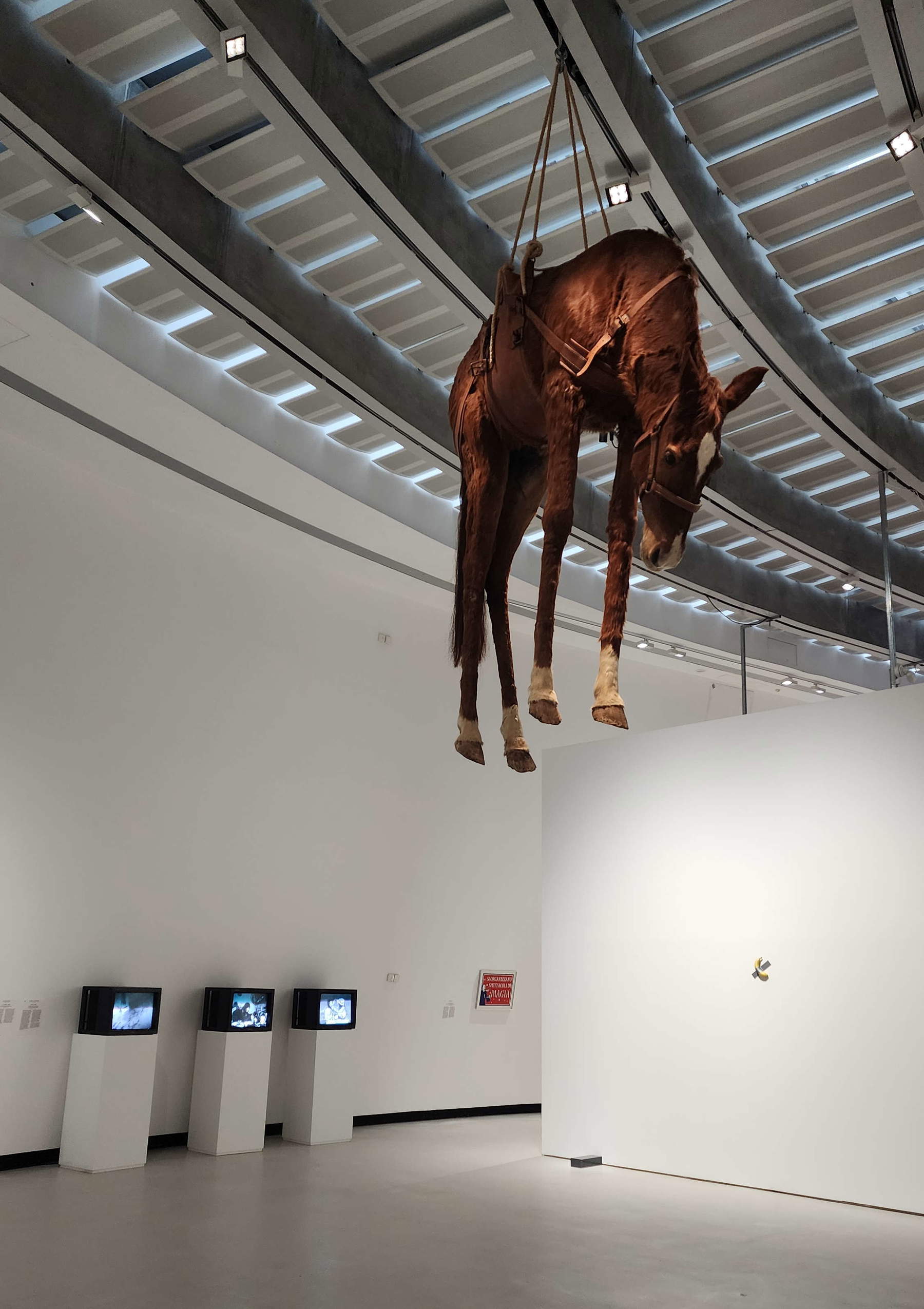
There are works that are worth the price of admission on their own: Gino De Dominicis’s sculptures still possess that quality of objects that have escaped from another symbolic system, and then there are Fabro, Boetti, and Penone—figures who can carry any exhibition. There are also fresher works that might have stood out more clearly in a more carefully curated context, but the narrative thread that connects them—or rather, that fails to connect them—is the real problem. The visitor who enters without a disciplinary compass leaves with the feeling of having seen many beautiful things and many strange things, without understanding why they were grouped together. The visitor who does have that compass leaves with the feeling of having taken stock, not embarked on a journey.
“Tragicomica” could have been organized into clearer sections (by historical periods, by aesthetic strategies, by relationships between specific artists) and would have gained in clarity without losing any of its ambition. Instead, it opted for totality. And totality, without strong internal guides, leads to disorientation.
What’s missing from thematic exhibitions—and what is also significantly lacking in “Tragicomica”—is not intelligence, but trust. Trust that the visitor can tolerate partial incomprehension, the unresolved fragment, the dialogue between works that isn’t explained but is felt. Trust that not everything needs to be mediated, that the space can have zones of silence and indeterminacy without thereby being perceived as a failure.
The thematic exhibition, in its dominant form, is an anxious exhibition. Anxious to convey meaning, to justify itself, to prove that the choices were not arbitrary. This anxiety transfers to the spaces, the exhibition texts, the section titles, and the captions that explain nothing but fill the silence. Ultimately, it transfers to the visitor, who walks under the weight of a pre-determined interpretation and wonders whether what they are feeling is correct. The exhibitions that endure and are remembered years later—the ones people keep talking about—are almost always exhibitions that placed their trust in something: an artist, a story, a juxtaposition of two objects, a space. Not a theme. A theme is a useful tool when it remains in the background, when it suggests without imposing, when it lets the works speak for themselves. When it takes center stage and becomes the protagonist, the works take their seats in the audience. And the audience, often, leaves before the finale.
Contemporary art doesn’t need more explanations; it needs more curatorial courage: the courage to bring together things that don’t stand on their own, to let the confrontation be harsh, to not reassure anyone about the coherence of what they’re seeing. That courage is rare, and it’s the only kind worth exercising.
Warning: the translation into English of the original Italian article was created using automatic tools. We undertake to review all articles, but we do not guarantee the total absence of inaccuracies in the translation due to the program. You can find the original by clicking on the ITA button. If you find any mistake,please contact us.