





The author revisits here the article that appeared on January 31, 2022, in this same journal, but has now expanded it with the necessary in-depth analysis. This study of Correggio, in fact, focuses on that great Renaissance artist who embodied the entire ethical heritage of earlier Italian art and transformed it for the centuries to come: the painter “about whom one must always write.”
Around the year 1520, the lady of the Mantuan court, at the rather advanced age of 46, was worn down by numerous pregnancies, her travels, and her recent long pilgrimage to Sainte-Baume near Marseille (1517) to venerate in person the grotto and the memory of Saint Mary Magdalene. The death of her husband, Marquis Francesco II Gonzaga (1519), left her directly in charge of state affairs; moreover, the complex artistic project to renovate the old wing of the palace kept her personally engaged on a daily basis. For all these reasons, she decided to move her Studiolo and the “Grotto of Antiquities” from the uncomfortable quarters of the old Castle of San Giorgio to the more pleasant setting of the Corte Vecchia on the ground floor, at the heart of the marquis’s ceremonial quarters. The Studiolo had become famous for its paintings by Mantegna (The Parnassus, followed by The Triumph of Virtue and the Expulsion of the Vices); by Perugino (*The Struggle Between Love and Chastity*); by Lorenzo Costa (*Isabella d’Este Crowned in the World of Harmony* and, finally , *The Kingdom of the God Como*). These titles alone outline the broad theme of the struggle between good and evil, between wisdom and carnality, while making no attempt to conceal Isabella’s own prominent role as the central figure. The sources for the princely patron’s manifold and intricate conceptualizations were drawn from a vast body of ethical literature with selected mythological roots, but translated into exasperating minutiae, demanded of and imposed upon the subjugated painters. Let us not forget that in the new layout, the passage between the Grotto and the Studiolo was adorned by two portals, one of which—by Gian Cristoforo Romano, a work of great beauty and still in situ today (circa 1521)—was also decorated with the same motifs. The open, tree-lined courtyard also featured a tall inscription running along the walls, in which Isabella declared herself “niece of the Kings of Aragon, daughter and sister of the Dukes of Ferrara, wife and mother of the Marquises of Mantua.” What we might call the “new space of identity” was given a floor of commemorative majolica tiles and a magnificent gilded wooden ceiling. The paintings we have listed were arranged along the long sides of the hall, but the new exit wall left two vertical spaces on either side of the door; from these arose Isabella’s vision for a paradigmatic conclusion to the lengthy theme. In fact, the most noble of the Este family embodied the Renaissance ideal of womanhood. Wisdom was to be celebrated, and Vice relegated to utter failure.
It is almost unnecessary to add that all the painted works, following the French occupation, were taken to Paris around 1627 and now belong to the Louvre Museum. Here, we will not address the pictorial complex we have mentioned. Our narrative will follow the Lady’s quest to complete the figurative decoration of the Studiolo near the exit: that is, to choose a painter who would work with figures larger than those constrained by the previous series and who could convey with strength and grace both the final admonition of the walls’ persistent ethical preaching and the solemn celebration of the noble patron as the moral guide of an entire society. Isabella thought of Correggio. For many months, she had been receiving admiring praise for the works of that former pupil of Mantegna, whom she had known as a young fresco painter in the Master’s Chapel, and who had later sent her that “Young Christ, aged about twelve,” never painted for her by Leonardo, and imbued with mystical depth. Correggio had now moved to Parma, and his fresco for Abbess Giovanna’s Chamber was arousing great admiration.
We do not have a commission contract, but the document carefully examined by the meticulous Elisabetta Fadda records a payment made in 1522 to Correggio by the court of Mantua—that is, by Isabella. In a 1542 inventory of the Marquise’s art collection, the two paintings by Antonio da Correggio are listed as being “on either side of the door at the entrance.” Thus, there is no objective doubt—neither historical nor critical. In the same inventory, the “story of Apollo and Marsyas” is listed first—though the subject is misidentified—rather thanthe Allegory of Vice or Folly. This painting, as is commonly believed, was intended to conclude the left wall with a cautionary passage as one exits, though the opposite order is possible. We do not know with certainty how the five magnificent canvases, moved from their previous location in the Castle, were arranged on the two walls, but the overarching anagogical theme was undoubtedly a single one: the contrast between the Good and all the errors of humanity. Goodness embodies the activities of the intellect and biblical conscience, effectively blending classical culture and its examples with Christian humanism, the bearer of ethical and virtuous sovereignty. We will not revisit the orderly arrangement of the pictorial subjects, nor do we wish to repeat their interpretations, which have already been amply provided by relevant critical literature. Here we address only the dual message that Isabella entrusted to Correggio.
First and foremost, this is an inseparable pair, in which, pictorially, the two groups of figures, in their internal composition, are situated on a ledge beyond a steep drop-off in the foreground: this arrangement conveys a sense of “no return,” or rather, of a definitive state.The Allegory of Virtue or Wisdom is more distinctly marked by ascending lines: here the composition moves from the inhabited earth to the atmospheric sky and then bursts forth with impetuosity into a golden, vivid radiance of spiritual emphasis, where the theological virtues soar triumphantly.
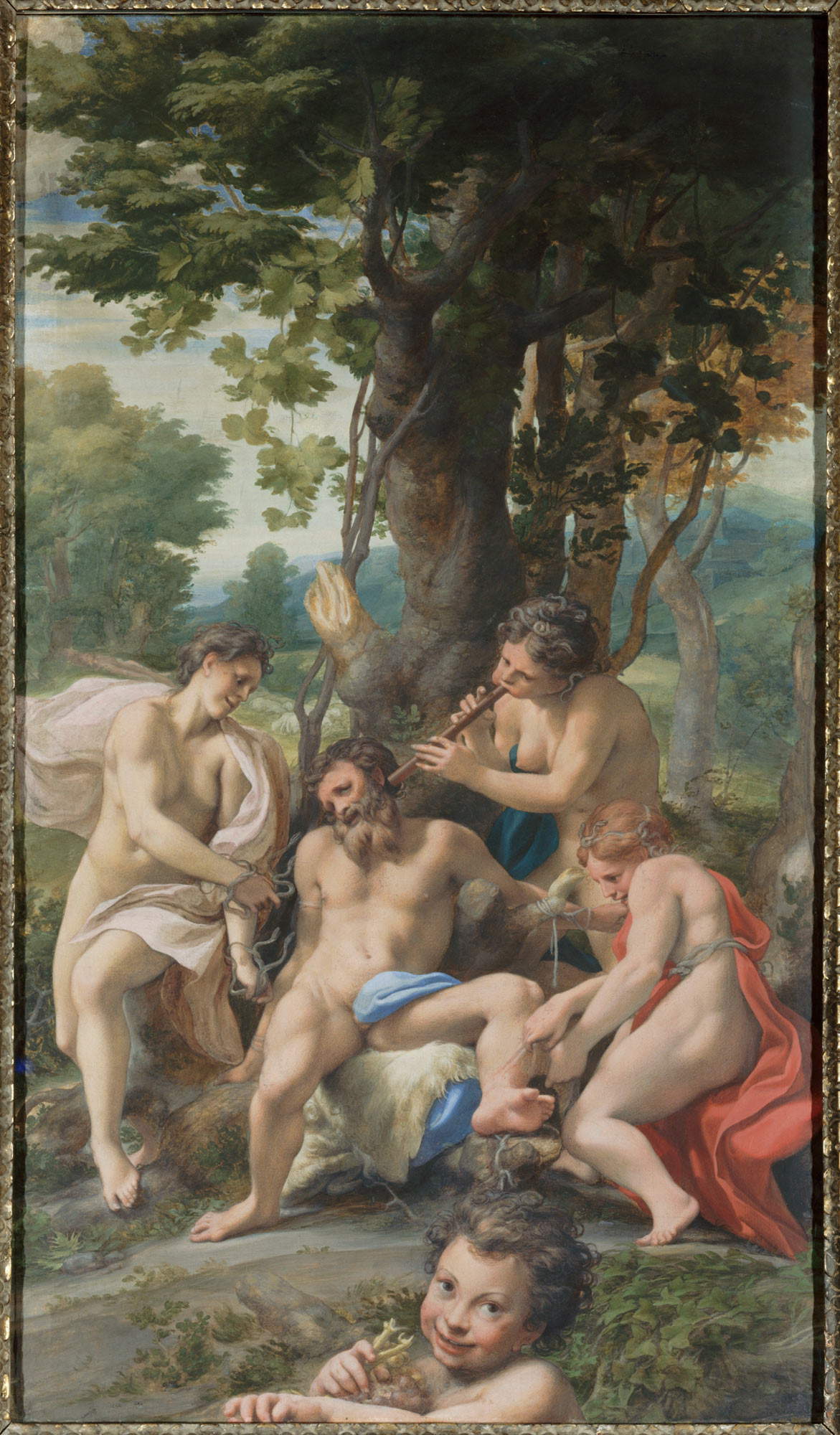
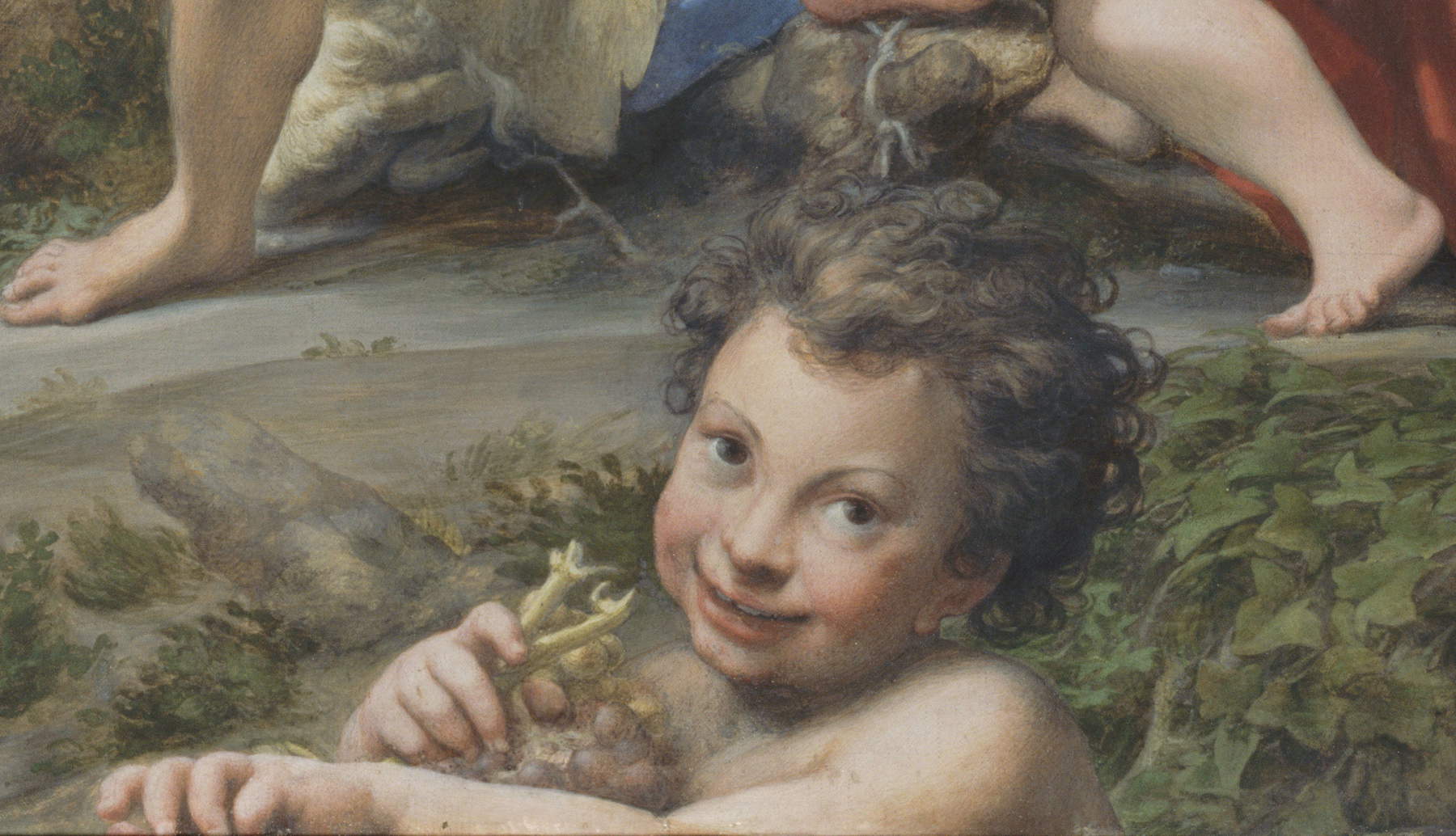
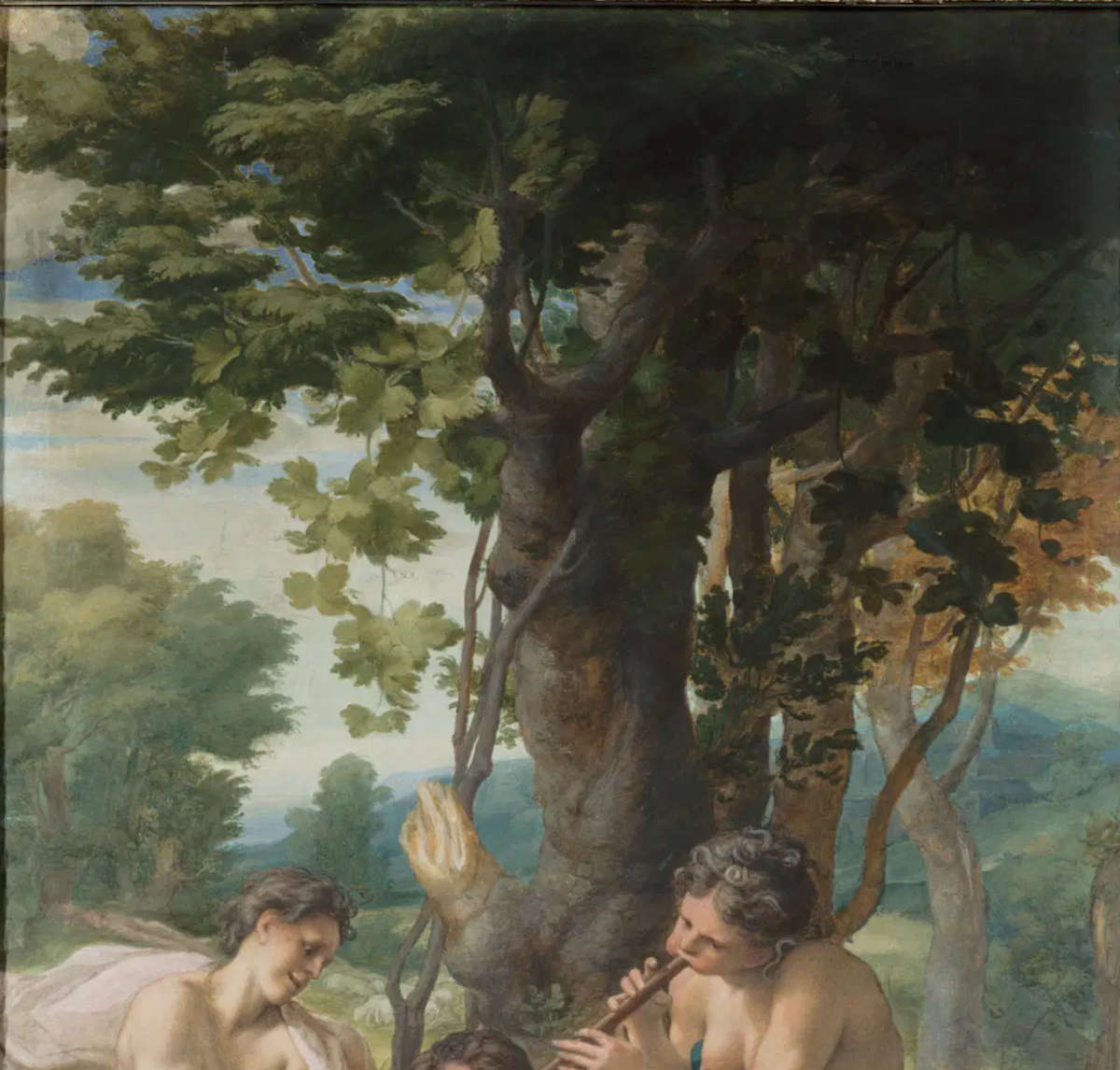
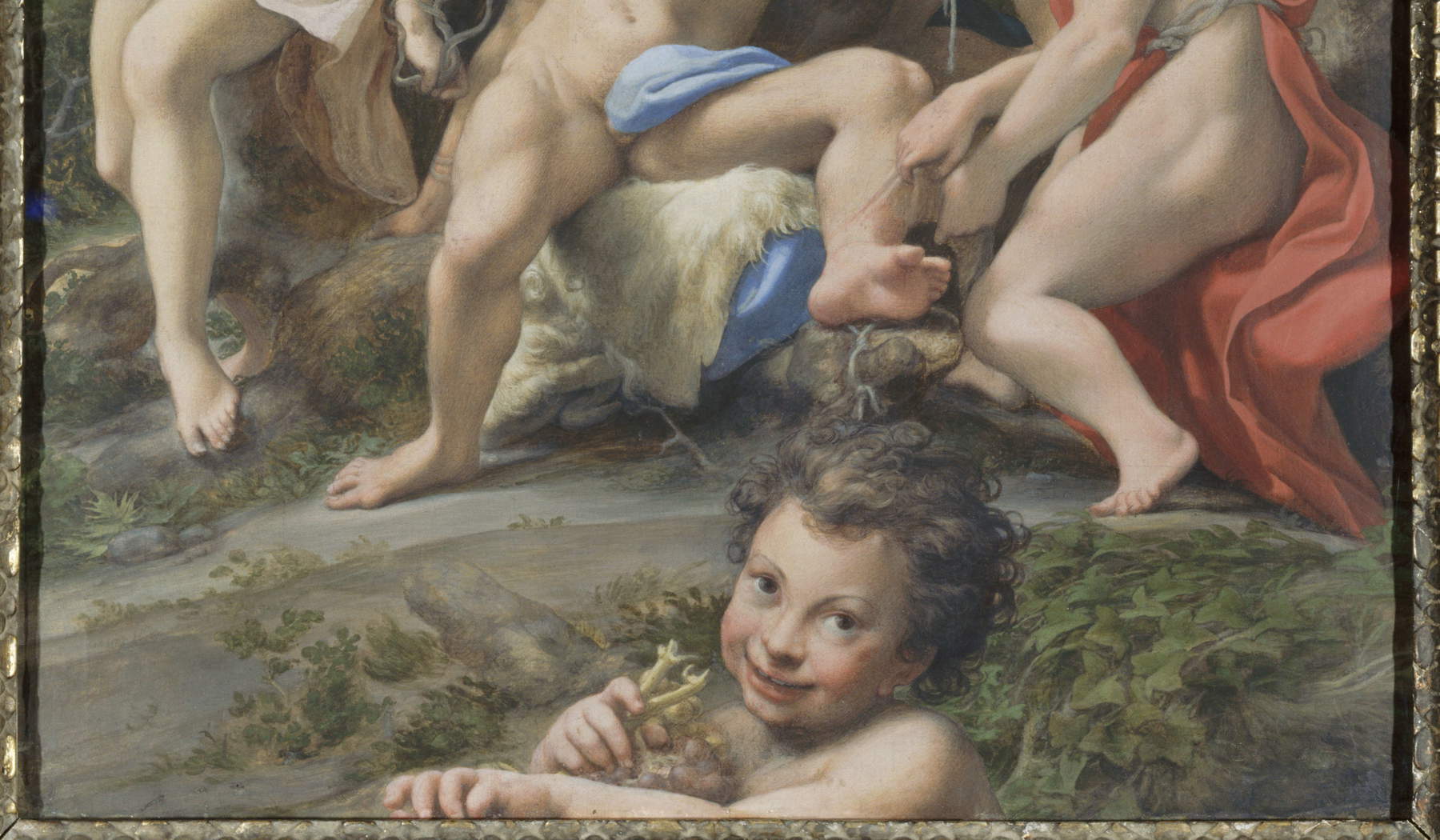
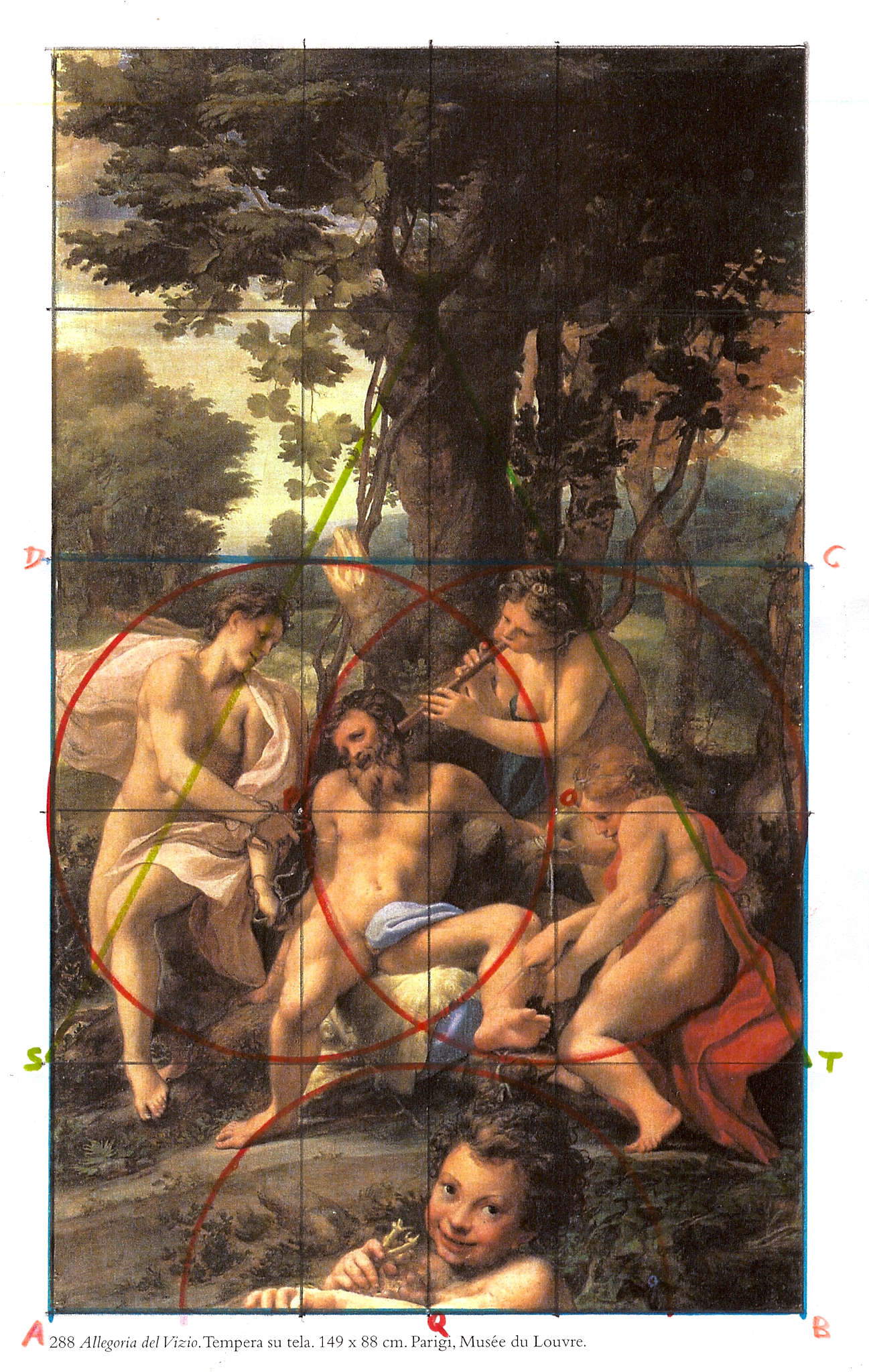
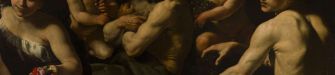
In The Allegory of Vice, Correggio groups the figures—mostly nude—in the lower portion of the canvas, illustrating the downward plunge of the vicious man, who has one foot in the mud and the other on a rotting log. The upper part of the painting is occupied by the dense, very dark canopy of a large tree, whose lowest branch is clearly diseased and has already broken off. The darkness of the canopy contrasts with the dazzling light of the nearby Allegory of Virtue.
Our painter directs our attention not so much to the vices themselves as to the man’s final destination in his advanced age after having led a dissolute life; by now his body is defenseless, no longer possessing the strength to resist the temptations that—as poetic justice—appear to him here as three Furies, all armed with snakes. After binding him, they torture him through the very senses he had used to “enjoy” himself: hearing, sight, and touch—in accordance with the law of retribution. One Furia, in the lower right, tries to flay him; higher up, another stuns him with the shrill sound of a flute blown directly into his ear, while on the left, hissing, twisted, and venomous serpent-like creatures terrify him. There is a biblical echo in this depiction of death. The reality of vices is not represented in and of itself, nor even symbolically, as in the painting of Virtue, where, moreover, these same vices are alluded to and kept at bay by Minerva’s shield.
We may recall that in the same Studiolo, Andrea Mantegna, depicting the triumph of Virtue in a different way, had already shown—and quite unpleasantly—how the vicious man is reduced. Correggio, partly due to the limited space available—but above all because of his ability to synthesize —concentrated the ultimate meaning of Vice into a single figure of a man who, though still possessing a powerful body, is dominated and wounded by the “beautiful maidens” who were once his source of pleasure.
A brilliant idea in the painting is that of the Satiretto, who seems to emerge from the infernal underworld with bulging eyes, and who, too, signifies the end of the practice of vice. His ruddy cheeks allude to the tasting of those grapes, of which only a cluster forked like a sling remains. The ground from which this unsettling little figure emerges is, in fact, covered with creeping—and thus barren—ivy; branches of vine, already hollowed out and fruitless, also hang from the large tree.
The vicious man sits on a shaggy goatskin, a symbol of lust. This skin reminds us of the flock grazing alone in the meadow behind: an abandoned flock that devours every blade of grass. To the right, in the background, a walled city appears, from which the depraved man has evidently been expelled; nevertheless, the landscape is still quite lush and serves to remind us of the beauty of creation, which man must not destroy but rather guide toward Eden.
The importance that Correggio attaches to nature—which he so loved and experienced firsthand—is admirably highlighted in all his works and would go on to influence all the artists of subsequent generations. The landscape retains a Leonardo-esque expansiveness, serene and sweeping from the golden fields to the ethereal mountains, embracing a silent, distant city. It seems that the distant cities in Correggio’s works have a prophetic and evocative character, just as we can see in other paintings: they always refer to the mystical “place of God,” to the heavenly Jerusalem. In contrast,the Allegory of Vice or Folly, which explicitly alludes to earthly vices, has a wholly earthly setting, and for this reason is situated within a vast expanse of vegetation that offers Correggio —we must say—an airy and expansive naturalistic scene, forming one of the most beautiful “landscapes” in his work.
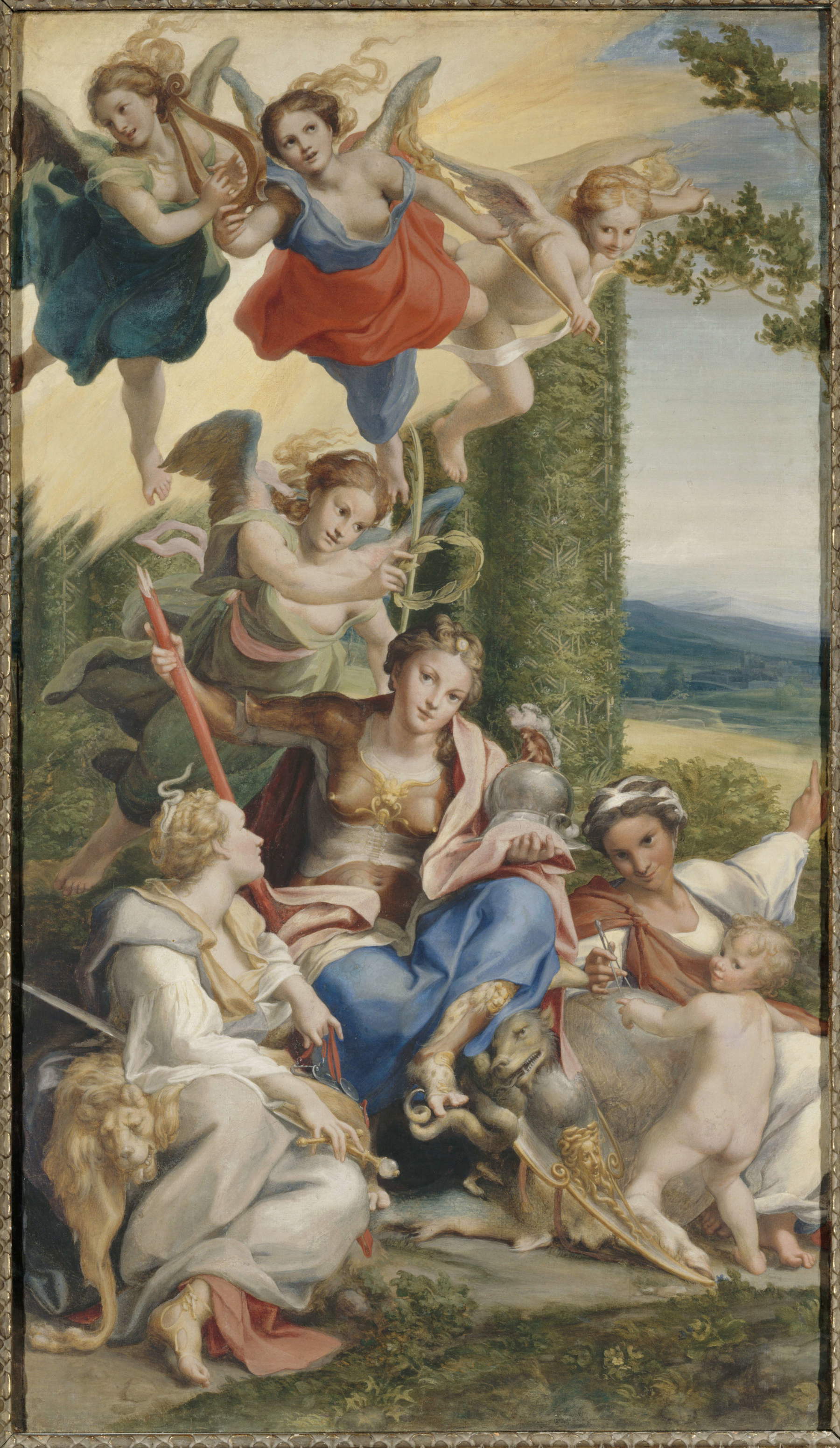
Before moving on to our semantic analysis, we believe it is worthwhile to address that impulse of constant self-examination that always drove the painter to “see himself in the work” and thus to re-examine himself, as we can recall in the back-and-forth between sketches, panels, and drawings on various other creative occasions. The presence of an earlier version already at Palazzo Altieri, on panel, also supports our view. This is discussed at length in the essay *The Doria-Pamphilj Allegory of Virtue: Technical and Critical Notes* by Diego Cauzzi, Andrea G. De Marchi, and Pietro Moioli, Claudio Seccaroni, * * (available at ) in the Proceedings of the 2008 Symposium held at the Associazione Amici del Correggio. There it is stated:“Correggio’s *Allegory of Virtue* in the Doria Pamphilj Gallery arouses particular interest for two reasons. The first lies in the work’s unfinished state, which allows for a better understanding of its genesis and the painter’s working method, sparking speculation about the reasons for the work’s interruption and revealing the initial nude studies. The second concerns the technique—tempera on canvas—which was already in use during the Middle Ages and was particularly prevalent in the Po Valley region, especially within Mantegna’s circle, that is, precisely the milieu from which the young Correggio emerged.”
We will delve into this further later; for now, let us proceed to examine Allegri’s works from a conceptual perspective. In the fresco in the Camera di San Paolo in Parma (1518–19), Correggio succeeded in blending myth with biblical-Christian tradition in accordance with the complex ideas of Abbess Giovanna Baroni da Piacenza and the profound essence of the Benedictine rule. We must consider this extraordinary fresco, rich in vivid semantic nuances, as a closely related and earlier expression that certainly helped the painter in fulfilling the subsequent and demanding requests of the Marquise of Mantua for the maieutic completion of her new Studiolo: this, too, was a locus explicationum by its very nature.
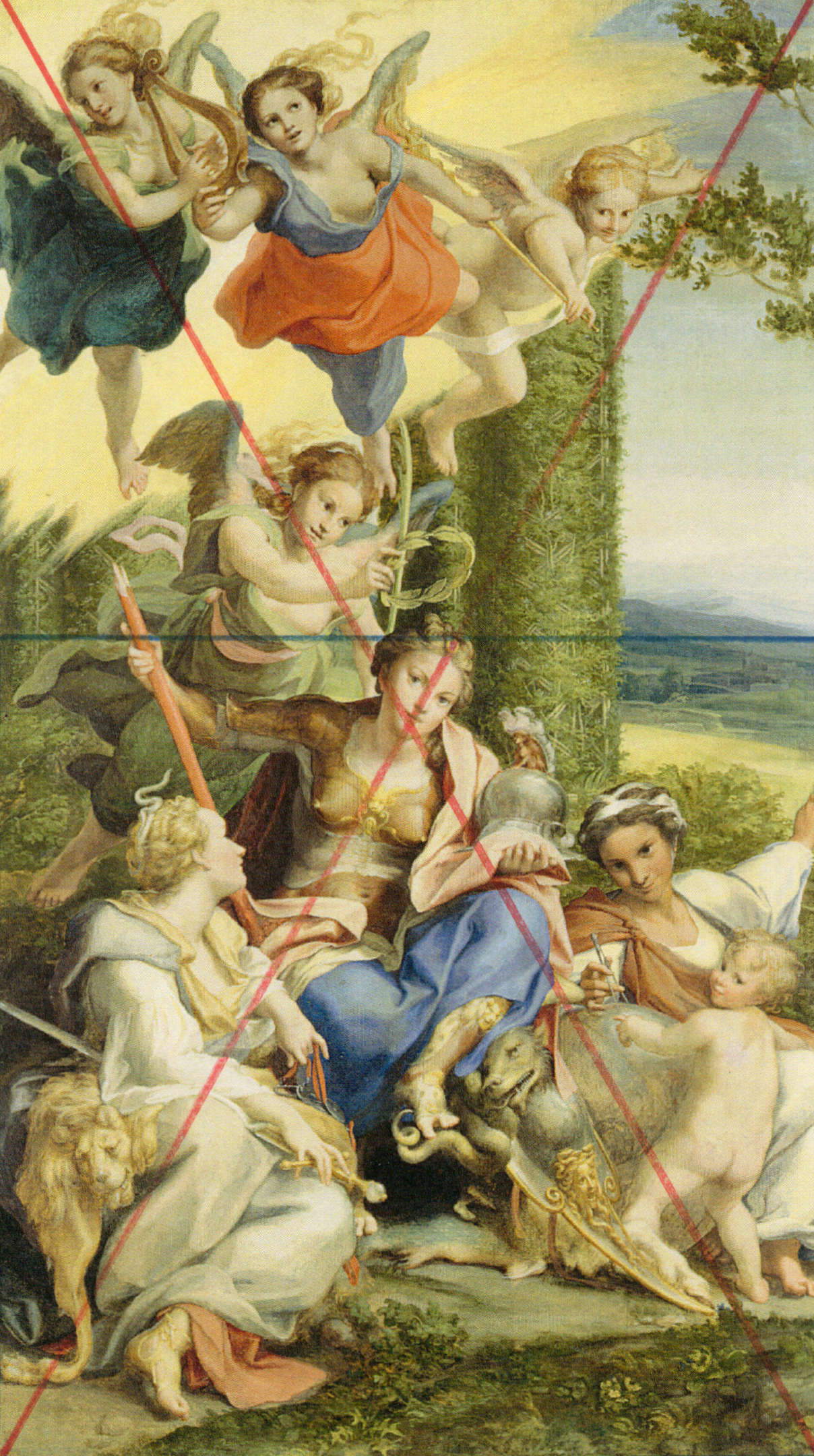
To arrange on a canvas of modest dimensions (149 x 88 cm) the Three Theological Virtues, the allusion to the Four Cardinal Virtues, certain elements of knowledge, the crowned protagonist, and other significant figures—and to do so clearly—was undoubtedly a daunting task, which only the artist’s genius managed to resolve with vigor and refinement. We know, for example, that when looking at a painting, our eye naturally rests first on what is in the center, and Correggio does not overlook this effect. In this case, when drawing the two diagonals of the painting, the central point of the entire composition falls on the mouth of the beautiful woman, who gazes at us with an expression of great tenderness: the protagonist is, in fact, depicted as the Allegory of Wisdom, with whom—most likely—Isabella d’Este Gonzaga wished to be identified.
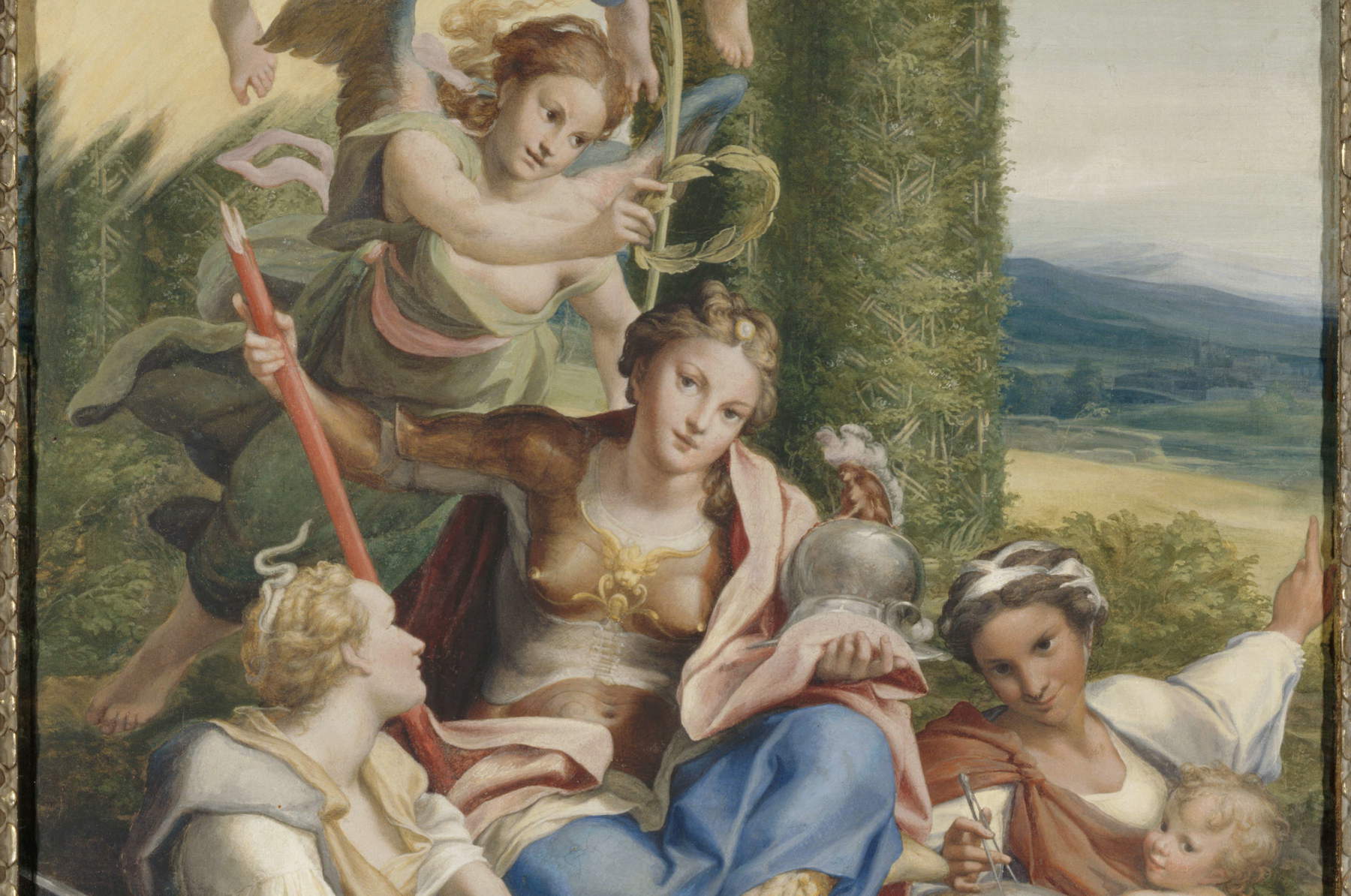
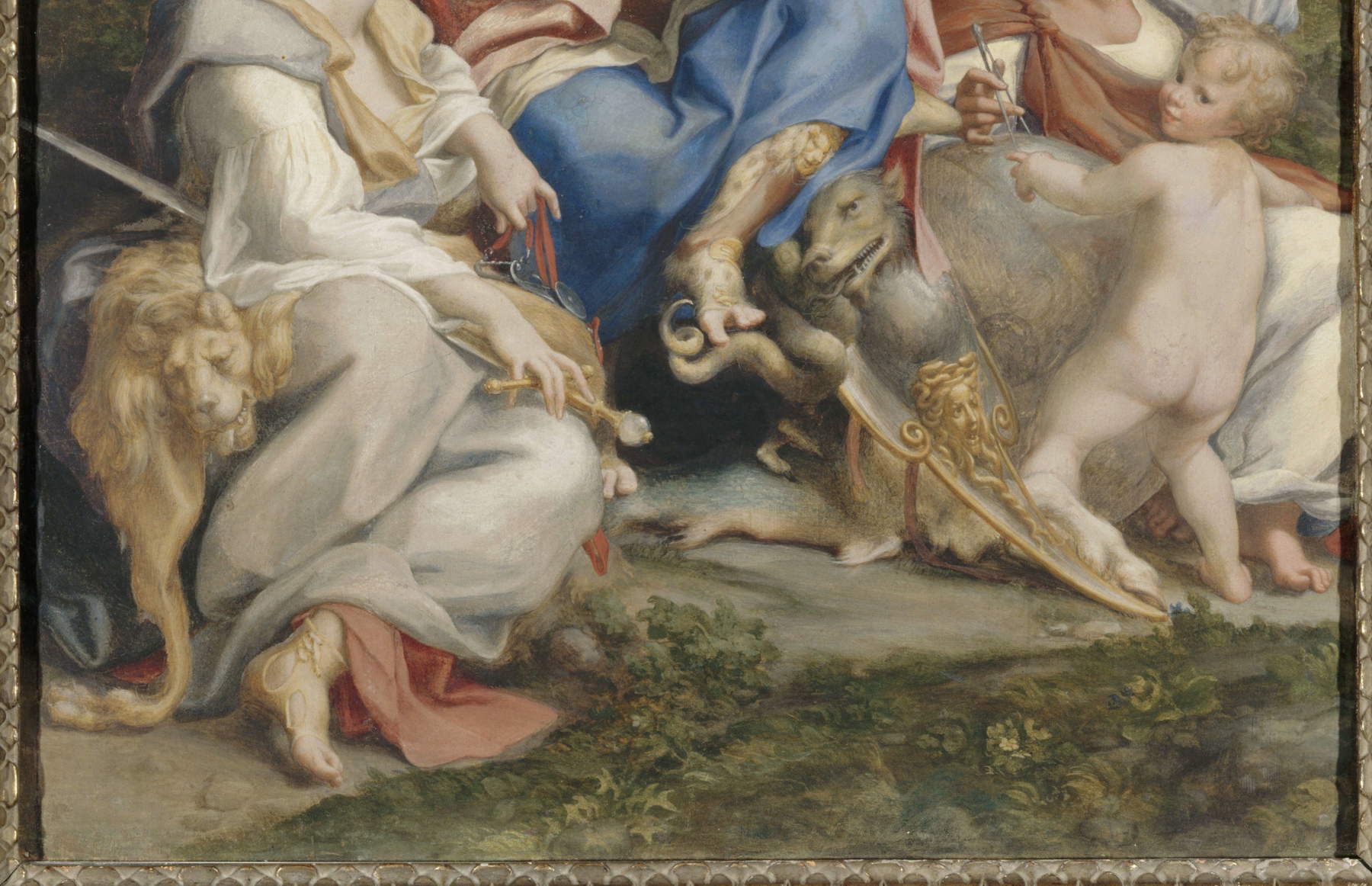
The “Virtue par excellence” from whom the other virtues emanate is, in fact, Wisdom, and Correggio—undoubtedly in dialogue with the marquise—depicts her as the Roman Minerva. Here she is not exactly like the Greek Athena, who was also a goddess of war, for she has set down her shield adorned with the terrifying Gorgon, her spear is broken, and she has removed her feathered helmet surmounted by a Sphinx, a symbolic figure of fierce “obtuseness” that can be overcome only through study and sagacity. The goddess’s leg, partially covered by a flap of her cloak, is elegantly adorned with a greave covered by a cloak flap patterned with a feline’s spots, culminating below the knee with an unsettling human head: the flap could be made of lynx fur, an animal symbolizing speed, intellect, and vigilance over humanity due to its keen eyesight. It is worth noting that Correggio had used a similar fur for the quiver carried by a cherub on the east wall of the Camera di San Paolo, and he would reprise this motif on the same quiver in the sumptuous erotic painting—also destined for Mantua—of Venus, Cupid, and a Satyr (1526–28), now housed at the Louvre. Isabella, for her part, chose to wear an equally spotted fur in the late portrait she commissioned from Titian! Thus, we have identified a series of parallels that are likely symbolic rather than coincidental.
Correggio maintains another thematic link between myth and scriptural truth in the ideal superimposition of the figure of Wisdom herself, who appears here as Minerva but broadly personifies Mary, the “Sedes sapientiae” of the Christian faith.
Correggio, however, continues to amaze us, for other symbolic elements appear in the painting. Behind Minerva (Wisdom) stand two columns formed of cedar branches supported by interwoven reeds: a display of painterly virtuosity similar to that he had already demonstrated on the vault of the Camera di San Paolo in Parma. Other similar columns are visible to our left—that is, to the right of Wisdom—which is also the geographical direction in which the Holy Land lies. Following a likely Isabellian interpretation, we recall that King Solomon had asked God for the gift of wisdom and had the Temple in Jerusalem built with columns and paneling made of precious Lebanese cedar wood. We must also bear in mind that the cedar, together with the palm, symbolizes the Virgin Mary, an incorruptible and eternal figure—just as the longevity of these trees is idealized.
We observe that a small shell containing a pearl adorns the head of the Supreme Virtue, similar to the one worn by Diana in the Chamber of St. Paul, where it represents chastity. We may thus venture the hypothesis that Wisdom, standing at the foot of a cedar tree, adorned with a pearl in a shell, is a symbol of the maternal womb that guards a precious treasure and, with one foot, crushes a dragon—a sign of evil—and alludes to the Virgin Mary: the earthly figure chosen by God to redeem humanity from sin through her. And it will be she, the woman of the Apocalypse, who at the end of time must definitively destroy the dragon. In the painting, the dragon’s belly is already pressed to the ground by the woman’s foot, and it attempts to fight back—but in vain—with its final lashs of its tail. The red spear, normally reserved for heroes, is broken—in accordance with the ancient symbolism of a battle that has ended in victory. Even the garments worn by the woman echo those of Mary: the blue, which is a divine symbol, and that antique pink that Correggio used several times in his Marian imagery. It is worth noting that no detail could have escaped the mindset and the highly semantic demands of Isabella—the most imperious and discerning patron of all time. Thus, the significant analogies continue.
Even the crystal—a symbol of wisdom that, in the shape of a sphere, adorns the sword of Fortitude—is traditionally the image of Mary, traversed by the heavenly light of her Son while remaining Immaculate. The evangelist Luke recounts the episode in which Mary found her twelve-year-old son, Jesus, in the Temple in Jerusalem, discussing with the Doctors of the Law and filling them with wonder: among those cedar columns stood none other than He who was the supreme wisdom, the Son of God. And Mary truly entered the Temple to seek him. Finally, we must not overlook the angelic figure hovering above the central figure: the laurel wreath she wears is perfectly linked to Wisdom, but the palm branch—a symbol of martyrdom and victory—must be attributed to the One who endured the ultimate martyrdom and achieved victory over death: Christ, the pillar connecting earth and heaven! Even in the Annunciation at the Porziuncola in Assisi, the angel offers Mary the palm branch in addition to the lily. Certainly, Allegri first developed these concepts—which were difficult to represent—in his discussions with Isabella, and then, in his painting, he created these lofty figurative symbols, proving himself to be both cultured and ingenious.
In the lower section to our left are the Cardinal Virtues—Fortitude, Justice, Prudence, and Temperance—personified by an elegant yet sober young woman seated on the ground, to the right of Wisdom, who towers over and reigns above the group of figures: these Virtues are, in fact, closely linked to relationships among human beings. Moreover, Correggio places the entire group of women at the bottom of the painting within a well-defined space: a square that the painter creates by rotating the base side vertically, following a technique typical of Allegri. The top edge of this square thus precisely touches the top of Wisdom’s head.
We know that the square symbolizes the four elements of creation: air, water, fire, and earth. Instead of using four figures to represent the Cardinal Virtues, Correggio creates a surprising and admirable synthesis in a single maiden who bears four symbols: Prudence, signified by the serpent rising from her head; the bit of Temperance in one hand and the sword of Justice in the other, where the importance of this virtue always being crystal-clear is emphasized by the vivid crystal pommel adorning the tip of the sword. On the other hand, Fortitude, represented by the Lion, must never be excessive but measured, which is why the maiden keeps it subdued beneath her.
Opposite the female figure bearing the symbols of the Cardinal Virtues stands a group of rather unsettling elements that, lying at the foot of Wisdom, are blocked by the shield. Not only did the shield of the Greek goddess Athena bear the image of the Gorgon on its front, but on the inside was depicted the serpent Erithonius, protector of the city of Athens, whose tail, in the painting, is crushed by the Woman, while the paw of a bird of prey appears below.
In the painting at the Louvre, a ravenous wolf’s head peeks out from the upper part of the shield, and a kid’s paw rests at the bottom of the shield near the child’s leg. One might now suppose that the artist has grouped together here a series of negative elements, in keeping with the symbolism of the vices, in contrast to those on the side depicting the virtues. The serpent is also present on the head of the beautiful young woman on the left, where, however, it is interpreted as “prudence”: Jesus says in the Gospel, “Be as prudent as serpents,” referring to the attention they pay to every rustle around them. At the same time, the serpent was also, in the beginning, the evil tempter—that is, the one who led man to sin through pride and arrogance. The wolf is the devourer, the hungry one, while the goat was, in ancient times, a symbol of lust: in the Middle Ages, the devil was in fact depicted in the form of a goat; the small, hooked claw of a bird of prey brings us back to the idea of the cruel kidnapper. Here it is worth mentioning two beautiful and original sculptures, two medieval holy water fonts, at least one of which Allegri must surely have seen, since it is located in the Romanesque church of Ganaceto, on the road from Correggio to Modena, where two alluring sirens are depicted with the legs of birds of prey emerging from their bodies. Also in the Modena area, there is another parish church, in Rubbiano, on the road crossing the Apennines toward Tuscany, where a holy water font with a similar subject can still be seen today. Correggio was certainly observant of everything and noted—at least in his memory—many details that he would later use as needed.
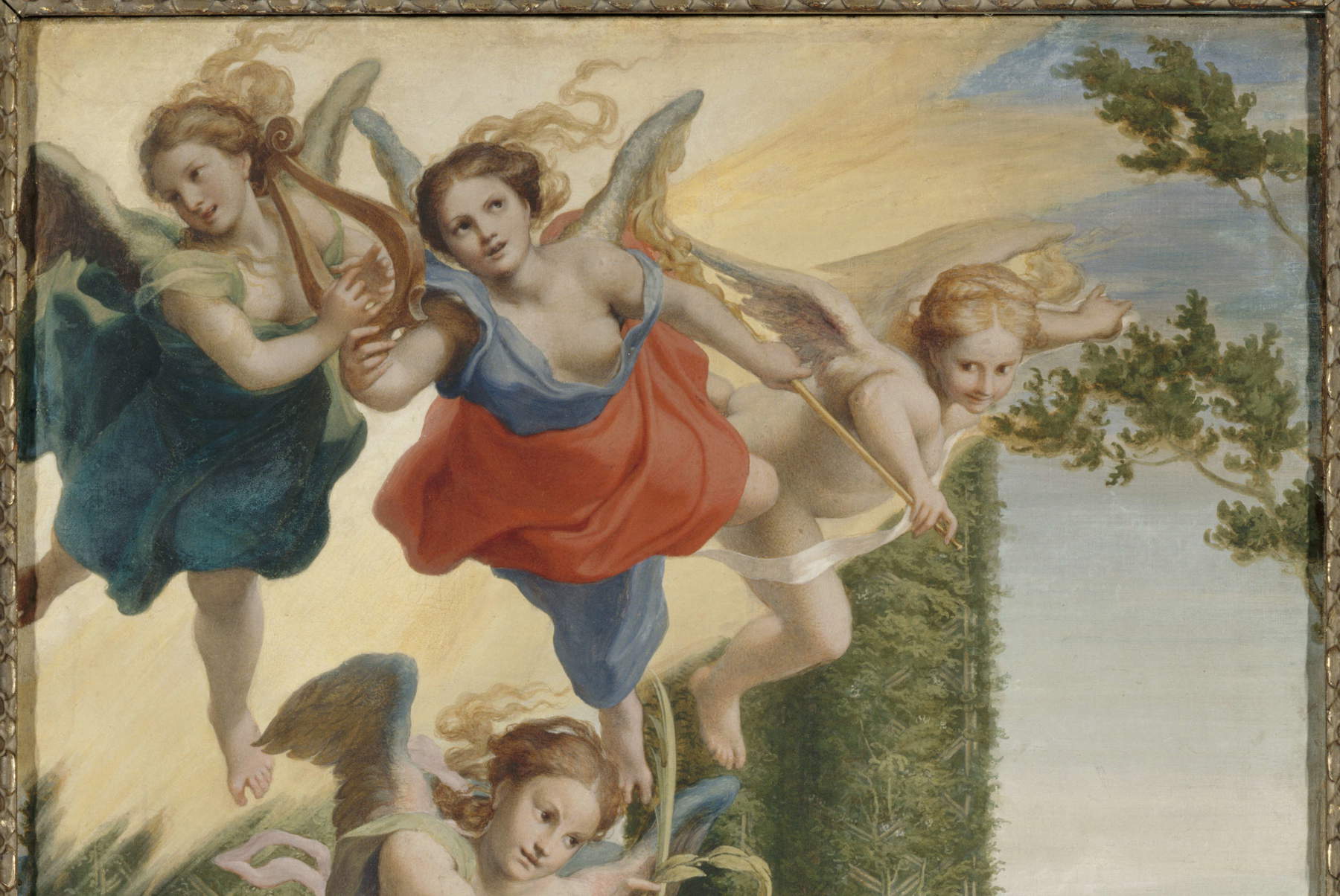
Returning to the composition of the *Sapienza* canvas and having traced its diagonals, we have graphically defined two equilateral triangles juxtaposed vertically. To achieve this, we believe that Allegri carefully studied the two geometric “perfect” patterns that were perfectly suited to the symbolic roles of the figures to be placed within them. In the upper triangle, which represents the sky—or rather, Paradise, since the artist used a dazzling burst of golden color—are placed the Three Theological Virtues, winged and clearly depicted in garments of their typical colors: green for Hope, red for Charity, and white for Faith. Of the three Virtues, Charity is the most advanced, because, as St. Paul says, it is the most important, and it is by this that we will be judged; in eternal life, Faith and Hope will no longer exist, while what will remain is the good that has been accomplished: Love. These three Virtues hold two musical instruments: a lyre and a golden trumpet. In mythology, the lyre was a symbol of cosmic harmony uniting heaven and earth; to make the lyre vibrate meant to make the world vibrate and to tame wild beasts: as we can see in the painting, the Dragon is subdued by Wisdom—that is, trampled under her foot. The trumpet, which in great celebrations linked heaven and earth, is depicted in Christian art—especially in paintings—in scenes of the Last Judgment, the moment when the apocalyptic Beast will be definitively defeated. In this painting, however, the trumpet is not raised to be played but is turned backward, held by Faith and even more firmly by Charity, who does not wish to reveal the good that has been bestowed. Before the instrument’s flared end, Allegri has placed a small, equally gilded sculpted figure who appears to be playing a buccina—that is, a loud-sounding conch shell symbolizing the Word. Equally important is the dominant and supreme radiance that envelops and propels the Theological Virtues: one is struck by the exceptional power of this divine flash, which possesses an eternal force and does not fade into the earthly atmosphere as occurs in other works by Allegri that stretch between heaven and earth. Here, the chromatic intensity is absolute, joyful, and resounding.
Certainly more intriguing are the figures on the opposite side: a Woman holds an open compass against the globe, before which stands a naked child. The sphere depicted is not a celestial globe, as has always been written, but an earthly one: not only does it feature blue and brown patches (sea and land), but the equator is also clearly visible. Furthermore, terrestrial measurements are taken in degrees and are therefore performed with a compass, whereas celestial measurements are taken with a sextant. The woman has a darker complexion than the others and is perhaps older, but her more explicitly smiling expression reminds us of the various saints Elizabeth and Anne. A series of bandages encircles her head—as in *La Cingana* or *Zingarella* and also in *The Rest with Saint Francis* —perhaps a sign of her habit of traveling, and with her index finger raised, she points to a distant place. It is commonly believed that she personifies the terrestrial sciences. We can therefore formulate a hypothesis: since the New World had been discovered only a few years earlier, it is likely that Isabella, certainly aware of this sensational conquest, wished to include it in her painting with the conviction that such a discovery stemmed from enterprising human wisdom. Thus, the Elderly Woman could represent Europe—that is, the Old Continent—which, through travel, discovered the New World, indicated and almost personified here by the naked Child, who is, in fact, uncovered: with his joyful face turned toward the viewer, he points with his left hand to a distant point on the globe. With the compass resting on a specific point, the woman measures the degrees of distance on the globe, and with her left hand—which extends beyond the pictorial frame—she seems to signal the discovery of a new, distant land. It is not unlikely that Isabella wished to highlight this momentous event, supported by her royal Spanish namesake, the wife of Ferdinand of Aragon, her cousin.
It is worth noting that the theme of the Allegory of Virtue had already been depicted in a fresco in Siena’s Palazzo Pubblico by Ambrogio Lorenzetti as part of the broader celebration of Good Government (1337–1339), which is personified by the figure of an elderly and magnanimous king, seated on a throne and surrounded by the Cardinal Virtues. Above the elderly king stand the three Theological Virtues, with Charity in the center. These figures, as well as “Wisdom,” which stands above Justice, are depicted with their bodies fading into the blue of the sky, as was customary in those days. Correggio certainly saw this scene in person during his trip to Rome, just as he was able to admire Pinturicchio’s Piccolomini Library.
Let us return to examining this canvas, which remained unfinished, to compare it with the other version and, if possible, identify the reasons for its incompleteness. As we have noted, the work’s unfinished state allows us to understand Correggio’s working process as he progressed, as well as the transition from lean tempera to oil tempera. First of all, we see a ground preparation, sometimes enriched with a layer of gold (something other artists generally did not do, preferring to use a neutral color), but this allowed the colors applied on top to produce a more intense effect and appear brighter. The use of this Correggian technique has also been demonstrated by restorations and studies of works by the same artist.
In the *Virtù* at the Louvre, we observed a careful graphic composition in the arrangement of the figures: the central point of the painting falls, in fact, on the mouth of *Sapienza*, while in this unfinished work it is located on the protagonist’s neck but at a non-significant point. The main difference between the two versions lies in the female figure at the center: at first glance, the woman in this barely begun canvas appears to be nude, especially in the upper part, which, however, —upon closer inspection—is covered by a very thin veil that can be seen rolled up on her right shoulder and in the round neckline, while in the center, between her breasts, there is a brooch featuring a human or satyr’s head.
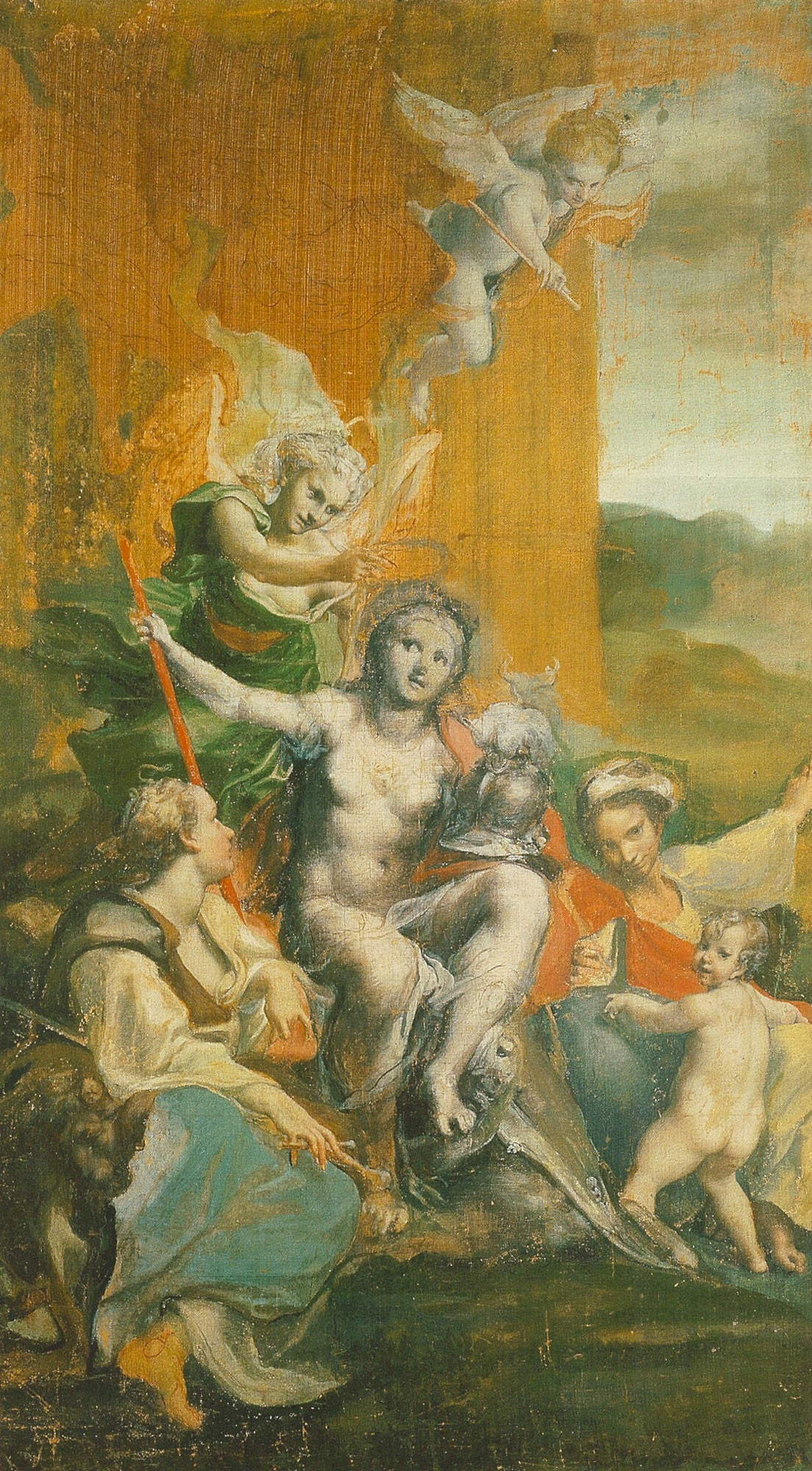
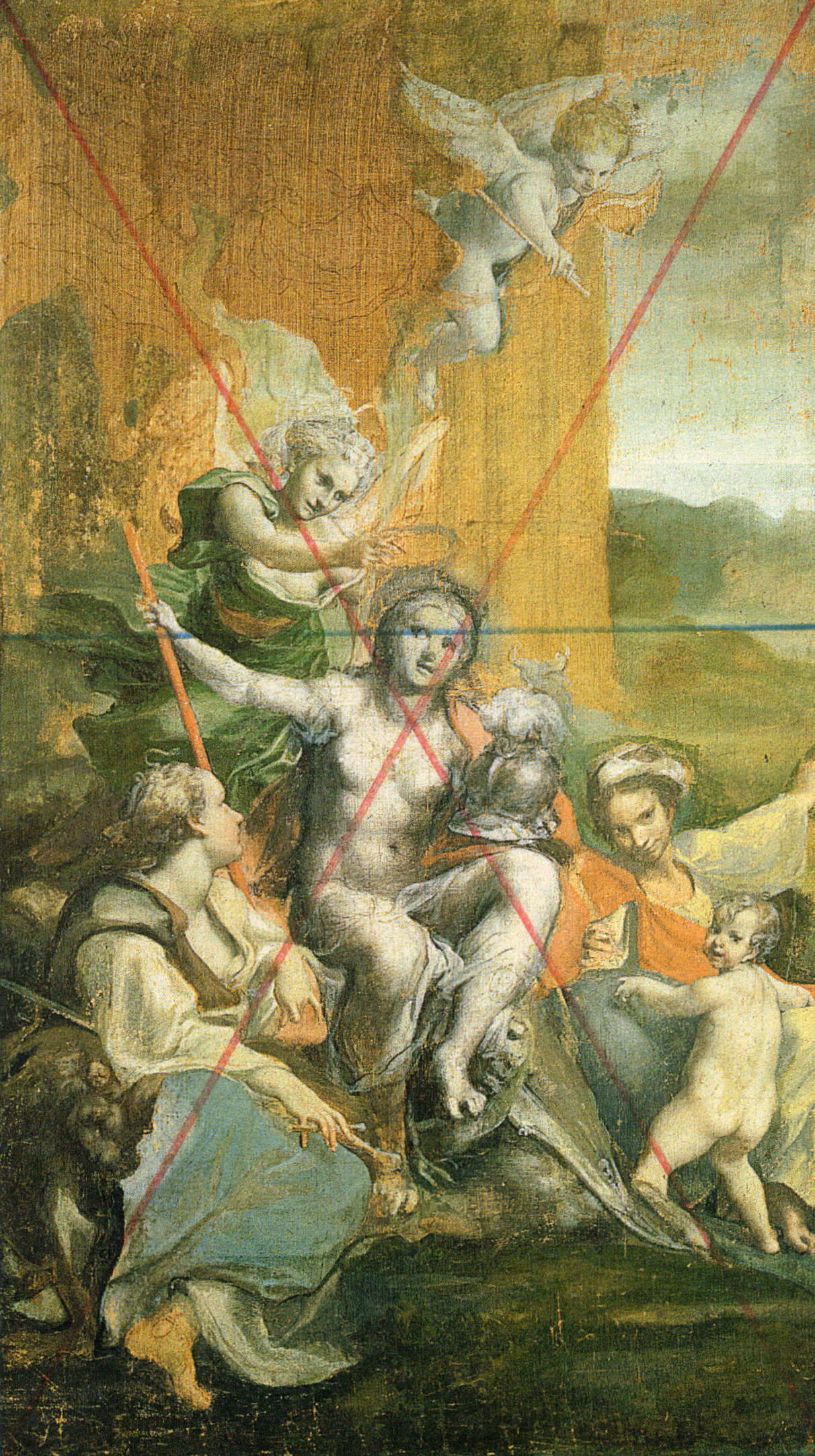
All of this leads us to believe that this figure represents not Wisdom but the “Naked Truth,” another important symbolic entity. We recall that Gian Lorenzo Bernini, a great admirer of Correggio, created an almost identical sculpture specifically to represent the Naked Truth.
On the head of this unfinished figure of ours, Correggio sketched a turban similar to those worn by Isabella in several of her portraits. Now, if we assume that in this version the Marquise of Mantua had intended to depict herself, then being portrayed nude would not have been appropriate: perhaps for this reason, we can suppose that Isabella wanted to change the subject and embody Wisdom instead!
Next to the woman’s left leg is a sketch of a shield, but here, in the upper part, an unpleasant human face peeks out—with a false, demonic grin—rather than a wolf’s head. In the center, near the right leg, a gaunt bird of prey’s claw is depicted, and resting against the shield, next to the child’s little leg, a kid’s hoof peeks out.
Those negative elements we have observed are kept at bay by the shield, so as not to cause harm. Recall that Correggio possessed a great capacity for synthesis: we have also noted this in the group of virtues represented as symbols. For the paintings she commissioned, the Marquise Isabella had always listed a veritable plethora of elements to be included—not always in a pleasing manner—so much so that some masters even refused the commission. Allegri, with his gift for synthesis and his rich cultural background, managed—even for this sublime Virtue—to satisfy the noblewoman despite the painting’s modest and unconventional dimensions, creating a refined yet powerful work.
At the conclusion of this analysis of these works—which still belong to what we might call an early phase of his maturity—we can draw some important conclusions regarding Correggio’s working methods. Regarding colors, the first phase on the canvas or wooden panel consisted of a base layer of plaster and glue that ensured a uniform surface, over which a further colored layer was applied to eliminate the whiteness of the plaster; and served as a true, variably colored ground that would reinforce the upper layer of pigment.
As for composition, the geometric patterns formed by the square, circle, and triangle allowed the figures of the entire painting to be arranged harmoniously, especially in large-scale works with multiple images. In Correggio’s works, these guiding patterns remained almost identical up until the Allegories, only to be arranged with varying angles in his second, mature period, where the figurative compositions became more dynamic and diagonal, also responding to the prescribed viewing angles of the works, to which our painter paid close attention.
It is worth noting that before painting, the artist would typically sketch lines and figures with charcoal, which was then brushed away, leaving only a light shadow, after which he would proceed with very precise coloring. In the drawings for the domes, a grid appears to aid in the subsequent execution on a much larger scale.
A remarkable quality of Correggio was his ability to synthesize: to avoid using too many figures—which would have reduced the scale of the work and created confusion in the painting—he made use of symbols: unobtrusive yet highly explanatory. It is worth noting that in the past, symbolism was highly valued, and that today we must make a concerted effort to uncover its meanings.

Warning: the translation into English of the original Italian article was created using automatic tools. We undertake to review all articles, but we do not guarantee the total absence of inaccuracies in the translation due to the program. You can find the original by clicking on the ITA button. If you find any mistake,please contact us.




















 IT
IT FR
FR DE
DE ES
ES CN
CN


