




by Noemi Capoccia 21/07/2026



Categories: Works and artists / Disclaimer
From the Mykonos vase to the interpretations by El Greco, Tiepolo, and Odevaere, the myth of the deception that led to the fall of Troy continues to inspire artists. To mark the release of Christopher Nolan’s *Odyssey*, here’s a journey through the imagery of one of classical antiquity’s most famous episodes.

It is one of the most famous deceptions in history, and for over two thousand years it has continued to intrigue artists, scholars, and—why not?—even audiences: the Trojan Horse, a symbol of cunning and betrayal, has become one of the most powerful images in Western culture. Its earliest depictions date back to ancient Greece, as evidenced by the decorated pithos (jar) preserved at the Archaeological Museum of Mykonos. The popularity of this episode continued into the Roman era, as demonstrated by the 1st-century A.D. fresco discovered in Pompeii, which depicts the arrival of the Trojan Horse at the city gates.
From the classical world to the Renaissance, from the Baroque to Neoclassicism, the tale of the fall of Troy has offered artists the opportunity to engage with an episode in which narrative tension, human drama, and reflections on fate coexist. The moment of deception is interpreted in different ways: from the Master of the Aeneid, who in his 16th-century enameled copper plate depicts Greek warriors hidden inside the wooden structure, to Giulio Bonasone, who translates Francesco Primaticcio’s invention into an engraving showing the Trojans intent on dragging the horse into the city; from El Greco, who places the horse in the background of his dramatic *Laocoön*, to the monumental Baroque visions of Juan de la Corte and the works ofGiovanni ndDomenico Tiepolo, dedicated to the construction and procession of the horse.


The exhibition concludes with a neoclassical drawing by Joseph-Désiré Odevaere, who in 1818 interpreted the episode in the style of historical painting and ancient monumentality. With the release of Christopher Nolan’s *Odysee* (see our review of the film here), the myth returns today to the center of the contemporary imagination: seven works recount the enduring visual appeal of an episode that continues to represent the fine line between appearance and reality, victory and ruin. Here are the ones we’ve chosen.
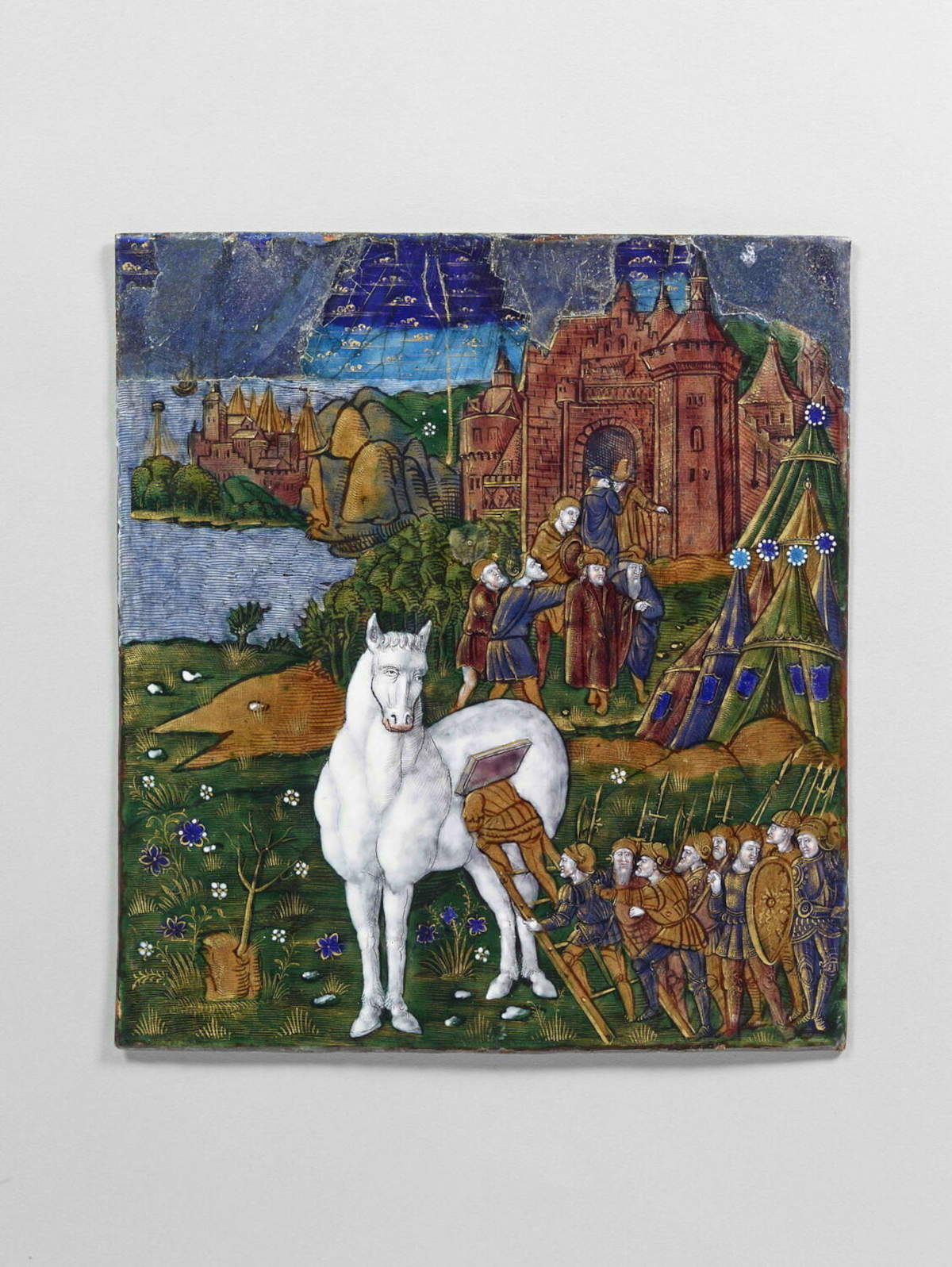
1. Master ofthe Aeneid, The Trojan Horse
Dated around 1530 and attributed to the so-called Masterof the Aeneid, this enameled copper plaque made in Limoges is part of a series of eleven panels dedicated to Virgil’s epic poem. The scene depicts one of the key moments of the ruse devised by the Greeks: soldiers enter the interior of the great wooden horse, while in the background the tents of the Achaean camp and a gate in the walls of Troy are visible. Executed in polychrome enamel with gilded details, the work condenses into a format measuring just over twenty centimeters an episode destined to change the course of the war. Narrative precision and rich color are hallmarks of the work of 16th-century Limoges enamelers, who helped spread classical themes through refined objects intended for collecting and private devotion.
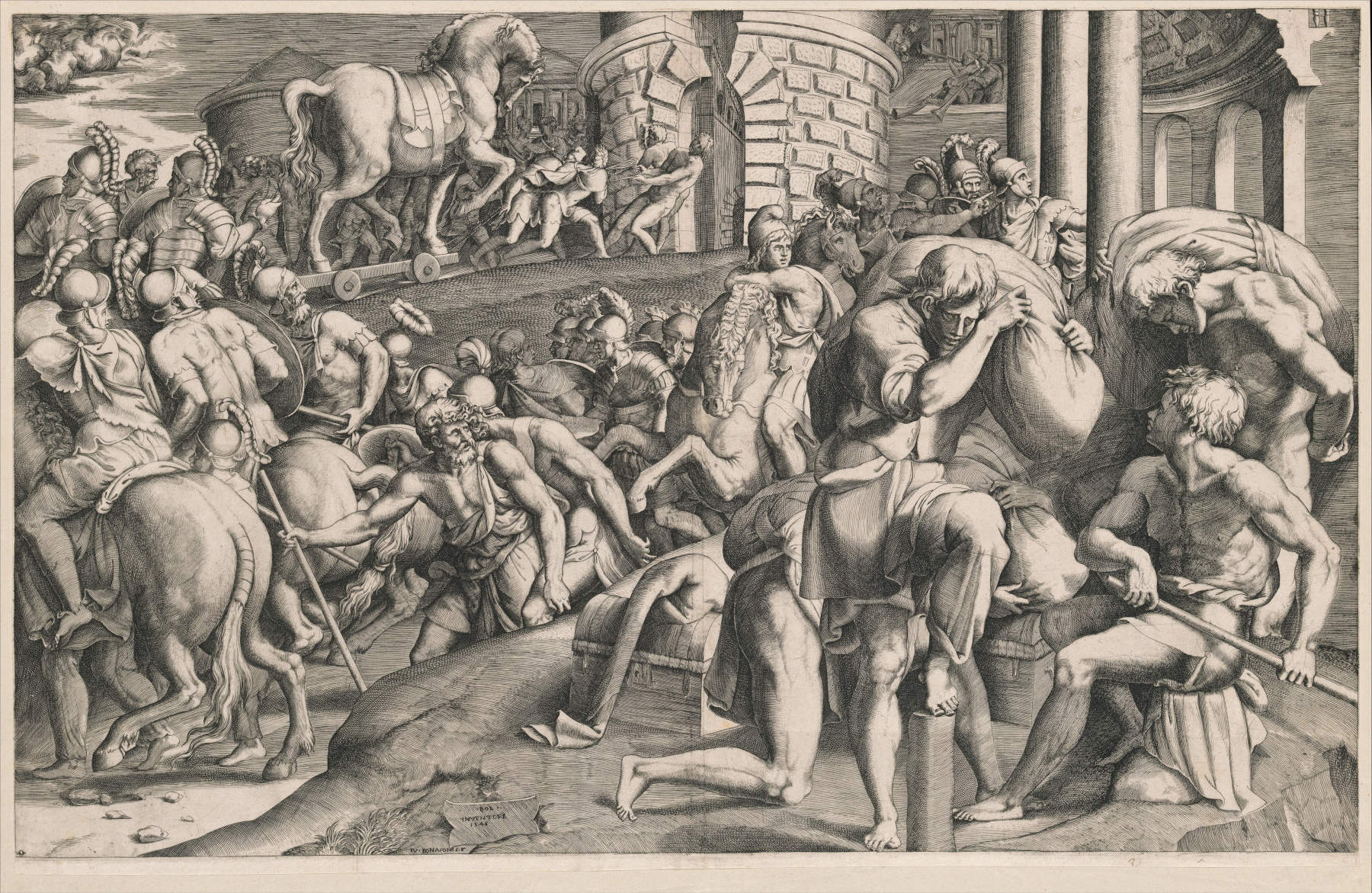
2. Giulio Bonasone, The Trojans Drag the Wooden Horse into the City
Created in 1545, the engraving by Giulio Bonasone depicts a composition by Francesco Primaticcio. The work depicts the moment when the Trojans, deceived by the Greeks, bring the wooden horse inside the walls of Troy, convinced that the gift would ensure their victory. The scene depicts the monumental wooden machine being dragged through the city by its citizens, while Greek soldiers—destined to bring about the fall of Troy—hide inside it. The engraving is based on a preparatory drawing by Primaticcio now housed at the Royal Library, Windsor Castle, and was likely conceived as an initial design for the fresco depicting the fall of Troy intended for the Galerie d’Ulysse at the Château de Fontainebleau (1541–1547), one of the great decorative cycles of the French Renaissance.
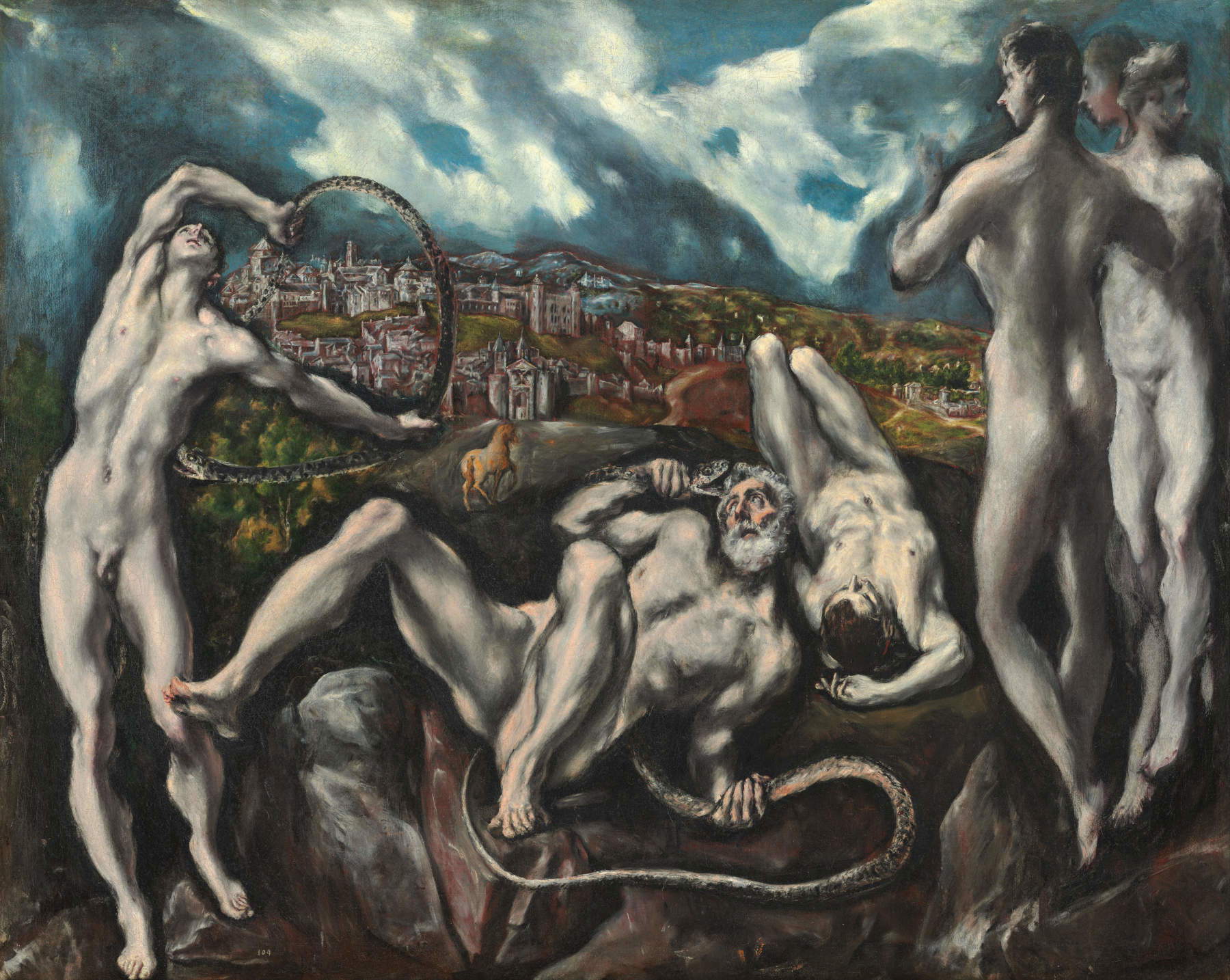
3. El Greco, Laocoon
Painted between 1610 and 1614, *Laocoon* is the only known work by El Greco ( Domenikos Theotokopoulos) with a mythological subject. The painter depicts the Trojan priest Laocoon and his two sons at the moment they are being attacked by two sea serpents sent by the gods. According to the myth, Laocoon had warned the Trojans against the wooden horse left by the Greeks, but his warning was ignored. In the background, the Trojan Horse—already brought within the city walls—is visible; this subtle yet crucial element links the priest’s tragedy to the imminent fall of Troy. El Greco, however, transposes the scene from the city to the Toledo of his time—recognizable in the background—with the aim of transforming the myth into a universal reflection on fate and tragedy. The elongated figures, contorted bodies, surreal space, and strong chromatic contrasts accentuate the dramatic tension, in a style that prioritizes emotional expression over naturalistic representation.
4. Juan de la Corte, El caballo de Troya — The Trojan Horse
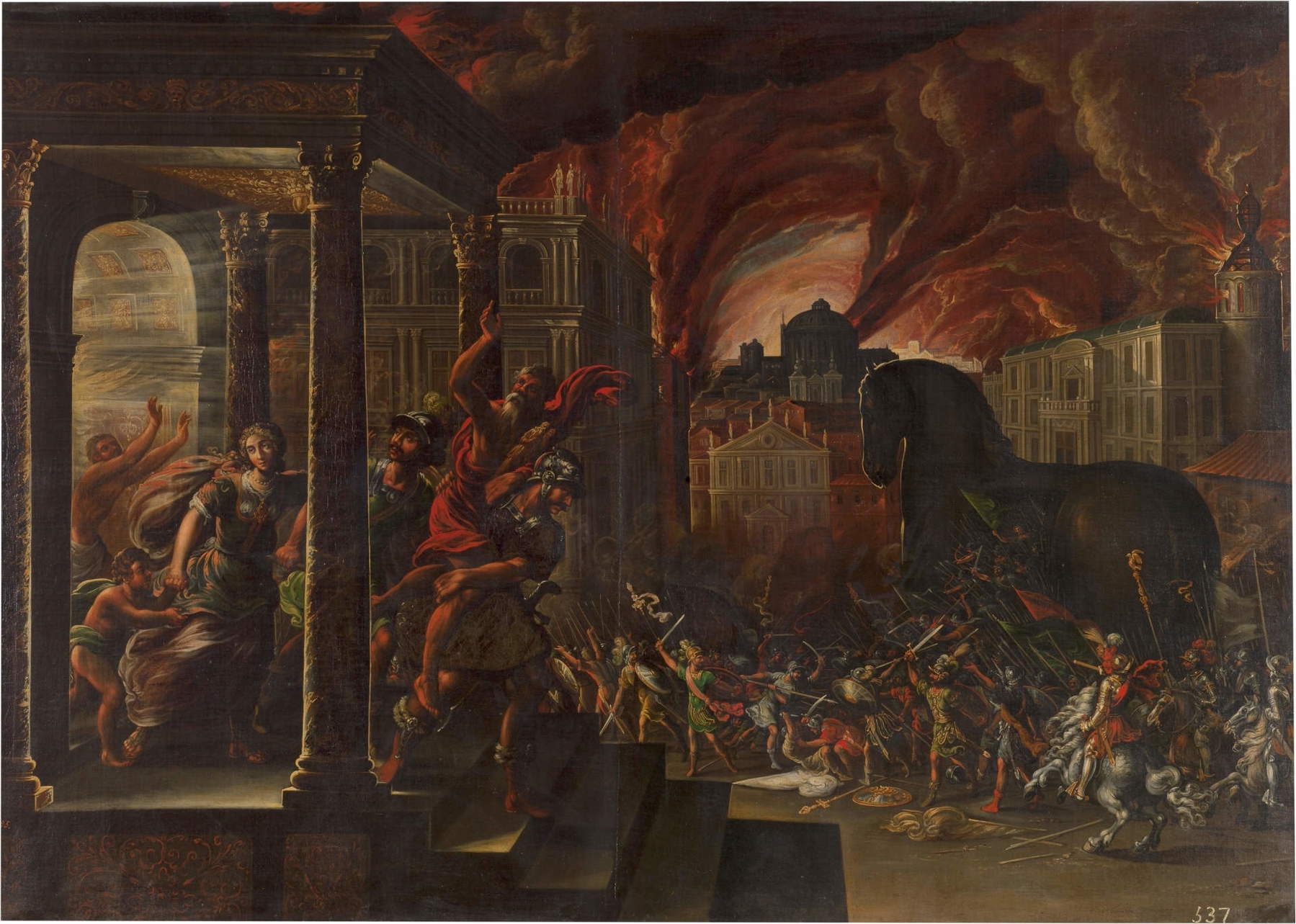
Painted in the first half of the 17th century by the Spanish painter Juan de la Corte, *El caballo deTroya* ( The Trojan Horse) depicts one of the most famous episodes from Virgil’s*Aeneid* (Book II). The enormous wooden horse dominates the right side of the composition, while at its feet, Greek warriors storm the streets of Troy, beginning the massacre. In the background, the city is already engulfed in flames that spread beneath a dark, swirling sky, transforming the horizon into an apocalyptic scene. On the left, inside a monumental building, a group of figures tries in vain to flee to safety: an elderly man raises his arm toward the sky, while women and children seek shelter. The stark contrast between the monumentality of the architecture, the chaos of the battle, and the red of the fire lends the work an intense theatrical quality, typical of Baroque painting. Housed at the Prado Museum in Madrid, the work exemplifies Spanish Baroque painting’s enduring fascination with the great narratives of classical antiquity.
5. Giovanni Domenico Tiepolo, The Construction of the Trojan Horse
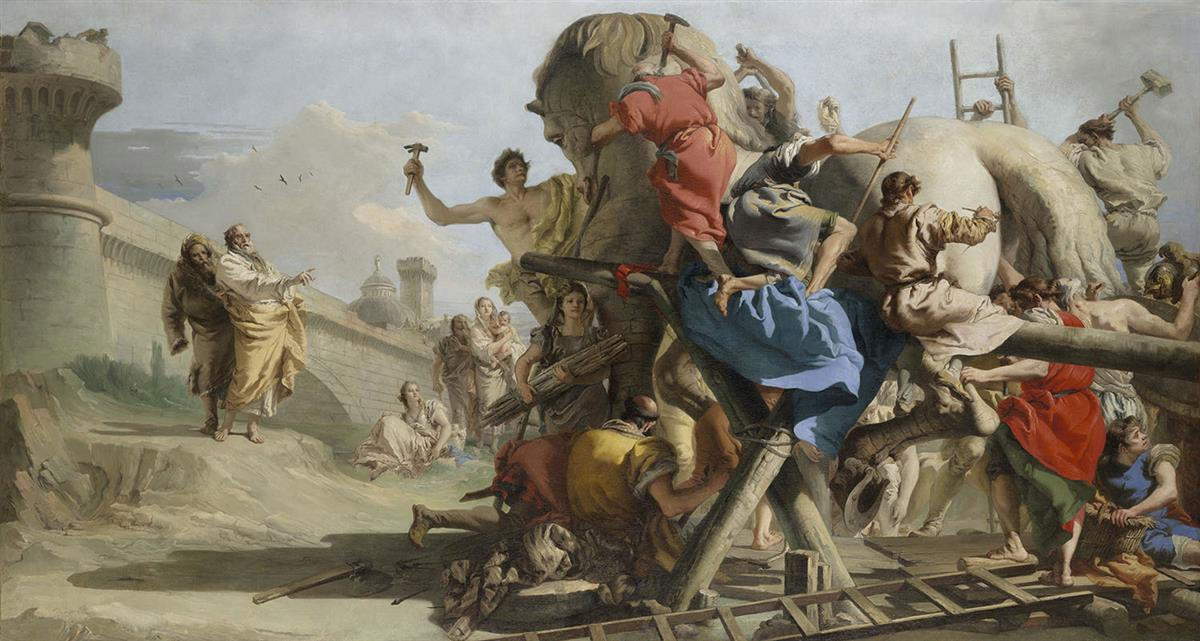
Painted around 1760, Giovanni Domenico Tiepolo’s *The Construction of the Trojan Horse* depicts the phase leading up to the famous ruse that would bring about the city’s fall. At the center of the composition, artisans and laborers are busy assembling the enormous wooden horse, working tirelessly with hammers and chisels, while around them, armored soldiers prepare for battle. An unusual detail is a man sitting on a plank who is finishing the horse’s surface with a brush, helping to give it a surprisingly realistic appearance. The glossy coat, powerful musculature, and flowing mane make the animal appear almost alive. The painting, executed with loose and rapid brushstrokes, is believed to be a preparatory sketch for the monumental canvas on the same subject, now housed at the Wadsworth Atheneum in Hartford, United States.
6. Giovanni Domenico Tiepolo, The Procession of the Trojan Horse into Troy
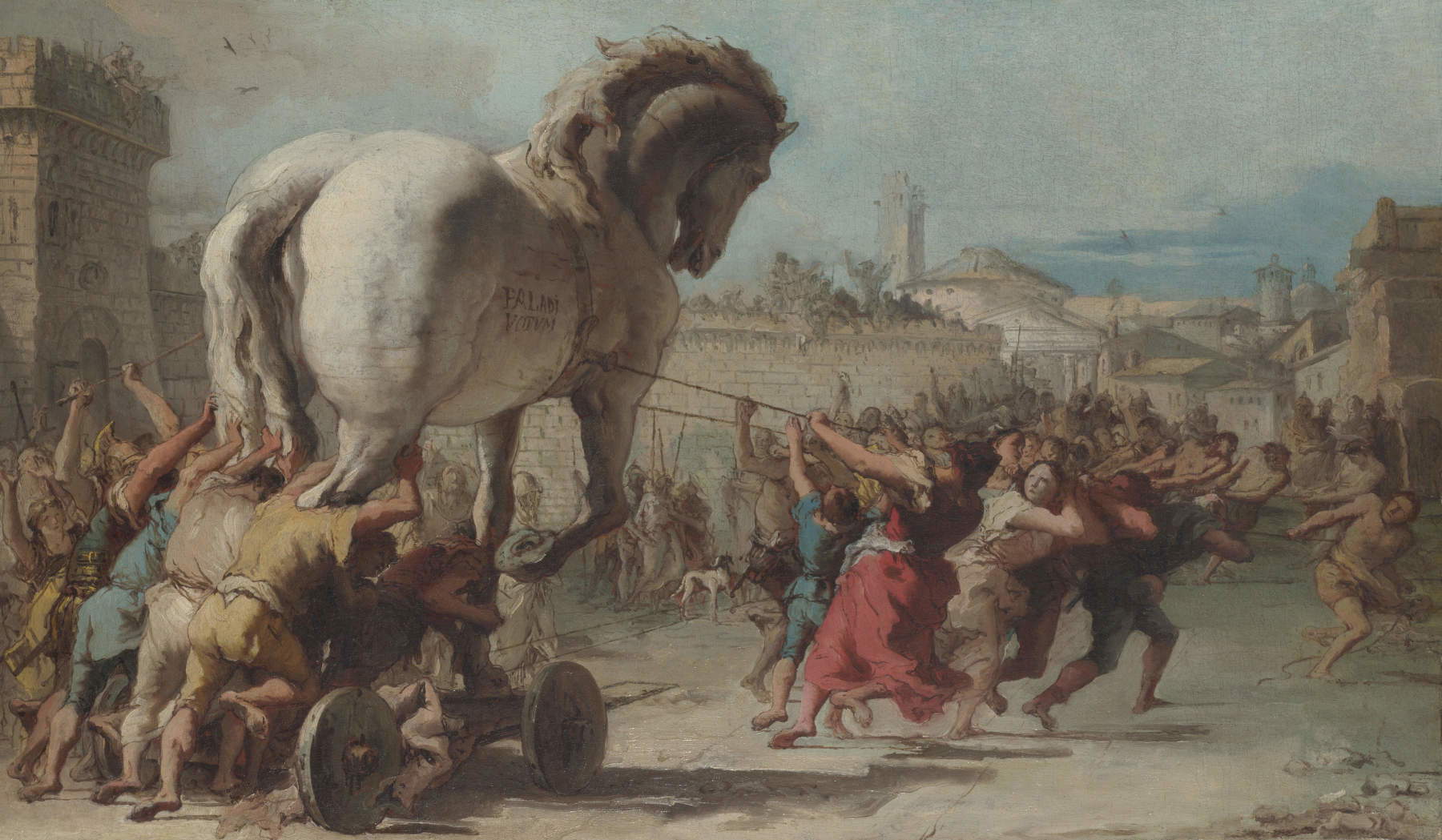
Painted around 1760 by GiovanniDomenico Tiepolo, *The Procession of the Trojan Horse into Troy* depicts the decisive moment when the Trojans drag the gigantic wooden horse into the city, convinced that it is an offering consecrated to the gods. The composition is brought to life by a constantly moving crowd, which helps emphasize the epic nature of the scene, while the horse—imposing and muscular—dominates the foreground. In the background appears Cassandra, daughter of King Priam, who was arrested after unsuccessfully prophesying the ruin of Troy should the horse be welcomed within the city walls. The mighty fortifications and the perspective draw the eye toward the city, which Tiepolo modeled on the architecture of ancient Rome. The painting was part of a series dedicated to the fall of Troy and was likely conceived as a preparatory sketch for a larger canvas.
7. Joseph-Désiré Odevaere, The Entry of the Trojan Horse
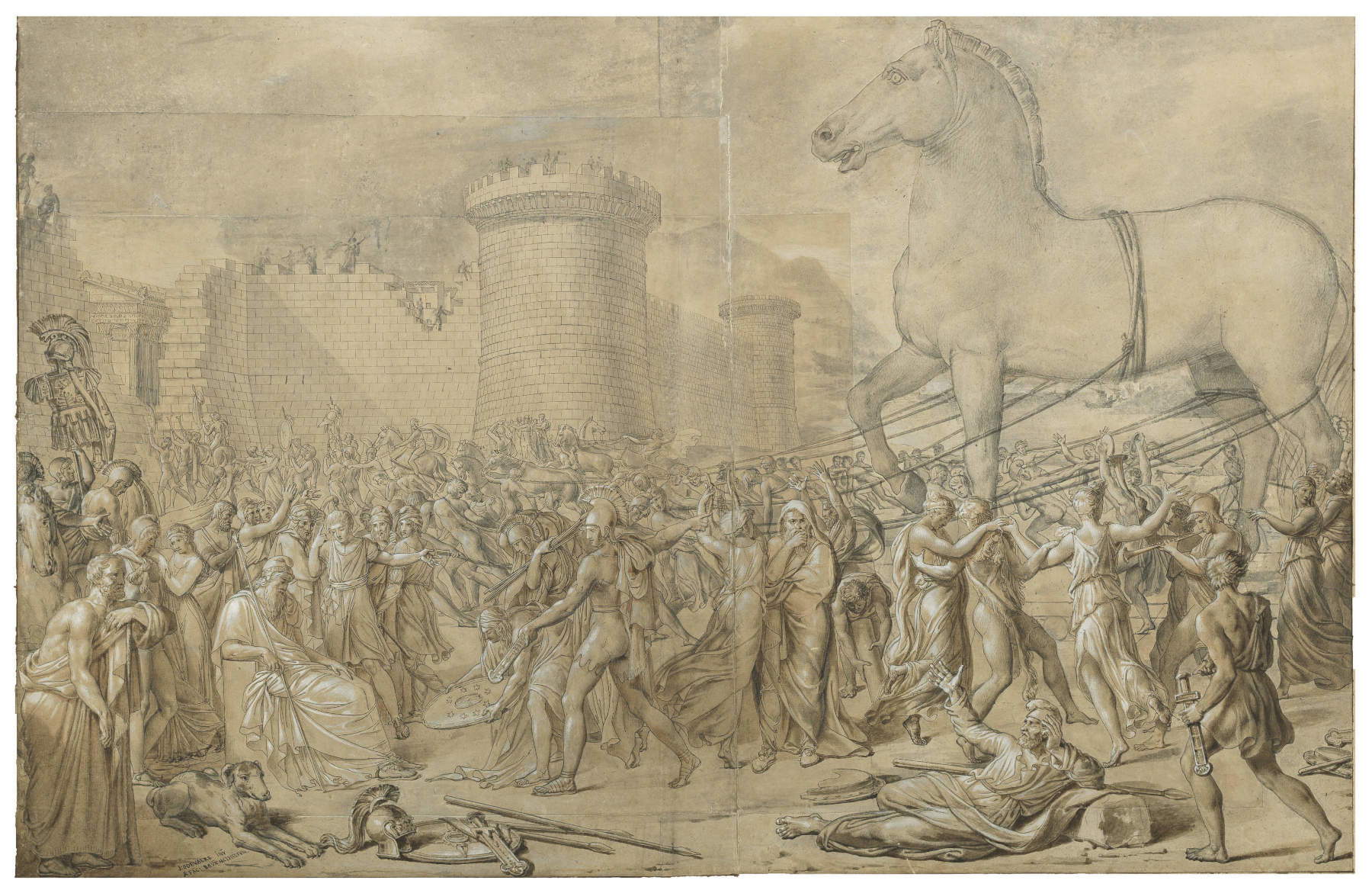
Created around 1818, Joseph-Désiré Odevaere’s *The Entry of the Trojan Horse* interprets the episode from the Trojan War according to the principles of Neoclassicism. The large painting depicts the moment when the Trojans drag the wooden horse inside the city walls, unaware of the Greek warriors hidden within it. The scene is organized as a monumental historical composition: a vast crowd accompanies the procession, while classical architecture serves as the backdrop to the event. The orderly arrangement of the figures, the attention to anatomy, and the sense of monumentality reflect the influence of Jacques-Louis David, with whom Odevaere trained in Paris. The work, executed in graphite, pen, ink, and watercolor washes, was likely intended to be engraved, but the project was never completed.
Warning: the translation into English of the original Italian article was created using automatic tools. We undertake to review all articles, but we do not guarantee the total absence of inaccuracies in the translation due to the program. You can find the original by clicking on the ITA button. If you find any mistake,please contact us.