




by Ilaria Baratta 02/09/2026



Categories: Works and artists / Disclaimer
A gesture frozen in the moment of delivery, a Venetian landscape, and a mysterious Saint George: the Manfron Altarpiece, a masterpiece by Paris Bordon (Treviso, 1500 – Venice, 1571), reveals the refinement and complexity of this Venetian artist’s painting. An article by Ilaria Baratta.

Two charming winged cherubs support and lift into the air the green, precious banner of honor embroidered in gold, as if they wished to set apart the Virgin Mary, the Child, and Saint Christopher from the rural landscape surrounding them—the very landscape from which the saint, whose name literally means “bearer of Christ,” hails. Paris Bordon, a highly refined and cultured painter of the Venetian sixteenth century, was very familiar with the hagiography and widespread iconography of the martyr, as seen in one of his most exquisite masterpieces: the Madonna and Child with Saint George and Saint Christopher in the Tadini Academy Gallery in Lovere. The Golden Legend by Jacopo da Varazze—which spread and popularized the story of Saint Christopher during the Middle Ages and linked the saint to travelers and pilgrims as their patron—tells precisely of a man of extraordinary height, a giant named Reprobo, who was of Canaanite descent and who sought out the greatest prince in the world to remain by his side and serve him. Believing that the greatest and most powerful lord in the world was the devil, he found him and declared himself his servant for all eternity, but the devil revealed to him that whenever he came upon the cross of Christ, he was terrified and fled; Having heard this, the man concluded that Christ was, therefore, the Lord he must seek and serve. But where could he find him? A hermit who instructed him in the faith suggested that he go live near a dangerous river to help pilgrims cross it: so he did; He then built a hut and used a long pole to steady himself while carrying people across the river. Until one day a child appeared before him and asked him to carry him to the other side: the ferryman hoisted the child onto his shoulders; the waters began to swell, the current grew stronger and stronger, and the child grew heavier and heavier, weighing down on him like an unbearable burden, so much so that the giant feared he would drown. Once they reached the other side, the child revealed that he was Christ himself and confessed that on his shoulders he had carried not only the weight of his little body, but the weight of the entire world. Following that episode, the giant Reprobo converted and was baptized with the name Christopher, meaning “he who carries Christ.”
This is why Paris Bordon’s Saint Christopher is depicted with his feet emerging from the water, from which the snout of a little dog can also be seen: the toes of his right foot are already resting on the riverbank, in the moment before he pushes off with his muscular, powerful legs and brings his other foot—still ankle-deep in the water—onto the damp ground. During the crossing, he helped himself, as iconography dictates, by the long pole he clutches in his hands, which he twists slightly—thus also highlighting the muscular strength of his upper limbs—to allow the Virgin Mary to receive into her arms the Child he is taking from the saint’s shoulders. In fact, the Virgin Mary is also depicted seated in profile, leaning forward to take the infant Jesus into her arms; he is already clinging with his little hand to the sleeve of his Mother’s iridescent red robe, while turning his gaze toward his ferryman. In this exchange of glances between the Child and Christopher, the Virgin is the only one turning her face toward the viewer, wrapped in a wide cloak in shades of Prussian blue. This divine entrustment is the focal point of the entire scene depicted in Bordon’s work; it is this transition from Christopher’s shoulders to Mary’s hands that the winged cherubs seek to highlight with their precious drapery— the arrival of the Child in this simple, rustic Venetian landscape. Is this a declaration of the necessity of faith and its ability to reach every place? Or the desire to reveal oneself to the divine in order to entrust oneself entirely to Him?


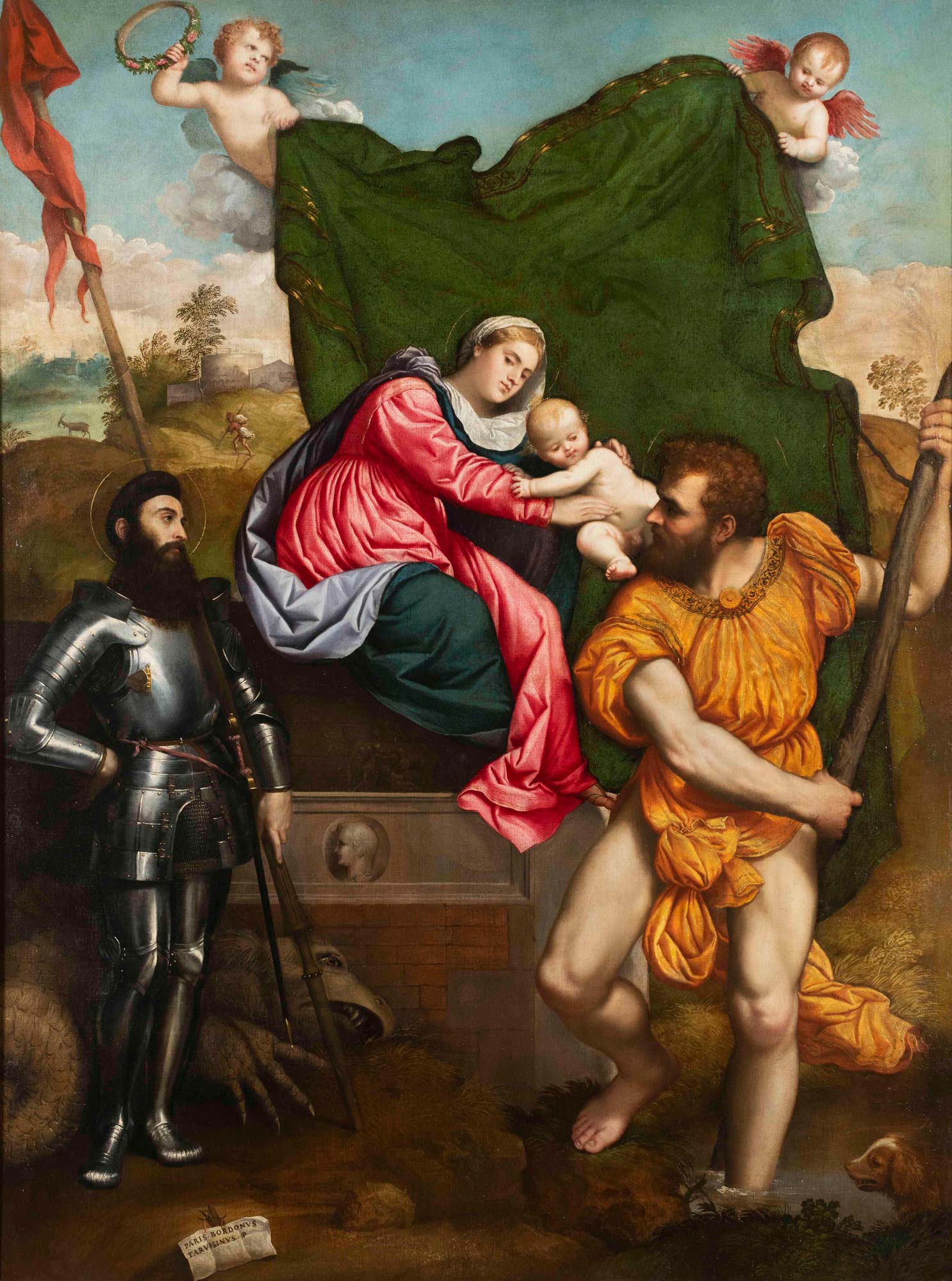
The scene includes another figure who has not yet been mentioned: Saint George, clad in his gleaming armor, the holy knight who defeated the fearsome dragon, depicted here lifeless at his feet. And he is the only figure to remain outside the drapery, as if, despite appearances, he were not truly to be considered a saint. In fact, through the figure of Saint George, Paris Bordon portrayed Giulio Manfron, a military commander from Vicenza who had embarked on a brilliant military career in the service of the Venetian Republic, from 1525 as commander of a garrison, and who had died from an arquebus shotduring the siege of Cremona on August 15, 1526. The painting is thus a commemoration of a commander as valiant as the holy knight, but it also takes on political significance due to the complete loyalty Manfron demonstrated to the Serenissima, the Republic of Venice. This identification had already been clarified by Giorgio Vasari, who, in the Giunto edition of his *Lives* published in 1568, inthe extensive biographical appendix he added to the life of Titian ( Paris Bordon was one of the greatest pupils of the painter from Cadore), in which Vasari recounts information he learned directly from Bordon during their meeting in Venice in May 1566, states that the painter from Treviso “painted two panels of Saint Augustine in Crema, one of which depicts Signor Giulio Manfrone as a fully armored Saint George”; this information is confirmed by the description of the condottiero—identified by Monica Ibsen—as recorded by Pandolfo Nassino in his Diary: “he was of fine stature but dark-complexioned, with a full beard and a very large mustache, about 40 years of age.” Furthermore, as Simone Facchinetti and Arturo Galansino pointed out in their essay on the Life and Works of Paris Bordon in the catalogof the major exhibition on the painter held between late 2022 and early 2023 at the Museum of Santa Caterina in Treviso, the artist’s birthplace, the saint “wears a fashionable garment, commonly used in military circles of the time—namely, a black cap—which is hardly appropriate on the head of a saint.” The two curators also pointed out that “Paris’s commissions in Crema can be explained by his appointment as Podestà of that city, a position he held from 1522 to 1524. In 1523, Alvise Foscari was authorized to ‘spend up to twenty-five scudi to build a Chapel of Our Lady in the Church of St. Augustine’,” a building destroyed in 1830 for which the painter had created two altarpieces: *The Pentecost*, now housed at the Pinacoteca di Brera, and the *Manfron Altarpiece*, so named because it was commissioned by the family of the condottiero. It was the research by Matteo Facchi ( 2019), taken up by Barbara Maria Savy (2021), that made it possible to clarify the provenance of the painting from the Venetian podestà’s chapel in the Augustinian church, established by Podestà Alvise Foscari at the behest of Doge Andrea Gritti.
The Manfron Altarpiece was described as follows by the scholar and art collector Marcantonio Michiel (Venice, 1484–1552) in the Church of Sant’Agostino in Crema: “The small altarpiece on the right-hand side, halfway down the nave, depicting Our Lady holding the infant Christ on the shoulder of Saint Christopher, with Saint George fully armed, was painted by Paris Bordon.” A masterpiece dating to 1526–1527, around the year of Giulio Manfron’s death, as confirmed by Savy’s studies, and which can be traced to a tradition of Po Valley Michelangeloism, as seen in the muscularity of Saint Christopher and the dynamic pose of the Virgin, a style already adopted by other painters, such as Pordenone. However, the pensive gaze of Saint George is more reminiscent of Giorgione’s style, which Bordon, as Vasari reports, “resolved [...] to follow in every way.” On the scroll placed beneath Saint George, on the ground, the inscription reads “PARIS BORDONVS / TARVISINVS P.”: the painter signs himself as Tarvisinus, proud of his Treviso origins, to which he remained attached throughout his entire life.
The work was purchased by Count Luigi Tadini in March 1805 for 364 lire and 16 soldi, following the dissolution of the Church of Sant’Agostino in 1797, and was first added to his collection in Crema and later, in 1827, into his collection in Lovere, where it is still preserved today in the museum founded by the count himself to display his works of art to the public.
Warning: the translation into English of the original Italian article was created using automatic tools. We undertake to review all articles, but we do not guarantee the total absence of inaccuracies in the translation due to the program. You can find the original by clicking on the ITA button. If you find any mistake,please contact us.