





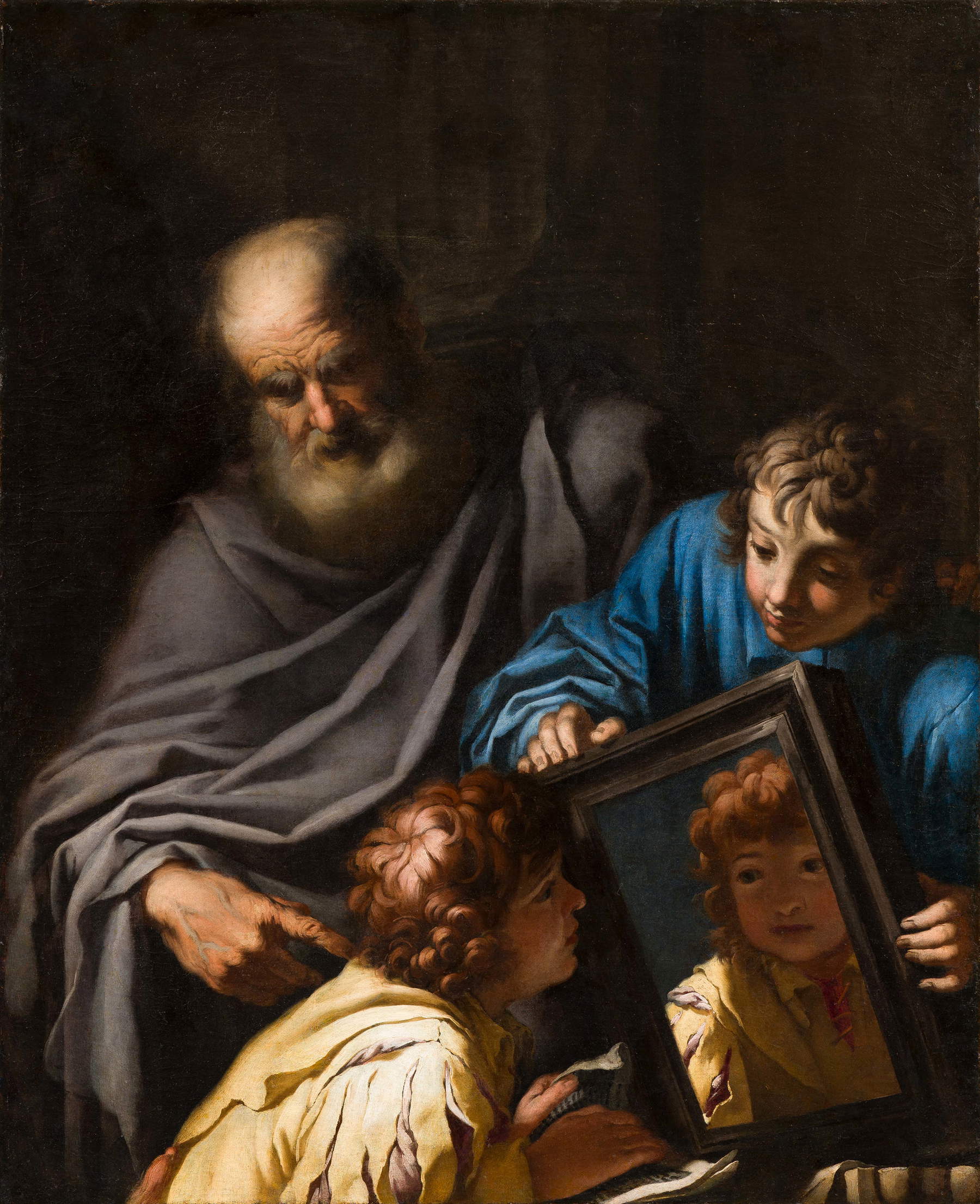
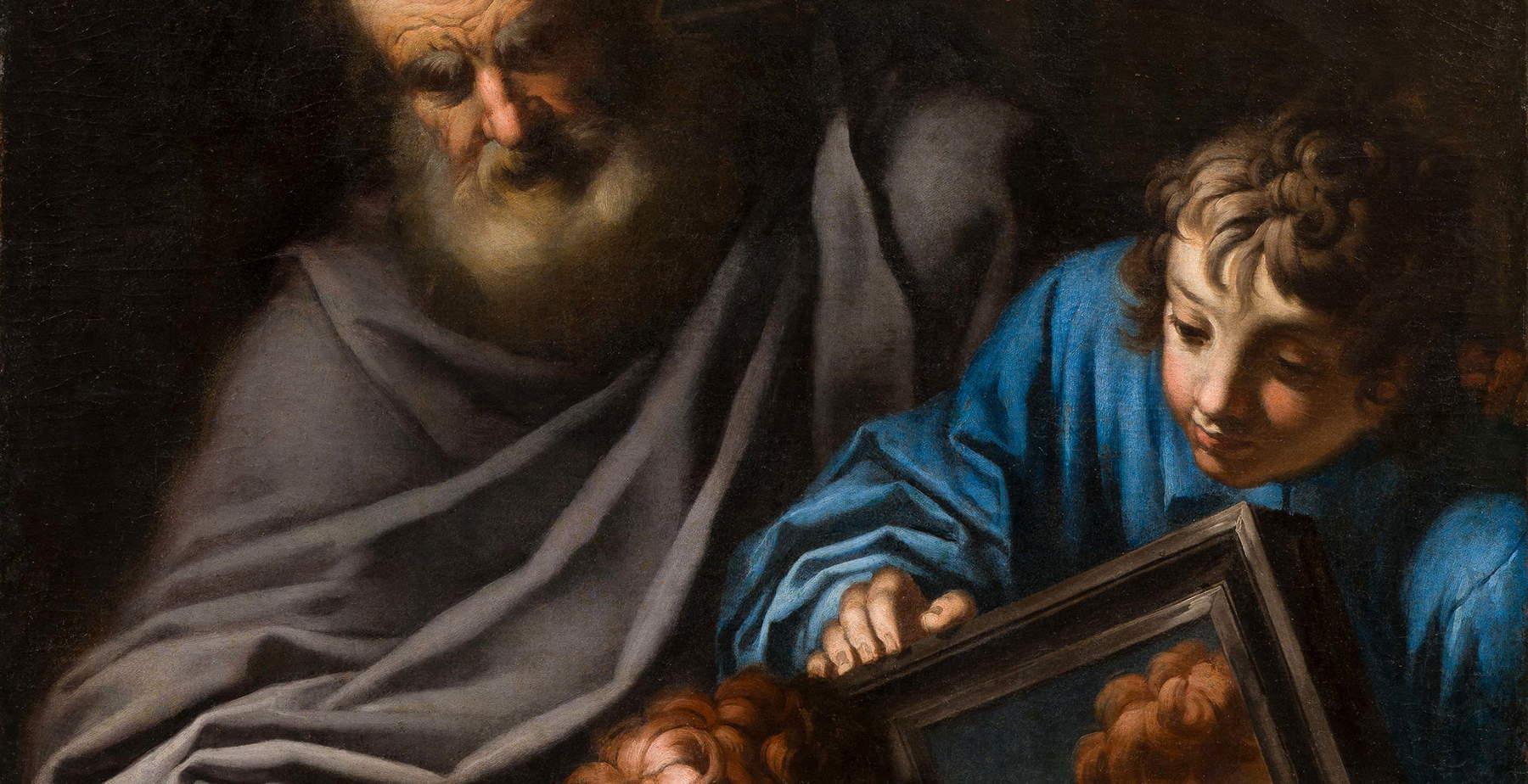
A young man intently observes his own reflection in a mirror. A young classmate of his carefully holds up the mirror, while behind them stands the solemn and austere figure of Socrates, wrapped in an imposing gray cloak and distinguished by a wavy, soft beard. The Greek philosopher does not merely passively observe the scene: with a cautionary and thoughtful gesture, he points to the young man intent on contemplating his own features, directly guiding him along a path of moral introspection and inner exploration. This is the rich and effective figurative composition with which the painter Francesco Ruschi (Rome, 1600 – Treviso, 1661) has translated into an image the famous adage “Nosce te ipsum,” “Know Thyself,” traditionally associated with Socratic teaching. The work was rediscovered by the Modena-based Cantore Galleria Antiquaria, which presented it at the 2026 Florence International Antiques Biennale (with an asking price of 65,000 euros), and for the occasion was studied by the young scholar Martina Leone, who included it in her recent monograph on Ruschi (*Francesco Ruschi e l’abundantia barocca*, Campisano editore, 2026).
The work, long unknown to scholars and recently rediscovered, revealing a painterly quality of the very highest order, transforms a philosophical reflection on self-awareness into an intimate, theatrical, and extremely compelling scene. Against the dark, deep background—where only the outline of a half-fluted column is discernible—the three protagonists emerge, arranged within a compressed and intensely dramatic space. In this compositional framework, the mirror is not merely a decorative detail or a simple stylistic accessory, but serves as the conceptual and expressive linchpin of the entire narrative. It is a refined iconographic device capable of triggering a complex and intricate interplay of gazes, psychological resonances, and internal references that traverse and connect the canvas. The young boy observing his own reflection thus becomes the ideal point of convergence between the physical and pedagogical action exerted by the teacher and the engaged presence of the other student holding the frame. The composition thus takes the form of a profound and intricate visual meditation on the theme of recognizing one’s own identity, understanding one’s own being, and the inevitable realization of human limitations.
Behind the conception of this extraordinary painting, one can clearly sense the lively and nonconformist intellectual climate that characterized Venice in the mid-17th century. In the lagoon city of the mid-17th century, philosophical, moral, and emblematic subjects found particularly fertile ground in elite circles and among the erudite and libertine milieu associated with the Accademia degli Incogniti. Moralizing genre painting responded to a specific cultural demand; furthermore, as Martina Leone explains, “in the Baroque popularity of images with philosophical and emblematic content,” the mirror “takes on a specific value: an instrument of knowledge and self-awareness, a visual translation of the Socratic exhortation to self-awareness.”
From a strictly stylistic and technical perspective, the painting proves to be fully consistent with and authentic to Francesco Ruschi’s catalog, reflecting a complex figurative culture enriched by multiple influences. The artist demonstrates, in fact, that he has assimilated and developed the motifs of early 17th-century Roman naturalism—a language learned, contemplated, and internalized through direct observation of the major monumental construction sites in the papal capital. The echo of those great Roman decorative undertakings is clearly evident in the monumental figure of Socrates: “constructed through monumental, broken drapery—almost sculptural—and defined by a wispy beard and a wide gray cloak,” writes Leone, “it recalls the heads of patriarchs and apostles from the great Roman construction sites that Ruschi had likely observed and to which he had paid homage in the saints of his altarpieces.” By contrast, the physiognomic rendering of the two young students—characterized by rosy complexions, delicate chiaroscuro effects, and luminous, vibrant curls of hair—finds precise and compelling parallels with the child figures present in various versions of *The Repudiation of Hagar*, a paradigmatic work in the painter’s career.
While the conceptual meaning of the work is fully rooted in seventeenth-century Venetian culture, the painting’s collection history and material history form a documentary tapestry of considerable interest, reconstructed through meticulous research into archival photographic sources. A key turning point in reconstructing the painting’s historical journey is a photographic card preserved in Florence at the photo library of the Kunsthistorisches Institut – Max-Planck-Institut. Identified by inventory number 41503 and labeled with the typological designation “Ital. Barock,” this vintage photographic document reproduces the painting and bears various handwritten annotations on its surface that have shed light on its location in Berlin during the first half of the 20th century. The inscriptions on the photograph indicate that the painting was located in the German capital at the Galerie Schmidt, an important and influential antique art gallery active in Berlin during the early decades of the 20th century and also referred to in documents of the time as “Galerie Schmidt & Co.” or “Galerie Rudolf Schmidt & Co.” The painting’s presence in the German art scene of those years is attested not only by the archival photograph but is also objectively and conclusively confirmed in the printed catalog of the exhibition dedicated to Italian Baroque painting, organized in 1927 within the exhibition spaces of the Warenhaus Wertheim in Berlin. In that 1927 exhibition catalog, the painting was listed under number 128 with the simple title “Sokrates,” explicitly identified as the property of Galerie Schmidt & Co. (The link identifying the painting known today with the work exhibited in the Berlin show appears to be absolutely certain: the historical photograph preserved in the Florentine photo archive of the Max-Planck-Institut bears the same catalog number, confirming that the photograph was taken specifically in connection with the staging of that exhibition or for the related cataloging and exhibition documentation purposes).
Leafing through the pages of that same 1927 Berlin catalog, one also discovers that at the immediately following number, number 129, another painting attributed to Francesco Ruschi was listed—depicting Lamech and his family—indicated as belonging to the Galerie Ehrhardt and, unfortunately, untraceable to this day. The Florentine photograph thus takes on extraordinary historiographical significance: on the one hand, it unequivocally proves the work’s passage through the Berlin antiquities market of the 1920s; on the other, it clearly refutes a handwritten note added to the image, which erroneously indicated that the canvas belonged to the collections of a German state museum. On the contrary, the work was never incorporated into Germany’s public collections but was simply documented by the Florentine research institute for the purposes of study and scientific cataloging.
In the wake of this significant period in Berlin and the traumatic war years that devastated Central and Eastern Europe, all traces of the painting were lost for decades: there was, therefore, a long period of documentary silence. The painting remained in the shadows until recently, when it finally reemerged on the international art market, specifically from a private collection located in southern Germany. The decisive turning point that refocused critical attention on the painting occurred in Munich, where the Neumeister auction house included the work in Auction 417, held on July 2, 2025. Presented as Lot 208, attributed to Ruschi and titled “Socrates and Two Students,” the painting was sold and re-entered the antiquities market.
Today, the painting is in the collection of the Cantore Galleria Antiquaria in Modena. During the 34th edition of the Florence International Antiques Biennial (BIAF) in 2026, the Modena-based gallery officially presented it to an audience of art enthusiasts, collectors, and art historians. And so the Florence exhibition became a tangible opportunity to admire up close a painting that has reemerged from the past, one capable of combining the intellectual rigor of Socratic philosophy with the high formal quality of 17th-century painting.
 |
| Socrates' Mirror: Francesco Ruschi's Rediscovered Masterpiece |

Warning: the translation into English of the original Italian article was created using automatic tools. We undertake to review all articles, but we do not guarantee the total absence of inaccuracies in the translation due to the program. You can find the original by clicking on the ITA button. If you find any mistake,please contact us.





















 IT
IT FR
FR DE
DE ES
ES CN
CN


