



by Redazione 08/11/2026


Categories: Archaeology / Disclaimer
Starting November 10, 2026, the Ostia Antica Archaeological Park is launching a new project that allows visitors to virtually explore monuments, streets, and sites of everyday Roman life. Thanks to the app and VR headsets, visitors will be able to immerse themselves in photorealistic reconstructions of Ostia and the ancient imperial harbors.


The Ostia Antica Archaeological Park is preparing to offer visitors a unique experience that aims to bring the atmosphere of the Roman city and its port back to life through virtual reality. The multimedia project will be officially unveiled on November 9, 2026, at the Ostiense Museum, in the presence of Alfonsina Russo, Head of the Department for the Promotion of Cultural Heritage. Starting the following day, Tuesday, November 10, the new content will be accessible to the public both via personal devices and through immersive experiences in specially designed spaces set up within the arcades of the Ostia Theater and the Casale Torlonia, in the area of the Imperial Harbors of Claudius and Trajan in Fiumicino.


The project offers various tools to deepen understanding of the archaeological sites. By downloading the free “Ostia Antica” app and scanning the educational panels located near the monuments with your smartphone, you can access additional materials: translations of the texts into eleven languages (English, French, German, Spanish, European Portuguese, Polish, Dutch, Russian, Arabic, Chinese, and Japanese), images, drawings, and in-depth bibliographies. Also available will be 360-degree panoramic photographs of buildings that cannot be visited for conservation and safety reasons, along with virtual reconstructions of the monuments created from the visitor’s actual vantage point.


The reconstructions can be viewed directly on the screen of your device in 2D format, without any additional accessories, or in 3D using special VR headsets, which can be purchased at the ticket offices. Those seeking an even more immersive experience can choose the “Plus” ticket, which includes the use of standalone VR headsets. This will allow visitors to take a journey into the past: virtually stroll along the streets of Ostia, meet its ancient inhabitants, and stop at a tavern, or experience the perspective of a sailor who has just docked at Portus after a long voyage.


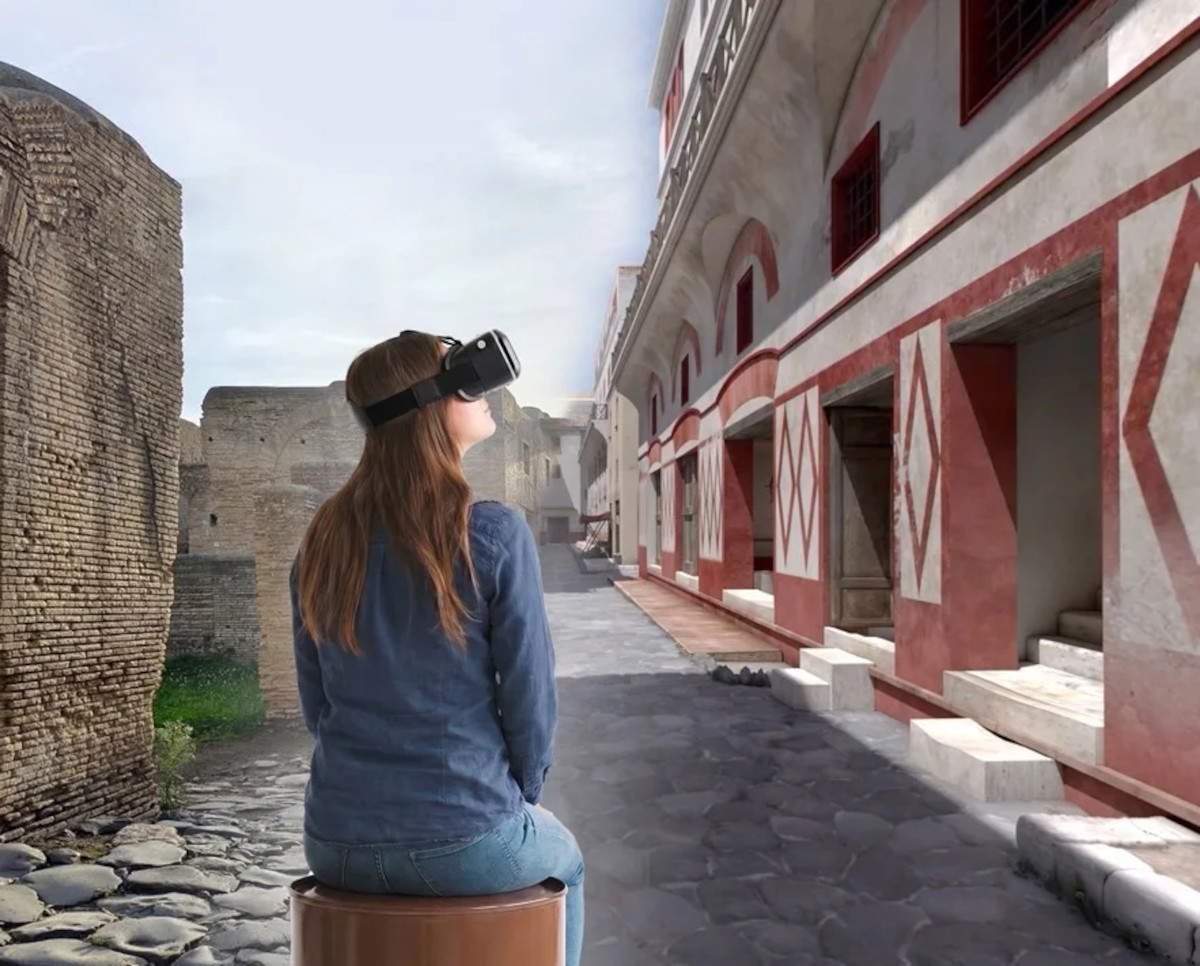
Two Virtual Tours to Discover Ostia
Inside the arcades of the Ostia Theater, two different routes will be offered, both integrated with a virtual tour of the Caupona del Pavone, previously reconstructed as part of the “S.T.Ar.T. Ostia” project.
The first itinerary will begin at the monumental Porta Romana, the ancient gateway to the city, and continue along a section of the Decumanus Maximus. The route will then allow visitors to virtually enter the Baths of Neptune, observing the rooms and famous mosaics up close, before reaching the Piazzale delle Corporazioni and the Theater. Here, the experience will conclude with a particularly evocative scene: seated in the auditorium, bathed in the warm light of the sunset, visitors will be able to witness the finale of a performance, with the monumental marble stage serving as a backdrop.
The second tour, on the other hand, will wind through the heart of the ancient city, starting from Via di Diana, characterized by its insulae—multi-story residential buildings—and numerous shops. After a stop at the House of Diana and the Thermopolium, the virtual tour will end in the Forum Square, the center of public and social life in Ostia.
A Virtual Journey Through the Port of Claudius and Trajan
Visitors can also enjoy an immersive experience at the Imperial Ports archaeological site in Fiumicino. At Casale Torlonia, visitors can virtually board a ship and retrace the journey to Rome through its ancient port system. The vessel will set sail from the open sea, enter the Port of Claudius, and follow the pier until it reaches Trajan’s striking hexagonal basin. All around, visitors can observe the imposing facades of the warehouses and the cargo-handling activities that once bustled along the docks.
The reconstructions have been rendered in photorealistic detail, enhanced by animations and 360-degree panoramic images. This feature allows visitors to explore the environments from different perspectives, without being limited to a single vantage point. The goal is to convey as vivid a picture as possible of Ostia and its ports, bringing to life the activities, spaces, and atmospheres that characterized these places in antiquity.
Technology thus becomes a tool to expand and enrich the visit, offering new opportunities for learning and deeper understanding without replacing the direct experience of the monuments and archaeological landscapes. The “Ostia Antica” app and the new immersive reality experiences will be available to the public starting Tuesday, November 10, 2026.
“The completion of the multimedia project at the Ostia Antica Archaeological Park,” states the Park’s Director, Alessandro D’Alessio, “marks a moment of radical renewal in how the extraordinary archaeological heritage of the Ostia Excavations, the Imperial Harbors of Claudius and Trajan, the Porto Necropolis at Isola Sacra, and the Laurentina Necropolis is experienced. Designed and developed to offer visitors various levels of in-depth exploration and with a strong focus on the philological accuracy of the reconstructions and settings, it aims to provide the public—indeed, diverse audiences—with a decidedly up-to-date and more informed experience of one of the world’s major archaeological and monumental complexes.”
“The Ministry of Culture,” states Alfonsina Russo, Head of the Department for the Promotion of Cultural Heritage, “has for several years now had a wide and varied range of multimedia products to support visits to museums and archaeological parks. These are tools that enhance the experience of the country’s cultural heritage alongside more traditional methods, and that aim for a more inclusive and accessible form of outreach, one that speaks the language of the contemporary world and of younger generations. The field of digital humanities places Italy among the world’s leaders, particularly in terms of the scientific quality of the reconstructions presented, and now makes the Ostia Antica Archaeological Park one of the cultural sites best equipped with VR multimedia products.”
|
| Ostia Antica Comes to Life Through Virtual Reality: An Immersive Journey Through the Streets and Harbors of the Ancient City |
Warning: the translation into English of the original Italian article was created using automatic tools. We undertake to review all articles, but we do not guarantee the total absence of inaccuracies in the translation due to the program. You can find the original by clicking on the ITA button. If you find any mistake,please contact us.