




by Redazione 14/10/2026



Categories: Archaeology / Disclaimer
The Archaeological Park of Pompeii is reviving the project conceived in 1866 by Giuseppe Fiorelli with a new school dedicated to advanced education and field research. The inaugural program will be dedicated to “The Animals of Pompeii.”


Transforming Pompeii into a major center for education, as well as for field research: this is the project that Giuseppe Fiorelli envisioned over 150 years ago and that is now being revived through a new initiative by the Archaeological Park. It is called La Scuola di Pompei and aims to turn the ancient city into a center for advanced education, research, and experimentation, in collaboration with Italian universities.


The initiative revives and updates one of the most ambitious visions in the history of the Pompeii excavations, offering young scholars the opportunity to engage with the archaeological heritage through an interdisciplinary educational experience. For its first year, the program will focus on “The Animals of Pompeii,” a theme that is also set to become the centerpiece of an upcoming exhibition at the Park. Six curricular internships are planned, open to students enrolled in master’s and doctoral programs, with a stipend of 700 euros for each participant.
In 1866, Giuseppe Fiorelli—one of the most important directors of the Pompeii Excavations—founded the site’s first School of Archaeology, also known as the School of Pompeii. His goal was ambitious: to turn the ancient city into a permanent laboratory where young archaeologists could train throughdirect field experience, combining theoretical study with research. The project, however, was short-lived, hampered by a lack of resources, facilities, and students.




Fausto Zevi, an archaeologist and superintendent of Pompeii from 1977 to 1982, highlighted its significance, describing the experience as an “exceptional opportunity” for training, accompanied by the “bitter […] certainty of a great missed opportunity.”
Fiorelli’s vision was part of the broader ferment in nineteenth-century European archaeology, when institutions dedicated to research and training were taking shape in the major centers of the classical world. A similar vision would find expression in 1909 with the founding of the Italian Archaeological School of Athens, which was destined to become an international center of excellence for studies of the ancient world.
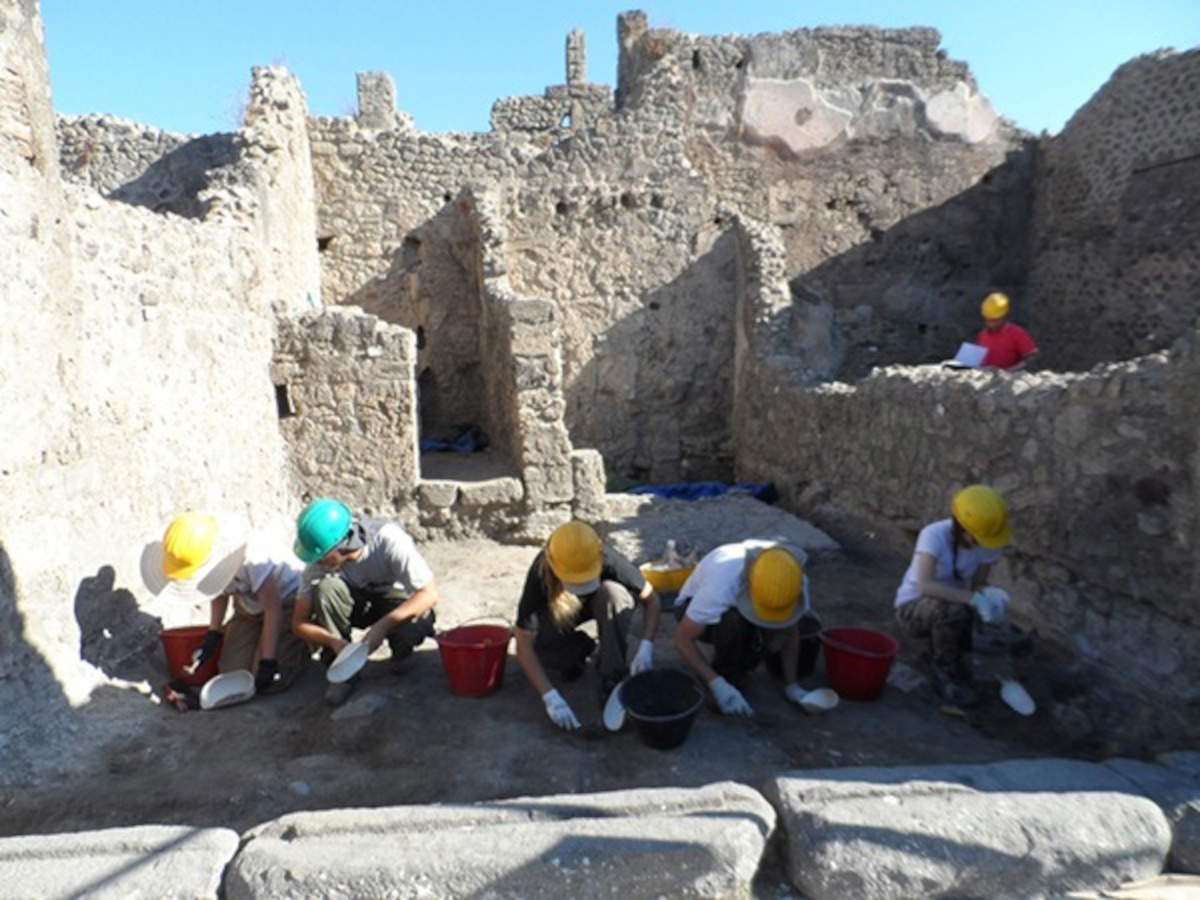
Today, the Archaeological Park aims to reclaim that legacy through a concrete project: the construction of a campus in the San Paolino area. The complex will be designed as a space dedicated to education, research, and the sharing of scientific findings, featuring a library, guest quarters, a storage facility and laboratory, and spaces for study and temporary exhibitions. The new School aims to be a working environment where contemporary methods of archaeological research can be explored. Direct contact with the site will allow students to engage with artifacts, investigative methods, and scientific questions, developing skills useful for their future professional careers.
The educational program will also include participation in initiatives to promote the Park, including the design of temporary exhibitions. In this way, the training will not be limited to the study of materials but will also encompass the ability to communicate research findings to the public. The goal is to create a concrete link between scientific knowledge, conservation, and public outreach, making Pompeii an environment where the various stages of archaeological work can be experienced firsthand.
The School’s inaugural program will be dedicated to “The Animals of Pompeii,” a theme that will allow participants to explore various aspects of life in the ancient city through an interdisciplinary lens. This same topic will form the core of an upcoming exhibition organized by the Archaeological Park. This choice aims to connect archaeological research with other disciplines, highlighting the insights that the study of animal remains can offer about ancient society and the relationship between humans, the environment, and animals. Participation in the project will offer young scholars the opportunity to engage in research and outreach activities, contributing to the development of scientific content intended for public dissemination.
For the first year of the project, six curricular internships are available for students enrolled in master’s or doctoral programs at Italian universities. Applications are open to students from various disciplinary fields, including Archaeology, Conservation, Museology, History, Classical Philology, Biology, Archaeozoology, Art History, and related fields.
The internship will take place in person at the Archaeological Park of Pompeii, tentatively between March and April 2027, for a total of 150 hours to be completed over a two-month period. The activities will be preceded by a three-day preparatory meeting. Participants may be offered, upon request, accommodations at the Park’s guesthouse. At the end of the program, each intern will receive a stipend of 700 euros.
Applications must be submitted by November 22, 2026, via certified email (PEC) to pa-pompei@pec.cultura.gov.it. (To view the call for applications, click here).
“Our School of Archaeology is not in competition with doctoral or specialization programs, as Fiorelli’s School was 150 years ago, but rather is closely complementary to them: we offer hands-on field experience to apply theory to the reality of the ancient city,” emphasizes the director of the Archaeological Park of Pompeii, Gabriel Zuchtriegel. “With this program, we aim to consolidate Pompeii’s role as an international hub for research and education, offering young people an extraordinary opportunity: to work closely with the archaeological heritage, research data, excavation sites, and the professionals who work daily at the Park.”
|
| Pompeii Revives the School of Archaeology: Advanced Field Training Internships for Young Researchers |
Warning: the translation into English of the original Italian article was created using automatic tools. We undertake to review all articles, but we do not guarantee the total absence of inaccuracies in the translation due to the program. You can find the original by clicking on the ITA button. If you find any mistake,please contact us.