





The National Archaeological Museum of Civitavecchia is preparing to welcome an artifact of extraordinary historical, documentary, and symbolic value. To mark the museum’s reopening, scheduled for September 18 following a major renovation and redesign, the funerary inscription of Sesto Congenio Vero, a sailor in the Praetorian fleet of Miseno, which had been presumed lost since World War II and was recently returned to Italy by the United States thanks to a complex international cooperation effort coordinated by the Carabinieri Command for the Protection of Cultural Heritage. This restitution represents one of the most significant recoveries of Italian archaeological artifacts in recent years and allows a work that seemed permanently lost to be reunited with the museum’s collections. The marble stele had in fact disappeared in 1943, when the Civic Museum of Civitavecchia, where it was housed, was destroyed by bombing during World War II. For over eighty years, there was no further news of the artifact, until its unexpected reappearance in the United States.
The inscription, dating to the 2nd century A.D., had been discovered in 1866 during construction work on the Civitavecchia prison. The discovery took place in the area of the Roman burial ground at Prato del Turco, near ancient Centumcellae—today’s Civitavecchia—one of the most important seaports of the Roman Empire. The burial ground was intended for sailors from the praetorian fleets of Miseno and Ravenna, tasked with ensuring the security of the monumental port built by Emperor Trajan, one of the main ports of call in the western Mediterranean. After its discovery in the 19th century, the tombstone became part of the city’s Civic Museum collection, contributing to the documentation of the Roman navy’s presence in the ancient port of Centumcellae. However, the destruction of the museum building during World War II seemed to seal the fate of the artifact, which was considered lost from that point on, although it remained known to scholars through transcriptions and major epigraphic catalogs.
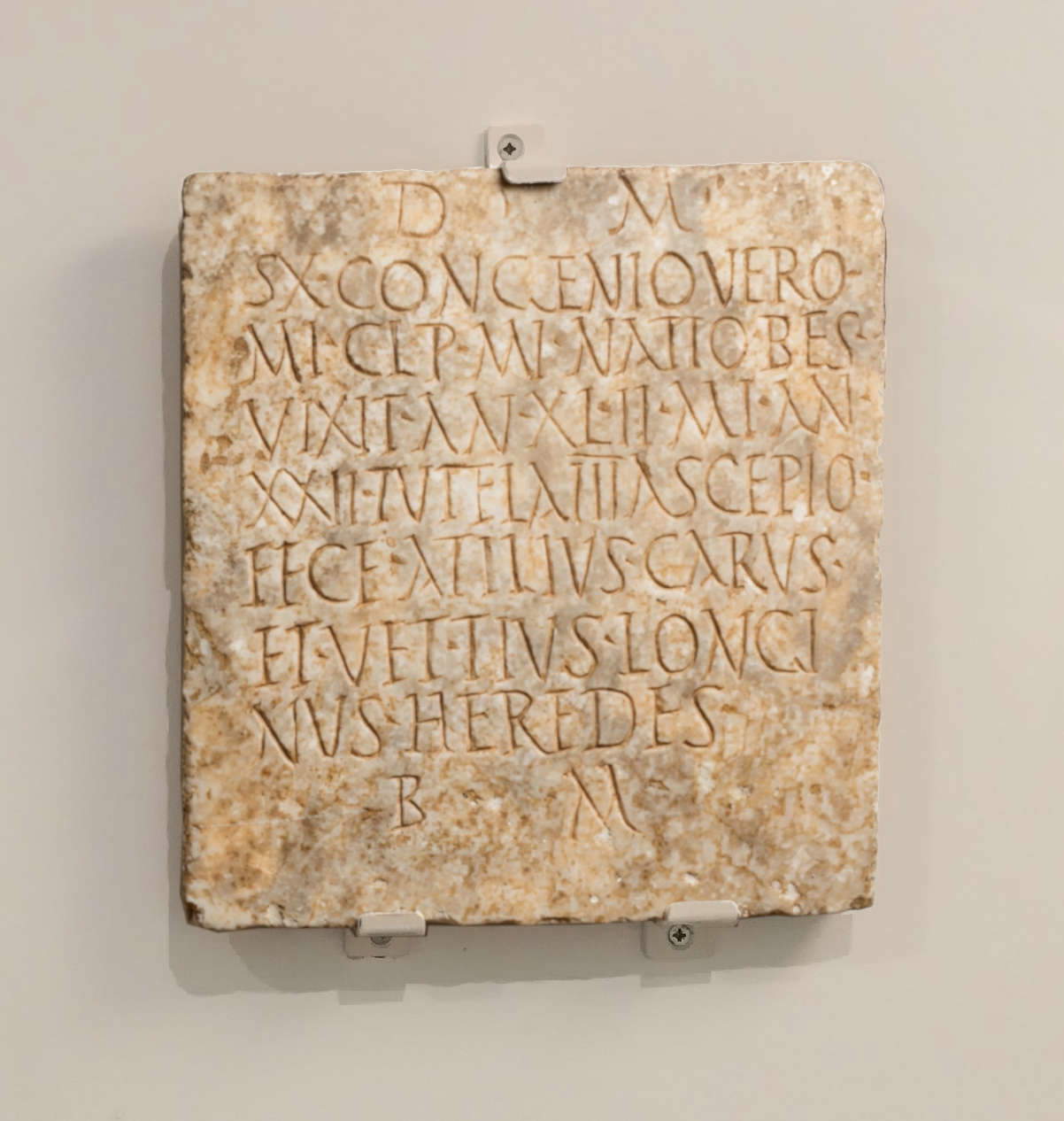
The turning point came in March 2025, when the inscription reemerged completely unexpectedly in New Orleans, in the United States. It was recognized by Professor Susan S. Lusnia, a professor of Classical Archaeology at Tulane University, who identified the marble slab as the funerary inscription of Sextus Congenius Verus—known to the scientific community but believed to have been lost for over eighty years.
This identification paved the way for a complex international collaboration involving Italian and U.S. institutions. A decisive factor was the attitude of the private individuals who had come into possession of the artifact and who expressed a willingness to voluntarily return it to Italy. On this basis, it was possible to initiate the necessary procedures for its repatriation. The operation involved collaboration between the FBI’s Art Crimes Unit—the division of the Federal Bureau of Investigation specializing in the protection of cultural heritage—the Consulate General of Italy in New York, the Carabinieri Command for the Protection of Cultural Heritage, and the Public Prosecutor’s Office at the Court of Civitavecchia. The joint efforts of these institutions made it possible to successfully complete all necessary procedures, culminating in the inscription’s return to Italy on April 10, 2026.
The recovery holds significance that goes beyond the mere physical return of an archaeological artifact. The inscription is, in fact, direct evidence of the presence of the Praetorian fleet of Miseno at Centumcellae and constitutes a valuable source for reconstructing the composition and organization of the Roman naval forces assigned to defend Trajan’s port. The inscription is dedicated to Sextus Congenius Verus, a soldier in the Praetorian Fleet of Miseno who was a member of the Bessi, an ancient ethnic group from Thrace. The text notes that the soldier lived forty-two years and served for twenty-two years in the imperial navy, thus providing valuable information both on the deceased’s career and on the multicultural composition of the Roman armed forces. The inscription also mentions two triremes, the Tutela andthe Ascepio, identified as the sponsors of the funerary monument, while the dedication is attributed to Atilius Carus and Vettius Longus. These details allow scholars to deepen their understanding of the internal dynamics within crews and the commemorative practices adopted within the imperial fleets.
The text of the inscription reads: “To the gods / To Sextus Congenius Verus / a soldier of the Praetorian Fleet of Miseno, born in Bessus / who served for(nis) XLII mi(litavit) an(nis) / 5 XXII, Tutela ((trireme)) Ascepio / fece(runt) Atilius Carus / et Vettius Long,” meaning “To the Manes. To Sextus Congenius Verus, a soldier in the Praetorian Fleet of Misenum, originally from Bessus (in Thrace). He lived 42 years and served in the military for 22 years. The trireme Tutela and the trireme Ascepio erected the funerary monument. It was dedicated by Atilius Carus and Vettius Longus.”
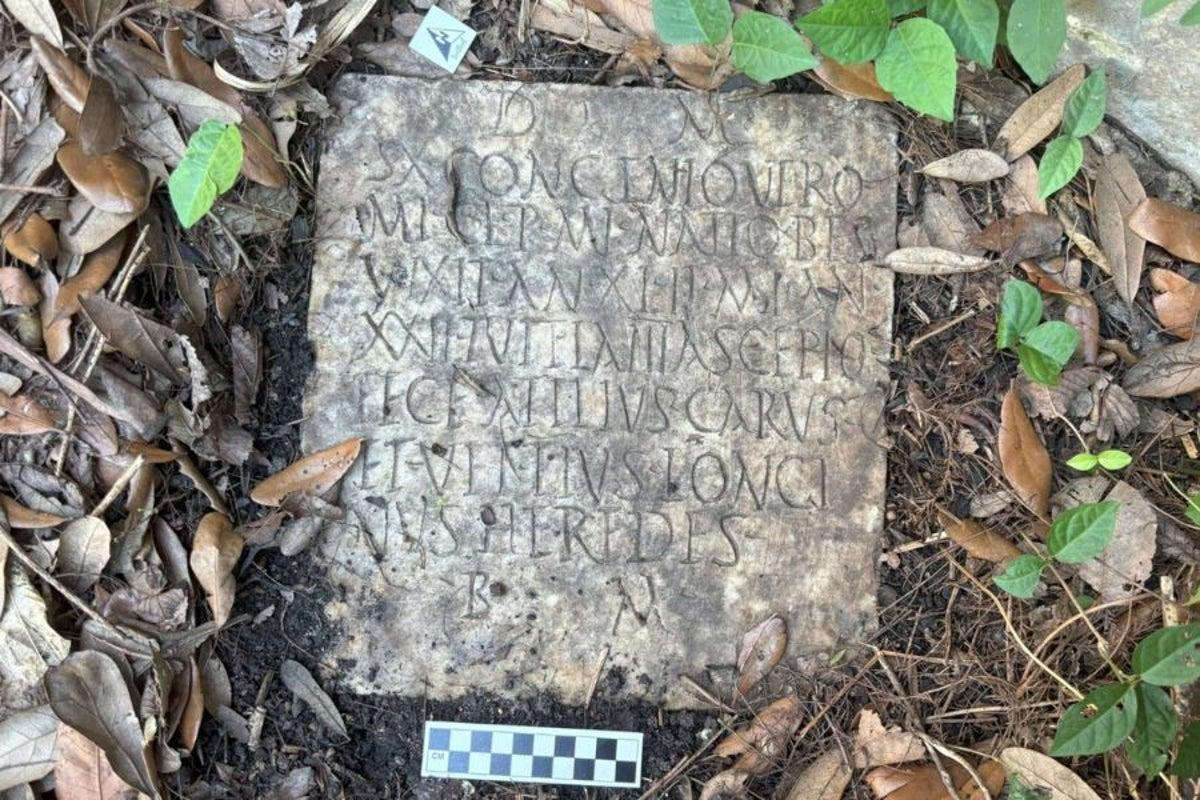
Physically, the tombstone is small in size, measuring 31.5 centimeters in height, 29.5 centimeters in width, and 2.5 centimeters in thickness. Despite the events that have marked its conservation history and its long stay outside Italy, the artifact retains its documentary value intact and constitutes a source of primary importance for reconstructing the history of the ancient Roman port.
The return of the inscription coincides with a phase of profound renewal at the National Archaeological Museum of Civitavecchia, an institution under the jurisdiction of the Lazio Regional Directorate of National Museums. The artifact will, in fact, become part of the new permanent exhibition designed as part of the redevelopment and redesign project, which will be inaugurated on September 18. The new exhibition layout was designed with the aim of offering a cohesive narrative of the history of Civitavecchia and its surrounding area, spanning a chronological arc of over three thousand years. The exhibition will highlight numerous artifacts previously stored in the museum’s storage facilities, finally making them accessible to the public and integrating them into an updated narrative of the region’s history.
Alongside the archaeological artifacts, the exhibition will feature reconstructions, three-dimensional models, multimedia installations, and numerous tools designed to support physical, sensory, and cognitive accessibility. The goal is to create a visitor experience that combines scientific rigor with contemporary educational tools, making the archaeological heritage understandable and accessible to the widest possible audience.
|
| Roman Inscription Missing Since 1943 and Rediscovered in the U.S. Returned to the Civitavecchia Museum |

Warning: the translation into English of the original Italian article was created using automatic tools. We undertake to review all articles, but we do not guarantee the total absence of inaccuracies in the translation due to the program. You can find the original by clicking on the ITA button. If you find any mistake,please contact us.




























 IT
IT FR
FR DE
DE ES
ES CN
CN


