



by Redazione 23/11/2026



Categories: Art and artists / Disclaimer
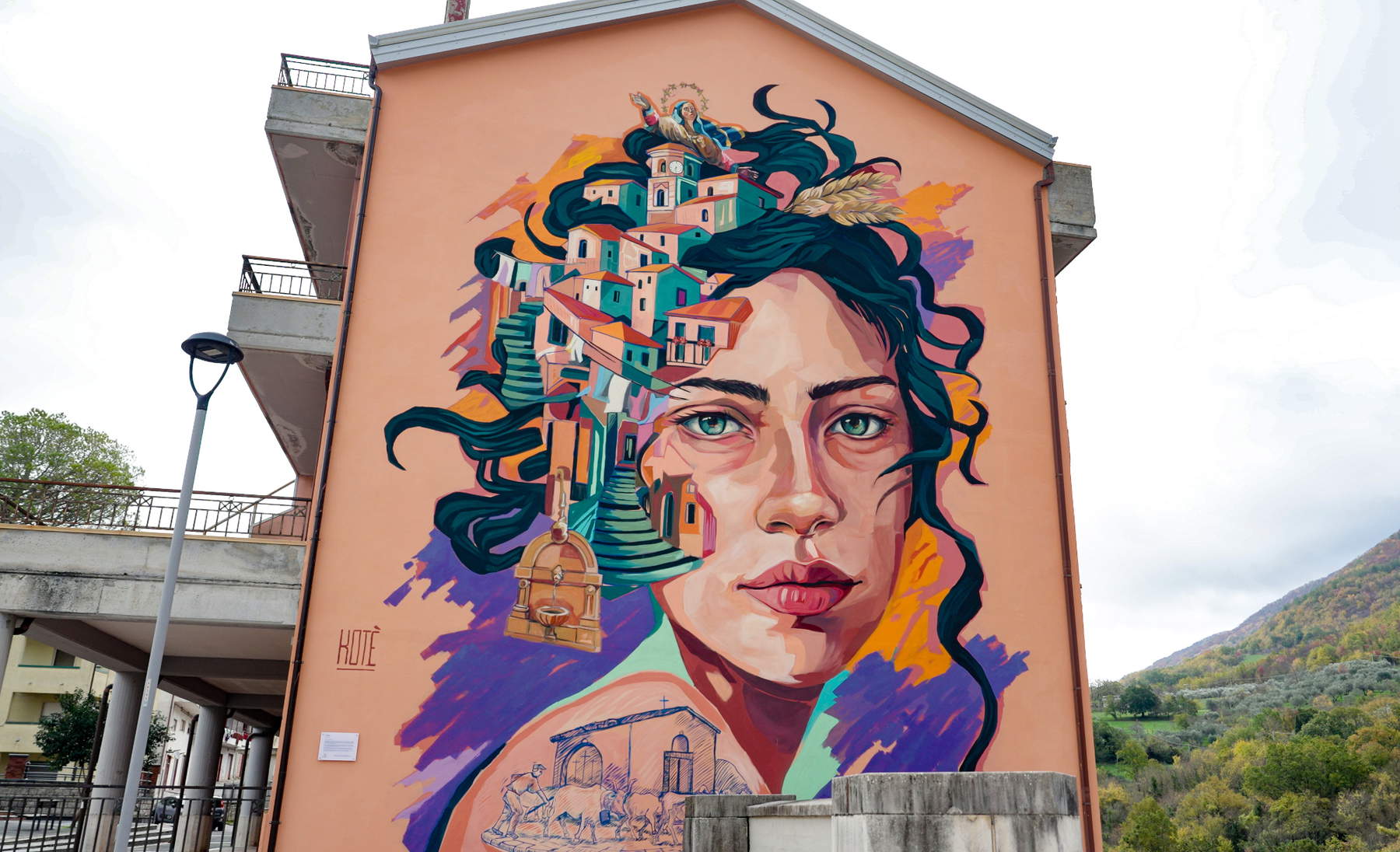
Forty-six years after the Irpinia earthquake, the artist Kotè is creating a large mural in Laviano, in the Salerno area. The portrait of a young woman incorporates the architecture, traditions, and symbols of the ancient community, transforming urban art into a tool for collective memory.


The face of a young woman has become the symbolof Laviano, whichwas almost entirely destroyed by the earthquakeof November 23, 1980. The new mural, titled “Laviana,” was created by Salerno-based artist Antonio Cotecchia—known by his artist name Kotè—and unveiled on Sunday, November 22, 2026, in the town center, in the province of Salerno. The work was created to mark the 46th anniversary of the Irpinia earthquake, which almost completely destroyed the village in the Sele Valley, leaving a deep wound in the community and its history.


The project, sponsored by the Laviano municipal government in collaboration with the ArteViva ETS association, was unveiled during a well-attended ceremony attended by Mayor Piero Robertiello, parish priest Don Giuseppe Zarra, regional councilor Luca Cascone, and the artist himself.
The urban art installation covers the side facade of a residential building overlooking Piazza della Repubblica, one of the main landmarks of city life. The choice of location holds special significance: the square is home to the Triton Fountain and the 1924 War Memorial, created by the Perugian sculptor Torquato Tamagnini. Together with Castello D’Anna, these monuments represent some of the few historical remnants of the ancient town that survived the earthquake.




With *Laviana*, Kotè continues his artistic exploration centered on large-scale female portraits painted on building facades. This stylistic signature is already recognizable in some of his works in Salerno, the artist’s hometown, where—in the Torrione and Pastena neighborhoods—he created *Figlie del tempo, fuori del tempo*( Daughters of Time, Outside of Time), dedicated to the Salerno School of Medicine, and *Parolana*, centered on freedom of the press and expression. In the new mural, the young woman’s face transforms into a sort of visual archive of local memory. Among her features, glimpses of the pre-earthquake Laviano—its buildings and traditions—take shape. The composition unfolds from top to bottom, bringing to life the ancient Mother Church of Santa Maria Assunta with its bell tower, the alleys and stairways of the historic center, the traditional homes and laundry hanging out to dry, all the way to the Fontana dei Papi. Even the details of the portrait contain references to the culture and history of the region. On the young woman’s arm is a monochromatic tattoo evoking the Turniata di San Vito, an ancient agrarian-pastoral rite of the community, while three ears of wheat are woven into her hair—a tribute to the Via del Grano, the ancient trade route that connected Laviano to the commercial networks spanning Campania, Basilicata, and Puglia.
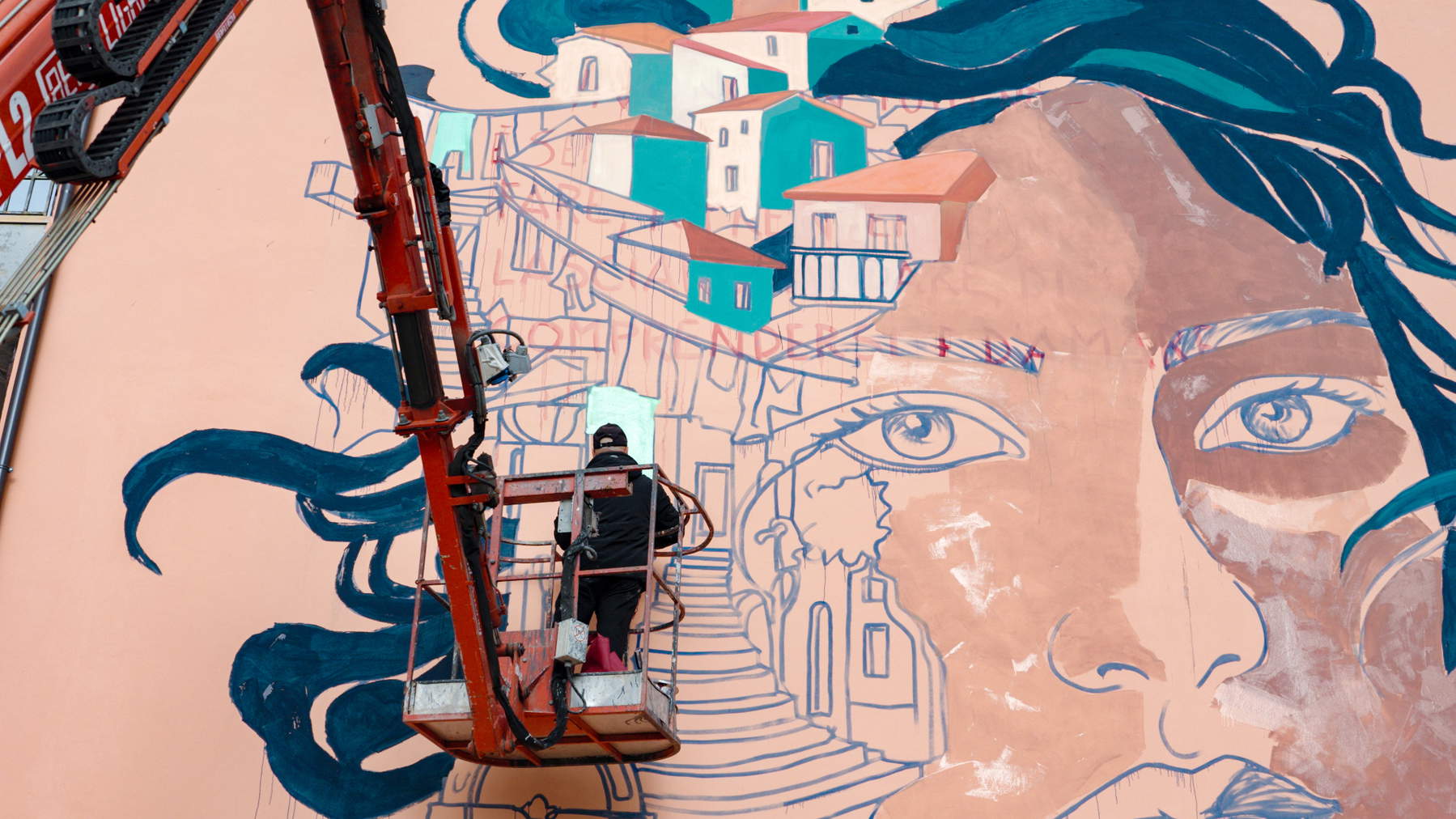
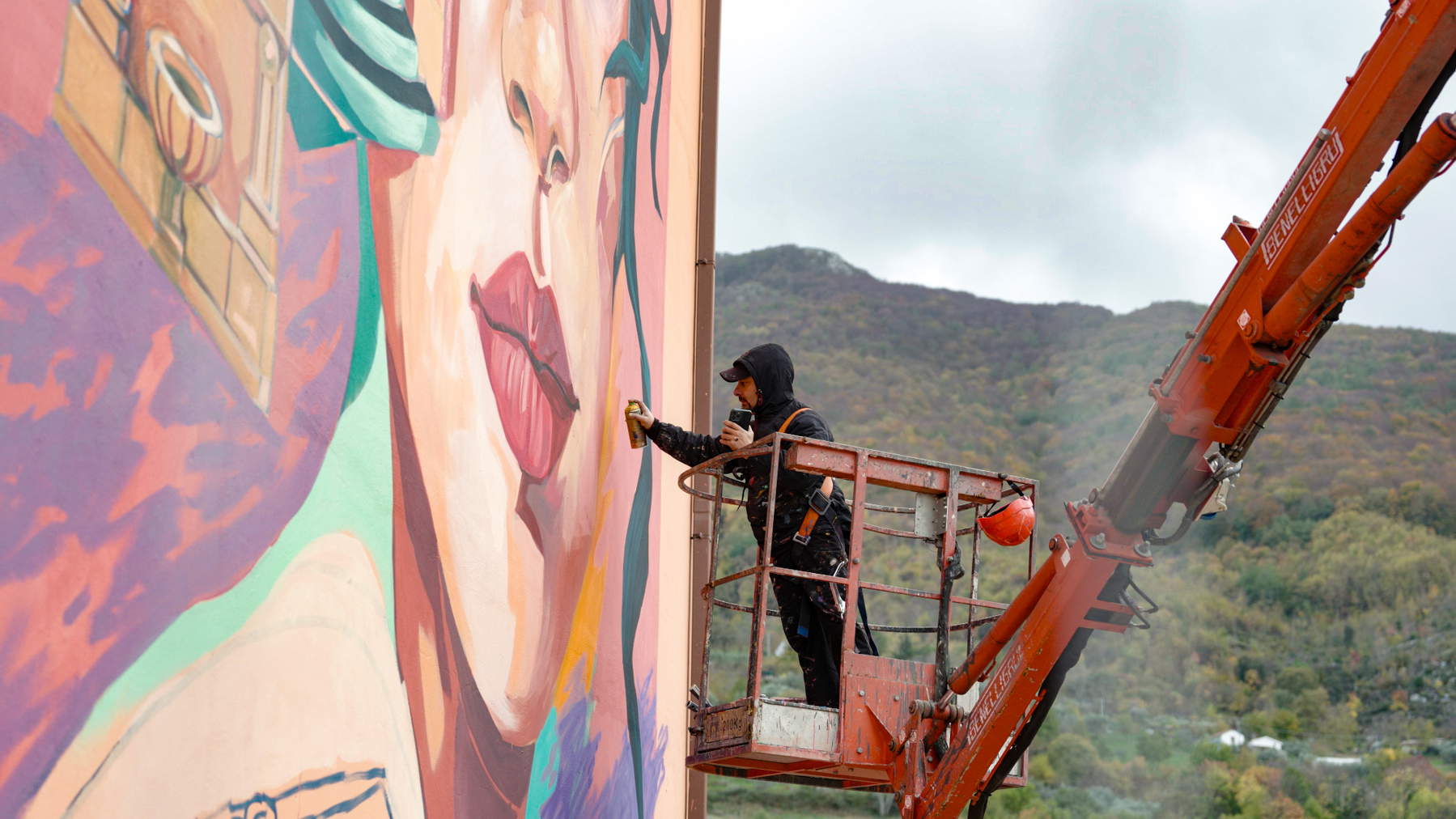
The creation of “Laviana” was preceded by research and dialogue with the local community. In the months leading up to the mural’s creation, Kotè met with the town’s residents, gathering testimonies, personal memories, and stories related to daily life in the ancient village. These conversations made it possible to recover not only images and places that have since disappeared, but also traditions, rituals, and customs that continue to represent an important part of the collective identity. The mural becomes a meeting point between past and present, aiming to bring a shared memory back into the spotlight and keep alive the bond between the community and its origins.
Antonio Cotecchia, known artistically as Kotè, is a painter, urban artist, and sound artist. For over twenty years, he has been pursuing a body of work that spans the visual arts, music, and experimentation, developing a language centered on identity and the complexity of human nature.
“I tried to entrust to this girl’s gaze the power to transform pain into awareness and healing. Memory does not live solely in the recollections of survivors or in photographs tucked away in drawers, but in a small community it is nourished every day through listening and the way residents care for one another,” explained Kotè. “I wanted to portray the face of a new generation that embraces and cherishes this memory, and with confidence and courage experiments with a new way of inhabiting a place that is as tormented as it is beloved—in other words, of being in the world.”
With Laviano, the artist entrusts the mural with the task of preserving the memory of a town and the people who lived there, transforming a large urban surface into a collective narrative of Laviano’s history.
“Over time, I’ve come to realize that depicting reality is never simple. Memories overlap, transform, and sometimes end up raising doubts, leaving a sense of uncertainty about what really happened,” says the mayor of Laviano, Piero Robertiello, the initiative’s promoter. “I believe that this is precisely where one of art’s greatest values lies: the ability to freeze a moment, to preserve it, and to share it with others through a personal perspective. Art reinterprets reality, certainly, but at the same time it leaves a tangible trace—a starting point from which future generations can continue to reflect on their own past.”
“More and more young local officials are choosing participatory urban art projects as a catalyst for structured paths of renewal and community engagement. They know full well that a mural, to put it simply, is not a cure-all, but it is a concrete first step. “As an association, we’re happy to help make their vision a reality,” commented Debora Malaponti of the ArteViva ETS association.
|
| The face of a young woman painted on a wall serves as a reminder of the town devastated by the Irpinia earthquake |
Warning: the translation into English of the original Italian article was created using automatic tools. We undertake to review all articles, but we do not guarantee the total absence of inaccuracies in the translation due to the program. You can find the original by clicking on the ITA button. If you find any mistake,please contact us.