



by Redazione 23/11/2026



Categories: Contemporary art / Disclaimer
Two Swiss artists reinterpret the collection of the MASI in Lugano through new works, sculptures, and installations that engage with more than twenty pieces from the museum’s collection.


The myth of the feminine, the forces of nature, and the connections between past and present form the central theme of “Re-imaginings,” the new exhibition project at MASI—the Museum of Art of Italian-Speaking Switzerland in Lugano. The featured artists are Mai-Thu Perret (Geneva, 1976) and Una Szeemann (Locarno, 1975), who present two solo exhibitions interwoven with a selection of over twenty works from the museum’s collection, chosen directly by them. Paintings, sculptures, and graphic works—spanning from the 19th century to the present day—thus engage with recent creations and new works produced specifically for this exhibition by the two artists, giving rise to an exhibition itinerary where historical heritage meets contemporary artistic exploration.


The exhibition, open from November 15, 2026, to May 16, 2027, marks the first exhibition curated at MASI by Director Letizia Ragaglia and inaugurates a new exhibition season aimed at strengthening the relationship between the museum’s international mission and the Ticino region. The goal is to engage artists in a reinterpretation of the local cultural and museum heritage. As the title suggests, the project invites visitors to view the museum as an open, dynamic, and ever-evolving space, where one can rethink not only the works in the collection but also the very function and meaning of the museum as an institution.


While developing independent trajectories and distinct artistic languages, Perret and Szeemann share several interests: the circular conception of time, the material dimension, and representations of the feminine. Their explorations span myth, nature, and narrative, albeit from different perspectives. Mai-Thu Perret focuses on deconstructing dominant discourses, while Una Szeemann explores dreams and the realms of the unconscious. Furthermore, both seek to transcend categories of thought still tied to an anthropocentric view of the world, favoring a broader and more holistic approach, often characterized by a feminine sensibility.


“The decision to draw on the artistic visions of Mai-Thu Perret and Una Szeemann enriches the museum with new perspectives: through these two artists, a ‘philosophy of the interstice’ is introduced, shifting the focus to relationships, processes, liminal zones—in this way, we aim to present an exhibition that does not provide answers but instills questions and reflections, becoming a space of potential and creation attentive to the experience of visitors,” emphasizes Letizia Ragaglia, director of MASI and curator of the exhibition.
Mai-Thu Perret: Ancient Deities, Archaeology, and New Feminine Iconographies
At MASI, Mai-Thu Perret presents a series of sculptures that reimagine mythological figures and hybrid female deities, creating a dialogue between archaeological references, ancient imagery, and feminist reinterpretations of historical forms. Among the previously unseen works is *The Garden*, a large tapestry created for the occasion, in which plant and animal motifs merge into a single composition. The piece was produced in Mexico by the Gobelinos Guadalajara atelier, with the involvement of local artisans.
Artistic, literary, and biographical sources are a fundamental component of Perret’s practice, which she combines with elements of the imagination to construct multi-layered narratives. In the works on display in Lugano, this method gives rise to unexpected and utopian visions in which different eras and languages overlap.
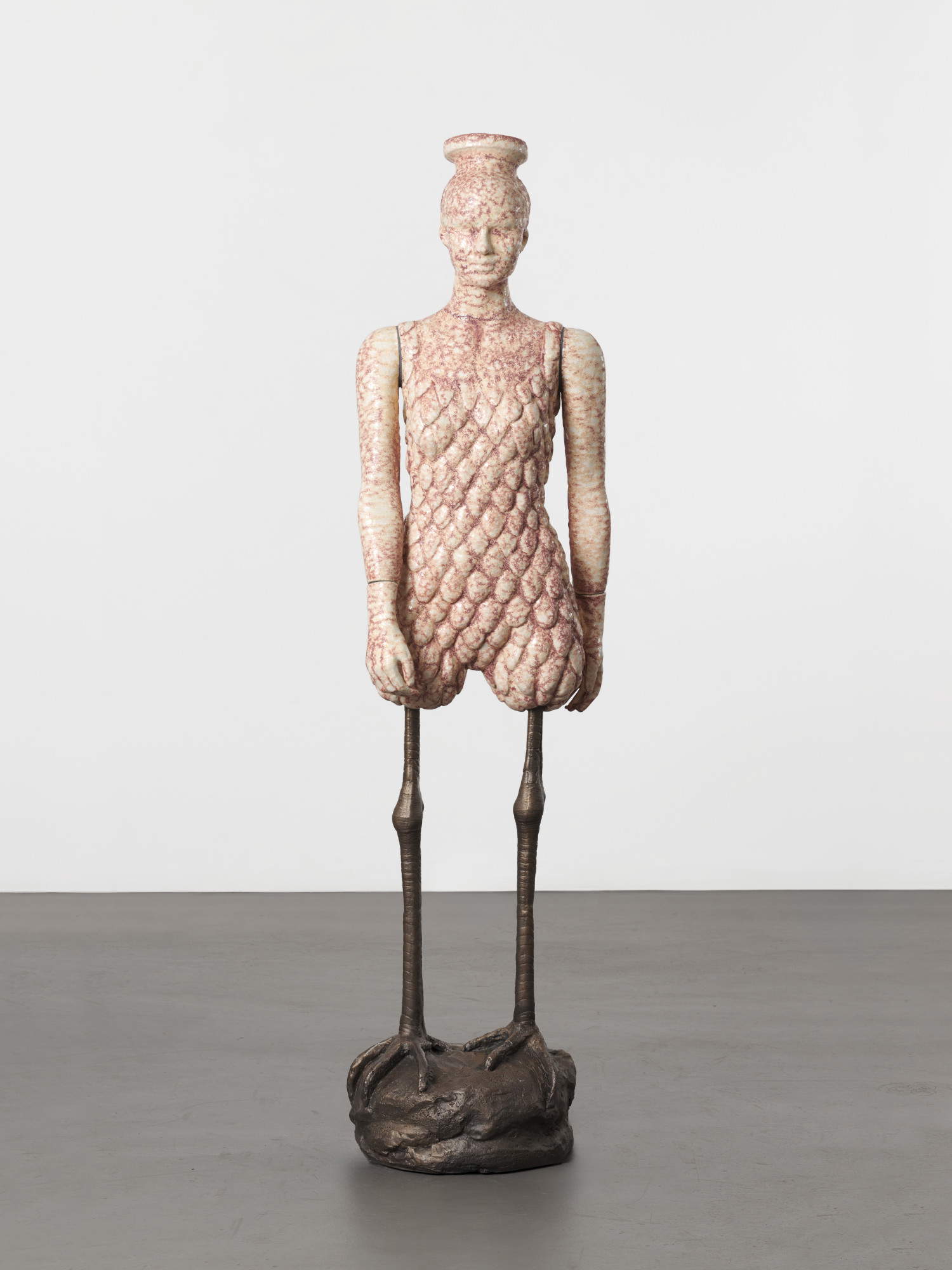
This is the case with *Siren I* and *Siren II* (2024), two life-size sculptures in ceramic and bronze depicting imposing creatures, facing the audience head-on and characterized by an almost menacing presence. The works are loosely inspired by two 4th-century B.C. terracotta sculptures housed at the National Archaeological Museum of Taranto, and they reclaim the image of Homeric sirens as monstrous, composite beings—half-woman, half-bird. Perret thus restores to these figures their original irrational and destructive nature, moving away from the sensual and alluring image that subsequent patriarchal interpretations have progressively constructed.
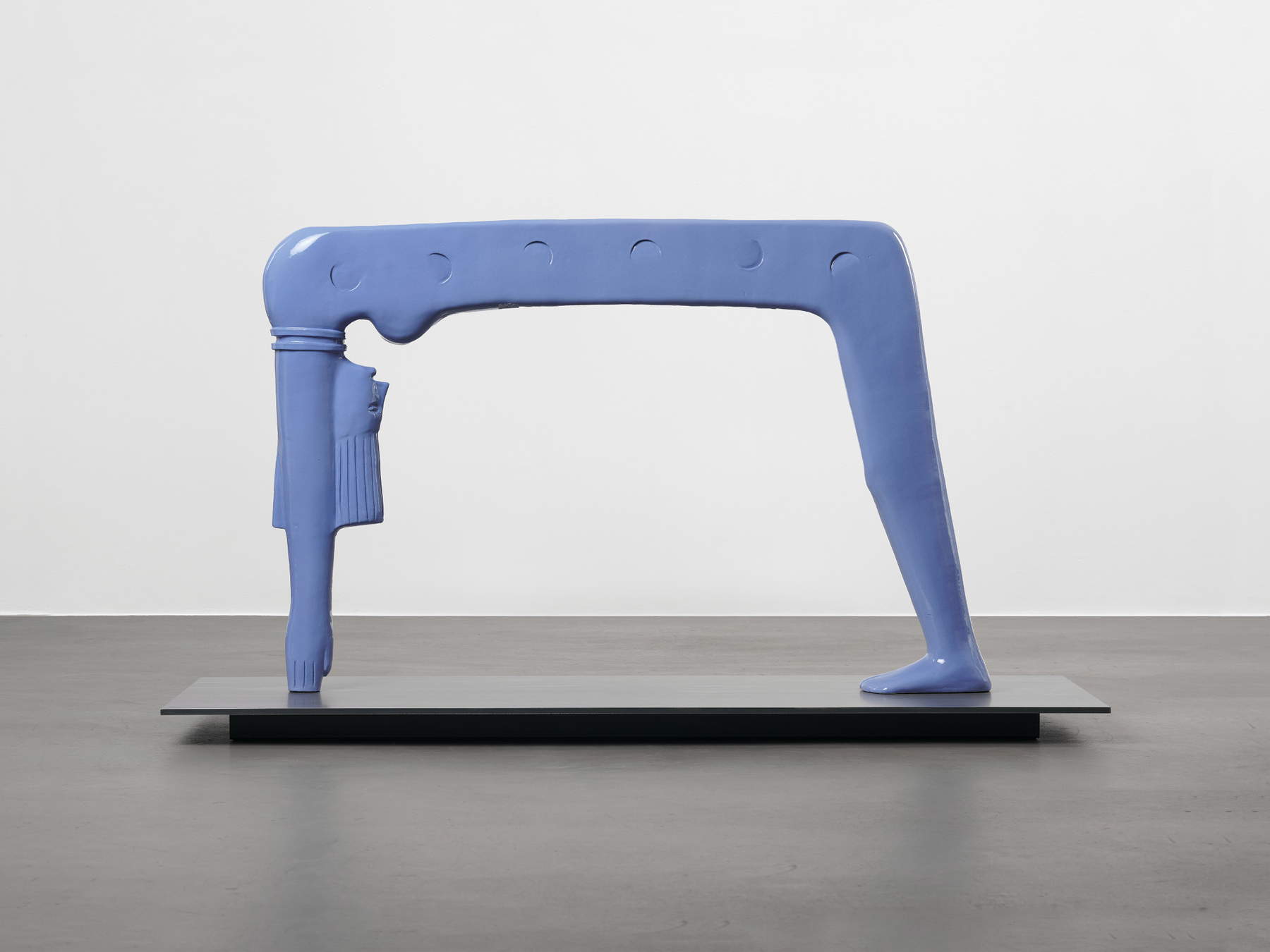
In *Nut I* (2026) as well, the divine feminine is removed from the purely figurative and decorative realm to take on a structural function. The blue ceramic sculpture, in fact, depicts the Egyptian goddess of the sky through an essential and minimalist form, transforming her into an element capable of symbolically supporting entire worlds. The work evokes ancient knowledge linked to natural rhythms and processes of regeneration, of which Nut is an expression.
An equally significant reinterpretation concerns Minerva, the Roman deity associated with knowledge and the protector of artisans, poets, and poetesses. In *Minerva I* (2022), Perret reimagines her appearance, drawing inspiration from a relative of her own—a Euro-African woman—and creates a sculpture entirely out of red-glazed ceramic. The intense hue introduces new meanings into the traditional iconography of the goddess, evoking revolution, menstrual blood, and the cyclical nature of the female body.
Una Szeemann: Between Dreams, Botany, and the Symbolism of the Ticino Region
Una Szeemann’s practice, on the other hand, unfolds through installations and material compositions that draw on enigmatic symbolism, dreamlike imagery, and the unconscious. Botany, geology, and rituality constitute some of the main areas of reference in her practice, which on this occasion engages specifically with the landscape and traditions of the Canton of Ticino.
Among the new works created for the exhibition are the neon piece *As Above*, *So Below* (As Above, So Below), inspired by folk tales of mermaids and nymphs from the lakes of Ticino, and *Divine Anomalies*, a set of four sculptures evoking the silhouettes of female bodies. In the first work, the mermaid—a creature suspended between water and air—becomes the emblem of the connection between the microcosm and the macrocosm, in accordance with the hermetic principle evoked by the title. The second work, on the other hand, is situated in the suspended space at the tip of the LAC, where the four figures form a sort of magic circle, in dialogue with the Ticino landscape and its geological and symbolic stratifications.
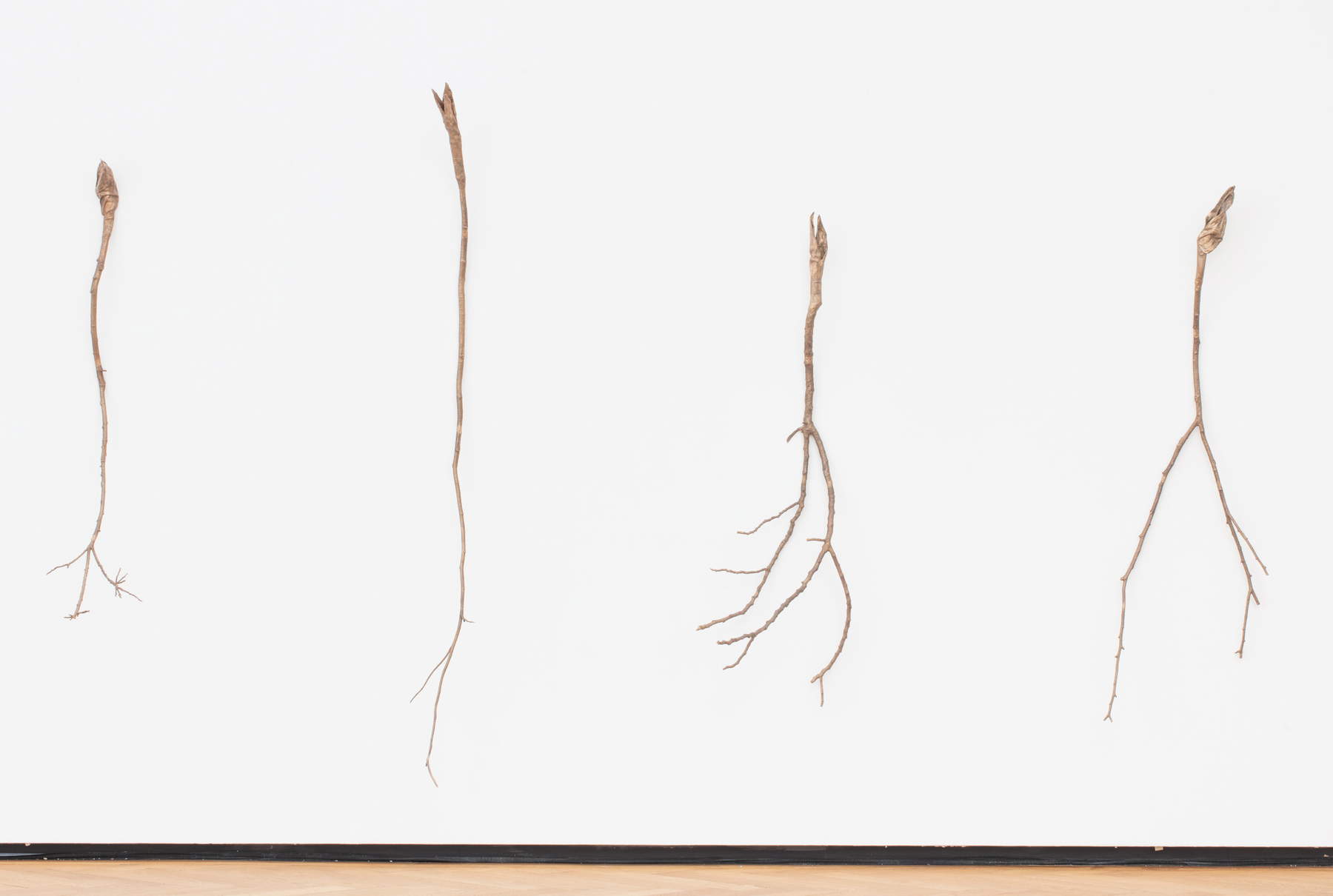
For the exhibition project, Szeemann also returned to her formative experiences connected to Monte Verità in Ascona, a place upon which numerous artistic, spiritual, and geological narratives have accumulated over time. The materials used for *Incantarsi* (2024)—a series of sculptures created by fusing branches of birch, chestnut, ash, and linden, trees traditionally used in medicinal and ritual practices—come from this territory and the surrounding areas. The compositions are topped with a palm frond. The result recalls forms that oscillate between lightning bolts and witches’ brooms, evoking the animistic traditions and oral culture of pre-Christian rural Europe.
Observation of nature and imagination also merge in *The Birds Said You Move*, a work created between 2021 and 2026. It was inspired by the resilience of the banana plants grown in the artist’s garden in Tegna. The sculptures, arranged on a table as if they were offerings to the gods, transform this plant—a symbol of the continuous cycle of life and death—into a material and spiritual conduit to other dimensions.
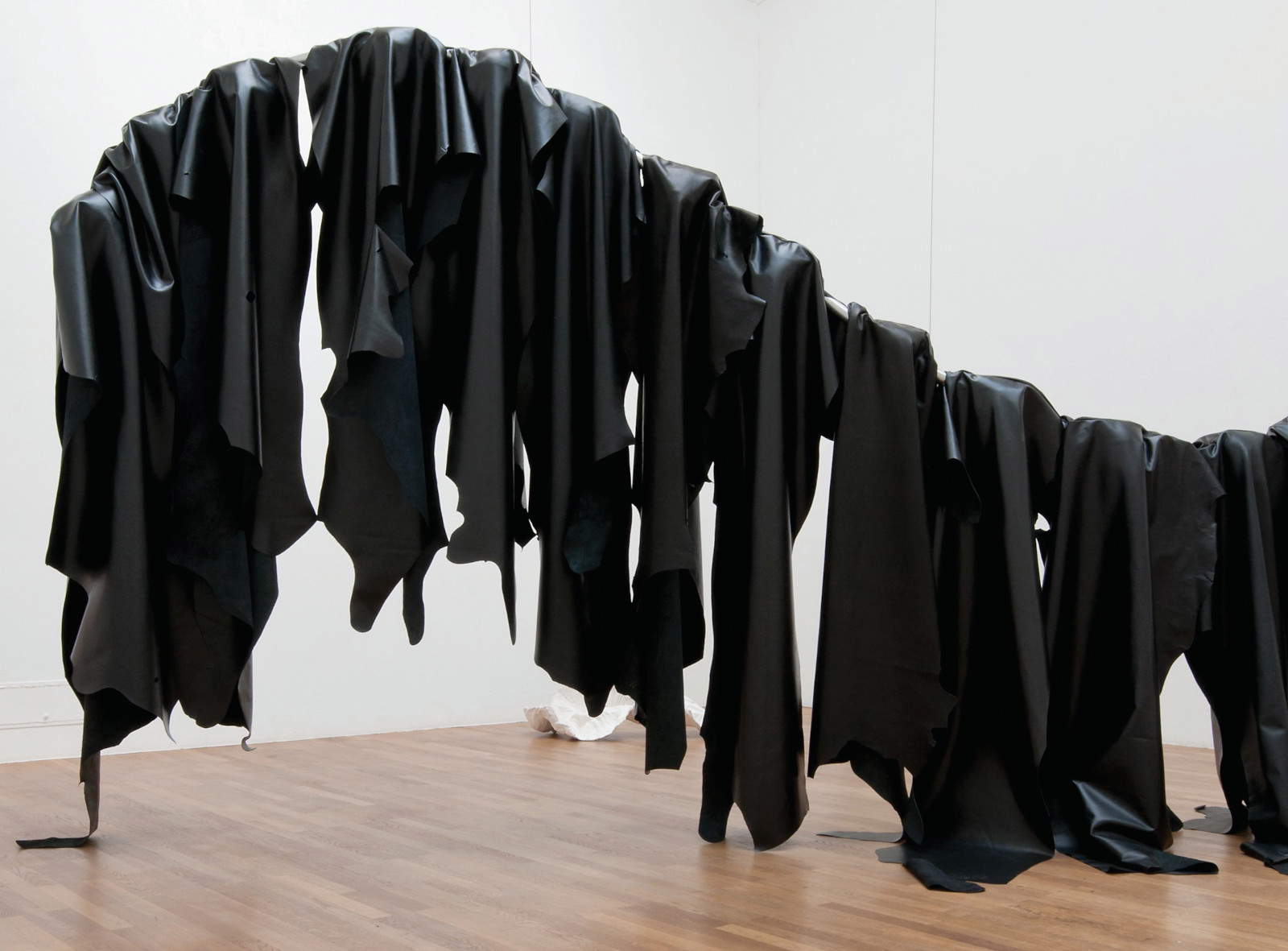
The same tension between the material and the imaginary characterizes *Auf einem langen Schatten* (On a Long Shadow), from 2018. The large sculpture is composed of black cowhides, stripped of their original function as body coverings and transformed into elements open to new interpretations. The surfaces evoke bodily metamorphosis and become the starting point for constructing a mental landscape populated by magical and mythological imagery. It is no coincidence that Szeemann defines her own work as a veritable “landscape of the unconscious.”
The MASI Collection as an Archive of Unprecedented Connections
One of the central aspects of Re-imaginings is its engagement with the MASI collection, which houses over 14,000 works. Perret and Szeemann explored this heritage as a collection of veritable time capsules, guided by personal intuitions and cross-disciplinary associations, without necessarily following chronological criteria or traditional classifications.
This process gave rise to unprecedented connections between the works of the two artists and those in the museum’s collection, spanning different eras, techniques, and artistic languages. The exhibition includes, among other works, the 19th-century bust *Giulietta* by Adelaide Maraini-Pandiani, the large canvas *Le ghirlande* by the historicist painter Giuseppe Sciuti, and the graphic works of Fidus. Alongside these are works by radical figures in 20th-century art, such as Carol Rama, VALIE EXPORT, and Ulla von Brandenburg—artists who have helped challenge a uniform and linear interpretation of art history.
In some cases, the two artists’ choices coincided, giving rise to interesting points of convergence. This was the case, for example, with Meret Oppenheim, a key figure in 20th-century Swiss art, whose body of work explored themes such as dreams, irony, nature, and female identity. Also particularly significant is their shared selection of Leonor Fini’s *Le radeau* (*The Raft*), a work placed at the beginning of the exhibition itinerary. The painting subverts the traditional stereotype of a woman waiting to be rescued: on the raft, in fact, two female figures are steering the vessel, in control of their own decisions and their own destiny. Their proud and self-assured gaze is directed squarely at the viewer, establishing a connection with the audience from the moment they enter.
The exhibition design, by Marco Palmieri Studio, guides visitors through the various narratives of “Re-imaginings” via a gradual itinerary, conceived to encourage discovery and highlight the connections between the works.
A bilingual catalog, in Italian and English, will be published to coincide with the exhibition by Verlag Scheidegger & Spiess / Park Books and Edizioni Casagrande. The volume will include a curatorial essay by director Letizia Ragaglia and critical essays by Estelle Hoy and Jennifer Higgie. The project is also accompanied by the creation of the Relax Corner, born from a collaboration between MASI, the School Center for the Arts Industries (CSIA), and the Higher Vocational School of Applied Arts (SSS’AA), both institutions under the Department of Education, Culture, and Sports (DECS). The museum’s second-floor foyer has thus been reimagined as a space open to rest and contemplation, conceived as a place to be experienced and not merely passed through. The project draws inspiration from the myth of Elpis, the Greek goddess of Hope. Through its choice of materials and colors, the Relax Corner evokes life’s ability to regenerate and flourish anew even after adversity, offering visitors a place to pause and immerse themselves in the atmosphere of the exhibition.
|
| At the MASI in Lugano, two Swiss artists are reinventing the museum’s collection with “Re-imaginings” |
Warning: the translation into English of the original Italian article was created using automatic tools. We undertake to review all articles, but we do not guarantee the total absence of inaccuracies in the translation due to the program. You can find the original by clicking on the ITA button. If you find any mistake,please contact us.