



by Redazione 23/11/2026



Categories: Contemporary art / Disclaimer
Gerhard Richter’s Doha Pavilion, a permanent structure designed by the German artist in collaboration with Selldorf Architects, opens at MIA Park in Doha. Featuring geometries inspired by Islamic art, abstract paintings, mirrors, and sculptures, the pavilion is conceived as a standalone work, straddling the line between architecture and contemporary art.


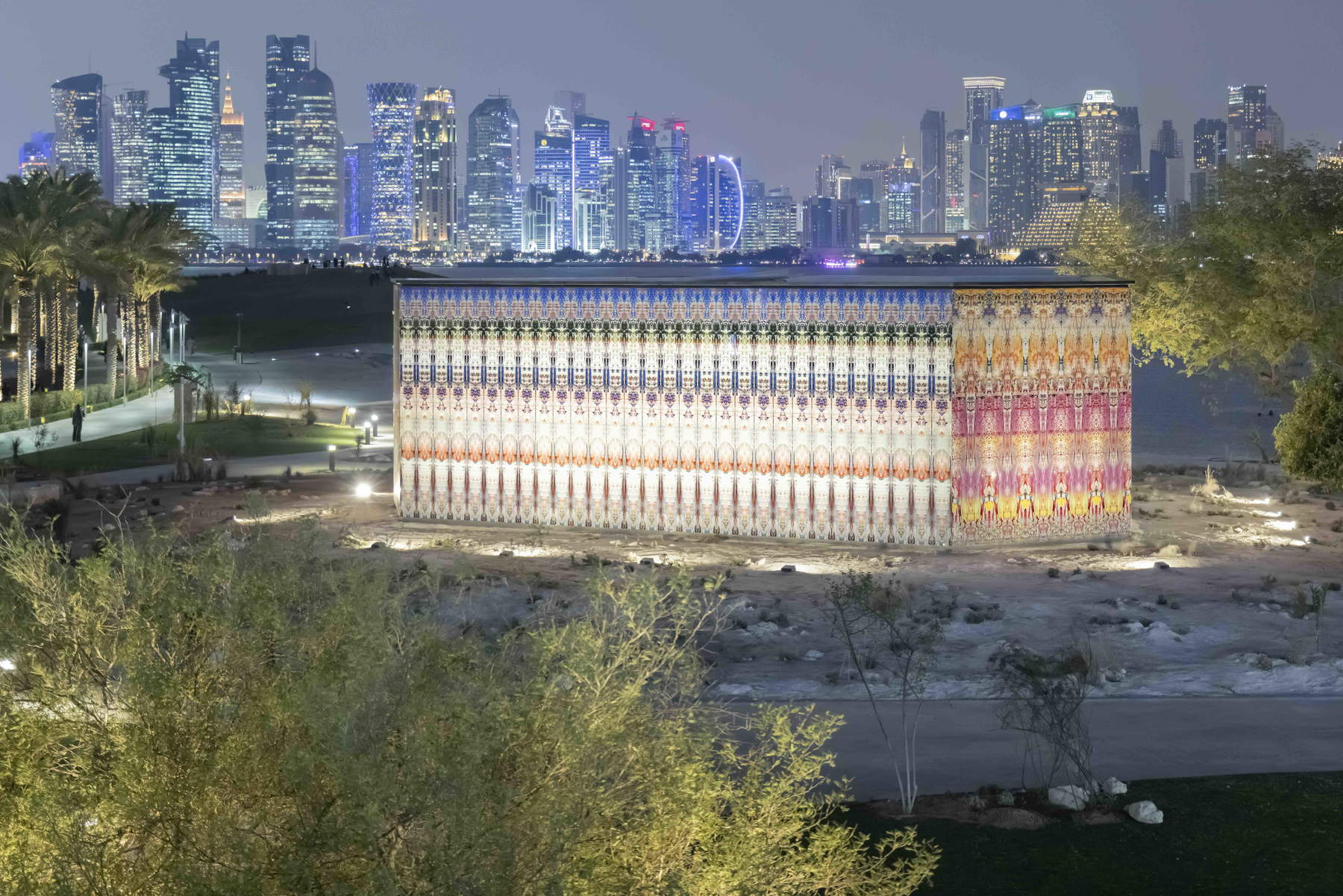
A new monumental work by Gerhard Richter has become part of Doha’s landscape. In MIA Park, the public space in front of the Museum of Islamic Art, Qatar Museums has inaugurated Gerhard Richter’s Doha Pavilion, a permanent structure conceived by the German artist as a standalone work, straddling the line between architecture and contemporary art. Created in collaboration with Selldorf Architects, the pavilion houses paintings, sculptures, and installations, including a new work created specifically by Richter for this site. The project emerged as a legacy of the 2017 Qatar-Germany Year of Culture and further enriches the public art collection at MIA Park, which already features works by leading figures on the international scene, including Richard Serra, Nairy Baghramian, Peter Fischli, and David Weiss.


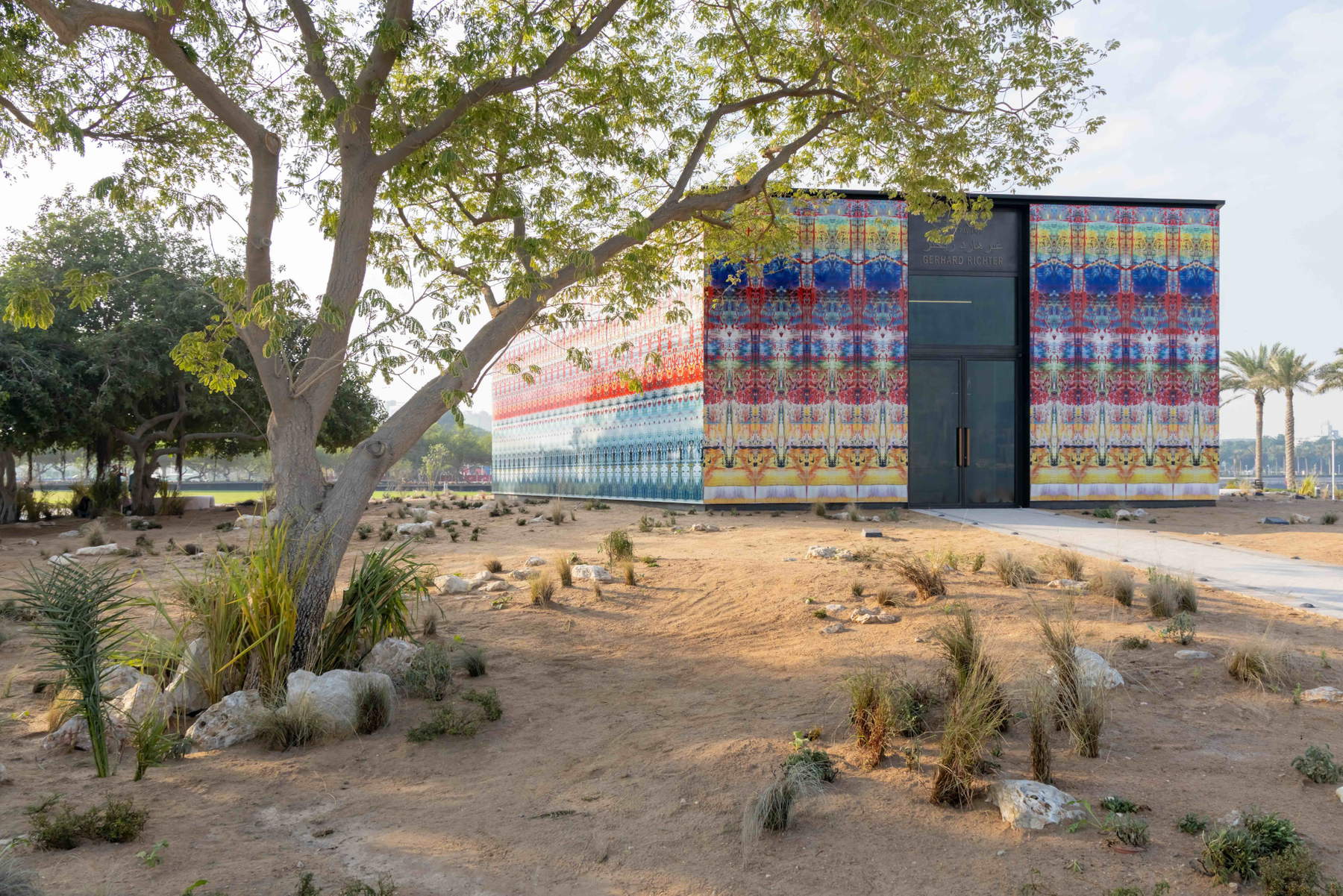
The pavilion’s hexagonal structure translates into architectural space the analytical and experimental approach that characterizes Richter’s work, which has always focused on the relationships between painting, perception, and the construction of images. The appearance of the six exterior walls is defined by a complex geometric pattern, created through a mathematical process developed by the artist in 2010.


The starting point was *Abstract Painting (724-4)* from 1990, a digital image that Richter initially divided into two vertical bands. These were subsequently fragmented into a progressively increasing number of strips: from four up to 8,192 segments. Each element was then mirrored and repeated, generating a horizontal and symmetrical composition. The result evokes the intricate geometries of Islamic art, characterized by intertwined arabesques and modular decorations that repeat potentially ad infinitum, creating hypnotic visual effects and suggesting a spiritual dimension.


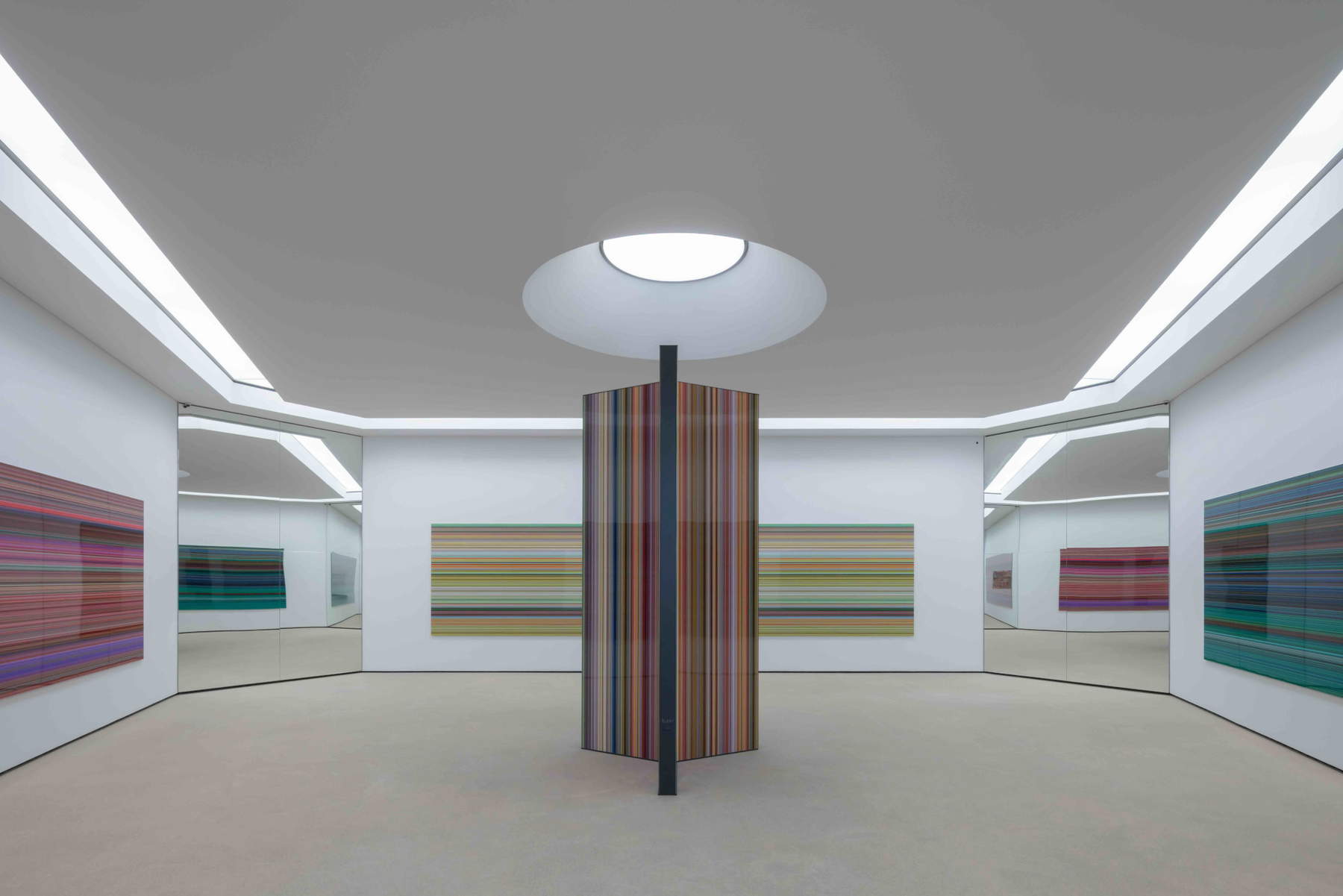
The interior spaces also continue Richter’s exploration of fragmentation and the perception of images. Here, three large striped paintings—part of a series begun in 2011—are on display. The works derive from the decomposition of the original abstract painting into extremely thin horizontal segments, each just 0.08 millimeters thick, transforming the pictorial composition into a sequence of minimal visual elements.
In the center of the pavilion stands *Strip Tower*, a freestanding sculpture divided into three parts and designed by Richter specifically for this space. The installation interacts with two large, floor-to-ceiling mirrors, part of a series the artist began developing in the 1980s. Positioned on the narrower walls of the building, the mirrors reflect the artworks and the presence of visitors, multiplying the images and creating a perception of a shifting, almost boundless space.
Outside the structure stands another sculpture, made of stone and titled *Brunnen* (Well), which completes the artistic installation and establishes a further connection between the pavilion and its surroundings.
Active from the second half of the 1960s to the present, Gerhard Richter is considered one of the most influential artists in international contemporary art. Throughout his long career, he has developed an extremely multifaceted practice, experimenting with different techniques and languages and constantly challenging the formal and conceptual boundaries of painting. His body of work includes paintings, objects, installations, works on paper, editions, and photographic documentation. At the heart of his work lie fundamental questions such as our relationship with images, memory, and history, along with the ways in which we observe and interpret reality. The Doha Pavilion represents a new expression of this exploration, extending it from the pictorial surface to the architectural dimension and the audience’s direct experience.
The opening of the Doha Pavilion: Gerhard Richter is part of the Qatar Creates Fall/Winter 2026–27 program and coincides with the launch of the first edition of Rubaiya Qatar 2026, the new international visual arts festival held every four years, scheduled from November 21, 2026, to April 30, 2027. The cultural season will take place at various venues throughout the Qatari capital through a diverse calendar of exhibitions, design projects, events dedicated to fashion and film, public art installations, conferences, and cultural experiences. Among the main events are new exhibition openings, the second edition of Design Doha, and the debut of Rubaiya Qatar.
“My trip to Doha in 2013 took place two years after I began developing my paintings in the Strip series, and the city’s architecture and history sparked the idea for a pavilion that could tie together the thematic threads of that body of work. The exterior of the Pavilion features decorative tiles based on the motifs that initially led me to the ‘Strip’ series. Inside, the paintings from the ‘Strip’ series are displayed alongside works titled ‘Mirrors,’ and the ‘Strip Tower’ is installed in the center. “Doha is the right place and the only suitable place for my Pavilion,” said Gerhard Richter.
|
| Gerhard Richter Unveils a Permanent Pavilion in Doha: Art and Architecture Come Together in a New Monumental Work |
Warning: the translation into English of the original Italian article was created using automatic tools. We undertake to review all articles, but we do not guarantee the total absence of inaccuracies in the translation due to the program. You can find the original by clicking on the ITA button. If you find any mistake,please contact us.