




by Redazione 05/09/2026



Categories: Exhibitions / Disclaimer
At the Wolfsoniana in Genoa-Nervi, through November 1, 2026, an exhibition traces the main phases of Giovanni Korompay’s artistic journey, from his debut in the 1920s to his aeropainting and subsequent abstract experiments in the postwar period.


At the Wolfsoniana in Genoa Nervi, an exhibition dedicated to Giovanni Korompay (Venice, 1904 – Rovereto, 1988) offers a fresh perspective on the work of one of the leading figures of Second Futurism. Curated by Alex Casagrande, Matteo Fochessati, Franco Tagliapietra, and Anna Vyazemtseva, *Giovanni Korompay. An Anthology will be open to the public through November 1 , 2026—nearly fifty years after the previous retrospective dedicated to the artist at the Gallery of Modern Art in Bologna in 1979.


The exhibition project aims to reconstruct the main phases of Korompay’s painterly exploration in light of the most recent studies on the movement founded by Filippo Tommaso Marinetti in 1909. Particular attention is given to his involvement in aeropainting and to the stylistic developments in his work following World War II.
The exhibition begins with his early years in the 1920s, when the artist was still working within the realm of traditional painting, though certain elements already recognizable as defining features of his later work were already present. In 1922, after meeting Marinetti in Venice and making his first contacts with the Futurist movement, Korompay created *Rumore di locomotiva*(Sound of a Locomotive), an oil on panel featured in the exhibition, in which a progressive decomposition of the image and a tendency toward abstraction emerge. In the following years, the artist came into contact with Balla, Bragaglia, Caviglioni, Crali, Depero, Dottori, Fillia, and Prampolini.




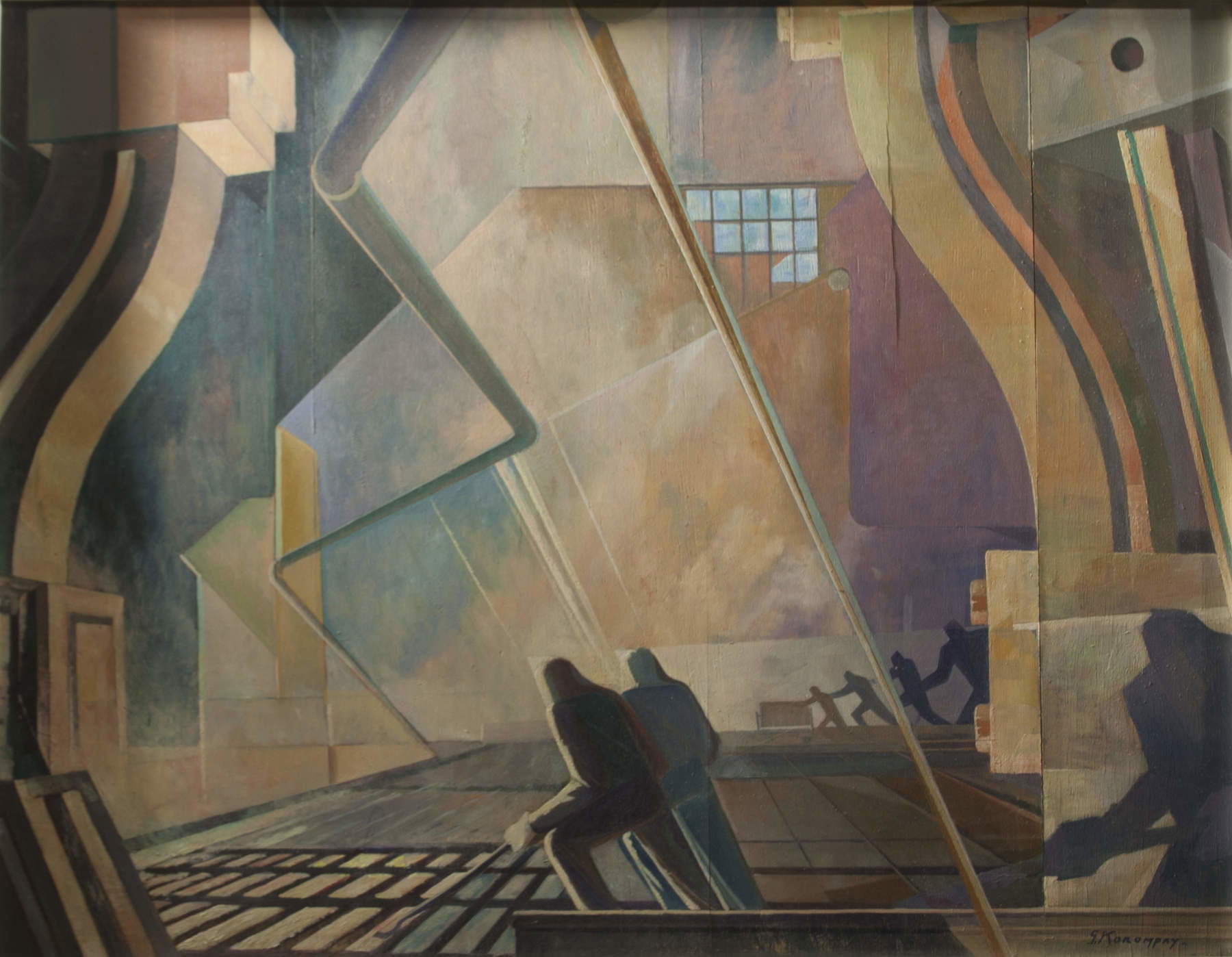
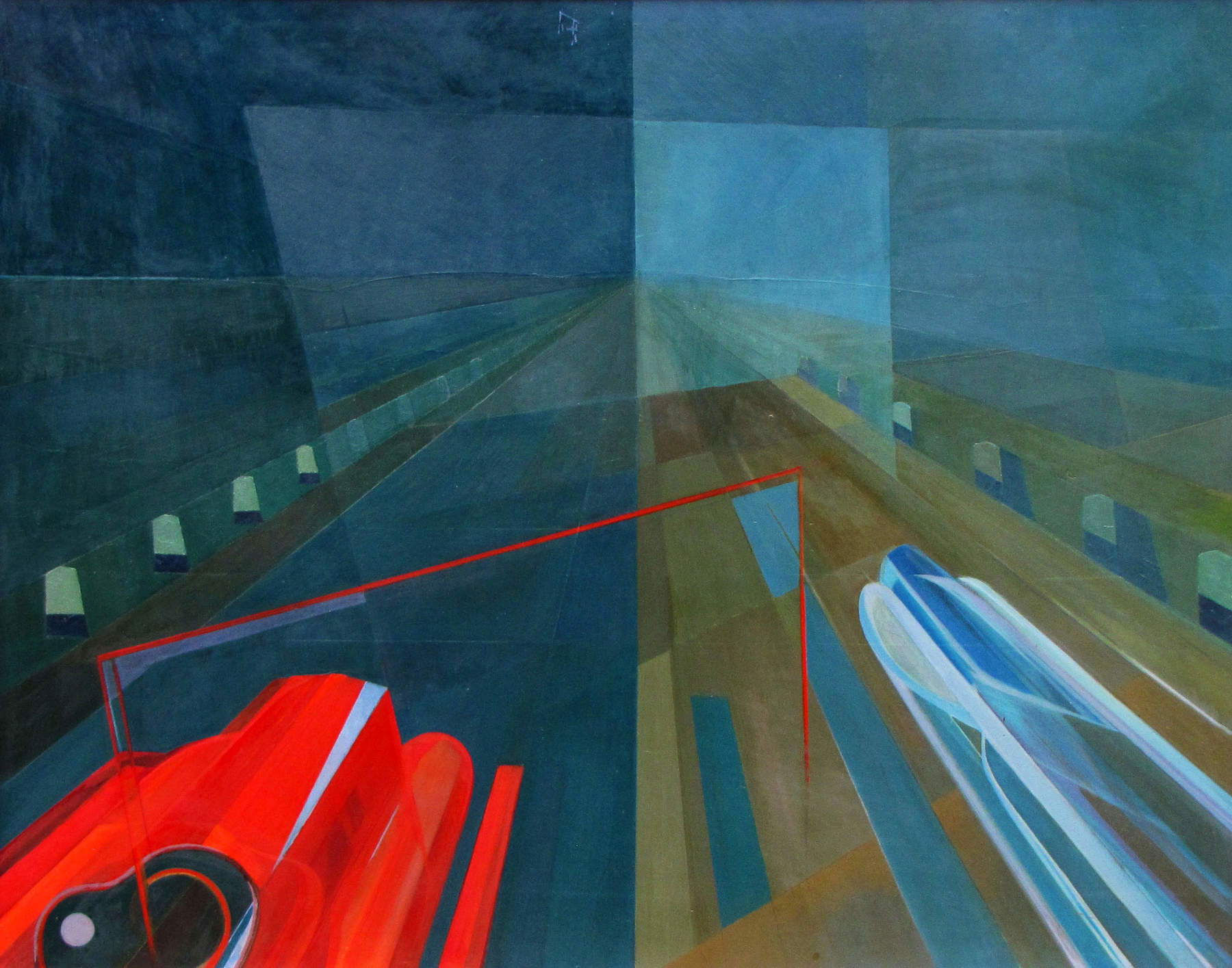
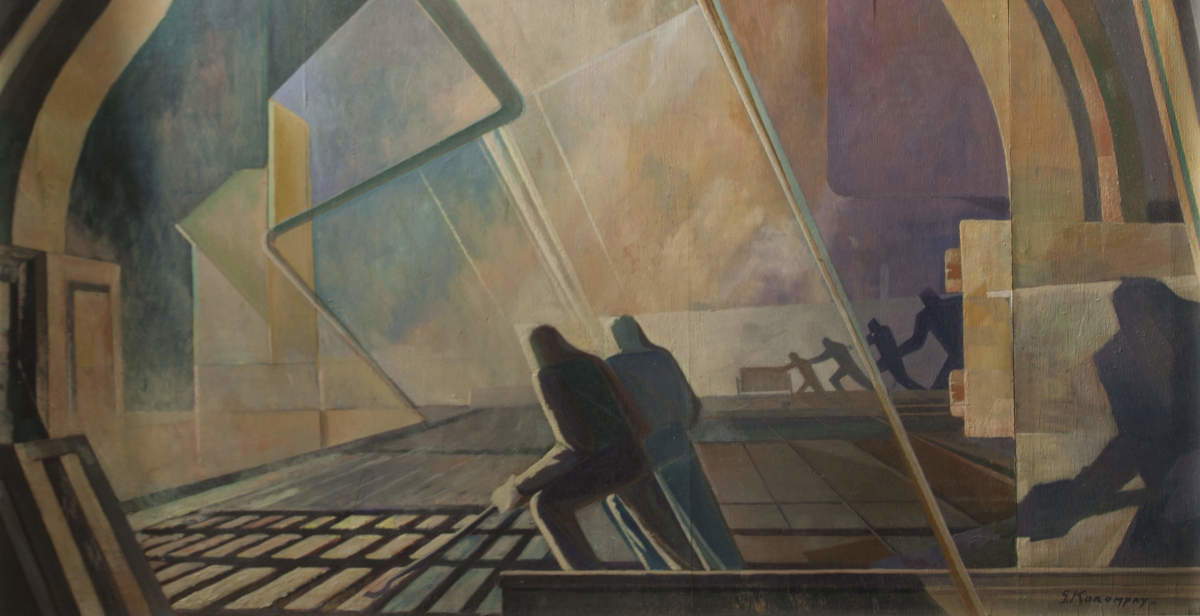
The paintings created between the 1920s and 1930s document the gradual deconstruction of certain recurring themes through abstract structural forms: mountain landscapes, Venetian architecture reflected in the lagoon, shipyards, workshops, and, more generally, workplaces. In the 1930s, Korompay solidified his commitment to Futurism and also began his first experiments with plastic art, represented in the exhibition by *Shipyard* (1930) and *Tank* (1934). During this period, he participated in the Futurist sections of the Venice Biennales of 1936, 1938, 1940, and 1942, as well as the Rome Quadriennales of 1935, 1939, and 1943.
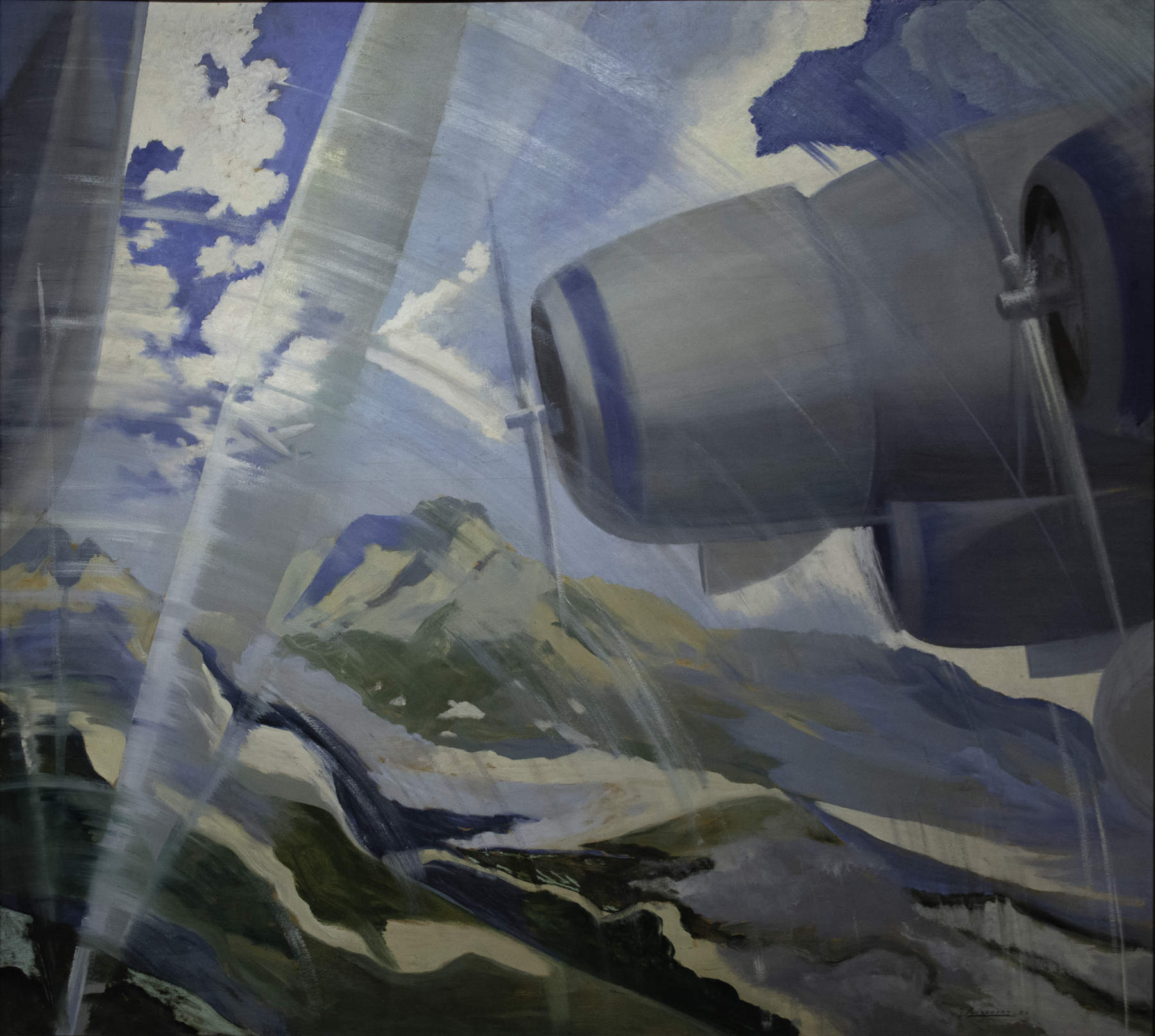
His aeropainting research initially developed through dynamic landscape views observed from the cockpit of an airplane, as seen in the two works from 1935 and 1936 featured in the exhibition. The latter, exhibited at the 20th Venice Biennale, belongs to the Wolfson Collection. The “aeropaintings” then evolved toward more abstract and rigorous compositions, in some cases evoking surrealist atmospheres, as in the 1938 oil paintings *Marine Atmosphere* and *Aeropainting* (“aerofemmina”) from the late 1930s.
At the turn of the 1930s and 1940s, abstraction took on an increasingly significant role in works dedicated to workplaces. In the postwar period, this exploration continued through a geometric composition based on symmetrical chromatic structures, while retaining the dynamic tensions of his earlier Futurist experience within the synthetic framework.
![Giovanni Korompay, Portrait of Mrs. B. M. [Benedetta Marinetti] (Mid-1930s; oil on panel; private collection)](https://cdn.finestresullarte.info/rivista/immagini/2026/fn/giovanni-korompay-ritratto-della-signora-b-m.jpg)
The exhibition also places Korompay’s works in dialogue with those of other Futurists in the Wolfsoniana’s permanent collection, including Gerardo Dottori, Enrico Prampolini, Ernesto Thayaht, Nicolaj Diulgheroff, and Tullio D’Albissola. Organized by the Wolfsoniana – Palazzo Ducale Fondazione per la Cultura, Genoa, in collaboration with the Giovanni Korompay Foundation in Rovereto, the exhibition brings together works from the museum’s collections and the heirs’ collection, alongside loans from museums, institutions, and private collections. The project is accompanied by an illustrated catalog published by Sagep Editori, featuring texts by the curators and catalog entries detailing Korompay’s artistic career.
 |
| At the Wolfsoniana in Genoa-Nervi, a retrospective exhibition on Giovanni Korompay traces his Futurist work |
Warning: the translation into English of the original Italian article was created using automatic tools. We undertake to review all articles, but we do not guarantee the total absence of inaccuracies in the translation due to the program. You can find the original by clicking on the ITA button. If you find any mistake,please contact us.