



by Redazione 19/10/2026


Categories: Exhibitions / Disclaimer
From the canvas measuring over two meters by three, painted for the Cremona Prize, to the machinery of “Mechanical Symbolism”: at the Chamber of Deputies, in the Vicolo Valdina Complex, 26 works trace the career of Alfredo Catarsini, with displays designed to be accessible even to blind visitors.


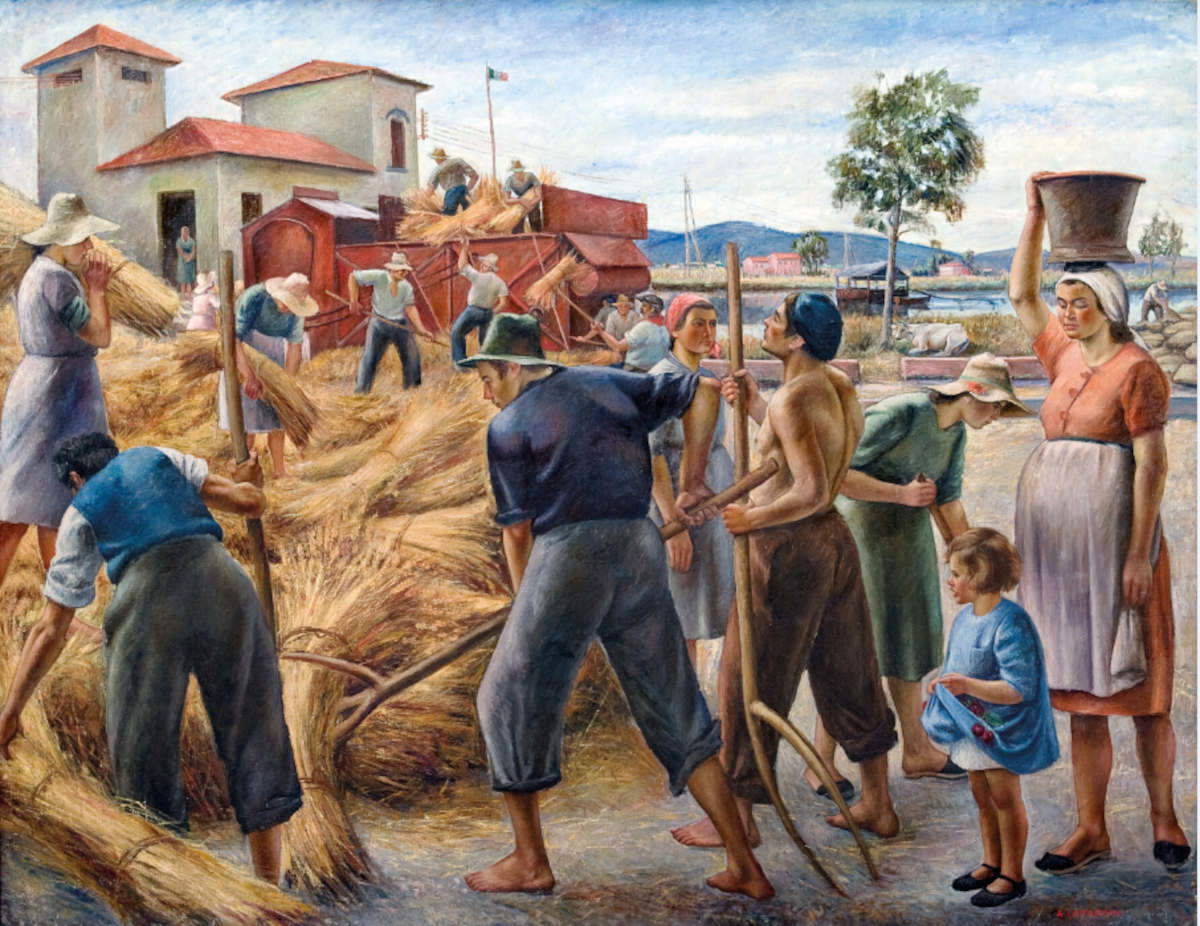
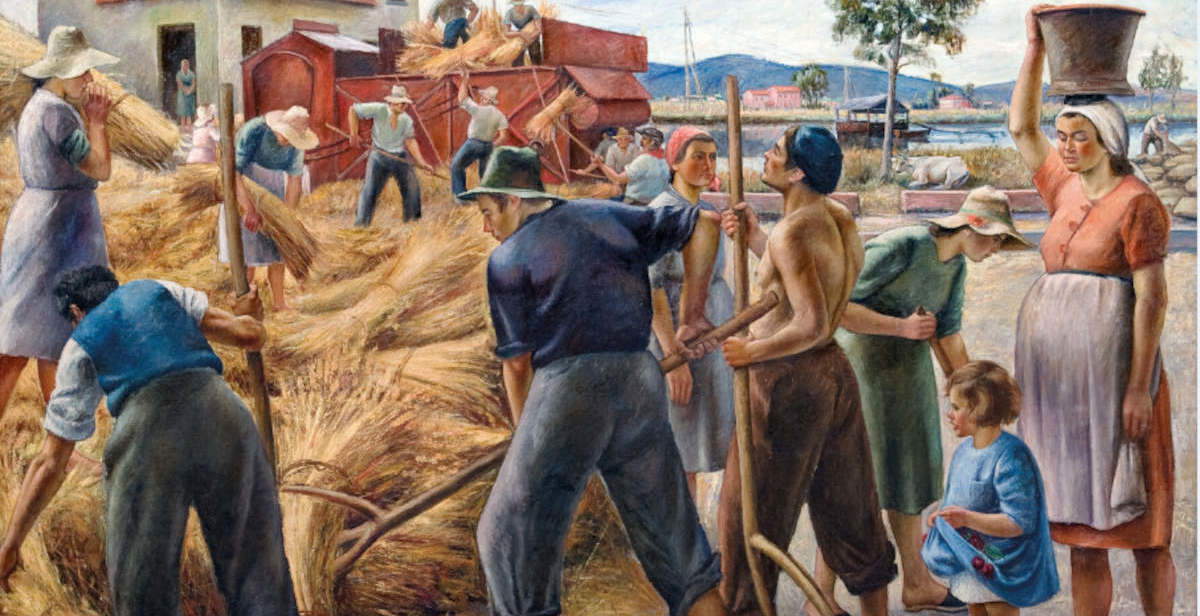
The large canvas titled *Il grano della bonifica lucchese* was the work with which Alfredo Catarsini (Viareggio, 1899–1993) entered the 1940 Cremona Prize, the national competition in which he had placed second the previous year. More than eighty years later, the painting’s exhibition history is anything but static: in 2022 it was displayed at the Gallery of Modern and Contemporary Art in Viareggio; in September 2023, it was the focus of a guided tour at the Palazzo Ducale in Lucca; and in 2024, it traveled to the MART in Rovereto for the exhibition *Art and Fascism*. It now occupies the Sala della Sacrestia of the Vicolo Valdina Complex in Rome, where, from October 20 to 30, the Chamber of Deputies is hosting the exhibition *Catarsini’s Twentieth Century: From the Bush to the Machine*.

For Catarsini, Rome is a city with which he has long had unresolved business. In the text he wrote for the exhibition brochure, curator Rodolfo Bona notes that the Viareggio-born artist exhibited there from 1943 to 1985, with fourteen exhibitions—including both solo and group shows—and participation in five Quadriennales, from the mid-1940s to the late 1950s. It was precisely at the fourth edition, in 1943, at the Palazzo delle Esposizioni, that one of his works, *Paese Toscano*, was acquired by the National Gallery of Modern Art in Rome. That same year, Bona writes, the then-Minister of National Education, Giuseppe Bottai, inaugurated a solo exhibition of his work at the Bank Employees’ Social Club on Via Colonna Antonina. The last exhibition in Rome took place forty-one years ago: this is the time span separating the galleries on Vicolo Valdina from the previous occasion when Catarsini’s works were shown in the capital.


The exhibition is the final stop on a traveling exhibition promoted and organized by the Alfredo Catarsini 1899 ETS Foundation and curated by Bona, an art historian. The exhibition debuted at the Vittoriale degli Italiani in Gardone Riviera, where it remained on view from March through September 2024. Since June 2025, the project has continued its journey through Tuscany, visiting museums and historic palaces: the Palazzo Strozzi Sacrati in Florence, seat of the Tuscan Regional Council, the Villa Paolina Museum in Viareggio, whose top floor houses the studio where Catarsini worked, the Fortilizio della Cittadella in Pisa, the Mo.C.A. in Montecatini Terme, the Palazzo Guinigi in Lucca, and the Scuderie of the Palazzo Mediceo in Seravezza. At each venue, the number of paintings and drawings selected varied depending on the available space, without losing the exhibition’s anthological character. In Rome, the exhibition features twenty-six works, distributed between the Sala del Cenacolo and the Sala della Sacrestia, which overlook the cloister.
So who was Catarsini? Born in Viareggio on January 17, 1899, he began drawing as a child and graduated from the Royal Institute of Fine Arts in Lucca in 1919. He associated with Lorenzo Viani, who considered him a rising star of the local art scene, and Filippo Tommaso Marinetti, who invited him to exhibit at the Futurist group’s shows. His first exhibitions date back to the early 1920s, and his early paintings drew on a robust Tuscan realism and landscapes influenced by the Macchiaioli and Post-Impressionist movements, eventually evolving toward more volumetric and sculptural compositions, with a style that generally remained expressionist, while absorbing Futurist, Metaphysical, and “return to order” influences. Catarsini is, however, a painter who spanned the entire 20th century and who, while immersed in the artistic vibrancy of an era that often found its summer retreat in Versilia, maintained his own identity as a figurative painter.
The exhibition’s title, *From the Macchia to the Machine*, sums up this trajectory. “Macchia” refers to the post-Macchiaioli roots of Catarsini’s early work. “Machine,” on the other hand, refers to the most original outcome of his artistic exploration: mechanical symbolism, which the artist developed in the early 1950s—following the artistic climate fostered by the Fronte Nuovo delle Arti—and continued to refine through the 1980s. In this language, as the artist’s biography explains, mechanical images intermingle with restless human figures, yielding results of great visual ambiguity. The press release describes it as a critique—conveyed through stunned human figures and complex machinery—of technological progress that is overwhelming humankind, now incapable of controlling the machines it has created. Mechanical Symbolism was very successful in Paris: in 1971, Catarsini won the Gold Medal at the Salon Babylone for these works, and in 1982, a selection was exhibited at the Palazzo dei Diamanti in Ferrara, in an exhibition entirely dedicated to this period.
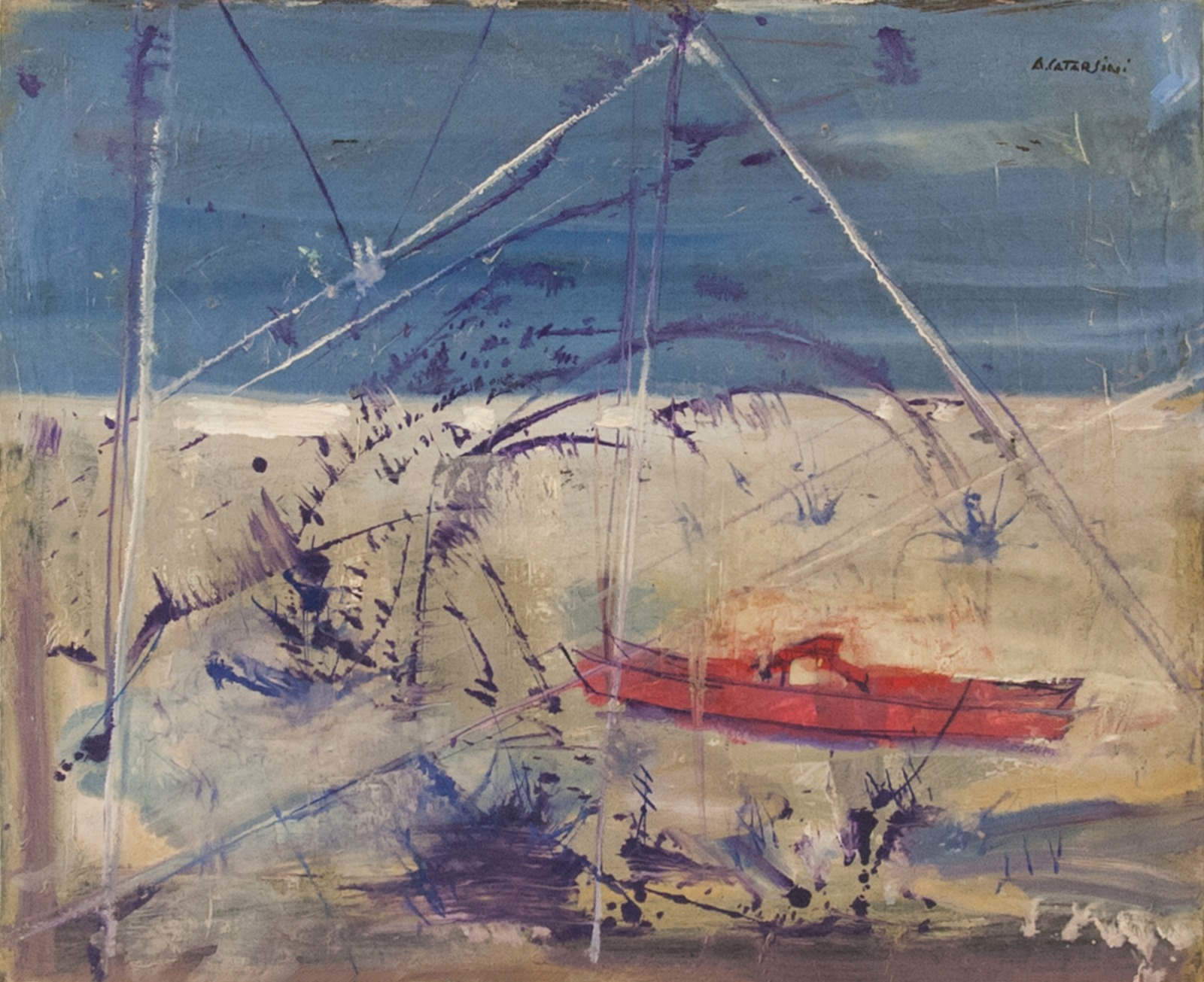
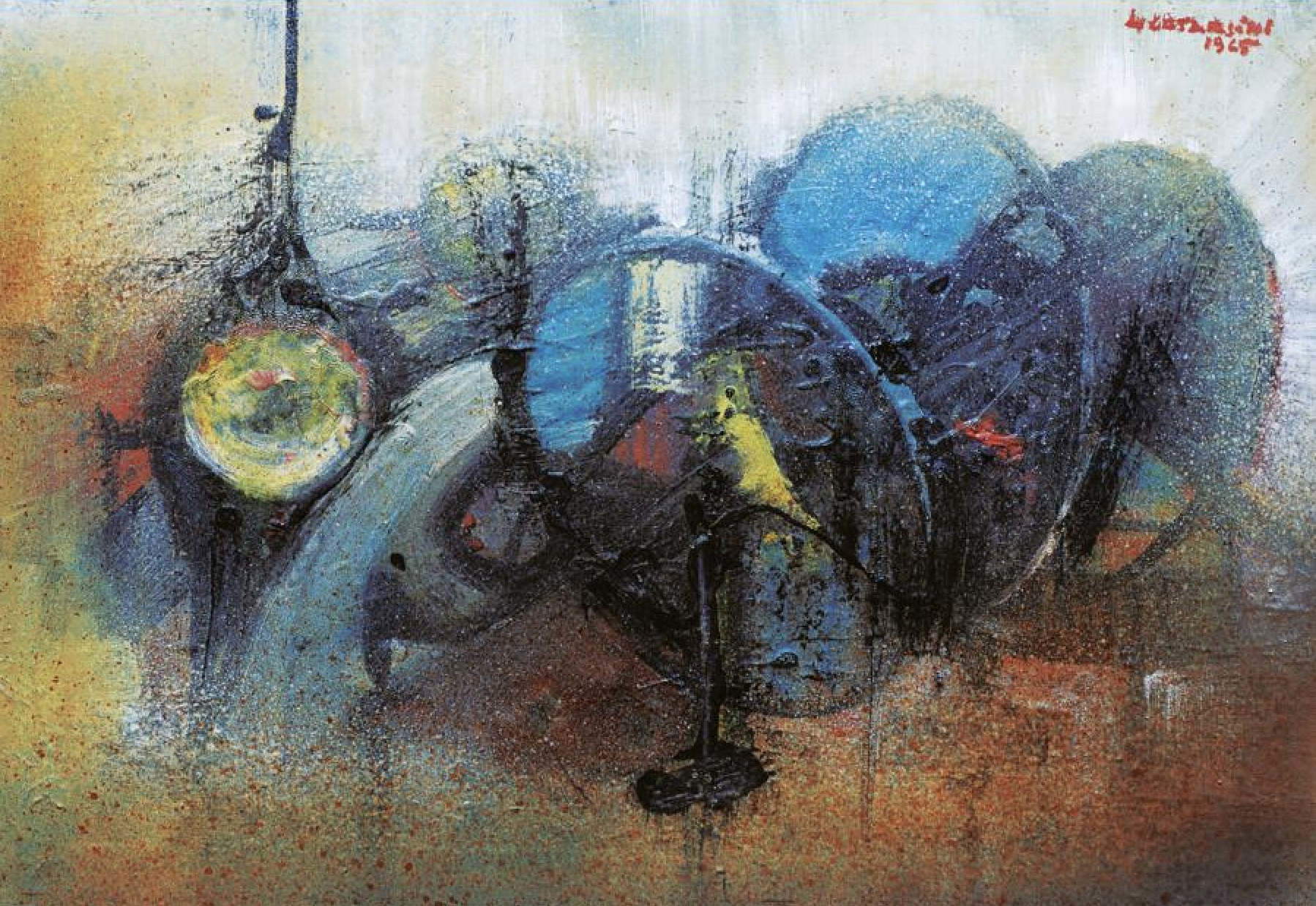
In Rome, there are two canvases bearing this title: *Mechanical Symbolism* from 1965, oil on cardboard, and another *Mechanical Symbolism* from 1970, oil on canvas. The former is also the image chosen for the catalog cover and reflects his thoughts on the relationship between man and machine. From the same period of exploration is a *Fantastic Still Life*, an ink-and-watercolor work on paper dating from around 1960–70, among the works on paper featured in the exhibition.
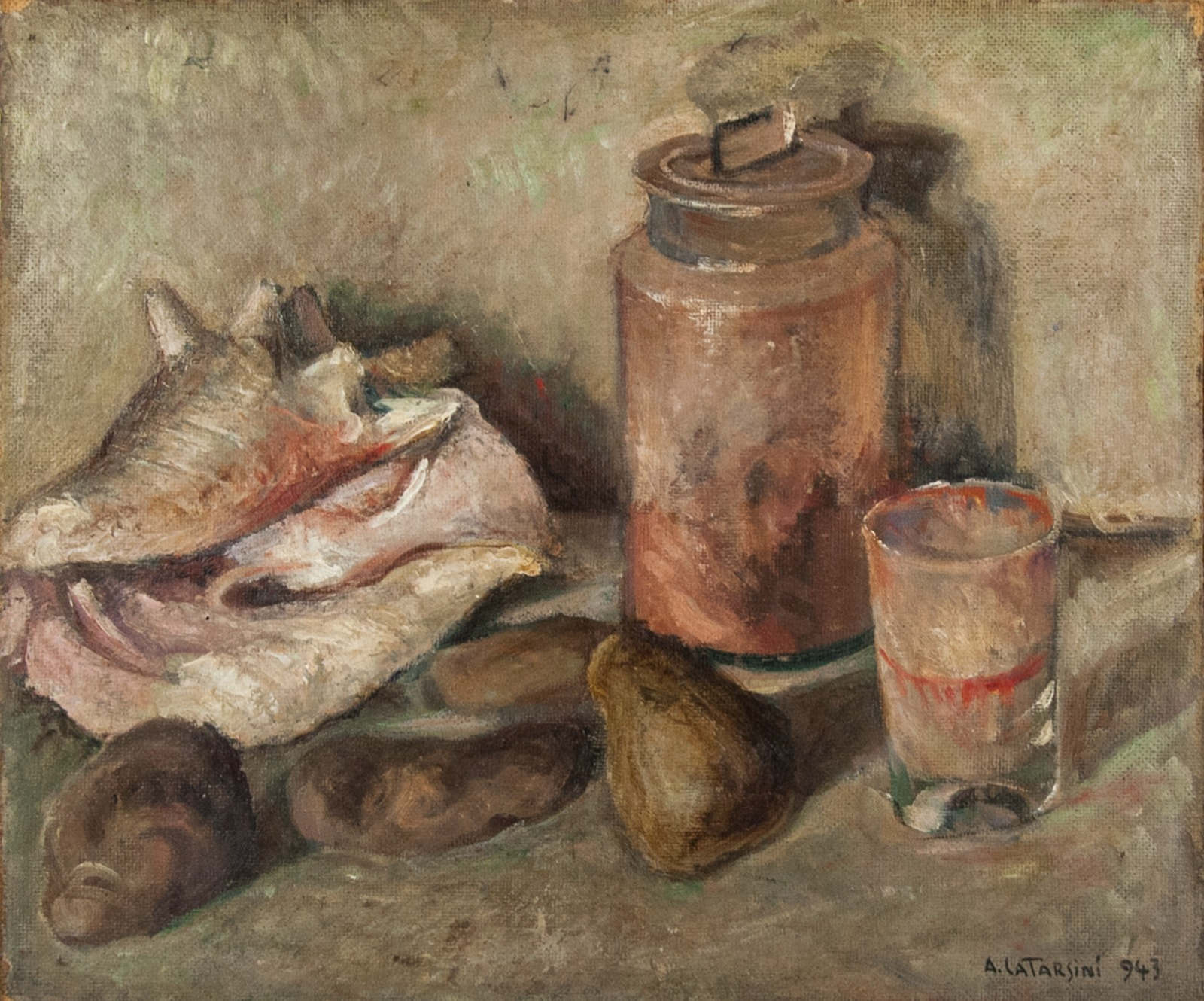
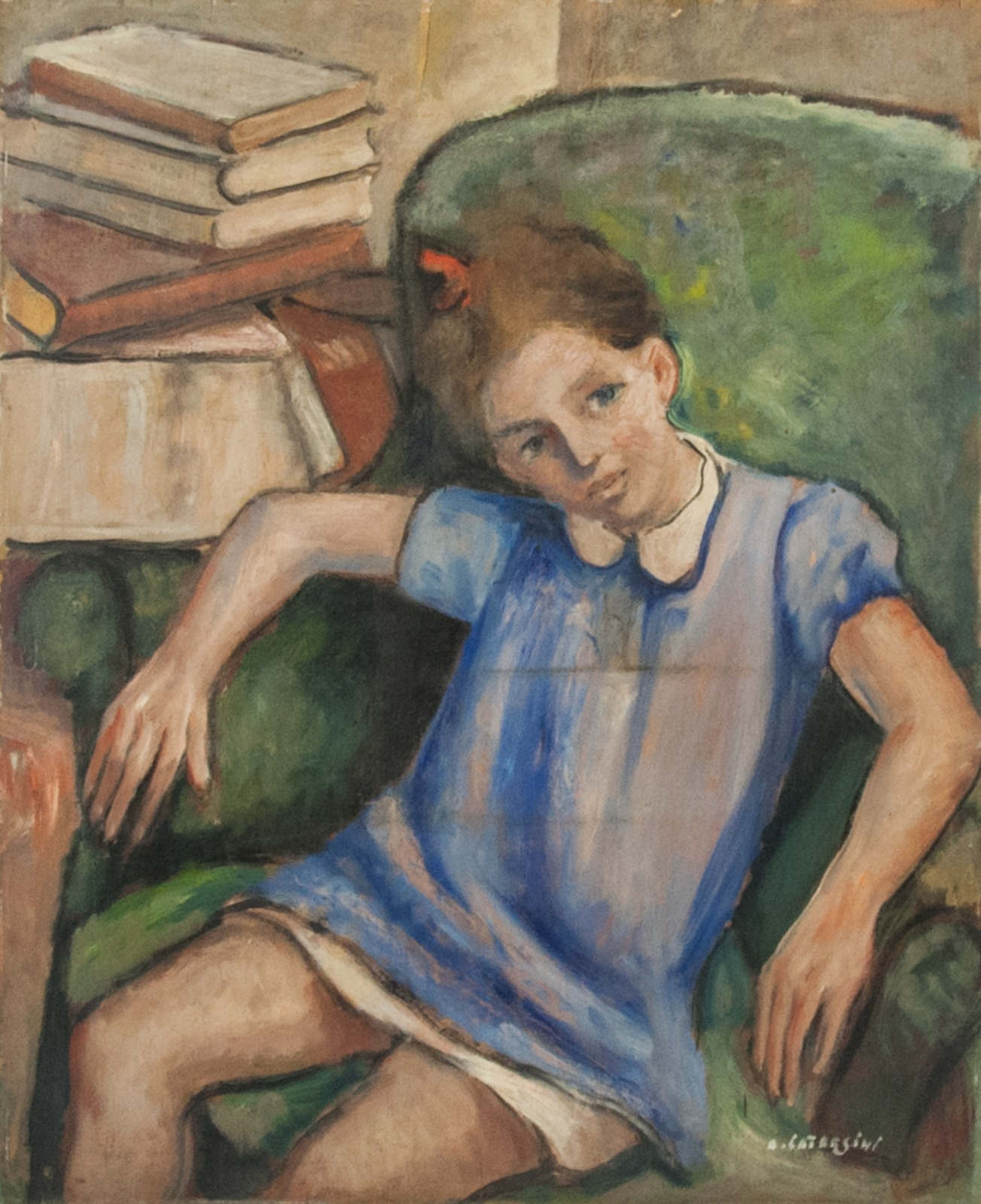
Running parallel to this strand is what his biography refers to as “Reflectivism, ” a brief painterly phase that began during the war years, featuring experimental works in which ordinary objects and landscapes take on ambiguous meanings through the fragmentation and overlapping of planes and perspectives. This was also the period of the fresco the artist created in 1944 in the apse of the church of San Martino in Freddana, near Lucca, where he had been evacuated: an iconography in which the sacred event is immersed in a landscape scarred by the barbarities of war. That work, *The Immaculate Conception between Saints Martin and Paul*, plays a special role in the Rome exhibition, as will be seen later.
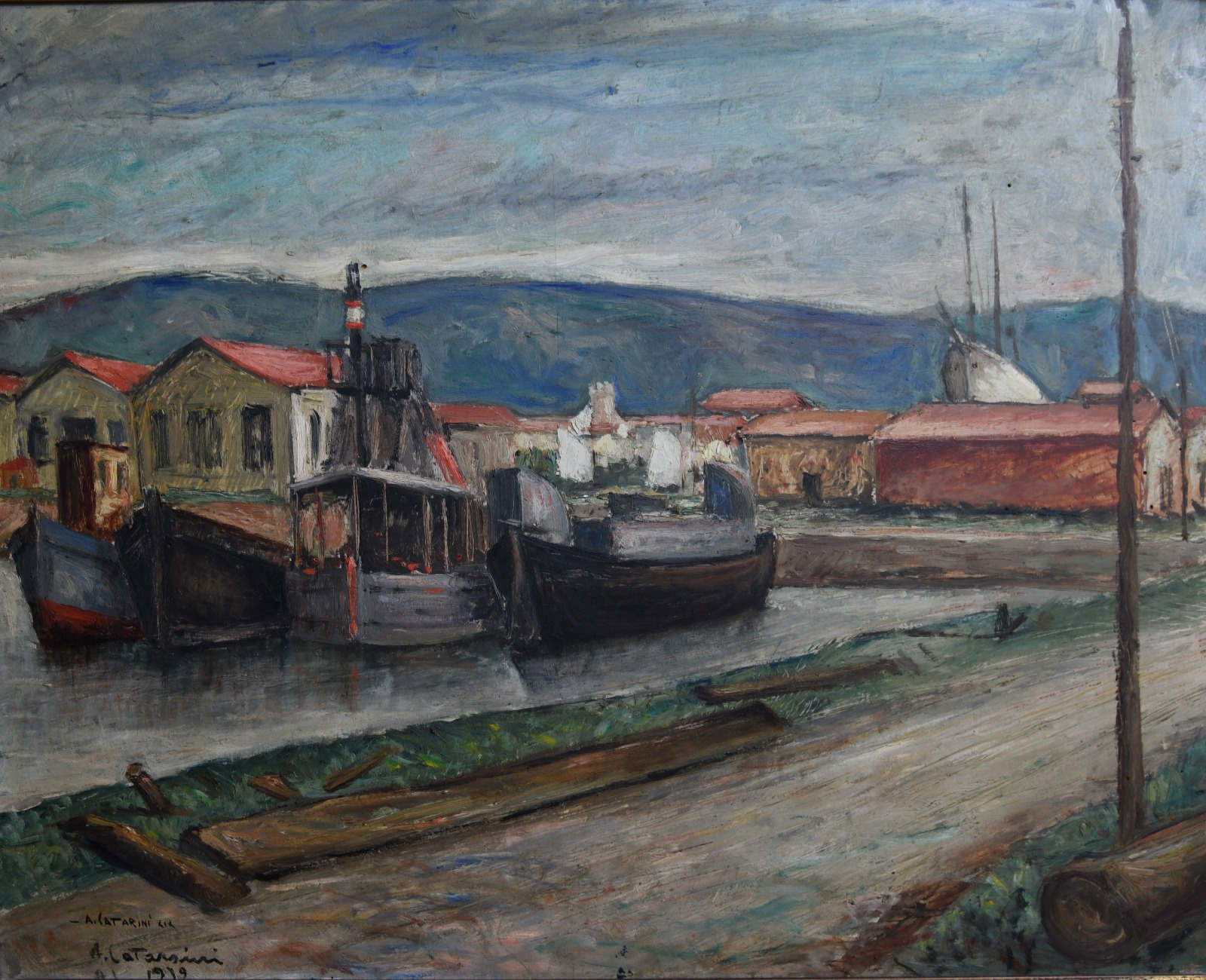
The largest and most recognizable group of works on display, however, consists of figure and landscape paintings. There are two cornerstones of Catarsini’s most characteristic body of work, *Boats in the Port of Viareggio* (1939) and *The Pier at Viareggio* (1942), joined by *Shipyard* (1936), “Huts by the Sea” (1936), “Old Shipyard” (1952), “The Red Patino,” datable to between approximately 1950 and 1960, “Gasometers” (circa 1955–60), and “Rough Sea” (1969). The sea and workplaces thus run through the entire selected chronological span, from the 1930s to the 1960s. In the artist’s biography, moreover, the 1980s see a return of focus to his immediate surroundings—his beloved dock, seascapes, and bathers—themes that bring his early Expressionist roots back to the surface.
Then there are the more intimate figures and subjects: *Portrait of My Daughter* (1941), *Girl in the Studio* (circa 1945–49), a *Red Nude in an Armchair* (1945), a *Composition with Nude* (1951), the still lifes from 1943 and 1946, including the one with a bottle of seltzer, and the Bombed Houses from around 1945. One theme recurs with particular insistence: the self-portrait: a substantial series of them remains, ranging from the 1930 monotype on paper to the 1934 “Double Self-Portrait,” fromthe 1949“Self-Portrait at Fifty ” tothe 1973“Stone Self-Portrait.” More than forty years of life are thus reflected in the artist’s face, rendered in various techniques, from printmaking to oil painting.
Bona emphasizes that the painter from Viareggio was “a model of originality within the 20th-century art scene, distinguished by his figurative quality, expressive depth, and modernity of thought,” including in his extensive literary output. The curator notes that the selection of paintings and drawings spans six decades of intense activity, from 1930 to 1990, a period marked by significant historical events and major transformations.
Catarsini, however, was not merely a painter. In 1951, he began teaching at the Stagio Stagi Art Institute in Pietrasanta and simultaneously pursued a career as a writer, journalist, and critic. In 1969, he published *Giorni neri* (Black Days), a novel set during the partisan struggle in the Lucca region, which La Nave di Teseo reissued in 2021 with an introduction by Giordano Bruno Guerri. The same publisher released *Dall’incudine al martello* in 2026, with a preface by Vittorio Sgarbi. He was a highly prolific artist who was also deeply involved in the art world: Alfredo Catarsini’s resume includes nearly three hundred solo and group exhibitions in Italy and eleven abroad. Among these were three Venice Biennales (1942, 1948, 1950), five Rome Quadriennales (1943, 1948, 1951, 1955, 1959), and the three editions of the Cremona Prize (1939, 1940, 1941), in the first of which he won second prize. Also worth noting are the 1939 Bergamo Prize and, in 1981, the retrospective exhibition at Palazzo Strozzi in Florence.
The other defining feature of this exhibition does not concern the works themselves but rather the way they are presented—as has consistently been the case in recent Catarsini exhibitions, which have been made fully accessible to visitors with visual impairments. The same is true in Rome, where each work is accompanied by a label with a QR code that, when scanned with a smartphone, links to adapted descriptions of the painting or drawing, in Italian and English. An Experiential Workshop has also been set up in the galleries of Vicolo Valdina, where tactile activities are held on exhibition days for blind or visually impaired visitors. The high relief reproducing the 1944 fresco of San Martino in Freddana was chosen as a tactile educational aid: *The Immaculate Conception between Saints Martin and Paul*, created for the Foundation by experts from the “Omero” State Tactile Museum in Ancona. It is a way to bring to Rome, in a form that can be touched, a work that cannot be moved: a fresco painted in the apse of an ancient church in the Lucca area.
According to the exhibition’s organizers, a focus on inclusion is a distinctive feature of the Foundation’s work, which it advances through the multi-year project “Art Accessible to All.” Since 2022, the “I luoghi di Catarsini” trail has been part of this initiative; conceived and created in collaboration with the Touring Club, it is presented as the only trail in Italy that is fully accessible to people with visual impairments: It is divided into twelve stages, which can be covered via three routes of varying lengths, and connects Lucca to all the municipalities in Versilia that house some of the master’s works in their historic sites, featuring totems equipped with audio descriptions and experiential workshops for the visually impaired.
The catalog, published by the Region of Tuscany, also serves as a monograph on Catarsini (featuring a catalog of his works, an updated bibliography, and an account of the activities carried out to date by the Foundation—established in 2020 by Elena Martinelli and her husband Gianvittorio Serralunga in memory of Mity Catarsini, the artist’s daughter and Elena’s mother)—is part of this approach: it is, in fact, fully accessible. In addition to the catalog, the exhibition features a brochure with all the relevant information, documentary material, and explanatory panels with notes on the painter’s artistic career. The initiative is sponsored by the Chamber of Deputies and the Alfredo Catarsini 1899 Foundation, with the support and patronage of the Region of Tuscany. Partners include the Omero State Tactile Museum, the Italian Touring Club, and, as a media partner, Superando.
The opening is scheduled for October 20. It will be hosted by journalist Paola Severini Melograni, with remarks by Federico Mollicone, chair of the Chamber of Deputies’ Culture Committee; Cristina Manetti, Tuscany’s Regional Councilor for Culture; Elena Martinelli, president of the Foundation; and Luisa Berretti, director of the National Museum of Medieval and Modern Art in Arezzo (MIC) and member of the Foundation’s Scientific Committee. The invitation specifies that gentlemen must wear a jacket. The exhibition will be open from October 20 to 30, 2026, with free admission and hours from 11:00 a.m. to 7:30 p.m., at the Vicolo Valdina Complex of the Chamber of Deputies, in the Sala del Cenacolo and the Sala della Sacrestia, at Piazza Campo Marzio 42, in Rome.
 |
| Catarsini returns to Rome after 41 years, with his large canvas depicting wheat and an accessible exhibition |
Warning: the translation into English of the original Italian article was created using automatic tools. We undertake to review all articles, but we do not guarantee the total absence of inaccuracies in the translation due to the program. You can find the original by clicking on the ITA button. If you find any mistake,please contact us.