



by Redazione 07/09/2026



Categories: Exhibitions / Disclaimer
From September 24 to October 28, 2026, the Srisa Gallery in Florence will host “Doveva essere qui?”—the new solo exhibition by Gabriele Landi, one of Italy’s leading abstract artists—curated by Federico Giannini, director of Finestre sull'Arte. The exhibition centers on a monumental, previously unseen work: a painted and carved map of a place that does not exist.

From September 24 to October 28, 2026, the Srisa Gallery in Florence is hosting the exhibition *Doveva essere qui?*, a new solo show by Gabriele Landi (Schaerbeek, 1971), curated by Federico Giannini, a journalist and art critic who serves as editor-in-chief of the publication *Finestre sull’Arte*. The exhibition, held in the gallery spaces under the artistic direction of Rebecca Olsen at Via San Gallo 53R, presents to the public a selection of recent works by the Ligurian artist, among which a monumental, previously unseen piece stands out: the “Painted and Carved Map of a Non-Existent Place,” the result of a creative process that began in late September 2025 and continued for several months, eventually becoming one of the most complex undertakings in the artist’s recent body of work, which focuses on abstract and imaginary geographies that take shape in the form of carved maps. The opening is scheduled for Thursday, September 24, from 5:00 p.m. to 9:00 p.m., while admission to the exhibition will be free for the entire duration of the show, during the gallery’s regular hours: Monday through Friday from 10 a.m. to 7 p.m., Saturday from 1 p.m. to 7 p.m., and Sunday from 1 p.m. to 4 p.m.
The title of the exhibition, as Landi himself explains, did not arise from a decision but from a chance encounter, since in his view a title is not chosen but either encountered or not, and it is normal for this to happen. The material used to create the works on display—a densely woven pattern of small squares of paper that are at once present and absent, painted on both sides with multiple layers of color—embodies this very contradiction: on the one hand, a texture that the artist himself describes as almost erotic, exuberant, and effervescent; on the other, its opposite—that is, disintegration, decay, and the gradual emptying of the material.


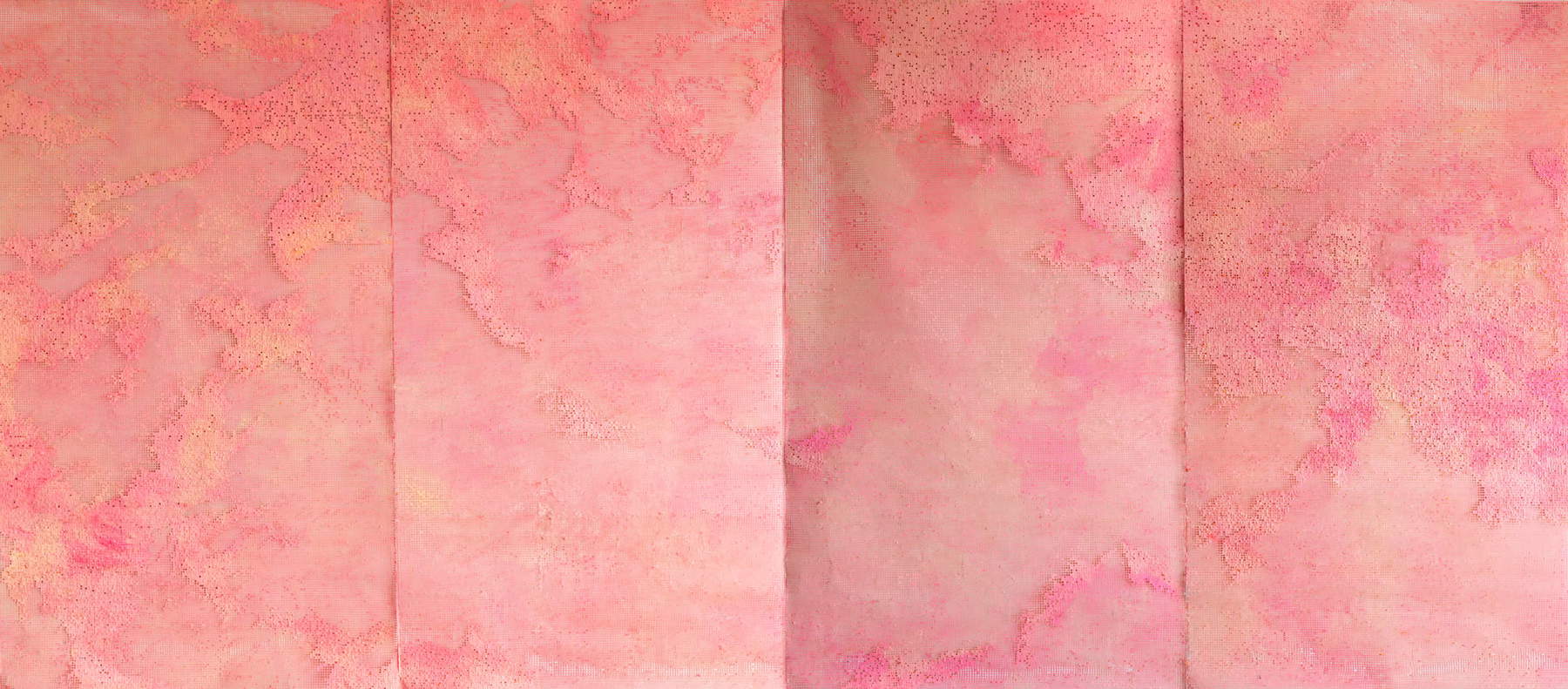
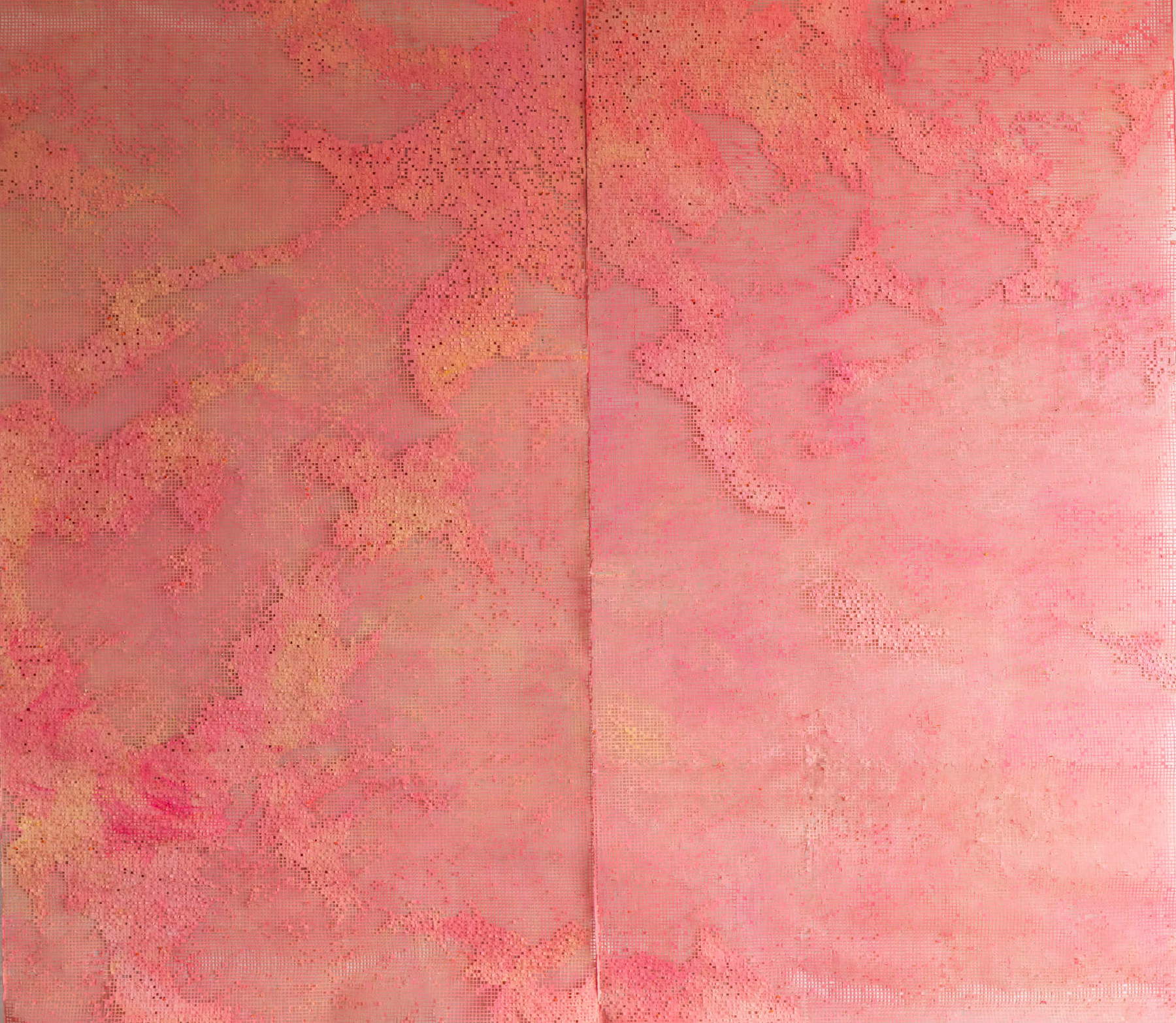
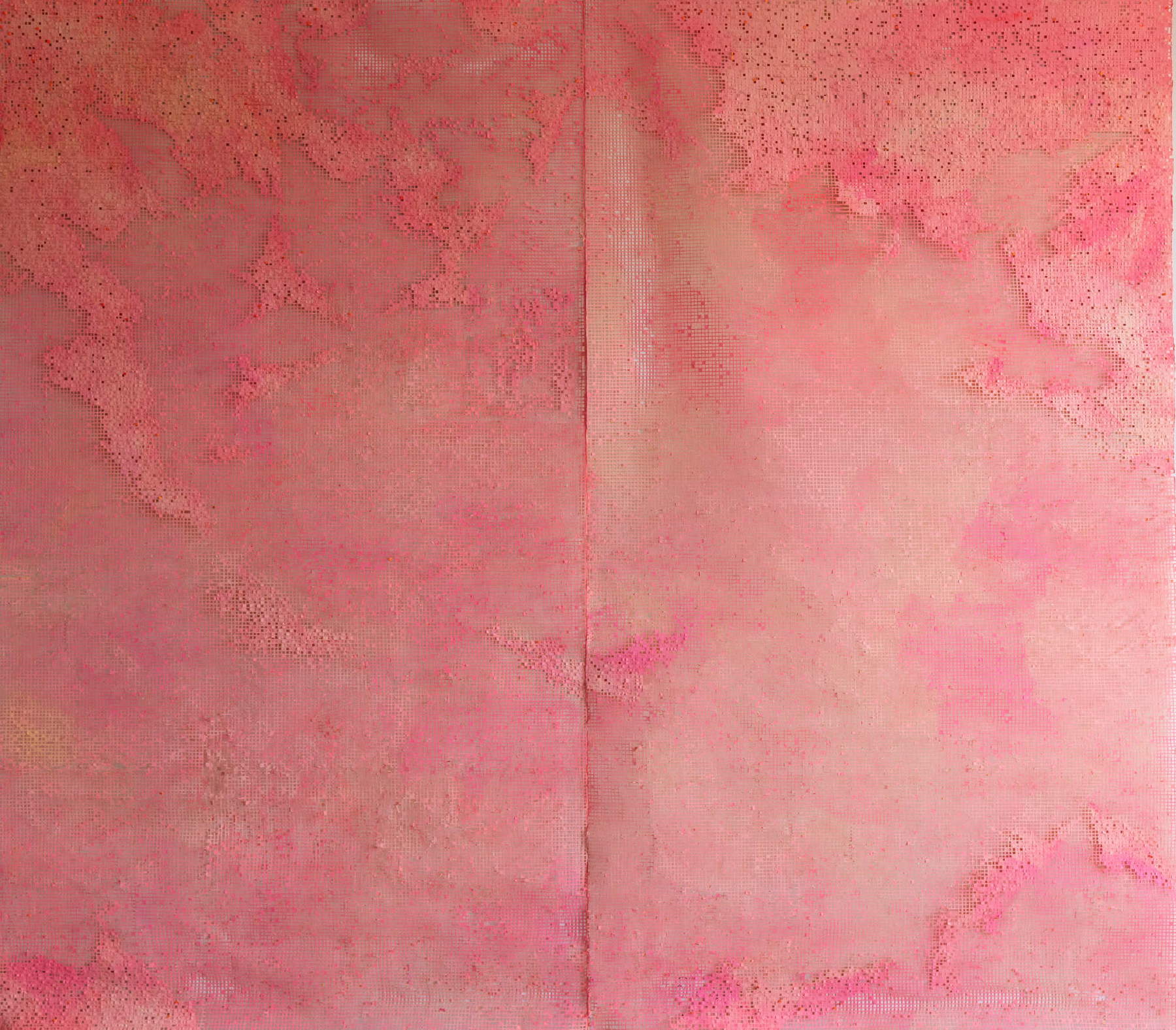
The origin of this monumental work lies in a specific need that developed within the artist: after spending nearly a year working on small-scale pieces, Landi felt the need to tackle a much larger scale. He therefore set to work on a roll of watercolor paper ten meters long and one meter forty high, dividing it into four equal parts and painting on both sides: he laid the sheets out on the floor in his studio, drawing on the back of each one—using fluorescent colors—shapes that evoked a geographical map. The final result is a composition measuring 250 by 560 centimeters. Upon completing this first phase of the work, the artist moved his workbench near the studio entrance and began tracing a dense grid of lines on the back of each sheet to guide him during the cutting phase—composed of squares with 7-millimeter sides, separated by a 2-millimeter-thick grid.
Given the size of the sheets, Landi had to unroll them a few centimeters at a time, cutting out each individual square freehand—first vertically and then horizontally, one after another—using a small, sharp blade. From the very beginning, the guiding concept behind the work was clear: to completely remove the grid in the areas where no shapes had been painted, leaving instead shreds of paper in the zones corresponding to the painted islands, peninsulas, and promontories, with the aim of drawing the map of a place that does not exist, one that can be traversed only through the visitor’s imagination.
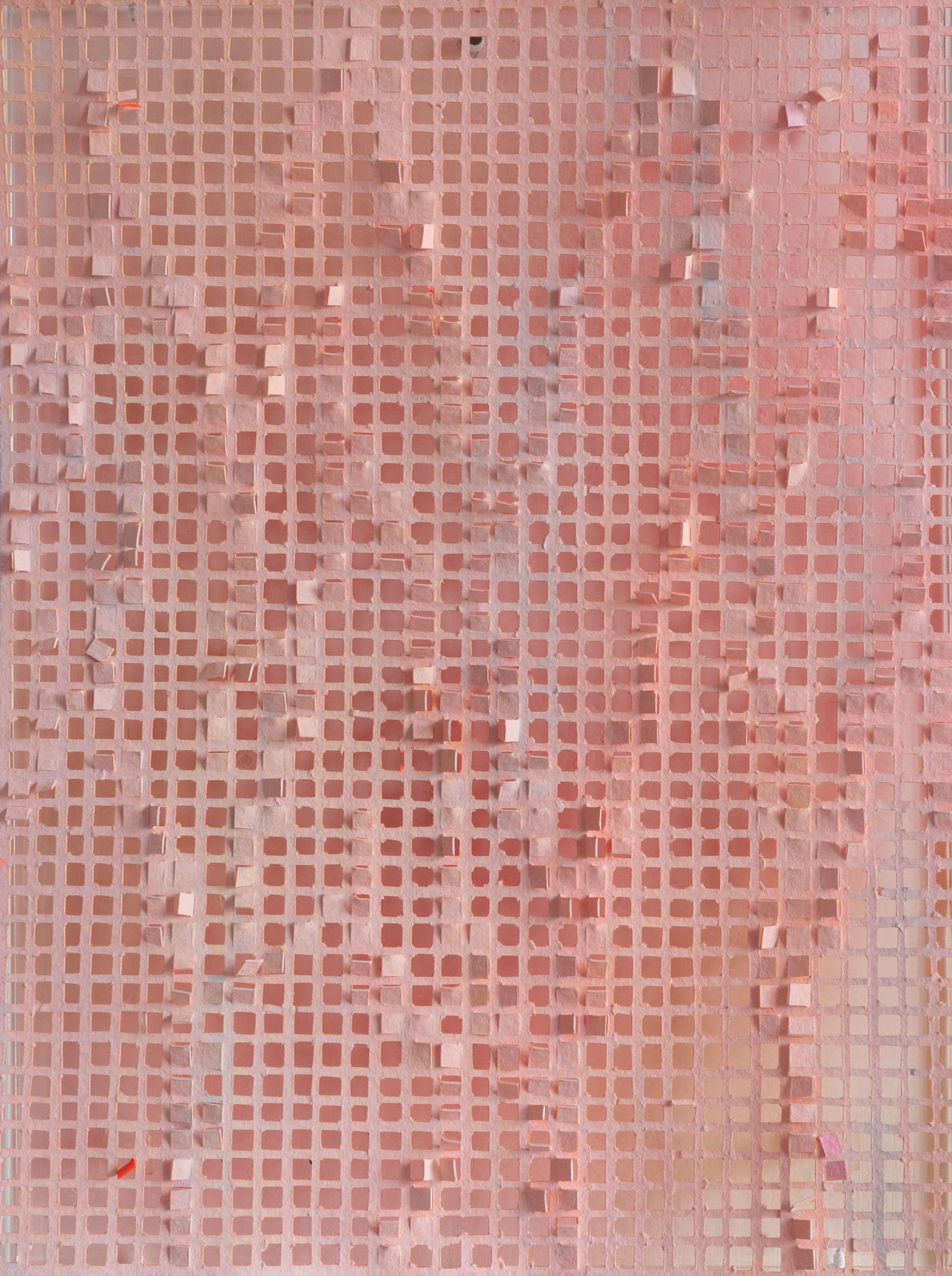
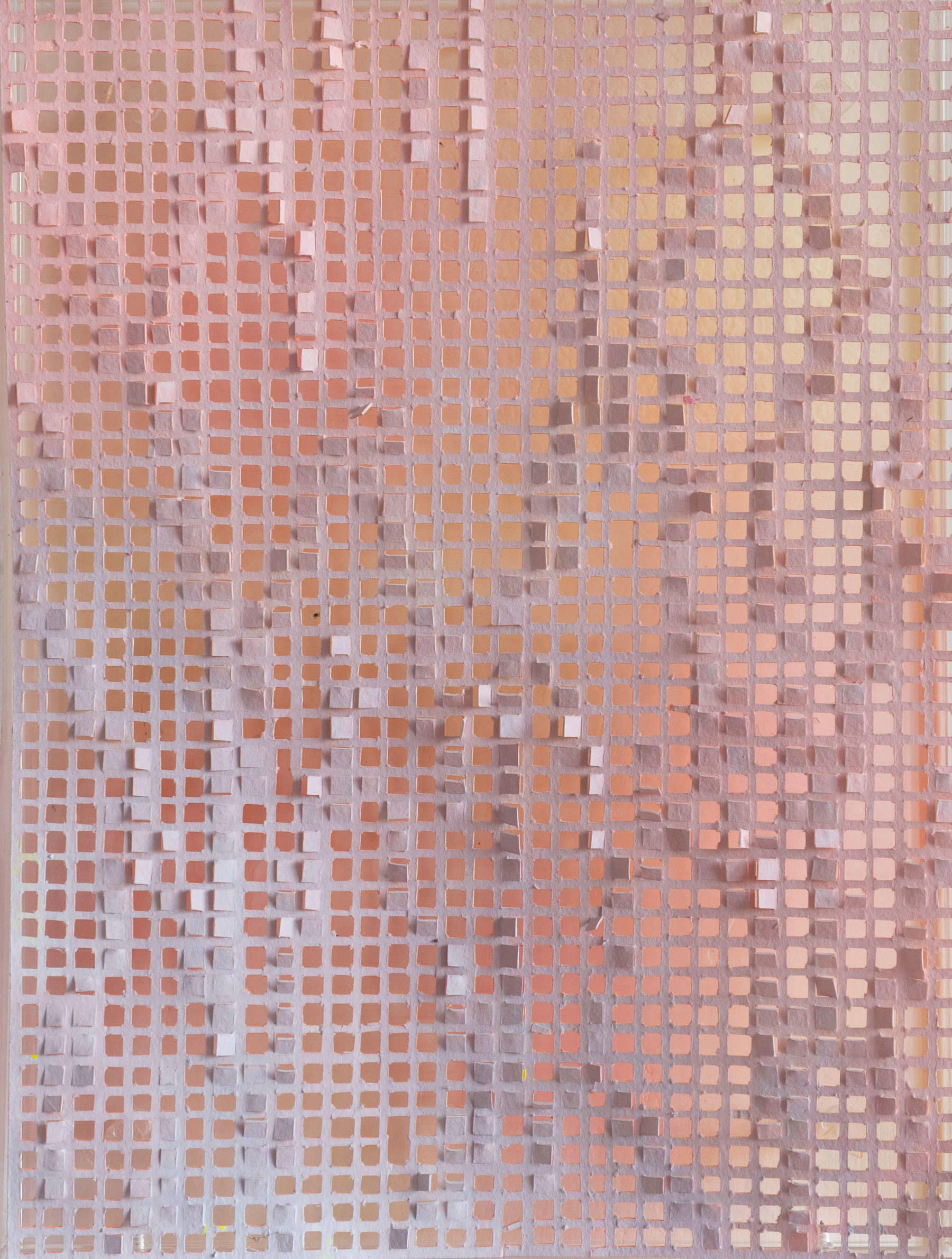
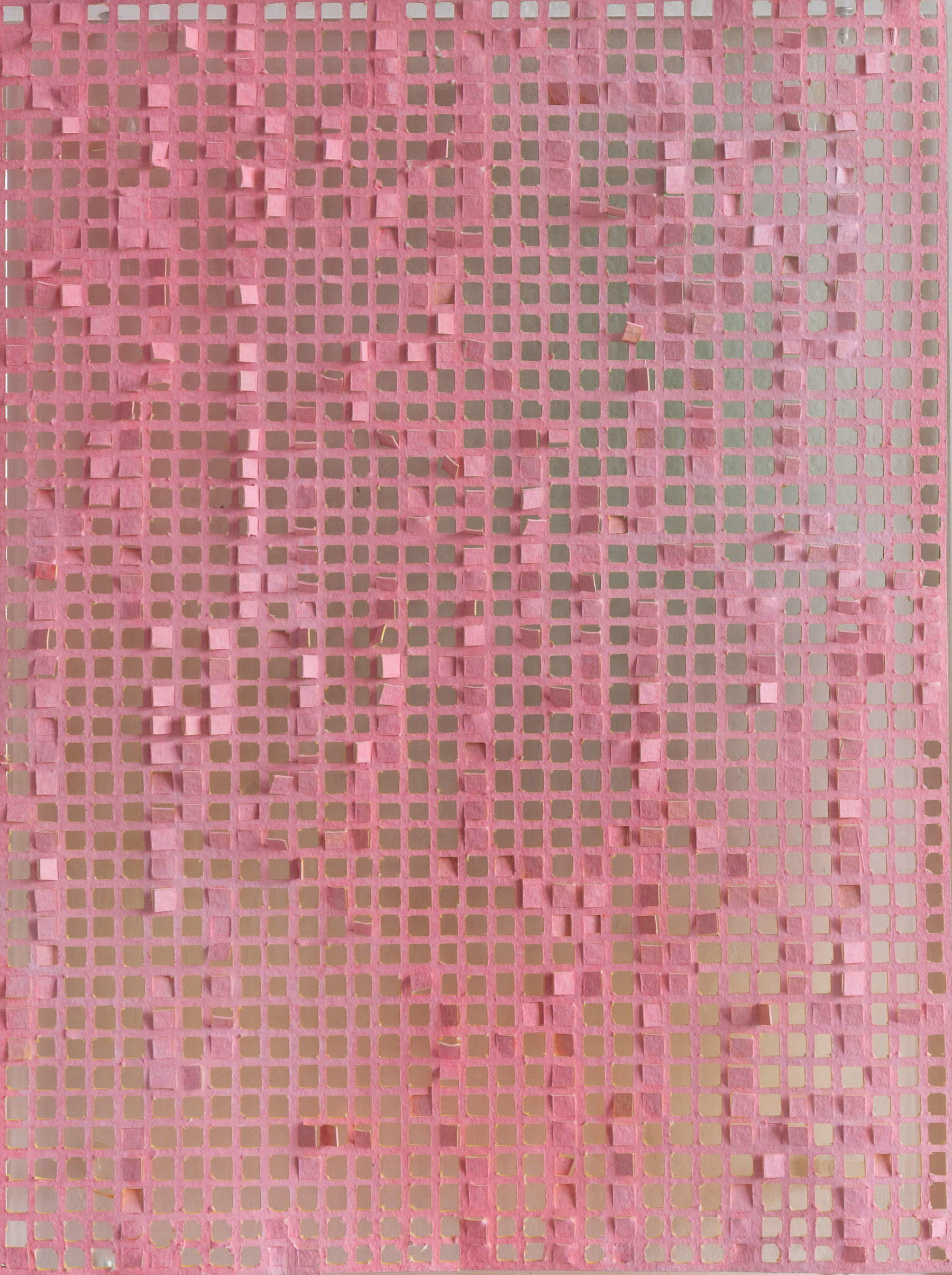
“I like the fact that the exhibition title is a question and that this question has no answer,” Gabriele Landi points out, “but evokes doubt and leaves room for uncertainty, like a missed appointment—was it supposed to be here? I find that the short circuit created between the title—which evokes an absence— the uncertainty of being in the wrong place, and the fact that the work I’m presenting in this exhibition is a map of a nonexistent place—amplifies, in and of itself, a paradoxical dimension that seems to confront us with our deepest uncertainties. The material that makes up this image—composed simultaneously of the presence and absence of an infinite number of tiny squares of paper and the various layers of paint with which I painted them on both sides—has, on the one hand, an erotic quality with an irrepressible, effervescent exuberance, on the other, it evokes its exact opposite: decay and decline.”
“Gabriele Landi’s new work,” states curator Federico Giannini, “introduces us to the cartography of an ‘elsewhere’ with vague contours—a cartography that disorients, offering neither compasses nor cardinal points, but merely dispenses uncertainties, evokes doubts, vagueness, and suspension. It is the most recent chapter in a body of work that continues to explore the boundaries between painting and sculpture, between the figurative and the abstract, between presence and absence with a lightness that has nothing to do with weight—if anything, with the delicate intensity of a process that manages to be at once writing and weaving, carving and painting, drawing and sculpture—and that invites the eye to return again and again to what it believes it has already seen. These new works—substantial yet fragile, gestural yet conceptual—are the result of a slow and precise process of stripping away, one that moves forward with a repetitiveness that is more ritual than serial; they are an open structure that unfolds to the infinite possibilities of the empty whole. Ultimately, the idea is that in Gabriele Landi’s maps of invention, every visitor may find their own geography.”
Gabriele Landi was born in Schaerbeek, Belgium, in 1971, and currently lives and works in the province of La Spezia. He graduated from the Brera Academy of Fine Arts in Milan, and for years his artistic practice has explored the fine line between painting and sculpture and the way the viewer relates to images, through carved paper, sculptural objects, and painted wooden sculptures, maintaining a constant dialogue with Italian geometric abstraction and the avant-garde movements of the 20th century, while never losing a critical eye toward the contemporary world. Among the artist’s most recent exhibitions are *Raggio verde*, created in collaboration with Gianluca Sgherri at the National Museum of Antarctica in Siena in 2025, *Alle montagne* at the mudaC in Carrara in 2024, *Solide incertezze* at Palazzo Picedi Benettini in Sarzana in 2023, and *Lieve svanire* at Vôtre Spazi Contemporanei in Carrara in 2021.
|
| Gabriele Landi’s exhibition in Florence, “Doveva essere qui?”, curated by Federico Giannini |
Warning: the translation into English of the original Italian article was created using automatic tools. We undertake to review all articles, but we do not guarantee the total absence of inaccuracies in the translation due to the program. You can find the original by clicking on the ITA button. If you find any mistake,please contact us.