



by Redazione 12/11/2026


Categories: Exhibitions / Disclaimer
The Mart in Rovereto presents an exhibition tracing the artistic debate that swept through postwar Italy, comparing the visions of Renato Guttuso and Emilio Vedova. The exhibition spans social realism, Informal art, and experimental art, culminating in the works of Fontana, Burri, and Manzoni.


Social realism versus abstraction, political commitment versus the freedom of the painterly gesture: the comparison between Renato Guttuso and Emilio Vedova serves as the starting point for exploring one of the most vibrant periodsin 20th-century Italian art. From November 28, 2026, to April 4, 2027, the Mart in Rovereto presents “Opposing Fronts. Italian Art Between Guttuso and Vedova, an exhibition curated by Daniela Ferrari that aims to explore the contrasts, ideas, and experiments that characterized the national art scene in the postwar period.

The exhibition is part of the museum’s research program, which draws on its own collections, documentary materials, and archival holdings to explore the events and key figures of 20th-century Italian art.
The exhibition examines a time span between two pivotal editions of the Venice Biennale: the 1948 edition, which marked the resumption of dialogue between Italy and the international art scene after the war, and the 1964 edition, which would go on to establish the American Pop Art revolution.



During these years, Italian artistic exploration developed primarily along two distinct paths. On the one hand, figurative painting emerged, linked to social realism and characterized by a strong ideological and political component. Artists who adhered to this vision attributed a specific civic and moral responsibility to art, using it to depict everyday reality, the world of work, the sufferings of war, the human condition, and the difficult process of reconstruction. On the other hand, an abstract and informal artistic movement emerged, in which the painterly gesture became the primary means of expression. The material, the mark, and the movement on the canvas were transformed into manifestations of intense and dramatic energy, capable of translating philosophical reflections and political stances into images.
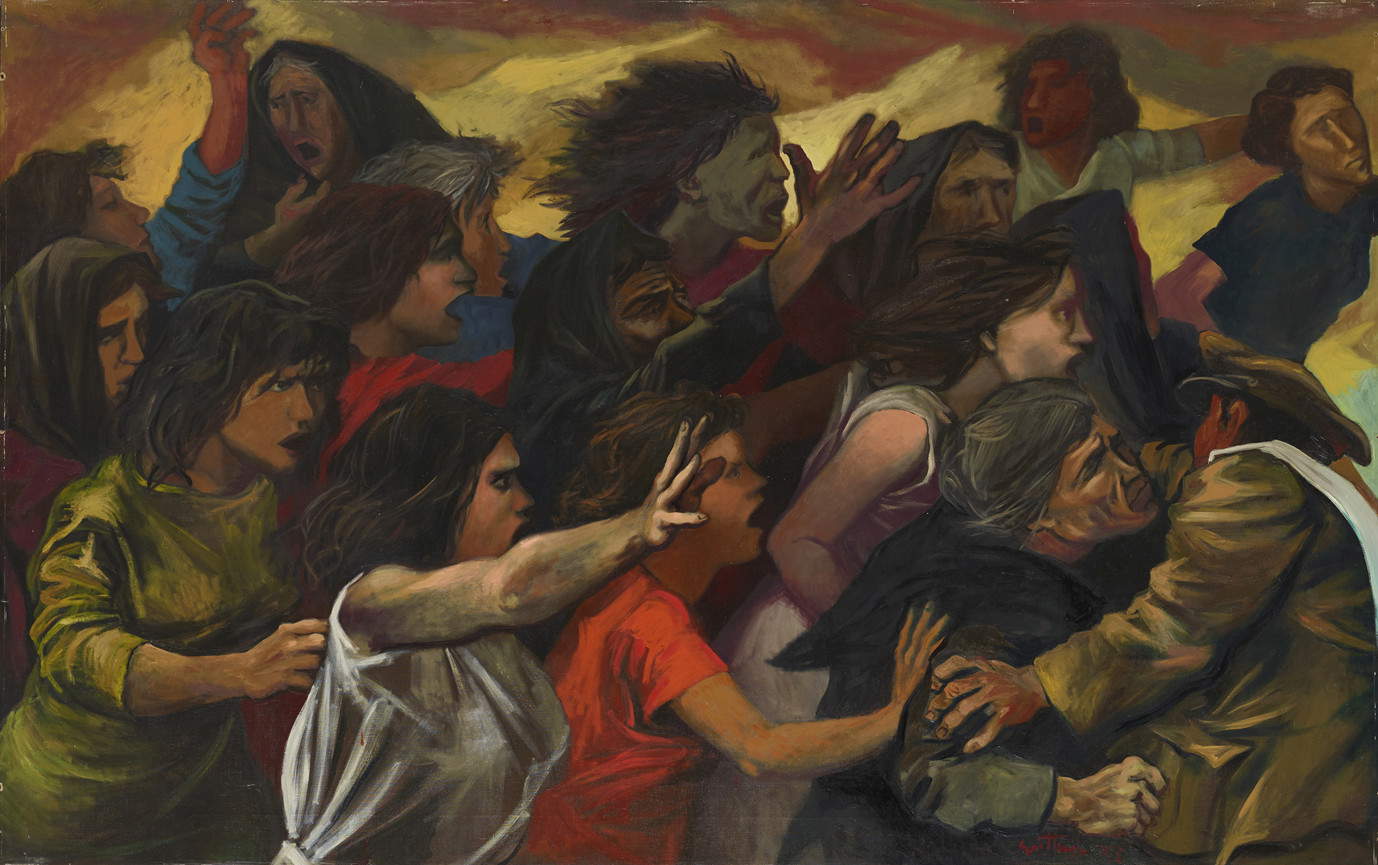
The contrast between figurative and abstract art gave rise to a heated debate, which involved not only artists and academic circles but also art critics and the broader Italian cultural scene. At the center of this discussion were, above all, Renato Guttuso and Emilio Vedova, who embodied two different conceptions of the role and language of art. The confrontation between their positions did not reach a definitive resolution, but it helped foster a climate of continuous research and experimentation. It was precisely from the vitality of this period that some of the most radical movements of the Italian 20th century took shape, destined to bring Italian art back to the forefront of the international scene.
A pivotal stage in this transformation was marked by the work of Lucio Fontana, Alberto Burri, and Piero Manzoni—three leading figures who, through innovative artistic languages and a profound redefinition of the boundaries of the artwork, transcended traditional artistic categories, opening new perspectives for subsequent generations.
|
| Guttuso vs. Vedova: An Exhibition at the Mart in Rovereto Explores the Clash Between Figurative and Abstract Art in Italian Art |
Warning: the translation into English of the original Italian article was created using automatic tools. We undertake to review all articles, but we do not guarantee the total absence of inaccuracies in the translation due to the program. You can find the original by clicking on the ITA button. If you find any mistake,please contact us.