



by Redazione 10/09/2026



Categories: Exhibitions / Disclaimer
From September 10, 2026, to January 5, 2027, Palazzo Medici Riccardi will host “Beyond the Renaissance: Between Dürer and Parmigianino,” an exhibition dedicated to European Mannerist prints and the collection of Georg Baselitz.
Florence once again explores the relationship between the Renaissance and Mannerism through the collection of a contemporary artist. From September 10, 2026, to January 5, 2027, Palazzo Medici Riccardi will host *Beyond the Renaissance*. Between Dürer and Parmigianino, an exhibition curated by Daniel Blau, Sergio Risaliti, and Valentina Zucchi, brings together approximately 150 works from Georg Baselitz’s private collection and the collections of the Budapest Museum of Fine Arts. The project, sponsored by the Metropolitan City of Florence and organized by the MUS.E Foundation, focuses on the technical and aesthetic richness of European Mannerist printmaking, drawing parallels between 16th-century works and Baselitz’s curatorial choices.
The starting point is the line, understood as a space for experimentation, while the human figure becomes a field of tension and the classical legacy undergoes transformations. The Florence opening comes just a few days after the conclusion of “Baselitz. AVANTI!”, the exhibition that the Museo Novecento is dedicating to the artist through September 13, 2026. The two projects offer complementary perspectives on his body of work. The exhibition at the Museo Novecento spans over sixty years of work through approximately 170 works, including prints, paintings, and sculptures, with a focus on graphic art and engravings. At Palazzo Medici Riccardi, on the other hand, Baselitz emerges as a collector and connoisseur of the old masters, drawn to the inventive freedom, dissonances, and unconventional approach of Mannerist prints. In the days following the opening, visitors will thus be able to draw a conceptual parallel between Baselitz the artist and Baselitz the collector.


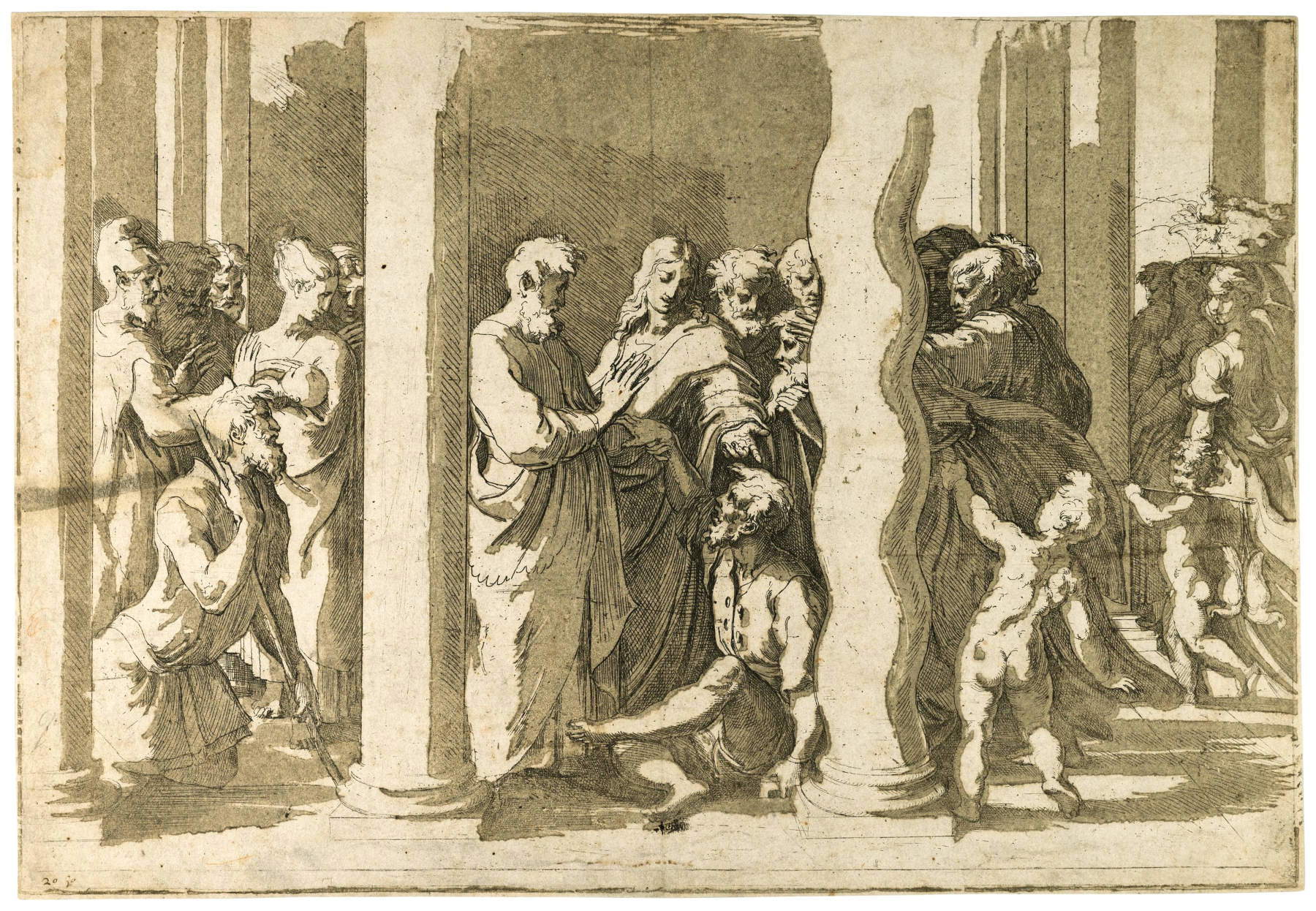
The project stems from the exhibition *The Mannerist Mind. Prints from the Georg Baselitz Collection*, scheduled to take place between late 2025 and early 2026 at the Museum of Fine Arts in Budapest, featuring Mannerist prints from the museum’s and Baselitz’s collections. The exhibition in Florence offers a new interpretation of this theme, built on a dialogue between 16th-century printmaking and the German artist’s sensibility. The prints are accompanied by four important sculptures by Baselitz and his self-portrait.
The relationship with the Hungarian museum is well-established: in 2017, the institution dedicated a monographic exhibition to him, and in 2020, the artist donated thirty engravings to the museum’s collections. In Florence, therefore, two forms of collecting are juxtaposed—that of a public institution and that of a private artist—offering a reflection on the idea of a collection as a practice of conservation, preservation, study, and sharing of works.
Baselitz’s collecting of early prints began in the 1960s and has continued for over six decades. A pivotal moment came in 1964, when he acquired *The Sacrifice* by Antonio Fantuzzi from Trento, a print that reinterprets Rosso Fiorentino’s painting at Fontainebleau. Since then, the collection has expanded, driven by an interest in the unstable and eccentric forms of Mannerism and in the possibility of transcending convention and challenging the classical vision.
Graphic art forms the core of the exhibition as an independent field of research. Baselitz’s collection brings together works by Italian, French, German, and Dutch masters and allows viewers to observe the potential of drawings and prints as reservoirs of images, models, and tools for experimentation. Woodcuts—including those made with multiple blocks—etchings, chalcography, and drypoint engravings display different linear, chiaroscuro, and tonal effects.
The preparation of the plates, the skill of the line, the variations introduced during printing, and the diverse rendering techniques all become expressive tools. In the sixteenth century, these possibilities challenged tradition and gave rise to new images and ways of seeing. The circulation of prints throughout Europe also fostered the exchange of models, experiences, and sensibilities, making printmaking a tool for the transmission and transformation of images.
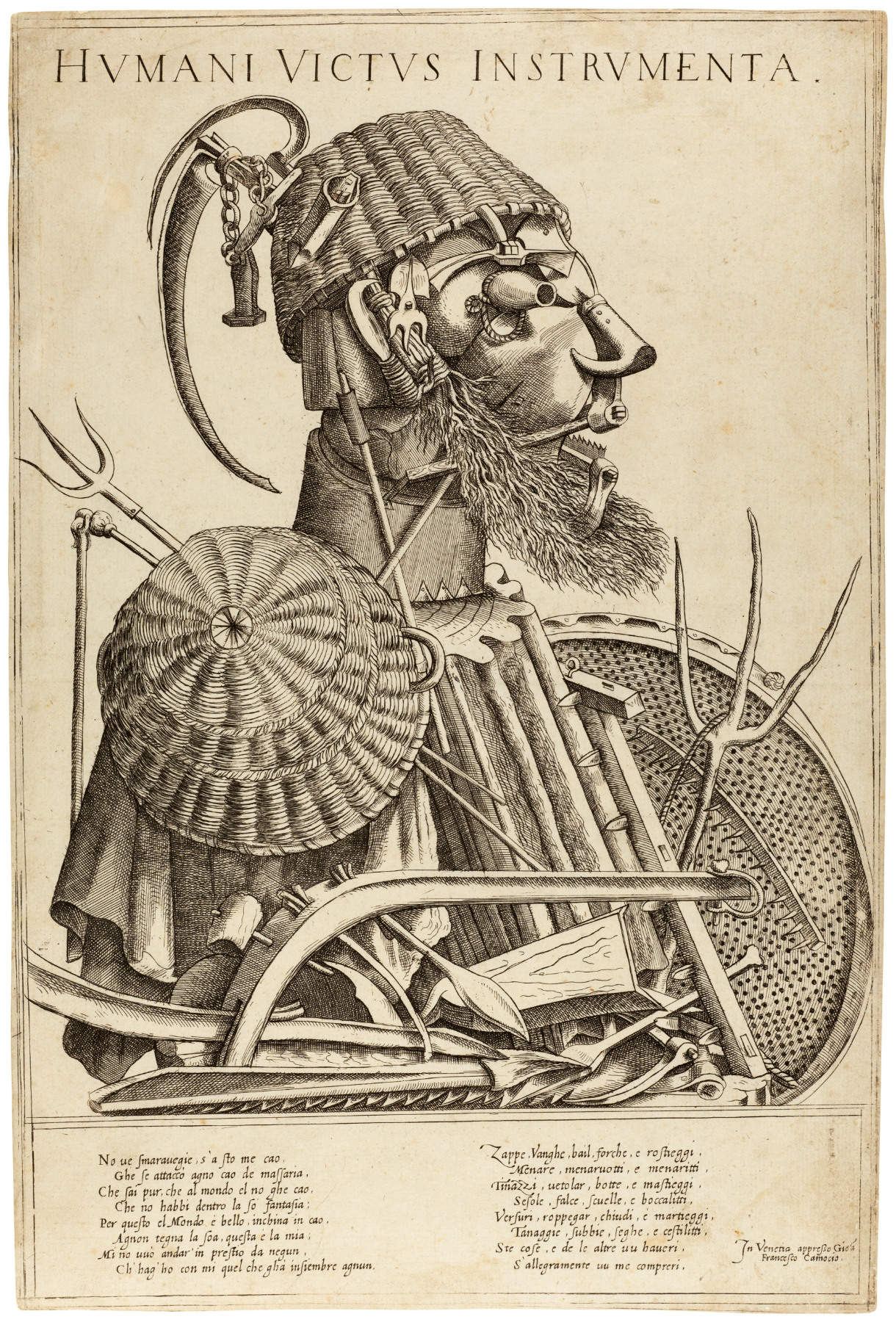
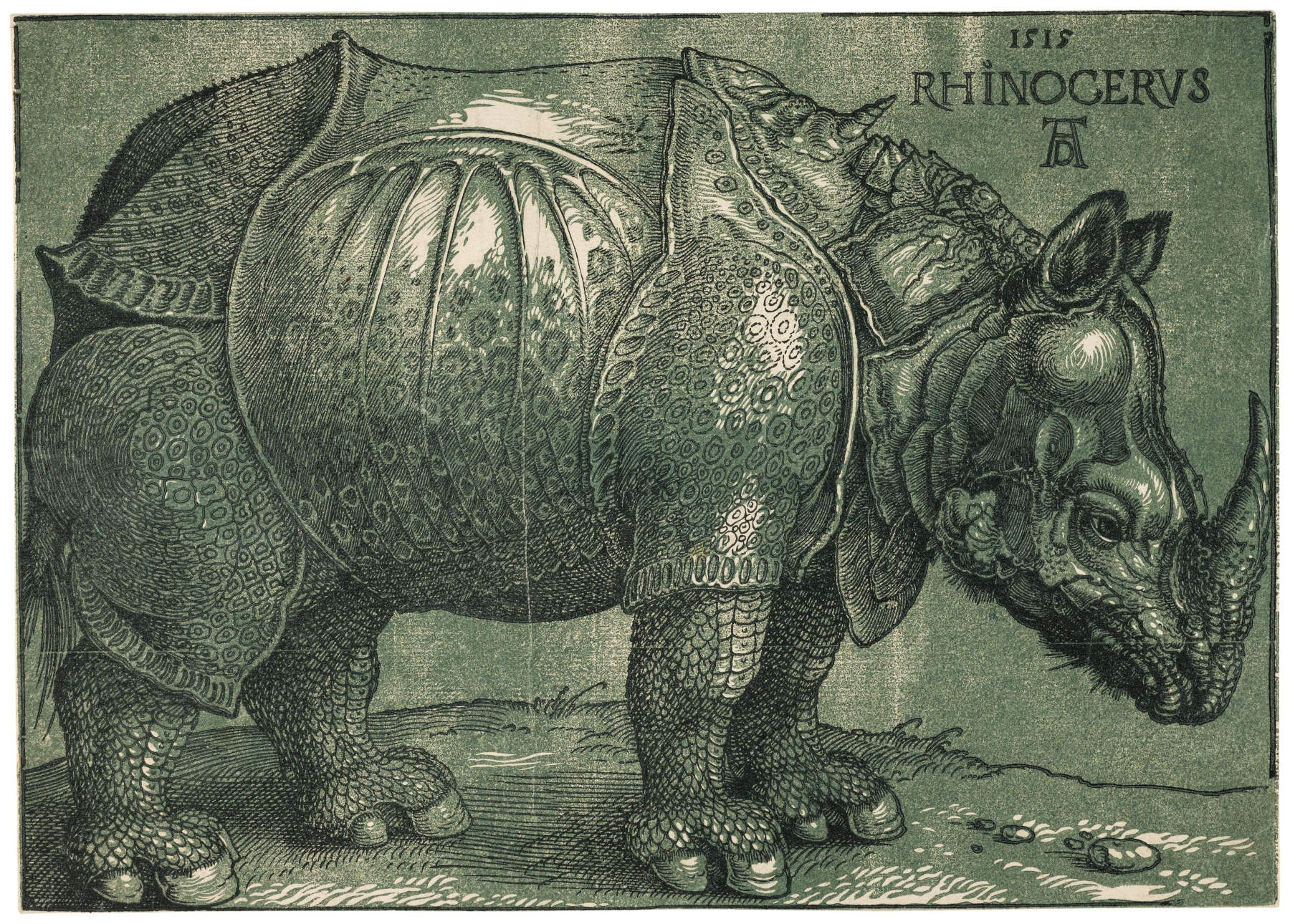
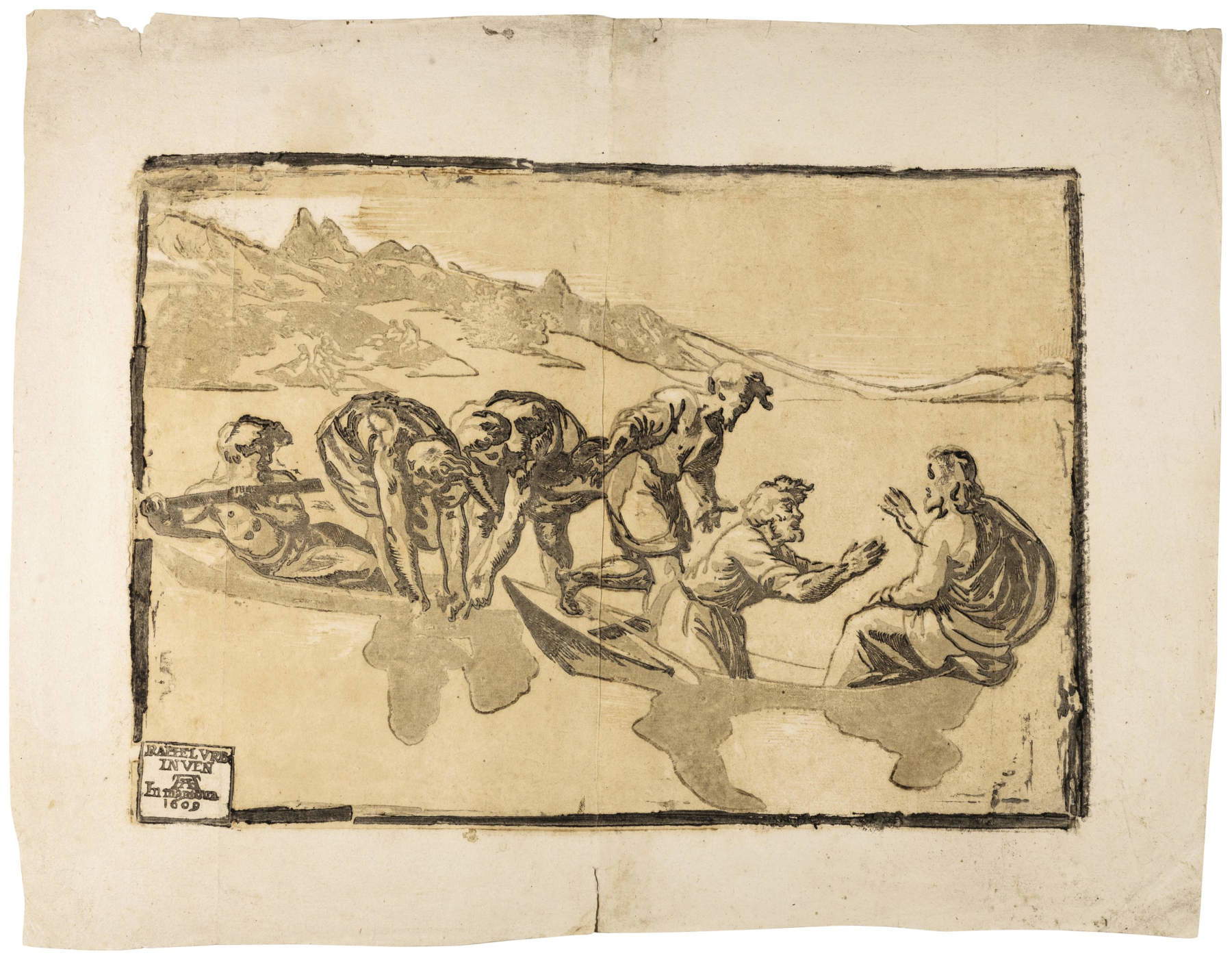
The exhibition spans different eras and geographical areas. It opens with the famous prints by Albrecht Dürer, including *The Rhinoceros*, and a series of works by Lucas Cranach the Elder, presented alongside a rare woodcut plate by the artist. These are followed by the chiaroscuro prints of Domenico Beccafumi and Ugo da Carpi—including *Diogenes*—and works by Jacques Bellange. Another section consists of prints derived from a lost painting by Arcimboldo, one of which was chosen as the exhibition’s symbolic image, alongside imaginative figures in period costume.
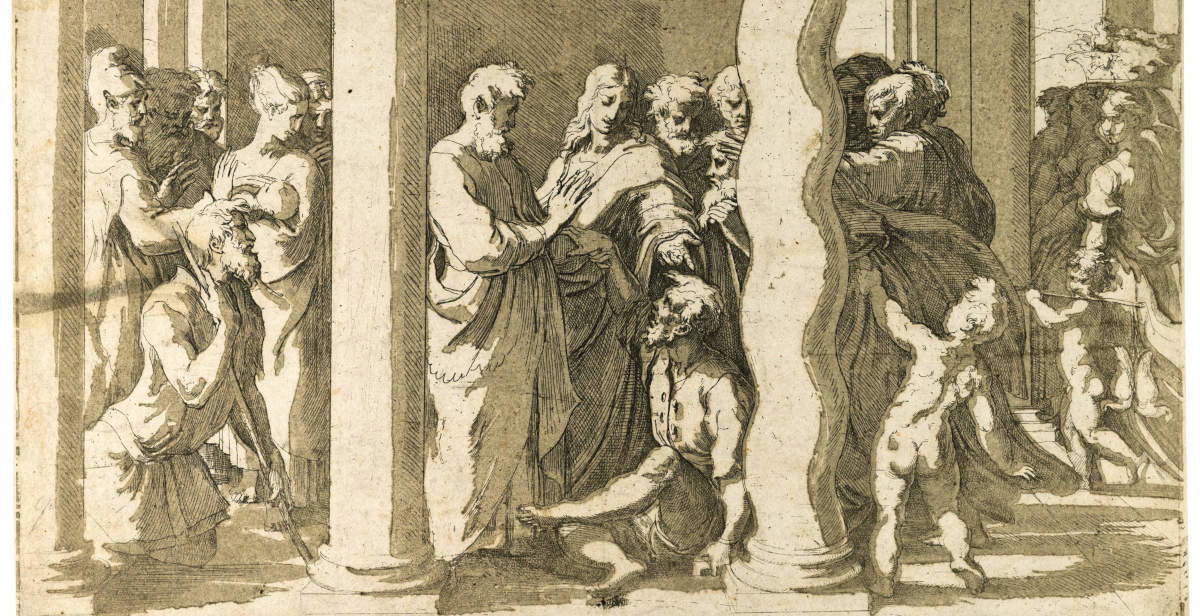
Particular attention is devoted to Parmigianino and the artists associated with him, with a focus on studies of Raphael’s work and the theme of the Deposition of Christ. The exhibition continues with solitary figures in meditative poses or in heroic and monumental stances, serving as a counterpoint to the works of the Fontainebleau school, and concludes with the pioneering works of Antonio del Pollaiolo and Andrea Mantegna.
Also featured are works by Andrea Schiavone, the French masters of the Fontainebleau school—Léon Davent, Geoffroy Dumonstier, and Juste de Juste; the Dutch and German artists Hans Sebald Beham and Albrecht Dürer; and experimenters with chiaroscuro such as Ugo da Carpi, Domenico Beccafumi, Andrea Andreani, and Hendrick Goltzius. Also on view from the collections in Budapest are works by Antonio del Pollaiolo and Parmigianino himself, presented in dialogue with the Baselitz collection.
Rounding out the exhibition are display cases featuring tools and equipment related to various engraving techniques, curated by the Il Bisonte Foundation, to illustrate the processes and steps involved prior to printing and the relationship between the matrix, the artist’s gesture, and the image. The program includes guided tours every Saturday and Sunday at 3:00 p.m. and a family activity on Sundays at 10:30 a.m., featuring an engraving workshop. Tours and activities can also be booked by elementary schools and middle and high schools.
Statements
“For Baselitz, ‘deconstruction’ was not a slogan but a deliberate choice to break down the aspects through which the power of the Third Reich had manifested itself. His artistic exploration is aimed precisely at this,” states Sara Funaro, Mayor of the Metropolitan City of Florence. “The exhibition we are hosting at Palazzo Medici Riccardi, in addition to paying tribute to the artist who passed away a few months ago, highlights the fruitful intertwining of his passion for Mannerist printmaking (a passion he also cultivated during the period when he won a scholarship and studied for six months at the Villa Romana in Florence) and his original reinterpretation, aimed at highlighting vulnerability—free from ethnic affiliations—in the face of forms of power. We are faced with a message that—thanks in part to the presence of several works by Baselitz himself—prompts reflection in the face of the bitter realities of the present.”
“Florence played a profound role in my father’s life and art,” said Daniel Blau, curator of the exhibition and the artist’s son, “without the time he spent here, I am certain his work would have been different. He loved these prints dearly, and we hoped he might finally see them on display in the city he loved so much. It wasn’t possible, but as he said shortly before his passing: ‘Up there, there will surely be a small open window. I’ll be watching from there.’”
“During the preparatory stages of the major exhibition *Baselitz. AVANTI!,” dedicated to Georg Baselitz’s printmaking and held at the Museo Novecento,” explained Sergio Risaliti, curator of the exhibition and director of the Museo Novecento, “the idea arose to broaden our focus to include his extraordinary collection of prints, seizing a fortunate opportunity: the Budapest Museum of Fine Arts was in fact preparing to stage an exhibition dedicated to this important collection of engravings. This opened up the possibility of building a bridge between two dimensions that are only seemingly distinct—that of the artist and that of the collector—which are deeply interconnected by a common denominator: printmaking as a space for invention, experimentation, and knowledge. From the very beginning, Palazzo Medici Riccardi seemed the most natural venue for this project, as it was here that Cosimo the Elder and Piero the Lame laid the foundations, in the 15th century, for the culture of collecting that would help define modernity. The extraordinary coincidence of the exhibitions *Baselitz. AVANTI! * at the Museo Novecento and *Beyond the Renaissance: Between Dürer and Parmigianino* at Palazzo Medici Riccardi allows us to present the public with a two-sided portrait of Georg Baselitz. I would like to thank Daniel Blau, thanks to whom this evocative idea was able to take shape, and the Budapest Museum of Fine Arts, which has further enriched the project with several important antique prints from its collections. Even today, printmaking is sometimes considered—according to a distinction that is now obsolete yet surprisingly persistent—a “minor” art, assuming that such a thing as a “minor” art even exists. Yet someone has rightly defined prints as “the lifeblood of ideas.” This exhibition reveals just how much the mark, the matrix, and the reproducibility of the image have been—and continue to be—fundamental tools of artistic creation. This is especially true of a period such as the sixteenth century and of artists who made anti-classicism and anti-Renaissance their hallmark, embracing eccentric and imaginative styles and that timeless expressionism to which even Baselitz has adhered since his youth. Perhaps this distrust of printmaking still reveals a conception of art that is, on the one hand, too tied to mimesis and, on the other, to the ideal of beauty. Baselitz, both an artist and a collector, shows us instead just how much the power of an image can lie precisely in its ability to transform itself, multiply, and continually challenge what we see and what we believe to be absolute beauty.”
“A surprising exhibition that makes experimentation, eclecticism, and dialogue its defining features,” explained Valentina Zucchi, curator of the exhibition and scientific director of Palazzo Medici Riccardi. “The richness and variety of the works on display—including absolute masterpieces of European printmaking—allow us to grasp the possibilities offered by engraving techniques from the late 15th century to the early decades of the 16th century, presenting the kaleidoscope of sensibilities and tendencies that emerged—and spread —throughout Europe. An opportunity to explore the multiple facets of that Mannerism which, drawing on the Renaissance masters, opened new avenues of expression, composition, and artistic rendering—as refined as they were disruptive.”
 |
| In Florence, Georg Baselitz’s Mannerist graphics engage in a dialogue with Dürer and Parmigianino |
Warning: the translation into English of the original Italian article was created using automatic tools. We undertake to review all articles, but we do not guarantee the total absence of inaccuracies in the translation due to the program. You can find the original by clicking on the ITA button. If you find any mistake,please contact us.