



by Redazione 02/11/2026


Categories: Exhibitions / Disclaimer
From October 30 to January 31, 2027, the Stefano Bardini Museum will present over fifty works—some of which have never been exhibited before—including tapestries, rugs, historical garments, and archival documents. The exhibition traces the role of textile artifacts in the work of the antiquarian and his children, Emma and Ugo.

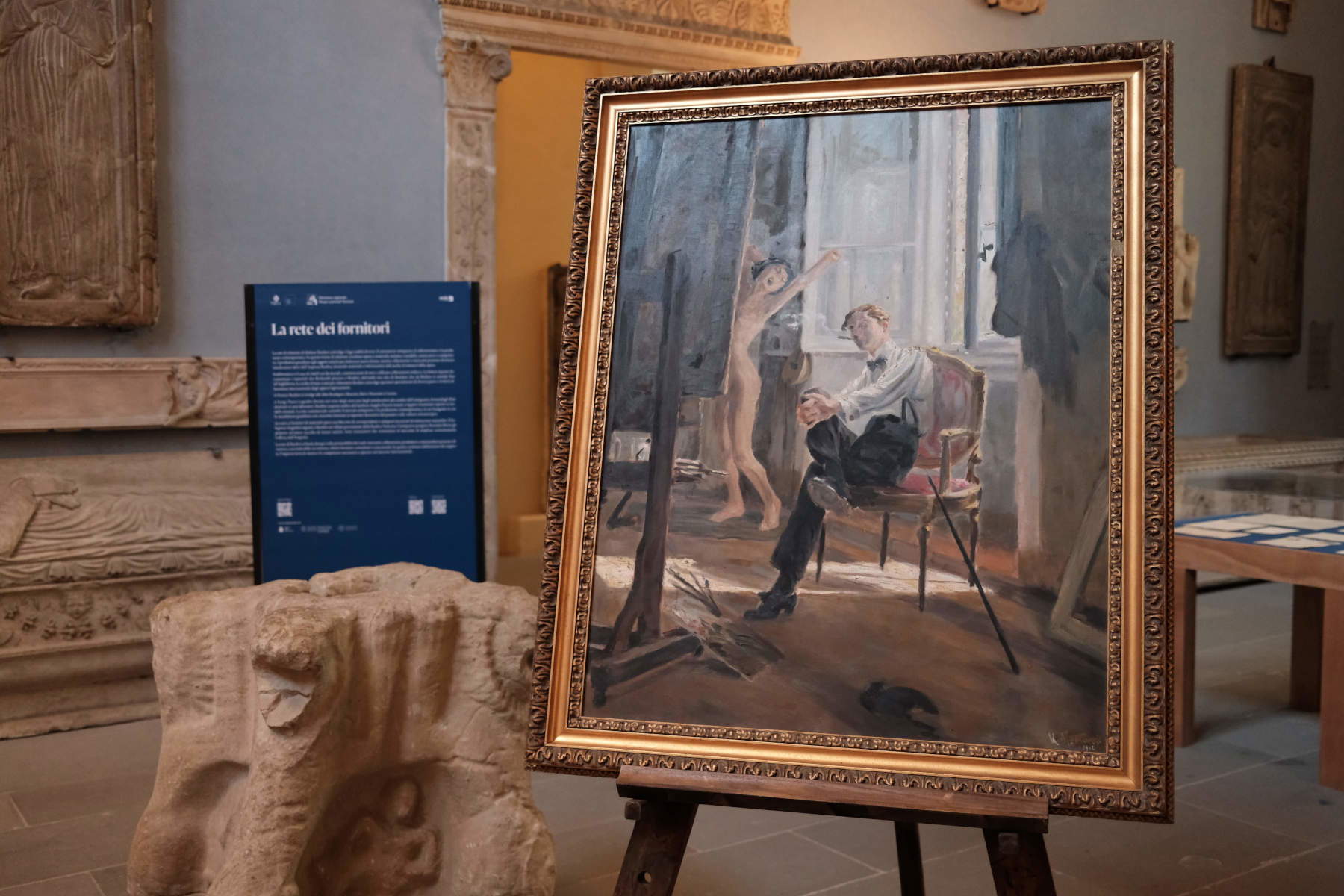
Precious silks, Oriental rugs, tapestries, historical garments, and archival documents reveal the complex network of commercial, artistic, and artisanal relationships forged by Stefano Bardini, the renowned Florentine antiquarian, and his children Emma and Ugo. From October 30, 2026 , to January 31, 2027 , the Stefano Bardini Museum in Florence will host “Officina Bardini: Unveiled Textures—Fabrics, Carpets, and Tapestries,” the third installment in the exhibition series dedicated to the family and its legacy. The exhibition features over fifty works from the Bardini Estate—some of which have never been shown before—presented in dialogue with the city’s collections and on loan from other museums.


The exhibition follows *Officina Bardini* (2022), organized on the centennial of the antiquarian’s death, and *Officina Bardini: The Art of Wood* (2024). The new project is the result of two years of research, study, and restoration and is sponsored by the City of Florence—Superintendence of Municipal Museums, the Ministry of Culture—Regional Directorate of National Museums of Tuscany—Mozzi Bardini Museum and Gallery, and the MUS Foundation.E. The curatorship is entrusted to Marco Betti, Marco Mozzo, and Rosario Ruggiero Terrone, with scientific coordination by Carlo Francini and Valentina Zucchi. The initiative renews the collaboration launched in 2022 to highlight the heritage of the Bardini Estate and the museum’s collections.


Organized into five thematic sections, spread across the ground floor and first floor, the exhibition explores the role of textile artifacts in the family’s activities. For Bardini and his sons, in fact, these objects were not merely items to be collected, but also tools for social status, sought-after commodities, and models for contemporary production. Paintings, photographs, correspondence, receipts, inventories, and artifacts document an international enterprise capable of connecting workshops, restorers, manufacturers, collectors, and museums.

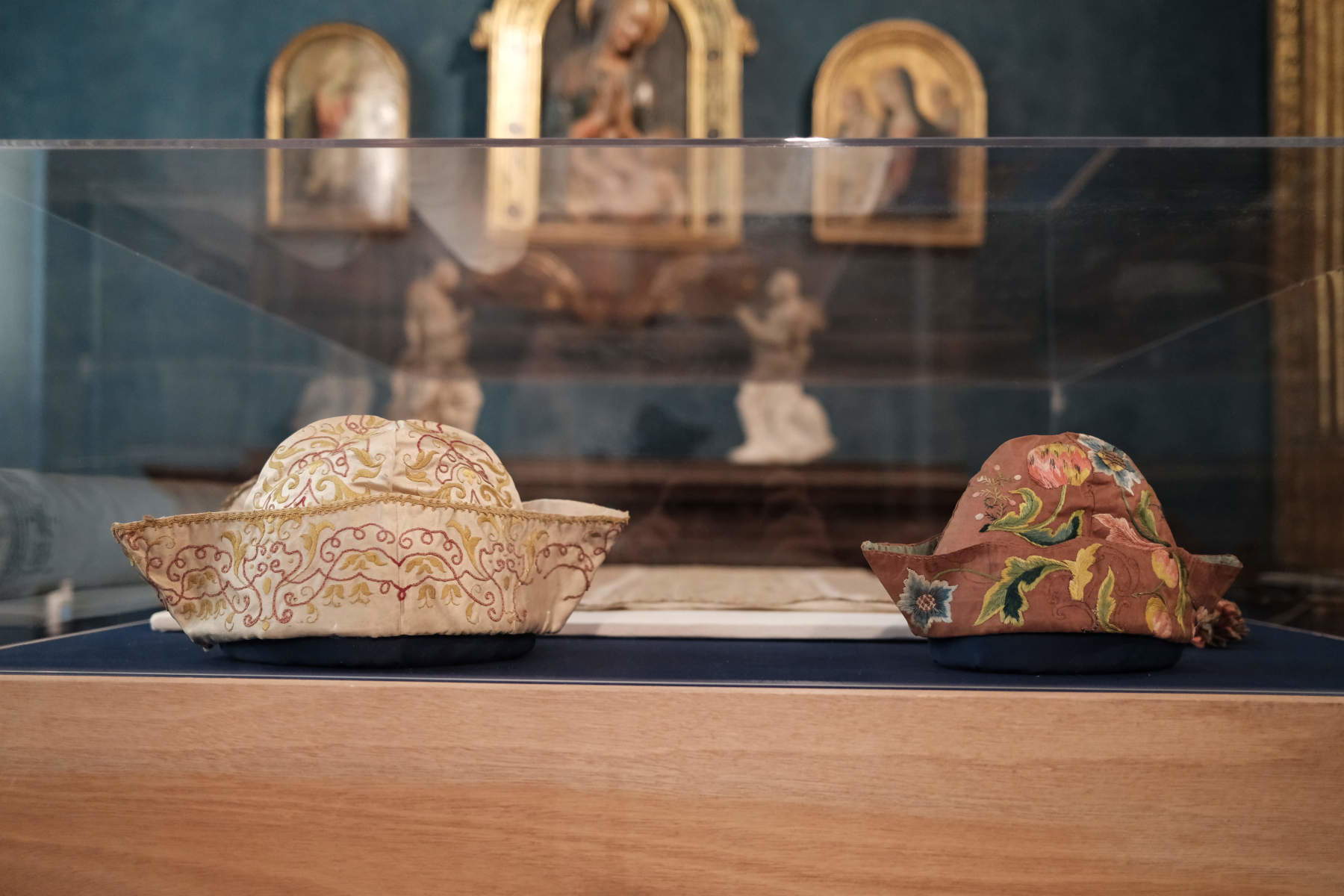
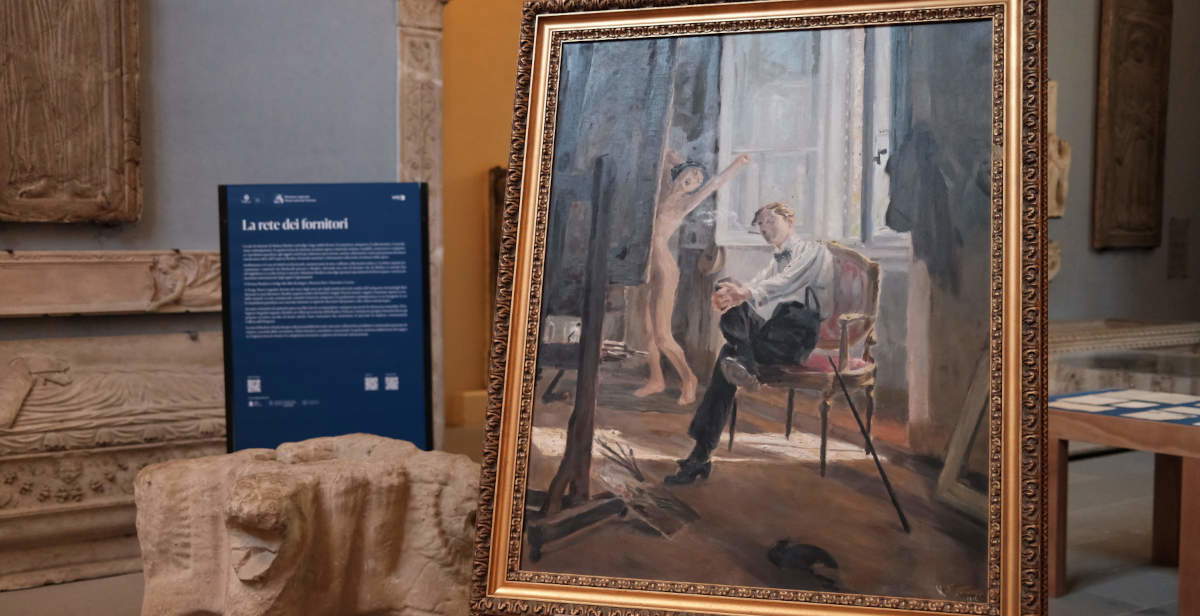
The first section is dedicated to the style of the Bardini family, who, between the late 19th century and the early decades of the 20th century, built their public image in part through elegance and luxury. Emma, a painter and multilingual intellectual, personalized her clothes with sophisticated decorative embellishments: on display are several items from her wardrobe and Salvatore Ferragamo sandals with cork soles, accompanied by their original receipts. Ugo, an artist and collector, embodied the dandy ideal. Portraits and private documents allow us to reconstruct the social settings, relationships, and receptions held at Villa Bardini.
The international scope of his activities is evident from the documentation regarding suppliers and buyers. From Florentine workshops to manufacturers in Paris, Berlin, and London, Bardini sourced wool, silk, velvet, and antique artifacts through a network of correspondents, including the collector and dealer Adolf von Beckerath and the Parisian supplier Pierre Legendre. His clientele included major museums of applied arts as well as European and American collectors. Among the episodes reconstructed are his dealings with the South Kensington Museum in London—which also purchased a fragment of a Persian carpet recommended by William Morris—and with the art historian Wilhelm von Bode.
Inventories, sample books, ledgers, and photographs were essential tools for managing the business. Textile fragments still bearing numbered tags, business ledgers, bibliographic indexes, and the “Collection Bardini, Étoffes anciennes” photo album document a cataloging and promotional system that made it possible to study the objects, trace their provenance, and present them to an international clientele.
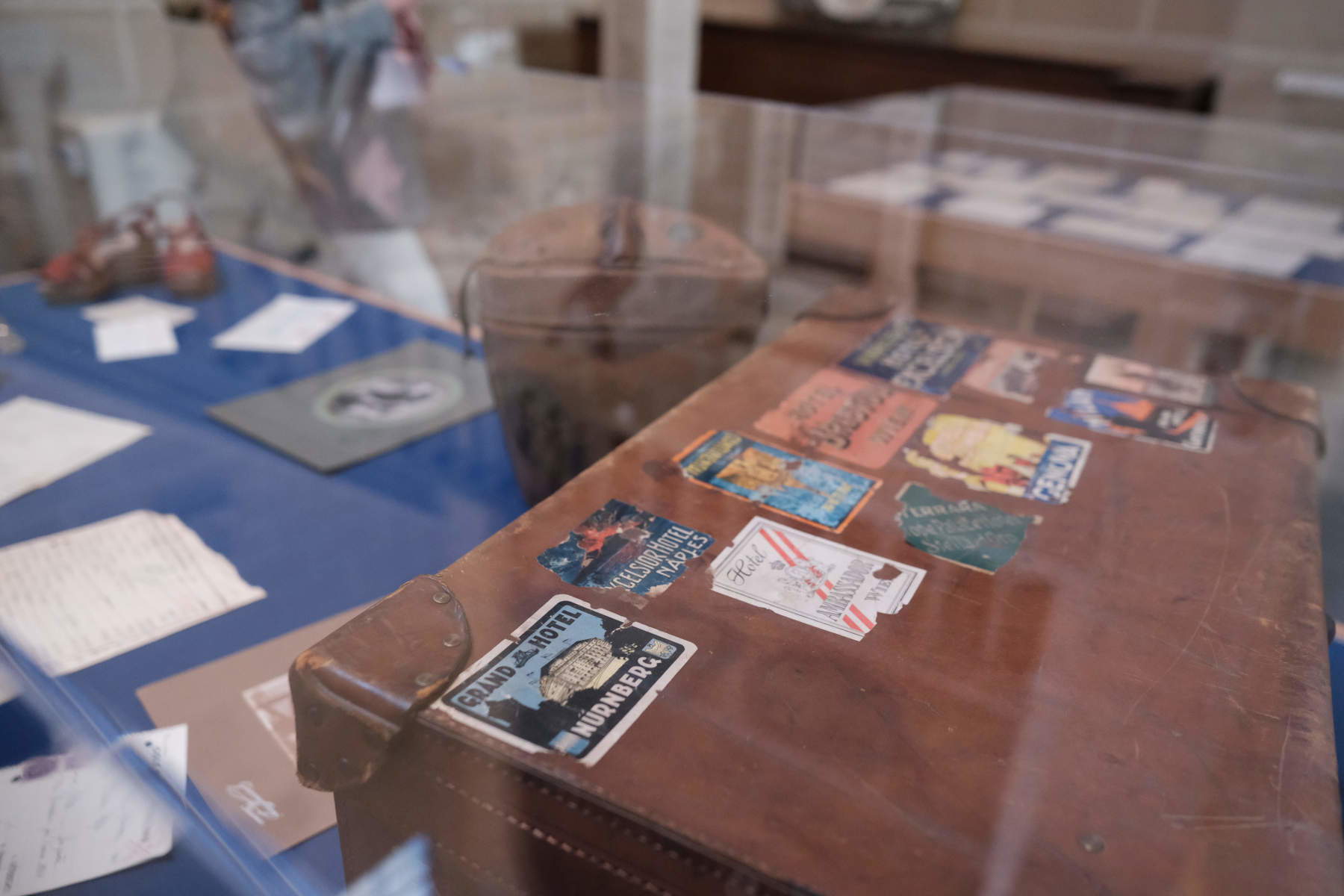
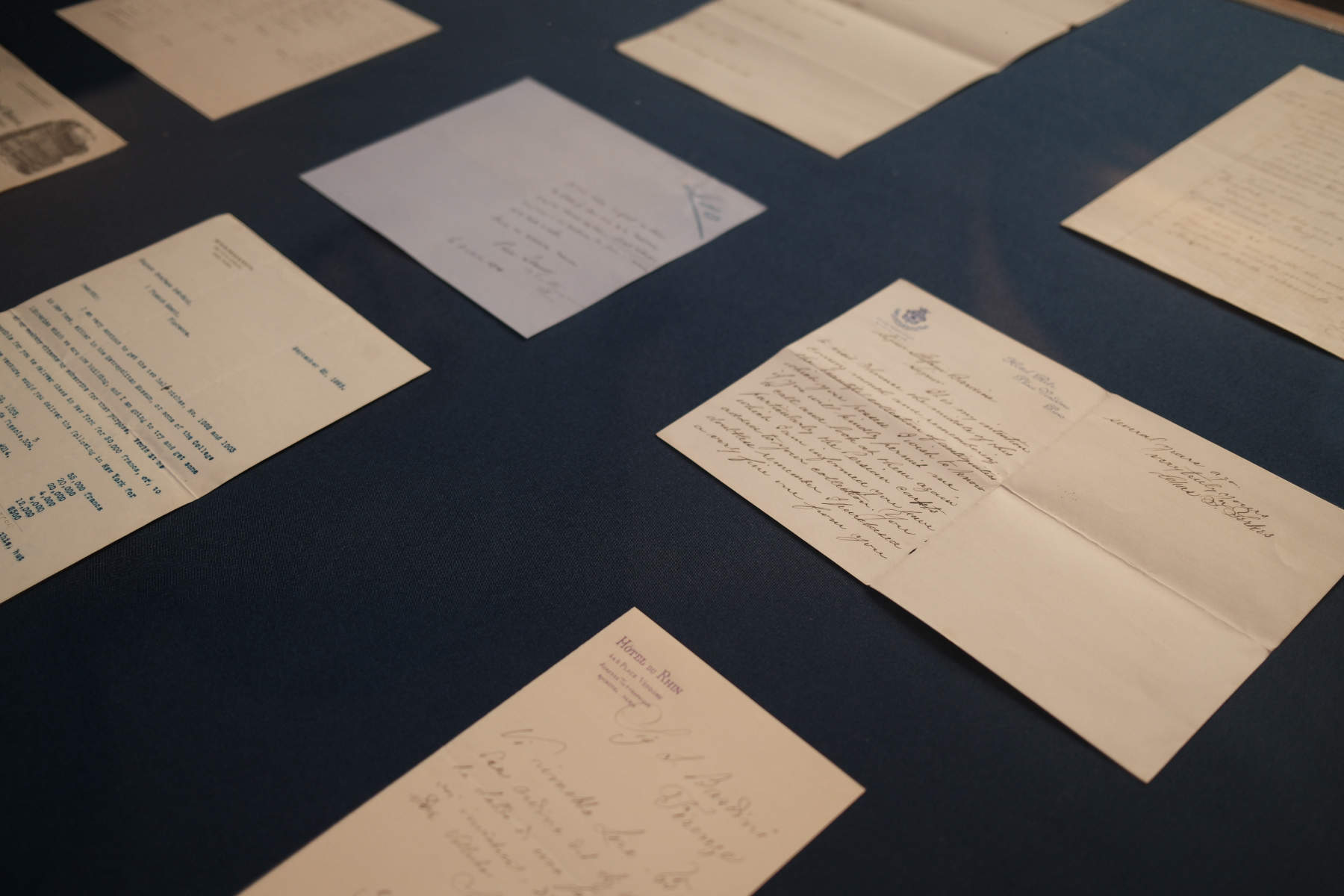
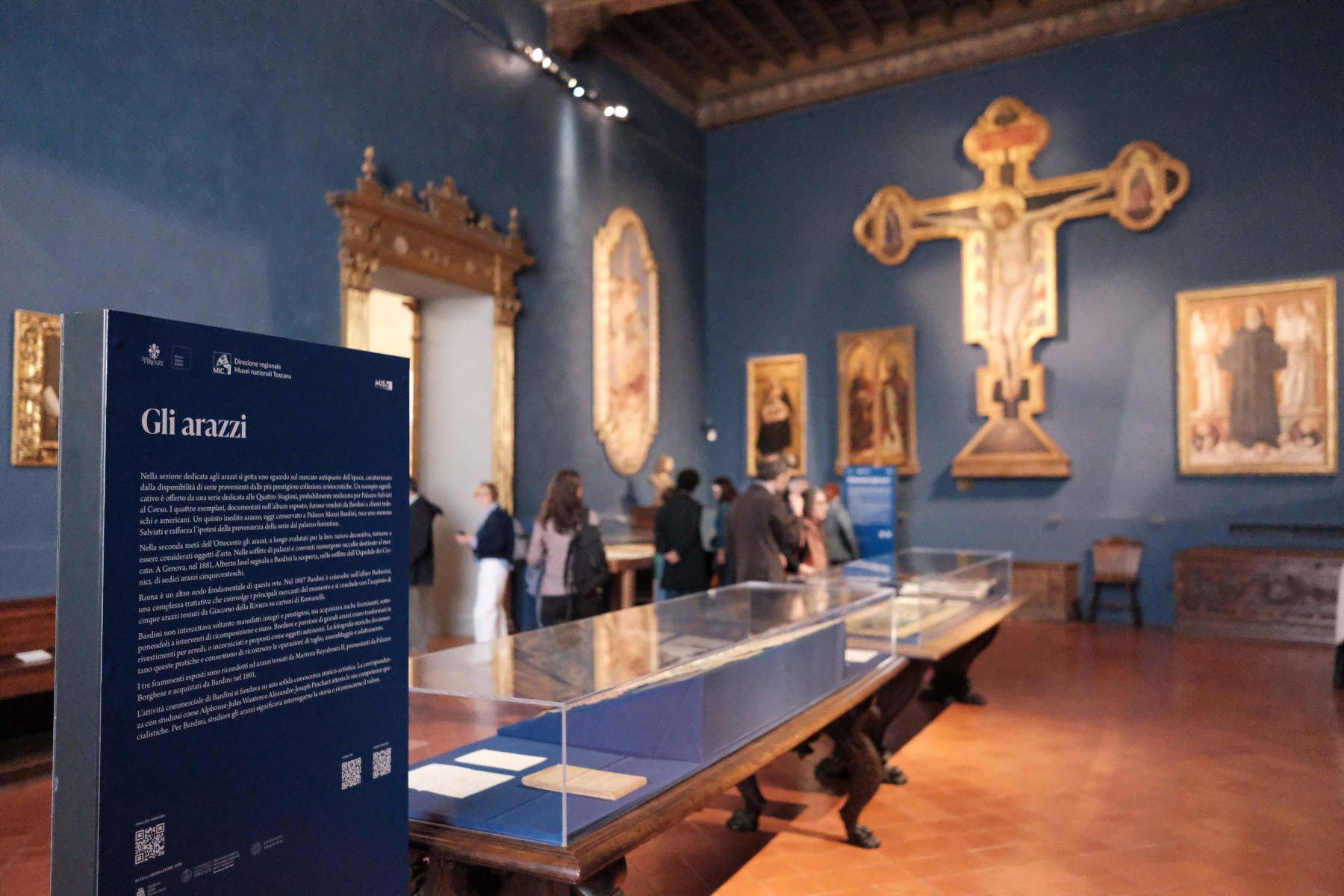
One section explores the history of tapestries, which were often restored and adapted to meet the demands of the antique market. Photographs and archival documents trace the history of the “Four Seasons” series—likely originally intended for Palazzo Salviati al Corso—and the reuse of antique fragments as upholstery for furniture. Among the works on display are also two chairs upholstered with “mille fleurs” tapestry, from the Medici Villa in Cerreto Guidi.
The tapestry workshop represents another chapter of the exhibition, with a particular focus on the work of female artisans. A letter from 1899 documents Stefano Bardini’s plan to entrust the supervision of the workshop to the Daughters of Charity of Saint Vincent de Paul and to train new specialized workers. A list from 1900 records twenty-three female workers, many of whom were very young. Letters, regulations, and requests for financial support provide insight into weaving and restoration techniques, as well as the actual working conditions. The workshop ceased operations in 1901, while other artisanal skills continued to be utilized within the company.
The story continues with Oriental rugs, which were central to the antiques market and studies of Islamic art between the 19th and 20th centuries. Emma’s memoirs recount the sale of a carpet to Baron Adolphe de Rothschild, while photographs, publications, and correspondence attest to the interest of European scholars and manufacturers in these artifacts. The pieces on display, along with an item illustrating manufacturing or restoration techniques, highlight the relationship between antique objects, decorative patterns, and modern productions.
A reconstruction of a display case from the so-called “Stanza delle stoffe” (Room of Fabrics)—originally set up by Ugo Bardini at Palazzo Mozzi and recreated here with the original artifacts based on photographs from the 1970s—is dedicated to antique textiles. Velvets, damasks, lampas, and taffetas from the 15th to the 18th centuries reflect the family’s taste in displays. The selection is complemented by textiles and lace from the Funghini Collection of the National Museum of Medieval and Modern Art in Arezzo. The documentation also recalls the invitation extended to Stefano Bardini for the 1887 Exhibition of Fabrics and Lace in Rome, although his name does not appear in the catalog. The dialogue between tradition and contemporary production is further illustrated by Mariano Fortuny’s fabrics, inspired by historical decorative motifs.
The final section is dedicated to historical garments, featuring clothing and accessories from the Renaissance to the 18th century: a 16th-century women’s linen shirt adorned with embroidery, a 17th-century bodice in Genoese velvet, an 18th-century men’s tailcoat with a matching waistcoat, headwear, and bags. Restoration work has made it possible to recover and deepen our understanding of the materials, tailoring techniques, and decorations.
Restoration work and scientific collaborations are an integral part of the project. The Opificio delle Pietre Dure contributed its specialized departments for the restoration of textiles, tapestries, and carpets, as well as paper and membrane-based materials. The CNR-INO and the Department of Chemistry and Industrial Chemistry at the University of Pisa contributed to the scientific investigations. A central role was also played by the Eredità Bardini Historical Archive of the Regional Directorate of National Museums of Tuscany – MiC, which since 2019 has been engaged in cataloging and digitization efforts in collaboration with the University of Florence, the Memofonte Foundation, and the University of Udine.
In addition to the organizations responsible for the project, the organizing committee includes the Opificio delle Pietre Dure, the University of Florence through the DIDA – Laboratory of Architecture and Self-Construction and SAGAS – Department of History, Archaeology, Geography, Art, and Performing Arts, as well as the Memofonte Foundation. Among the lending institutions are the National Museum of Medieval and Modern Art in Arezzo—Regional Directorate of National Museums of Tuscany—MiC, and the Florentine Villas and Monumental Residences, including the Medici Villa in Cerreto Guidi and the Museum of Hunting and the Territory.
Statements
“With the third edition of Officina Bardini, we are renewing our commitment to showcasing one of the most fascinating aspects of Florence’s artistic and cultural heritage,” said Giovanni Bettarini, Councilor for Culture. “Trame rivelate takes us on a journey of discovery through textiles, carpets, and tapestries, revealing not only the beauty and refinement of these artifacts but also the stories, artisanal expertise, and international connections that helped make Stefano Bardini a leading figure in the world of antiques. This exhibition has the merit of bringing to light precious works and documents—some of which are being presented to the public for the first time—and of telling the story of a heritage that continues to reveal new perspectives for study and understanding. It is also an opportunity to rediscover the value of artisanal skills, restoration, and the transmission of knowledge—fundamental elements of our cultural identity. I would like to thank Carlo Francini, Superintendent of the Municipal Museums, and Valentina Zucchi, scientific coordinator of the MUS.E Foundation, for their work and for the scientific and organizational contributions that made this new edition of Officina Bardini possible, along with all the institutions and professionals who collaborated on the project.”
“This third monographic exhibition , *Officina Bardini: Revealed Weaves*,” emphasized Carlotta Paola Brovadan, Regional Director of the National Museums of Tuscany at the MIC, “in addition to confirming and strengthening the partnership with all the institutions involved, thanks to the work of the art historians on the curatorial team, offers visitors and experts, for the first time, the opportunity to rediscover a kaleidoscope of textile works—including tapestries, rugs, and precious, previously unseen pieces—that make up the incredibly rich Bardini Legacy. It also offers the chance to truly appreciate the painstaking research and study conducted by the Bardini Archive to preserve a precious legacy aimed at showcasing an extraordinary heritage.”
“The exhibition *Officina Bardini. Unveiled Weaves,” explain the curators, “is the result of a comprehensive two-year research project and offers a unique and evocative journey into the world of textile art and fashion through the works and objects collected, traded, and crafted by Stefano, Emma, and Ugo Bardini. The exhibition unfolds through a rich selection of works and artifacts, accompanied by tools of the trade, archival documents, vintage photographs, and auction catalogs, which shed light—from various perspectives—on the intricate web of relationships woven by the Bardinis: from the wealthy American tycoons of the Gilded Age to scholars and museum directors, all the way to major figures of the 20th century such as Gabriele d’Annunzio. The exhibition thus aims to broaden our perspective on the history of the workshops and their artisans, creating a dialogue between antique and modern artifacts that reflect an aesthetic sensibility in tune with Art Nouveau tastes. Among the works on display are carpets of particular interest, including a previously unseen piece signed by Paul Follot, prestigious tapestries from the Borghese collection, and textile artifacts such as Fortuny fabric. These are complemented by a selection of historical garments and accessories: from a 16th-century women’s linen shirt to a Baroque bodice, from an 18th-century tailcoat to Ferragamo sandals with cork wedges that belonged to Emma Bardini. Taken together, these artifacts convey the vibrancy of an “Officina” and the richness of a collecting ethos guided by far-sighted intuition and extraordinary aesthetic sensibility—qualities that remain surprisingly relevant even today."
Practical Information
Hours: Friday through Monday, 11:00 a.m.–5:00 p.m.
Tickets: full price €10; reduced price €7.
 |
| In Florence, Stefano Bardini’s textiles reflect the international art and luxury markets |
Warning: the translation into English of the original Italian article was created using automatic tools. We undertake to review all articles, but we do not guarantee the total absence of inaccuracies in the translation due to the program. You can find the original by clicking on the ITA button. If you find any mistake,please contact us.