



by Redazione 17/11/2026


Categories: Exhibitions / Disclaimer
From December 10 to January 29, the Basilica of St. Peter in Perugia is exhibiting the “Bambin Gesù delle mani,” a fragment of the fresco that Pinturicchio painted for Alexander VI and that the pope’s successors had removed. The pope’s hand is still visible in the fragment.


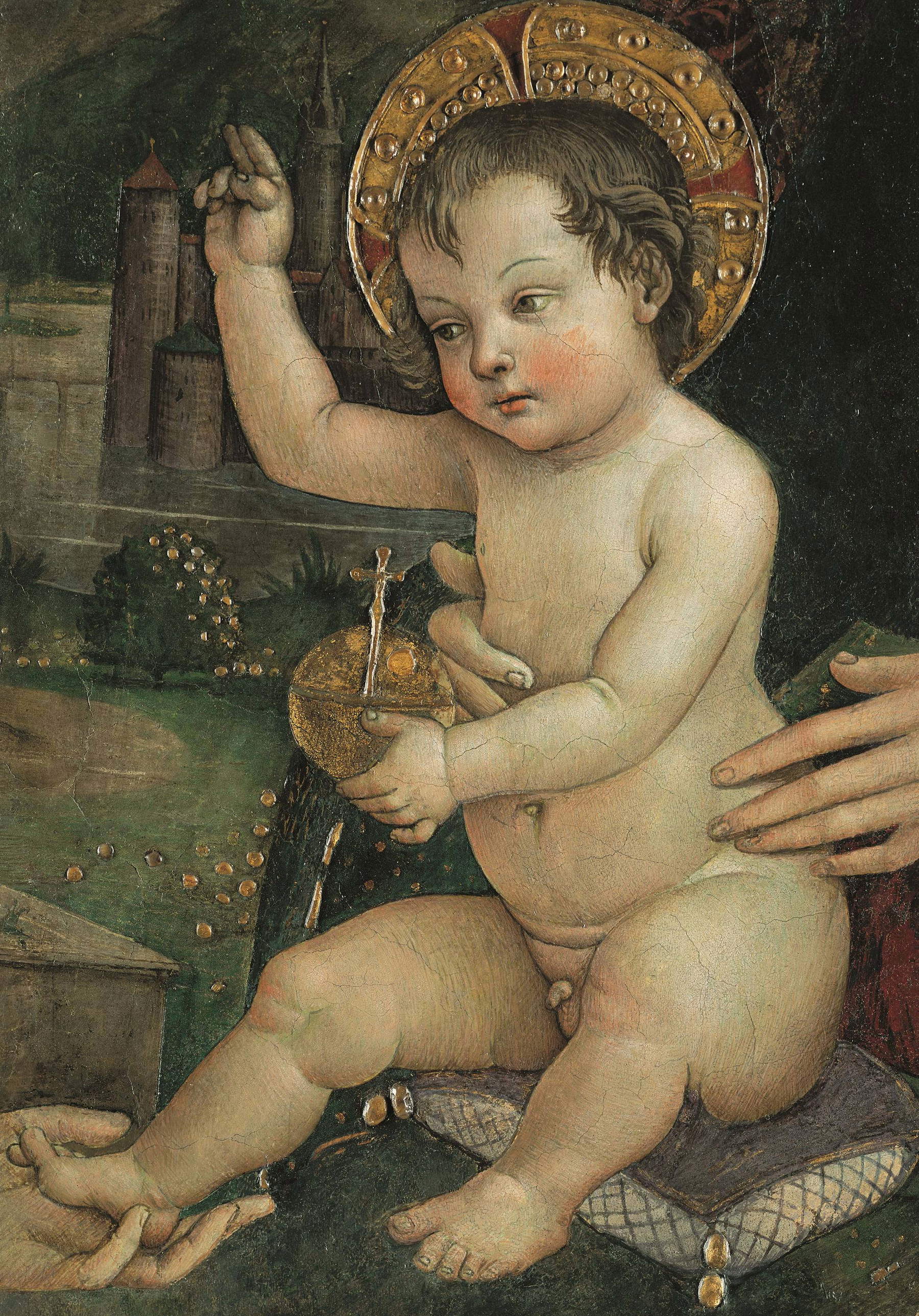
The Infant Jesus is depicted giving a blessing and wearing a golden robe. Next to him, at the edge of the fragment, is a hand that belongs neither to him nor to the Virgin Mary: it is the hand of Pope Alexander VI Borgia. In the original fresco, the pontiff was depicted kneeling before the Virgin, in the act of caressing the Child’s little foot. All that remains of the pope is that hand, and that is the origin of the work’s common name: the Infant Jesus of the Hands. It is a fragment measuring approximately 48 by 33 centimeters, detached from the wall, representing what remains of a fresco painted around 1492 by Bernardino di Betto, known as Pinturicchio (Perugia, c. 1452 – Siena, 1513), for the private chambers of Alexander VI in the Vatican. From December 10, 2026, to January 29, 2027, the work—owned by the Giordano Foundation of Perugia—will be on display in the Basilica of St. Peter in Perugia as part of the exhibition *D’oro e di luce* (Of Gold and Light).

The history of this fragment is linked to the memory of the pope who commissioned it. According to scholars’ reconstructions, the fresco was a doorpiece in a room of the Borgia Apartments—perhaps the pope’s own chamber—and was painted during the same period as the rest of the decoration. Many historians and artists saw it, including Giorgio Vasari, and the Mantuan painter Pietro Facchetti made a copy of it. Then the work disappeared. According to the most widely accepted account, it was removed from the wall and largely destroyed as a result of the sort of damnatio memoriae that the successors of Alexander VI—particularly Julius II—inflicted upon Pope Borgia. The depiction of the kneeling pope caressing the Child’s foot was unusual. According to sources, however, the greatest scandal concerned the Virgin Mary, for whom Giulia Farnese, the pope’s mistress, was said to have posed. Some scholars do not rule out the possibility that the Child also depicted one of the Borgia’s sons.


The fragment remained unknown for nearly five hundred years. In modern times, it was first documented in 1912 by Corrado Ricci in the collections of Palazzo Chigi al Corso in Rome, alongside a Madonna similar in style, technique, and dimensions. Since then, it has been mentioned by many scholars, including Gnoli, van Marle, Incisa della Rocchetta, Strinati, Todini, Acidini, and Scarpellini. In 2004, Nucciarelli identified it on the antiquities market and reported its discovery on July 18 in the *Giornale dell’Umbria*. The work was subsequently acquired by the Giordano Foundation in Perugia, which has since been responsible for promoting awareness and dissemination of the piece.

Initially, critics were cautious: various origins were hypothesized for the two fragments, such as the cloister of Santa Maria del Popolo or a possible lost “Adoration of the Magi.” The first to note the stylistic similarity to the frescoes in the Borgia Apartment was Fausta Gualdi, while research by Giovanni Incisa della Rocchetta later revealed that the two fragments in question had been mentioned in Cardinal Flavio Chigi’s collections as early as 1693, attributed to Perugino. It was also discovered that the inscriptions on the edge of the Madonna’s mantle had caught the attention of Pope Alexander VII, Fabio Chigi, the cardinal’s uncle. At that point, the connection to the composition described by Vasari and other sources from the 16th and 17th centuries became evident, and even the main fragment—the one depicting the Madonna, which had been believed lost—reappeared: in recent years, it has been reported to be in the possession of a Roman-Swiss family related to the Chigi family.
Meanwhile, the “Bambin Gesù delle mani” has traveled extensively. It has been exhibited at the Guggenheim in New York, in Paris, Madrid, China, and Rome. Now it returns to Perugia, the city of Pinturicchio. “It is precisely here,” notes Deputy Mayor and Councilor for Culture Marco Pierini, “that the artist is underrepresented: ‘This is a living and extraordinary piece of history: its uniqueness lies in the fact that, despite lacking its original context, it possesses such autonomy and unity that it can be fully appreciated. A rarity made all the more intriguing by the fact that Pinturicchio is an artist who is underrepresented in the city, having carried out his artistic career primarily elsewhere.”
The choice of venue is also significant. With 1,132 works of art, the abbey complex of San Pietro is Perugia’s second-largest museum complex after the National Gallery of Umbria. It is also a central site in the city’s civic history: during the massacres of June 20, 1859, when papal troops and the Swiss regiment occupied the city—which had rebelled against the Papal States following the Piedmontese victories in the Second War of Independence— the Benedictine monks provided shelter and care there to the patriots who had risen up for the unification of Italy. “San Pietro is a place of profound symbolic value, where the transmission of Renaissance-era knowledge intertwines with the roots of our civic history and the struggles of the Risorgimento,” said Tommaso Bori, vice president of the Umbria Region with responsibility for Culture. “It is precisely in this setting, so rich in meaning, that the Region has chosen to support the return of Pinturicchio’s work.” For Bori, the exhibition is part of a broader strategy to promote cultural heritage, and hosting it in the heart of Borgo XX Giugno means “charting a concrete path to restore energy and vitality to the entire city.” The vice president of the Fondazione Agraria, Alessandro Montrone, emphasizes that the complex “is not yet well known enough, even though it is, to all intents and purposes, an extraordinary art gallery,” and that events like this serve to attract new visitors.
The exhibition is the result of a collaboration between the University of Perugia, the Fondazione Agraria, the Umbria Region, and the Fondazione Guglielmo Giordano. It was unveiled on November 11 at the abbey complex. It aims to highlight one of the most important sites in the city’s history and bring a new cultural offering to the Borgo XX Giugno and Corso Cavour neighborhoods. Throughout its run, it will be accompanied by a series of in-depth discussions. It is also part of the region’s Christmas program, alongside other exhibitions such as the one dedicated to Steve McCurry. “Art, history, and the promotion of the local area now go hand in hand,” said Regional Councilor for Tourism Simona Meloni, who sees the initiative as a way to attract “more discerning and informed visitors” and to allow “our fellow citizens to rediscover the places that define their identity with fresh eyes”.
The director of the University Center for Scientific Museums, Roberto Rettori, described the exhibition as “a true gift to the city, hosted in a venue of art and great civic significance that citizens deeply love.” For the Rector’s Delegate for Cultural Policies, Cristina Costantini, Pinturicchio’s work can be viewed “as a veritable generative archive, a space of permanence and continuous revelation capable of renewing our knowledge,” in line with the university’s mission, because “there can be no research or progress without memory, just as there can be no education without imagination.” The president of the Giordano Foundation, Andrea Margaritelli, who is making the work available, recalled the promoters’ shared goal: “to promote active participation in the life of a city and an entire region, to strengthen the fabric of social relationships, and to revive the healthy habit of coming together in person.”
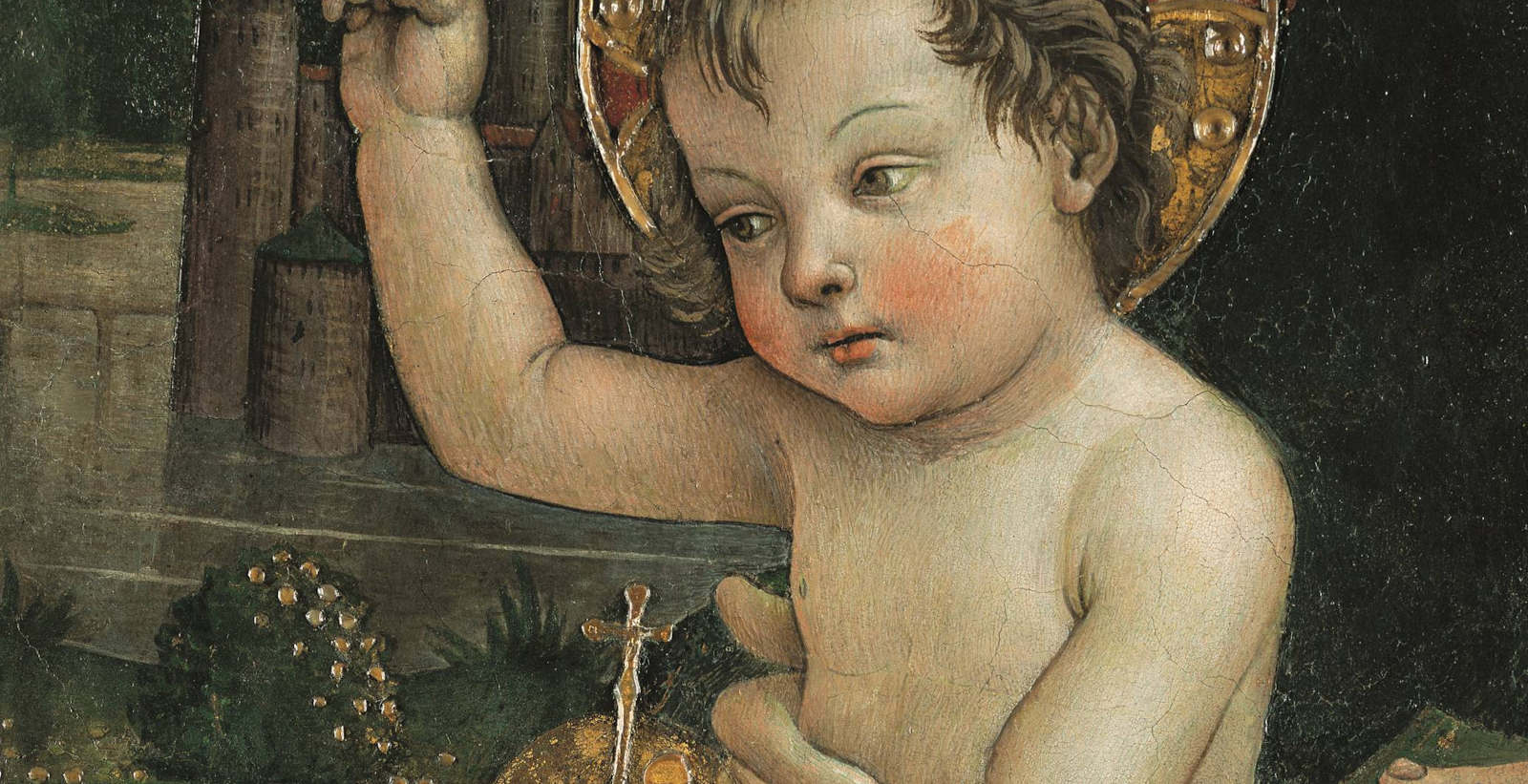 |
| Perugia: Pinturicchio’s “The Infant Jesus” on display at the San Pietro complex |
Warning: the translation into English of the original Italian article was created using automatic tools. We undertake to review all articles, but we do not guarantee the total absence of inaccuracies in the translation due to the program. You can find the original by clicking on the ITA button. If you find any mistake,please contact us.