



by Redazione 20/11/2026


Categories: Exhibitions / Disclaimer
Sand mixed with paint, monotypes, his early realistic architectural works, and figures gazing at their own doubles: in the paintings from 2026 on display at Cardelli & Fontana through February 14, 2027, Andrea Barzaghi reimagines his own style of painting.


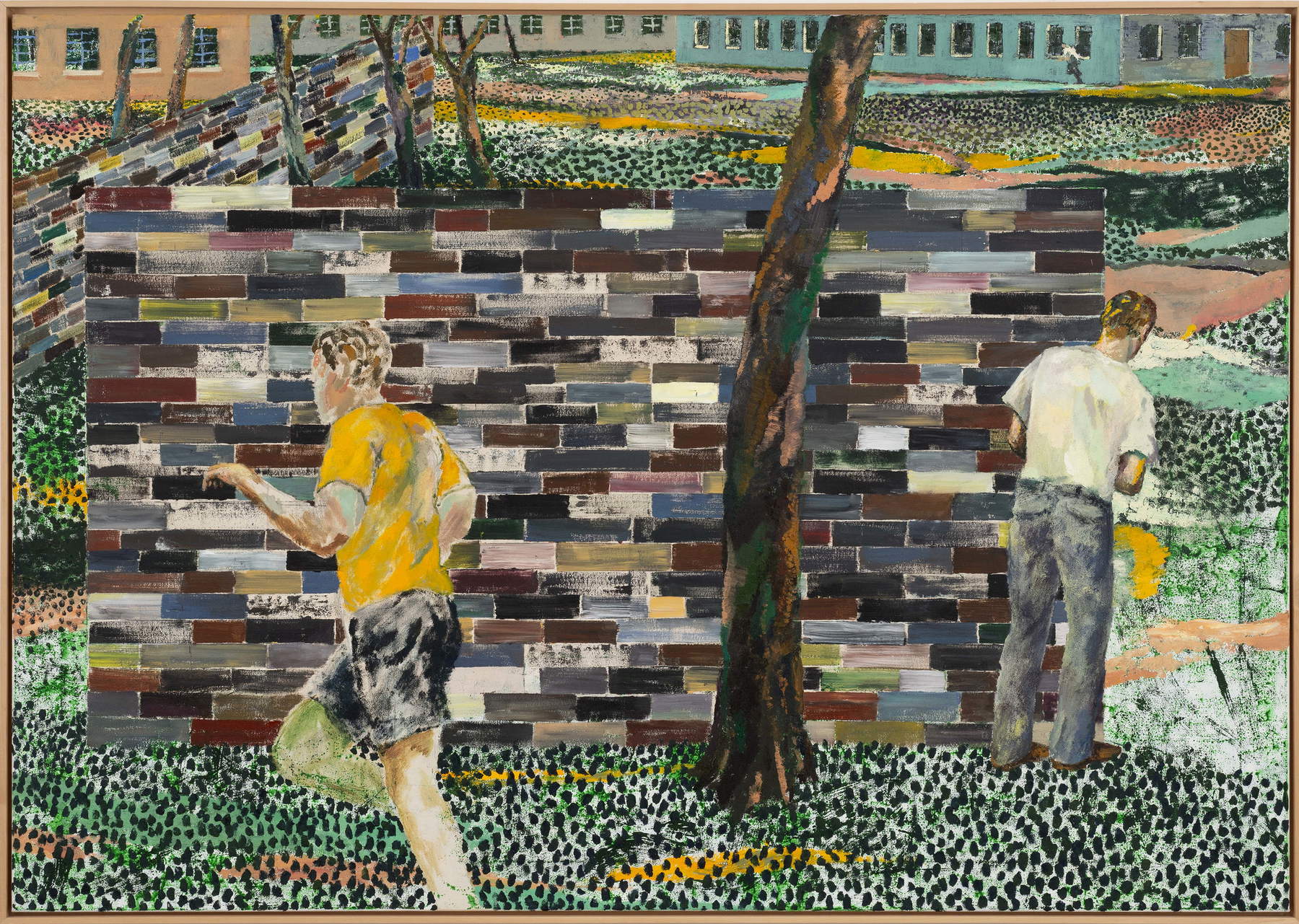
Behind a large brick wall, someone is peeking out. He is playing hide-and-seek, but his opponent is himself. Buildings surround him, and from their windows, the gaze extends even further, toward a background that seems to stretch on forever. The painting is titled *Hide and Seek*; it is a large-scale canvas and marks the first time Andrea Barzaghi (Monza, 1988) has painted realistic architecture. It encapsulates, on a small scale, the essence of the exhibition in which it is included, *Playground*. “When I Saw My Back Again,” on view through February 14, 2027, at the Cardelli & Fontana Gallery in Sarzana. The subtitle speaks precisely to this: seeing oneself from behind again—that is, viewing one’s own work from a new distance.

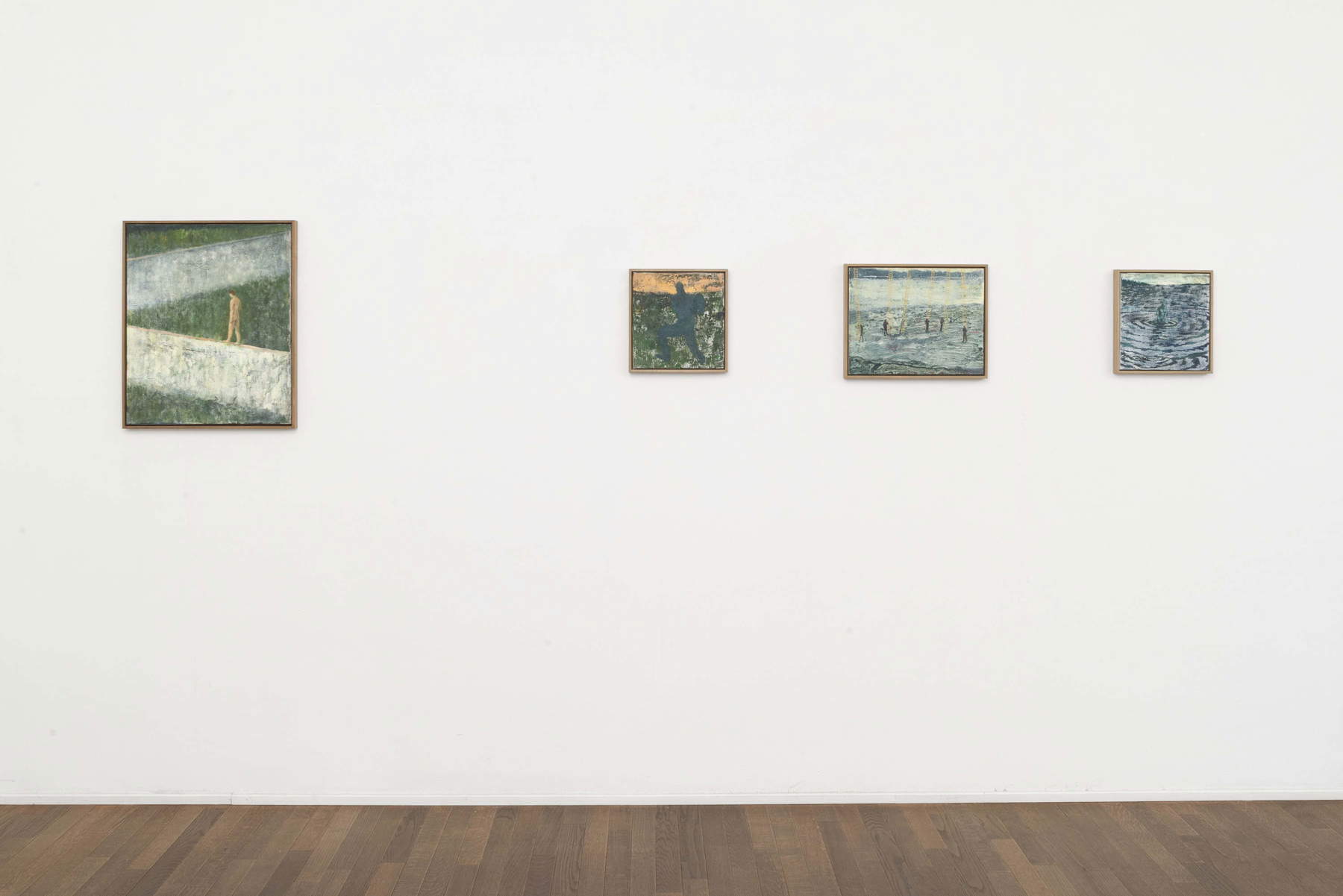
Barzaghi is holding his first solo exhibition at the Ligurian gallery and is showing a selection of paintings all created in 2026, which at first glance strike the viewer with their variety: surfaces treated in different ways, diverse subjects, and stylistic results that are very different from one another. The artist presents this variety as a deliberate choice. “I need to see that different directions exist, to allow the works to take their time, to leave them open and breathing with all their imperfections, so that the creative power of painting is not lost,” she says. Giulia De Giorgi, author of the text accompanying the exhibition, speaks of a rediscovery of forgotten and now regained freedoms. The idea behind the exhibition—and thus its title—stems from shuffling the cards at one’s disposal: looking within oneself and putting oneself back in the game to approach painting in a new way. The “playground” of the title is the setting in which this experiment takes place, and De Giorgi uses its imagery—from the sandbox to hide-and-seek, from the skating rink to the swing set and merry-go-round—to guide visitors through the works.


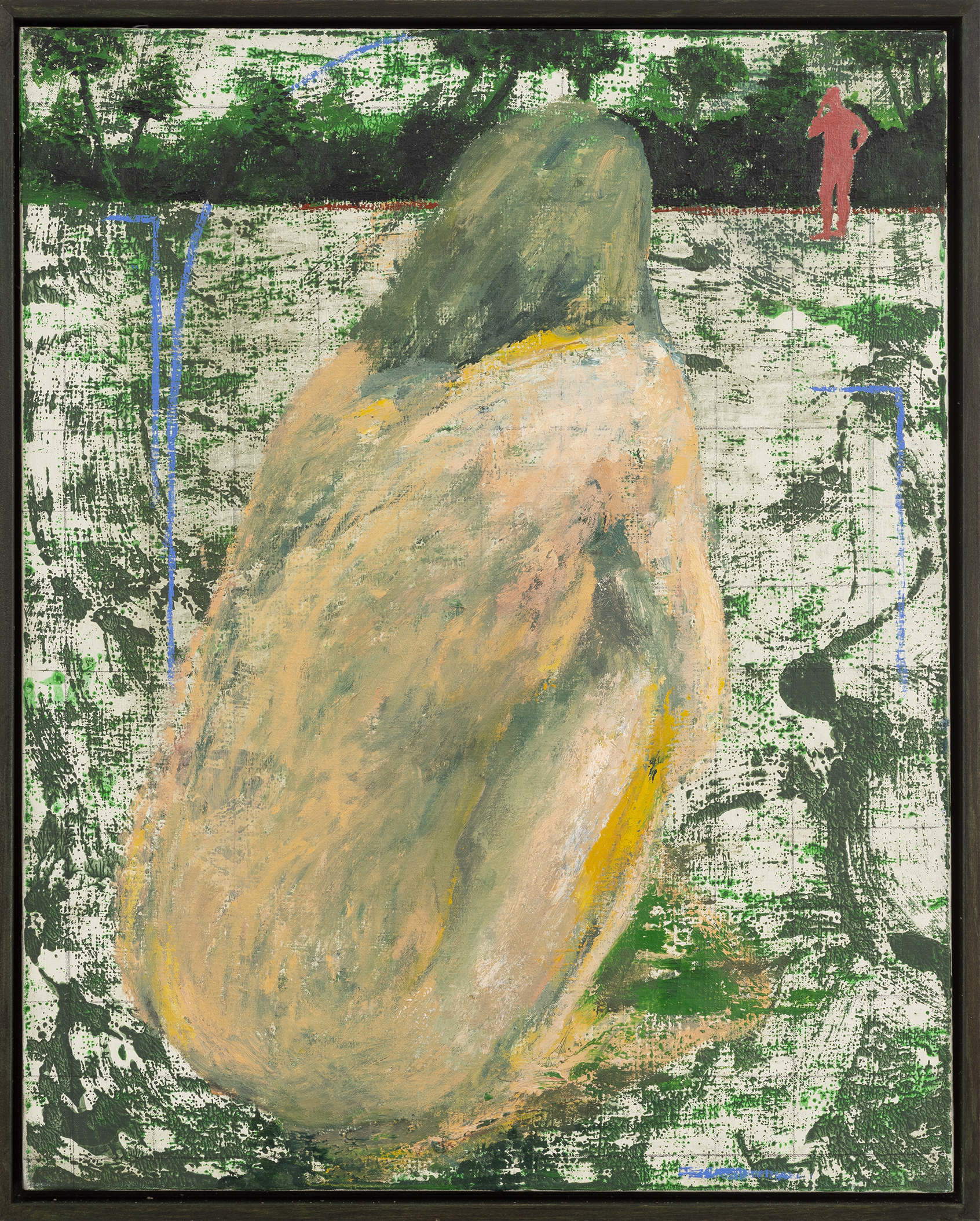
The first change concerns the materials. Barzaghi paints on canvas, burlap, and wood, using oil and acrylic paints. In some paintings, the layers of color are thick and highly textured; in others, they remain thin, revealing the raw texture of the support. The colors can be diluted and spread by holding the work horizontally on the work surface, until they become sheer veils, or mixed with sand and minerals to make them thick and rough. In more than one painting, sand mixed with paint is used to render the figures’ skin. Alongside painting, monotype appears. In *Target*, a small-format painting, the image emerges across the entire canvas at once, built up in layers—from the lightest to the most textured and lumpy—rather than in individual sections. The vanishing point is a figure in the background, barely sketched, almost a splash of pure color, which serves as the target of a huntress crouching in the foreground.


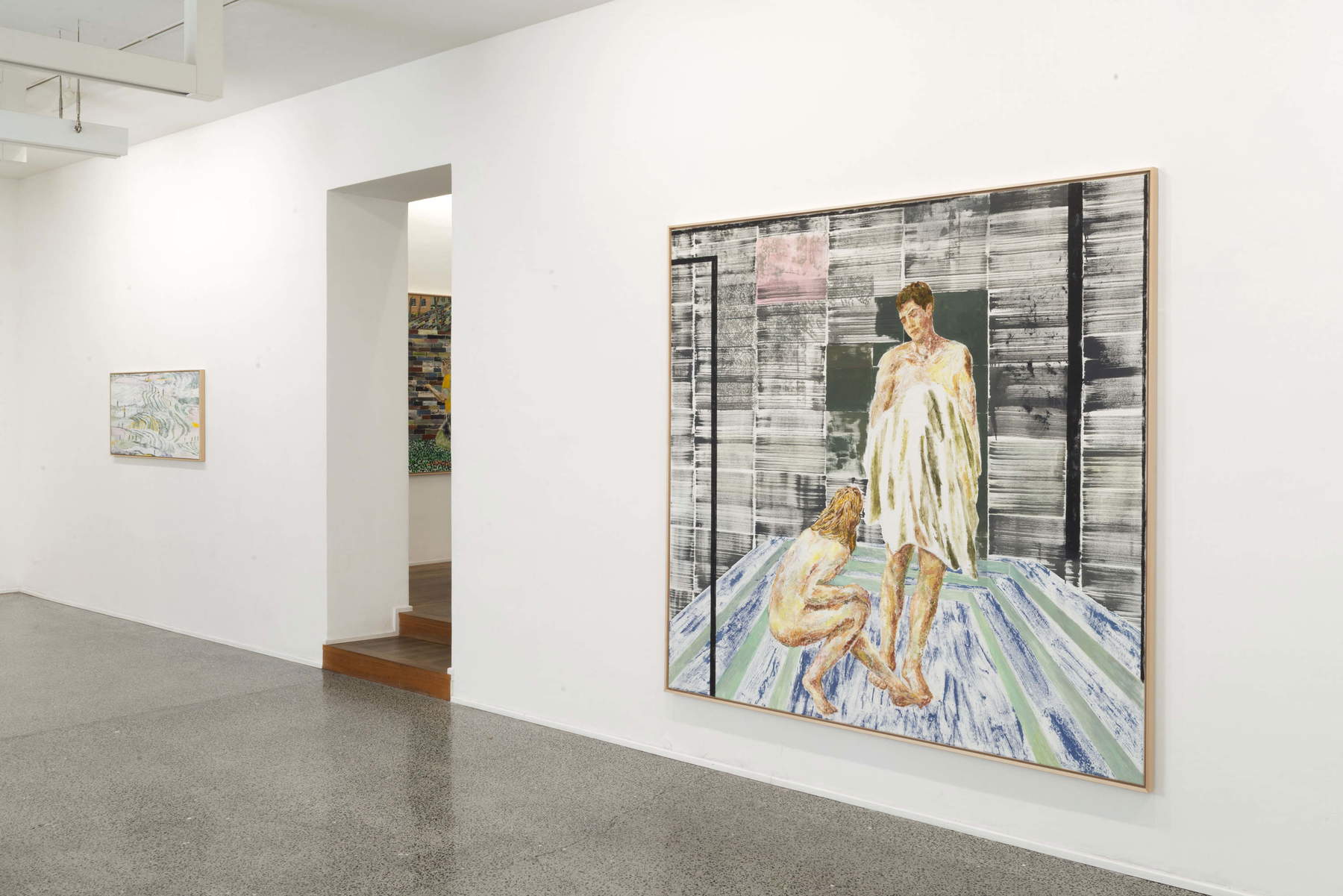
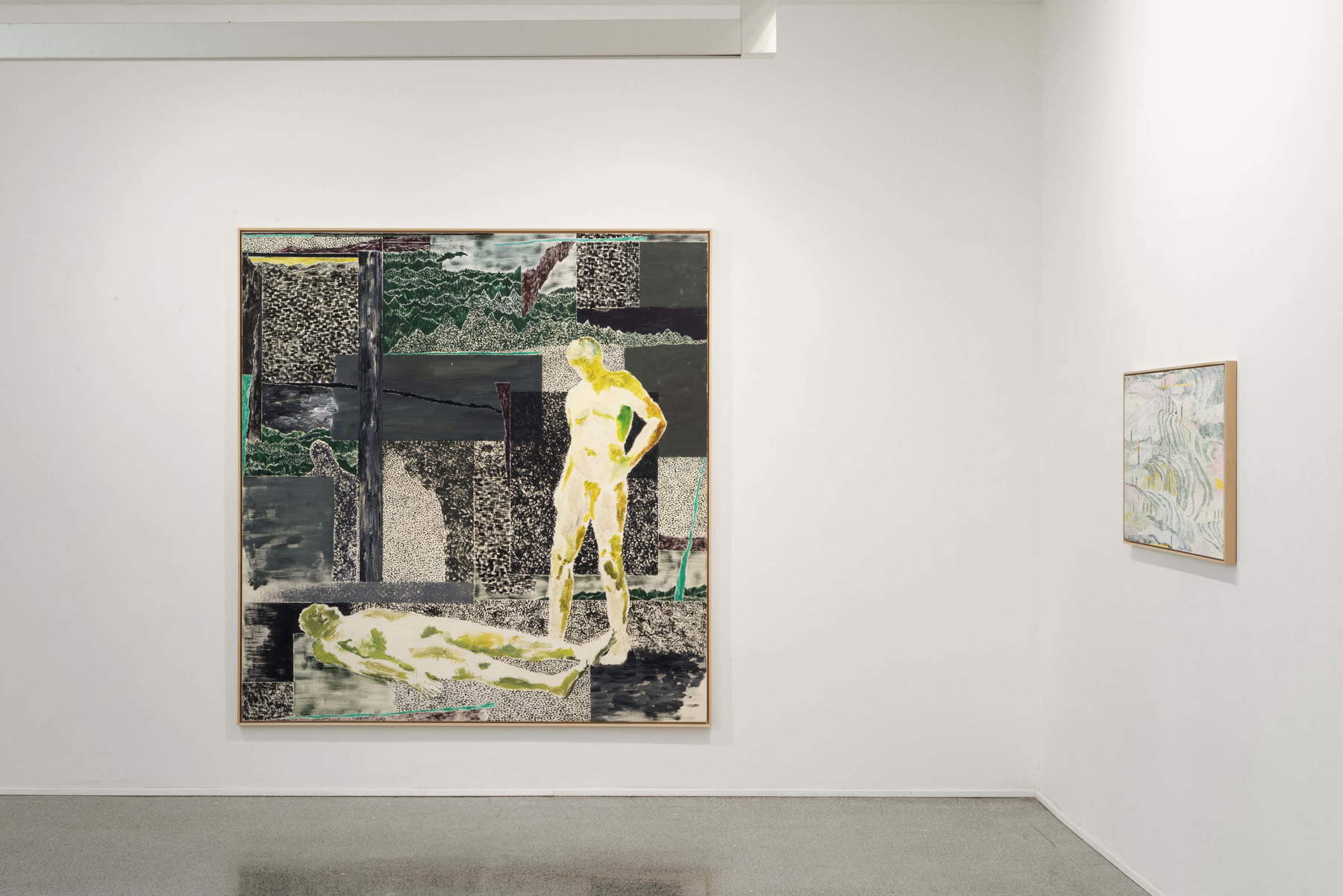
“Hide and Seek” clearly illustrates how the artist’s relationship with the surface changes. De Giorgi describes the large canvas as a playground on which Barzaghi plays with planes, allowing himself to leave a portion not entirely defined, and grappling with a surface too large to control the scene as a whole. He loses himself in the colors, taking one step forward and one step back, until he finds the composition’s balance. In these paintings, elements emerge, then recede, then reveal themselves once more. Starting from an initial image, the artist decides as he goes along how much to define each level, and the viewer can search for details in the foreground or push their gaze into the depth, where things are not necessarily any less clear.
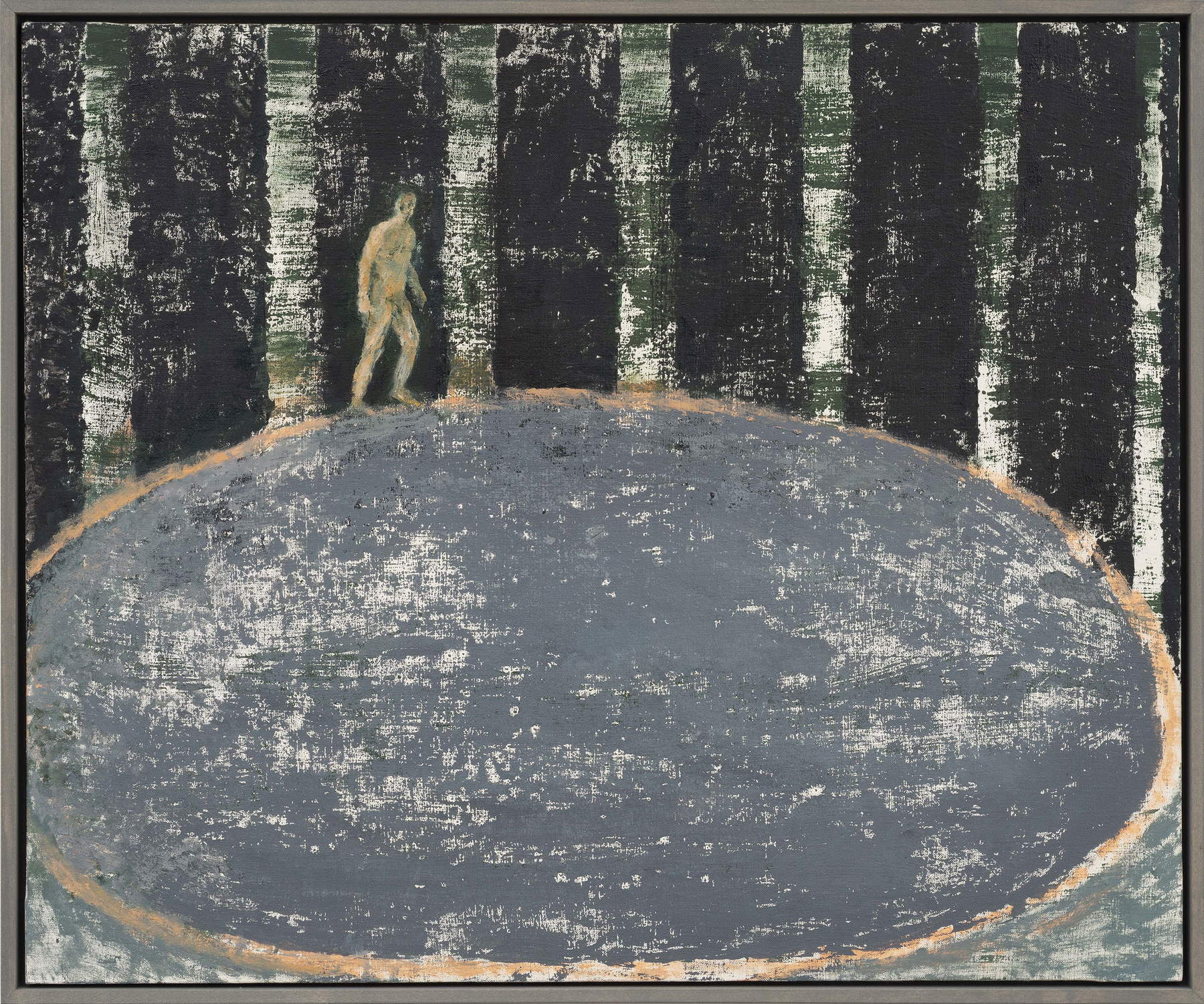
The narrative style also changes. Those familiar with Barzaghi’s work will recognize some familiar elements in the exhibition. In *First One*, a solitary figure walks surrounded by greenery, in a barren landscape, beneath a barely hinted-at horizon. The suspended atmosphere, the seemingly inconsequential act of walking, and the reduction of the scene to a few essential elements belong to an earlier phase of his artistic exploration. But here, every centimeter of the panel is covered with full brushstrokes. *En plein air* also stems from that period: the brushstrokes reveal the undercoat beneath a rocky, vibrant landscape in which the whites seem to move. In this case, however, the narrative takes an unexpectedly realistic turn, because the two women depicted are performing a precise and recognizable action.
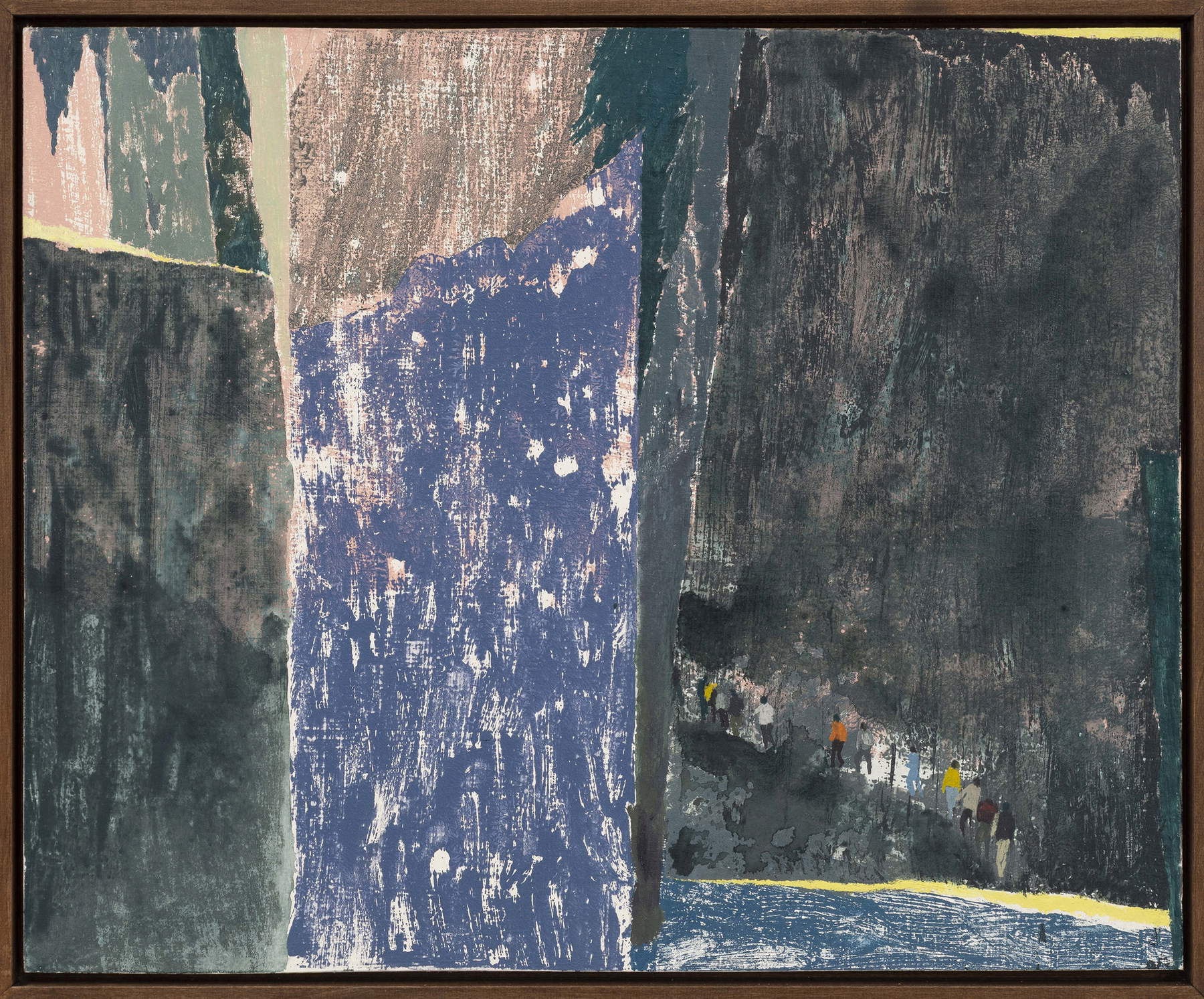
The same is true of the figures on the move. In his earlier works, Barzaghi’s characters seemed to exist outside of any specific time. In *Leaving the beaten track*, however, the members of an expedition are climbing an impassable path that disappears behind a mysterious wall—a wall that occupies almost the entire painting—and they wear clothing that places them in a recognizable context. In *Edge*, the walls extend beyond the edges of the canvas. The figure might be standing still, balancing, or ready to move forward along the wall—unless the wall conceals two separate paths destined never to meet. De Giorgi describes these figures as walkers along rugged paths, anonymous walls, and endless staircases, propelled upward yet aware that the ascent can suddenly turn into a fall.
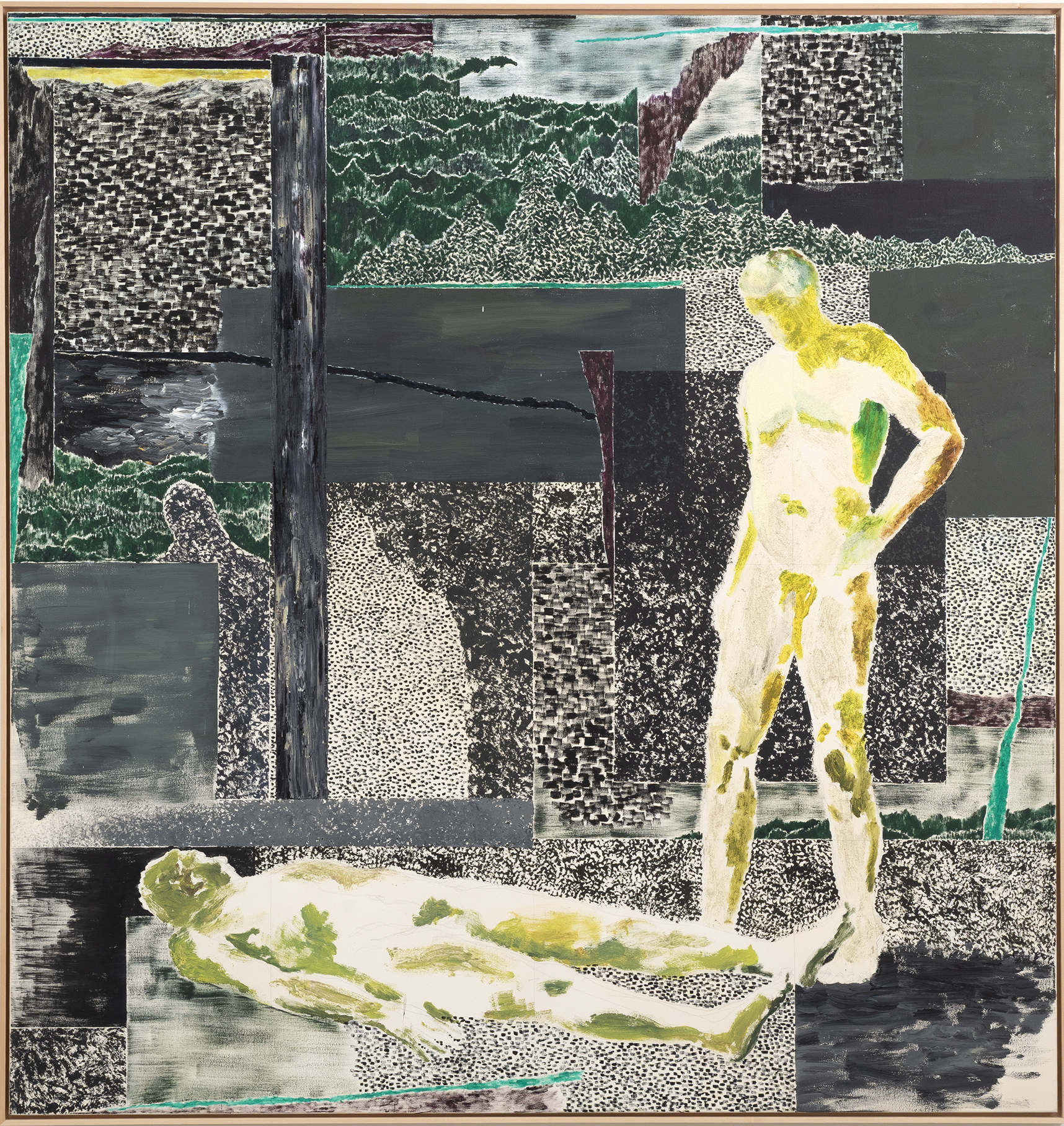
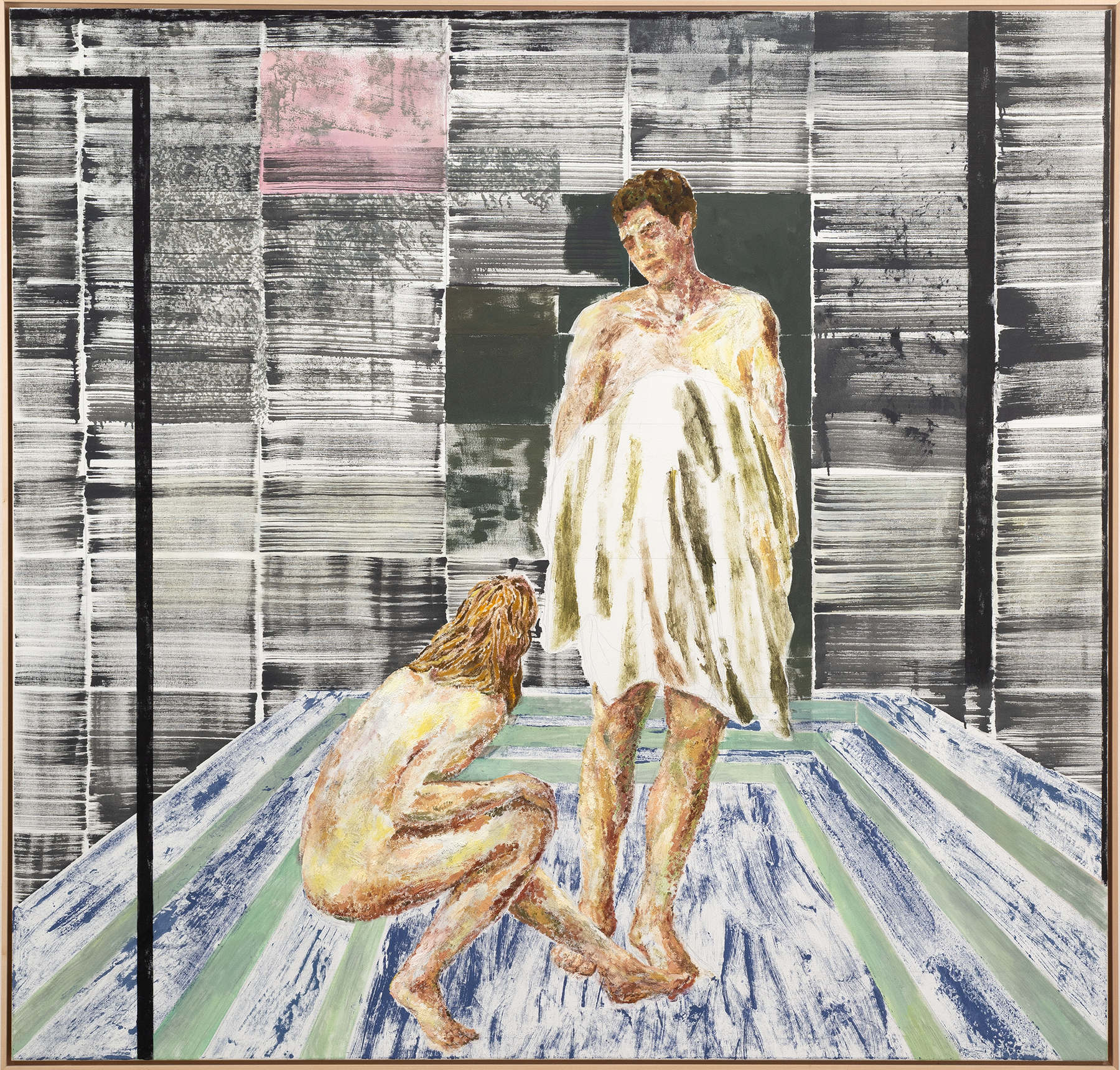
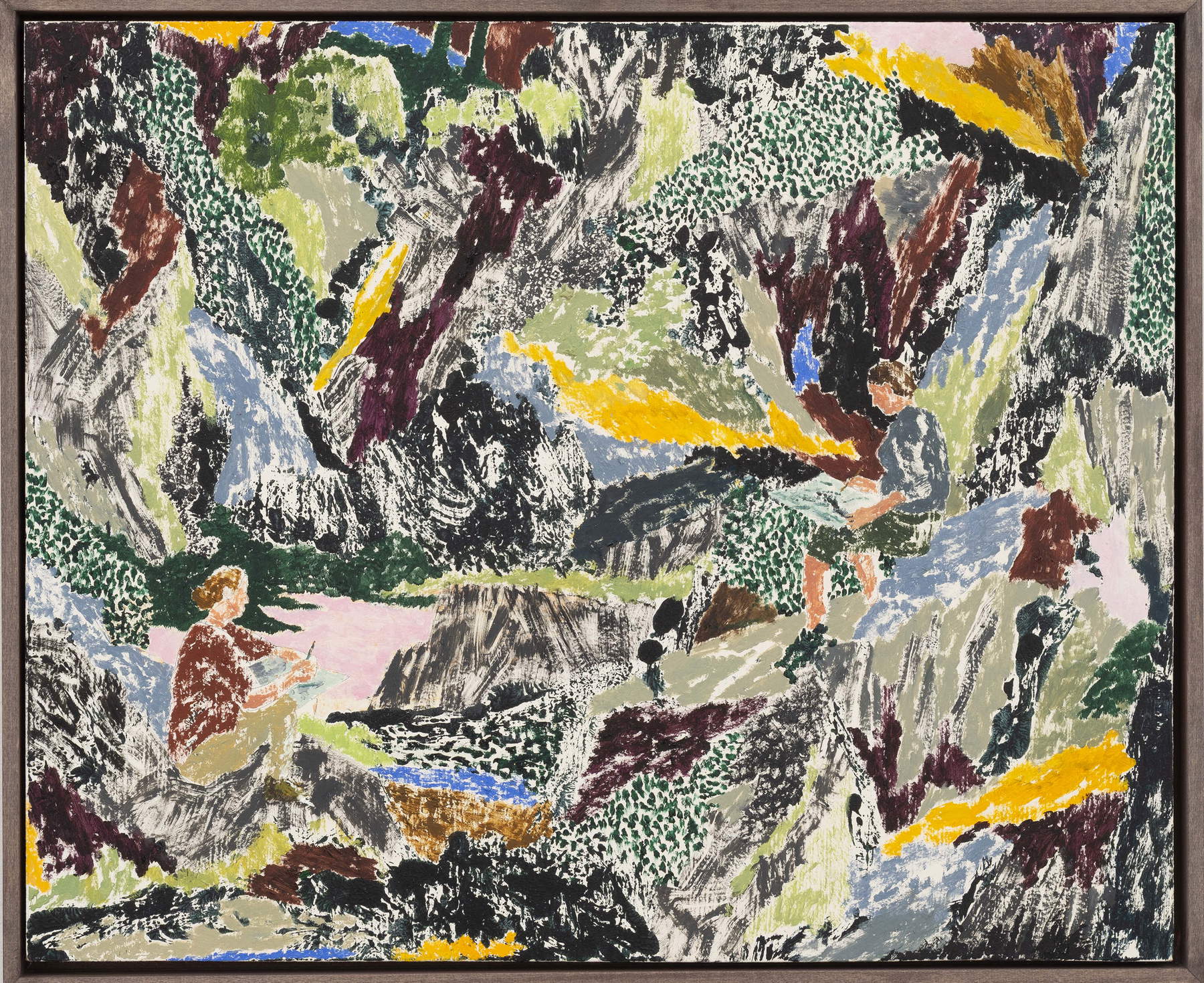
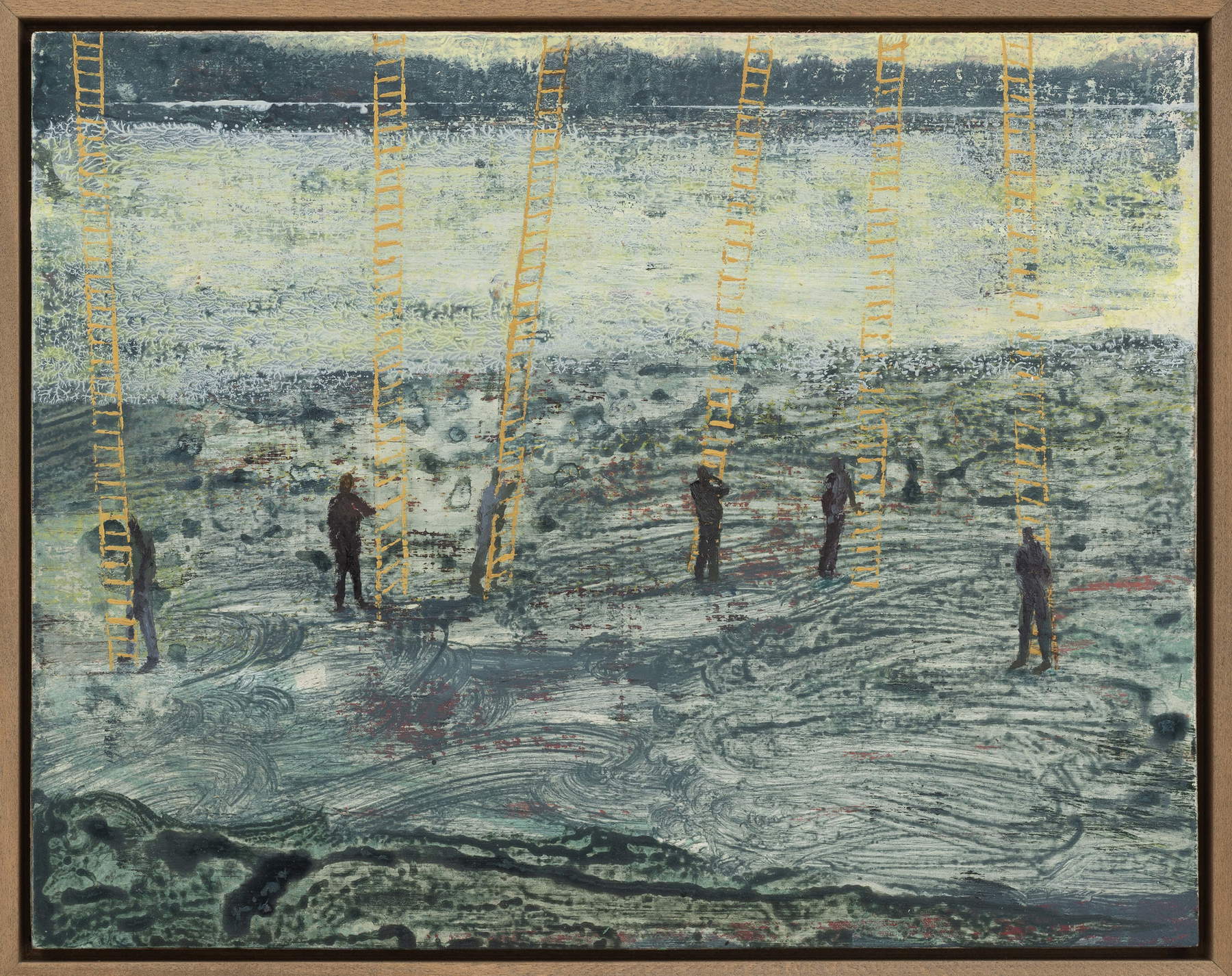
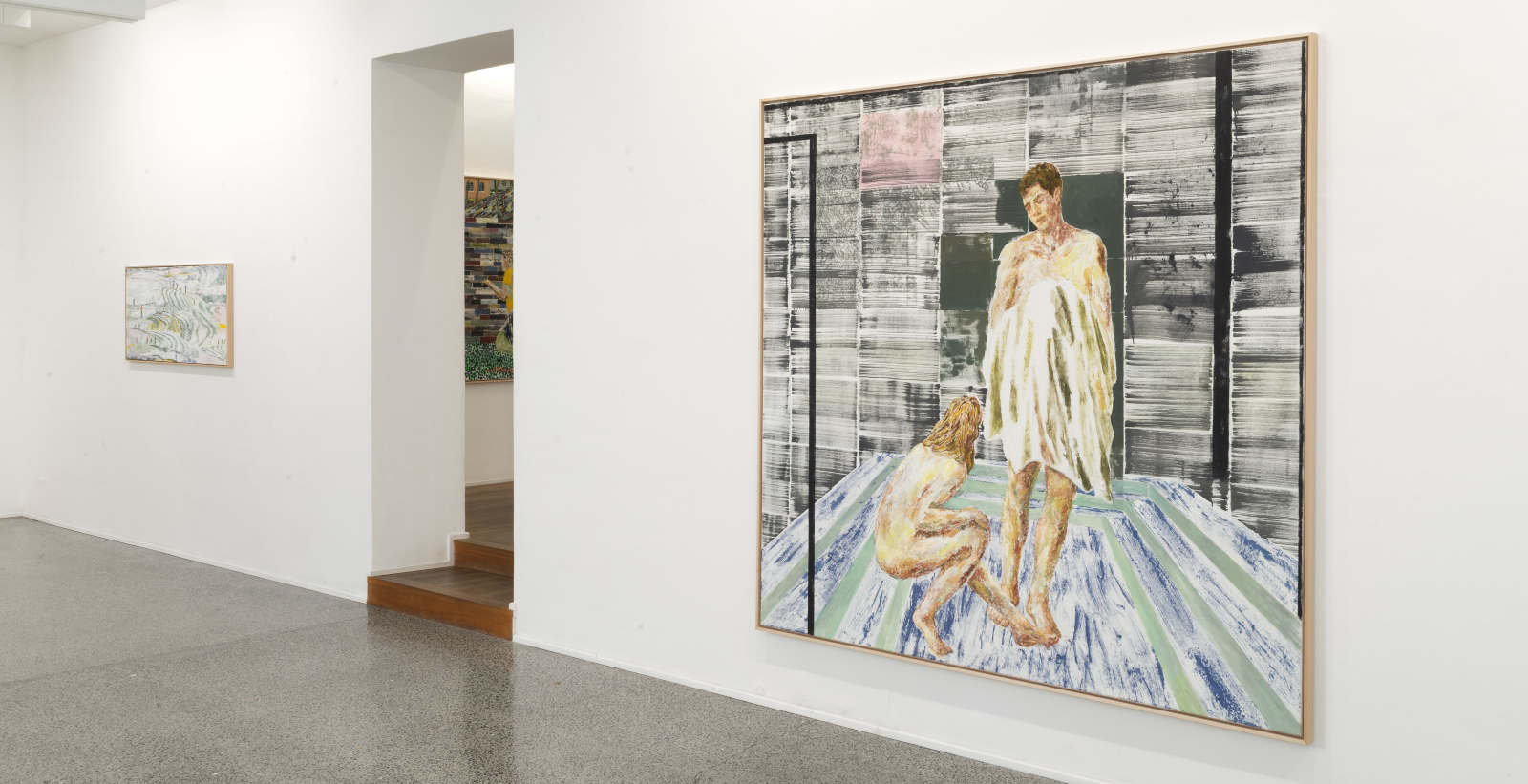
According to De Giorgi, the most challenging works are the two large-format paintings, *A Man with Himself* and *After the Bath*. Both feature two main figures: bodies defined without excessive detail, colors applied in scattered and then swirling strokes, and skin rendered with sand mixed into the pigment. The backgrounds differ: in one, a repeated pattern creates a uniform and distinctive surface; in the other, the textures vary continuously. The atmosphere is also different: in the sauna of *After the bath*, an intimate, private, and realistic scene unfolds. In *A Man with Himself*, a dreamlike scene depicts a man gazing at his double, but the solemnity of the moment is disrupted by a third and fourth character who enter the scene. The theme of the double—of viewing oneself from the outside—thus returns to the center of the exhibition.
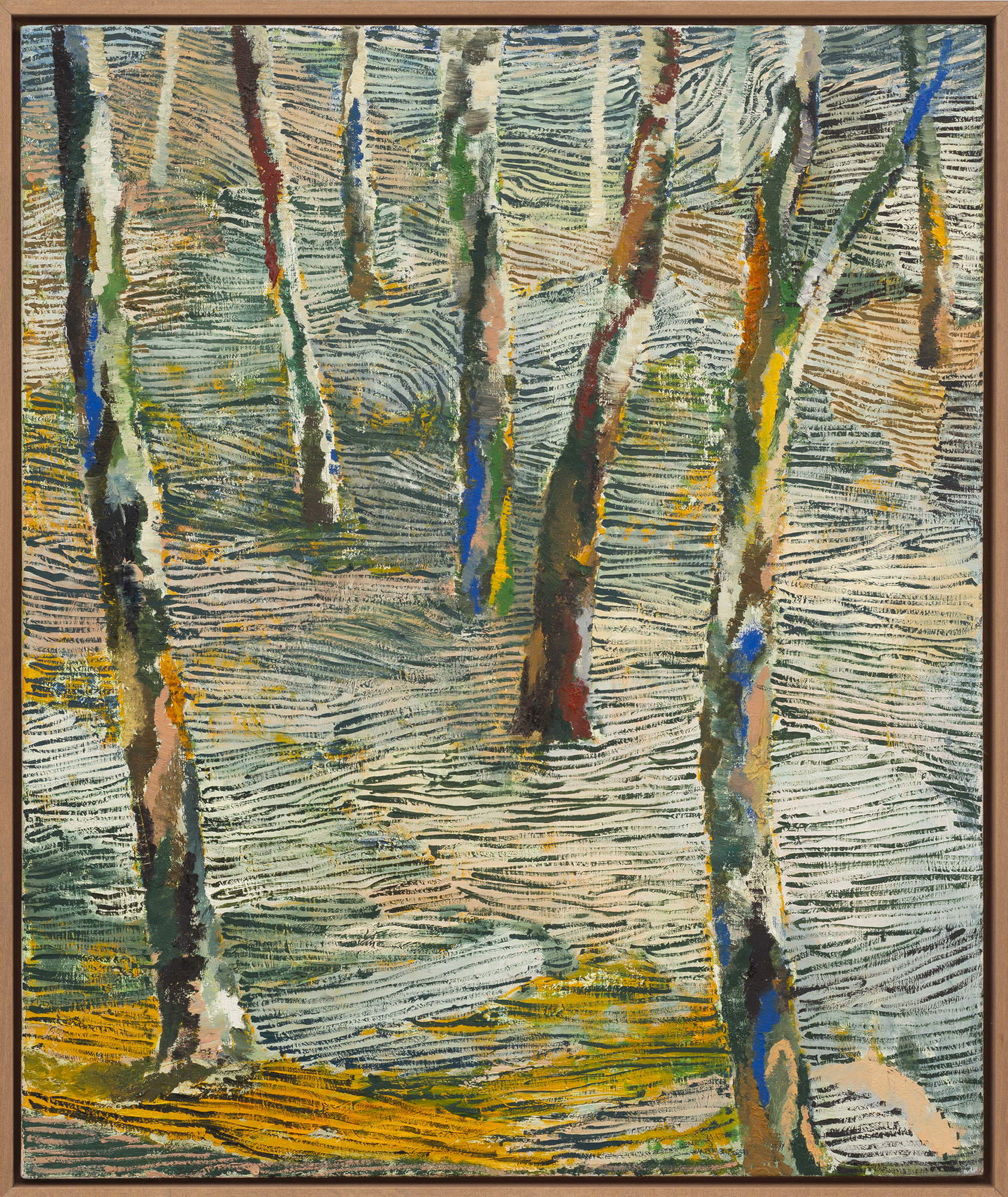
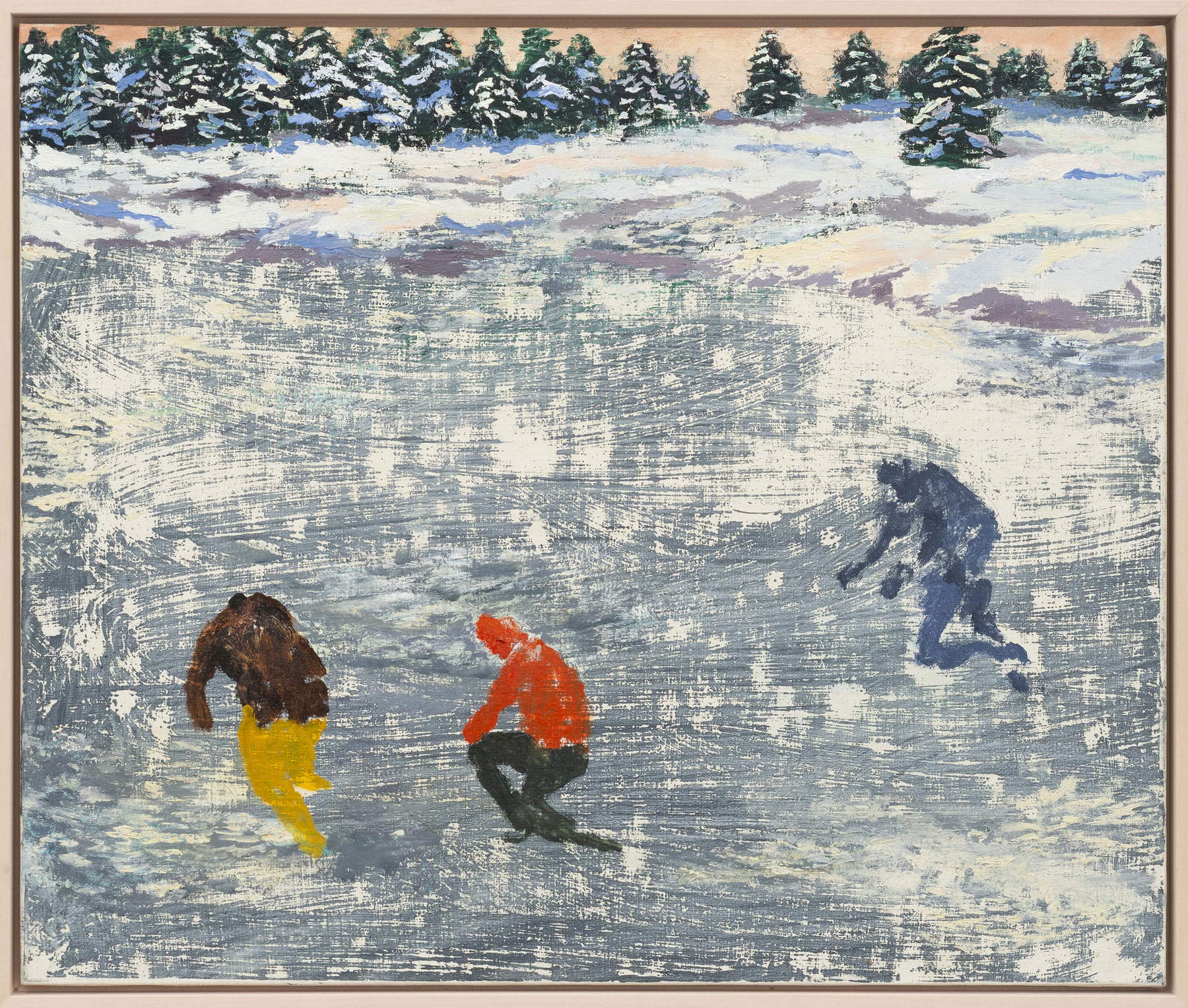
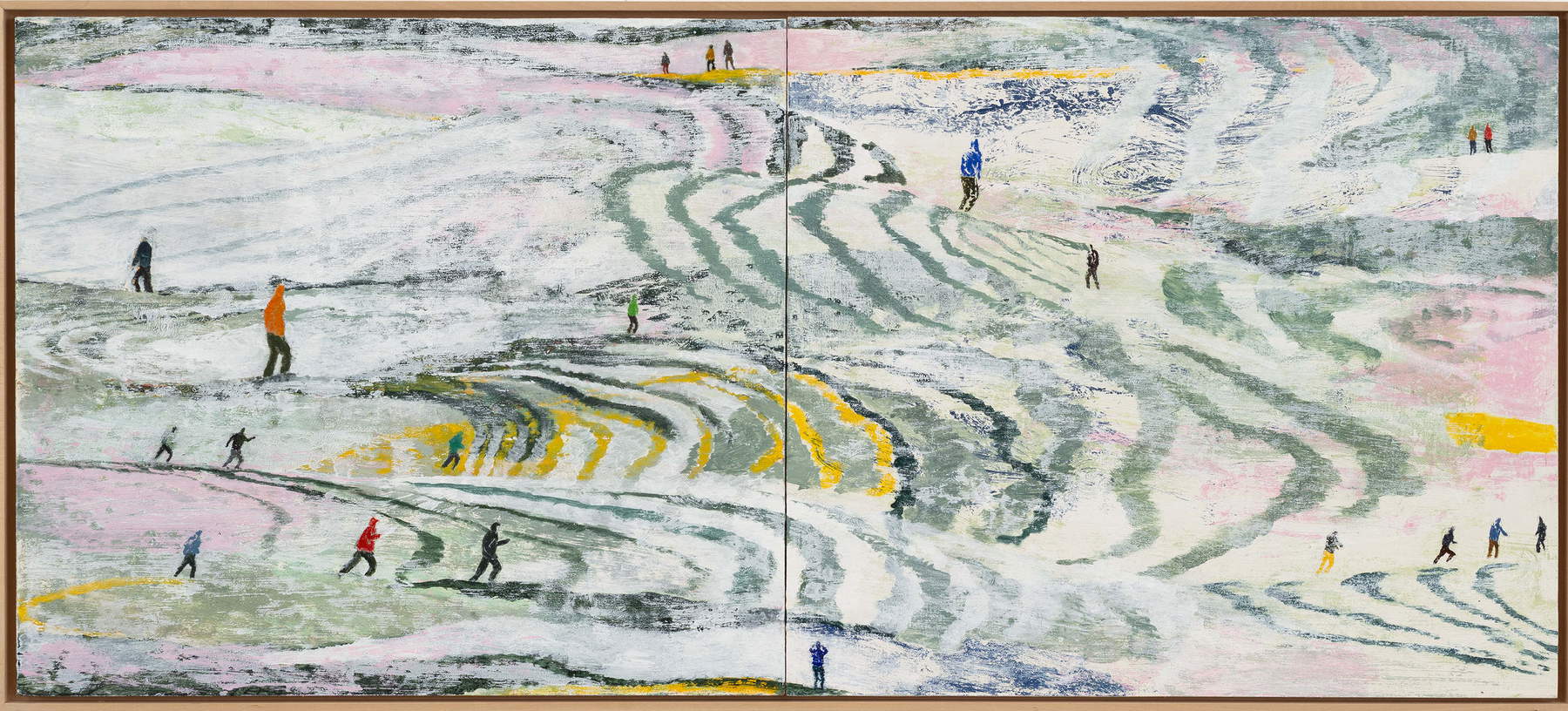
Elsewhere, the material becomes a landscape. In *Portrait*, the layers of color are so numerous that they give the face an unexpected three-dimensionality, with geometric, sharply defined features, so much so that the portrait approaches sculpture. *Study for Trees* is an exploration of the texture of a forest’s bark, while *Chasing Echoes*, a canvas with a very elongated horizontal format, is read from left to right like a story in multiple episodes, painted in light hues: within the waves of color, one glimpses figures chasing their own voices, which have already echoed through the landscape. In *Slipping on Ice*, the monotype conveys the sensation of snow rather than a mere description of it. The ground layer, left visible on purpose, reveals white drifts and sudden reflections of light. The figures glide across ice that the brush does not depict but makes one perceive almost by touch. In that muffled atmosphere, the forest remains sharp, while the human silhouettes blur together.
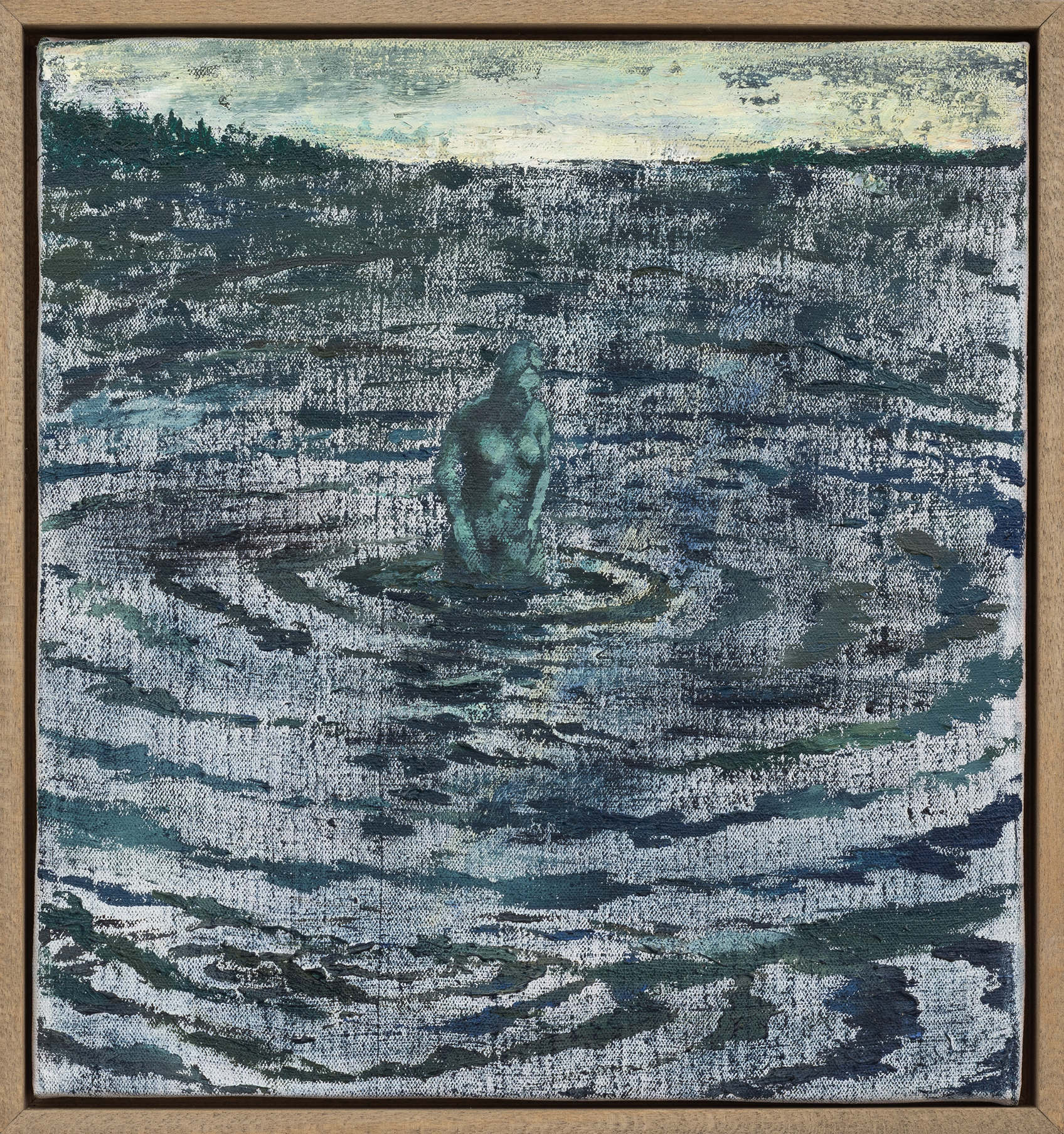
Finally, two works are built around the idea of the circle, which De Giorgi associates with a carousel: a movement that always returns to the starting point, but which can also become a return to a renewed self. In *Lake*, light brushstrokes radiate from a center, sending ripples extending beyond the frame, and in *Sacred Room*, a figure stands within a space bounded by white columns, created using only the preparatory layer and then smudged with color. The figure could step outside, but seems to choose to remain within the boundary that has been imposed upon it—or that it has imposed upon itself—in order to become aware of itself and the space around it.
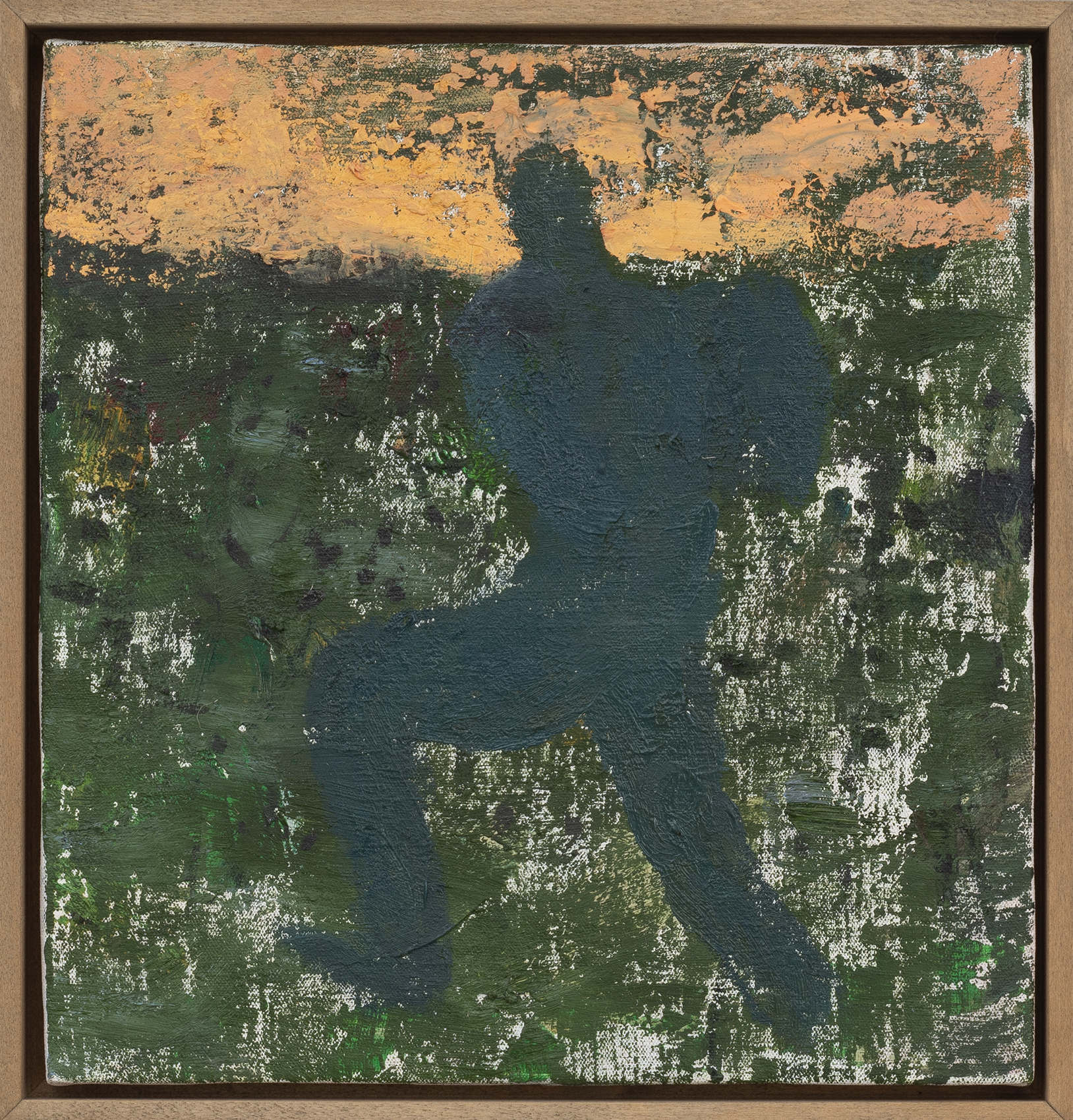
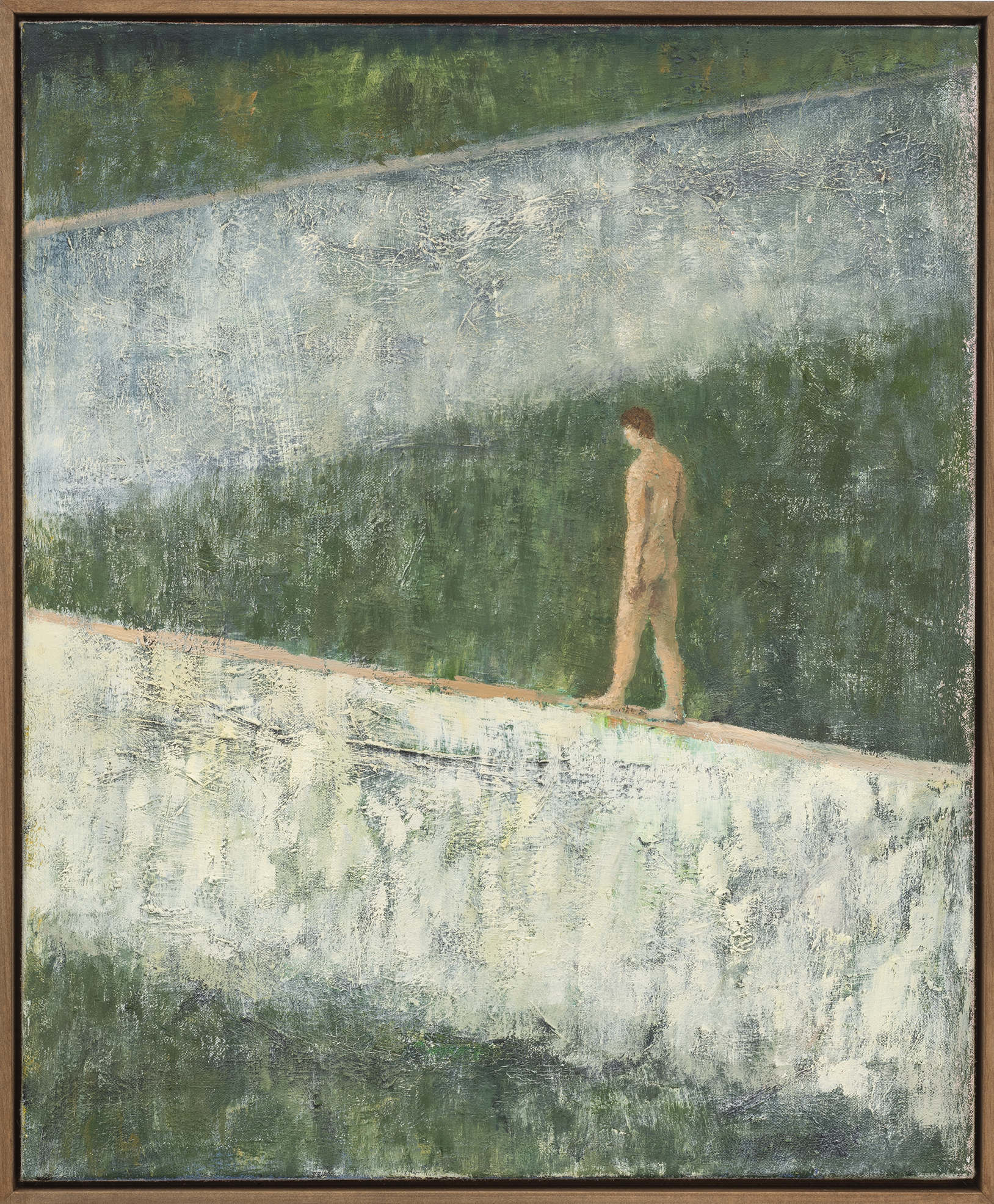
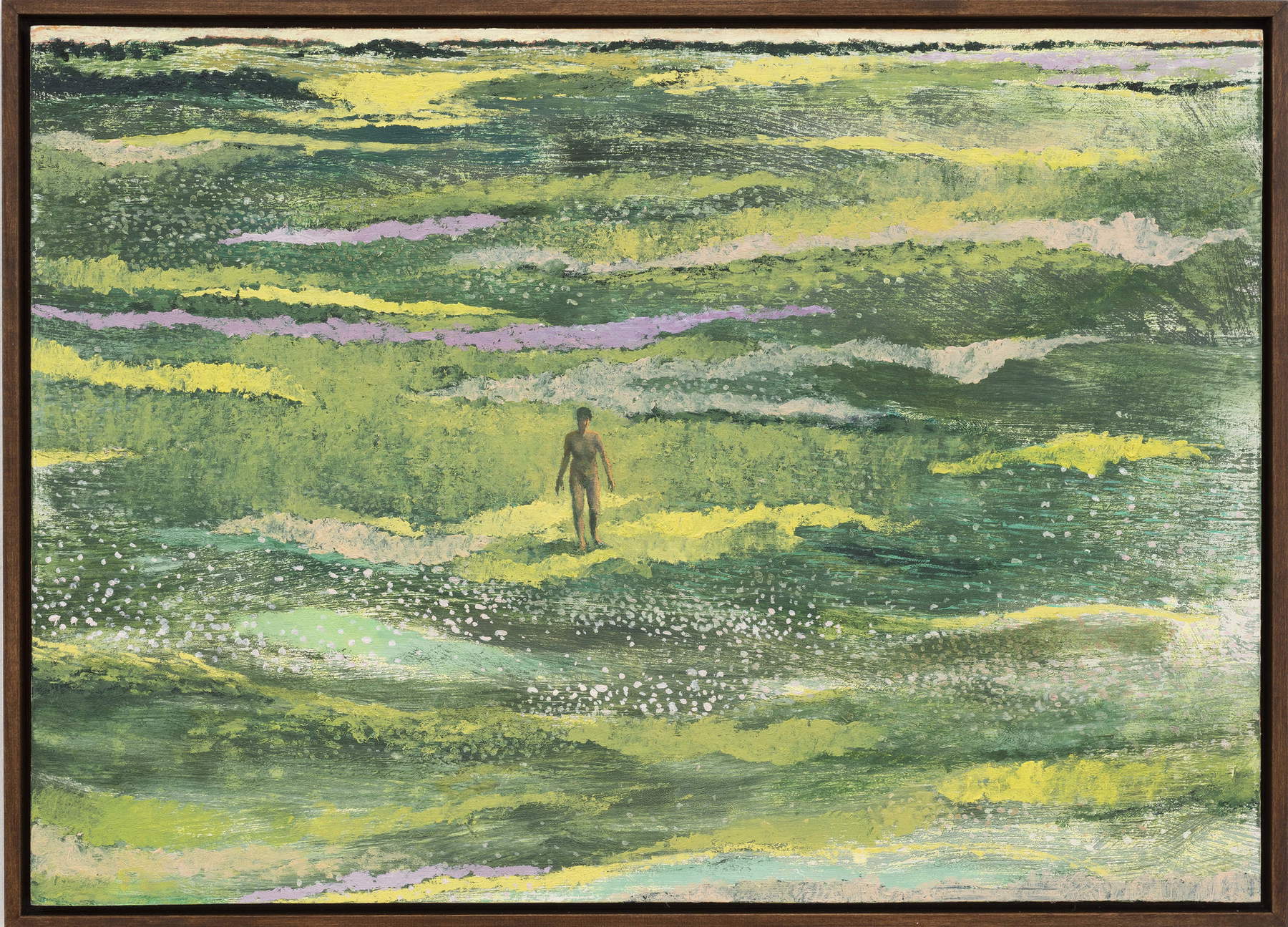
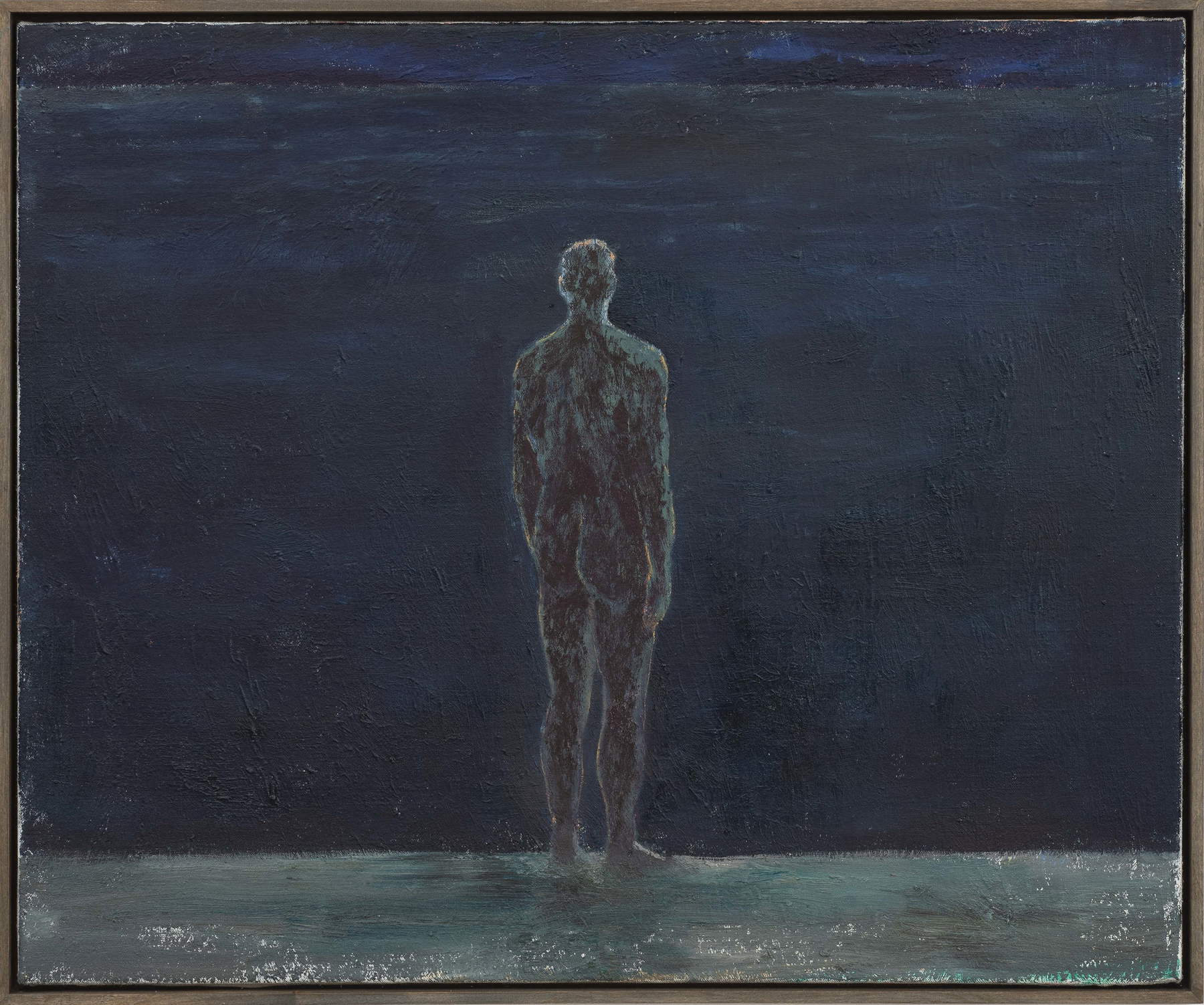
All the works, as mentioned, were created in the same year, yet they hint at an evolution in the artist’s working method. De Giorgi invites visitors to play a game: to guess which paintings were completed first and which later, when they took new and unexpected directions. For Barzaghi, after all, the exhibition itself is no mere afterthought. It is a milestone at the end of a journey—the moment when one can look back with clarity and from a certain distance at what has been created, and share this reflection with the public. The result is a conception of painting in which the work embraces many different possibilities and the artist allows himself to be guided by these variations. “Every painting has its own personality,” says Barzaghi.
The exhibition *Andrea Barzaghi. Playground. When I saw my back again* is on view at the Cardelli & Fontana Gallery in Sarzana through February 14, 2027, Monday through Saturday, from 9:30 a.m. to 12:30 p.m. and from 4:30 p.m. to 7:30 p.m.
 |
| Playing Hide-and-Seek with Oneself: Andrea Barzaghi’s New Paintings in Sarzana |
Warning: the translation into English of the original Italian article was created using automatic tools. We undertake to review all articles, but we do not guarantee the total absence of inaccuracies in the translation due to the program. You can find the original by clicking on the ITA button. If you find any mistake,please contact us.